The True Tale of Johnny Appleseed

JohnnyAppleseed

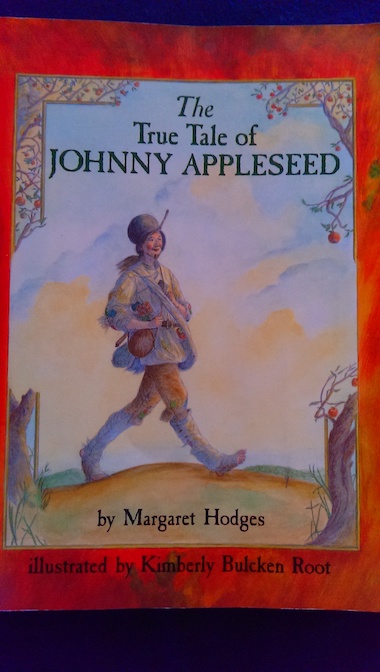
The True Tale of Johnny Appleseed by Margaret Hodges, 1997.

This American folktale was based on the life of a real person, John Chapman.

Johnny Appleseed was born as Johnny Chapman in 1774. His family lived in Massachusetts. There were plenty of apple trees there, and Johnny loved them. When he was grown, he started traveling west with the idea of spreading apple trees.

He carried very little with him, and some people said that he wore the pot that he used to cook his meals on his head as he walked. Everywhere he went, he planted apple seeds.

His reputation spread, and although people thought that traveling around just to plant apple seeds sounded crazy, they sometimes let him stay with them on his travels. Even Native Americans seemed to like him because he was friendly and helpful and interested in learning their languages. His legacy continued long after his death with trees that were enjoyed by generations of families across the Midwest.

There is a section in the back of the book that explains more about the history behind Johnny Appleseed’s story, including the end of the Revolutionary War and the beginning of westward migration in America. One of the things they mention is the effect that the War of 1812 had on relations between pioneers and Native Americans. Because pioneers were already pushing into the territory of Native Americans in the area that later became Ohio, the tribes there sided with the British in the war, hoping to push out the invading pioneers. After the war was over, though, the pioneers continued to come west, and when they did, they retaliated against the tribes that had been on the side of the British. The pioneers could be brutal, and part of the reason that Native Americans liked Johnny Appleseed was that he was different. He wasn’t trying to hurt anyone or take land for himself; he just wanted to plant trees. After he planted trees, he would build fences around them to keep animals from eating them while they were growing.

John Chapman’s life was unconventional.  He never married, and he acted as a Christian missionary in his travels as well as a planter.  Although he could be regarded as something of an oddball in the itinerant way he lived his life, he became a legend.

The book is currently available online through Internet Archive.
Miss Rumphius

MissRumphius

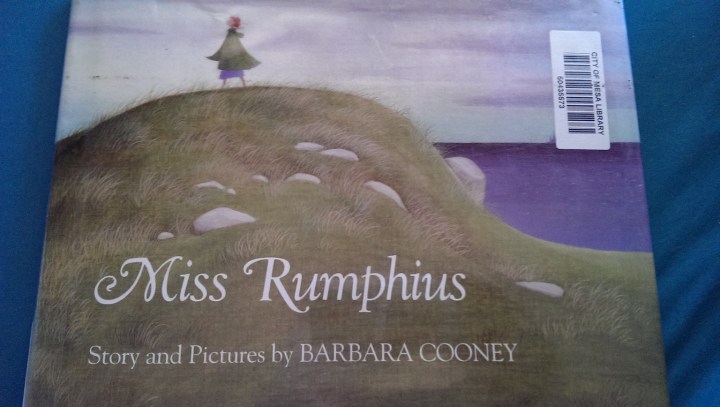
Miss Rumphius by Barbara Cooney, 1982.

From the time she was young, Alice Rumphius wanted to travel and see the world.  She planned to return home to live by the sea when her travels were over.  However, her grandfather, an artist, gives her one more mission in life: to make the world more beautiful.  Although Alice isn’t quite sure how she will accomplish that, she agrees.

RumphiusPainting

When she grows up, she lives out her dream of traveling, seeing all the places that she read about while she working in a library.  However, she ends up hurting her back while getting off of a camel she was riding, so she decides that it’s time to retire and find a home by the sea, as she planned.

RumphiusCamel

As she recovers from her injury, she thinks about her mission to make the world more beautiful.  At first, she still doesn’t know how to accomplish that, but some flower seeds she planted and her particular love of lupines give her the inspiration for her final legacy of beauty.

RumphiusLupines

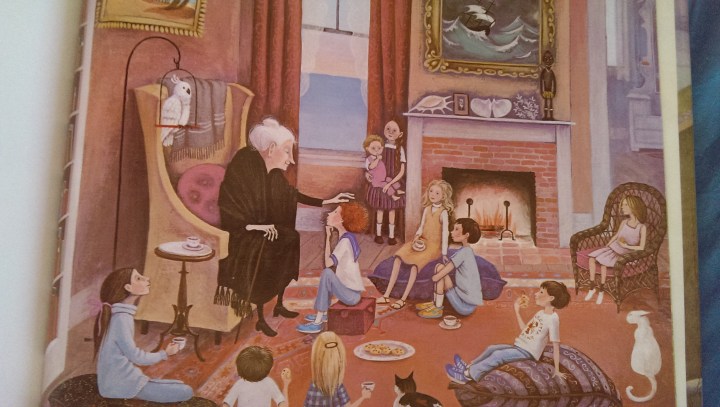
Her gift of spreading seeds of beautiful flowers gives her a reputation as an eccentric, the Lupine Lady, but it also inspires a new generation to undertake their own missions to see the world and to create beauty in their own way.

RumphiusChildren2

One of the things that fascinates me about Miss Rumphius and her story is that she leads a very non-traditional life.  She has very definite goals from childhood and sticks to them throughout her life, but they are not quite the common goals of most people, like marriage and career.  She remains unmarried throughout her life (the book never says anything about whether she had any romances in her life because that wasn’t one of her main life goals and therefore not really important to the story), and her only listed career was that of working in a library, which allowed her to have some money and to read about the places where she wanted to travel.  In the end, she is not wealthy and has no husband or children of her own, but she is happy because she has achieved the things that always meant the most to her.  She has had rich life experiences, she has made the world a little better for her presence, and she encourages her nieces and nephews to see the world, to enjoy their experiences, and to leave their own mark of beauty.

Apparently, parts of the story are based on the author’s own life and on the life of Hilda Hamelin, the original Lupine Lady.  The book is currently available online through Internet Archive.