Cousins in the Castle

cousinscastleCousins in the Castle by Barbara Brooks Wallace, 1996.

Young Amelia Fairwick is living a happy life in London with her father and her father’s fiancée, Felicia, when her father leaves on a business trip and word reaches her that he has been killed in a hotel fire. Now, the poor orphaned girl must go live with her deceased mother’s cousins in New York. Amelia leaves behind everything that is familiar to her when she accompanies her stern and gloomy Cousin Charlotte on the ship to New York.

On the ship, she makes only one friend, a young actress and singer named Primrose Lagoon, whom Cousin Charlotte forbids her to see. Although the future looks gloomy for Amelia, there are far stranger and more sinister events in store for her. As soon as they reach New York, Cousin Charlotte abandons Amelia on the docks. A kind woman named Nanny Dobbins and her son offer help her, only to steal her luggage and make her a prisoner in a small cellar in a bad part of town.

When her jailer, the drunken Mrs. Shrike, falls asleep, leaving the door open, Amelia escapes and attempts to find Primrose, her only friend in the city. Throughout Amelia’s adventures, she doesn’t know who to trust, and every step she takes seems to bring her closer to the mysterious Cousin Basil, who is supposed to be her guardian, and his castle-like home.

The time period for this story is never exactly defined, but it appears to take place during the 1800s because of the gaslights in use.  Like many of Wallace’s books, things and people are not what they seem, but in spite of the villain’s sinister intentions, it all ends happily.

Ghosts in the Gallery

ghostsgalleryGhosts in the Gallery by Barbara Brooks Wallace, 2000.

Eleven-year-old Jenny was raised in China by her mother and stepfather, who ran a dance studio. She has no memory of her real father, who died when she was a baby. When her stepfather dies and her mother becomes deathly ill, her mother writes a letter to her real father’s father, a grandfather that Jenny never even knew existed before. In the letter, her mother explains that she is dying and that she will be sending Jenny to live with her grandfather. Then, Jenny starts the long journey from China to the East coast of the United States alone.

Leaving her dying mother to head to a strange country to live with her previously unknown relations is frightening enough, but there is still worse to come. When Jenny arrives at her wealthy grandfather’s home, no one is expecting her or knows who she is. Her uncle, Winston Graymark, insists that her mother’s letter never arrived. Worse still, he believes that Jenny is an imposter, and that her mother merely made up the story about his long-lost brother being her father.

At first, he angrily threatens to send Jenny back to China, but Madame Dupray, a servant who cares for Jenny’s ill grandfather, suggests that she be taken on as a household servant. Jenny is given a dreary little room in the cellar and embarks on the drudgery of household chores. Could the Graymarks really be her relatives? If so, what happened to the letter that Jenny’s mother sent? Something sinister is happening in Graymark House, and Jenny will have to face suspicious servants and attempted murder before she finds the truth.

The “ghosts” in the title are the portraits of Jenny’s ancestors, which hang in the gallery. They appear grim and frightening at first, but when Jenny begins to recognize them as her relatives, they no longer frighten her.  Like many of Wallace’s books, this book contains sinister characters with hidden motives, but ends happily.  The story takes place at some point during the Victorian era.

Peppermints in the Parlor

peppermintsparlorPeppermints in the Parlor by Barbara Brooks Wallace, 1980.
Newly orphaned Emily Luccock journeys to the home of her Aunt and Uncle Twice in San Francisco. She has not seen her aunt and uncle in years, but they are the only family she has now, and she hopes that she will soon feel at home in their lovely mansion, Sugar Hill Hall.

Upon arriving in San Francisco, however, she is met by her Aunt Twice, who seems to be a pale shadow of the woman she once was. Sugar Hill Hall is now owned by the sinister Mrs. Meeching, and Aunt Twice is forced to work as a cook and housekeeper. Aunt Twice seems very frightened of something, but she refuses to say exactly what she fears, and Uncle Twice is nowhere to be found.

Aunt Twice tells Emily that her wealthy parents lost all their money before they died, and she is now poor, too. Emily is quickly put to work as a housemaid alongside Tilly, another orphan girl. Her only real friend is Kipper, a fishmonger’s son who is paid to do chores around the mansion sometimes. The house is being run as a home for elderly people, but the elderly people are treated badly, fed rotten food, and punished severely for even so much as taking a single peppermint from the bowl in the parlor. Emily tries to do little things to make the old people happier, but all the time, she is right at the center of all the sinister events surrounding Sugar Hill Hall.

The book is available online through Internet Archive.

Abigail

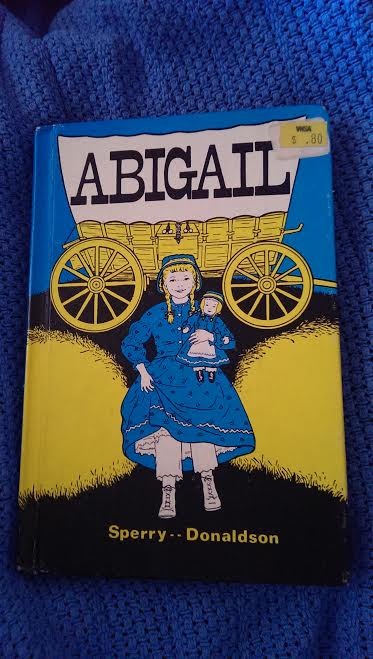
abigailAbigail by Portia Howe Sperry and Lois Donaldson, 1938.

Susan is a little girl living on a farm in Kentucky during the 1800s.  Her family has recently decided to move to Indiana, which is the new frontier of the United States.  Her uncle and his family are already living there, and he has persuaded Susan’s parents of the opportunities that await them.

As the family packs up to leave, Susan’s grandmother gives her a special present that she and Susan’s aunt made for her: a new doll.  Unlike Susan’s old wooden doll, this doll is a soft rag doll that she can sleep with.  They made the doll to look like Susan herself, but Susan names the doll Abigail after her grandmother.

Abigail accompanies Susan on her adventure as the family heads west to Indiana in their covered wagon.  Susan is sad and a little afraid at first, but when she thinks of what Abigail would say to her about her need to be brave and to explain to her all the strange things they will encounter on the journey, Susan regains her courage.

The family does have adventures on their two-week trek to Indiana.  They have to cross rivers, face down a bear, and worry about whether they will encounter unfriendly Indians (Native Americans).  Even after they arrive in Indiana, joining their other relatives, they will still have to get used to life in a new place.

Throughout the book, there are little side-stories, poems, and hymns that the family sings and tells each other.  Through it all, Abigail is Susan’s constant companion, helping her to feel at home in her new home.  I loved this book when I was a child because I always loved dolls.  This book was a bigger part of my youth than the Little House on the Prairie series, but it would probably appeal to Little House on the Prairie fans.

The book is available to borrow and read for free online through Internet Archive.

The Great and Terrible Quest

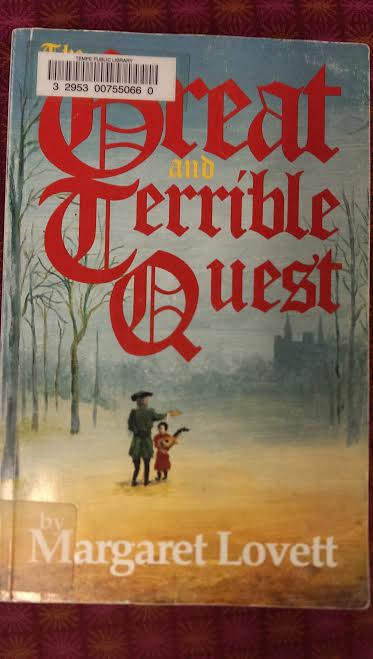
greatterriblequestThe Great and Terrible Quest by Margaret Lovett, 1970.

This story takes place in a fictional kingdom during the Middle Ages. Trad is a ten-year-old boy who has lived most of his life with his abusive grandfather. He barely remembers his parents, who died in a plague when he was only four. This grandfather consorts with robbers and evil men. Trad often pretends to be stupid to avoid their notice and warns travelers away from their territory.

One day, he rescues a man who has been badly wounded and cares for him in a secret cave. This man, whose white hair makes him seem elderly, insists that he is on a mission, a great and terrible quest . . . but because of a head wound, he can’t remember what his quest is. All that he knows is that time is short, and he does not have long to complete his quest to find something very important.

Trad soon learns that his grandfather’s wicked friends are the ones who attacked this mysterious stranger. Taking Trad’s father’s old lute, a couple of coins, and a mysterious ring dropped by one of the robbers which seems to have once belonged to the stranger, Trad and the stranger embark on a journey across the land, making friends and pursued by enemies as they go. While the stranger struggles to remember his identity and the nature of his mission, Trad begins to learn a few things about his own forgotten past and the nature of his family. Nothing is what it seems. Their country is in trouble because of the evil men who have been controlling it. Everything depends on the success of the stranger’s mission, and Trad has a much larger role to play than he had ever dreamed.

It’s a beautiful and fascinating story about good and evil, loyalty, friendship, and determination to do the right thing, even against the odds. There are parts that might frighten younger readers. The fights are violent and bloody, and there are a couple instances of cruelty to animals (partly, it seems, to show how truly evil Trad’s enemies are). Still, it’s a great story for tweens and teens, and readers will want to cheer Trad on as he struggles to help those around him and find his own destiny.

Although the kingdom is fictional and the themes are similar to fantasy stories, there is no actual magic in the story.

The book is currently available online through Internet Archive.

The Battle for the Castle

battlecastleThe Battle for the Castle by Elizabeth Winthrop, 1994.
This is the sequel to The Castle in the Attic.

William is growing up.  As William’s twelfth birthday approaches, he feels like he and his best friend, Jason, are growing apart. Actually, what he fears is that Jason is out-growing him. Jason has grown taller than William and much more muscular, thanks to his off-road bike training sessions with his father. William, on the other hand, is still short and feels like a shrimp next to Jason.

In their town, it is traditional for boys to “jump the trains” when they turn twelve. It involves grabbing hold of a ladder on the side of one of the cars as the train reaches a point on the track when it slows down, climbing over the top of the car, and jumping off the other side. It’s a dangerous trick to pull, and parents try to keep the kids from doing it. Still, the boys who don’t do it are considered to be wimps by the others. When Jason and William try, Jason makes it, but William gives up when his hand starts to slip. William is not hurt, but he is embarrassed at his failure.

To show Jason that he’s not just a wimp, William decides to let him in on the secret of the castle in the attic. Mrs. Phillips decided not to drop the magic token into the sea along with Alastor as she said she would (see previous book), and she sends it to William as a birthday present. After William explains to Jason how the token works, he convinces him to become small with him and visit Sir Simon and William’s other friends. When the boys arrive, they are welcomed by Sir Simon, who is about to leave for a tournament. William and Jason agree to help look after Sir Simon’s castle until he returns, along with his friend Dick, Dick’s son Tolliver, and Dick’s niece Gudrin. Sir Simon’s old nurse, Callendar, has died, but before her death, she made a prophecy of death and danger. Almost everyone believes that she was just raving, but Gudrin knows that danger is approaching. A strange ship of skeletons has been seen approaching the town, and bones have been floating down the river. Sir Simon had the ship towed out to see again, and Dick thinks there’s nothing more to fear. However, the ship has returned, and the boys and Gudrin know that something must be done in order to keep Callendar’s prophecy from coming true.

There is an army of rats aboard the ship, led by a giant rat that walks on its back legs like a human. The boys and Gudrin attempt to burn the ship, but the rats escape and begin attacking people across the countryside. When one of these people makes it to the castle to warn everyone, Dick finally believes them that something needs to be done. Most of the people are sent away from the castle, Tolliver is sent to bring Sir Simon back to help, and the others stay to wait out the siege. Although William is scared, he manages to keep his head and come up with a plan that defeats the rats once and for all.

In the end, when the boys return to their own world, William declares that he will never jump the trains because he thinks it’s a crazy stunt. Jason doesn’t mind because, as he says, “there’s more than one way to jump the trains.” William doesn’t need to prove that he’s grown up by performing a crazy stunt because he’s already behaved with courage and maturity while facing real problems and saving the lives of other people.

Starlight in Tourrone

starlighttourroneStarlight in Tourrone by Suzanne Butler, 1965.
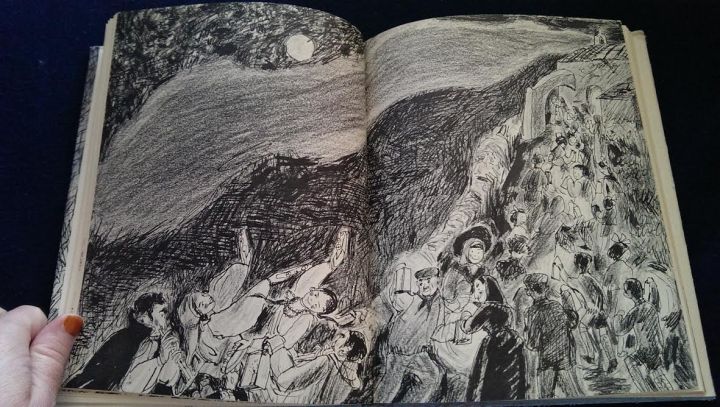
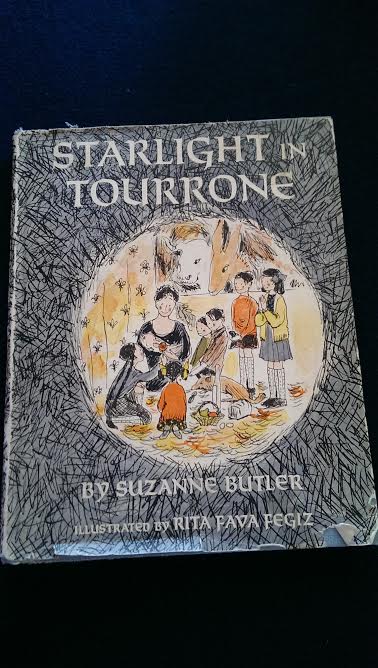
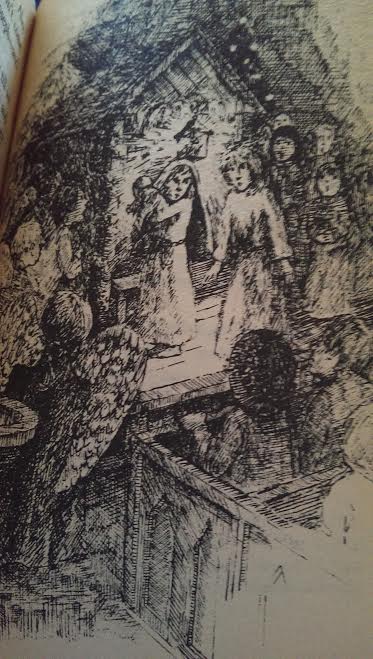
This is a story about a group of children in southern France during the middle of the 20th century, not too long after World War II, who want to stage a special Nativity scene at Christmas. One of the older men in the small village of Tourrone tells his grandchildren about how, when he was young, the village had held a live Nativity scene at the chapel on the hill with the youngest baby in the village playing the part of the Christ child and his mother playing Mary. Then, all the people in the town would climb the hill to the chapel and present gifts to Mary and the baby Jesus in a ceremony called the March to the Star.

However, these traditions have been lost because, following World War II, the village has lost much of its population, and the chapel is an unused ruin. The children and their friends, inspired by the grandfather’s stories, decide that they want to hold the March to the Star and the Nativity scene this year.

starlighttourronemarchAt first, most of the adults in the village are skeptical. Since there are no young couples living there anymore and no babies have been born there for several years, no one knows where the mother and child for the Nativity scene will come from. Many of the adults are too busy with their own problems and worries about the future to help. Still, the children continue to work faithfully on their plans, drawing in the adults in spite of themselves.

starlighttourronepreparationsstarlighttourronelanternJust as people in the village start to feel hopeful again, something happens that threatens to ruin everything, but there is still one more miracle yet to come, thanks in part to the one person who never doubted it would happen.

It’s a beautiful story about the power of faith and how miracles come to those who are prepared for them. The last page of the book contains the music for the Provencal Carol that the children sing along with the English translation.

The book is available to borrow and read for free online through Internet Archive.

starlighttourronenativity

starlighttourronecarol

The Best Christmas Pageant Ever

christmaspageantThe Best Christmas Pageant Ever by Barbara Robinson, 1972.
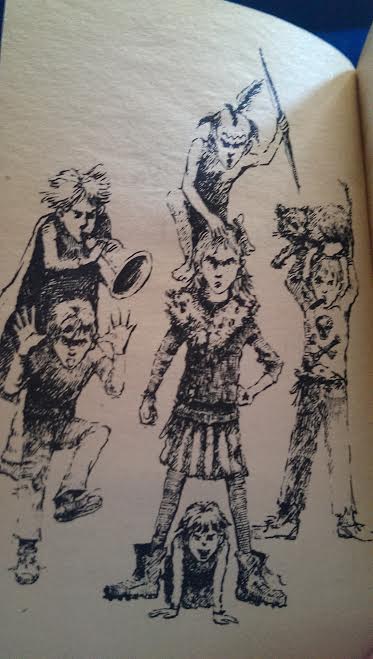
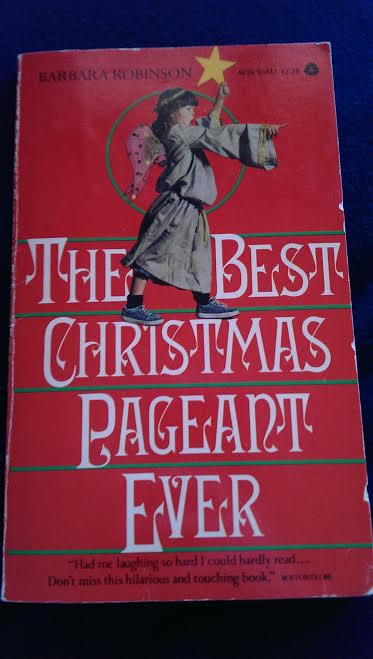
The Herdmans are the meanest, toughest kids in town.  They lie, cheat, steal, and when the mood strikes them, set things on fire.  Their father deserted the family, and their mother works all the time, so the six Herdman kids are pretty much left to their own devices, giving them plenty of opportunity to cause trouble.  Certainly, no one ever made the Herdman kids go to Sunday school.

But, to everyone’s surprise, the Herdmans suddenly show up at Sunday school in time to get cast for the annual Christmas pageant.  It wasn’t because the Herdmans suddenly found religion.  They were mostly there because they heard that there would be snacks.  Charlie told them so when they stole the dessert from his lunch at school.  In reality, Charlie exaggerated the snacks just to get back at the Herdmans.

christmaspageantpic1Although the Herdmans don’t get the cake Charlie mentioned and have little interest in Jesus, they begin to be fascinated by the description of the pageant and decide to stick around.  The Herdmans love movies, and the idea of being in any kind of play strikes them as fun.  Although the Christmas pageant basically goes the same way every year, typically using the same kids for the same parts, once the Herdmans make up their minds that they want the starring roles, they manage to push and bully their way right into the center of everything.
All of the other kids in Sunday school already know the story of Christmas and how the pageant usually goes, and they’re usually bored with the whole thing, but this year, the Herdmans make the pageant so unpredictable that even the kids the Herdmans tend to pick on find it fascinating.  The Herdmans are only hearing the story of Christmas for the first time as they assume their new roles of Mary, Joseph, the three wise men, and the angel.  Because they aren’t as familiar with the story and the routine of the pageant, they end up adding their own little twists to their performance.

christmaspageantpic2At first, the more conservative adults in the church are horrified at the prospect of what the wild Herdmans might do on Christmas itself, but the minister and the lady overseeing the pageant decide to give the Herdmans a chance.  As the title says, it ends up being The Best Christmas Pageant Ever as the Herdmans unexpectedly bring out parts of the Christmas story that the other people who had taken the story for granted hadn’t really thought about much: the simple human reactions of a poor young couple who were strangers in a new town, the fear and expectation that accompany doing something great but unfamiliar and confusing, and the sense of wonder and surprise that are at the heart of the Christmas season.
Parts of the book are laugh-out-loud funny, and parts are actually touching.  While the awful Herdman kids stumble their way through the Christmas pageant, changing things, is it possible that the play is also changing them?

This is the first book in a short series about the Herdmans.  It is available to borrow and read for free online through Internet Archive (multiple copies).  There is also a movie version of the book.  Sometimes, you can find it on YouTube.

Christmas Around the World

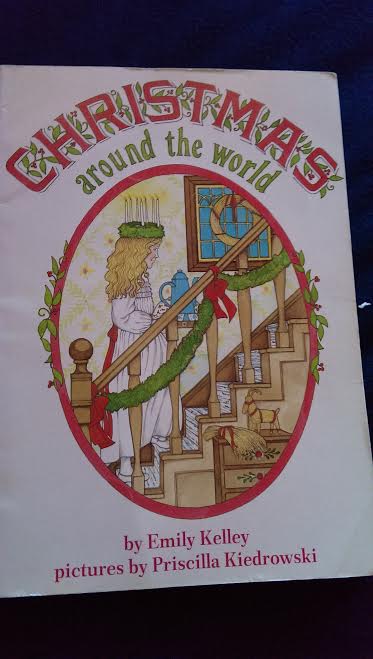
christmasworldChristmas Around the World by Emily Kelley, 1986.
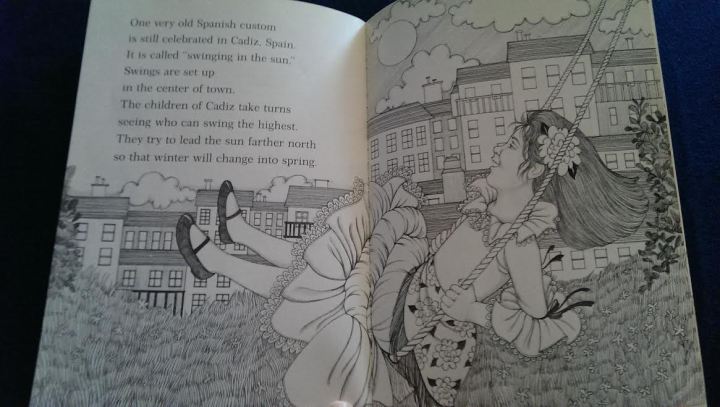
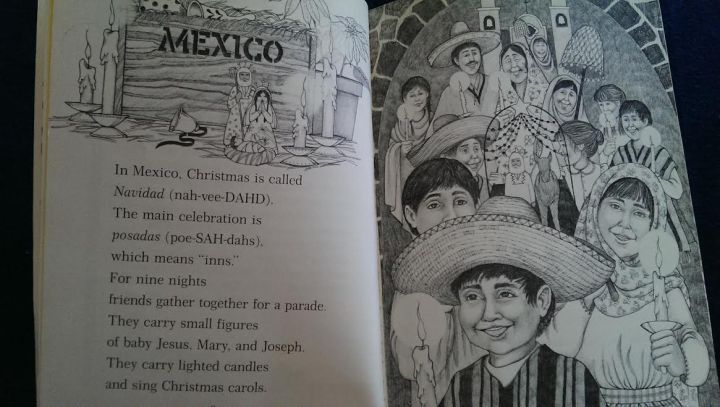
This is a non-fiction book that describes Christmas customs from various countries around the world.  There is some history and folklore associated with different Christmas traditions in every country.  The main countries described are Mexico, Iran, China, Sweden, Iraq, Spain, and Norway, although there is a section in the back that briefly mentions a few other countries.

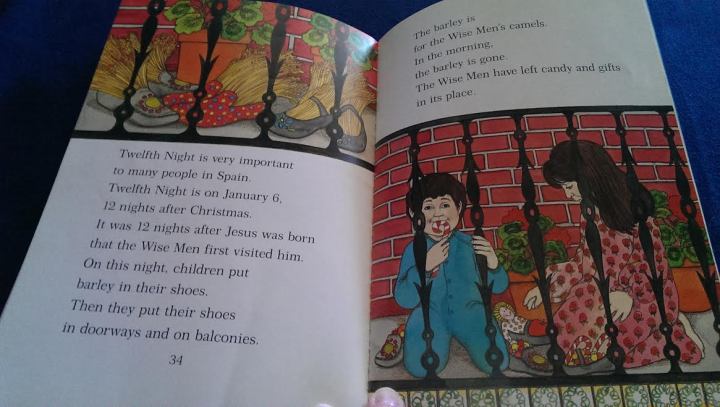
In some countries, children leave out their shoes instead of their stockings in the hopes of receiving small presents in them.  Sometimes, the gifts are from Santa, and sometimes, they’re from someone else, like the Wise Men.  In other countries, people do not give gifts on Christmas, except maybe new clothes for the children.

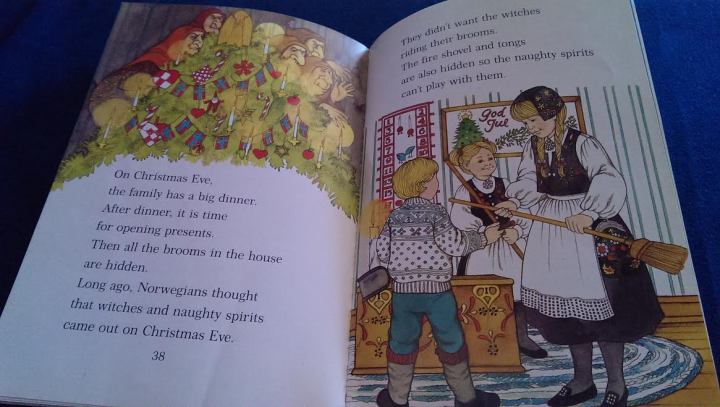
Some of the traditions described are older ones, based on folklore, like the one about hiding brooms and tools from witches and bad spirits in Norway.  In countries in the Southern Hemisphere, Christmas is associated with summer instead of winter, changing the way people celebrate the holiday.  Each country has their own special foods associated with the holiday, too.

christmasnorway

The book also describes traditions that are associated with other special days related to Christmas, such as St. Lucia Day in Sweden (December 13) and Twelfth Night, when the Wise Men came to visit Jesus (January 6).  These special days are kind of an extension of the Christmas season in different countries.

christmasspain

christmasspain2

The pictures in the book are beautiful.  Some of them are in color and some are in black and white.

christmasmexico

In the back of the book, there are jokes, a craft project, and a recipe for Christmas cookies.

The book is available to borrow and read for free online through Internet Archive.

Mystery Up the Winding Stair

Harry Hunter and his mother have been living with his grandfather in his big mansion while his father is in Japan doing work for the government. His family has owned the mansion for a long time, and it has a small museum in it containing Native American artifacts and things relating to pioneer life, including a small log cabin built in a large room up a winding staircase.

When Harry’s mother goes on a trip to see his father, Harry and his grandfather invite Harry’s cousins to visit them: Ned and his sister Lou, and Carol, whose family has only recently moved to the area.  When the children try to decide what they would like to do together, Carol suggests a treasure hunt.  Their grandfather sends them on a treasure hunt to find something that he hid himself a long time ago: a set of silver spoons made by Paul Revere and a diamond. The explanation is that the grandfather is rather absent-minded and has forgotten where he hid the treasure, although he knows that it’s somewhere in the house.

A storm leaves them all snowbound in the mansion, but they are not alone. There are mysterious footsteps, someone using a secret staircase to the attic, and signs that the bed in the cabin has been slept in. The children begin to realize that someone else is in the house with them, and this person wants the treasure for himself!

This book is out of print, but you can borrow and read it online for free through Internet Archive.  Internet Archive requires you to sign up for an account to borrow books, but the account is free, and you read the books directly in your browser.  There are no overdue fees because the books simply disappear from your virtual loan list when your time is up.  You are allowed to re-borrow books as long as copies are available (not being “borrowed” by other people).

The house the mansion in the book was based on was the old summer home of Governor Washington Hunt, located in Lockport, New York. (I learned about the house from an article about the story behind the book and an event related to the book that was held at the library in Lockport, but the site that had the article doesn’t have it up anymore. I think I saved a copy somewhere, but I’m having trouble finding it right now.)  It was called Wyndham Lawn and later became a children’s home. It’s now a private school called the Henrietta G. Lewis Campus School.  When the author, Helen Fuller Orton, was young, some of her relatives rented Wyndham Lawn from its owner, and she lived with them for a time.  In the article, the author noted that the house had been changed somewhat since the time when she lived there in the 1880s in order to accommodate the needs of the children’s home.

When I first read this book, I thought that the part about the grandfather simply forgetting where he hid an important treasure was a little cheesy, but the treasure hunt in a mansion with its own museum is fun. It’s a little spooky when the kids realize that there’s an intruder in the house with them while they’re snowbound, although it’s pretty obvious to readers of the story who the intruder was. The house really makes the story because it is a fantastic setting! It’s a very cozy mystery for winter.

I enjoyed the story and learning about the history of the real house. I also considered what Harry’s father is doing in Japan because this book was published just after WWII. I don’t think they ever explain why Harry’s father is in Japan on government work, but I’m sure he’s involved with the occupation and reconstruction of Japan after the war. It’s a subtle reference to current events at the time this story was written that’s not part of the main story but is used as part of the reason why the main story is happening.