The Haunting of Grade Three

HauntingG3The Haunting of Grade Three by Grace Maccarone, 1984.

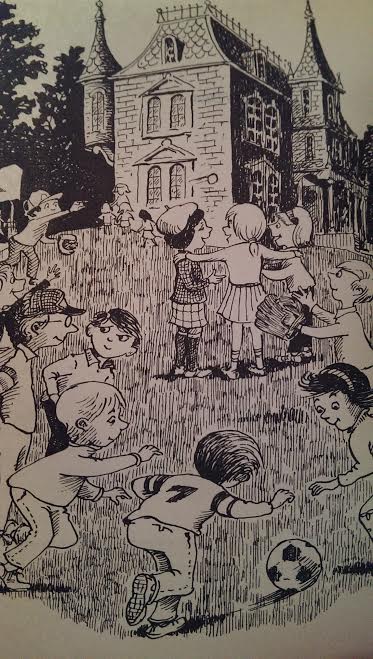
Elwood Elementary has become overcrowded, so the third-graders have been moved to an old mansion, Blackwell House, which has been empty for years. The house looks kind of spooky, and there are a lot of local ghost stories about it. Fortunately, Adam Johnson likes scary stories, so he thinks that it’s wonderful to go to school there.

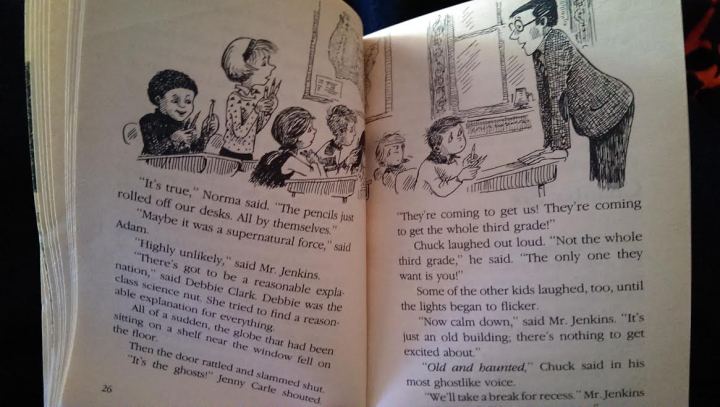
Soon after the students move into the house, strange things begin happening. Objects fall off desks and shelves, and door slam for no reason.  Some of the kids discover a grave marker on the property for a boy about their age who died during the Civil War.  The kids start getting nervous, and so does their teacher, Mr. Jenkins. Then, Mr. Jenkins decides to give the kids group assignments. Each committee gets to go to a different place in town and learn about it. Adam’s committee is assigned to study Blackwell House and decide if it’s really haunted. The kids think their assignment is pretty strange, but Adam is excited.  He wants to be a ghost hunter like on Ghostbusters!

HauntingGradeThreeMost of the group members are misfits in one way or another. Norma Hamburger is a shy girl, frequently teased about her last name. Debbie Clark is a talkative girl who’s really into science. Chuck Webber, Adam’s best friend, is the class clown, always telling stupid jokes (and one of the main people who teases Norma about her name). Danny Biddicker is strong and good at sports, but he worries that he’s not as smart as the others. Joey Baker feels overshadowed by his large family, so he tells tall tales to get attention. The other kids don’t understand and get annoyed with his lies. By working together, they not only learn the secret of Blackwell House, but they learn more about each other and become a real team and friends.

In the end, there is a reasonable explanation for the haunting of Blackwell House.  The kids take a methodical approach to the mystery, gathering their facts and ruling out various possibilities along the way.  Joey gets a chance to be a real hero, Danny proves to himself and everyone else that he’s smart and has good ideas, and Adam gets a new life ambition.

HauntingG3Pic

One other thing that I thought was interesting is that Adam, the main character in the story, is African American, but it’s never mentioned in the text of the story.  You only know because it’s shown in the pictures.  It’s just a little detail and not important to the story, but I thought it was interesting in a story that encourages kids to notice details.  I also liked it that Adam isn’t defined by race or appearance as so many characters in kids’ books are.  He stands by himself as an interesting character with his own ideas, courage, and leadership abilities.

This is the first book in the Third Grade Ghosthunters series.  It is currently available online through Internet Archive.

Wrapped in a Riddle

wrappedriddleWrapped in a Riddle by Sharon E. Heisel, 1993.

Miranda is living with her grandmother in Oregon while her scientist parents are away studying algae in Antarctica. Her grandmother owns a bed and breakfast called The Jumping Frog, which has a Mark Twain theme. At first, all Miranda is concerned about is finding some friends and fitting in at her new school, but soon strange things start to happen at the bed and breakfast.

First, someone attacks their housekeeper, hitting her over the head with a bust of Mark Twain. Then, some letters that were written to an ancestor of Miranda’s by Mark Twain himself are stolen.

Although Miranda’s grandmother likes to think the best of everyone, Miranda is convinced that the villain is someone living in the bed and breakfast. With her new friends (the main characters from A Little Magic, another book by the same author) Miranda begins her investigation, determined to find the letters for her grandmother, although it may mean solving a double mystery.  There is more that one person in the bed and breakfast with something to hide.

One of the fun things about this story is the riddles that Miranda and her grandmother like to tell each other.  Even her friends enjoy riddles, and they help provide Miranda with the inspiration to solve the mystery.

This book is currently available online through Internet Archive.

The Mystery at Fire Island

mysteryfireislandThe Mystery at Fire Island by Hope Campbell, 1978.

Darcy Littlewood, called “Dash,” is appalled when her art teacher tells her not to draw anything over the summer.  Drawing comes almost as naturally as breathing to Dash, who wants to be a cartoonist when she grows up.  She’s always doing sketches and caricatures of people she sees, especially her younger brother, JC (James Colson Littlewood, also known as “Coleslaw”).  But, her art teacher thinks that her style has grown too strong and inflexible too early in her life.  He thinks that if she takes a break from drawing for the summer, she’ll be able to come back to it with a fresh approach that will allow her to try different styles as she grows older.

To Dash, the idea of not drawing at all is intolerable, especially since she broke her leg shortly before the start of summer vacation.  She can’t go much of anywhere or do much of anything while her family is staying at their beach house on Fire Island.  Without much to do, she doesn’t know how she’d entertain herself if she couldn’t draw.

Her older sister, Candace, isn’t happy about spending the summer on Fire Island, either.  She says that there’s never anything to do there, although their mother attributes part of her boredom to the fact that she’s the only one in the family who doesn’t have an outstanding talent or a particular goal in her life.  Everyone else in the family is artistically-inclined in some way.  Mrs. Littlewood is a writer, Mr. Littlewood teaches drama, JC has acting skills and a special talent for imitating people, and Dash has her art.  Mrs. Littlewood thinks that Candy’s attitude would improve if she found something that she was especially good at and truly cared about.

While Dash is brooding about her inability to stop drawing in spite of her art teacher’s request, she makes the acquaintance of Mrs. Guizot, an eccentric older woman who spots her drawing caricatures.  It turns out that Mrs. Guizot is an art lover, and she quickly becomes a fan of Dash’s work.  But, there is something mysterious about Mrs. Guizot, or at least the man they see her talking to.

Both Dash and JC notice that the man has a peculiar way of standing and walking.  Dash draws it, and JC imitates it.  So, when they see the same man on the beach later that night, looking different without his beard and wig, but still walking and standing the same way, they wonder why the man was in disguise.  Also, he seems to be going out surfing when there aren’t any waves for surfing.  Then, they discover that he’s bringing scuba tanks with him, and they aren’t real scuba tanks.  What is the man doing?

The kids try to investigate the mysterious man with JC doing much of the leg work at first because Dash can’t get around very well.  JC is worried about what they might learn because the man might turn out to be truly sinister and violent.  He even has suspicions about Mrs. Guizot.  Later, Dash’s leg improves and she’s able to take a more active role in the investigation, but the kids pretend like she’s still laid up as a cover for their activities.  The kids’ investigation doesn’t go as planned, but they do uncover a crime and also inadvertently help their sister to find her life’s vocation.

Part of the story has to do with seeing with depth.  Part of the reason why Dash’s art teacher wants her to observe more and draw less is so that her art will contain more depth.  Dash also learns to see the depths of people, the things they keep hidden behind their facades.  Her sister, Candy, also has hidden depths which even she doesn’t appreciate yet.

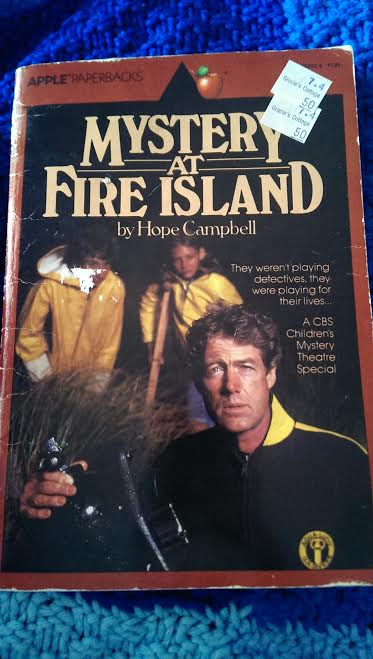
The story was later made into a tv movie by the same name, and the picture on the front cover of this edition of the book is from the movie.

The Green Book

greenbookThe Green Book by Jill Paton Walsh, 1982.

The story takes place at an indeterminate time in the future. Earth is dying as the sun grows dimmer. The only hope for humans is to find new homes on other planets. In one of the last ships to leave Earth is a father and his three children: Joe, Sarah, and Pattie. They can take very little with them, only a few practical things, a couple of small keepsakes, and a single book each.

The journey to their new planet takes years, and people quickly go through their own books. Pattie, who is very young, brings a blank book with a green cover, which the others criticize and tease her about.  What use is a book with nothing in it that you can’t even read?

When they finally arrive on their new planet, everything is strange. The native plants seem to have a glass-like quality which makes them sharp, shiny, and dangerous to eat. Their guide came equipped with a set of rules to help them get their colony established, but soon they run out of rules and are completely on their own. Survival is a constant struggle, and everything involves a new discovery.

At first, it seems like they aren’t going to make it, but the children’s willingness to take a chance saves the day. Also, the little green book that Pattie brought gives the colonists hope. As they have exhausted all the old stories, she provides them with the first new one on their new world.

The book is currently available online through Internet Archive.

greenbookpic

The Treasure of Kilvarra

TreasureKilvarraThe Treasure of Kilvarra by Elizabeth Baldwin Hazelton, 1974.

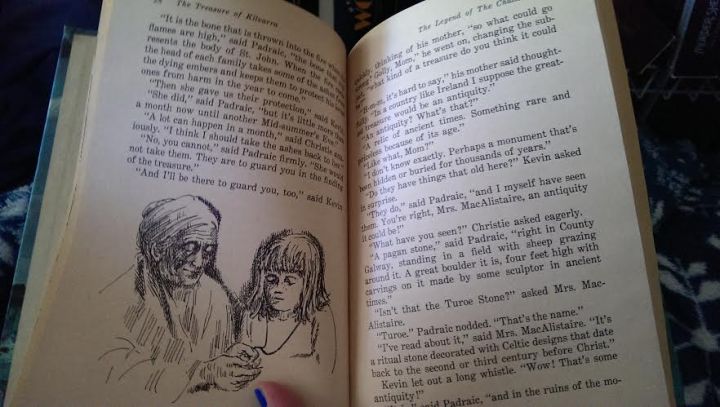
Christie and Kevin MacAlistaire go to Ireland with their mother to visit a family friend, Padraic O’Flaherty, and their visit turns into a terrifying treasure hunt!  Christie is fascinated by the gypsies living nearby and asks to visit them.  It’s her birthday, and the oldest gypsy, Sorcha, tells her fortune.  She says that Christie is fated to discover a treasure during her visit to Ireland, but there will be great danger involved, and she will need her brother to protect her.  Sorcha also gives Christie an amulet filled with holy ashes to help keep her safe.

Christie is eager to find the treasure Sorcha spoke of, although she doesn’t know what kind of treasure she is supposed to find or what kind of danger she will face along the way.  Their new friends tell them the history of the region with stories of ancient kings, fairy folk, and haunted castles.  Christie and Kevin visit some of these supposedly haunted ruins with their new friend Colum (a gypsy boy) and his pet crow, Ben.  Colum tells them the history of the castle ruins and the legends associated with it, and they discover that Christie has the ability to see and hear things that the boys can’t: spirits of the past.  Unfortunately, Ben is fascinated by Christie’s amulet and takes it, losing it in a nearby river.

KilvarraWithout the amulet to protect her, Christie continues her search for the treasure.  An accidental injury takes her to the place where it is hidden, but it’s a dangerous place.  Caught in a terrible storm, the children explore an ancient stone tower.  There, Christie sees the ghost of a long-dead monk, gesturing to her, begging her to follow him to the treasure that she seeks.  The monk died protecting it, and it’s a very unexpected but wonderful treasure indeed.  But, getting out of the place is going to be even more dangerous than getting in.

The book is currently available online through Internet Archive.

This is actually the second book in a series about Christie MacAlistaire and her brother Kevin.  Unfortunately, I don’t have the first one and haven’t read it.  I do know that the first book in the series is called The Haunted Cove.  Christie and Kevin spend the summer in a cottage by the sea in Oregon, where they investigate a cove haunted by the ghosts of sailors and a woman who may be a witch.

The Castle in the Attic

CastleAtticThe Castle in the Attic by Elizabeth Winthrop, 1985.

Ten-year-old William’s life is being turned upside down.  Mrs. Phillips, his nanny, is leaving for good!  Mrs. Phillips has lived with William’s family and helped to take care of William ever since he was born. Both of his parents work, so William spends most of his time with Mrs. Phillips after school. She fixes him his snacks, takes him to his gymnastics lessons, spots for him as he practices his routine, and reads stories about King Arthur with him. However, now that William is ten years old, Mrs. Phillips thinks that she would like to go live with her brother in England, which is where she is from. William is upset because he can’t imagine life without Mrs. Phillips. Mrs. Phillips tells him that he will be fine without her and that his parents will start spending more time with him after she leaves. William tries everything he can think of to get her to stay, but she is determined that it’s time for her to go.

As a leaving present, Mrs. Phillips gives him a toy castle that has been in her family for generations, along with a little lead figure known as the Silver Knight. Still, William is determined to find a way to keep Mrs. Phillips from leaving.  Then, he discovers that the toy castle is magic! When the little knight comes to life and gives him a magic token that can make people small, William thinks he’s found the way he’s been looking for. With Mrs. Phillip’s impending departure and his fears of losing her, William suddenly realizes that he can use the magic coin to keep Mrs. Phillips with him.  Before she can leave, he shrinks her and puts her in the castle with the knight.

Of course, turning his nanny small and keeping her inside the toy castle was unethical, as Mrs. Phillips and the knight point out, but William’s mistake proves to be only the beginning of a fantastic journey that will fulfill a legend, free the knight’s kingdom from the reign of an evil wizard, and give William the confidence he’s been looking for.

Over the drawbridge of the castle is a poem about the beginning of a quest. Mrs. Phillips had said that there was a legend about the little knight, and when he comes alive, he tells William that his name is Sir Simon and that he was turned to lead by an evil wizard who has taken over his kingdom. The poem is the key to defeating the wizard, and the little token is really only half of one that the wizard was wearing around his neck. When William turns Mrs. Phillips small, he cannot reverse the spell because he lacks the other half of the amulet. To get it, he must become small himself and fulfill the poem by crossing the drawbridge as Sir Simon’s squire.  The two of them set out together to defeat the wizard and retrieve the other half of the token. Along the way, they become separated, and William must continue on to the wizard’s castle and finish the quest by himself. William has an inner strength that he doesn’t fully appreciate at first, and he can use it to defeat the evil wizard!

There is a sequel to this book called The Battle for the Castle.

My Reaction

I liked this story when I was a kid, and it’s a good coming-of-age story.  The sequel is also a coming-of-age story, but in a different way.  This book is about William coming to a better understanding of what kind of person he is and what he’s really capable of doing.  He can do more and handle more than he thinks he can.  In the end, although William is still a little sad at saying goodbye to Mrs. Philips when she leaves, he feels a little better about her going because he knows that he can take care of himself now, thanks to his magical adventures. Mrs. Phillips tells him that he always had what he needed inside himself but that he just didn’t believe it before.

The next book focuses on what it really means to be a man instead of a boy.  As William and his best friend grow up and are under social pressure from other boys to do a certain stunt in order to prove that they’re really grown-up, William and his friend set out on a magical adventure that teaches them that there are more ways of becoming a man than one.

Mystery Aboard the Ocean Princess

MysteryOceanPrincessMystery Aboard the Ocean Princess by Robin Gottlieb, 1967.

Jill Washburn is about to make her first trip to Europe on the same ship as a priceless painting!  Her Uncle Chow and Aunt Rose have invited her to accompany them on the cruise ship to Europe over the summer because her cousin Connie isn’t enthusiastic about the trip, and they thought that the girls would be good company for each other.  Lately, Connie has been trying to act ultra-sophisticated, declaring anything and everything that she doesn’t think is cool to be simply “tedious” (Connie loves big words, and “tedious” is her pet word).

Jill is fascinated by the presence of the famous painting on the ship, a painting of a young Spanish prince by Goya, “Don Manuel Osorio de Zuñiga.”  Jill loves art, and her ambition in life is to be an art teacher, like her father.  She has also read about recent art thefts in the newspaper and wonders whether Don Manuel is at risk during its journey.  She can’t help but seek out the room where the painting is kept and talk to one of the guards about security.  The guard just tells her that he appreciates her concern but that everything is under control.  But later, Jill finds the guard meeting secretly with a mysterious man by the lifeboats.

MysteryOceanPrincessPicCould the two men be plotting to steal the painting?  Jill persuades Connie to help her investigate and spy on the them, but things aren’t what they seem.

A mysterious gift left in Uncle Chow and Aunt Rose’s cabin frames Jill’s aunt and uncle for art theft.  Although Connie thinks their snooping has caused enough problems already, Jill thinks that the only way to clear their names is for her and Connie to find the real thieves.  With the ship’s costume ball coming up, Jill comes up with a daring scheme to get the thieves’ attention and hopefully get them to reveal themselves.  One thing is for sure: Connie was wrong about this trip being “tedious.”

Candleshoe

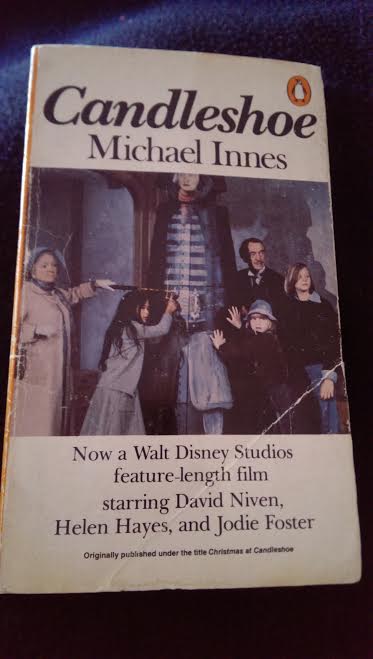
candleshoeCandleshoe by Michael Innes, 1953.

I own the movie version of the book, which was originally named Christmas at Candleshoe (although it’s not about the holiday).  It contains the text of the original story, but the picture on the front cover is from the movie.

The Disney movie is very different from the original book.  For one thing, the hero of the story is a boy (Jay), not a girl (Casey/Margaret), and unlike the movie version, the child’s identity is established for certain by the end of the book. The book has a happy ending, and so does the movie, but part of the movie’s point was that the idea of family isn’t dependent on blood relations alone, so it isn’t important whether Casey is really Margaret or not (although there are strong hints that she is).

The book is a bit hard to follow at first because it jumps back and forth between different places and different sets of characters, although it all takes place during the course of a single day and night.  Actually, I’m not sure this can really be called a children’s book, but I included it here because of the movie tie-in.  Because of the difficulty level of the book, I’d really recommend it for older children or adults.  Personally, I have to admit that I liked the movie better.

The story takes place in the mid-twentieth century, after WWII. There are two manor houses involved, Benison Court and Candleshoe. Benison Court, the newer of the two, is owned by the Spendloves, and Candleshoe, the older one, is owned by the elderly Miss Candleshoe. The two families are related, and neither one of them has as much money as they used to. The Spendloves take in some extra money by offering tours of Benison Court and showing people paintings and antiques owned by the family for generations. To raise some additional money, they decide to sell a couple of the paintings by Titian. To their surprise, the expert they call in to evaluate the paintings tells them that the paintings are forgeries.  Archdeacon, who cares for the antiques and library at Benison, reminds the Spendloves that during the war, the paintings were sent to Candleshoe for safekeeping.

Meanwhile, a couple of American tourists, the wealthy Mrs. Feather and her son Grant, having seen Benison, stop by Candleshoe. Mrs. Feather is fascinated by the old place, in spite of its state of disrepair, and Miss Candleshoe invites them to have dinner there and spend the night. Mrs. Feather has an interest in purchasing Candleshoe for herself and fixing it up.  Miss Candleshoe and her longtime friend, the retired chaplain, Armigel, know that there is not enough money for them to fix up Candleshoe, and they like the idea of traveling, so they are willing to consider selling the manor house. This plan does not sit well with Jay, the orphaned son of Miss Candleshoe’s housekeeper, Mrs. Ray.

After Mrs. Ray died, Miss Candleshoe cared for Jay, and now, with Miss Candleshoe and Armigel showing signs of senility, Jay has been handling much of the practical running of Candleshoe. On this particular evening, Jay is worried about more than the possible sale of the property. He has been noticing strange people paying unusual attention to the house. He suspects, correctly, that they intend to break into the house that night, and he has assembled a small army of local children, armed with antique weapons, to defend the place. Grant, befriending Jay, admires the boy’s practical turn of mind but worries that they are not up to the task of handling the siege that is coming to this isolated country house. As the danger presses closer, the Spendloves, Archdeacon, and the art expert are heading toward Candleshoe in search of the missing paintings.

The answer to all of these problems may lie in the strangest feature of the house: the Christmas box, a stone monument in the gallery made by Gerard Christmas and dedicated to the memory of an ancestor of the Candleshoes, who may have been a pirate. According to the lore of Candleshoe, the box will open at a time when Candleshoe is in crisis and will save the day.

The book is available online through Internet Archive.

But, is Casey Really Margaret?!

I think so. I want to say, “yes, she is,” but “I think so” is about as definite as I can be because the movie changed the story from the original book.

Whether or not Casey is actually Margaret, the lost heir to Candleshoe, is the burning question everyone is left with after watching the Disney movie Candleshoe. The movie deliberately left Casey’s true identity unresolved at the end, probably because they wanted to have the people at Candleshoe decide to accept her into their family on her own merits, not just because they had to because she’s the heir to the place. In the beginning, the audience is told that missing heir of Candleshoe, Margaret, was kidnapped as a young child by her own father, apparently in some kind of marital/custody dispute, and that she disappeared after his death in a car accident and has not been located although attempts to find her were made in the ten years that have passed since her disappearance. Casey is a teenage girl who was apparently an abandoned child with an unknown past and no memory of her early life who bears an odd resemblance to Margaret, including a couple of distinctive scars that are like ones Margaret was known to have. She is recruited as by con artist to play the part of Margaret, returning to Candleshoe as the lost heiress in order to gain access to the house and find a hidden treasure. Although Casey initially came to Candleshoe under false pretenses as part of a con with the promise of a share of the Candleshoe treasure and a red Ferrari as her payment, she eventually becomes fond of the people there and decides that she can’t let them be cheated by the real villain. Casey proves herself to be part of the Candleshoe family through her loyalty to them, and in the end, they would accept her whether she really was Margaret or not. It’s a nice sentiment, but viewers still have the urge to ask who Casey really is.

Casey is legitimately an orphan or abandoned child, found at about the right time and the right age and in the right place to really be Margaret. She has no memory at all of her early childhood, her parents, or where she came from, and she also bears some telltale scars that match ones that young Margaret was known to have. That’s what we’re told about Casey. Casey’s history is never explained in detail in the movie (we never find out under what circumstances she was found and entered into the Los Angeles foster care system), but from what we do know, her history meshes well enough with Margaret’s known past that it would seem plausible for her to actually be Margaret. Is she really Margaret, and Harry Bundage, the con man, just persuaded her that she was only pretending in order to use her for his own ends? Or, is the real Margaret still out there somewhere? If Casey actually is Margaret, did she lose her memory in the car crash that killed her father, or did he abandon her somewhere before his death, even though he had kidnapped her from her mother and took her to a completely different country?

When Harry Bundage is briefing Casey about Margaret’s background, he poses the theory that Margaret was in the car when her father crashed it and that she may have wandered off in a state of shock after the accident. That explanation might be partly for the benefit of the viewers, helping to explain how Casey could be Marget and not remember it. A young child suffering from shock might be unable to tell anyone who she was or what had happened to her. An accident may even have left some bruising that might have obscured the telltale scars that could have identified her, but again, the matter is never fully settled, and we just don’t know enough of Casey’s background to make a full connection. There are enough pieces to make it possible, maybe even probable, but nothing that definitively settles the matter.

In the final scene of the movie, Casey asks Margaret’s grandmother what will happen if Margaret is ever really found and comes home, and the grandmother says cryptically that maybe she already has. It’s a brief hint that the grandmother thinks Casey might really be her kidnapped granddaughter, even though she accepts that Casey was lying to her earlier about things she said she remembered and knows that Casey herself thought that she was just an imposter. Casey does have those telltale scars, and it does seem like quite a coincidence that two random girls of the same age and similar circumstances would have identical sets of scars. However, the movie stops short of declaring that Casey really was Margaret all along, and the unanswered questions still rankle viewers. So, some of us turned to the original book to get more detail, but it turns out that it doesn’t completely help.

As I said, the original book was different from the movie. Not only was the child hero in the book a boy instead of a girl, he wasn’t kidnapped and taken to America the way that Margaret was. In the book, Jay definitely knows who his mother was, and it’s the question of who his father was that establishes his identity as the heir to Candleshoe. It turns out that Jay’s father was the nephew of the lady of Candleshoe, making her his great-aunt rather than his grandmother. Her nephew had been a ne’er-do-well, and although his family didn’t know it, he had married an American woman before his death. He died not too long after the marriage, but by that point, he had fathered Jay. Jay’s mother knew about her husband’s family, but she wasn’t sure yet whether or not she wanted to tell them about Jay. She took the job as housekeeper so she could observe the family and decide whether or not to reveal their relationship. Unfortunately, she died in an accident before she made up her mind. By the end of the book, Jay’s identity is established, and he is definitely proven and recognized to be the heir to Candleshoe, and because of that, I believe that Casey really is the missing Margaret. At least, that’s as close to confirmation as we’re likely to get. If the child in the book was the rightful heir to Candleshoe, it would make sense if the child in the movie was, too, even if it’s not really the same child.

Of course, that’s not full proof, and it doesn’t answer the questions about Margaret’s kidnapping or her father’s accident or how Casey was found and placed in foster care in California without anyone else connecting her with the missing Margaret when Margaret’s disappearance was reported to the authorities and newspapers. I have a theory that Harry Bundage was right that Margaret was in the car during the accident and that she did wander away from the scene of the accident in shock and possibly suffering injuries that covered up her identifying scars, but that’s still just a theory. There’s nothing in the movie or book that I could use to prove it. We don’t even know exactly why Margaret’s father in the movie kidnapped her in the first place or why Margaret’s mother died not long after she disappeared. (A convenient accident or illness for story purposes so there’s one less person to try to identify Casey/Margaret, or did she kill herself out of despair at the loss of her husband and daughter? The movie doesn’t say, so those are just guesses, too.) There’s a lot of backstory missing, and the book doesn’t clarify these points because of the differences between the book and movie. I guess it’s not really important to the story in the movie, but inquiring minds still want to know.

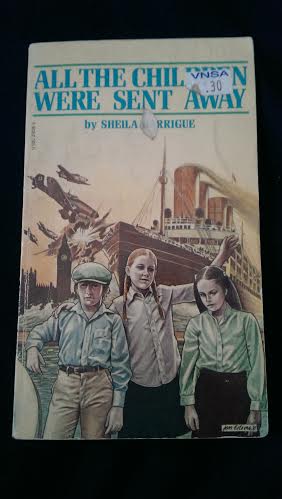
All The Children Were Sent Away

It’s 1940, and Sara Warren’s parents are sending her to stay with her uncle in Canada until the war is over.  With the increasing bombings of England, her parents have decided that it’s just too dangerous for Sara to stay, and her uncle has written, asking them to send her.  Many other British families are sending their children away to escape the bombings, and Sara travels to Canada on a ship with other British child evacuees.  All of them are worried about the families they’ve left behind and what it’s going to be like, living in another country.  They also worry about whether or not they’re ever coming back.

Sara’s escort for the trip is Lady Drume.  She is a bossy, over-bearing woman with very definite ideas about how children should be raised.  She doesn’t like Sara to talk to the sailors on the ship because they can be “impertinent,” and she doesn’t want her to play with the other children because they’re “guttersnipes!”  She even refuses to attend the lifeboat meeting or let Sara go without her!  To Sara’s mind, Lady Drume is as bad as any Nazi.

Sarah still manages to make friends with some Cockney children, Ernie and Maggie, seeing them whenever she can get away from Lady Drume, and an old sailor called Sparky makes sure that she understands safety on board the ship and attends the lifeboat drills.

But, when Lady Drume forces Sara to cut her hair after she’s been waiting so long for it to grow out, Sara decides that’s the last straw!  With the help of her friends, Sara hides from Lady Drume on the ship.  In the process, she learns something about Lady Drume which changes some things for the better, although it takes an outbreak of measles for Lady Drume to really understand and appreciate Sara.

This book is available to borrow and read for free online through Internet Archive.

Part of trouble with Lady Drume and her behavior is that she’s actually very afraid.  She doesn’t like to talk about lifeboats or life jackets because the war and the possibility of sinking frighten her.  She deals with problems by being brusque and trying to ignore frightening things, charging on ahead with whatever seems like a practical course of action to her.  It’s not even just the war but the changing world around her that frightens Lady Drume, a woman who’s used to knowing who’s who and what’s what and getting things done the way she likes them.  But, the rigors of their journey and their mutual vulnerability when they’re sick help lower Lady Drume’s barriers.  Lady Drume isn’t a bad person, and in the end, she arranges a special surprise for Sara to make her exile from England more bearable.

The end of the story is a brief section explaining Sara’s return to England, having been away for a few years, and her feelings at seeing how England and her parents have changed during that time.

There is a sequel to this book that shows what happened during Sara’s time in Canada called The Eternal Spring of Mr. Ito.  It focuses on suspicion of Japanese people following the bombing of Pearl Harbor.  There were Japanese internment camps in Canada as well as the United States during World War II.

Sheila Garrigue’s books about child evacuees from England were partly based on her own experiences as a child evacuee during World War II, as explained in her obituary after her death in 2001.

The D- Poems of Jeremy Bloom

jeremybloomThe D- Poems of Jeremy Bloom by Gordon Korman and Bernice Korman, 1992.
This book is mostly a collection of funny poems, but there is an overarching story to them.  Jeremy Bloom, a typical middle school slacker, wanted to sign up for the easiest elective course he possibly could.  But, by accident, he overslept on the first day of school, and by the time he got there, sign-ups had already started and the easiest and most popular electives were full.  Desperately trying to find something easy and with as little work possible under the remaining electives, Jeremy decided to sign up for Pottery. (“It was no Snooze Patrol, but how hard could it be to make ashtrays?”)  Only, he made another mistake and accidentally signed up for Poetry, and once he was enrolled, there was no way out of it.  He was committed to spending a year writing poetry.

jeremybloompoemJeremy tries to make the best of things, but somehow (partly through his own fault and partly by accident), he continually manages to do things to annoy his poetry teacher, Ms. Terranova (or, as the kids call her, Ms. Pterodactyl, thanks to a mistake Jeremy made when he said her name on the first day of class).  Every single poem Jeremy writes during the year receives the same grade: D-.  The book is divided into different periods of Jeremy’s work, along with an explanation about what Jeremy did during each period to tick off his teacher.  At the end, the reader can be the judge: Are Jeremy’s D- grades because he’s a terrible poet or because his teacher is mad at Jeremy for everything else he does during the year?  (The answer is pretty obvious.)

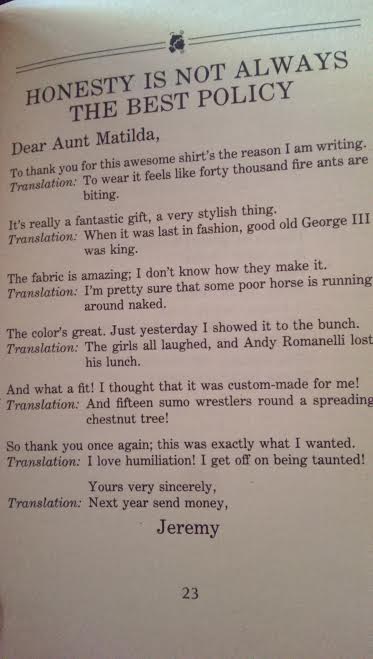
My favorite poems are the longer ones like “Why I Was Late,” “The Wheeler-Dealer,” and “No Boring Parts Allowed.”  Just to give you an idea of what the poems are like (although they are written in a variety of styles), here’s another one of my favorites, “Honesty Is Not Always the Best Policy.”

The book is currently available online through Internet Archive.