The Adventures of the Red Tape Gang

RedTapeGangThe Adventures of the Red Tape Gang by Joan Lowery Nixon, 1974.

Hardcover editions of this book are called The Mysterious Red Tape Gang.

Mike’s father loves to read the newspaper every morning and rant about the stories that make him angry.  It annoys him how little gets accomplished because there’s so much “red tape” involved.  Take the case of their neighbor, Mr. Hartwell.  He has a large bush that’s dangerously close to the corner of their street and has caused several accidents. The city wants him to cut it, but he refuses to do so out of meanness and stubbornness.  Now, the city has to go through all kinds of red tape to make it happen.

His father’s rants give Mike an idea.  Why not put the new clubhouse he and his friends are working on to good use and form a club to right the wrongs of their neighborhood and make all of that red tape unnecessary?  Besides, cutting the Hartwells’ bush in the middle of the night would be a great joke on Mr. Hartwell’s nosy daughter, Linda Jean, who’s always hanging around, getting in the way of Mike and his friends.

Mike’s friends love the idea of being secret neighborhood heroes, but of course, it turns out to be harder than they expected.  After trimming the Hartwells’ bush as best they can, they decide that instead of just cutting the bush, it would be better to move it to a completely different spot so there will be no need to cut it again when it grows out.  But, Mr. Hartwell almost catches them in their midnight landscaping, and when Linda Jean finds Mike’s shears, they’re forced to let her into their club.

Their next project, boarding up the doors and windows of an abandoned house so that curious children won’t wander in and get hurt, also comes with complications.  It seems that the house wasn’t quite as abandoned as everyone thought.  Still, the Red Tape Gang accomplishes something even greater than just keeping kids out of the house and successfully keeps their identities secret.  But while they’re congratulating themselves on the wonderful job they’ve been doing, they discover that their neighborhood contains far more serious problems than they originally thought. Their activities are also starting to come to the attention of the wrong people.  And, for one member of the group, these problems hit dangerously close to home.

This was one of my favorite books when I was a kid.  The descriptions of the kids’ midnight excursions are hilarious and make you want to cheer them on!

This book is currently available online through Internet Archive.

Our Teacher Is Missing

TeacherMissingOur Teacher Is Missing by Mary Frances Shura, 1992.
Eliza is a quiet girl, and she likes to be that way.  Too many of her teachers try to make her be more “outgoing” or “lively.”  Mostly, Eliza wishes that they would just leave her alone.  That’s why she likes her new teacher, Miss Dixon.  Miss Dixon is quiet and soft-spoken, like Eliza.  Ben, the class bully, calls Miss Dixon “Mouse,” but in spite of that, Miss Dixon has no trouble controlling her class.

Then, one day, Miss Dixon doesn’t show up to class.  The kids wait around for her, goofing off, but Eliza is really worried.  She knows that it’s not like Miss Dixon to simply not show up.  Soon, other kids also start becoming concerned, and other faculty members realize that Miss Dixon is missing.  The principal arranges for a substitute teacher while they are looking for Miss Dixon, and the children continue wondering what could have happened to her. The students consider every possibility behind their teacher’s disappearance, from secret mafia connections and entry into the Witness Protection Program to alien abduction.

But, for Eliza, all these wild speculations, stupid jokes about their “Mouse” teacher being eaten by a cat, and the adults’ constant reassurances that they’re sure that there is a reasonable explanation and that no one should be “unduly concerned” are just not enough.  Whatever happened to Miss Dixon, Eliza is sure that she would have come to school or at least called if she could.  Eliza thinks that something terrible must have happened and that Miss Dixon needs help fast.  If the adults won’t do anything about Miss Dixon’s disappearance, then she will!

This book is currently available to borrow and read for free online through Internet Archive.

My Reaction and Spoilers:

I love this book because I identified with the main character from the time I first read it as a child. One of the themes of this book is about people’s perceptions of different personality types. Eliza’s teachers and even her parents underestimate her because of her quiet nature.  Eliza is an introvert, and she is under constant pressure from most adults to be more of an extrovert.  Eliza resents their attempts to reshape her into a more outgoing, forceful person, not recognizing that her real strengths are her intelligence, perceptiveness, and quiet determination to do the right thing.  Being a loud person isn’t the same as being a competent person, although some people have that perception.  However, the people around her come to understand her better in the end.  Eliza also finds some unexpected sympathy from friends who understand her impatience with the shallow immaturity of other kids and who also are content to not be completely understood by other people as long as they have the freedom to quietly be themselves.

Eliza succeeds in this mystery where the adults fail because she is perceptive and has insights into her teacher’s personality that other lack.  Although Eliza’s friends Robin, Stephen, and Chris are worried about getting into trouble by playing detective, when they see how determined Eliza is, they agree to help.  Soon, they realize that Eliza is right to be worried.  Miss Dixon intended to be home over the weekend, but something happened to keep her from coming home.  The more the children talk about what they really know about their teacher, the more they begin to put the clues together.  Finally, they realize where Miss Dixon was right before she vanished, but the situation is serious.  Miss Dixon is being held captive because she accidentally stumbled upon criminal activity.  When one of their classmates is also in danger, Eliza shows everyone that even a quiet person can have the bravery and determination to do what needs to be done.

Sideways Arithmetic from Wayside School

SidewaysArithmetic

Sideways Arithmetic from Wayside School by Louis Sachar, 1989.

This is a companion book to the Wayside School Series.  Unlike the other books in the series, it doesn’t contain stories.  It talks about the things that kids at Wayside School study, partly from the point of view of Sue, a new student who is stunned to learn that kids at Wayside School do arithmetic with words, not numbers.

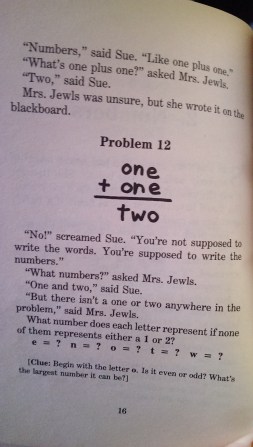
SidewaysArithmeticPicBasically, it’s a puzzle book.  In the Arithmetic section, the letters in the words stand for numbers.  The book gives an example to demonstrate how to figure out which numbers the letters stand for.  The problems get harder through the sections labeled Numbers, Pronouns, and Paragraphs.

From the Recess section on, there are logic puzzles.  In Recess, you have to use the information provided to figure out what games the children play at recess.  In Science, Geography, Etc. (that’s one chapter), you have to figure out who got the right answers to the tests from the information provided. You see the answers five of them got and know that only one of them got all the answers right and no two of them had the same score. When you look in the back to see if you solved the problem right, you get to see what the test was actually about, and that’s the funniest part.  The Lunch section combines logic puzzles with math.  The True or False section gives you true/false questions to answer based on a series of statements about which of them are true or false.  Finally, in the After School section, Joy and Sue give up and go home (as well they should).

I like the book because I like puzzles, and there are funny little stories around the problems and answers.  All of the puzzles are answerable (except for one or two where the correct answer is that they’re impossible, which is why Joy should definitely get up and go home, but you’ll figure that out way before she does).  If you like puzzles and the Wayside School series, you’d like this book.  If you don’t like puzzles, you can skip this and just stick to the regular books in the series (as regular as Wayside School gets).  If you like puzzles but don’t know about the Wayside School series, you could still find it interesting but you wouldn’t really appreciate the funny parts.  If you don’t like the Wayside School series or puzzles, you probably aren’t reading this right now, so don’t worry about it.

This book is currently available online through Internet Archive.

Wayside School Gets a Little Stranger

WaysideStrangerWayside School Gets a Little Stranger by Louis Sachar, 1995.
Just when you didn’t think it was possible . . .

Having finally managed to remove all of the cows from Wayside School (see the last story in the previous book in the Wayside School Series), Louis declares that Wayside School is ready for the students to return.  Everyone is glad because they were all sent to far more normal schools while Wayside was closed, and they hated it.  Nothing normal ever happens at Wayside, the school that was built sideways (and has a missing floor, where all the really strange stuff happens).

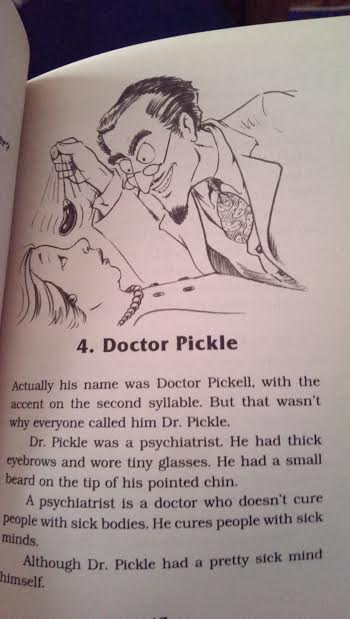
But, things are about to get stranger yet.  The school hires a new school counselor (they probably needed one) named Dr. Pickell (or Dr. Pickle, if you prefer).  He takes the job when he can’t practice psychiatry anymore because of his tendency to play practical jokes on people while they’re under hypnosis.  Can he finally cure Paul of his desire to pull Leslie’s pigtails?

WaysideStrangerPic1Meanwhile, the principal declares that “door” is a very bad word and that everyone should say “goozack” instead.  Mrs. Jewls tells the children to write poems about colors, but some colors rhyme better than others.  Kathy tries to convince everyone that Santa doesn’t exist.  Miss Zarves (who also doesn’t exist), laments about how difficult teaching really is.

Then, the children learn something really surprising: Mrs. Jewls is expecting a baby!  She has to take a break from teaching, and the children have a series of substitutes who are stranger than Mrs. Jewls.  Mr. Gorf turns out to be Mrs. Gorf’s son, and he wants revenge.  Mrs. Drazil turns out to be Louis’s old teacher, the one he was always afraid of, and she wants revenge.  Mrs. Nogard is an unhappy person who wants to make other people unhappy . . . until she realizes that isn’t what she really wants.  Wayside School may be strange, but it does have happy endings!

By the way, anyone notice what the substitutes’ names spell backward?

This book is currently available online through Internet Archive.

Wayside School is Falling Down

WaysideFallingWayside School is Falling Down by Louis Sachar, 1989.
The books in the Wayside School Series are collections of short, funny stories about a school that was accidentally built sideways.  Instead of being a one-story school with thirty classrooms all in a row, Wayside School is a thirty-story school with only one classroom on each floor.  Strange things are always happening there. The stories mostly focus on the kids in Mrs. Jewls’s class on the top floor of the school.  Like the first book in the series, there are 30 short stories in this book.

It would take too long to describe all the stories in the book individually, but they’re just as funny as in the first one.  Mrs. Jewls has a new student, Mark Miller, except that Mark Miller is really Benjamin Nushmutt.  Benjamin would correct Mrs. Jewls except that he seems to be a much better and more popular student as Mark Miller.  But, as he soon learns, answering to a name that isn’t yours is about the least strange thing at his new school.

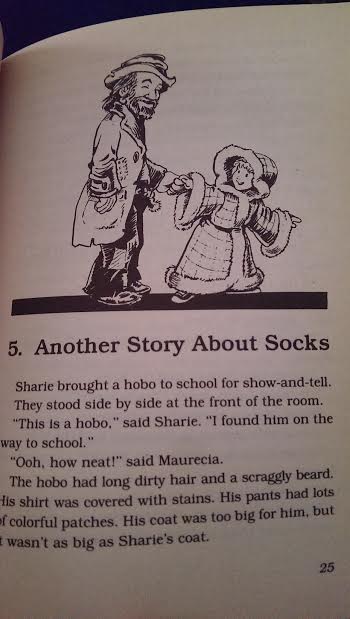
WaysidePic1Socks figure into many of the stories, with a special jingle invented by Mac, who used to be named Nancy until he traded names with a girl.  It’s fortunate that Mac invented the jingle because Allison uses it to free herself from the non-existent 19th story.  Myron chooses freedom over safety, emancipating himself from the school’s rules.  Bebe invents a younger brother, and things turn around for Leslie when her pigtails pull Paul.  Rondi fears that she’s no longer cute now that her front teeth have grown in.  Joy learns the best thing about the toy dog that Todd brought to school, and Ron actually tries the school lunch.

There are plenty of lessons to learn.  Watch as Mrs. Jewls teaches her class about gravity using her brand new computer!  Dana thinks that she hates stories until she learns that she actually loves them.  Mrs. Jewls teaches Jason not to chew pencils using masking tape.  Dameon learns about love via a dead rat.  Stephen explains how uncomfortable clothes and strangling ties make people look important, and Mrs. Jewls says that it’s what’s underneath that counts, so it’s best to wear expensive undies.  Then, everyone learns to tango in dance class (except Myron).

But, one windy day, the children are faced with an alarming possibility: Can their overly-tall school actually fall down?  (Lyrics courtesy of Kathy, who still hates everyone.)

This book is currently available online through Internet Archive.

Sideways Stories From Wayside School

Wayside

Sideways Stories From Wayside School by Louis Sachar, 1978.

The books in the Wayside School Series are collections of short, funny stories about a school that was accidentally built sideways.  Instead of being a one-story school with thirty classrooms all in a row, Wayside School is a thirty-story school with only one classroom on each floor (the compensation is the extra-large playground).  Also, they accidentally left off the 19th story.  Strange things happen at the school.  Even stranger ones happen on the non-existent 19th story.  But, the stories mostly focus on the kids on the top floor of the school.

WaysideStoriesPic1Each of the books contains thirty stories, like the school (ha, ha!).  It would take awhile to describe them all, but there are stories about each of the kids in Mrs. Jewls’s class.  Mrs. Jewls took over the class on the 30th floor after Mrs. Gorf accidentally turned herself into an apple.  She used to turn her students into apples when they made her mad, but most forms of revenge backfire eventually.  Mrs. Gorf ends up turning herself into an apple when one of her students holds up a mirror, and then, Louis the yard teacher eats her.
Mrs. Jewls is a much better teacher.  She helps Joe learn to count.  Joe can usually only get the right answer when he counts numbers in the wrong order.  She helps John learn to read right-side up instead of upside down.  She teaches Bebe that when it comes to art, quantity doesn’t equal quality (although Bebe did have a pretty good system going there for awhile) and cures Dana’s mosquito bites with the power of arithmetic.  Mrs. Jewls even invents new flavors of ice cream when Maurecia gets tired of every flavor in existence.

The students in Mrs. Jewl’s class are pretty amazing, too.  Todd saves the day when confused bank robbers burst into the class.  Sharie shows her intelligence by sleeping in class, D.J. smiles constantly, and Kathy hates everyone and everything.  Rondi is cute for the things she doesn’t have (like her two missing teeth) and the stuff she doesn’t do (everyone laughs when she doesn’t tell a joke), but what can she do about it?  Paul just wants to pull Leslie’s pigtails, and Leslie thinks maybe she should sell her toes because she can’t find a use for them.

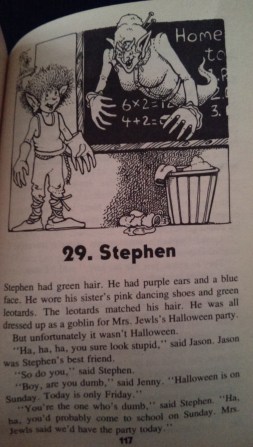
WaysideStoriesPic2Mrs. Gorf does make one more reappearance on the Friday before Halloween.  Mrs. Jewls and the children argue that she can’t haunt the school if it’s not Halloween, but when Halloween falls on a weekend, schools have to have their Halloween party on the Friday before.  Stephen’s just happy that the ghost of Mrs. Gorf justifies his costume.
As Louis the yard teacher says, “It has been said that these stories are strange and silly.  That is probably true. However, when I told stories about you to the children at Wayside, they thought you were strange and silly. That is also probably true.”  Fair is fair.

This book is available online through Internet Archive.

The Seventh Princess

The Seventh Princess

The Seventh Princess by Nick Sullivan, 1983.

Jennifer never remembers her dreams, so she doesn’t think that she’ll be able to complete the essay that her teacher assigned them to write: My Strangest Dream.  While she’s worrying about not being able to finish her homework, she dozes off on the school bus on her way to school.

Suddenly, Jennifer finds herself in a beautiful carriage being driven through a dark forest.  Jennifer is happy that she’s apparently going to have a dream that she can write about, so she decides to enjoy it as much as possible, trying on the beautiful gown, cloak, and jewelry that she finds in the carriage with her.  Eventually, the carriage stops at a huge palace, and Jennifer comes to the realization that the carriage never had a driver.

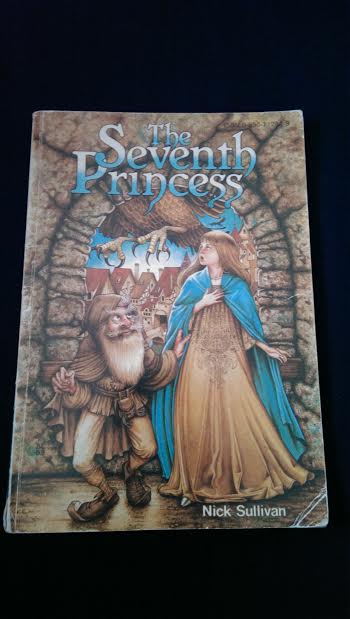
She is greeted by Duke Rinaldo, the Lord High Chancellor of the kingdom of Eladeria. Jennifer is informed that she is Princess Miranda, the king’s adopted daughter.  Actually, Jennifer is the seventh of the king’s “daughters.”  There were six others before her . . . and their fates are unknown.

This is no ordinary dream.  The king of Eladeria is ill, possibly bewitched.  The king’s son is missing.  There is treachery in the palace.  People live in terror of the evil enchantress Swenhild and her harpies.  Soon, they will demand a tribute: a golden-haired princess with blue eyes . . . like Jennifer, er, Princess Miranda!

The only one who seems to want to help Jennifer is her new friend, Samson the dwarf, who is the palace’s court jester.  He introduces her to his friend, Prospero, who can do magic and understands more of what’s happening than most people.  He tells her that her only hope is to find the Paladian Scroll and use its power.  Can Jennifer and Samson find this mysterious scroll in time?  It might still be possible to save the other princesses, but Jennifer worries about whether she’ll ever wake up in her own world again.

This book is available online through Internet Archive.

My Reaction

One of the things that I love about this book is how it brings in some lesser-used fantasy creatures, like the harpies, and characters, like the dwarf jester.  The “was it a dream or wasn’t it” trope has been used a lot, but the adventure within the dream itself is fun, exciting, and very well-done.

Twenty and Ten

TwentyTenTwenty and Ten by Claire Bishop, 1952.

The story takes place in occupied France during World War II.  Children were often sent to the countryside to escape the violence of war, and a group of twenty children, both boys and girls, are staying at a small school taught by a nun, Sister Gabriel.  Most of them are about eleven years old, although four-year-old Louis is allowed stay at the school with his older sister, Denise.

Janet, another student at the school, tells how a strange man comes to the school and begs them to help him hide ten Jewish orphans from the Nazis.  Sharing their school with these newcomers means that they will have to share their already meager rations with them and to keep their presence at the school absolutely secret.  In spite of the danger and difficulty, everyone at the school agrees to help.  They think of it as being like when Mary and Joseph had to take baby Jesus to Egypt to hide him from King Herod, a story they had recently acted out in play form.

TwentyTenPic1The two groups of children soon make friends, and one of the Jewish children, Arthur, shares something special with his new friend, Henry: a small piece of chocolate.  With the rationing, none of them have seen chocolate in a long time.  Henry decides to share a little with Janet because he likes her, and they decide to hide the rest and save it for later.  When Denise spies them with the chocolate and wants to have a little herself, she steals the piece of chocolate from where Henry has hidden it. The others chase after her to get the chocolate back, and they end up accidentally discovering a cave that none of them knew was there.

This becomes a vital discovery when the children spot a pair of Nazis heading toward their school.  Sister Gabriel is away, so the children have to take care of the situation themselves.  Quickly, Arthur leads the other Jewish children to the cave, where they can hide.  The other children remain at the school and try to keep the Nazis from learning anything.  They try not to even talk to the Nazis when they start asking questions.  But, how long can they keep it up?  Something has obviously happened to Sister Gabriel, and the Jewish children can’t hide in the cave forever.

There is a movie version of this book called Miracle at Moreaux.  The movie differs significantly from the book.  In the book, the children at the school are all welcoming to the Jewish children, but in the movie, some of the children at the school are afraid of the Jewish children (there are only three of them in the movie), one of them in particular hating Jewish people because she believes anti-Semitic stories she’s heard.  Also, instead of the cave that appears in the book, the movie uses a Christmas pageant as the device for confusing the Nazis and allowing the Jewish children to escape to Spain (instead of staying at the school until the end of the war, as they did in the book).

This book is available online through Internet Archive.

More Stories from Grandma’s Attic

This is the second book in the Grandma’s Attic Series (I’ve only read two of them, although there are more in the series than that).  Like the first one, grown-up Mabel shares stories from her childhood with her granddaughter: short, humorous stories about life on a farm during the 1800s, often with a moral to them (the stories typically have Christian themes).  The stories are entertaining, thoughtful, and mention interesting details about life in the past.  Watch what happens when Mabel and her friend try to play “mother” to a piglet!  Also, is it possible that the doll Mabel found in the mud is actually . . . alive?

This book is available to borrow and read for free online through Internet Archive.

The Nuisance in Ma’s Kitchen

Mabel helps to nurse an ailing baby goat, but when the goat is better, she has trouble accepting that it’s time for it to return to the barn with the other goats.

Grandma’s Sampler

Mabel learns that it’s better to be careful and to fix mistakes early when her over-confidence jeopardizes her chances of winning a contest with her sampler.

Mrs. Carter’s Fright

Mabel and Sarah Jane love babies!  They admire Mrs. Carter’s new baby so much when she comes to visit that they’re inspired to pick a “baby” of their own from a litter of piglets.  But, when they borrow Mrs. Carter’s baby carriage for their “baby,” they accidentally give everyone a fright!

When Grandma Needed Prayer

Young Mabel questions the need to pray on a busy morning, but when she and her friend get lost later, they come to understand the importance of being able to stop and pray.

The Stranger

A stranger comes to the farm and visits with them one day.  He seems to know them, and doesn’t introduce himself.  While he helps them with chores and spends a pleasant evening with them, no one is willing to admit that they don’t know who the man is.  Who is the mysterious stranger?

The Big Snow Storm

When Mabel’s Ma is sick during a big snow storm, the family doesn’t know how they’ll manage to get help for her.  But, ironically, the storm actually brings help to them.

Grandma and the Slate

Mabel’s brother, Roy, gets a new slate to write on for school.  Mabel admires it and wants to try writing on it herself, but Roy teases her that she’s just too young.  Then, when Roy makes a bargain with Mabel to give her the slate if she does something for him, he ends up getting more than he bargained for.

A Pig in a Poke

Grandma Mabel explains to her granddaughter that the word “poke” used to mean a bag or sack.  If someone bought a pig in a poke, it meant that they bought something sight unseen, not knowing exactly what they were going to get or what quality it would be. Young Mabel once saw her brothers do that the day they bought a trunk that had been locked for years because the key was lost.  Will their trunk contain a fabulous treasure or just a disappointment?

Grandma’s Day Off

Young Mabel persuades her mother to let her have a day with no chores and finds out that a life of leisure isn’t all it’s cracked up to be.

How News Spreads

When Mabel’s family hears that the girl Sarah Jane’s brother wants to marry is buying cloth for a wedding dress, Mabel and Sarah Jane get the wrong idea.

Charlotte

Mabel finds a doll lying in a mud puddle and brings it home to play with.  But, Charlotte turns out to be an unusual doll.  Wait, did she just move?!

The Slate Pencil

Mabel finds a lost slate pencil at school. Even though she knows who lost it, it’s a nice pencil, and she’s tempted to keep it for herself.

What Shall We Write About?

Mabel and Sarah Jane want to write exciting stories like the ones in the magazines, but they don’t have anything interesting to write about.  Then, Sarah Jane finds a diary that her cousin Laura left behind when she visited.  Could it be a source of story material?

The Cover-Up

Roy is punished for teasing Mabel by having to wash the dishes (since he told her that she was such a baby and couldn’t do it right).  He tries to hurry through the chore and ends up breaking one of the plates.  Is there any way he can keep everyone from finding out?

The Haircut

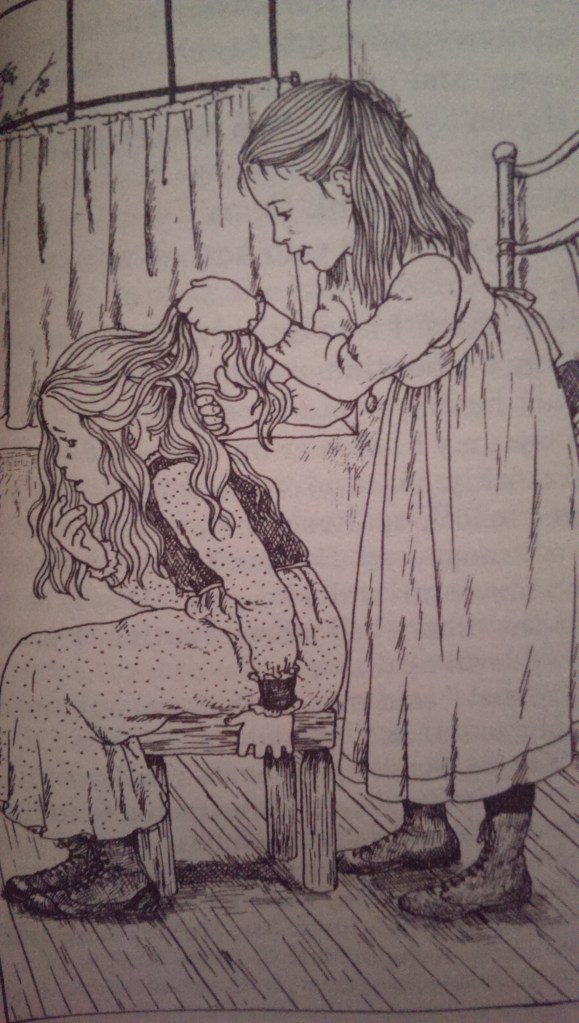
Mabel is honored when her friend, Sarah Jane, decides that she’d like to carry a lock of her hair in her new locket.  Unfortunately, Sarah Jane accidentally cuts off more of Mabel’s hair than she means to.  What will Mabel’s mother say when she sees it?  Or is there some way that they can cover it up?

Grandma Makes a Friend

Mabel resents the new girl in class, Alice, because the teacher gives Alice Mabel’s seat next to her best friend and Alice always seems to have nicer clothes to wear and everything.  But, hating people isn’t a healthy way to live your life, and Mabel’s mother convinces her to give Alice a second chance to be her friend.

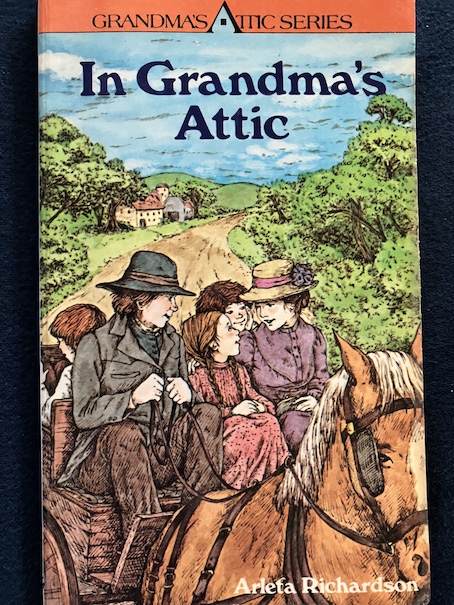
In Grandma’s Attic

The books in the Grandma’s Attic Series are collections of short stories (although I think later books in the series are novel-length stories) told by a grandmother to her granddaughter about life when she was young.  They typically begin with the young granddaughter (unnamed in the stories) asking her grandmother, Mabel, about an object in her house, and Mabel then tells the story about it.  These are usually short, slice-of-life family stories with a humorous twist, often with a moral (the stories generally have Christian/Biblical themes).  The inspiration for the stories was the author’s own grandmother, who grew up on a farm in Michigan in the 1800s.  I’m kind of sentimental about them because the books I have were presents from my own grandmother, who also grew up on a farm.

This series is good for discussing aspects of life in the 1800s. They include little details about daily life like the types of chores children did, how they got to school and what lessons were like, and other little household details like warming clothes on a wood-burning stove and throwing water from washing dishes outside because they didn’t have a modern sink.  They’re also good for talking about morals or making ethical decisions (it’s not just Christian themes, Mabel also talks about more general issues of growing up, like honesty, responsibility, and the awkward mistakes children make when they try to act more grown-up than they really are) or just for a good laugh because some of the stories are really funny (learn the perils of attempting to sit down in a hoop skirt without really knowing how)!

In Grandma’s Attic is the first book in the series and it is available to read for free online through Internet Archive.

Pride Goes Before a Fall

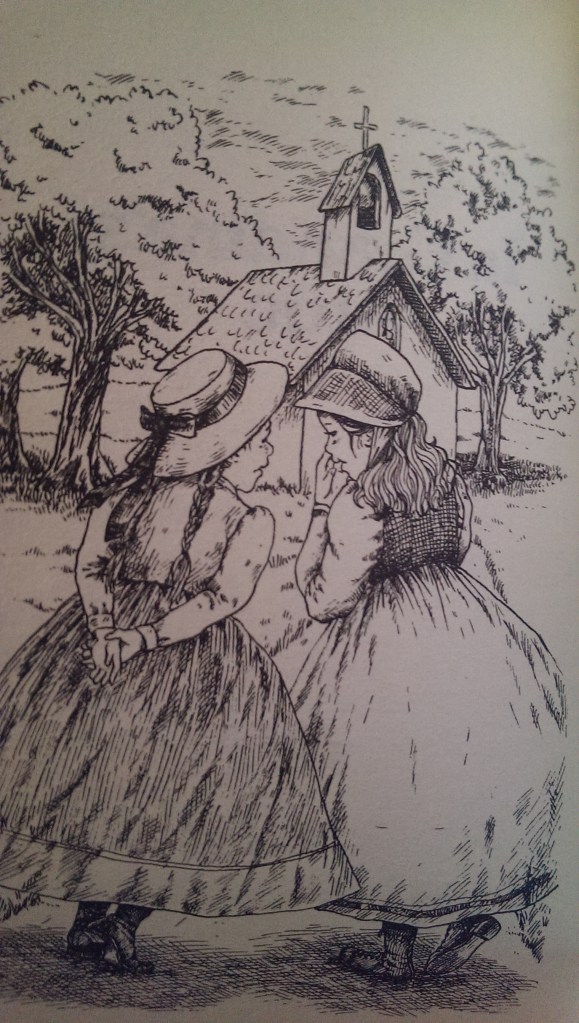
Mabel and her best friend, Sarah Jane, badly want to wear hoop skirts like the fashionable young ladies and have everyone admire them, even though their mothers say they are really too young. When they get the chance to wear them in front of everyone, they make a mistake and learn the lesson in the title of the story.

When God Knew Best

Mabel talks about a childhood disappointment that turned out well in the end because she was saved from disaster.  Sometimes disappointments are blessings in disguise.

The Red Bonnet

A lost bonnet gives everyone the wrong impression, and a search begins for a not-so-missing child.

Grandpa’s Apron

The other guys teased him when he asked Mabel to make him a work apron with pockets because aprons were supposed to be women’s clothing, but his comes in handy in some unusual ways.

Ma’s Busy Day

Being a mother is hard work, and when a hectic day leaves Mabel’s Ma no time to change her aprons when one after the other gets dirty, the layers of aprons she has on at the end of the day become a record of the day’s events.

Grandma’s Mistake

Mabel misunderstands something her mother says, and it causes her problems at school.

The Button Basket

A strange Indian (Native American) comes to the farm and trades a beautiful basket for food.  Unfortunately, they can’t speak the same language, so they never learn the reason why, and they marvel over the mystery of the basket’s origins.

The Little Gray Shoes

Mabel learns that vanity comes at a price when she insists that she wants a beautiful pair of gray shoes that don’t fit her properly.

Nellie and the Buttons

Why does their horse, Nellie, keep trying to bite the buttons on Mabel’s new coat? Nellie might be smarter than they think.

The Pearl Buttons

When Mabel has trouble fastening the buttons on her new dress, she finds a creative solution that causes her some embarrassment.

Nellie’s Trips to Town

When Mabel’s family makes a trip to town, their horse and buggy suddenly disappear.  Then, as soon as they get a ride from a friend, they are suddenly returned.  Why?

The New Pump

Young Mabel learns the hard way why it’s a bad idea to lick cold metal in the winter.

You Can’t Always Believe

When strange things start happening around the farm, Pa blames one of Mabel’s brothers but learns that it isn’t a good idea to be too quick to blame.

The Old Door

Mabel’s brother plays a trick that causes some embarrassment for their mother.

Pa and the Dishwater

Mabel’s fear of the dark makes it difficult for her to throw the dishwater outside after they wash the supper dishes.  When she thinks she’s found a shortcut for getting rid of the dishwater, it gets her into trouble.

The Dishes

Mabel tries to put off her chores so that she can play with her friend, but the guilt she feels takes the fun out of it.

Ma’s Birthday Cake

Mabel is so pleased to be making a cake for her mother on her birthday, but has she gotten the recipe right?

Grandma’s Warm Clothes

Mabel and her brothers used to warm their clothes by the stove on cold winter mornings, but Mabel’s attempt to make it easier on herself and her forgetfulness have unintended consequences.

Grandma’s Prayer

Mabel thinks that a selfish prayer she made may have brought bad luck to her family.

Molly Blue

Molly Blue the cow always gives Mabel trouble.  Her family thinks it’s funny until they see how much Mabel needs their help.

Grandma and the Gun

Gun safety is a big issue in modern times, and it was back then, too.  Mabel is a curious child and makes a mistake that almost has very serious consequences, but she learns an important lesson.

What Grandma Lost

When Mabel’s brothers are sick and she gets to take the family’s horse and buggy to school by herself (a special privilege for a child of her time), she decides to show off a little.  But, in her attempt to look more grown-up and responsible, she ends up proving that she’s not as grown-up and responsible as she thought.

What Did You Expect?

Not exactly a full story, but Mabel shows her granddaughter what a miracle looks like because she believes it can happen.