The Zucchini Warriors

zucchiniwarriorsThe Zucchini Warriors by Gordon Korman, 1988.

One of MacDonald Hall’s former students, Hank “the Tank” Carson, has made it big with his zucchini stick snack company.  As a former football player, he also wants to create a winning football team for his old school, funded by his zucchini fortune.

Mr. Sturgeon isn’t happy to see Hank again.  He was in Mr. Sturgeon’s math class, before Mr. Sturgeon became the school’s headmaster.  Hank was always a loud, obnoxious student, and against his morals, Mr. Sturgeon gave him a passing grade even though Hank actually failed the class.  He only did it because he couldn’t stand another year with Hank as his student, although he’s felt guilty about it ever since.

The boys aren’t thrilled about the new football stadium and team, either.  What they really wanted was a new rec hall.  But, when Bruno gets up the nerve to tell Hank about it, Hank makes the kids a deal: if they get a football team together and make a decent showing with it, he’ll fund a rec hall for them, too.  Bruno, as the one who wanted the rec hall the most, becomes the driving force behind the new football team, talking the other guys into playing and even eating Hank’s zucchini sticks even though everyone at school actually hates them.

The biggest stumbling block that the MacDonald Hall Zucchini Warriors faces is that they know nothing about the game.  In fact, the only one around who’s really into football is Cathy, one of the girls across the street at Miss Scrimmage’s Finishing School for Young Ladies.  But, football is a man’s game . . . right?

This book is part of the MacDonald Hall Series (or Bruno and Boots series). It is currently available online through Internet Archive.
The War with Mr. Wizzle

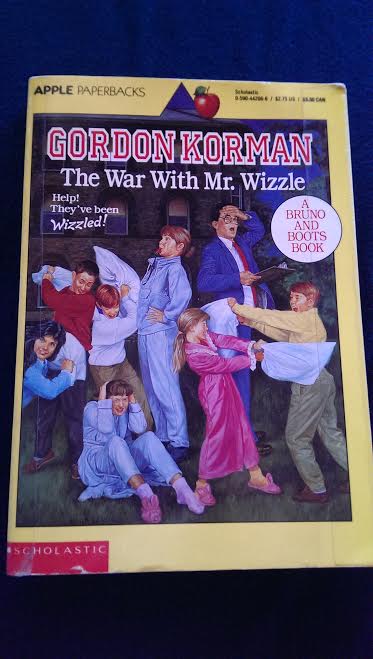
warwizzleThe War with Mr. Wizzle by Gordon Korman, 1982.
MacDonald Hall hasn’t been the same since Mr. Wizzle came.  He’s obsessed with computers and analyzing and categorizing everyone and everything.  He uses his computers to analyze the boys’ personalities, making changes to their schedules and activities based on the results.  But, no computer could ever understand the wacky and complex personalities of the students at MacDonald Hall.

Mr. Wizzle thinks he can understand everything with his computer, but he doesn’t understand the boys at all.  The boys soon get sick of being tested and analyzed and ordered around and told that they should consider changing their last names because the length is too inconvenient for the computer.  Even Mr. Sturgeon and the other faculty members are getting fed up with Mr. Wizzle, but they can’t do anything about it because the school’s board of directors are still hoping that Mr. Wizzle will modernize the school.

Meanwhile, the boys’ friends across the street at Miss Scrimmage’s Finishing School for Young Ladies are having personnel problems of their own.  Miss Scrimmage’s new athletics teacher, Miss Peabody, used to be a U.S. Marine, and she’s trying to train the girls like they’ve signed up for boot camp.  Like the boys, they would do just about anything to get rid of this new nuisance!

What ensues is a series of hi-jinks in the usual spirit of McDonald Hall as the students at each school attempt to drive out the new faculty, but along the way, the kids are forced to acknowledge that they don’t really want anything bad to happen to these new people.  It’s not that they’re bad people, they’re just not right for the types of schools and the students they’re trying to teach.  Then, a thought occurs to them: Is it possible that Mr. Wizzle and Miss Peabody might be right for . . . each other?

This book is part of the MacDonald Hall Series (or Bruno and Boots series). It is currently available online through Internet Archive.

Beware the Fish!

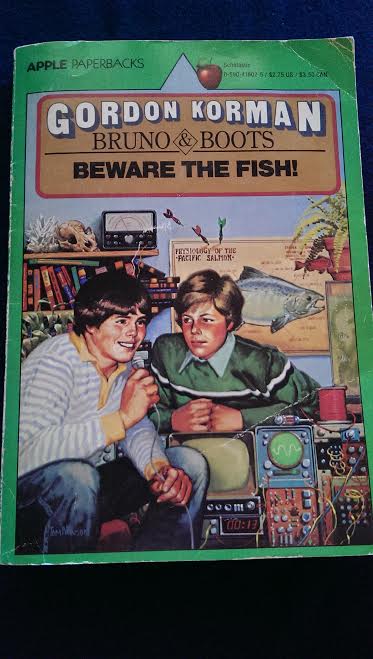
bewarefishBeware the Fish! by Gordon Korman, 1980.
In spite of MacDonald Hall’s prestigious reputation, it is continually plagued by money problems.  The students can’t help but notice all the budget cutbacks, and now, there are rumors that the school might even have to close permanently.  The last thing anyone wants is to leave MacDonald Hall.  Bruno, the school’s resident idea man and master prankster, decides to spearhead a movement to raise money and publicity for MacDonald Hall so they can save the school!

Bruno, his best friend Boots, and their other fellow students try everything they can think of to spread the word about what a great place MacDonald Hall is so that enrollment will go up and the school can earn enough money to stay open.  They enlist the help of the girls at the nearby finishing school to help them break a world record.  The school’s science whiz, Elmer, shows the boys some of his inventions in the hope that one of them will make the school famous.

Unfortunately, as usual, nothing turns out as planned.  World records are extremely difficult to break, and Elmer’s inventions backfire.  One of his inventions backfires in such a way that it comes to the attention of the local police, and even the government becomes convinced that a gang of terrorists may be operating somewhere in the vicinity of MacDonald Hall.

The boys try to keep their activities secret from their headmaster, Mr. Sturgeon (or, as the boys nickname him, “The Fish”), while government agents snoop around, looking for the head of the organization that’s been issuing cryptic messages over television signals, a shadowy figure known only as “The Fish.”

This book is part of the MacDonald Hall Series (or Bruno and Boots series).  It is currently available online through Internet Archive.

This Can’t Be Happening At MacDonald Hall

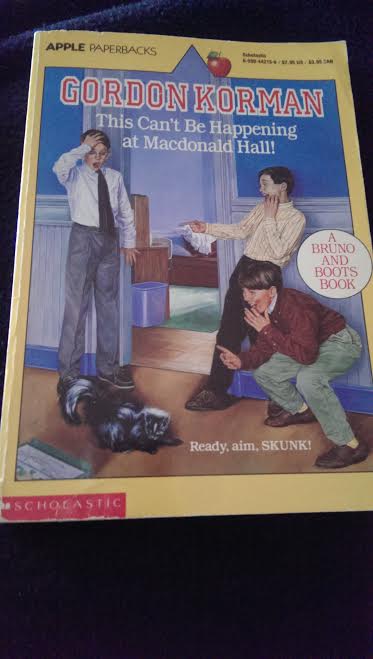
macdonaldhallThis Can’t Be Happening at MacDonald Hall by Gordon Korman, 1978.
Bruno and Melvin (called Boots) have been roommates ever since they began attending boarding school at MacDonald Hall.  The two of them are best friends, and they do everything together.  Quite a lot of what they do involves practical jokes.  But, they’ve really been pushing the limit with their antics, and when they go a little too far during a hockey game, the headmaster gives them the ultimate punishment: they can no longer share a room.  Mr. Sturgeon thinks that they’re a bad influence on each other.  Each of them is assigned to a new roommate, and they won’t even be able to hang out together.

The prospect of losing each other as best friends is too much for Bruno and Boots. Besides, neither of them likes their new roommates.  Boots has to share a room with George, who comes from a wealthy family and is only interested in money.  George is also a germophobe who hates it that Boots sneezes every morning when he wakes up.  Bruno’s new roommate is Elmer, the school’s supreme science nerd.  Elmer isn’t happy about Bruno’s presence, either, because Bruno and his belongings take up valuable space that Elmer requires for his many projects.  Obviously, the situation is completely intolerable for everyone.

Bruno, the idea man of the duo, declares that he will find a way for him and Boots to become roommates again.  They meet secretly at night to discuss their plans.  The boys try every tactic they can think of.  They try making themselves completely obnoxious to their new roommates so that Mr. Sturgeon will have pity on them and give them their old room assignments.  They try framing George and Elmer for some outrageous pranks of their own so Mr. Sturgeon will think that they’re a bad influence on Bruno and Boots.  Bruno and Boots even try (as an extreme measure) behaving themselves!  What will finally work?

This is the first book in the MacDonald Hall Series (or Bruno and Boots) series.  It is currently available online through Internet Archive.

Cranberry Thanksgiving

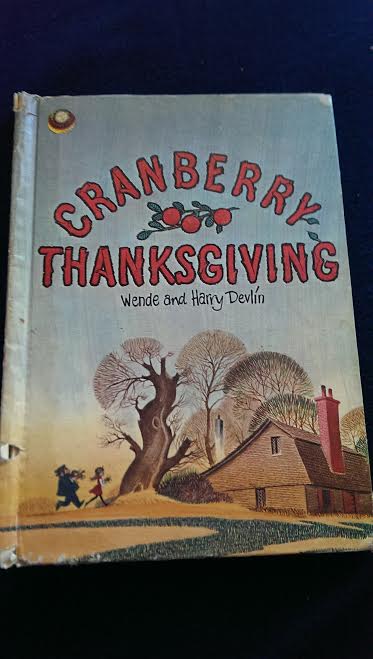
cranberrythanksgivingCranberry Thanksgiving by Wende and Harry Devlin, 1971.

Maggie and her grandmother like to invite friends to spend Thanksgiving with them.  Grandmother always tells Maggie to invite someone who doesn’t have anyone else to spend the holiday with.  This year, Grandmother has invited Mr. Horace, a pleasant man with an elegant manner staying at the local hotel.  Maggie has invited Mr. Whiskers, a friendly but somewhat scruffy sailor who has been on his own for years.

Grandmother has never really approved of Maggie’s friendship with Mr. Whiskers (whose real name is Uriah Peabody, but is called Mr. Whiskers because of his long, busy beard).  Mr. Whiskers’s unkempt appearance and lack of refinement have always bothered her.  She also suspects Mr. Whiskers of wanting to steal the secret recipe for her famous cranberry bread because he often shows up when she’s making it.  Some people have offered her a great deal of money for her recipe, but she insists that it’s a family secret that she’s leaving to Maggie.  Still, Mr. Whiskers has been a good friend to Maggie, so she allows him to come to Thanksgiving dinner.

As it happens, someone is out to steal Grandmother’s recipe, but not the person that she suspects.  It’s a nice holiday story about how appearances can be deceptive and real friendship is shown through honest behavior.

This book is part of a series, and like all the other books in the series, there is a recipe in the back.  The recipe in this book is for Grandmother’s Famous Cranberry Bread.

Sarah Morton’s Day

sarahmortonSarah Morton’s Day: A Day in the Life of a Pilgrim Girl by Kate Waters, 1989.

This book is part of a series of historical picture books. It features a young girl who was an historical interpreter at Plimoth Plantation, a living history museum, playing the part of a real pilgrim girl who lived in 17th century Plymouth.  The pilgrim girl’s name was Sarah Morton, and she was nine years old in 1627, the year that Plimoth Plantation reenacts.

As Sarah Morton, the girl takes readers through a typical day in her life.  She demonstrates the chores that a pilgrim girl would have to perform.  She explains the clothes that a pilgrim girl would wear and what people ate.  There is a recipe for 17th Century Indian Corn Bread, a simple recipe that readers can make at home, but it warns that modern people wouldn’t think that it tastes very good.  It’s basically just water and cornmeal grits.

sarahmortonpic1Although much of Sarah Morton’s day is taken up with chores, she also discusses her relationship with her mother and her new stepfather.  The death of a parent was something that pilgrim children often experienced.  After her father’s death, Sarah’s mother remarried, and Sarah is concerned about whether her new father likes her.

However, her stepfather is a good man who cares about her.  He gives her lessons in reading and writing, something that not every pilgrim girl would have.  He also gives her a special toy: a knicker box, which is a wooden box with arches for rolling marbles through as a game.  She gets to play with her friend, Elizabeth.

The two girls are also excited about a ship that has been sighted out at sea.  Soon, new people will be coming to their colony, and they wonder if the ship is also carrying letters from England or special goods that they would like, like a new bolt of cloth.

In the back of the book, there are sections explaining a little about the Plimoth Plantation living history museum, the real Sarah Morton, and the girl portraying Sarah Morton, Amelia Poole. The Plimoth Plantation site has more information about the real Sarah’s Morton’s life, including what happened to her when she grew up.  If you’re curious about what Amelia Poole is doing today, she is a fiber artist and lives in Maine.

The book is available to borrow and read for free online through Internet Archive.

sarahmortonpic2

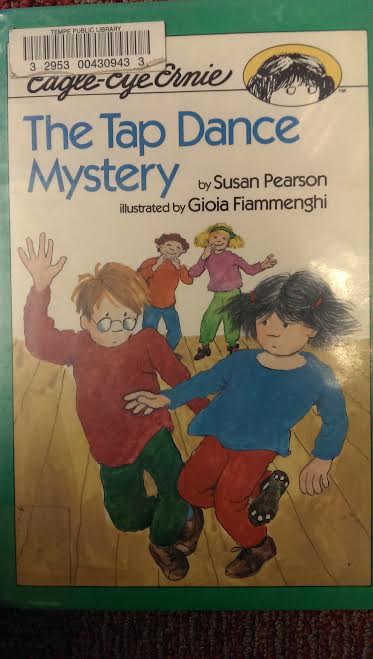
The Tap Dance Mystery

eeetapThe Tap Dance Mystery by Susan Pearson, 1990.

The kids in Ernie’s class are assigned to groups to plan different acts for the show that they will have when their parents visit the school on Parents’ Night. The Martians are assigned to different groups. R. T.’s group is going to do magic tricks. Michael’s group is going to pretend to be a music group from Jupiter and play different homemade instruments. Unfortunately, William and Ernie are in the same group as Marcie, a mean and bossy girl who always smells sticky and sweet, like Juicy Fruit gum.

Marcie convinces the others that their group should tap dance because she has been taking lessons and can teach the others. William and Ernie struggle to learn the steps and make homemade tap shoes by tacking washers onto the bottoms of their shoes. Jason, the fourth member of their group, really likes dancing and shows a lot of talent for learning the moves. Still, only Marcie really looks the part of a dancer in her fancy costume and beautiful tap shoes.

Several kids ask Marcie if they can try on her tap shoes, including Jason, but she refuses to let them. Every day, she hides her shoes in a different place in their classroom when she isn’t there to watch them. When the shoes disappear, Marcie is convinced that Jason took them, but he says he didn’t. Ernie believes him, but she has to hurry if she is going to find the shoes and clear his name before Parents’ Night.

The solution to this mystery is fairly simple, but the story also has some interesting insights into the reasons why Marcie acts the way she does and the effect that parents’ expectations can have on their children.

This is part of the Eagle-Eye Ernie series.  The book is available to borrow and read for free online through Internet Archive.

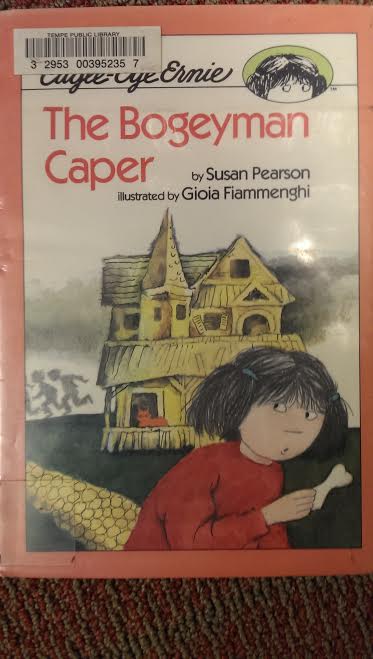
The Bogeyman Caper

eeebogeymanThe Bogeyman Caper by Susan Pearson, 1990.

This is part of the Eagle-Eye Ernie  mystery series.

Everyone says that the old yellow house in their town, White Bear Lake, Minnesota, is inhabited by a bogeyman, but Ernie doesn’t believe it. She decides to prove to her friends that there is no bogeyman in the old house.

Ernie finds ways for her and her friends to keep an eye on the house.  At first, all they see is a creepy-looking old cat. Then, William finds a strange bone in the yard, and Ernie sees a red glow inside and hears tapping sounds. Are her friends right about the bogeyman, or is there another explanation?

Ernie uses her powers of observation to determine that many of the spooky things about the house and its new owner are actually familiar, both to herself and her friends.

The book is available to borrow and read for free online through Internet Archive.

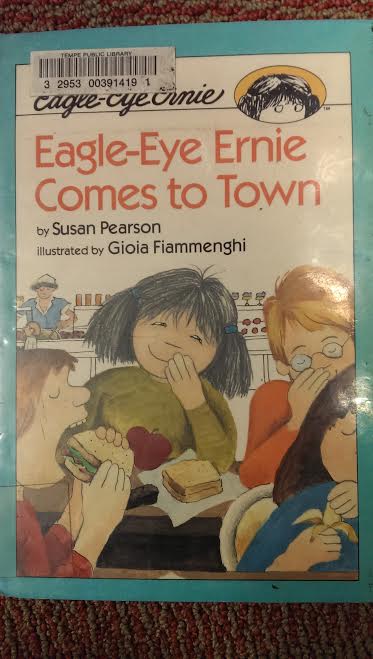
Eagle-Eye Ernie Comes to Town

eeetownEagle-Eye Ernie Comes to Town by Susan Pearson, 1990.

Ernestine Jones, better known as Ernie, is upset because her family has moved from Newport News, Virginia to White Bear Lake, Minnesota. She has no friends at school, and the other kids all think she’s strange and that she talks funny because of her southern accent.

Worse yet, someone has recently started stealing things from people’s lunches at school, and some of the kids think that Ernie might be the thief. Ernie has a knack for finding things, and her father says that she has an eagle eye. To save her reputation and any chance she might have of making friends, Ernie needs to use her eagle eye to find the thief so everyone will stop blaming her.

Ernie not only figures out who the real thief is but even helps the person find a solution to a bigger problem.

This is the first book in the Eagle-Eye Ernie series. The book is available to borrow and read for free online through Internet Archive.

My Reaction

The books are easy, beginning chapter books. The series starts with Ernie moving to her new town and making some new friends. These friends, William, Michael, and R.T. (Rachel) end up calling themselves the Martians because Michael is interested in outer space and likes calling everyone a Martian.

One of the cute parts of this book was when Ernie painted her saddle shoes to look like little bears in honor of “White Bear Lake.”  For a long time, this was the part of the story that I remembered best.

The Eleventh Hour

The Eleventh Hour by Graeme Base, 1989.

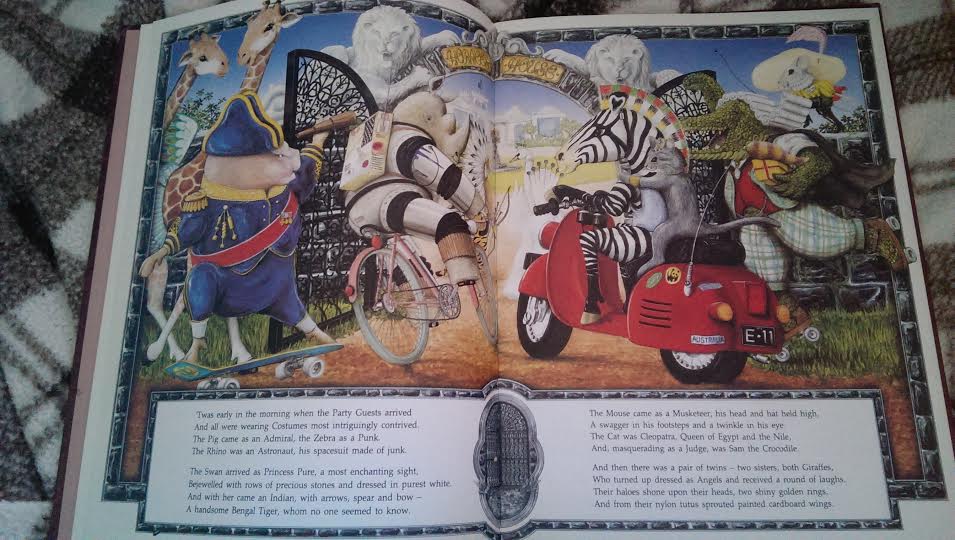
Horace the elephant is turning eleven years old, so he’s invited all of his animal friends to his house for a costume party.  The best part will be the extraordinary feast that Horace has created himself with all kinds of cakes and pastries and other desserts.

eleventhhourguests2

But, Horace refuses to let his friends eat any of the goodies until after they’ve played the party games. The guests have a lot of fun, but through all the games, they’re still thinking about that glorious feast. Only, when they finally go to eat, the food is all gone! Who could have taken it?

The book is available to borrow and read for free online through Internet Archive.

My Reaction

This picture book is actually a puzzle book, with puzzles difficult enough to even challenge adults.  Hidden within each of the large pictures taking up the entire page of each page in the book, are secret messages that hint at the identity of the thief, who is one of the party guests.  Some of the messages are in code.  Although a young child might enjoy the pictures in the book and the rhymes of the story, it would take someone older to be able to solve the puzzles.

There is a way to find the thief without finding the hidden messages or solving any codes, but it still requires attention to detail. There is a section in the back of the book that explains everything, pointing out all the secrets that you can find in the pictures, including the names of one of the giraffes and the swan, whose names are not given in the story itself.

But, don’t skip straight to the answers.  As Base himself says at the beginning to the section of answers, “the getting of wisdom is no match for the thrill of the chase, and those who choose the longer road shall reap their reward!”