Conrad’s Fate

Chrestomanci

Conrad’s Fate by Diana Wynne Jones, 2005.

This is the fifth book in the Chrestomanci series.  In this series, there are many different dimensions, and in each of those different dimensions, there is a copy of every person.  Different versions of our world can differ dramatically in their history across the dimensions, and individual people’s lives can differ dramatically between the dimensions. There is one person in each generation who has no duplicates in any of the other dimensions.  This person is called the Chrestomanci.  All of the talents, abilities, and lives that would have been spread across the other dimensions are now centered on that one person, giving that person, literally, nine lives.  The Chrestomanci fills an important role, being better able than anyone else to travel across the dimensions, and he acts to keep a balance between them and make sure that the different worlds keep their proper course.

Conrad lives in the 7 series of worlds in Chrestomanci’s universe. His family owns a bookshop. Well, technically, his Uncle Alfred owns the bookshop. He started it with Conrad’s father, but he says that Conrad’s father needed a large amount of money before his death, so he sold Alfred his half. When he was young, Conrad and his older sister, Anthea, imagined that their father probably lost a large amount of money at the casino. Conrad likes that idea because he’s a bit of a risk-taker himself and likes doing adventurous things, like rock climbing. Uncle Alfred tells them that they’re wrong about their father gambling. He says that he thinks that the aristocrats at the mysterious Stallery Mansion stole a large amount of money from their father. He doesn’t explain any more about how that happened, but he cautions Conrad not to be such a risk-taker because he has bad karma.

Conrad doesn’t understand what karma is, and his sister explains that karma is sort of like fate, but it’s the consequences of good or bad deeds committed in previous lives coming back to affect the present life. She thinks that the only way to clear bad karma is to correct for the misdeeds of the past. Conrad is intrigued and asks if it’s really possible for people to live more than once, but everybody else is busy with things they’re trying to do, and nobody will give him a straight answer. Conrad can’t help but wonder what this could all mean for his karma and his fate.

One day, while Conrad is looking for a book in the shop that is part of a series he’s been reading, he realizes that the books in the series have changed titles, and although he can tell that the basic stories are the same, some of the details are different. When Conrad asks his uncle about it, Uncle Alfred is very angry. He says that it’s the fault of the aristocrats at Stallery Mansion. Uncle Alfred explains that the aristocrats at Stallery Mansion make themselves richer by very literally playing the possibilities. They use powerful magic to evaluate different possible realities and make little shifts in the nature of reality itself to make things go the way they want them to go for their business interests, so they can turn bigger profits. The problem is that any little change in reality can have a ripple effect, changing many other details of life around them, from the titles of books to the color of everyone’s mailboxes. Not everyone notices these magical changes in reality because they use mind games to fool people into thinking that whatever changes they made were always like that. (It’s a weird combination of gaslighting and the Mandela Effect.) They also use powerful enchantments around their area to stop people from sensing what they’re doing, so powerful that they disrupt computers and television sets. Uncle Alfred is a magician himself, so he can tell what they’re doing, and he despises them for their manipulations.

However, Uncle Alfred is greedy and manipulative, too. Conrad discovers how greedy and manipulative he is after his sister leaves home to go to university. Both his mother and uncle are angry at her for leaving because she had been doing much of the work around the house and bookshop, and they had never had to pay her to do it. Anthea knows they’ve been taking advantage of her, and that’s the reason why she knows that she needs to leave and build a life of her own. Conrad misses her after she goes, and his uncle has to actually hire another girl and (gasp!) pay her to work for him. He frets constantly about how much it costs to actually pay someone wages in exchange for work. The other girl, Daisy, tells Conrad that his uncle isn’t hard up for money at all. The bookshop is very successful, and with what it brings in, Uncle Alfred could afford to pay her much better than he does. He just doesn’t want to do it because he’s so stingy. All of the money he brings in, he spends on himself. For the first time, Conrad becomes aware of how much money his uncle spends on fine port and tailored clothes. His mother is also two-faced, spending all of her time writing books about the oppression and subjugation of women while making Conrad do all the cooking in Anthea’s place. Conrad’s not very good at cooking, but his mother won’t cook anymore because she doesn’t want to be subjugated as a woman. She’s not above subjugating her own children for her benefit, though.

Conrad realizes that he has to use the techniques that Daisy uses to get his mother and uncle to stop exploiting him as badly as Anthea. He stops cooking and refuses to make any more food until his uncle agrees to give him things he wants as payment, like a bicycle. He notices that other kids at school get presents from parents without having to work for them or bargain for them, like he does, but he supposes that it’s all part of his bad karma.

Uncle Alfred has been blaming all of the changes that have taken place since Anthea left on Conrad’s bad karma. Conrad isn’t sure whether he lived a past life or not, since Anthea said that she didn’t believe in past lives, but since he keeps getting into trouble in various ways, he suspects that his karma might really be bad. He also starts blaming his bad karma for any accident he has (which all sound like perfectly ordinary accidents that could happen to anybody, really), and he starts feeling like maybe he deserves it all somehow for past sins. He asks his uncle what he could have done that could cause his karma to be bad. His uncle says he doesn’t know and that he’ll try to figure it out with magic.

When Conrad is getting old enough to go to high school, Conrad realizes that he’s going to have to use some kind of persuasion or negotiation to get his uncle to let him go on with his education. He wants to learn magic himself, but he knows that his uncle will probably want him to work in the bookshop for free, like Anthea did. His plan is to offer to work part time for his uncle in exchange for the money to attend high school with his friends when word spreads that Count Rudolph of Stallery Mansion has died. His heir is a 21-year-old man, and he only has a younger sister. People speculate that both of them will have to marry soon to ensure that their family line will continue. Sure enough, there is an announcement that the new count, Robert, will marry soon. People say that the old count’s wife is a controlling person and that she will control her son and his new wife, too. For some reason, the news upsets Uncle Alfred and his group of magicians.

Then, when it’s time for Conrad to leave his school and declare whether or not he’s going on to high school, his mother shocks him by telling him that he can’t go to high school because he already has a job at Stallery Mansion. Conrad demands that his Uncle Alfred explain what this job at Stallery Mansion is and why he signed him up for it. His Uncle Alfred says that he has learned through his magic that, in Conrad’s previous life, he was supposed to kill a wicked person, and he failed to do it, so this person continued their wickedness and has been reborn as an equally wicked person. Uncle Alfred says that this person’s current incarnation is someone at Stallery Mansion and that he got Conrad a job as a servant there so he can take care of the mission he failed to do in his previous life … to kill the person he is supposed to kill. Uncle Alfred says that this is the only way that Conrad can clear his bad karma and go on to live his own life. If he doesn’t, fate will take retribution on him by killing him before the year is out. Conrad isn’t sure whether to believe Uncle Alfred or not, but Uncle Alfred’s magician friends all say the same thing to Conrad, that they can read his bad karma and that it will hang over him and may kill him soon if he doesn’t clear it. As horrible as it is, twelve-year-old Conrad resigns himself to going to Stallery Mansion as a servant with a mission to kill some unknown evil person to save his own life.

When he goes for his interview at Stallery Mansion, Conrad is hired on as a page boy along with another boy, who is taller, handsomer, and very well-dressed. This other boy calls himself Christopher Smith, although Conrad is sure that “Smith” isn’t really his last name. At first, Conrad regards Christopher as a professional rival, but Christopher assures him that he isn’t interested in competing to move up the ranks of the servants. In fact, he admits that he is here for another purpose, and as soon as he’s found what he’s looking for, he will leave. Both Conrad and Christopher have their own intrigues.

Of course, Christopher is really Christopher Chant, who is currently in training to be the next Chrestomanci in his world. He is in Conrad’s world to find Millie, who has run away from boarding school because the other girls there were bullying her, and she didn’t feel like she was learning anything. Christopher had tried to tell their guardian, Gabriel DeWitt, who is the current Chrestomanci, that Millie was miserable, but he wouldn’t listen. After Millie disappeared, DeWitt still wouldn’t listen when Christopher tried to tell him that Millie was no longer in their world, so he went in search of her himself. He knows that she’s somewhere close, somewhere in Stallery Mansion, but he can’t find her, and he’s very worried. It feels like she’s trapped somewhere, but Christopher isn’t sure where.

Conrad is moved by Christopher’s story and offers to help him find Millie. Then, Christopher also witnesses the changes in reality that Conrad has seen and sees how someone at Stallery has been playing with probabilities. When Conrad confides in Christopher about his bad karma from a previous life, Christopher is sure that what his uncle told him isn’t true, no matter what his uncle and his uncle’s friends said. Together, Conrad and Christopher must confront the mysteries of Stallery: who is changing the nature of reality at Stallery and how, where is Millie and why can’t they find her, what is the truth about Conrad’s fate?

The book is available to borrow and read for free online through Internet Archive (multiple copies).

My Reaction and Spoilers

I really liked seeing young Christopher Chant in this adventure, while he’s still learning how to be the Chrestomanci. As an adult, Christopher is always very sure of himself and able to handle just about anything, but here, he’s still young and not always sure of himself. He has high self-confidence from knowing that he’s a powerful, nine-lived enchanter, but in this story, he runs up against things that he doesn’t completely know how to handle. He puts on a show of knowing what he’s doing, but both Conrad and Millie know that there are times when he’s just bluffing or muddling his way through.

I also enjoyed seeing Christopher’s relationship with Millie develop more. They were both children in The Lives of Christopher Chant, but they have known each other for years now. It’s pretty clear that Christopher has strong feelings for Millie from the way he desperately searches for her when she’s lost. Millie knows that he’s powerful, but she also knows his faults from growing up with him. She knows that there are times when he’s lazy and doesn’t want to bother learning something, so he just bluffs his way through. He’s also grown accustomed to getting his way with things. When Millie first told him that she was unhappy at school, he wanted to run away with her so they could live alone on an island together, and Millie realized that was a terrible idea. She likes Christopher, but she doesn’t want to live alone on an island or have him constantly dictating what they’re going to do. That was why she took matters into her own hands and ran away on her own. Since Christopher is a teenage boy, I can guess why he wants to be alone on an island with the girl he likes, and even Conrad realizes that Christopher is trying to be like a knight errant to Millie by single-handedly charging to her rescue. Christopher really does love Millie, and he’s trying to be her hero and help her in romantic ways.

Christopher is a little full of himself and still has some growing up to do, but both Conrad and Millie admit that they like him in spite of his faults. The fact that they know both his good and bad points and still like him makes their relationships with him stronger. Christopher’s faults, like his superior attitude and fussiness about his clothes are minor in the face of bigger issues. He’s on the side of good, where other people in the story definitely aren’t, and although he is powerful, he never abuses those powers. Millie respects Christopher, and he does his best to look after her. At the end of the story, Conrad says that Christopher and Millie are engaged to be married, and Christopher trusts Millie with the ring that contains one of his extra lives.

When Conrad and Christopher start working at Stallery Mansion, they both learn about the divided world of a wealthy mansion with servants, with areas where the family lives and the areas where the servants live, like that shown in Upstairs Downstairs, Gosford Park, and Downtown Abbey. The boys have to learn to make themselves unobtrusive, like they’re pieces of furniture, except when they’re needed to do something for the family. They also learn to be observant and to anticipate the needs of the people they serve. Conrad has some experience with housework and cooking from home, but when Christopher arrives, he has little or no idea how to do certain things because there are staff at Chrestomanci Castle to take care of the chores. Christopher isn’t exactly humbled by his time as a servant, but he does gain the experience of working a regular job and doing menial chores, like polishing shoes. It is a learning experience for him.

I thought it was pretty obvious from the beginning that Uncle Alfred and his friends were villains and that they made up the idea of Conrad’s bad karma to manipulate him into doing their bidding. Fortunately, both Christopher and Anthea help to convince Conrad of the truth before he does anything horrible. Anthea has also discovered that her father was the real owner of the bookshop, not their uncle, even has a half partner. When he died, he left it to their mother and to his children after her. Uncle Alfred has been using memory spells of his own to manipulate everyone into believing that he owns the bookshop. Anthea only realizes it after being away from his influence for a few years and meeting Conrad again at Stallery.

What Christopher realizes about Stallery Mansion is that it’s built on a probability fault, a place where several different probabilities happen to meet. The mansion keeps shifting between different probabilities, and the reason why they have trouble finding Millie is that she has gotten trapped in one particular probability. They can’t reach her until the mansion is in her particular probability. Part of the peculiar shifting of the mansion through probabilities seems to happen naturally because of its location, but both Christopher and Anthea realize that someone is helping it along. Unraveling the mystery of who is responsible reveals some further secrets about Conrad’s family and Conrad himself. Conrad has magical abilities and ends up receiving training from de Witt along with Christopher.

While Christopher and Millie learn a few things from their experiences, Gabriel de Witt also admits at the end of story that he has learned a few things about the way he was treating both of them. As their guardian, he takes his job of educating them and preparing them for the future seriously, something that he berates Conrad’s mother for neglecting for her own children. However, he confesses that he has neglected the emotional well-being of his wards and that he is partly responsible for them running away. When Millie complained about her school and Christopher told him off for ignoring Millie’s unhappiness, Gabriel brushed it off as teenage melodrama, but he later admits that he should have taken their complaints more seriously. After Millie ran away, he did what he should have done in the first place and went to the school to see the conditions there for himself, and he admits that Millie was right that it wasn’t a good school. He promises Millie that he will find her a better school where she can finish her education. He still makes it clear to Christopher that he was behaving like a hothead by running off himself and taking unnecessary risks, but the two of them eventually forgive one another. Later books show that Christopher and Millie still have respect and affection for Gabriel as adults. Gabriel de Witt isn’t always a perfect guardian and he doesn’t always understand young people, but he does care about his young wards and wants the best for them, which contrasts with the way Conrad’s mother and uncle were just using him and his sister with no thought to their well-being or future.

Mixed Magics

This book is part of the Chrestomanci series. Although most of the books in the series are longer novels, this book is a collection of four shorter stories, all set in the universe of Chrestomanci, where there are multiple dimensions with other worlds and series of worlds. The Chrestomanci is a powerful enchanter with nine lives (or, at least, he starts out with that many – he leads a dangerous life, or lives). The Chrestomanci’s job is sort of like the ultimate law enforcement for magic. He prevents the misuse of magic and stops evil magicians, especially ones who disrupt the balance between the worlds. The stories in this book focus on different characters, some of which were introduced in earlier books in the series. Of course, the Chrestomanci plays a part in every story. The book was published in 2000, but some of the stories were published in the 1980s in other sources.

I really like these stories because some of them clear up issues that were unresolved in other books in the series. Like Cat, I assumed that Christopher Chant became the Chrestomanci on the death of Gabriel DeWitt, his predecessor, who was introduced in The Lives of Christopher Chant. But, it turns out that Chrestomanci isn’t always a job for life. Gabriel DeWitt actually retired from the job and had years of happy retirement. One of the stories in this book shows Gabriel DeWitt at the end of his lives. He had several left at the end of his career, more than either Christopher Chant or Eric “Cat” Chant (who is Christopher Chant’s young cousin and the next nine-lived enchanter in line to be Chrestomanci) has now. (The Chants seem to have a tendency to lose lives faster than other Chrestomancis both because they are more reckless in their youth than DeWitt was and because their own relatives have either actively killed them more than once or put them in extreme danger for personal gain. They are a complicated family.) We get to see that even nine-lived enchanters don’t live much beyond the age their human bodies can manage. When they get very old, they repeatedly die of old age, over and over, until they use up the last of their remaining lives.

The book is available to borrow and read for free online through Internet Archive (multiple copies).

Following the adventures in Charmed Life, the Willing Warlock had his magical powers removed by Chrestomanci. With no way to pursue his usual work in magic, he turns to a life of crime. Unfortunately, he’s terrible at crime. He tries to steal a car and is almost caught by the police. He holds up a post office with a toy pistol and uses the money to pay a magician to send him to another world where he can have his magic again. When he reaches the new world, he can do magic again, and he attempts to continue his life of crime. It turns out that he isn’t any better at crime in the new world, though. He accidentally steals a car that also has a bossy little girl and an angry dog in it. There are some things that are worse than prison!

This book starts after the events in The Magicians of Caprona. Chrestomanci invited Tonino Montana to visit England and have some training at Chrestomanci Castle. However, Cat Chant and Tonino don’t get along when they first meet. Cat resents Chrestomanci making him responsible for Tonino, who is younger. His cousins and Janet think Tonino is nice, and Chrestomanci is interested in learning more about Tonino’s unique abilities. Cat knows that he has no real reason to resent Tonino, but he does because Tonino is now the center of everyone’s attention. As the next Chrestomanci and the youngest of the children who normally live at the castle, Cat has become accustomed to everyone paying attention to him and looking after him instead of the other way around. He doesn’t really want someone to be his responsibility.

It gets worse when Gabriel DeWitt, the former Chrestomanci, says that he wants to meet Tonino. The current Chrestomanci can’t go to see him just now, so he sends Cat to DeWitt with Tonino. Cat has met Gabriel DeWitt before, but he finds it difficult to talk to him because DeWitt is a very old man and an old-fashioned one, and Cat has to be on his very best behavior around him. When he first learned about being a Chrestomanci, Cat assumed that the new one didn’t take over until the previous one was dead, but Gabriel actually retired from the job when Christopher Chant’s training was complete, and he was ready to take over. However, now that Gabriel has gotten very old and sick, his remaining extra lives are leaving him as he repeatedly dies of old age. It’s alarming to Cat, who doesn’t want to watch him die. Yet, it’s important for Cat to see DeWitt one more time because DeWitt has something important to tell him.

DeWitt believes than an evil enchanter called Neville Spiderman is stalking him and that he’s trying to get hold of both Christopher’s and Cat’s extra lives. Everyone else thinks that DeWitt is imagining things because of his poor health. Neville Spiderman lived long before DeWitt himself, and everyone believes that he’s dead. DeWitt insists that Neville Spiderman has the ability to travel through time and tells the boys to warn Christopher of the danger.

However, as the boys take the train back to Chrestomanci Castle, their memories suddenly leave them. They become confused about exactly who they are and where they are going. All Cat remembers is that he’s supposed to look after Tonino. A stranger takes charge of them and delivers the boys to a strange house in London, where they are told that they are apprentices who have just arrived from the poor house.

The owner of this house is Neville Spiderman, who tells them that his workshop exists outside of normal time. He has managed to keep himself alive much longer than a normal person, and he is working on a spell to turn himself into a ten-lived enchanter in an attempt to become more powerful than any Chrestomanci. Part of the trouble is that he needs to know which of the boys is Eric Chant, and with their memories affected, neither of the boys is entirely sure, either. They can tell that they’re in danger and that Spiderman is planning to kill one or both of them. Spiderman needs two more souls from nine-lived enchanters to complete his collection. All that Cat remembers for certain is that he’s supposed to look after Tonino as the boys struggle to remember who they are and how to use their powers.

In this story, we learn that Tonino’s mother, Elizabeth, who was originally from England, was one of the children with magical abilities who were brought to Chrestomanci Castle to study and act as companions to Christopher Chant, the current Chrestomanci, at the end of The Lives of Christopher Chant. We also see Mordecai and Rosalie, two other characters from that book.

Although Carol Oneir is young, she is already famous for her dreams. She has the ability to control her dreams and make it possible for wizards to bottle her dreams and sell them for other people to enjoy. Then, on the night when she is about to have her 100th dream, she is unable to do it. Days go by, and she cannot seem to dream at all. Carol is very upset, but the doctors can’t seem to find anything wrong with her. Carol’s father is an old school friend of Chrestomanci’s, so he asks Chrestomanci if he can help Carol. After the adventure in the previous story, Chrestomanci is vacationing in the south of France with his family, and he asks his old friend and his wife to bring Carol to him there.

When Chrestomanci insists on talking to Carol alone, he discusses her methods for dreaming and her past dreams, evaluating them like a reviewer would a series of books. In a way, that’s what Carol’s dreams are, like stories or books meant to be enjoyed by other people while they sleep. Chrestomanci realizes that part of Carol’s problem is that she’s too self-conscious. Her dreams have all been made public, her mother constantly monitors her and urges on her success, and she is often interviewed for newspapers for details of her life. There are some private thoughts that Carol has had that she can’t bring herself to tell anyone, and something is happening in her 100th dream that she can’t even bring herself to tell herself.

When Carol tries to dream once more, she learns that all of the characters in her dreams are on strike. Her characters are angry with her for their living and working conditions. They get no time off, some of them get killed off in her dreams, her main hero and heroine don’t really want to marry each other, and none of them get credit or compensation for their work. Carol has completely misunderstood her characters. She has underestimated how real they are, and she has cast them in the wrong roles, ones that are really unsuited to their true personalities. They all need some time to be themselves and relax between story dreams. When it comes right down to it, so does Carol. She’s as much in a rut as her characters, and she also needs some time to develop her own personality and understanding of other people and to come up with new story concepts. Everyone needs a vacation and some privacy sometimes.

Carol’s characters drink alcohol in this story, something that shocks Carol herself because she never allows them to do that in the course of her dreams. Her dreams are meant primarily for girls her age, so they’re age-appropriate, but the alcohol use is part of the characters showing Carol that they have their own independent personalities and need time to themselves to do more adult things outside the setting of her dream stories.

The world of Theare is extremely orderly. Even their heaven and gods are very precise, with everyone knowing their rule and following detailed rules. Then, one day, the gods learn that the prophesied Sage of Dissolution has been born! According to the prophecy, this Sage will question everything and break down the order of this carefully-ordered world. The gods are fearful of the chaos this will bring, so they decide that they must put a stop to it by finding and killing the Sage before he can grow up and start asking his questions.

I’ve always found the different ways fantasy books approach the subject of religion interesting. Some fantasy authors try to ignore the issue altogether because they don’t want religious beliefs to disrupt the fantasy elements or change the way people look at them. Others try to invent or adopt religions that match the fantasy elements. The universe of Chrestomanci is based on the concepts of parallel worlds, different dimensions, and alternate realities, which leaves quite a lot of possibilities open. Religion or religious concepts enter into all or most of the books at some point. There’s a world that’s supposed to be “our” world, where things work like they do in real life, and Chrestomanci’s related world, where the religions that we know exist alongside magic, accepted as normal by their society. There are churches and cathedrals and clergy, and Chrestomanci himself seems to be a Christian, as established in earlier books. He attends church and is friendly with clergy members. When he was younger, he once thought that his mother might want him to grow up and become a missionary because of the way she talked about missionaries, and he says that he doesn’t believe in the “heathen” gods and goddesses of other worlds, initially not even believing that the girl he ends up marrying is really the avatar of a goddess in the world where she was born. It was eventually proved in The Lives of Christopher Chant that the goddess was real, at least within that particular world, although that story kind of hints that much of the magic Millie did was her own magic as a powerful enchantress, not necessarily the goddess’s. I’m still not sure whether Millie is still supposed to be one of the goddess’s incarnations or not, but since she’s living an independent life in another world now, it no longer seems to matter, except that her magic is very powerful. In this story, Christopher Chant, regardless of what his inner beliefs are, is not afraid to tell actual gods what he thinks of their plans when they’re in the wrong.

This particular story establishes the idea that, in this universe, religion and heaven and gods or goddesses are all individual to each individual world. Each world has its own Heaven and at least one god or goddess, and these are distinct from those in other worlds, so what’s true about each of these varies depending on the world where the story is set. (There may not be an over-arching God of the entire universe in this fictional universe, or if there is, there is no explanation of that.) In this particular story, all the religious rules point to order, and the gods themselves love rules. They are terrified of the concepts of disorder and chaos. However, when they decide that they’re going to eliminate the Sage of Dissolution, they have a problem. They’re not really sure which of the worlds he’s in or where exactly he will be asking all of his questions. They search and search, but they can’t seem to find him.

Then, one of the gods, Imperion, takes a break and visits the mortal woman he loves, Nestara. He is devoted and faithful to her, and he loves the small son they already have, Thasper. Thasper was very slow to learn to speak, but now that he has … he has started asking questions. To his shock, Imperion realizes that Thasper is the Sage of Dissolution. It’s just that nobody realized it until he gained enough ability to speak to start asking his questions. Imperion can’t bring himself to kill his own son, so he decides to take him to another world, out of the reach of the other gods. He tells Nestara that the other gods have approved of making Thasper a god, too, and he must take him to be the cupbearer of the Great Zond, the highest god. He puts Thasper into a sphere of forgetfulness to make him stop asking questions and makes sure to take Thasper to a world with kind people who will raise him. When he admits to the other gods what he’s done, they are satisfied that the problem of the Sage is settled and that he will not interfere with their orderliness.

Thasper spends several years in his sphere of forgetfulness, not aging, but when someone finds him, the spell ends. As soon as he is out of the sphere, he starts asking questions again. The people of this world don’t mind answering his questions, but they can tell that he’s not from their world. After a little experiment, they figure out that he is from Theare and that he was probably sent to their world because someone found him too disruptive. They return him to Theare and, through magic, convince a woman who has just lost her own son, that Thasper is her son. She and her husband take him in and raise him. He still pesters everyone with questions, and his new mother does her best to answer them.

Then, one day, Thasper receives a message from Chrestomanci (delivered by Cat, who is starting to travel through other worlds as part of his Chrestomanci training), who tells him that his situation is an odd one and that he should call him when he finally meets himself face-to-face. Thasper doesn’t know what means at first. For several years, Thasper develops a fascination for the rules of his world. Rules make an interesting intellectual exercise, and Thasper enjoys thinking about them and making up new games with new rules, the more complicated, the better. Then, Thasper begins seeing messages around town that ask questions and make him think about rules in new ways. All of the messages are signed the Sage of Dissolution. Fascinated, Thasper keeps trying to meet up with the Sage of Dissolution and see him in person, but it seems like he always just misses him. He is going to need Chrestomanci’s help to catch up with himself! At that point, Chrestomanci tells the gods how they would have brought about their own end if they had succeeded in defeating their own prophecy. Of course, seeing the gods for himself answers some of Thasper’s questions, but he can still ask others.

Mr. Pine’s Purple House

Mr. Pine lives in a little white house. All of the houses on Vine Street are white, and they look completely identical. Mr. Pine thinks that he’d like to do something that will make his house different from all the other little white houses.

His first idea is to plant a pine tree in his front yard. Since his name is Pine, everyone seeing it will think of him, and his house will be different from everyone else’s. The problem is that all of his neighbors like his pine tree and decide to plant their own trees. Soon, all of the houses look alike again with pine trees in the yards.

To make his house look different, Mr. Pine tries to plant a bush next to his tree, but everybody likes that idea, too. Soon, everybody has both a bush and a pine tree in their yard, and the houses look identical again.

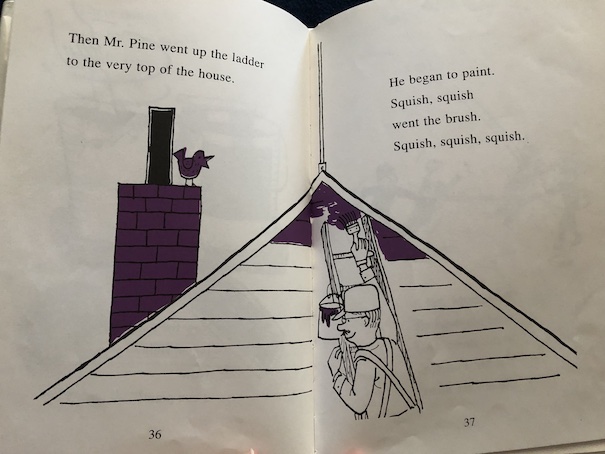
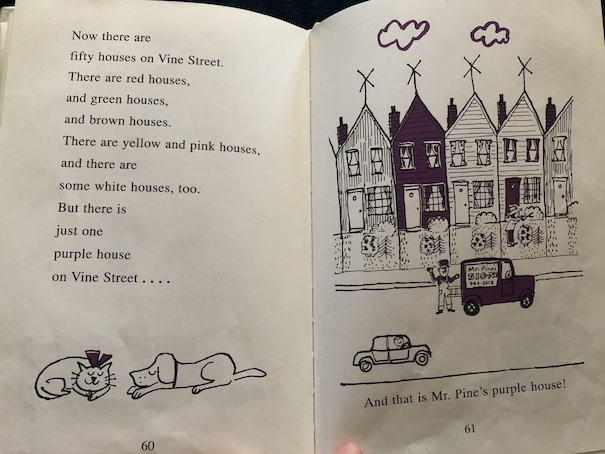
Mr. Pine tries to think of something that he can do with his house that his neighbors won’t imitate. He gets the idea of painting his house, but he can’t pick any obvious color that all of his neighbors will want, too. He decides to paint his house purple. Is this finally the idea that will make Mr. Pine’s house different from the rest?

This book is actually the second book in a series of picture books about Mr. Pine.

I often think of this book and The Big Orange Splot together because they’re both about people in a neighborhood of identical houses who make changes to distinguish themselves and their houses and end up changing the way their neighbors view their own homes. The difference between the books is that, in The Big Orange Splot, the neighbors were completely opposed to changes that made anyone’s house different until they began to see the opportunities for living out their own dreams through their homes. In this book, the neighbors immediately seize on everything that Mr. Pine does that’s different and start copying him. They think all of his changes are great and frustrate his efforts to be different by doing everything he does until they decide to all paint their houses different colors. Of course, Mr. Pine’s changes are all less outlandish than the ones from The Big Orange Splot, so they would be easier to accept.

I liked it that Mr. Pine’s neighbors all have colors for names: Mrs. Gray, Mr. Gold, Mrs. Green, Mrs. Brown, and Mrs. White, and all the colors they eventually pick for their houses are different from the colors in their names. Even though this book mentions a lot of colors, the only colors shown in the pictures are black, white, and purple. In the end, when the houses are all different, the differences in color are shown with lines providing shading rather than with actual colors. It still works to show that the houses are now different from each other.

The Big Orange Splot

The Big Orange Splot by Daniel Manus Pinkwater, 1977.

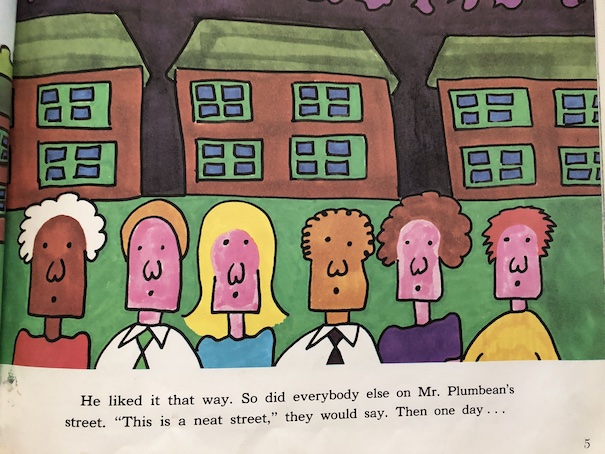
Mr. Plumbean lives in a neighborhood where all the houses look alike. He and his neighbors all think of the uniformity as making their street “neat” and tidy, and they appreciate it. Then, something happens that makes them reconsider.

For reasons that nobody ever understands, a seagull carrying a can of orange paint happens to fly over Mr. Plumbean’s house and drops the can, leaving a big orange splot on Mr. Plumbean’s roof. Mr. Plumbean realizes that the big orange splot means that he’ll have to repaint his house, but the painting project makes him think.

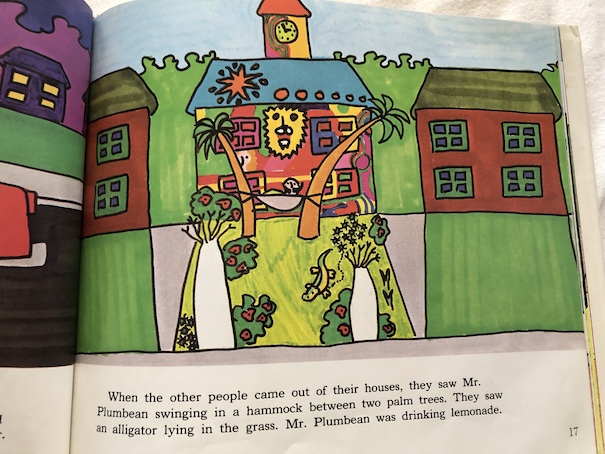
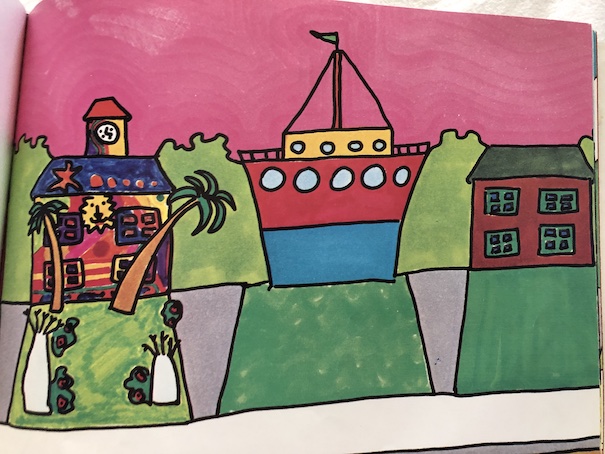
Instead of painting his house to look like everyone else’s, the way it was before, he gets a bunch of wild colors and turns the exterior of his house into a rainbow explosion, working around the big, orange splot on his roof! He adds paintings of animals and other things he likes and colorful patterns. It’s such a wild and crazy design that his neighbors think he went mad. Before long, he adds a clock tower onto his house and an alligator and some trees with a hammock in the front yard.

The neighbors think he’s gone too far, but Mr. Plumbean says, “My house is me and I am it. My house is where I like to be and it looks like all my dreams.”

One of Mr. Plumbean’s neighbors tries to talk some sense into him, but instead, Mr. Plumbean talks to him about his dreams. The next day, the man goes out to buy some building supplies. It turns out that he always loved ships, so he turns his house into the ship of his dreams!

With Mr. Plumbean’s encouragement, other neighbors also start to change their homes to reflect their dreams, changing their quiet, “neat” street into a magical wonderland of imagination!

The book is available to borrow and read for free online through Internet Archive (multiple copies).

My Reaction

I remember this book from when I was a kid, and I always liked the pictures! It’s fun to imagine all the creative themes a house could have and what you might choose if you had the opportunity to live in a house that could look like anything you wanted. The houses shown in the pictures of the neighborhood end up looking nothing like their original shapes, except for Mr. Plumbean’s house, oddly. The others are vastly different from their original shapes, and the windows aren’t even in the same places, making them look like they’ve been completely rebuilt. This level of renovation would be difficult and costly in real life, but this story is meant to be fun and to celebrate imagination and the capacity people have to add a touch of color to their lives. If you read this book with a child, you can invite them to decide which of the house was their favorite at the end (mine was the one that looked like a castle) or what they would do if they could make their house look like anything they want.

In real life, I’ve never particularly liked those neighborhoods where all the houses look alike. I’m not the only one because tract homes and uniform suburbs were controversial from their beginnings in the mid-20th century. In the early 1960s, a song called Little Boxes (listen to it on YouTube) poked fun at the uniformity of suburban houses and the lives of the people in them (although the houses in that song were still different colors – just saying). The connection between the uniformity of homes and the conformity of the people living in them is a topic that resurfaces periodically in popular culture and other songs, like “Subdivisions” by Rush (listen to it on YouTube).

The themes of non-conformity and self-expression are pretty profound, but the story is lots of fun and isn’t too deep for kids. If you read the back section about the author, it explains that the inspiration for this story came from a time when he spilled orange ink on his own pair of new yellow boots.

This picture book is a fun story about non-conformity and self-expression. In the beginning, Mr. Plumbean is as content as anyone with his neat, uniform neighborhood until a strange, inexplicable accident creates a situation where Mr. Plumbean has to paint his house. Once he’s confronted with the task of repainting his house, Mr. Plumbean begins to consider the creative opportunities this chore provides, and he enjoys exploring the possibilities and changing his house to be more of a reflection of the wild and wacky person he really is or dreams of being. Once his creative side is unleashed, it begins to get his neighbors thinking along similar lines. True, they liked it when their street was neat and uniform because they could see the appeal of having things orderly, but it turns out that each of them also has an inner creative side that’s been waiting for a chance to get out. The non-uniformity and non-conformity of their street becomes more comfortable for each of them as they each embrace those sides to their personalities that they don’t normally show. When they come to accept and embrace their own dreams and each other’s, it doesn’t matter to them anymore that they’re not all alike. They’re comfortable with the wacky and whimsical parts of their personalities, and they’re not afraid to show them anymore. They’re happy with themselves, their homes, and their different visions.

I really liked the art style of the illustrations in the book. It’s very simple but colorful, and you can tell that the artist used markers because you can see the marker lines, especially in the backgrounds of the drawings. It makes it different from more modern books that use digital art. I like seeing signs of the physical materials used, and it gives the story a funky, organic feel that goes well with the theme.

As I said earlier, I did notice that many of the new home designs in the pictures don’t take into account where the houses’ windows used to be, but that’s just part of the whimsy of the story. We don’t need to worry about how these people accomplished these drastic changes so quickly and easily. It’s just fun to think about how you can personalize your space to reflect what’s important to you.

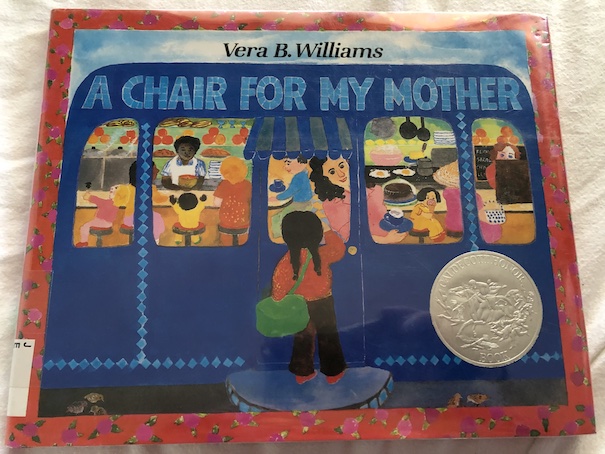
A Chair for My Mother

A girl explains how her family is saving up for a new chair after a fire destroyed all the furniture in their old home. The fire happened before the story really begins, but the girl explains how she and her mother returned from a shopping trip and discovered that their home was on fire.

The girl’s grandmother and the family cat escaped from the fire, but everything they had in the house burned.

The girl, her mother, and her grandmother all moved in with the girl’s aunt and uncle until they could move into a new apartment. However, they didn’t have any furniture in the apartment. Their relatives, friends, and neighbors all helped them by giving them food and pieces of furniture they didn’t need anymore.

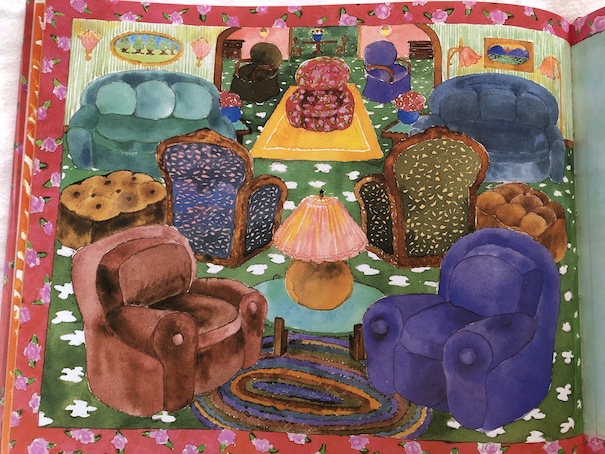
It was a big help, however, a year later, they still don’t have a sofa or comfortable armchairs. The girl’s mother works in a restaurant, and when she comes home, she’s very tired from being on her feet all day. She wishes that they had a comfortable armchair where she could rest after work.

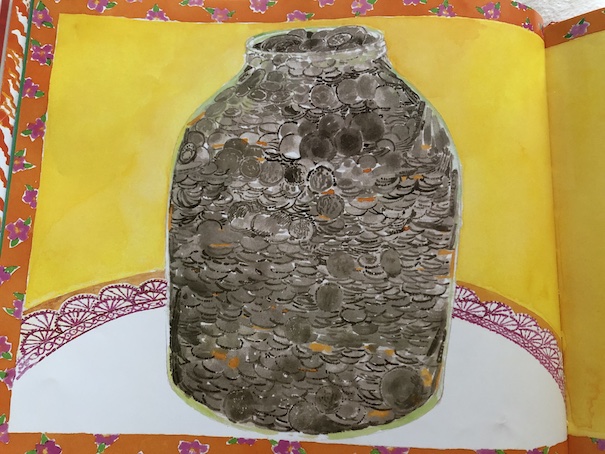
The mother starts saving part of her tips from the restaurant in a coin jar to save up for a new chair. Sometimes, the restaurant owner even pays the girl to do little chores, and she saves part of her money for the chair. Whenever the girl’s grandmother saves money on food she buys, she also puts the savings into the jar. They say that when the jar is full of coins, they will buy the new chair they want.

Eventually, the jar is completely full. They count the coins, roll them in coin wrappers, and take them to the bank to change them for ten-dollar bills. Then, they go shopping for a new chair! There are many chairs to choose from, but they know exactly what kind of chair they want.

The book is a Caldecott Honor Book. It’s available to borrow and read for free online through Internet Archive (multiple copies, including one in Spanish).

I remember this book from Reading Rainbow when I was a kid! The pictures are bright and colorful, and the story offers comfort and hope.

The people in the story have been through a tragedy where they lost almost everything they had, but the book shows how they recover. Although the fire was sad, the story starts after the fire happened, and the girl talks about the help they’ve received and what they’re doing to make their new home more comfortable. They’re over the initial shock of the fire and concentrating on improving their situation from there. This book felt both comforting and very real. I liked how it showed the family recovering from their ordeal through a combination of help from relatives and friends and their own efforts. Other people help them with some basic household items as they move into a new apartment, and they also save up their money for the chair they want to make their new place feel more like home.

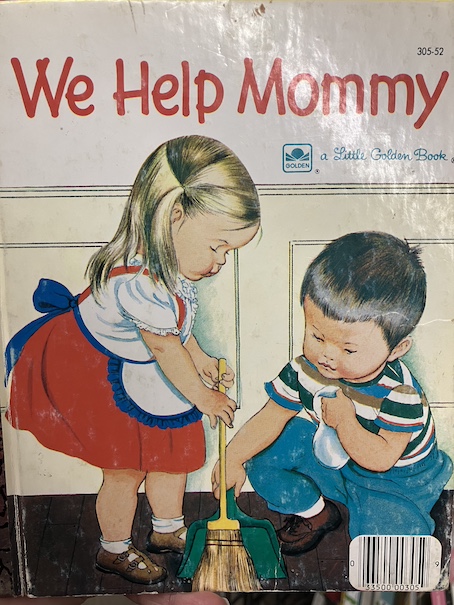
We Help Mommy

In this classic Little Golden Book, two small children help their mother with various household chores throughout the day. There is a note in the beginning of the book that says that the children in the story are based on the author’s own children, Martha and Bobby, but the children shown in the pictures are based on two other children, who were asked to pose by the illustrator.

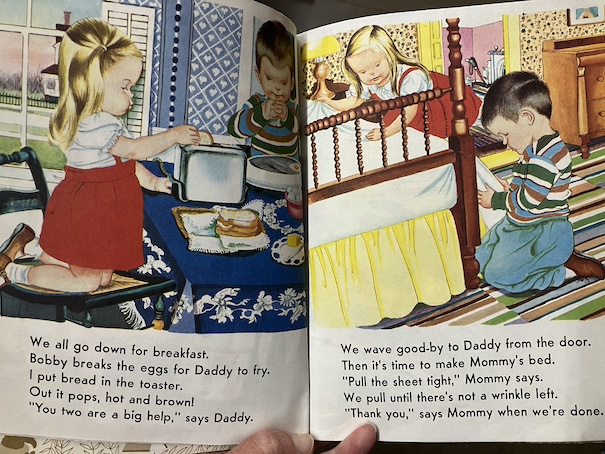
When the two little children in the story get up in the morning, the first thing they do is change from their pajamas into their clothes for the day. Sometimes, they need a little help from their mother because they’re still little. Then, they go downstairs and start making breakfast.

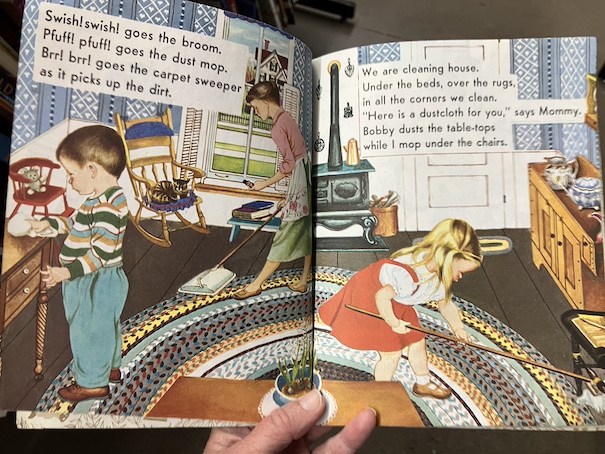
After their father leaves for work, they help make their parents’ bed. Then, they dust furniture and sweep the floors and put their clothes in the washing machine. Martha hangs her doll’s clothes up on a small clothesline, while her mother hangs up the family’s clothes on the high one. The children go to play with some friends next door.

Sometimes, the children go to the supermarket with their mother to buy groceries. When they get home, they put the groceries away and make lunch.

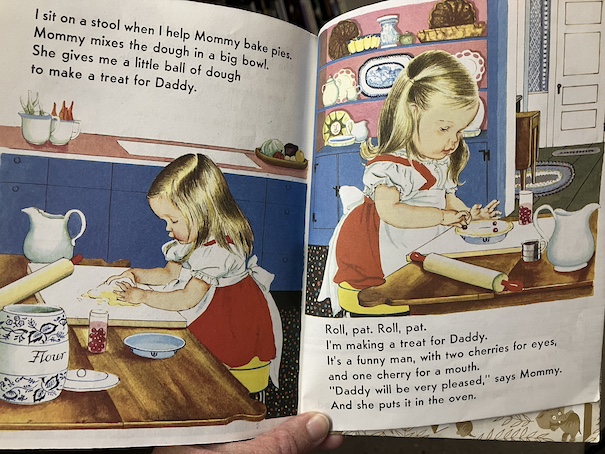
After lunch, they wash their dishes, and Martha makes a special little pie for their father for dessert.

At the end of the day, the children put away their toys. Their father comes to tuck them in when it’s time for bed, and he thanks Martha for the pie and both of the children for helping their parents.

The book is available to borrow and read for free online through Internet Archive.

I remember reading this book with my mother when I was a little kid in the 1980s. It’s just a cute, simple book for young children about helping their mother with daily chores. We still sometimes quote the line from this book, “Napkins for us all” when we set the table because, for some reason, that stuck in all of our minds and just got repeated for years.

At the time, I was too little to think about what year the story is from, and there was nothing in the book that was too seriously out of line with my experiences as a little kid. You can tell by the pictures that it’s from an earlier decade because of the family’s clothes and hair styles (particularly the parents), and the carpet sweeper the mother uses is older than I am. However, I have to admit that my parents still had one of those types of carpet sweepers in the 1980s, so I knew what it was when I saw it in the picture. They hang their clothes up to dry instead of using a clothes drier, but even that isn’t too far out of line because, even today, some people prefer to dry their clothes on a clothesline. In fact, there are 21st century people who consider it more environmentally friendly. The style of the clothesline they use is very mid-20th century, but my grandmother had one like that in the 1980s, too, so I had seen it before. Some of the things I was familiar with as a young child were hold-overs from previous decades, just like this book. Modern children might not be as familiar with some of these things, but this book is such a simple story about small children helping with daily chores that I think even 21st century children would understand it, even if it looks a little old-fashioned in some respects.
When I was a kid, I missed the part at the very beginning of the book about the children in the story being based on the author’s children, but I found it interesting when I looked at the book again as an adult. There is another Little Golden Book called We Help Daddy, which we also had when we were little kids. The two books read a little like companion books and were illustrated by the same illustrator, although We Help Daddy was written by a different author and features a different brother and sister. In We Help Mommy, the children mostly help their mother with chores around the house and buying and preparing food. In We Help Daddy, two kids help their father with yard chores, which somewhat shows how people in the mid-20th century typically expected domestic chores to be divided: the mother doing work inside the house and related to cooking, while the father mostly tends to chores outside the house. I don’t think this is a problem because, when the two books are taken together, both parents are still helping out and spending time with the children, but I thought it was interesting to notice that dynamic as an adult.
One of the things the mother and children buy at the grocery store in this book is a picture book. I didn’t understand that part as a little kid, but as an adult who studies and collects children’s books, I know that this is a reference to Little Golden Books because they were often sold at grocery stores, making them accessible to many families as inexpensive books for young children, sold where families would normally shop anyway. In fact, if you look closely at the cover of the Little Golden Book that the boy is taking out of the shopping cart, you can tell that it’s specifically Kittens: Three Complete Stories.

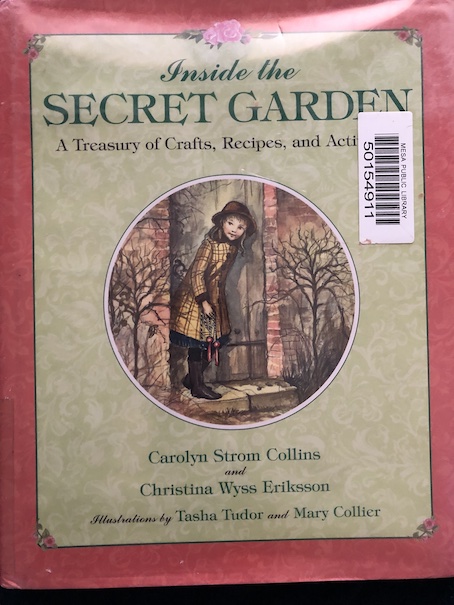
Inside the Secret Garden

Inside the Secret Garden by Carolyn Strom Collins and Christina Wyss Eriksson with illustrations by Tasha Tudor and Mary Collier, 2001.

This is a how-to book with activities, crafts, and recipes that fit the themes in the classic children’s book The Secret Garden by Frances Hodgson Burnett. The book has some of the classic illustrations from The Secret Garden by Tasha Tudor, and there are also illustrations by Mary Collier.

The book begins with an explanation of the story of The Secret Garden and the life of Frances Hodgson Burnett. In the description of the author’s life, the book discusses some of the places where she lived and people she knew who provided inspiration for aspects of the story of The Secret Garden. There is also a timeline of world events during the author’s lifetime.

The second chapter describes the setting of the story with descriptions of Misselthwaite Manor and its gardens. It explains how a large manor house like Misselthwaite would function and the types of staff and servants it would have. It also explains the types of gardens and plants that would have been grown in the kitchen gardens of English manors and cottages.

The third chapter in the book has recipes and menus based on the foods the characters eat during the story. Food is important in The Secret Garden because Mary and Colin didn’t have appetites when they were unhealthy, but after their time working in the garden and getting fresh air and exercise, their appetites improved. The recipes in the book are based on things the characters eat during the story.

  • A pot of tea
  • Porridge (oatmeal)
  • Treacle (They use molasses with corn syrup and honey to make it.)
  • Orange marmalade
  • Homemade bread
  • Snow-white eggs (soft boiled)
  • Raspberry jam
  • Clotted cream
  • Muffins
  • Ham
  • Oatcakes
  • Doughcakes
  • Apple Crumble
  • Crumpets
  • Robin cake
  • Roasted eggs (The instructions call for cooking them in an outdoor stone oven, like they did in the book, but it also discusses how to make an indoor version.)
  • Roasted potatoes (The instructions call for cooking them in an outdoor stone oven, but it also discusses how to make an indoor version in a standard oven.)
  • Currant buns

A book of activities based on The Secret Garden wouldn’t be complete without gardening activities! The fourth chapter has suggestions for creating your own garden. The gardening tips and suggestions are based on the plants the characters used in The Secret Garden. I’m not sure all of them would grow well in every climate, and planting seasons can vary by region.

  • Planting a spring bulb garden
  • Planting a rose in a flowerpot
  • Making an indoor “secret garden” with potted plants in a tray or pa

The fifth chapter has a selection of crafts and activities related gardening. They include things you can make to use in your garden and things you can make our of plants from the garden, including:

  • A twig tool holder
  • Plant labels (little signs for labeling plants in your garden)
  • Moss-covered flower urns
  • Key wind chimes
  • A planter in a watering can
  • A twig trellis
  • Pressed flowers and a pressed flower scrapbook
  • A bouquet of roses
  • A topiary flower arrangement
  • A miniature arrangement
  • A bird feeder
  • A bird bath
  • Nest-building station

It also explains how to make your own skipping rope, like the one Mary had in the book, and there is a section of traditional jump rope rhymes.

The book is available to borrow and read for free online through Internet Archive.

My Reaction

I liked the chapters about the history of The Secret Garden and the life of Frances Hodgson Burnett. I thought it was interesting to see some of what inspired her to write the story. I particularly like the chapter that describes how a manor like Misselthwaite would be run because I like seeing the historical background to stories.

I don’t think that the gardening tips are really universal. I grew up in Arizona, and I know from personal experience that plants and gardening techniques that would work well in cooler and wetter climates don’t work as well in a hot, dry desert climate. However, some of the garden-related crafts looked intriguing. I particularly like the idea of the wind chime that uses old keys as the chimes. I’ve seen antique stores and places that sell crafting supplies that also sell old keys, so know it’s possible to get them.

I like the selection of recipes the book provides, and I think most of them would be pretty easy to make. The most difficult ones are probably roasted eggs and roasted potatoes because they require an outdoor oven, like the kind the characters in The Secret Garden used. The book briefly describes how to make the kind of outdoor stone oven they mean, but I don’t think that kind of oven can be built just anywhere. It’s more for camping and the countryside, where you can safely have fire pits away from buildings. Fortunately, the book also includes instructions for making those dishes inside, in a standard kitchen.

The Secret Garden Cookbook

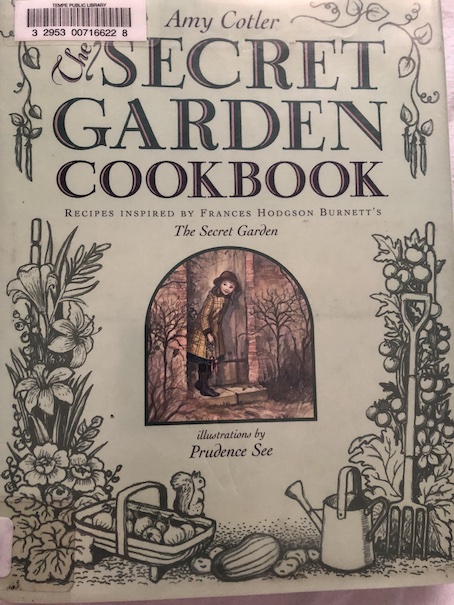
The Secret Garden Cookbook: Recipes Inspired by Frances Hodgson Burnett’s The Secret Garden by Amy Cotler, illustrations by Prudence See, 1999.

This book is a cookbook with recipes based on the types of foods eaten by characters in The Secret Garden by Frances Hodgson Burnett. Food is important in the story because Mary and Collin didn’t have any appetites when they were unhappy and unhealthy, but their appetites improve when they begin working in the garden and getting more fresh air and exercise. Most of the recipes are types of foods that are specifically named during the course of the story, but others are ones that the characters would have been likely to eat for the time and places where they lived. Because the original story focused on gardening, there is also an emphasis on using foods that would be grown in kitchen gardens

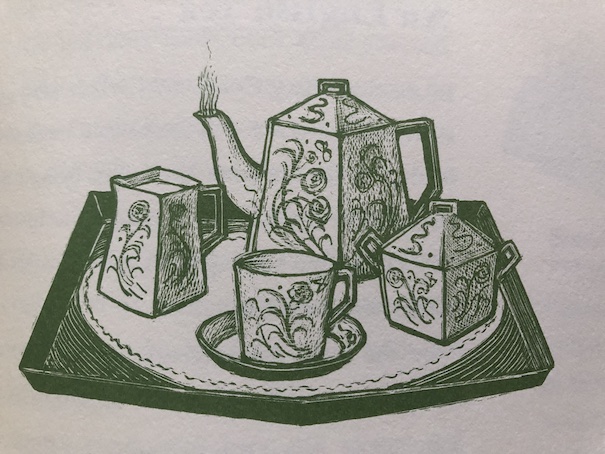
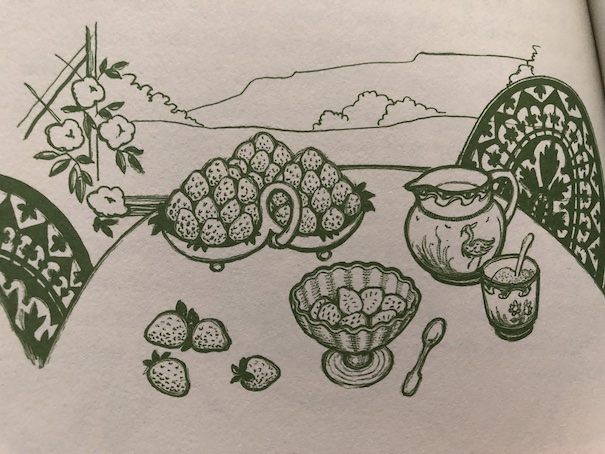
Most of the illustrations in the book are simple green and white drawings of different types of foods that accompany the recipes.

The recipes in the book are sorted into different categories, and each section has historical information about different meals and types of food. Individual recipes also have historical information, trivia, and quotes from The Secret Garden related to the dishes. Some traditional English foods need to be explained to Americans. For example, the word “pudding” refers to a specific type of dairy dessert in the US, but in England, it’s a more general word that can refer to any type of dessert.

I liked the selection of recipes, and I really liked the historical information provided with them!

The sections of the cookbook are:

Yorkshire Breakfasts

These are breakfast foods that the characters in the story ate or might have eaten during the Victorian era.

  • Porridge
  • Coddled eggs – Eggs cooked in a cup
  • Cheese muffins
  • Little sausage cakes
  • Cocoa

A Manor Lunch

This section explain the types of things that people of different classes ate as their mid-day meal in the Victorian era.

  • Yorkshire pudding – These are popovers with meat drippings.
  • Roasted fowl with bread sauce
  • Potato snow
  • Welsh rabbit – This is melted cheese on toast.
  • Cabinet pudding – This is a molded custard dessert with fruit.
  • Jam roly poly

An English Tea

This section explains things that Victorian people ate at afternoon tea.

  • A proper pot of tea
  • Cucumber tea sandwiches
  • Scones
  • Fruit tea loaf
  • Lemon curd tartlettes
  • Brandy snap baskets with whipped cream

The Kitchen Garden

This section is about things people would make from fruits and vegetables that they would grow in their kitchen gardens.

  • Fresh spring peas with mint
  • Glazed carrots
  • Summer pudding – This is a molded dessert made with bread and different kinds of berries.
  • Two fools – “Fools” are old-fashioned fruit-based desserts.
  • Raspberry jam
  • Raspberry vinegar
  • Molded spiced pears
  • Strawberries and cream

Dickon’s Cottage Food

Poor people, like Dickon’s family, would have eaten different things from the wealthier people in Victorian society.

  • Tattie broth – A potato soup.
  • Pease pudding
  • Yorkshire oatcakes
  • Cottage loaf – This is a basic bread recipe.
  • Dough-cakes with brown sugar – A basic dessert made with bread dough.
  • Parkin – A kind of oatmeal gingerbread.

A Taste of India

These are the types of foods that Mary might have eaten during the time she lived in India.

  • Fruit lassi – This is a kind of fruit shake made with yogurt.
  • Sooji – A hot breakfast cereal similar to cream of wheat.
  • Little bacon and coriander pancakes
  • Fresh mango chutney
  • Mulligatawny soup – This soup was invented in India for the British colonists. It’s curry coconut soup whose name means “pepper water.”
  • Florence Nightingale’s kedgeree – Florence Nightingale has nothing to do with the dish, but the Victorians named it after her because she was famous. It’s a rice and fish dish that was often made from leftovers and served for breakfast or lunch.

Garden Picnics

These are foods that can be prepared outside or are easy to pack for a picnic.

  • Roasted potatoes and eggs
  • Currant buns
  • Crumpets
  • Cornish pasties – These are savory pies or turnovers with meat and veggies, meant to be eaten with the hands. They’re sort of like larger, better-tasting Hot Pockets.
  • Chocolate picnic biscuits

The book is available to borrow and read for free online through Internet Archive.

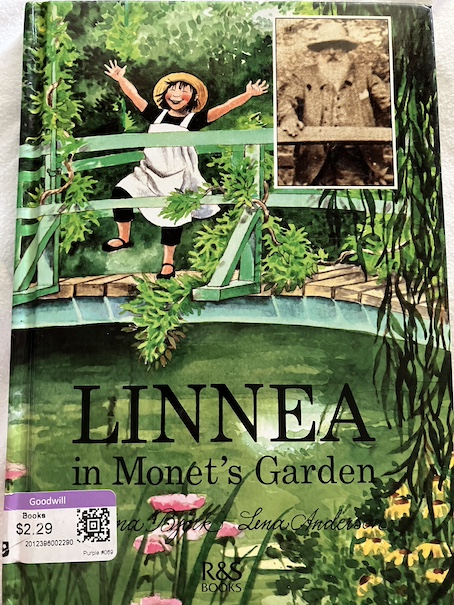
Linnea in Monet’s Garden

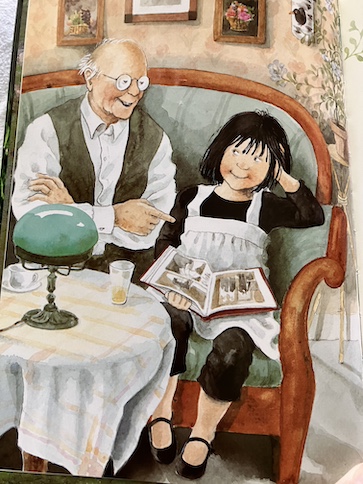
Young Linnea loves plants and flowers. Linnea’s upstairs neighbor, Mr. Bloom, used to be a gardener before he retired. He knows all about plants, and she likes to talk to him about them. Mr. Bloom has a particular book that Linnea likes about the French artist Claude Monet and his garden. Monet was famous for his paintings of the flowers and water lilies in his garden, and the book also has photographs of him, his wife, their children, and their garden. When Linnea looks at that book, she likes to imagine that she really knows the Monet family and that she’s visiting their garden.

One day, Mr. Bloom tells her that it’s possible to really go visit the garden because it still exists. Monet’s house had become run down and the garden was overgrown, but they have since been restored and turned into a museum. They could visit the garden if they go to Paris. They live a long way from Paris, but Mr. Bloom arranges with Linnea’s family for her to go on the trip with him.

Linnea and Mr. Bloom stay at a tiny, old hotel on the River Seine in Paris that was built in 1640. They can see the Notre-Dame Cathedral from the hotel, and it reminds Linnea of The Hunchback of Notre-Dame.

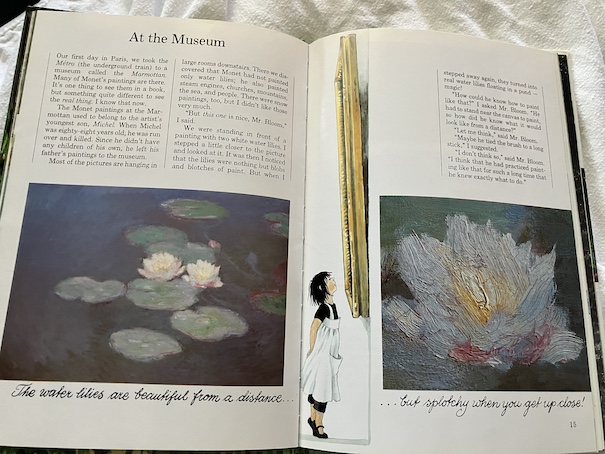
On their first day in Paris, Linnea and Mr. Bloom go to the Marmottan Museum to see Monet’s paintings. Monet’s youngest son left his father’s paintings to the museum when he died because he had no children of his own to inherit them. Mr. Bloom explains to Linnea that Monet painted in the impressionist style, which means that he tried to capture the rough images and impressions of the moment rather than creating detailed, completely realistic paintings. (I’m nearsighted, so impressionist paintings always look to me like what I see when I’m not wearing my glasses. I see colors and rough shapes, but everything is fuzzy with no sharp lines or fine details. I can still tell what objects are without my glasses, but nothing is distinct. I have impressions of things.) Mr. Bloom says that Monet particularly liked to show how light reflects off water and other objects in his paintings.

The next day, they take a train to the town of Vernon, and from there, and from there, they take a taxi to Giverny, where the Monet house and garden are. Along the way, they also buy some food for a picnic. Then, they go to see Monet’s garden.

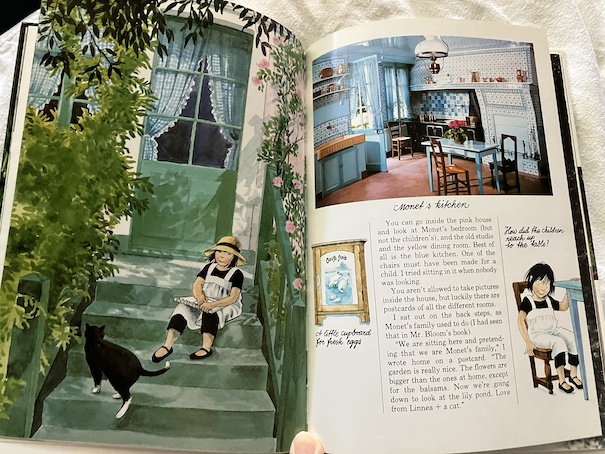
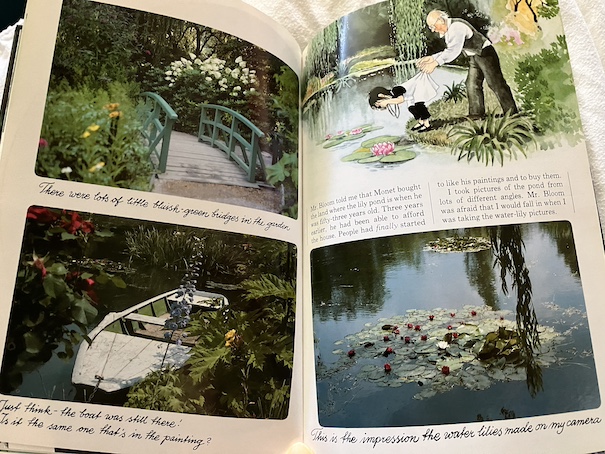
When Linnea sees the garden in person for the first time, it’s much bigger than she had imagined from the pictures in the book. Mr. Bloom tells Linnea all the names of the different flowers, and they take pictures of them. Then, they go inside Monet’s house. They’re not allowed to take pictures inside the house, but they get some postcards of the house’s interior.

One of the best moments for Linnea is that she is able to stand on the Japanese bridge in the garden, over the lily pond, as she always imagined she could do when she looked at the pictures in Mr. Bloom’s book! Monet painted pictures of that bridge multiple times. Each painting looks different because he painted them at different times and in different weather, so had different impressions of the bridge each time. The book shows Monet’s paintings of the bridge and how different they are from each other, and Linnea tries to capture her own impressions of the bridge.

They aren’t allowed to have their picnic lunch inside Monet’s garden, so they have lunch by the nearby river. Then, they return to Paris.

Back in Paris, they visit the Jeu de Paume museum to see more impressionist paintings. At the Orangerie, they try to see Monet’s giant water lily painting in the Water Lily Rooms. At first, they are told that the exhibit is closed for repairs, but when Mr. Bloom explains that they have come a long way to see them and Linnea starts to cry, the museum staff decide to make an exception.

For the last day of their trip, Linnea and Mr. Bloom decide that they want to return to Giverny. When they make their second visit, a man recognizes them as return visitors, and he turns out to be a member of Monet’s family, his step-great-grandson, Jean-Marie Toulgouat. He lives nearby, and he is also an artist, although his art style is very different from Monet’s. He talks to them about Monet’s life and family, and it also turns out that his wife was the author of the book about Monet that inspired Linnea and Mr. Bloom to take this journey!

When they return home, Linnea and Mr. Bloom go through all the pictures they took in France, and Linnea puts up a bulletin board with postcards and pictures from their trip. She also has a little wooden box with other souvenirs.

In the back of the book, there is a family tree for the Monet family and a timeline of events from Monet’s life. There is also a section of information about museums and sites in Paris and a list of books about Monet.

The book is available to borrow and read for free online through Internet Archive (multiple copies, including one in Chinese). The book was originally written in Swedish and published in Sweden in 1985. The English translation was published in 1987.

This is a lovely book about travel, art, and the beauty of nature and plants. Initially, Linnea becomes interested in Monet because of her love of plants and flowers, and when her neighbor says it’s possible to visit the garden Monet painted, she becomes interested in Monet’s life and work. I grew up learning about art and famous artists because my mother used to teach art lessons through a special program at my school. I don’t remember seeing this book at that time, although it is old enough that I could have. I found it by accident at a thrift store, and it reminded me of the art books that my mother kept around the house when I was a kid.

I enjoyed how the book brought a historical person to life, explaining Monet’s life story as well as his art and showing child readers that it’s possible to see the setting of his paintings in person. The book shows pictures of Monet’s art and photographs of the garden and flowers he painted so children can see the connection between the artwork and the real places and objects. Although not everyone can go to France just on a whim, the book does show what such a trip would be like, and it also shows kids how they can delve deeper into subjects that interest them and even go to places connected with their passions. The journey in the book is a magical trip that even adult armchair travelers can enjoy!

Emma

Emma has had a full life, and she has many grandchildren and great-grandchildren. However, she is often lonely when they aren’t visiting her. Most of the time, it’s just her and her pet cat, Pumpkinseed. It’s not a bad life because Emma loves the many simple things in her quiet life, but she unexpectedly discovers a new interest in life when she turns 72.

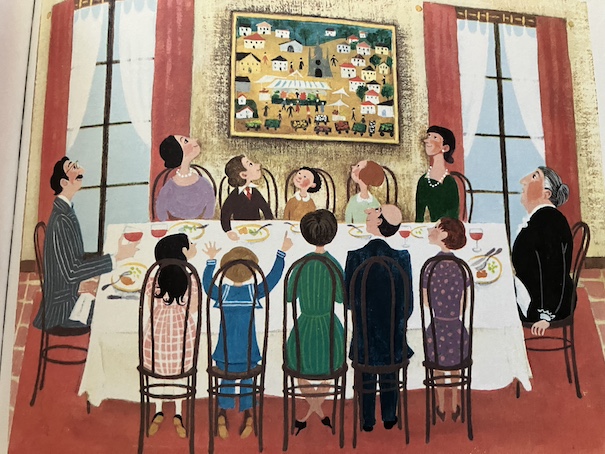
Her family comes to visit for her birthday, and one of the presents they give her is a painting of the small village where she was born. Although her family doesn’t entirely understand her attachment to her memories of her home village, they know that she is very fond of remembering it. 

However, the painting bothers Emma because it doesn’t look the way she remembers she remembers her village. The village has probably changed since she was last there, but the way the artist has painted it isn’t the way she remembers it. Emma realizes that she wants to capture those memories. Because no one else can paint her village the way it looks in her memories, Emma decides that she will do it herself. She buys an easel and paints and makes her own painting of her village. 

It makes Emma happy when she hangs her painting up in place of the painting that her family gave her because it looks like her memories. However, she doesn’t want her family to think that she didn’t appreciate their gift, so she is careful to replace her painting with the one they gave her whenever her family comes to visit. Everything changes one day when she forgets to makes the switch before her family visits her.

Everyone notices that the painting on the wall is different from the one they gave her, and they ask her where it came from. Emma is embarrassed and admits that she painted it. At first, she wants to put it away, but her family tells her not to do that because it’s a wonderful painting, and they encourage her to paint more.

Emma admits that she already has painted more, and she brings out her other paintings for everyone to see. From then on, she paints more paintings of her village and all of the little things around her that she loves to notice, and she openly displays them. Aside from her family’s visits, she also starts receiving other visitors who come to see her paintings. There are still times when she is alone, but she is no longer lonely when she is alone because she has her art to keep her busy and her memories of all the places and things she loves hanging on her walls.

The book is available to borrow and read for free online through Internet Archive.

I’ve been trying to figure out what this book is for years! I vaguely remember my mother telling me about this book when I was little. I can’t remember if she read it to me or just told me that she had seen the book somewhere, but the vague concept of the story about a grandmother who started painting because her relatives gave her a painting of her home town that didn’t look the say she remembered it stayed with me.

What I didn’t know or didn’t remember was that the grandmotherly painter in the story is based on a real person. In the back of the book, the American author explains that she met Emma Stern when she was living in Paris. Emma Stern was German, and she was born in 1878 and died in 1970. She is known for painting countryside scenes and village life. I’m not sure exactly where the village or small town where she was born was, although this website, which shows a selection of her paintings, has labeled most of them as being St. Wendel.

The story is inspirational because it’s an example of someone who found a new interest in life and a new talent when they were elderly. There are other examples in life of people who were “late bloomers” and found new careers or achieved something amazing in life at a time when many other people are just retired or taking it easy. It’s never too late to do something you really love!