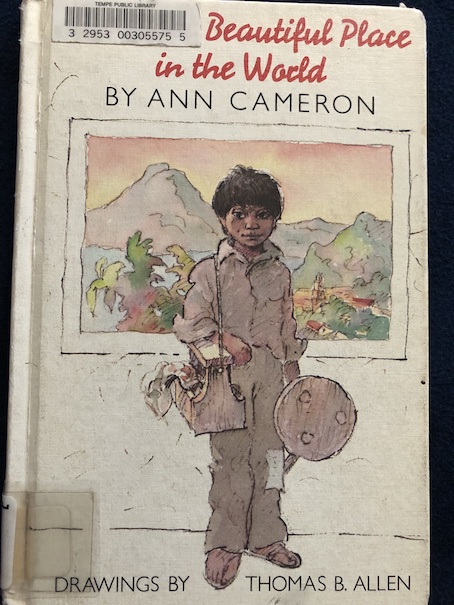
The Most Beautiful Place in the World by Ann Cameron, drawings by Thomas B. Allen, 1988.
Juan is a little boy living in the town of San Pablo in Guatemala. It’s not a very big town, but it is very busy. The town is on a lake with several other towns around it, but Juan has spent his whole life in San Pablo.
Juan is from a poor family, although he doesn’t consider his grandmother poor because she owns her own house and is able to take in other relatives whenever they fall on hard times. He knows that his father was the caretaker of a big house in the town, but he abandoned him and his mother when Juan was still a baby. His mother says that his father wanted to continue partying with his friends like he did when he was a single man, spending more than they could afford. After they argued about it, he left his family and went to a bigger city and never tried to see them again. Juan’s mother moved back in with her mother, so Juan grew up in a crowded little house filled with other relatives who needed help because they had gotten sick, lost their jobs, had marital problems, or various other things going wrong in their lives.
Juan’s grandmother supports herself by making arroz con leche and selling it in the marketplace. When Juan is still a small boy, his mother remarries to a man who doesn’t want anything to do with Juan, so his mother abandons him, leaving him with his grandmother. Juan is distressed by his mother’s abandonment, but his grandmother continues to look after him and begins preparing him to live an independent life from a young age. She has him help her sell arroz con leche in the marketplace, and later, she teaches him how to shine shoes so he can earn his own money. Juan is still very young, but his grandmother knows that life will tough for him without his parents.
Juan knows that his mother has had another child, and he feels jealous of his younger half-brother because he gets to live with his mother, and he doesn’t. (I question whether the younger half-brother is really going to be better off in the long run, but I’ll explain why below.) However, he is really jealous of the other children in town who get to go to school. Not all children in town go to school because many are from poor families, who need them to work and earn money, but Juan wishes that he could go to school, too.
He quietly teaches himself to read the signs in town and a newspaper, but he’s afraid to ask his grandmother about letting him to go school at first. He’s worried that, if he asks for that, his grandmother may tell him that she only cares for him because of the money he earns. If his grandmother abandoned him or withdrew her affection for him because he asked for too much, Juan doesn’t know what he would do. However, when he finally brings up the subject of school with his grandmother, he learns how much she really does care for him, how much she plans for his future, and how proud she is of him.
The book is available to borrow and read for free online through Internet Archive (multiple copies).
My Reaction
Juan’s family is poor, and at first, Juan doesn’t understand fully how poor they are. His grandmother’s life is more secure than others because she owns her own house, while others don’t, but even she has limited resources. The house has running water, but it doesn’t have electricity because she can’t afford it. She takes in other relatives when they are in trouble because she cares about her family, but she also has to make sure that everyone does whatever they can to support themselves because she can’t do it alone.
At first, Juan thinks that maybe she just keeps him because he earns money shining shoes, and she keeps most of his wages. However, when he talks to her about school, he learns that she has not spent any of his wages on herself or on other relatives. Instead, she has secretly saved them up because she knew that he would need money for his education, and she uses it to buy school supplies for him. At first, his teacher doesn’t want to accept him in class because the school year has already started, but when he demonstrates that he has already learned math from working in the marketplace and has taught himself to read, she accepts him. He exceeds everyone’s expectations for him, and his teachers even say that they will contribute to his education, if necessary, to keep him in school.
Juan’s grandmother cannot read, and she reveals that her parents wouldn’t let her go to school when she was young, even though she wanted to go. Her parents were afraid that she wouldn’t learn to do any practical work in school, so they didn’t want her to get an education, but she’s always felt disadvantaged because of it. She’s managed to get by in life, but she realizes that she could have done better with an education. She says that if Juan continues to work after school and does well in school, she’ll support his education, as far as he wants to go, even to the university. She says maybe he’ll even be able to figure out some of the big questions in life, like “why some people were rich, and some were poor, and some countries were rich, and some were poor, because she had thought about it a lot, but she could never figure it out.” Juan worries that he won’t be able to live up to his grandmother’s expectations for him, but she tells him not to worry about that. She just hopes for the best for him and wants to see him do the best he can because she loves him, and that’s what Juan really needs to hear.
The title of the story comes from a tourist poster that Juan reads to his grandmother, calling their town, “The Most Beautiful Place in the World.” Juan’s grandmother thinks that the most beautiful place in the can be anywhere where a person can be proud of who they are, but Juan privately thinks that the most beautiful place in the world is somewhere with someone you love and who loves you back. Juan has been deprived of love because of his parents’ abandonment of him, but he has found the love and support he needs from his grandmother, who wants him to succeed in life because she loves him and not just for what he can do for her.
Parts of the story are sad because Juan’s parents callously abandon him, and even his mother tries to act like it’s nothing because she knows his grandmother is taking care of him. I tried to decide how selfish Juan’s mother is in the story. On the one hand, I can see that she is poor and desperate and may have felt compelled to accept the first marriage proposal she was offered just to get out of her mother’s house, but she is very callous to her little son and his feelings and needs.
At first, he doesn’t even quite understand why his mother has left him, not even leaving him the bed they shared, so he has to sleep on some empty rice bags. He goes to his mother’s new house and tries to spend the night there. His mother lets him stay the night but hides him because she says his stepfather will beat him if he catches him in the house, which is why Juan never goes there again. I don’t know whether the stepfather ever beats Juan’s mother or the child they later have together, but the mother’s comment makes me think that it’s likely. Yes, Juan’s mother succeeded in getting remarried and out of her mother’s house, but I don’t think she’s really headed for a better life, and I have doubts about the future her younger child will have. It looks like the stepfather is selfish and temperamental, probably every bit as immature as Juan’s father was, and the children’s mother will always place her own needs first. As hurtful as it was for Juan to be abandoned by his mother, his mother is not going to nurture him and his future in the way his grandmother does. His grandmother has to be tough sometimes because of the family’s poverty, but she still does her best to look after everyone, even at her own expense, because she does love her family and wants the best for them and their futures, not just to get what she wants from other people and get ahead by herself. I would say that’s the quality that makes her different from Juan’s mother. At one point, she even marches Juan to her daughter’s new house and demands that she and her new husband at least provide a real bed for her son, reminding them of their responsibilities.
The book doesn’t go into the details of Guatemalan society and events in the 1980s, when this book was written, which was something I wanted to see. It’s pretty simple story for elementary school level children, but there is more going on behind the scenes that Juan would be aware of as a young boy living in a small town. The time period when this story was taking place was during the Guatemalan Civil War, which lasted from 1960 to 1996. The war and sharp differences in social class are partly responsible for the economic and societal inequities that Juan’s grandmother describes, although the economic and social disparities in Guatemalan society were part of the reason for the war in the first place. There was also general dissatisfaction with government incompetence and interference in Guatemalan affairs on the part of the United States, which sought to use Guatemala as part of its Cold War strategy, including using it as a training ground for Bay of Pigs Invasion against Cuba. These are complicated and long-term situations that would require more explanation than a children’s book of this level can provide, and because the characters in the story live in a small town, they may not be seeing many of these events directly. As he gets older, Juan will probably become more aware of the wider world and the circumstances that have shaped his family’s lives, as his grandmother hopes and expects, especially if he does end up going to the university in the capital city.
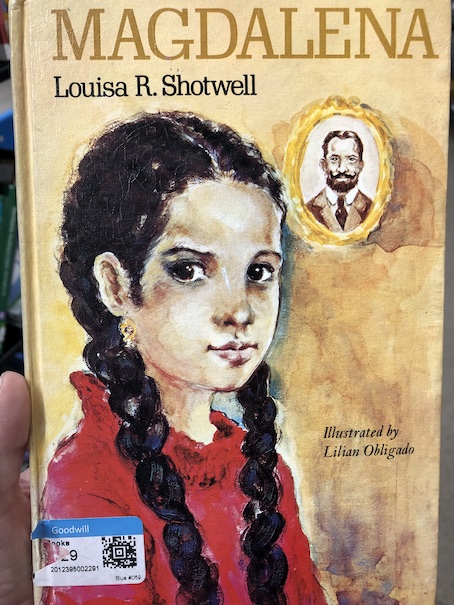
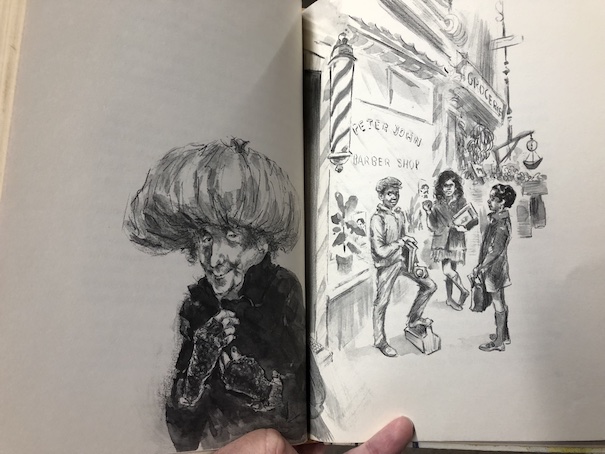
Magdalena by Louisa R. Shotwell, illustrated by Lilian Obligado, 1971.
Magdalena is switching classes at school. She’s happy about it because she found her old class too chaotic. She thinks she will be happier in her new class. Her friend in her current class at school, a boy named Saul, tells her that she must be an IGC, an Intellectually Gifted Child, in order to get transferred to that class because that class only takes gifted children. However, she is told that she will also have to wait a little for them to give her a desk in the room. When months go by without her being told that there is a spot ready for her and she can make the switch, Saul thinks that they were probably lying to her about her being able to switch classes.
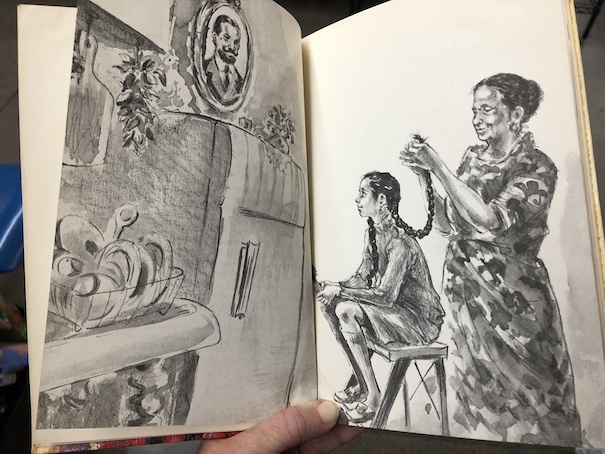
Finally, in January, she is able to switch to the new class, but right away, she runs into trouble with the class bullies. A boy named Andy and his friend start calling her “Miss Two-Ropes” because of her long braids, and the name sticks. Magdalena wishes that she didn’t have to wear her hair in braids, but her grandmother, Nani, insists on it. She loves Nani, who is from Puerto Rico and has looked after her for last two years, ever since her mother died when she was nine years old, but Nani has some old-fashioned ideas about how girls ought to be raised.
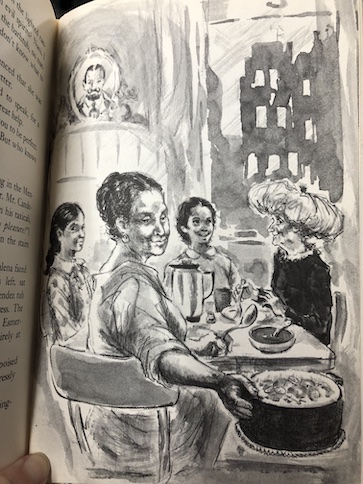
Magdalena’s father is a sailor, and he spends much of his time away at sea, so Magdalena and her grandmother are alone most of the time. Nani speaks Spanish to Magdalena at home because she thinks that’s proper for a Puerto Rican family like theirs, although Magdalena speaks English at school. She thinks that her grandmother probably knows more English than she pretends. Nani also keeps a portrait of Great-Grandfather Mendez, which she brought from Puerto Rico. Although he has been dead for years, the portrait always feels like a living person to Magdalena.
After some further teasing from the boys in her class, Magdalena decides to tell her grandmother that she doesn’t like her braids. Nani says that not unusual, that many children don’t like their braids, but they get over it. Magdalena doesn’t think she’s going to just get over it. Like a lot of kids, she would rather just look like everyone else so she won’t get teased, but Nani doesn’t approve of the short hairstyles that are popular among American girls at Magdalena’s school. She says that Magdalena’s braids are a mark of pride and a caring grandmother who brushes and braids her hair. She thinks the American girls wear their hair short because their mothers can’t be bothered to spend time on caring for long hair, and they don’t have grandmothers to nurture them. When Magdalena tells her that the boys at school are calling her names because of her braids, her grandmother decides that she should talk to the teacher about it. Magdalena thinks that having her grandmother talk to the teacher might be more embarrassing than having the boys call her names, so she persuades her grandmother to forget about it for now and let her handle it.
Then, Magdalena is called to the principal’s office at school. At first, Magdalena is upset because it sounds like she’s in trouble, and she can’t understand what she could have done to cause that. She is calmed a little when a black boy in the office, who is also waiting to talk to the principal, is nice to her. It turns out that Magdalena isn’t really in trouble. Instead, the principal wants to talk to her about one of her classmates, a girl named Daisy Gonzales, who is also transferring into her new class.
Madgalena is surprised because Daisy hasn’t struck her as a gifted child. Most of the other students call her “Spook” because she tends to lurk around the school and suddenly jump out at people to scare them, and she is known to frequently skip classes. The principal says that Daisy might be gifted, but it’s difficult to tell. The teachers think that she’s at least bright, but she’s an “under-achiever.” The principal explains that means that Daisy could do better at school than she does, but for some reason, she doesn’t seem motivated to do better. That’s why they’ve decided to transfer her to the class with the gifted students. They think that she isn’t being challenged enough in the class where she is. The teachers are also concerned that Daisy has no friends at school. They’ve noticed that the other girls at school seem to be afraid of Daisy, although they don’t seem to understand about Daisy’s “Spook” act. They do know that Daisy has behavioral problems and an unhappy home life. The reason why the principal is telling Magdalena about this is that she wants Magdalena to try to be Daisy’s friend when she transfers into her new class. The reason why she selected Magdalena to be Daisy’s new friend is because Daisy’s family is also Puerto Rican, like Magdalena’s family, so she thinks that the girls might understand each other better than their other classmates. The principal thinks that Daisy might settle down at school if she had a friend to help her feel more comfortable there. Magdalena isn’t comfortable with the idea of trying to be Spook’s friend because she also finds Daisy spooky, but the principal persuades her to try but not to let on that the principal asked her to do this.
Magdalena has no idea how to approach Daisy/Spook to be friends, since she’s not the easiest person to approach about anything. Then, Sue Ellen, the most popular girl in class tells Magdalena that she wants to be friends with her. She says that she’s been feeling empathy for her since the first day that she came to class and the boys started teasing her, and she felt it again when she got called to see the principal. She asks her what the principal wanted, and Magdalena explains that she asked her to do something, but it’s something really hard, and she isn’t supposed to talk about it. Sue Ellen offers to help her with whatever the principal’s task is. Magdalena thinks maybe making friends with Spook won’t be so bad if Sue Ellen helps, so she takes Sue Ellen into her confidence. Sue Ellen agrees with Magdalena that making friends with Spook would be hard because she’s so weird and spooky. Both girls admit that they’re a little afraid of her, but Sue Ellen agrees to try to be basically nice to Spook along with Magdalena and see what happens. Sue Ellen says that the principal ought to have more empathy for the students and see just how hard it would be to get along with someone like Spook.
Their first attempts at making friends with Spook are clumsy. Sue Ellen tries offering her advice, pointing out that she wore the wrong thing to the school assembly, but criticism and advice aren’t the best ice-breakers. Then, to Magdalena’s surprise, Spook approaches her in the school library, when she is trying to find a specific book for her grandmother. The school library doesn’t have the book she wants, but Spook says that she knows where to find it. However, she will only help Magdalena if she plays hooky and goes with her right now. Magdalena hesitates because she doesn’t really want to skip class and get in trouble, but Spook says that Magdalena will have to come with her because she’s “emotionally disturbed” and might do crazy things if she doesn’t get her way. Magdalena points out that school will end in only 20 minutes, and she asks Spook to wait for her. Spook makes her promise that she won’t change her mind and let her down in that time.
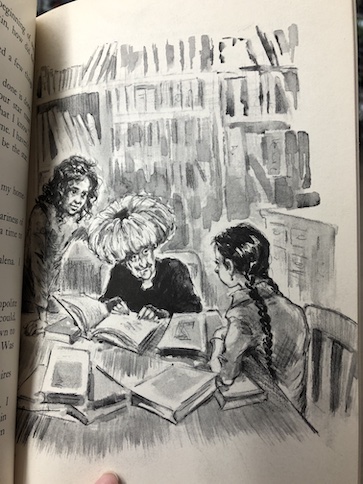
When Magdalena waits for Spook, she doesn’t show up at first, but Spook jumps out at her just when she’s giving up waiting. Spook says that she just wanted to see if Magdalena was serious about wanting to come with her. The place where Spook knows they can find the book turns out to be the Brooklyn Public Library. Along the way, Magdalena begins to learn more about Spook. The reason why she wasn’t dressed right this morning was that the sweater she was wearing was the only thing she had to wear that was clean. She skipped out during the school assembly to go home and see if her mother was back from the laundromat so she could put on something else. Also, Spook isn’t completely friendless. She is friends with a strange woman named Miss Lilley, who wears an unusual, large hat. When Daisy tells Miss Lilley that she got put into the class at school with the smart kids, Miss Lilley congratulates her and tells her that she knew she was smart. Daisy admits that she’s been trying not to let her teachers know that she’s smart because she knows that they will expect more of her and insist that she do all her homework. People don’t expect so much of kids who aren’t bright. There is method to Daisy’s madness. All of her weird and spooky acts are tools that she uses to get her, get out of things that she doesn’t want to do, cover up for problems that she has, and keep people she doesn’t like or doesn’t think would understand her at a distance.
Daisy introduces Magdalena as one of the smart kids from her class, but Miss Lilley thinks that Magdalena’s manners aren’t very polite because she keeps staring. Magdalena has trouble getting over the large hat, which looks like a large pumpkin. Miss Lilley begins evaluating Magdalena’s appearance, and Magdalena comments about how she hates her braids, but her grandmother makes her wear them. Miss Lilley says that she understands that her grandmother likes the quaintness of the braids, but she knows how to deal with that. She also knows where to find a good barber. The black boy who was nice to Magdalena earlier, Samson Shivers, makes money after school by shining shoes outside the library, and when Miss Lilley asks him if he would be willing to lend them money for the haircut, he joins the others at the barber shop. Miss Lilley takes the kids to the barber shop, and Magdalena gets a haircut. Magdalena feels wonderfully free after he haircut, although she saves the braids as a souvenir and worries about what her grandmother will say when she gets home.
Nani is very upset when she sees Magdalena’s short hair and worries that Magdalena is rejecting her care for her and her Puerto Rican heritage. Magdalena says that’s not the case and explains about going to the library and meeting Miss Lilley. Magdalena’s grandmother thinks that she’s bewitched and says that she knows how to deal with that. She uses herbs on Magdalena to break the bewitchment.
Getting the haircut changes things for Magdalena. The boys stop teasing her, which is a relief. However, Sue Ellen is annoyed that Magdalena didn’t tell her that she was going to get her hair cut. Magdalena explains that it was a sudden decision and a possible bewitchment by Miss Lilley. Sue Ellen thinks that Spook is probably the one who bewitched Magdalena because she’s so spooky and that maybe Magdalena would rather be best friends with her. Magdalena says that’s not the case and that she doesn’t see why she can’t be friends with both girls. Sue Ellen still expects that Spook is going to do something to ruin the class, but Magdalena notices that Spook is becoming less spooky in their class. She stops skipping classes, does more of her homework, and cuts out some of her previous spooky behavior.
Samson, often called Sam, is a practical boy, and when Magdalena tells him how her grandmother thinks Miss Lilley is a witch and bewitched her, he says that she can’t be a witch. Sam sees her often because he shines shoes by the library, and he realizes that Miss Lilley is actually just a poor, old woman. She goes to the library all the time because she can’t afford proper heating for her apartment. She often has little to eat, and she partly survives off of candy that he gives her. Like Spook, she seems spooky because she looks odd and behaves oddly, but there are explanations for what she does that show that she’s actually unfortunate.
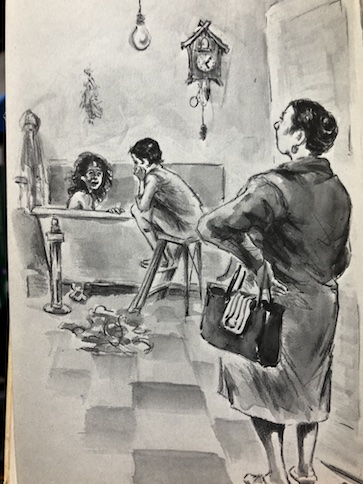
Magdalena’s grandmother meets Spook for the first time when Spook hangs out with Magdalena at her apartment after school. Nani isn’t home at the time, but the girls talk to each other about their lives and families. Magdalena gets to know more about Spook, and Spook admires the place where Magdalena lives. Spook’s family lives in a much poorer apartment, and it’s crowded with Spook’s younger siblings. Spook admires the nice bathtub that Magdalena and her grandmother have and says that she wishes they had one at her apartment. Part of the reason why she looks so strange is that she doesn’t get the opportunity to take baths often. Magdalena tells her that if she wants a bath, she can go ahead and take one. Nani arrives home before Spook is finished with her bath, but Nani stops her when she tries to get out and get her clothes. Nani can see how badly Spook needs some care, so she insists that she finish the bath, clean the tub, and let her shampoo her hair. When she’s done, Nani has Magdalena loan her some clean clothes, and the girls are amazed at the transformation.
After the bath incident, Spook avoids Magdalena for a while, and she can’t understand why, but it’s about Spook realizing what’s been lacking in her life and envying what Magdalena has: someone who really cares for her. She was so emotional when she looked at herself in the mirror that she spit at the image and then was embarrassed that she had done that. Nani surprisingly understands Spook’s behavior. She can see that Spook lacks impulse control and the ability to understand and manage her feelings. Nani comments that she’s angry with Spook’s mother because she can tell that the girl has been badly neglected. Having been a mother and grandmother herself, she knows exactly how to deal with this.
Meanwhile, Sam is correct about Miss Lilley. Miss Lilley is poor and not in very good health, but she also knows what Magdalena and Spook/Daisy need. She is eager to help the girls, but she also needs some help and attention herself. When Miss Lilley decides that it’s time to have a word with Nani about the needs of modern girls and her fears about her granddaughter becoming too American, a number of things get better.
The book is available to borrow and read for free online through Internet Archive.
My Reaction
The heart of this story is understanding and empathy. By the time it’s over, many of the characters come to a better understanding of each other and maybe themselves. Although Spook’s transformation is the most dramatic, the other characters are also changed after their experiences in the story.
Magdalena’s changes come with her admission to her grandmother that she really doesn’t like her braids and then with her decision to have her hair cut against her grandmothers wishes. She knew that her grandmother wouldn’t like it when she said that she didn’t want braids because her grandmother is a traditionalist, and she knew that Nani wouldn’t react well to the haircut. At first, it was easier for Magdalena to buy into the idea that Miss Lilley was a witch who bewitched her into doing it, but that’s not really the truth. It wasn’t even that Magdalena was getting her hair cut just because of the teasing. When Magdalena and Spook are talking about whether or not they truly understand the reasons why they do things, Magdalena acknowledges that she has reasons for the things she does, and the truth is that she got the haircut because she herself really hated wearing braids. If she had really loved her braids, she could have kept them in spite of the teasing, and she could have turned down the offer of a haircut, but she really wanted to change her hairstyle, and she just took advantage of the opportunity to do it.
Nani understands from the first time she meets Spook that she has not had nearly the level of care and attention that she has needed in life. Spook doesn’t even really understand all of the motivations she has for the things she does. Her behavior is odd partly because she acts on impulse, not fully thinking about the consequences or the affect her behavior has on others. She initially doesn’t have much self-awareness because she has not had caring adults in her life to teach her how to behave, how to understand her feelings, and how to control herself. Because she hasn’t really had any friends before, she hasn’t really had anyone to talk to about these things and help give her some perspective. When Spook and Magdalena talk about why she spit on the mirror, Spook says at first that she isn’t sure why she did it. As they continue to talk about reasons for doing things, though, Spook admits that she did it because, while she was stunned at how nice she looked, she quickly became upset because she didn’t think that nice look could last.
Nani is the nurturing type of person, and she quickly sees that Spook is in dire need of some nurturing and guidance. She also recognizes that Spook doesn’t have much confidence in herself. She is bright, but she has grown used to hiding it. She also thinks, because she doesn’t really understand her feelings or behavior, that is can never really control herself. She thinks that she will always be a “stinker” who does things that she shouldn’t and acts weird. Nani has a frank talk with her and tells her that she can be herself without being a “stinker”, and the first step is believing that she can. Even if she’s not in the habit of understanding and controlling herself, she can learn. People have different sides to their personalities and different ways of expressing themselves, and Spook can learn how to show the best sides of herself in the best possible ways.
Magdalena appreciates that Nani is understanding and helping Spook, but she also has a frank talk with her grandmother about why she doesn’t understand her own granddaughter as well. When Magdalena tries to tell her what she wants or doesn’t want, Nani contradicts her or ignores her feelings. Nani is understanding with Spook because she can tell that Spook is a disadvantaged child, but she doesn’t see her granddaughter the same way, so she doesn’t try to understand why Magdalena sometimes does things she doesn’t like. Nani admits that she wanted her granddaughter to be “perfect”, but maybe she doesn’t really know what “perfect” actually is. She wants the traditional ways for her granddaughter because she really thinks that’s what’s best, but even grandmother doesn’t always know what’s best.
Miss Lilley is concerned about the girls and offers them attention and support. When she goes to see Nani and open her eyes to her grandmother’s needs and the ways of modern girls, she collapses because of her bad health. Fortunately, Nani is a nurturing person, and she nurtures Miss Lilley, making sure that she gets the treatment she needs and even looking after her when she gets out of the hospital. Miss Lilley’s health improves, and the two of them become friends. Although they are both older ladies, they each admit that they have things to learn in their lives, and they can learn from each other. Nani helps her to make changes to her living arrangements so she will be healthier and more comfortable, and Miss Lilley helps her understand what modern American life has to offer for girls like Magdalena.
Samson is always a very understanding character because he is genuinely interested in people, and he meets many different types of people through his shoe-shining business. Although Sue Ellen is the first person who brings up the topic of empathy, she is really the one who understands it the least. I think her relatively narrow view of empathy is because of her relatively narrow life experiences. She feels some empathy for Magdalena because she sees Magdalena experiencing something she understands, but she doesn’t seem to know what to do when she encounters something she doesn’t understand. Admittedly, Spook’s spooky act is off-putting, partly by design and partly because Spook has issues she herself doesn’t know how to handle. However, because Sue Ellen only wants to stick to the familiar and understandable, she doesn’t notice when Spook begins to change and doesn’t see how some support from her could influence her for the better. Sue Ellen’s attempts at friendliness and helpfulness often involve offering some kind of criticism, like pointing out that Spook isn’t dressed right. Magdalena can tell that Sue Ellen is trying to be helpful, but she’s also kind of snippy and smug in the way she does it, and that gets on Magdalena’s nerves, too. Sue Ellen kind of fades out of the story toward the end, so we don’t know if she continues being friendly with Magdalena or not or if she ever recognizes Spook’s transformation.
There is also a subplot that I haven’t mentioned about the literary magazine that the girls’ class starts. Their teacher has some thought-provoking descriptions about what good writing is and does, and the girls’ choices of what to write about are based on their experiences and the changes in their lives.
The book doesn’t shy away from the harsh realities of life. Magdalena’s mother is dead, and her father is away most of the time, so she is being raised by her grandmother. Her father never even makes an appearance in the story. Miss Lilley is a poor and lonely old woman who needs help and friends. It is acknowledged that Spook is a neglected child, and she even tells Magdalena that her favorite brother died at age three because he was asthmatic, and they were living in bad conditions. We don’t know exactly how her family came to be living in such bad conditions, but Spook says that, if she wrote a story about her family, the teacher would think she had a filthy mind.
Since the story is about understanding other people, one could consider whether we might view Spook’s neglectful mother more sympathetically if we knew her past and what led her to the situation they’re now in, but we do not see Spook’s mother at any point in the story. I think it’s also important to note that understanding does not equal approval. You can know a person’s history and reasons for doing things and still not agree with them. Maybe Spook’s mother is another unfortunate soul who needs some help, but if she is, she doesn’t seem to be looking for that help. Her vulnerable children are suffering for it, and one has died. Empathy doesn’t mean saying that things are okay when they really aren’t, and this mother’s neglect of her children is not okay.
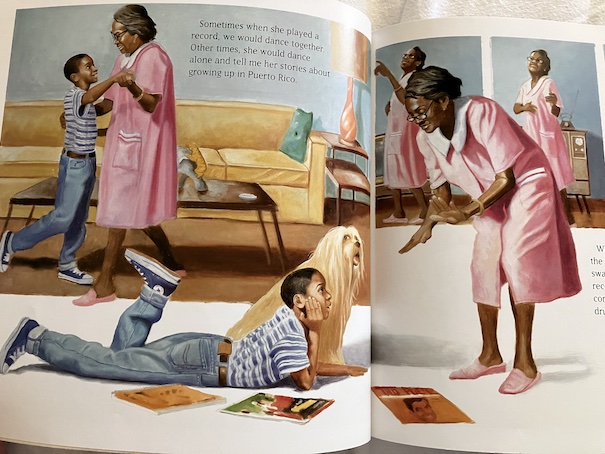
Every summer, a boy goes to visit his grandmother. He loves summers with his grandmother because she plays records from her record collection, teaches him to dance, and tells him stories about life in Puerto Rico, where she grew up.
She instills a love of music in her grandson and uses it to share memories with him about his grandfather and their home town. Sometimes, she lets him choose records from her collection to play, complimenting him on his choices. The boy likes art, and he makes sketches based on the album covers.
Then, his grandmother’s nephew comes to visit from Puerto Rico, along with his band. The boy is thrilled to meet them, and they give the boy and his grandmother tickets to see them perform in New York.
It’s a special occasion! They love the performance, and afterward, they visit with the band backstage. The boy and his grandmother continue sharing music with each other as the boy grows up, and as an adult, he continues to play it in his art studio.
At the end of the book, there are lyrics to one of the songs, In My Old San Juan (En Mi Viejo San Juan – YouTube video), both in English and Spanish. It’s a popular sentimental and nostalgic song for Puerto Ricans living abroad, as this YouTube video explains. The book is available to borrow and read for free online through Internet Archive (multiple copies, including one in Spanish).
My Reaction
The story is really about the author/artist of the book and his own grandmother. At the end of the story, the picture he’s drawing in his studio is the cover of this book. It’s a touching tribute to his grandmother and the special memories he shared with her as they bonded over music! Parts of the story reflect on their Puerto Rican heritage, which is something they share and discuss with the grandmother’s nephew and the members of his band. I like how the author emphasizes that what makes the music so special are the memories associated with it. At first, the memories are his grandmother memories, but through his experiences with his grandmother, he builds memories of his own associated with the music they’ve shared. It is these memories as well as the music that helps to fuel his art.
When Aunt Lena Did the Rhumba by Eileen Kurtis-Kleinman, illustrated by Diane Greenseid, 1997.
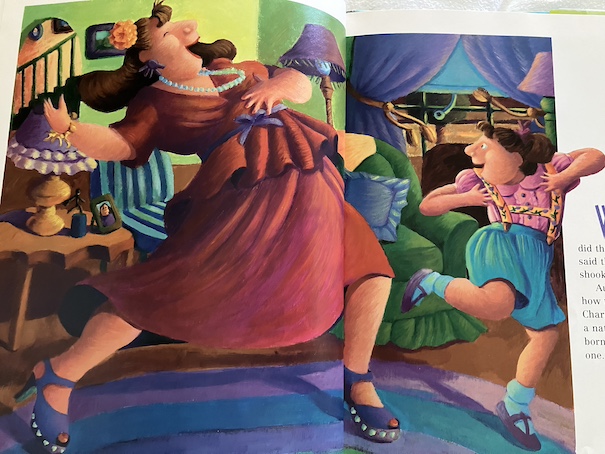
Sophie’s Aunt Lena loves music, dancing, movies, and theater, and she especially loves Broadway musicals. She goes to a musical matinee every Wednesday. After seeing a musical, she comes home, singing and dancing and acting out parts from the play she’s just seen.
One particular Wednesday, when she’s acting out a particularly dramatic dance in the kitchen, she accidentally slips and sprains her ankle. She has to stay home and rest until her ankle gets better, which means that she won’t be able to go to next Wednesday’s matinee.
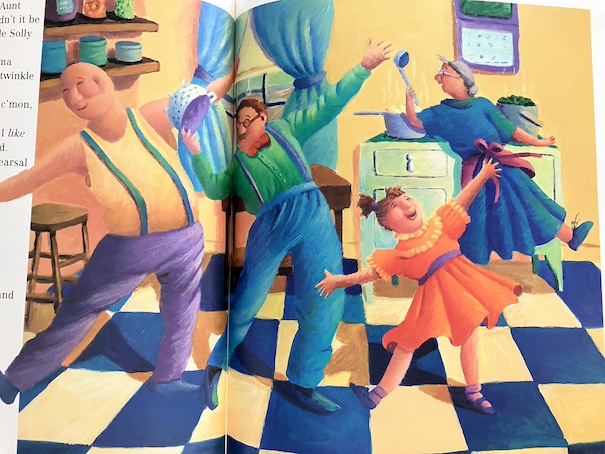
Aunt Lena is so sad about missing the musicals she loves that Sophie gets an idea to cheer her up. Sophie recruits other members of her family to put on their own musical to entertain Aunt Lena.
Not everyone is enthusiastic about the idea at first, but when Sophie gets her grandmother to help her put together a costume fit for a Broadway musical and choose some music, they begin drawing other family members in.
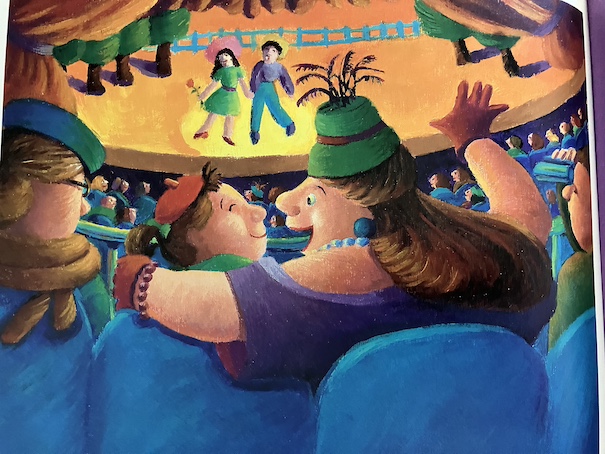
Aunt Lena loves their performance, and when she’s better, she takes Sophie to a matinee so she can see a real Broadway performance, too!
This book is available to borrow and read for free online through Internet Archive (multiple copies). It was also a Reading Rainbow book, and the episode of Reading Rainbow is also available to watch online through Internet Archive.
My Reaction
I didn’t see the original episode of Reading Rainbow that included this book when I was a kid because this book was published after I was too old for that. However, I always liked Reading Rainbow when I was a kid, and later, after I started this blog, I decided to go back and check out some of the books covered by Reading Rainbow after I stopped watching it. If you’re not familiar with Reading Rainbow, it was a children’s television program on public television in the US that encouraged children to read by discussing books and showing children things that were related to the books they were reading. For example, if they were reading books related to animals in an episode, the host, Levar Burton, might take a trip to a zoo and talk to zookeepers about animals in the zoo.
The themes of this particular story and the Reading Rainbow episode are music, dancing, and theater. In the episode, they show a boys’ choir and dancing class and talk about how performing helps the boys and young men develop confidence and maturity. There’s also a comedian who specializes in physical comedy, who talks about how he does his stunts, and an actress who plays one of the cats in the famous Broadway musical Cats.
I love how the aunt in the book shares her love of dancing and theater with her niece. The two of them have similar personalities and interests, so when her aunt is injured, her niece knows how to cheer her up. The ending of the story implies that the niece will now be going to performances with her aunt, or at least, will sometimes go with her. I also liked how the rest of the family participated in the girl’s plans when they saw what she wanted to do, even if they weren’t as enthusiastic about the idea themselves at first. Enthusiasm can be contagious, and I do think that adults sharing their interests with kids can spark lifelong interests in the next generation.
I also noticed that this seems to be an unconventional family, although the family’s living arrangements aren’t the focus of the story. The girl’s parents are never mentioned. She seems to live with just her grandmother, her aunt, and a couple of uncles, and there is no explanation why because it’s not directly important to the story. In any case, it seems to be a happy, close-knit family, with family members caring for each other and supporting each other’s interests.
The pictures in the book are bright and colorful, fitting with the energy, enthusiasm, and theatricality of the story.
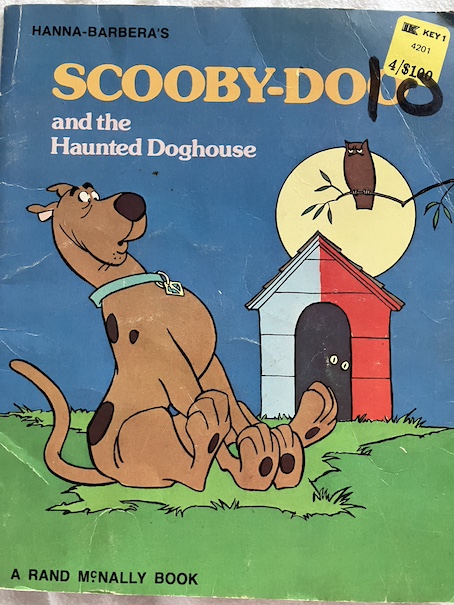
Scooby-Doo and the Haunted Doghouse by Jean Lewis, illustrated by Richard Lowe, 1975, 1983.
Scooby-Doo’s friends are building a new doghouse for him! They can’t decide what color to paint it, so they make half of it red and half of it blue. Scooby loves his new doghouse, at first, but then, something spooky happens!
One night, Scooby comes running into the house, scared. While Scooby cringes under the covers of Shaggy’s bed, Shaggy gets a flashlight and goes outside to see what scared Scooby.
When Shaggy looks in the doghouse, he sees a glowing pair of eyes, and then, something white runs past him with a shriek! Scooby and Shaggy both stay inside for the rest of the night, and in the morning, they tell their friends that they think the doghouse is haunted.
Their friends are sure that there must be some other explanation for what happened, but who or what was in Scooby’s doghouse?
The book is available to borrow and read for free online through Internet Archive.
My Reaction
Scooby-Doo was my favorite cartoon when I was a kid, especially Scooby-Doo, Where Are You!, and I’m still nostalgic about it! The mystery in the story is very simple, but suitable for young children with nothing truly scary about it. Even kids might guess what the solution is before the characters realize what’s in the doghouse.
Now that I think about it, it seems out of character for Scooby-Doo to have a doghouse because I don’t think he had one in the original cartoon series. I remember that he had a fancy one in one of the later spin-off series, but in the original series, he just always slept inside with his human friends. Of course, one of the hallmarks of the Scooby-Doo series is that there isn’t really a strict canon. Details about the characters and the Mystery Machine can change from episode to episode to suit the story without any real explanation because it’s a just-for-fun series.
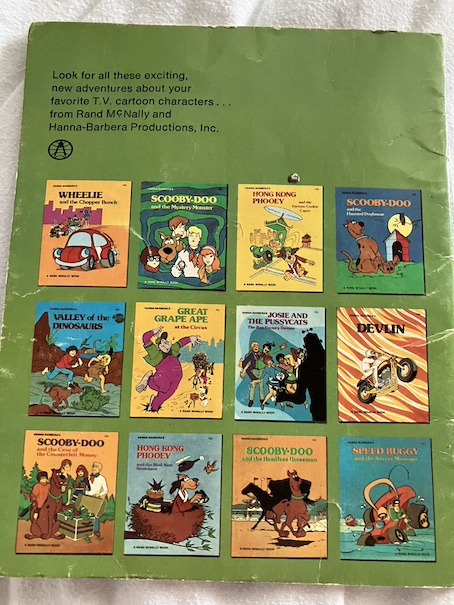
One of the things that I liked about this book was that it reminded me of all the other books I read as a kid that were based on popular cartoon characters. I think most of the cartoon series from my childhood in the 1980s and 1990s also had related books. On the back of this book, there are pictures of other books in this series, based on other Hanna-Barbera cartoon series, including other Scooby-Doo picture book mysteries.
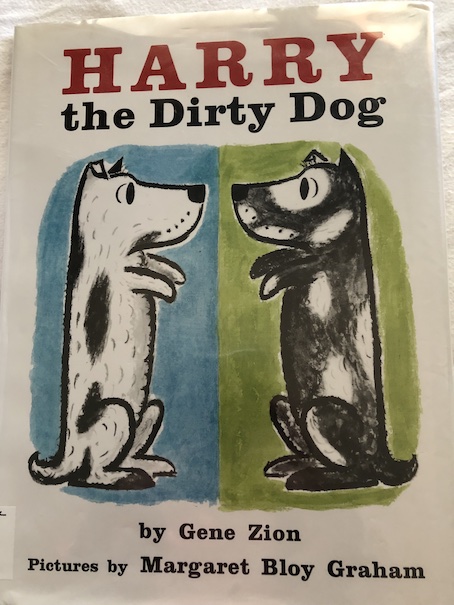
Harry the Dirty Dog by Gene Zion, pictures by Margaret Bloy Graham, 1956.
Harry, like other dogs, hates baths! One day, when he finds out that his family is about to give him a bath, he decides to steal the scrub brush! He buries the scrubbing brush in the yard and runs off into the city to have some fun and get good and dirty!
Normally, Harry is a white dog with black spots, but after a day playing with other dogs and running through construction areas in town, he’s so dirty that he looks like a black dog with white spots.
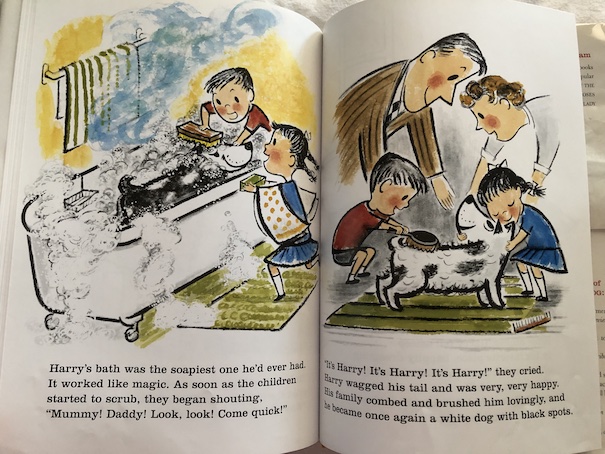
Eventually, he gets tired and hungry and misses his family, so he goes home. However, he has trouble getting his family to recognize him because he’s so dirty. Even when he does his usual tricks for them, they still don’t think he looks like their Harry.
At first, Harry fears that he’s lost his family because they don’t know who he is. Then, he realizes that what he really needs is the scrub brush and a good bath! He digs up the scrub brush again and manages to persuade his family to give him a bath.
Once he’s clean, his family recognizes him. Harry sees the benefits of getting a bath, but he still doesn’t really like them, and he still enjoys the thought of getting nice and dirty again.
The book is available to borrow and read for free online through Internet Archive (multiple copies).
My Reaction
Dogs in real life often don’t like baths, and this whimsical picture book is about a dog discovering the benefits of a bath. When I was a little kid and I first saw this book, I was really worried that Harry would lose his family because they didn’t recognize him, but really, the family would have to be pretty dense for thinking that this dog, which looks like the same breed/mix as theirs and acts like theirs and does all the tricks their dog does but is just covered in dirt, must be a completely different dog. The story is just meant to be humorous, and it’s questionable in the end whether any lessons are learned. Yes, Harry now sees that getting a bath and being clean help his family to recognize him, but he still dreams about getting dirty, and he’s hiding the scrub brush under his bed. My dog also hates baths and fears the groomer, but I have assured her that I would still know her anywhere!
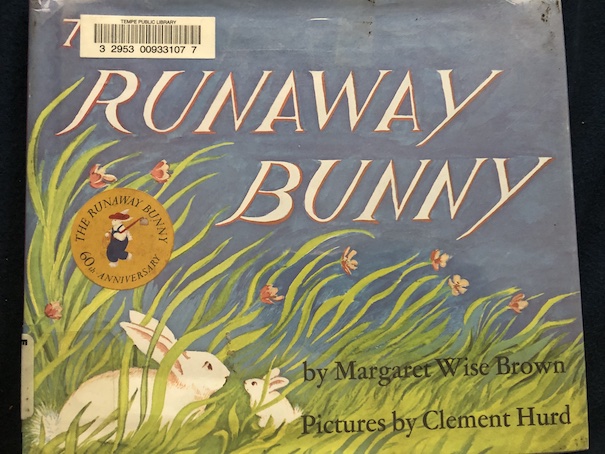
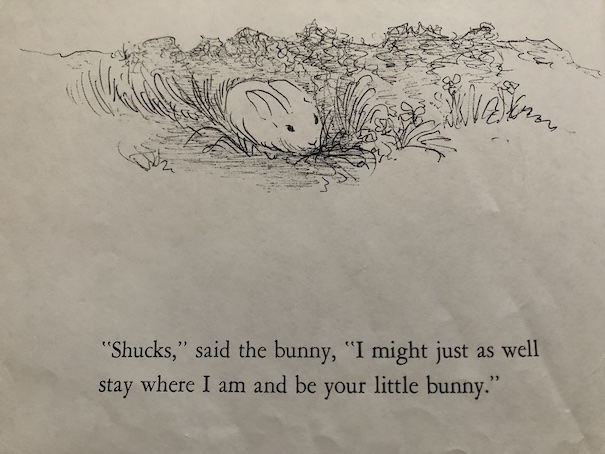
The Runaway Bunny by Margaret Wise Brown, pictures by Clement Hurd, 1942.
A little bunny tells his mother that he’s thinking about running away, but his mother assures him that, no matter where he goes or what he does, she would always come after him because he’s her little bunny, and she loves him.
The pictures where the little bunny talks about all of his ideas for running away and evading his mother and where his mother explains what she would do to follow him are in black-and-white.
However, there are large, full color pictures after each of these sections showing what would happen as the mother follows her little bunny.
The little bunny’s plans for running away become increasingly imaginative and outlandish, from going up a mountain and joining the circus to transforming himself into a fish, a bird, or a sailboat.
No matter what the little bunny thinks of for running away and changing himself into something else, his mother assures him that she would find a way to come after him and be there for him. In the end, the little bunny decides that he might as well stay with his mother, just as they are.
The book is available to borrow and read for free online through Internet Archive (multiple copies).
My Reaction
This is a very well-known and much-loved book about parental love and the lengths that parents will go for their children. The mother bunny is determined to be there for her child, even when the child wants to run away. We don’t know why the little bunny was talking about running away from his mother, and without that, it seems just like the little bunny was just trying to provoke his mother to find out how much his mother loves him. When she tells him all the things she would do to reach him if he ran away, he seems reassured and content to remain her little bunny.
This book was originally published during WWII and is a calm and reassuring story that probably comforted many children living through unsettling times. It has never been out of print since its original publication.
The author and illustrator of this book also later wrote and illustrated Goodnight Moon. The scene where the little bunny imagines himself as a boy in a house and his mother says that she would still be his mother reminds me of the illustrations in that book, and I wonder if the mother and child rabbits in that book came from this one.
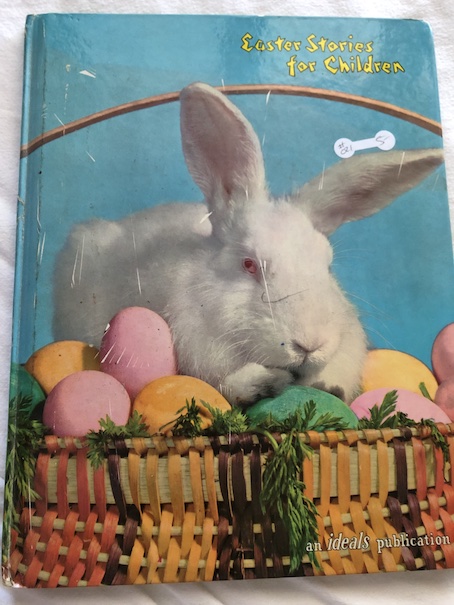
Easter Stories for Children edited by Van B. Hooper, 1962.
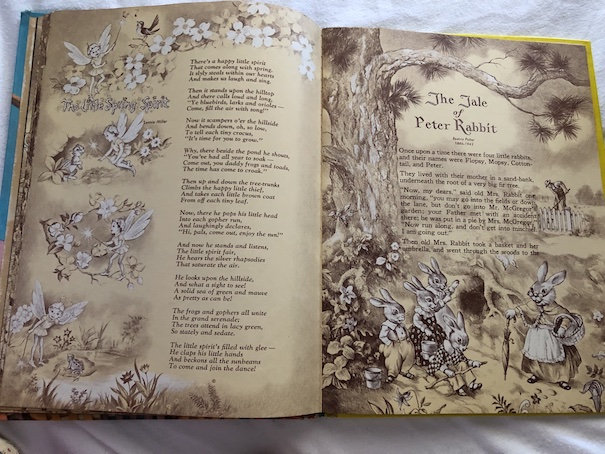
This book was published by Ideals, and if I remember right, is part of a series of holiday/seasonal books for children. (I don’t have a list of other books in the series, though.) It has short stories and poems about Easter. Largely, they’re not very religious in tone, tending to focus on fairies and the Easter bunny. I actually found all the references to fairies confusing because I never heard anybody talk about fairies being associated with Easter when I was a kid. On the religious side, there is one poem about prayer and a story about how the dogwood plant represents the crucifixion. There is also some information about how Easter is celebrated around the world.
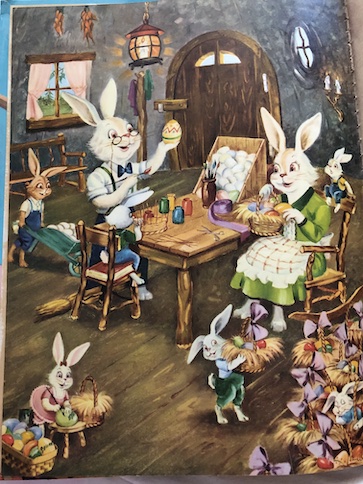
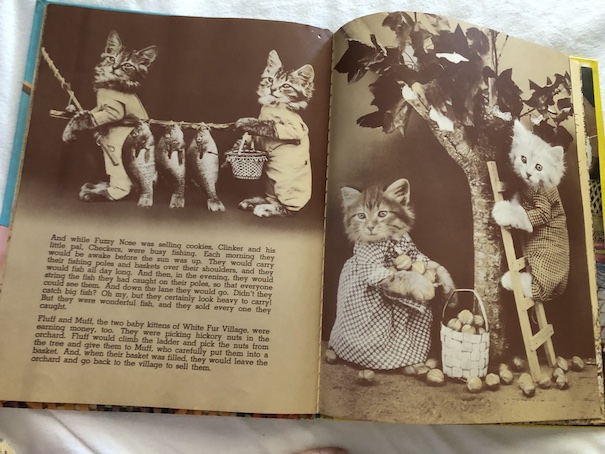
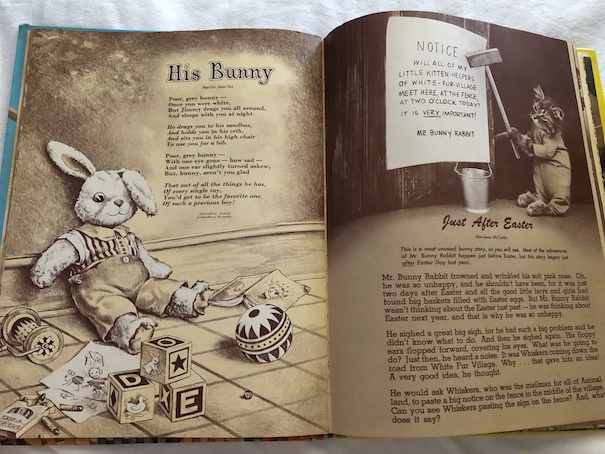
The pictures are in sepia tones. Mostly, they’re drawings, but there are also some photographs of cute bunnies and kittens wearing human clothes. The only full color pictures are on the inside of the front and back covers, and they’re scenes of rabbits painting Easter eggs. All in all, it’s a very cute book for Easter.
Stories:
How the Forest Fairies Get Ready for Spring – “Written especially for you by SPARKIE” – All of the forest fairies have special tasks for getting ready for spring.
The Tale of Peter Rabbit by Beatrix Potter (1886-1943) – A classic children’s story about a bunny who disobeys his mother.
Just After Easter by Maryjane McCarthy – Mr. Bunny Rabbit is worried about next Easter because the farmer is having trouble affording grain to feed his chickens. If he can’t keep the chickens, where will they get their Easter eggs? This is the story that has pictures of bunnies and kittens in costumes with props. The kittens try various ways to raise money for the chickens.
The Legend of the Dogwood – author unknown – The legend is that the cross of Jesus’s Crucifixion was made from dogwood, but the plant felt badly about it, so Jesus made the plant too small to be used for such a purpose again and gave it a cross-shaped flower.
Easter in Many Lands – About Easter customs in different countries, and the origins of the word “Easter” and how symbols like bunnies and eggs came to be associated with Easter. This is my favorite section in the book!
The Story of the Colored Easter Egg by “Maryjane” – A fairytale about a kind queen and the origins of Easter eggs.
Poems:
The Magic Pool by Dorothy Weiner – Bunnies color eggs in a magical pond fed by a rainbow.
Easter Bunny’s Secret by Mrs. Roy L. Peifer – The Easter bunny collects drops of paint that Jack Frost uses to paint leaves in autumn and saves them for Easter eggs, but when the paint gets spilled, he needs to get colors from other sources.
The Little Spring Spirit by Leonie Miller – The spirit of spring calls to plants and animals with the change of the season.
If Easter Eggs Would Hatch by Douglas Malloch – What would come out of an Easter egg? Brightly-colored chickens or maybe a little silver bunny?
In Cottontail Town by Marguerite Gode – A famly in Cottontail Town takes in an elderly rabbit and nurses him back to health. He starts a school there to teach the other rabbits how to paint Easter eggs.
The Gray Bunny’s Night – “As told by The big black Bumblebee” – A little gray bunny wants to be brightly colored for Easter, and his wish is granted by the queen of the fairies.
Hippety-Hop to the Barbershop by Claribel Ream – The Easter Bunny is going to the barbershop to deliver eggs and candy for the barber’s children.
Helping One Another by Mrs. Roy L. Peifer – The Little Red Hen helps the Easter Bunny to fill his basket for Easter.
His Bunny by Marilyn Jean Fais – About a little boy’s stuffed bunny. It can be hard on a toy to be a child’s favorite, worn and dragged everywhere, but it’s worth it!
Prayer by Ethel Romig Fuller – If we can hear songs from radio waves that travel through the air, God can also hear prayers.
Seed Thoughts by W. M. Walker – Good and kind thoughts produce good deeds, like plants sprouting from seeds, but selfish thoughts are like weeds that get in the way. Be careful what seed thoughts you grow in the garden of your mind!
Jack in the Pulpit by Mrs. Jessie S. Manifold – Spring plants and animals celebrate the Sabbath Day.
And He Hippety-Hopped Away by Rowena Bastin Bennett – The Easter Bunny delivers eggs and candy to children before sunrise.
Sniffy books or scratch-and-sniff books were a new development during the 1970s, and they remained popular through the mid-1980s, along with scratch-and-sniff stickers. This particular book features characters from Richard Scarry‘s Busytown series, especially Lowly Worm. The first part of the book has Lowly and his friend Huckle Cat looking at a sniffy book and teaching readers how to use the scratch-and-sniff parts of the picture.
The rest of the book takes readers through the four seasons: spring, summer, fall, and winter. In each season, there are different objects and foods associated with the season for readers to scratch and sniff. In the spring, the characters smell violets and bananas that they eat at the circus.
During the summer, there are lemons for making lemonade and chocolate ice cream sticks that they eat at the beach.
During the fall, there are apples and pumpkin pie at Thanksgiving.
The winter parts focus on Christmas, with pine-scented Christmas trees and gingerbread pigs.
My Reaction
Sniffy books and stickers were common features of my early childhood in the 1980s. I think they still exist, although I don’t know if they’re as popular in the 21st century as they were back when they were relatively new developments. This particular sniffy book was a favorite of mine and my brother when we were little kids.
One of the interesting things about finding some of these older sniffy books decades later is seeing which of the scratch-and-sniff patches have held up over the years. They do wear out over the time, especially the ones that have been scratched more than others, meaning that favorite scent patches will wear out faster. Milder scents are also harder to detect years later than the ones that were always strong. In our old copy of this book, I can’t smell the lemon, chocolate ice cream, pumpkin pie, or gingerbread any more, but the violet, banana, apple, and pine are still fine. I think those scents were always the strongest.
A small caterpillar hatches out of an egg and is very hungry. Each day, the caterpillar goes out looking for food, finding different things to eat.
Part of the book is a counting story, as the caterpillar eats different numbers of different types of fruit in different numbers. The format of this part of the book is really interesting because each of those pages isn’t a whole page but sections of pages that are different sizes, showing how the amount that the caterpillar eats increases each day.
Also, there are real holes in the pages to show where the caterpillar ate through different types of food. Kids like books with interesting physical features that encourage them to interact with the book as a toy as well as a story. I think that’s part of what has caused this book to have lasting appeal.
The book does also have a story to it about the growth and development of the caterpillar along with the counting part. At the end of the part that counts the number of pieces of fruit the caterpillar eats, the caterpillar eats a bunch of random junk foods and gives himself a stomachache. Eating a green leaf makes him feel better. By this point, the caterpillar is a fat caterpillar who is no longer hungry. At the end of the book, the caterpillar makes a cocoon and turns into a butterfly.
This is a cute picture book that is fun to show to very young children. The counting element is good both for teaching young children and for the children who have already learned to count because they can predict what the caterpillar is going to do next. The unusual format of those pages with the holes also makes the book distinctive.
On the 50th anniversary of the book in 2019, the BBC produced an article about the book’s history and its appeal to generations of young readers.
The book is available to borrow for free online through Internet Archive.




















 Jestress's Forgotten Books and Stories