There’s a Body in the Brontosaurus Room!

Our Secret Gang

This is the last book in the Our Secret Gang series. This story takes place in a museum, and at the beginning of the book, there are maps of the interior of the museum, which help in keeping track of the action. Members of the detective gang in the story take turns narrating different books, and this one is narrated by Davey.

The fifth and sixth grade classes at the kids’ elementary school are having a camp-in at the Museum of Science in Boston. When the kids are getting on the school bus, Tim notices that a teacher is reading a copy of a newspaper with an article that says the police have received a tip that there will be a jewel robbery at the museum they’re visiting because there is a visiting exhibition of valuable gems. The kids think that they may have found the next case for their detective gang, and they’re glad that they brought some of their equipment with, like their walkie-talkies.

When they stop for dinner at a pizza place, they learn that students from Longmeadow Middle School will be joining them for the camp-in at the museum. By coincidence, Jeanine knows one of the boys from Longmeadow, Jeremy, because she takes horseback riding lessons from his mother. Jeremy ends up joining the others for dinner. Even though Davey rolls his eyes at his little sister’s jokes that Jeanine is his girlfriend, he feel unexpectedly jealous at the way Jeanine blushes around Jeremy.

While they’re having dinner, Tim notices a boy who is all by himself and crying. Jeremy says that he’s a new boy at his school named Matthew. Kids have been trying to make friends with Matthew, but Matthew never seems interested.

As they’re getting ready to leave, Jeanine makes plans to meet up with Jeremy and hang out at the museum. Davey gets angry because he wants the whole gang to investigate their possible mystery, and he doesn’t want Jeremy being forced on the group. Davey and Jeanine have an argument about his jealousy, and Jeanine separates from the group at the museum to hang out with Jeremy. Davey worries that this will split up Our Secret Gang or at least that they’ll lose Jeanine.

To make matters worse, Davey sees Mr. Berrar, the headmaster of the special school for science and mathematics that his parents and school principal wanted him to attend, at the museum because he is one of the museum trustees. Davey’s secret is that he is a genius at mathematics, and his parents and school principal wanted to send him to a special high school, skipping multiple grades, even though he didn’t feel ready to do that. Davey managed to persuade his parents that he would be happier remaining in a normal school with his friends, but he dreads other kids finding out and teasing him for being a nerd.

While Davey and the other kids are looking at the gem exhibit and talking about the security features they’ve noticed, still considering whether someone could be planning to rob the museum, Davey spots Jeremy in an area that’s marked “Private-Museum Staff Only.” What is he doing, sneaking around an off-limits area?

The rest of the detective gang, minus Jeanine, solves a small mystery for a girl from another school who lost her retainer, Lorraine. It only earns them $3 in detective fees, but Davey decides to hang out with Lorraine for a while and see if Jeanine gets jealous of them like he was of Jeanine and Jeremy, which she does. Davey thinks it’s only fair that Jeanine feel some of what he’s been feeling, and since she’s been giving him the cold shoulder and not helping with the detective activities of the group or joining her friends in looking at the exhibits, she deserves it.

Just as all the students are getting ready for bed, a girl starts screaming that there’s a body in the brontosaurus room! She says that it was lying right underneath the dinosaur, but when everyone rushes to look, it’s gone. Then, Matthew apparently has an attack of appendicitis and is taken away in an ambulance. Something about the ambulance strikes the kids have peculiar, but they have trouble thinking what it is at first. By the time they realize what was wrong, things have already started happening in the museum. The guards are missing, and security devices have been turned off. It seems that the robbery rumors were true. What can the kids do to stop it?

The book is available to borrow and read for free online through Internet Archive.

I first read this book as a kid, and one of the things I liked about it most was the title. I still think about when I’m at a museum with dinosaur exhibits. I never went on one of those camp-ins at a museum when I was a kid, but it’s something that I would have liked, especially if there was a mystery involved!

The romantic bickering in the story is juvenile, but I remember similar incidents from when I was about the age of the kids in the story. Some adults still do things like the kids in the book do, like seeming to flirt with someone else to make a partner jealous and get their attention. It’s never a good idea. It just adds another person to an already-complicated and highly emotional situation without resolving whatever was behind the initial problem.

As an adult, I thought that Jeanine was a little thoughtless and rude for ditching her friends to hang out with a guy she seems to have a crush on. When you already have plans with a group of people, suddenly tossing them aside to make plans with someone else and ignore them is rude. However, Davey’s jealousy and possessiveness is also inappropriate, and his behavior is part of the reason why Jeanine broke off from her usual group instead of just having her other friend join them. If Davey had either allowed Jeanine’s friend to join their activities or simply told Jeanine that he was hurt that she seemed to be abandoning the group and their latest project to pay attention to this other guy, his behavior would have been more reasonable. Part of the problem with simply inviting a new member on short notice is the secret nature of the group. To invite Jeremy to join them, the whole group would really have to agree on it, and that’s difficult in the public setting of the story. I think Jeanine should be a little more aware of the awkwardness of the situation because she knows why their group and its activities are secret, but it still doesn’t excuse Davey’s behavior. A large part of the problem is that Davey hasn’t given much thought to his real feelings about Jeanine, and he’s having trouble coping with the realization that he feels more strongly about her than he’s been willing to admit. The two of them sort things out when they have an honest talk with each other about their feelings.

One of the things that I particularly remembered about this book was the controversy over whether the brontosaurus is really an apatosaurus. Some of the thinking about the brontosaurus has changed in recent years.

The Haunted Swamp

Our Secret Gang

The Haunted Swamp by Shannon Gilligan, 1991.

This is the second book in the Our Secret Gang series. Members of the detective gang in the story take turns narrating different books, and this one is narrated by Nancy. After having solved their first mystery in the previous book, the kids are organizing their detective club and discussing how to advertise their services. Then, Jason’s younger brothers and their friend, Kenny, bring them their next case.

Kenny tells them that he saw a ghost near the old, abandoned train yard. He says that he saw something white dart into the swamp near the train yard. He was riding the school bus at the time, and other kids on the bus saw it, too. Jason thinks that the kids probably just saw some swamp gas, but the rest of the gang decides to check it out anyway.

When they explore the area around the train yard, Nancy and Jason find someone’s camp site. Their first thought is that the “ghost” is just someone who’s been camping out in the area. However, when they bring their friends back to the camp site the next day, there is weirdly no sign of the camp fire they saw and no sign that anyone has been camping there recently. It seems weird that an entire camp site could vanish so completely in just a day. However, there is definitely someone hanging around the old train yard because someone lets the air out of the kids’ bike tires, and Nancy later realizes that the shades in the old station house where down, when they weren’t before.

Then, there an announcement at school that an elderly local man suffering from Alzheimer’s has disappeared, apparently wandered off. The fifth and sixth graders are recruited to help with the search for him. He is eventually found near the train yard, leading the kids to think that maybe the “ghost” was the old man, wandering around.

They soon realize that it wasn’t the old man when some of the kids see the ghost again after the old man is found and returned home. Is there someone else hiding out around the old train yard, or could it really be a ghost?

Meanwhile, Nancy has noticed that her parents are behaving oddly. They invite a woman Nancy has never met before to dinner, and they seem to be keeping secrets. Secrets are no stranger to Our Secret Gang because everyone in the club has a secret. Nancy’s is that she was adopted and very few people know. Could this mysterious stranger and her parents’ secrets have something to do with her adoption?

The book is available to borrow and read for free online through Internet Archive. In the back of the book, there are instructions for making plaster casts of footprints and how to analyze footprints, which the characters didn’t do themselves in the book. It’s more that books in this series include instructions for detective skill activities.

My Reaction

This mystery is the kind that I like to call Pseudo-Ghost Stories, mysteries of the Scooby-Doo variety, where there seem to be ghosts, but there are actually logical explanations for everything.

I first read this book when I was a kid, and I remember being intrigued by the secrets of the club members and Nancy’s sudden discovery that she was adopted. I think it’s common for kids to imagine what would happen if they suddenly made a discovery like that. Nancy’s discovery of her adoption happened when she and her parents first moved to the town of Millerton from Boston, so she’s know about it for a little while but not very long. When Nancy’s parents begin acting oddly and have a guest to their house who identifies herself as a nun and also seems to be a social worker, Nancy worries about what they’re keeping from her. I thought the answer was pretty obvious, and I don’t think that it stumped me for very long when I was kid, either, because Nancy even says at the beginning of the story that she’s always wanted a younger sibling.

I don’t think that her parents should have been so mysterious with her because their secret-keeping before about her adoption caused her some hard feelings, and I don’t think that there’s a good reason to keep her in the dark when they’re thinking of making a major change in their family. They say that it’s because they didn’t want her to get her hopes up because adoptions take a long time to arrange. It sounds like a realistic explanation; I just don’t think it’s the best idea. Nancy’s parents could have used the long process of the adoption of a younger sibling for Nancy to show Nancy what they went through when they adopted her and how much they wanted her because they were willing to go through the long process to get her, which could help her better understand her own past and what she means to her parents. In the end, Nancy does come to those realizations, and she also realizes that is a large part of the reason that her parents have been overprotective of her. She also realizes that the adoption of a new child will mean that her secret about her adoption will probably be revealed, but she decides that it’s okay. Her mother admits that her reluctance to reveal Nancy’s adoption had to do with her own unresolved feelings about her own adoption as a child, but she has been working through them.

As another small point that I found interesting in the story, when Nancy makes the flyers for their detective club, she uses press-type letters. I used to have some myself that I used for labeling things with my name. They’re also called dry transfers or rub-ons. They’re decals with pressure-sensitive adhesive on a piece of backing material. To apply them, you lay them face down on the object where you want them to be and rub the backing with something. The pressure activates the adhesive, and they stick.

Frindle

Frindle by Andrew Clements, 1996.

Nick is a creative boy in elementary school who is known for pulling elaborate stunts, like turning his classroom into a tropical paradise with fake trees and real sand. When he gets to fifth grade, he has Mrs. Granger as his language arts teacher. Mrs. Granger has a sense of humor about some things, but she also has some strict rules and is all business when it comes to her specialist subject. Her vocabulary lists for her students are extensive, and her favorite thing is the unabridged dictionary. Nick likes words and enjoys reading, but he finds the dictionary to be boring. When he sees a word he doesn’t know, he would rather ask someone else what it means than look it up in the dictionary.

In most classes, Nick is good at asking teachers questions to sidetrack them from assigning homework. The other kids know he does this, so they aren’t surprised when he asks Mrs. Granger about her big unabridged dictionary and where all the words in it come from. Unfortunately, for Nick, Mrs. Granger is also onto his trick, and rather than answering the question herself, she assigns Nick to look up the answer and tell the rest of the class what he’s learned the next day in addition to his usual homework assignment. Nick is upset because he usually doesn’t have much homework at all, and now, he has to do more.

When Nick gets home, he reads about dictionaries in his encyclopedia, but he’s not sure that he understand everything he’s read, and it all sounds terribly dull. Then, Nick gets one of his creative ideas that he thinks will make this boring assignment more fun. When it’s time for Nick to give his report, even he is surprised at how much he has to say about the dictionary. Mrs. Granger loves his report, although even she tries to cut Nick short when he goes on for too long. Although the other kids were initially bored, they begin to enjoy Nick’s report when they realize that he is actually using it to waste an entire class period. Eventually, Mrs. Granger tells Nick that he’s at a good stopping place in his report, and she praises him for all of his work. Nick, annoyed that she’s making him look like a teacher’s pet, decides to ask one more question. He says that he still doesn’t understands who decides what the meanings of words are, like who decided that the word “dog” refers to a dog. Mrs. Granger tells him that everyone who speaks English does. Words mean whatever the people who use them agree that they mean. People who speak other languages use different words to refer to the same animal, but those words are valid to them because they all agree on the meaning of the words.

Then, Mrs. Granger says something that really starts Nick thinking. She says that if everyone in their classroom decided that they wanted to call a dog by some other word, and they got other English-speaking people to agree on it, that word would come to mean “dog.” If enough people agreed to use their new word and agreed on its definition, the new word would be put into the dictionary. To answer Nick’s original question, people who speak a language determine the words of that language and whether they are included in the dictionary. Mrs. Granger adds that the dictionary is the work of many experts over many years, and there are good reasons why each of the words included in the dictionary are there. The dictionary contains the laws of the English language, and while those laws can change, it takes time.

Later, when Nick is walking home with his friend Janet, Janet finds a fancy pen. Nick thinks about what Mrs. Granger said about how people like him, who use a language everyday, decide what words mean. It reminds him how, when he was little, he used to use a baby word that his family understood meant “music.” He had to give up using that word when he went to preschool because nobody outside of his family understood that word, but Nick understands how the word had meaning in his family because they all understood what Nick meant when he used it. While he’s thinking about it, he bumps into Janet, who drops the pen. On impulse, when Nick gives the pen back to her, he decides to give the pen a new name. He calls it a “frindle.”

At first, Janet is confused about what Nick means by “frindle.” It’s the beginning of a new experiment for Nick. Out of curiosity, Nick tries to see if he can teach a saleslady at a local store that the word “frindle” means “pen.” He goes to the store and asks for a frindle, pointing to the pens. Then, he gets some of his friends to do the same thing. After several kids all ask the same lady for a “frindle”, she begins to respond to it by automatically reaching for a pen. Nick is excited because he has just created a new word. “Frindle” now means pen because he decided that it did, and he got other people to agree on the meaning. Nick is making language history!

To make sure his word becomes part of language, Nick gets his friends to use the word “frindle” instead of “pen” at school … in Mrs. Granger’s class. Mrs. Granger isn’t amused by the class’s excessive use of the word “frindle” for pen because she knows that this is another of Nick’s stunts, and it’s a distraction from school lessons. She tries to discourage Nick from promoting it at school, and Nick points out that he’s only doing what she said about how words are made. Mrs. Granger explains how words in language evolved from other words that also have meaning, but “frindle” doesn’t have that kind of evolution because Nick just made it up, based on nothing. Nick insists that “frindle” means something to him and his friends, and they’ve already sworn an oath to each other to keep using it.

To Nick’s surprise, Mrs. Granger responds by showing him a sealed envelope. She tells him that it’s a letter for him, but she doesn’t want him to read it now. The letter is for him after the question of “frindle” is resolved. For now, she just wants Nick to sign the envelope and date it so that he’ll know what she hasn’t switched envelopes or tampered with the letter in any way. Nick is confused, but he does sign the envelope, and Mrs. Granger mysteriously says, “And may the best word win.” It seems like Mrs. Granger is declaring a war of words, pen vs frindle, but are Nick and Mrs. Granger really on opposite sides?

The book is available to borrow and read for free online through Internet Archive (multiple copies).

My Reaction and Spoilers

This is a fun and humorous story that does a great job of showing how languages evolve and the purpose and meaning of language. Nick and his friends unwittingly give themselves an education during the course of their stunt. The reason why Nick had to sign and date the envelope is that Mrs. Granger is also enjoying their experiment, and she has made a prediction about how it will all turn out. Anyone who has ever had to deal with a small child who has learned a bad word can guess what Mrs. Granger has realized and how her own actions are calculated to make sure she gets the result she really wants.

Something that not even Nick fully reckons with until his experiment is well underway is that, now that all of the kids at school know about “frindle”, he can’t stop them all from using the word, even if he wants to. Although Nick originally created the word, words in a language belong to everyone who uses them. This is both a thought-provoking book about the nature of words and language and a good story for stopping periodically and having kids make their own predictions about what will happen next.

Even kids have power because they are also language-users, and they have the ability to influence the language and understanding of everyone around them by the words they choose! Nick is very much an idea person, but after “frindle” starts getting so much national media attention, he starts to get intimidated by the level of power he has. He has become more conscious of the consequences of his ideas and how they can affect large numbers of people. For a time, he becomes more shy because of that realization, but Mrs. Granger gives him some encouragement. She tells him that he has many good ideas and that she’s sure he will go on to do great things with them. Nick regains his confidence and realizes that he can use his powers for good, supporting good causes.

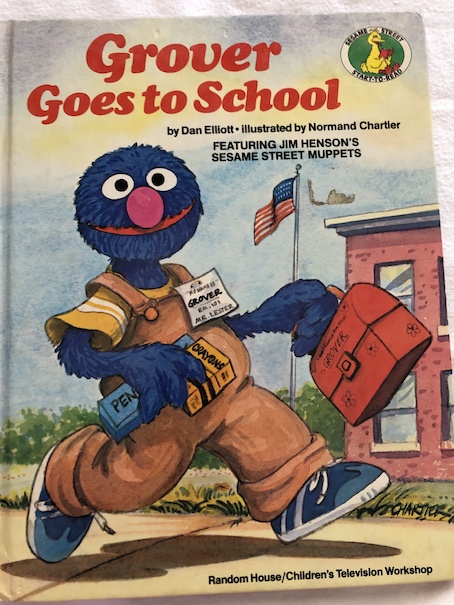
Grover Goes to School

Grover Goes to School by Dan Elliott, illustrated by Normand Chartier, 1982.

This nostalgic picture book about a child’s first day of school features Grover, one of the characters from the Sesame Street tv show.

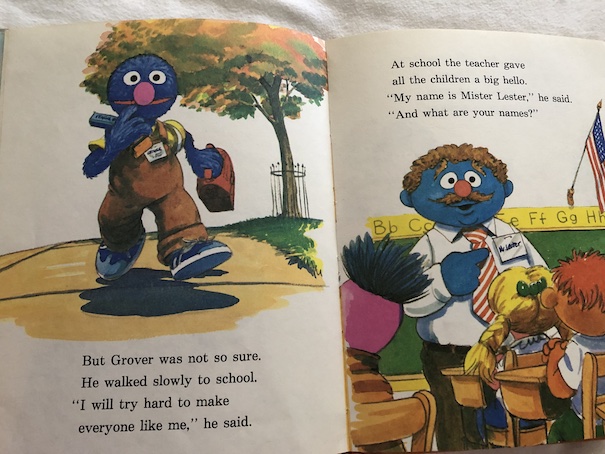
Grover is very exited about his first day at school. He’s ready and has everything he needs, but then, he starts to worry about whether the other kids at school will like him or not. His mother tells him that all he needs to do is be himself, but Grover decides he’s going to try hard to get everyone to like him.

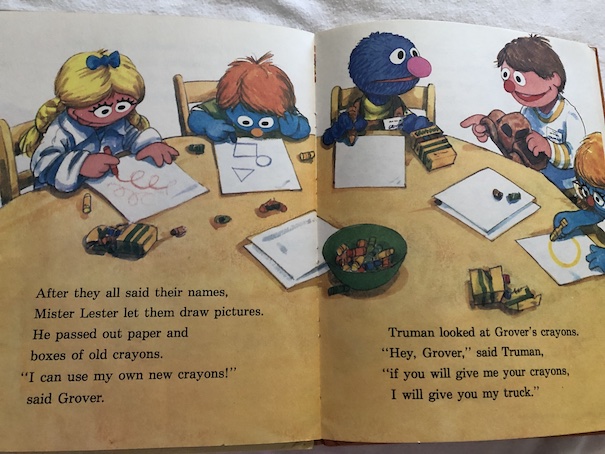
Grover’s attempts to get the other kids to like him cause him to agree to do things that he doesn’t really want to do. When a boy named Truman likes Grover’s nice, new crayons and offers to trade him his old toy truck for the crayons, Grover doesn’t really want to make the trade, but he agrees because he wants Truman to like him.

Then, Grover offers to clean up while the other kids have snack time. Grover does a good job cleaning, but the others forget to save a cookie for him.

The day gets worse with Grover helping the others play jump rope when he doesn’t want to and feeling obligated to trade his lunch for food that he doesn’t want. Finally, Grover bursts into tears

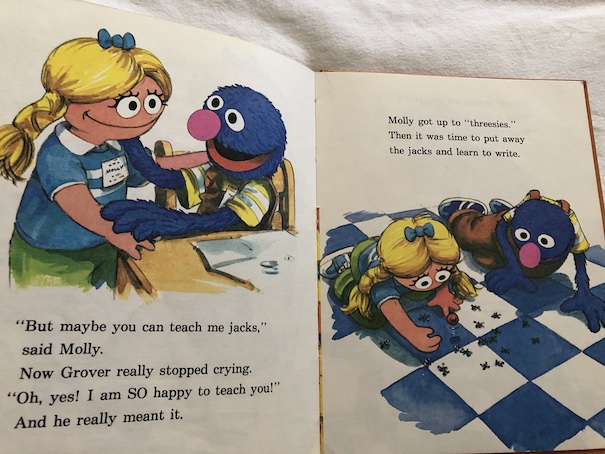
Seeing Grover sad and upset, a girl named Molly asks him what’s wrong. Grover explains everything that’s been happening to her, and she says that she’ll play with him and cheer him up. Molly doesn’t know how to play jacks, which is Grover’s favorite game, but she says that she’d like to learn, and Grover enjoys teaching her.

When a boy named Bill offers to trade his old pencil box for Grover’s nice, new one, Grover decides to say no and keep the pencil box he loves. Grover worries that Bill might be mad at him, but he’s not. Instead, it turns out that Bill also likes jacks.

Making friends with Molly and Bill turns Grover’s day around, and by the time he comes home, he’s feeling much better about school.

The book is available to borrow and read for free online through Internet Archive.

My Reaction

I loved this picture book when I was a kid! I used to watch Sesame Street as a young child, and I liked Grover, who is a shy monster kid who just wants to be friends with other people. In this book, he not only shows little kids how to get used to school on their first day but also teaches a lesson about trying too hard to get people to like you and what it means to be a real friend with someone. Grover realizes that he doesn’t have to do things he doesn’t want to do or give people things to buy their friendship. People still like him even if he sometimes tells them “no.” Like his mother says, he just needs to be himself, and he learns to make friends in ways that are comfortable to him, finding kids who genuinely care about others’ feelings and share common interests.

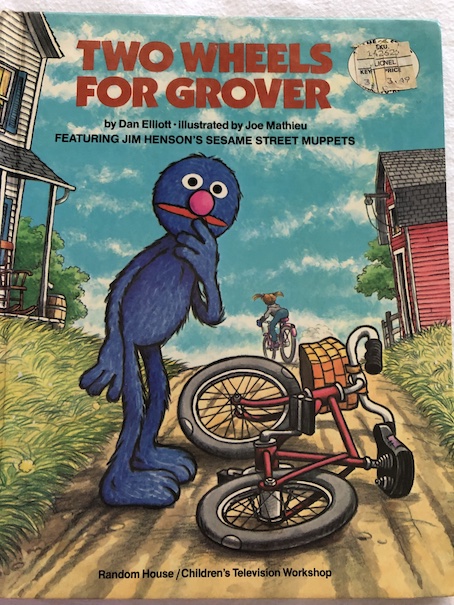
Two Wheels for Grover

Two Wheels for Grover by Dan Elliott, illustrated by Joe Mathieu, 1984.

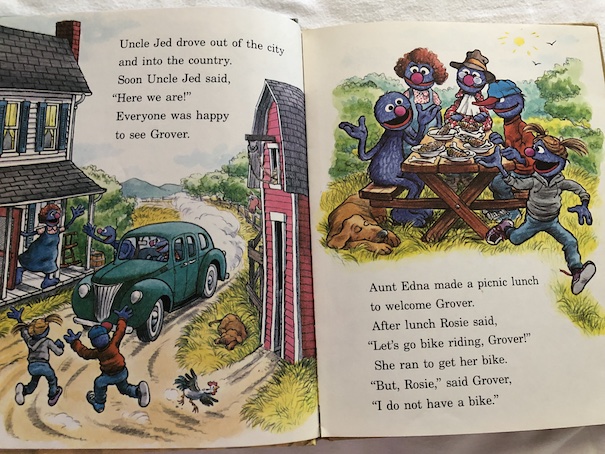
Grover is happy about going to visit his aunt, uncle, and cousins in the country, but the visit becomes a little awkward when his cousin Rosie wants him to go bike riding with her. Grover doesn’t know how to ride a bike.

He points out to Rosie that he doesn’t have a bike to ride, but she offers to lend him one. Not wanting to admit that he can’t ride a bike and being too afraid to learn how, Grover keeps making excuses about why he can’t ride a bike.

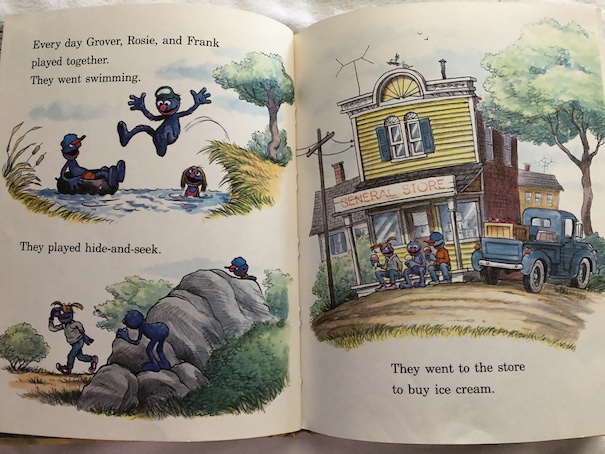
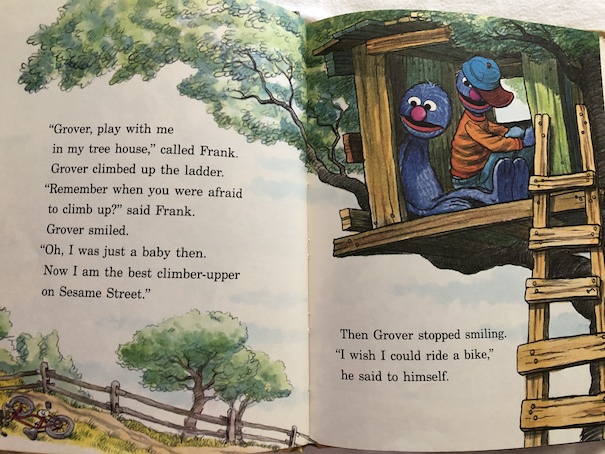
There are still plenty of other fun things to do with his cousins, but the problem of not being able to ride a bike still bothers Grover. Rosie keeps trying to find ways around Grover’s excuses, and Grover keeps trying to find new ones. Secretly, he wishes that he could ride a bike with Rosie, but he is too afraid that he can’t. Grover’s older cousin Frank points out to him that he loves playing in the tree house now, even though he used to be afraid to climb up to it.

Grover eventually confides in Frank his worries about riding a bike, and Frank understands. Big Bird once tried to teach Grover to ride a bike, but he couldn’t do it then, and he doubts whether he can learn. Frank says that the problem is that Big Bird’s bike was too big for Grover, but he could learn to ride a smaller bike, like Frank’s old one.

Although Grover is still nervous, he lets Frank teach him to ride, and soon, he discovers that he can ride a bike!

Grover learns to ride a bike just in time for Rosie to come and tell them that someone is giving away kittens. Now, Grover can ride over with Rosie to get a kitten for himself!

The book is available to borrow and read for free online through Internet Archive. It’s part of a series of picture books with the Sesame Street characters.

My Reaction:

This was a favorite book of mine when I was a kid, even though I found riding a bike much harder than Grover did. Some kids, like me, have more difficulty learning to balance than others, and it was often hard when other kids wanted me to come riding bikes with them when I couldn’t. Learning to ride a bike is one of those rites of passage that most people have during childhood, and it can be difficult for people who take longer to learn.

However, this book focuses on the rewards of perseverance. Just because Grover had trouble the first time he tried to learn to ride a bike doesn’t mean that he can’t do it. Frank understands that Grover is nervous about riding a bike, and it helps that he points out that there are other things that Grover has found difficult before that are now easy and fun for him, like climbing into the tree house. Learning new things can take time and multiple tries, but there are rewards for those who keep trying!

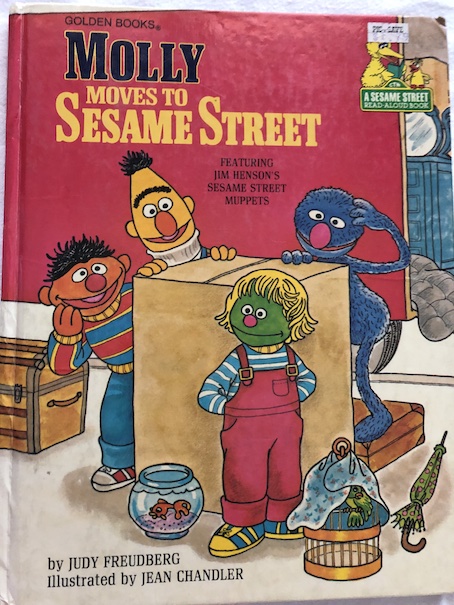
Molly Moves to Sesame Street

Molly Moves to Sesame Street by Judy Freudberg, illustrated by Jean Chandler, 1980.

The characters from Sesame Street greet a new neighbor who is getting used to a new home and needs some new friends.

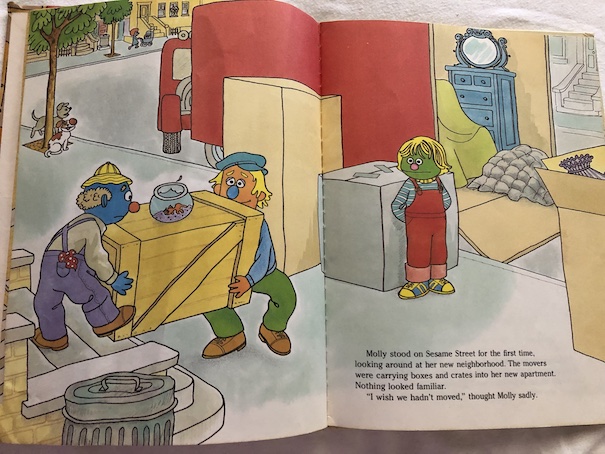
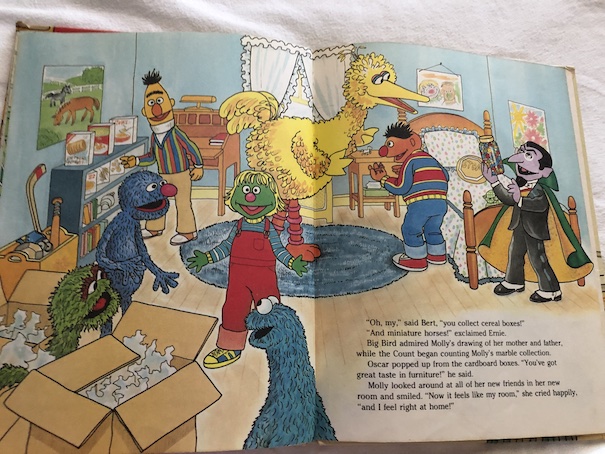
Molly and her parents are moving into a new apartment on Sesame Street, but Molly feels uncomfortable because nothing in this new neighborhood feels familiar. Her new room is still bare and doesn’t look or feel like home. Molly’s parents reassure her that it will feel more like home once all of her belongings are unpacked.

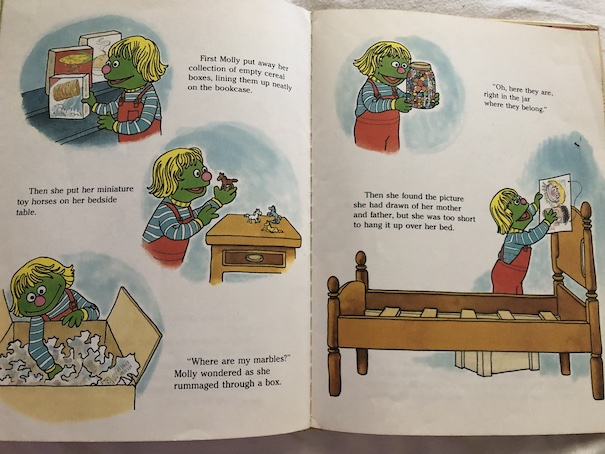
After Molly helps to unpack for awhile, her parents encourage her to go out, explore the neighborhood, and make some new friends. They say that, by the time Molly comes back, they’ll have things unpacked, and her new room will look much better.

When Molly first meets the characters from Sesame Street, they’re playing a game of hide-and-seek, but they all come out when she calls to them. They all introduce themselves to Molly and invite her to join their game.

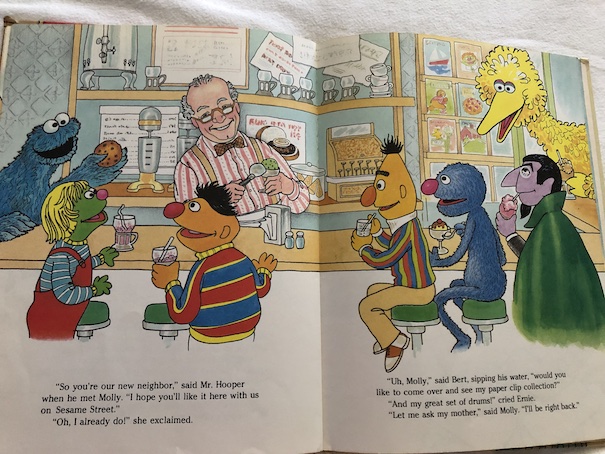
After they play, they all go to Mr. Hooper’s store for ice cream and sodas. Molly is happy that she’s having fun and starting to make friends, and she’s starting to like her new neighborhood.

When Molly returns to the apartment, her parents have finished unpacking and arranging her new room. Molly is happy because it looks and feels more like home, and she invites her new friends to come over and see it.

This is a fun and reassuring picture book for young children that shows how making a new home look familiar and making new friends can help them to feel more at home when they move to a new place.

The book is available to borrow and read for free online through Internet Archive (multiple copies, some in different languages), but some later printings of the book have different illustrations and include Elmo, who wasn’t in the first edition of the book.

The Mad Scientists Club

The Mad Scientists Club Series

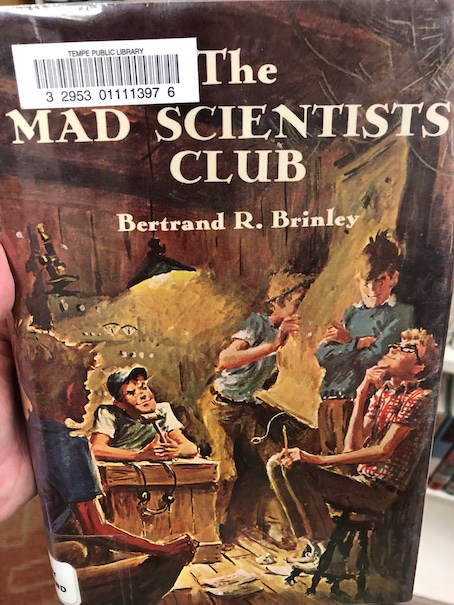
The Mad Scientists Club by Bertrand R. Brinley, 1965, 2001.

The Mad Scientists Club series is about a group of boys who like science and make things in their clubhouse laboratory. Their inventions are often part of pranks that they play on their town, Mammoth Falls, but the boys also use their inventions and skills to help people. People in town are aware that the boys pull pranks and stunts, but they are often unable to prove the boys’ involvement in particular pranks, and the boys typically keep the methods they use secret.

Henry is the idea man of the group, and the club’s rival is a former member named Harmon. Harmon’s cousin is still a member of the Mad Scientists Club, and Harmon likes to spy on them and pump his cousin for information so he can mess up their plans out of spite.

Each chapter in the book is its own short story about the club’s antics. Some of the stories originally appeared in Boys’ Life magazine in the 1960s. The stories are a good fit for Boys’ Life because some of the skills the boys use are skills that are taught in Boy Scouts, like what to do when someone is injured and how to tie different types of knots.

The stories reference scientific and mathematical principles, and the boys are methodical in their approaches to the problems in each story. The technology is old by modern 21st century standards (and so are some cultural references, like McGee’s closet), but the principles are sound. There are no projects for readers to do themselves in the book, but it does occur to me that these types of stories could work well with some included activities or nonfiction accompaniment.

The first story in the book was made into a live action tv movie by Disney, The Strange Monster of Strawberry Cove (1971), but the movie has different characters from the ones in the book. The Disney movie uses the same set of characters they used for their movie version of Secrets of the Pirates’ Inn (based on The Secrets of the Pirate Inn). The plot of The Strange Monster of Strawberry Cove is also very different from the original story because, in the Disney movie, the kids don’t know what the “monster” is at first and need to investigate it, whereas the boys in the Mad Scientist Club know exactly what the monster is in their story because they built it themselves. You can watch the movie online through Internet Archive, but unfortunately, I couldn’t find an online copy of the book.

Stories in the Book:

The Strange Sea Monster of Strawberry Lake

Dinky accidentally starts a town-wide rumor about a sea monster in the lake when he makes up a story about seeing a strange creature in the lake when he needs an excuse for arriving home late. His friends know it’s just a story, but they decide to play along and build a monster of their own out of canvas and chicken wire and scare people as a prank. Even though people in town are scared of the monster, the attention the town receives is so good for local businesses, the boys can’t bring themselves to stop their prank. Instead, they decide to make their monster more elaborate, and things start to get out of hand. How can they end the hoax while saving the town’s image and avoiding punishment?

Night Rescue

An Air Force plane explodes near the town of Mammoth Falls. The pilot escaped from the plane, but he’s now lost in the woods. The local authorities are searching for him, and the boys in the club want to help. The mayor doesn’t want the kids involved, knowing their usual pranks and stunts, but the Air Force colonel is willing to let them help, if they think they can, because he just wants his pilot rescued. The boys use a flare to determine which way the parachuting pilot would have drifted, and then, they calculate about how far he would have drifted to find him.

The Unidentified Flying Man of Mammoth Falls

The boys find an old department store manikin and keep it in their clubhouse until Henry gets the idea for how they can use it in an elaborate prank on the town’s Founder’s Day. They’re going to make the manikin fly!

The Secret of the Old Cannon

The town’s old cannon from the Civil War is a local landmark now. (We don’t know what state Mammoth falls is in, but there are statues of Confederate soldiers next to the cannon.) Years ago, the town filled the barrel with cement, so it can never fire again. Around the time that the cannon was filled in, there was a bank robbery in town, and some of the boys in the Mad Scientists Club think that the money might have been hidden in the cannon before it was filled with cement. The boys try to figure out how they can prove whether or not the money’s in there without removing all of the cement. Someone else also wants to know the answer to that, and the answer may be important to the upcoming race for mayor.

The Great Gas Bag Race

Henry has an idea for a new kind of balloon that he thinks will help the Mad Scientists Club win the balloon race, but the club’s rival, Harmon, is also entering the race.

The Big Egg

The boys are digging for fossils in the local quarry when they find a dinosaur egg! At first, they’re not quite sure what to do with it. They consider selling admission for people to come see it or maybe turning it over to a museum, but Henry announces that he has another idea. Henry wants to bury the egg in the ground and see if it hatches. It seems unlikely, but the other boys agree to try it. Then, when a couple of the boys go to check on the egg, they discover that it’s missing! They bring their friends back to look at it, and suddenly, the egg is there again! What’s going on? Did someone take the egg and then return it? Is this another one of Harmon’s tricks?

The Voice in the Chimney

One day, some of the boys in the club see Harmon throwing stones at an old, abandoned house in town while some girls watch him. Wondering what he’s doing, they get closer and hear him challenging the ghost that supposedly haunts the old house, trying to impress the girls with his bravery. The boys are disgusted because they know Harmon isn’t really that brave, and they hate seeing him show off for the girls. When they hear Harmon brag that he’s going to come back to the house at night, they tell the rest of their club, and the boys decide to put on a haunted house act of their own to scare Harmon. In the process, they also end up scaring the mayor and the chief of police!

Jessamy

Jessamy by Barbara Sleigh, 1967.

I couldn’t find a copy with its dust jacket intact.

Jessamy is a British orphan who is being raised by her two aunts, Millicent and Maggie. The two aunts aren’t really raising her together, though. Jessamy lives with Aunt Millicent during the school year, and she goes to stay with Aunt Maggie during school holidays. Truth be told, Aunt Millicent (her mother’s sister) and Aunt Maggie (her father’s sister) don’t really like each other, and they have different priorities and goals for Jessamy’s future. Aunt Millicent is doing her best to help Jessamy be pretty and popular, making sure that she wears a retainer to straighten her teeth and only allowing her to associate with “nice” children (apparently meaning ones from “good” families in the sense of social connections, who mostly don’t like Jessamy – Jessamy is usually not allowed to play with the children she actually likes and who like her). On the other hand, Aunt Maggie doesn’t care about beauty or popularity and just wants Jessamy to be well-behaved. Jessamy is confident that she is disappointing both of her aunts in all of these qualities. Her aunts are fond of her, but they are also occupied with their own lives. Aunt Millicent has her work, and Aunt Maggie has two children of her own, so Jessamy really has only half of their attention at any particular time.

However, Jessamy’s usual bouncing between her aunts is interrupted one summer when Aunt Maggie’s children, Jessamy’s older cousins Muriel and Edgar, catch whooping cough. Jessamy hasn’t had whooping cough herself, so she wouldn’t have any immunity. Rather than bring Jessamy into the household and have her end up sick, too, Aunt Maggie realizes that she has to find another place for her to stay until the other children are better. Jessamy can’t go back to Aunt Millicent because Aunt Millicent is leaving on a business trip, so Aunt Maggie arranges for Jessamy to stay with Miss Brindle, who is the caretaker of a large old house known to locals as Posset Place.

Miss Brindle is an older woman and is not used to spending time with children. Although Jessamy doesn’t really get along with her cousins, she isn’t sure if she’s going to like staying with Miss Brindle. However, Miss Brindle isn’t bad. She isn’t fond of Muriel or Edgar, either, and she says right up front that she’s glad that Jessamy seems different from her cousins. She also says that she’s going to treat Jessamy like an adult because she doesn’t know much about children, which suits Jessamy fine.

Miss Brindle tells Jessamy a little about the history of the old house. Posset Place was built in 1885 by a man named Nathaniel Parkinson, who made his money from producing a cough syrup called Parkinson’s Expectorant Posset. The house is largely empty now, except for the housekeeper’s quarters, where Miss Brindle now lives. Miss Brindle spends her time making sure the rooms are kept clean and well-aired.

Miss Brindle lets Jessamy explore the house a little before supper, and in particular, Jessamy is fascinated by the empty nursery. She finds herself imagining the children who used to live there and the toys and books the nursery once held. Then, she notices markings on the wall where the children’s heights were recorded, and she sees that one of the children was also named Jessamy. She tries to ask Miss Brindle about it, but Miss Brindle isn’t aware that there were any names written on the nursery wall.

During the night, Jessamy wakes up, still thinking about seeing her own name written on the wall of the nursery. She could have been mistaken, but it bothers her to the point where she feels like she has to go look at it again. Taking her flashlight, she goes upstairs again to look at the names. However, this time, the nursery is not empty, like it was before. There are clothes hanging on the wooden pegs on the wall and a line of shoes on the floor. When she checks the old measuring marks, she sees that there are fewer marks than she remembered before, but one of the names is definitely Jessamy, and the year next to that name is 1914. Jessamy lives in 1966 (contemporary with when the book was written), but the day in 1914 is the same day that she came to stay with Miss Brindle – July 23rd.

Then, to Jessamy’s surprise, she suddenly realizes that she is holding a lit candle instead of her flashlight. At first, Jessamy thinks that she must be dreaming, but then, an angry young woman comes and tells her that she should be in bed because she’s ill, not running around with a candle. The woman threatens to tell her aunt about this. When the woman lights her lamp, Jessamy sees that the nursery is now fully furnished.

It seems that Jessamy has gone back in time to 1914 and has been mistaken for the Jessamy who lived in the house in the past. The woman, who is Miss Matchett, the parlor maid, says that the other children named in the height markings – Marcus, Fanny, and Kitto – are all asleep and that it’s nearly midnight. The Jessamy of the past is the niece of the cook-housekeeper, which is why she is allowed to be with the children of the house. Jessamy’s head hurts, and she realizes that there is suddenly a bandage around it. Miss Matchett says that she fell out of a mulberry tree.

Jessamy realizes that the housemaid is only awake at this late hour and fully dressed because she had just returned from slipping out of the house secretly. When she points it out, Miss Matchett admits that she sneaked out to see her gentleman friend, and she says that if Jessamy doesn’t tell on her for doing that, she won’t tell her aunt that she was out of bed. Jessamy agrees, and Miss Matchett leads her back to her bed in the housekeeper’s quarters.

When Jessamy wakes up in the morning, she expects to find that everything that happened in the nursery during the night was a dream, but it isn’t. The room is the same one Miss Brindle gave her in the housekeeper’s quarters, but the bed and furnishings of the room are different. Jessamy is woken by a woman she’s never met before, not Miss Brindle.

This woman is the past Jessamy’s aunt, who tells her that she has had approval to stay on as the cook-housekeeper for the Parkinson family with Jessamy living with her. Not every household would accept a housekeeper with a young niece to raise, but as Nathaniel Parkinson himself says, the Parkinsons are not an ordinary family. Nathaniel Parkinson is a self-made man, from a humble background in spite of his current fortune, so he doesn’t put on airs, like other men of his current class. His granddaughter, Miss Cecily, at first disapproves of Jessamy, thinking that she might be too “common” (like the friends Jessamy’s Aunt Millicent disapproves of) and that she might not be a good influence on the children of the house, her younger siblings, who she is helping to raise. However, past Jessamy’s aunt defends her, and Nathaniel Parkinson says that she might actually be good for other children. He thinks Fanny has been acting too fine, and Kit could use the company of another child his age.

Jessamy is happy when she learns that past Jessamy has made friends with the Parkinson children and has really become part of the household. She is told that Fanny still thinks of her as being just the niece of a servant, but Kit (aka Kitto) is her special friend. Jessamy also likes this 1914 aunt better than her 1966 aunts because she seems nicer and more her kind of person. The realization that this is not a dream but that she has really traveled back in time is worrying, but Jessamy tells herself that she will somehow find her way back to her own time and that she should enjoy 1914 as much as she can while she can.

From the housemaid, Sarah, Jessamy learns that the Parkinson children live with their grandfather because their parents were killed in a carriage accident. Miss Cecily, the oldest girl in the family, takes care of her younger siblings and tries to manage the household while her oldest brother is away at Oxford. Miss Cecily is still learning about the running of a household, so past Jessamy’s aunt, Mrs. Rumbold, has to help her.

Jessamy also learns that she fell out of a tree house that she and Kit built together and that Fanny, who was also in the tree house at the time, was particularly upset by her accident. Fanny confesses to Jessamy that the reason she fell was because she pushed her. She hadn’t meant to push her out of the tree house or for her to fall, but the two of them were having an argument at the time. Fanny felt guilty about her getting hurt, but she’s still angry that Jessamy will be staying on at the house. She thinks that her grandfather and older sister decided to let her and her aunt stay partly because they felt badly about her getting hurt. Although Fanny is grateful that Jessamy didn’t tell on her for causing her accident, she still isn’t happy that Jessamy will be living with them. Fanny does put on airs, but she openly admits that she does it because everyone seems to be against her. Girls at school teasingly cough around her all the time because her grandfather made his money with his cough syrup, and since Jesssamy came, she feels like her brothers always side with Jessamy instead of her. Fanny has been in trouble before for bad behavior, and her brothers know that their grandfather has said if she does it again, he’ll send her to boarding school. Jessamy thinks that the idea of boarding school sounds exciting, but her brothers say that Fanny would hate it.

In spite of the drama with Fanny, Jessamy enjoys her time in 1914 and the other people there. She has the feeling that something important happened in 1914, and she remembers what it was when Nathaniel Parkinson and Kit talk about the possibility of war with Germany. Jessamy realizes that the coming war is going to be World War I and that it is going to start soon. Harry, the oldest boy in the Parkinson family, is back from Oxford, and he talks about how exciting it would be to be a soldier if there is a war, but Nathaniel Parkinson isn’t excited, understanding more about the nature of war than his grandchildren. Harry’s grandfather wants him to finish college, but Harry is in debt and wants to take his future into his own hands. Harry runs away, and at the same time, a valuable antique book belonging to his grandfather disappears. Jessamy doesn’t like to think that the pleasant young man stole his grandfather’s book, but what other explanation is there?

Just when Jessamy is getting caught up in the events in the Parkinson household and is concerned about the future of the past Jessamy and her aunt, Jessamy finds herself once again in 1966. Is it still possible for her to return to 1914 or learn what happened to the people she’s grown so fond of? Jessamy also begins to wonder who is the current owner of this old house and Mrs. Brindle’s employer? Learning the answers to those questions also explains a few things about Jessamy’s own family and past and gives her the one thing she really wants most.

The book is available to borrow and read for free online through Internet Archive (multiple copies).

My Reaction and Spoilers

This story is a combination of fantasy and mystery, a combination that I always like. In some ways, this story reminds me of Charlotte Sometimes because the time switching takes place between similar eras, but there are some notable differences between the two books. Charlotte Sometimes took place at a boarding school, and Charlotte went back in time to the end of WWI, not the beginning. There was also no mystery plot in Charlotte Sometimes beyond Charlotte trying to figure out how and why she is switching places with a girl in the past. Also, in Charlotte Sometimes, it isn’t clear whether Charlotte influenced or changed anything in the past, but Jessamy definitely does. The modern Jessamy had to be the one to solve the mystery because she has access to information that the past Jessamy didn’t have.

In the past, Jessamy begins investigating the mysterious theft of the valuable book. Although she knows that Harry isn’t the type to steal from his grandfather, it takes a second visit back in time for her to discover who the real thief is and to clear Harry’s name. Unfortunately, she is unable to actually find the stolen book in the past to return it to its first owner. It is through a new friend that she makes in 1966 that she learns what really happened to the book and is able to return it to the current owner of the house … an old friend of hers from 1914.

Along the way, Jessamy also learns a few things about the history of her own family. She realizes at the beginning of the story that Jessamy is an unusual name, which is why she is surprised that the girl in the past is also called Jessamy. It turns out that Jessamy is a name that is passed down through her family. She is not a direct descendant of the past Jessamy, as I first suspected, but the past Jessamy is a relative of hers. She also comes to understand that her family used to be more grand, but during the past, they fell on hard times. This is also important to the story because class differences figure into the plot.

Everyone in 1914 is concerned about class differences, but in different ways. Nathaniel Parkinson is actually the least concerned with class because he has actually shifted to a higher class during his lifetime, making him aware that people from different classes are really just people, only in different circumstances. His granddaughters are more class conscious, although both of them also soften on that after getting to know Jessamy better. Even the servants are also class conscious, with some of the servants putting on airs because they’re above other types of servants.

Something that surprised me in the story is the realization, toward the end of the book, that class differences are partly the reason why Aunt Millicent and Aunt Maggie don’t get along. Aunt Millicent’s efforts to make Jessamy more pretty and popular and have her be friends with certain people are social-climbing efforts, partly because Aunt Millicent is aware of their family’s past and wants the family to climb up from their humbled circumstances. Aunt Maggie’s disapproval of Aunt Millicent seems to come somewhat from her disapproval of Millicent’s efforts at social-climbing or trying to act like she’s more grand than she actually is. It isn’t stated explicitly, but it is heavily implied. We don’t meet Millicent in the book, but from her description, I suspect that she disapproves of Aunt Maggie because she thinks of her as being too “common.” From the characters’ descriptions of Maggie’s children, it seems like people who don’t like them think of them as being “common” or uncreative, indicating that this branch of Jessamy’s family is rather prosaic, being typical in a rather dull way.

The objective reality is probably that Jessamy’s two aunts are not very far apart in their social status, but they have different attitudes toward their social status. Aunt Maggie doesn’t care much about it. She fits in well where she is, she doesn’t care about moving up in society, and she just focuses on the children behaving well within their social status. Aunt Millicent, however, has a high opinion of who she is and where the family ought to be in society, and she is focused on moving up. Jessamy doesn’t really fit with either of her aunts’ philosophies of life. What she really wants is the chance to make real friends and fit in somewhere with people who like her and who like the sort of things she likes. She gets the opportunity at the end of the story when the current owner of the old house becomes her benefactor and arranges for her to attend boarding school, which she has said is something that she’s always wanted to do. At boarding school, Jessamy will be out from under the direct supervision of both of her aunts and will have the opportunity to develop independently and make new friends who suit her, rather than her aunts.

Even Fanny finds boarding school beneficial. We don’t know exactly how her life ended up in the 1960s, but when Fanny realizes that she’s caused problems for the past Jessamy in more ways than one and that she needs to admit the truth to her grandfather and older sister, her character develops for the better. She begins to develop empathy and compassion for the past Jessamy, looking beyond feeling sorry for herself to feeling something for another person she has directly harmed, and she reforms her character. She accepts the consequences for her actions, even though she was afraid to do so before, and it leads her to better things because the consequences are not as bad as she thought and actually help her. Although she was initially afraid of being sent away from her family, when her grandfather decides that she needs the discipline and sends her to boarding school, she discovers that she actually likes it. Going to boarding school allows her to get away from the girls who were bullying her at her local school and make new friends, and she develops some self-confidence from the experience, turning into a young lady who helps her older sister in her volunteer work for the war effort.

One final thought I had is that every time I’ve ever read a book with a sickness like whooping cough in it, I feel like it really dates the book. I know this book does have a specific date by design, and I know people still catch whooping cough in the 21st century if they haven’t been vaccinated (get your tetanus shot – in the US, the tetanus shot includes the whooping cough vaccine), but to me, this type of illness feels like a time travel back to my parents’ youths by itself. My parents and their siblings had whooping cough when they were young, but I’m almost 40 years old and have never seen a case of it myself.

Carrie’s War

Carrie’s War by Nina Bawden, 1973.

The story begins with an adult Carrie reflecting on her youth during World War II, taking her children to see the place where she stayed as a child evacuee and remembering an incident that has haunted her for the last 30 years. Adult Carrie is a widow who was married to an archaeologist who died only a few months before the story begins. In some ways, Carrie says that her husband was very much like a boy she used to know during the war, Albert Sandwich. The family trip and Carrie’s memories take them back to a small mining town in Wales and an old house called Druid’s Bottom, now a ruin, that used to house a mysterious skull … and what Carrie regards as the worst mistake of her life. Although adult Carrie knows that, logically, what happened couldn’t have really been her fault, there are some things in life that are difficult to prove or disprove, and she’s always blamed herself for what happened.

When Carrie Willow was eleven years old, she and her younger brother, Nick, were evacuated from London along with other children to avoid the bombings. All of the children were told to report to their schools with a packed lunch and a change of clothes, and none of them had any idea where they would be taken after that, only that their parents wouldn’t be going with them. Their mother tried to frame it all as a great adventure that they would enjoy, but the children were understandably worried. They had to wear labels on their clothes with their names on them, and they had to carry gas masks, which is never a reassuring thing to be told you might need. (Young Carrie thinks to herself that her mother is such an optimist that, if they found themselves in Hell, she’d look on the bright side and say, “Well, at least we’ll be warm.”)

The children’s teacher takes them aboard a train, and they head off into the countryside, ending up at a coal-mining town in Wales that doesn’t look like much. That’s where Carrie meets Albert, another boy who rode with them on the train. Albert is tall and serious and wears glasses. His first concern is that the town isn’t big enough to support a proper library. Carrie is mostly concerned about keeping her brother with her and making sure that someone will be willing to take them both together. (Hosts for WWII evacuees were told how many children they were expected to take in, but they were given the opportunity to choose which ones they would host from among the children available. Sometimes, siblings were split up if they couldn’t find accommodations that could house them together.)

Carrie and Nick are eventually chosen by Miss Evans, a woman who lives with her brother. Originally, Miss Evans had been hoping for two girls so they can share the one spare room that she and her brother have, but Carrie persuades her that she and Nick sometimes share a room at home because he has bad dreams. Miss Evans is a shy and nervous woman, and her brother, Samuel Evans, is ultra-strict and fussy. Everything in their house is super neat, and they have special rules to keep it that way. Carrie and Nick aren’t even accustomed to picking up after themselves because their family has a maid who does all the cleaning. The house has a bathroom with running hot and cold water, but if they have to go to the bathroom in the middle of the day, Mr. Evans wants them to use the outdoor one in the yard to avoid messing up the new carpet on the stairs with too much “traipsing” up and down. Even Miss Evans uses the outdoor bathroom, although Samuel Evans never does because he thinks it’s unseemly because of his position in the community as a store owner and town Councillor. So, for starters, Mr. Evans makes strict rules for others to follow that he doesn’t follow himself.

Carrie can tell right from the first that Samuel Evans is a bully who pushes people around, especially his sister. He’s much older than his sister and helped to raise her after their parents died. Really, Miss Evans was raised with Mr. Evans’s son, Frederick, who is now in the army, being more like her brother than her nephew. Now that Mr. Evans’s wife is dead, there’s no one else in the household but the two of them. When Miss Evans and Frederick were young, Mr. Evans used fear, intimidation, and harsh physical punishment to keep them in line. However, Mr. Evans can’t really bully the children because Carrie is careful not to show that she finds him intimidating, and Nick just isn’t intimidated because he refuses to be impressed by anybody with false teeth. Still, Carrie realizes that they should try to keep out of his way and not make him angry.

Samuel Evans is also very strict about religion. One day, when Nick eats some biscuits in his shop, Mr. Evans declares that he’s been stealing and that he’s going to get the strap for it. Carrie is horrified because their parents don’t use physical punishment, and Nick is terrified. Miss Evans is too afraid to intervene, so Carrie steps in and defends Nick, just saying that he didn’t understand that it was stealing to eat the biscuits. Mr. Evans says that’s not a good excuse, but Nick says that if he whips him, he’ll go to school and tell the teacher that Mr. Evans beat him for taking food because he was hungry. Mr. Evans realizes that, while other adults might not fault him for punishing a thief, they would if it looked like he was starving and neglecting his charges as well as beating them. Instead of giving Nick a beating, he prays out loud for Nick to turn from his “evil ways.” It’s difficult for Carrie to listen to because she realizes that Nick hasn’t been starved, wasn’t really hungry, and should have known better than to take the biscuits, and now, he’s made an enemy of Mr. Evans. They don’t have much choice other than staying in the Evans house because they can’t go back to their parents yet, and there just aren’t any other places in town for them to stay. The kids become fond of Miss Evans, who they start calling “Auntie Lou”, but they always have to be wary of Mr. Evans.

When their mother comes to visit, Mr. Evans acts extra nice to the children and tries to be charming to their mother. The children’s mother has some misgivings about how the children are being treated, but the children don’t complain about some of the harder aspects of living with Mr. Evans because they don’t want their mother to worry. She’s been working as an ambulance driver in Glasgow because her husband’s ship makes port there, and she can see him sometimes. She needs to know that her children are safely settled somewhere to continue her work, and the children have also grown attached to Auntie Lou and don’t want her to get into trouble, even if they don’t like Mr. Evans.

Shortly before Christmas, Auntie Lou explains to the children that she and Mr. Evans have an older sister named Dilys, and she’s giving them a goose for Christmas dinner. The reason why the children haven’t met Dilys before is that Auntie Lou and Mr. Evans don’t really get along with her and hardly ever see her. Mr. Evans in particular resents Dilys because, years ago, she married into the Gotobed family. The Gotobeds owned the mine nearby where their father was killed in an accident. Mr. Evans always blamed the Gotobeds for their father’s death because they didn’t have adequate safety measures, and he felt like Dilys was turning her back on the family by marrying Mr. Gotobed’s son. Now, Dilys is a widow, and she’s not in very good health, which is another reason why she doesn’t get out much. She lives in the old house known as Druid’s Bottom, at the bottom of Druid’s Grove, where the yew trees grow. A woman named Hepzibah Green looks after her and the farm where they raise poultry. Local people are rather superstitious about Druid’s Grove, but Carrie thinks it sounds wonderfully spooky and exciting. Auntie Lou and Mr. Evans send Carrie and Nick to Druid’s Bottom to pick up their Christmas goose from Hepzibah Green because Auntie Lou gets sick and can’t go herself.

On the way to Druid’s Bottom, Carrie and Nick are scared because they think they hear something chasing them, making odd sounds. It turns out that it’s only Mister Johnny, a cousin of Mr. Gotobed, Dilys’s deceased husband. Mister Johnny has developmental disabilities and can’t talk very well or understandably to most people, which is why he lives with Dilys in Druid’s Bottom and is cared for by Hepzibah. Hepzibah has been Johnny’s nurse since he was a baby, and she now cares for the elderly and ill Dilys as well.

Albert Sandwich has been staying at Druid’s Bottom, also in Hepzibah’s care, since Carrie and Nick last saw him. Albert tells them that Hepzibah is a kind of witch who knows some kind of healing magic. Albert hasn’t been to school with the other children because he was very sick after they last saw him, and Albert thinks that he only survived because Hepzibah gave him herbal medicines. Albert loves Druid’s Bottom because of Hepzibah and also because the old house has an impressive library. In the library, Albert also shows Carrie a strange curiosity – an old skull. The story surrounding this skull is that it’s the skull of an African slave boy who was brought to this house years ago. (Albert explains to Carrie that he doesn’t believe that because he’s examined the skull. He explains that the number of teeth suggest that the skull was from an adult, not a boy, and the size and shape suggest that it’s the skull of a woman. Albert suspects that some local person actually found the skull at the site of an Iron Age settlement nearby.) According to the legend of this skull (or what people say the legend is), the young slave boy died of a fever, and on his deathbed, told the Gotobed family that they must keep his skull in the house or the walls would fall. Hepzibah says that one of the Gotobeds’ ancestors tried removing the skull from the house once, and during the night, all the crockery in the kitchen broke and the mirrors in the house cracked for no apparent reason. When they brought the skull back into the house, they didn’t have any further problems. Albert is skeptical of this story, but it’s captivating for Carrie.

Carrie finally meets Dilys Gotobed one day when everyone else is busy and Hepzibah asks her to take tea up to Mrs. Gotobed. Dilys is a sad and weak old woman who doesn’t have much time left to live. She lives mostly in her memories, spending each day wearing the fancy ball gowns that her husband bought for her years ago one last time before she dies. All of her talk of death gives Carrie the creeps, but Dilys makes her promise to take a message to her brother after she dies. She insists that the message must be delivered only after her death because it’s sure to make Mr. Evans angry and Dilys isn’t up to dealing with his anger. The message is somewhat cryptic. Basically, Mrs. Gotobed wants Mr. Evans to know that she hasn’t forgotten him and she remembers that they’re still brother and sister, but she feels like she owes more to others than she does to family. Dilys has done something that is sure to make Mr. Evans angry, but she wants him to know that she did it only because she thought it was the right thing to do and not just to spite Mr. Evans. Carrie reluctantly agrees to deliver the message after Dilys is dead.

The meaning of the message becomes clear when Dilys finally does die. Dilys’s only relatives are Mr. Evans and Auntie Lou, but she wanted to provide for Hepzibah and Johnny because of their companionship over the years. At first, Carrie thinks that Mr. Evans will be reassured that his sister thought of him near the end, but Carrie hasn’t fully grasped Mr. Evans’s reactions. Mr. Evans flies into a rage at the suggestion that Hepzibah might inherit from Dilys instead of him. He storms over to Druid’s Bottom to search for a copy of Dilys’s will to establish who is going to inherit. Mr. Evans later says that he couldn’t find one, and even Dilys’s lawyer says that Dilys’s didn’t make a will or leave one with him. If that’s true, and there is no will, Dilys’s estate would go to her nearest relatives, which basically means Mr. Evans. But, is that the truth?

While Dilys may have meant to provide for Hepzibah and Johnny, she was so ill near the end of her life that she may have forgotten about making a will. Her mind wasn’t entirely there, so she may have thought that she’d already done it when she hadn’t. However, there is another explanation. What if Mr. Evans did find something in writing from Dilys about her last wishes for her estate? What if he stole or destroyed Dilys’s will or something she left behind? That’s what Albert believes. He’s ready to believe the worst about Mr. Evans because he is unquestionably a mean, bitter, and vindictive man, but Carrie still has trouble believing that Mr. Evans could do something so deliberately evil. Albert somewhat blames Carrie for delivering the message Mrs. Gotobed gave her for Mr. Evans, alerting him to the possibility that there might be another heir to the estate, depleted though that estate is. Carrie was only doing as Mrs. Gotobed asked as one of her final wishes, but Carrie does feel responsible, especially if Mr. Evans did what Albert suspects.

In the midst of Carrie’s guilt that Mrs. Gotobed’s wishes are not being honored and her anger at Mr. Evans for wanting the house all to himself and kicking out Hepzibah and Johnny, Carrie decides that there’s only one thing left to do in order to make sure that Mr. Evans never takes possession of the house. It’s a terrible, impulsive decision, and it’s only after she’s done it that Carrie realizes that she also may have misjudged the situation yet again. It’s also only when she returns to Druid’s Bottom as an adult that she comes to see the full truth of the situation and that what she’s done may not have been as bad as she thinks.

This book is very well-known, and it was made into a television mini series in 1974 (you can sometimes find clips or episodes on YouTube) and a movie in 2004. The book is available to borrow and read for free online through Internet Archive (multiple copies).

My Reaction and Spoilers

I saw the 2004 movie before I read the book. The movie follows the book very well, and after I looked up the television mini series, I decided that it also follows the book well. The section in the back of the book about the author explains that Nina Bawden was also a child evacuee from London during World War II, so the book was partly inspired by her experiences.

In real life, when children were evacuated from London to be safe from the bombings during World War II, they went through some of the same feelings of homesickness and unfamiliarity that the children in this story also go through. First, they’re worried about being far from home. They don’t even know where they’re going and who they’re going to be staying with when they get there. During the scene where they’re being selected by foster families, they worry about who will choose them and what will happen to them if no one wants them. It’s all very realistic, and people who were among the child evacuees of the time describe going through a similar process.

There’s also the adjustment that the children have to make living in a household with unfamiliar people and different rules and circumstances from what they’re used to in London. London at the time was a large cosmopolitan area, like it is today, but back in the 1940s, small towns and houses in the countryside had far fewer amenities than in modern times. Real life child evacuees were accustomed to indoor plumbing in London, but they didn’t always find that in the places where they had to stay during the evacuation. The characters in the story find a mixture where they’re staying. The fussy head of the Evans household has indoor plumbing, but he doesn’t allow everyone to use it during the day because he doesn’t want everyone constantly going up and down his wonderful carpet on the stairs, so they also have to use the outdoor privy.

Mr. Evans’s fussiness and anger issues are also, sadly, true to life. The real life evacuees came from a variety of backgrounds and were accustomed to different styles of home and family life, and what they encountered in their foster homes during evacuation could be wildly different from the life they had at home, both for better or for worse. Some foster families could be warm and welcoming to the child evacuees, but sadly, many were not, resenting the new obligations that had been thrust on them because of the war. (Households were told that they had to accept evacuees if they had room for them, and there was no option to refuse.) There were foster families who ended up keeping or adopting children they took in during the war because they were orphaned or abandoned by their parents by the time the war ended. Some children ended up drawing closer to their foster families than their birth families because they came from an unhappy home life in the beginning, and they found themselves liking the new life they found. Others had a very unhappy experience, feeling unwanted, unwelcome, or even abused by their temporary foster families. Unhappy children could try to reunite with their parents, transfer to a different household, or even just run away, and some did all of these things. (To hear about the experiences of real life evacuees in their own words, listen to this documentary or this interview series on YouTube.)

In the story, Carrie and Nick seem to come from a happy home life with close-knit family. Their family is not poor because they could afford a nice house with a maid, and their parents seem kind and understanding and do not use physical punishment of any kind with the children. The Evans household is a step down for them. The fact that Mr. Evans, as a shopkeeper, doesn’t seem to have as much money as their family did when they lived in London isn’t so much of a problem as Mr. Evans’s personal issues and bullying nature. Mr. Evans is a troubled person, twisted by anger and resentment, and rather than dealing with these issues himself, he takes them out on other people, even people who are not the source of his anger and resentment.

As the story unfolds, the children learn about Mr. Evans’s sad history with his older sister, Dilys. He and Dilys were once rather close, but their relationship unraveled when she married Mr. Gotobed, the son of the man who owned the mine where their father was killed in an accident. Not only did it seem like a betrayal, to marry into the family of the man Mr. Evans blamed for their father’s death, but Dilys also suddenly became a wealthy woman by marrying into a wealthy family, while the rest of her family was still poor working class. There were apparently even times when Dilys rubbed it in, making the situation worse. Mr. Evans had to work his way up from the son of a miner to becoming the local shopkeeper and a prominent member of the community, and even then, he’s still not as well-off as his sister, who simply married into money and has never had to work herself. Instead of just taking pride in his achievements, Mr. Evans can’t get over the injustice of his relative position with his sister, that she has it all easy, and he’s had to work and scrimp for everything he has. That’s why’s he’s ultra-protective of things he owns, like the biscuits in the shop or the new carpet on the stairs, and why he’s so controlling of the people in his life. In spite of his accomplishments, he feels “small” next to his sister who married wealth and always has more than he has. He’s constantly trying to assert his authority to avoid feeling “small”, but it never really works because he can’t change who his sister married, he’s never going to be rich, and he can’t internalize the idea that he can still be somebody worthwhile even if he’s not the guy who has the most money and power. He’s tied his sense of self-worth to what he has and the amount of control he has over everyone, so he can’t give up any part of it. He’s had all of these resentments for so many years that they’ve all been brewing inside him and explode out whenever any little thing in his tightly-controlled world goes wrong or he thinks he stands to lose something he regards as his. This life hasn’t been healthy for his younger sister, Auntie Lou, who has lived with Mr. Evans and his controlling nature and temper tantrums since she was young, and it’s not really healthy for Carrie and Nick, either.

Carrie becomes sympathetic to Mr. Evans, although Nick can’t understand why, because she sees the sadness and loneliness at the core of his bad behavior. Carrie is a very sympathetic/empathetic person, but one of the questions of this story is how far should someone go with sympathy/empathy when they’re dealing with a person who is causing harm to people around him. Mr. Evans is a toxic person. He is causing harm to others, and before the story is over, Auntie Lou runs away from the house to marry an American soldier she met, leaving her brother to live alone. By this point, the children know that they won’t be living with Mr. Evans much longer because their mother has sent for them to join her in Glasgow because she’s found a place for them to all live together. Carrie and Nick won’t be living with Mr. Evans or facing his temper problems, stinginess, or selfishness anymore. Carrie feels sorry for for Mr. Evans, an aging man who is now left alone. His only other living relative, his son, has already said that he isn’t planning to come back and run his father’s store after the war, although Mr. Evans doesn’t know it yet, so he’s going to be even more alone than he knows. Carrie sees the sadness of Mr. Evans’s situation and feels badly for him, even though at least part of this situation is his own making. However, Nick and Albert don’t like Carrie’s sympathy for Mr. Evans because her attempts to reach him emotionally put everyone else in a vulnerable position to Mr. Evans’s wrath because he’s never as sympathetic, understanding, or rational as Carrie expects him to be.

When the question arises of whether or not Mr. Evans could have stolen or destroyed Dilys’s will in order to get her house and get rid of Hepzibah and Johnny, Albert is prepared to believe that he did. He is a vindictive man, driven by his bitterness, and does not always behave rationally. Nick says he sometimes cheats his customers in petty ways, like giving them 97 saccharine tablets instead of the full 100 he owes them, but other times, he has Carrie give someone the correct change when she’s made a mistake. Sometimes, he extends extra credit or provides free groceries for people in need. Mr. Evans is definitely flawed, but he does still seem to have a system of ethics. Would he really commit a crime, like inheritance fraud?

For all of her sympathy for the sad Mr. Evans, Carrie doesn’t really understand him. For much of the story, she expects him to react to situations as she would and thinks that she can reach him through her own kindness and understanding. By the end of the story, she is partially successful, and she ends up getting to know him better than other characters do, but at the same time, she can’t control Mr. Evans, and it must be acknowledged that Mr. Evans doesn’t control himself. He has a long-standing habit of lashing out at other people that he doesn’t fully confront until he finds himself completely alone with no one else to lash out at but himself. As hard as Mr. Evans works at his professional life, his personal life is a mess because of the way he’s treated the people who should have been close to him, and Carrie can’t solve that for him. While Mr. Evans recognizes the kindness and sympathy that Carrie offers him and becomes fond of her for it, she’s still a child, and Mr. Evans is an adult who has control issues and temper tantrums and long-standing personal issues that have gone unaddressed for far too long. Perhaps Mr. Evans realizes that toward the end, partly through Carrie’s kindness, but it’s hard to say because he’s been wrapped up in feeling resentful and sorry for himself for so long.

Apparently, Mr. Evans wasn’t lying when he said that his sister didn’t leave a will. During a rare moment of candor, Mr. Evans reveals to Carrie that he was deeply hurt when Dilys didn’t even leave him a note or letter on her death. All he found in her jewelry box when she died was a single envelope with his name on it, and all it contained was an old photograph and a ring that he had bought for her as a present years before, when they were still close. Carrie thinks that it’s a hopeful sign, that Dilys remembered how much the present meant to both of them and how much it reminded them of better times, but Mr. Evans says that there wasn’t even a word of farewell with it. This candid moment reassures Carrie that Mr. Evans didn’t find a will and steal it, and more than just being greedy for the property, he is feeling hurt and abandoned by the final loss of his sister and the relationship they once had. What he really craved in the end, more than authority, control, money, or property, was a genuine connection with his sister that he realized he would never have again.

It’s sad, and much of it is still Mr. Evans’s fault, although Dilys also deserves some of the blame because there were times when she rubbed salt into Mr. Evans’s wounds by flaunting the difference in their wealth and social status. A death can make people rethink the relationships they had with other people, but those relationships were forged and maintained (or not) when the person was alive. Death can’t change the way people lived when they had the chance. Mr. Evans and Dilys both had chances to fix things between the two of them in the years leading up to the end, and they never took them. Not only that, but Mr. Evans’s bitter feelings and vindictiveness also poisoned the other relationships in his life. So, in the end, it seems that Mr. Evans isn’t evil, even though he can’t really be called “good”, either. Mr. Evans isn’t out to steal his sister’s estate. If he had found a will and an explanation from his sister, he probably would have honored it, even though it would have hurt to do so. What hurts him the most is not finding anything, only the ring, probably because Dilys wasn’t really in her right mind toward the end and couldn’t get her thoughts together well enough to leave anything in writing, which is why she asked Carrie to talk to her brother instead. There also isn’t as much money connected with the estate as there once was. Since Dilys’s husband died, Dilys hasn’t had any income, she hasn’t been able to keep the house up or retain a staff other than Hepzibah, and she has very little money left. She was living in prideful, genteel poverty while Mr. Evans was feeling resentful of what he thought she still had. In the end, Mr. Evans was the victim of his own pride and bad relationships.

The worst mistake that Carrie ever made in her life was trying to sabotage Mr. Evans’s attempt to take the house away from Hepzibah and Johnny by removing the skull from the house. Caught up in the stories about the skull and its supposed curse that would destroy the house if it was ever removed from the house, Carrie comes to believe that the stories are true and decides to use the legend of the skull to destroy the house and keep it out of Mr. Evans’s hands since he won’t let Hepzibah and Johnny live there. As Carrie and Nick leave Wales, they see that the house is on fire from the train, and Carrie comes to believe that the fire was her fault because of the skull. For years, she believes that Hepzibah, Johnny, and Albert were killed in the fire and blames herself for their deaths. But, again, Carrie still doesn’t understand the full situation.

So, does Carrie end up changing anything for Mr. Evans? I think she touched his heart a bit because she cared about him in ways few other people did (mostly because Mr. Evans himself didn’t have much caring for other people), but as far as Mr. Evans’s life and behavior goes, it’s hard to say whether she would have had any long term effect because (spoiler), she later learns that he died not too long after she and her brother left Wales to rejoin their mother in Scotland. He was under stress when Carrie last saw him, full of unresolved grief and anger at Dilys’s death and feeling abandoned by Lou because of her elopement. Then, while he was in the midst of taking control of what was left of his sister’s estate, Dilys’s house caught fire and burned, and then, Mr. Evans received word that his son was killed during the war. The shock of it all was too much for him, and he had a heart attack and died. Sad as that is, Mr. Evans’s death ends up changing things for the better for Hepzibah, Johnny, and Albert.

In spite of her sense of guilt, Carrie does grow up, get married, and have children. The return to Wales with her children when she’s an adult leads her to confront the past and her feelings about it, but it also reveals the truth (also a spoiler): Hepzibah, Johnny, and Albert are all still alive. The house was damaged by the fire but not completely destroyed. In fact, not only were Hepzibah and Johnny allowed to stay on the property after Mr. Evans died, but Albert has saved up enough money to buy the property and restore it. Albert has never married, and there are hints that he might marry the widowed Carrie and become her children’s new stepfather.
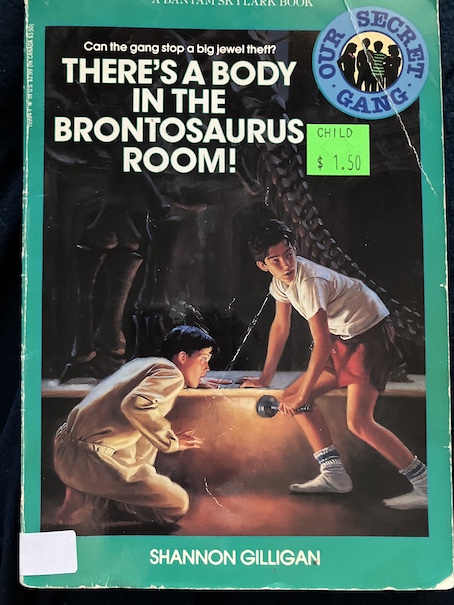
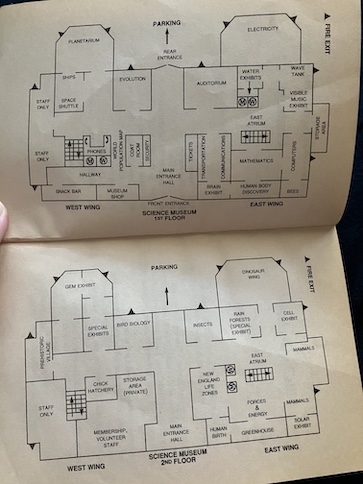
Stepping on the Cracks

Stepping on the Cracks by Mary Downing Hahn, 1991.

This is the first book in the Gordy Smith series, although the book really focuses on a girl named Margaret. Gordy Smith is the neighborhood bully and her nemesis. The series shifts to focus more on Gordy after the full story behind his awful behavior is revealed. This story begins in August 1944 because, although they don’t mention the year, the characters talk about seeing the story about the Liberation of Paris in Life Magazine.

Eleven-year-old Margaret and her best friend, Elizabeth, both have brothers who are fighting in World War II. Margaret’s brother is in the army in Europe, and Elizabeth’s brother is in the navy in the Pacific. The two girls have their own special ritual of stepping on the cracks in the sidewalk to “break Hitler’s back”, in a twist on the old stepping on a crack childhood superstition. Margaret knows that the war is Hitler’s fault, and she blames him personally for her brother, Jimmy, having to go away and fight and for the changes in her household since then. Since the war started and her brother went away, Margaret’s father has been very grim, and she knows that her mother sometimes cries when she thinks that Margaret can’t hear her. Her parents are happiest when they imagine what life will be like when the war finally ends. Margaret keeps a scrapbook of letters Jimmy has written to her and war-related news clippings and cartoons that she’s saved that remind her of things her brother has told her about his time in the army. Margaret hates Hitler and the Nazis with a vengeance.

At the same time, Margaret thinks about how odd it is that the war doesn’t seem entirely real. She knows that people in her community have already been killed in the war overseas, and her parents are worried about Jimmy. However, apart from the missing people in the community, like Jimmy, and the stars in people’s windows to signify people who are in the armed forces or who have been killed in battle, there are few outward signs that there is a war happening. They hear about battles, but their own town of College Hill, Maryland, is peaceful. There are some shortages of things because of war rationing, but otherwise, Margaret’s life has been continuing very much as before. She’s seen pictures of starving children in war zones, and she sometimes wonders why they suffer so much, and she doesn’t.

A neighborhood bully, Gordy Smith, gives the girls trouble, and Margaret thinks of him has being like a Nazi because he’s so mean. He calls Margaret and Elizabeth “Baby Magpie” and “Lizard”, pulls their hair, and gets his friends to gang up on them. At one point, he tries to force Elizabeth to kiss him. (One of those weirdos who are clearly interested in girls but have no idea how to be charming to girls.) Gordy brags about his brother in the army, saying that his brother has killed more Nazis than the girls’ brothers and that he’s going to join the army and kill Hitler when he’s older.

Margaret tells her mother about Gordy and says that she hates his guts. However, her mother tells her that young ladies shouldn’t say words like “guts” and that she should have some sympathy for Gordy because of the kind of family he lives in and what his father is like. (Personally, I don’t think sympathy alone is what’s called for to fix Gordy’s problems, but more about that later.) Elizabeth’s father is a policeman and has arrested Gordy’s father more than once for being drunk and disorderly. People in the community think of the Smith family as being “poor white trash” and wish they would move away. The other kids in the family are as nasty and troublesome as Gordy. Margaret doesn’t think Gordy’s family circumstances should excuse his awful behavior and still hates him.

One day in late summer, before school starts, Gordy and his two friends chase the girls out of the treehouse they built. They steal the comic books they like from the girls and rip up the ones they don’t like, tossing them from the top on the tree on top of the girls. Then, they start ripping up the boards from the platform in the tree so they can use them themselves, saying that girls can’t build anything well. It takes much less time and effort for them to destroy what the girls built than it did for the girls to build it. (This is always true of any kind of destruction, so that doesn’t mean anything complimentary about the destroyers, especially if they aren’t smart enough to realize that and think they’ve got some kind of special talent that’s better than building abilities – just saying because it’s true. All this stuff from the boys is just bluster and gaslighting to intimidate the girls into letting them have what they want by implying that they never deserved the things they actually owned and built themselves.) Margaret yells for help from her mother, but her mother doesn’t hear her. Elizabeth tells the boys that their act of sabotage makes them traitors and worse than Nazis, but they laugh it off.

Elizabeth tells Margaret that they’ll get even with Gordy and the other boys for this, but Margaret can’t imagine what they could do. She would rather stay away from Gordy. That’s easier said than done because Gordy steals the next set of boards the girls try to use to rebuild their tree house, too. One day, the girls see the boys going into the woods. They know that the boys have built a hut to use as a clubhouse with the boards they’ve stolen from the girls, and Elizabeth suggests that they follow the boys to find out where their hut is. Elizabeth thinks that it would be great revenge to find their hut, take it apart, and reclaim the stolen boards. After all, they have a right to their own boards. Margaret is more hesitant because they’re not supposed to cross the train tracks into the woods, and the woods are lonely. The boys have air rifles, and if the boys caught the girls trying to take back the boards, they could do all sorts of horrible things to them with no one around to save them. However, Elizabeth impulsively dashes off into the woods, and Margaret feels like she has no choice but to go with her.

The boys catch the girls spying on them at their hideout when Margaret accidentally sneezes. At first, Margaret is sure that the boys are going to kill them when they catch them. Instead, Gordy tries to scare the girls with a story about how he and his friends have actually saved the girls from the crazy man who lives in the woods. There’s an experimental farm near the woods used by the agricultural department at the local university, and Gordy spins a story about how the army was using the farm for an experiment on soldiers, using chemicals to try to make them stronger and braver. Gordy insists that the man they used in the experiment went crazy and broke out of the farm and has been hiding in the woods ever since, ready to attack anybody who finds him. Elizabeth says the story is a fake because she never heard anyone else say that, but Gordy insists that he saw the crazy man standing behind the girls with a knife. Gordy tells the girls that they better stay out of the woods or the crazy man might get them next time.

Elizabeth knows that Gordy must be lying, but Margaret is sure that the story must be true when she sees a wild-looking man with shaggy hair behind the boys in the woods. Margaret screams and runs for home with Elizabeth behind her. Unfortunately, Elizabeth didn’t see the wild-looking man herself. She thinks that Margaret was just being a chicken, falling for Gordy’s story and imagining that she saw something, and she teases Margaret about it. Margaret asks her mother about the experimental farm and Gordy’s story, without admitting that she was in the woods, and her mother says that it’s nonsense, that the farm is only used for agriculture. Her mother thinks that, if there is a strange man in the woods, it’s probably just some old tramp.

It does seem like a logical explanation, that maybe there was just some old tramp hanging around the woods who didn’t know that Gordy was going to tell some wild story about a murderous crazy man and just happened to wander by at the right moment to look scary. However, Margaret just can’t convince herself that’s all there is to it.

When the girls finally get up the nerve to go back to the boys’ hut, there are unmistakable signs that someone has been living there. There is also a knife, like the one Gordy said the crazy man had. Who is staying in the boys’ hut, and what are the boys really hiding?

My Reaction and Spoilers

I mostly think of Mary Downing Hahn for her ghost stories, like Wait Till Helen Comes and The Doll in the Garden, but this was actually the first book that I ever read by this author. I think I read it when I was in elementary or middle school. Because of some of the serious subjects of the book and some of the language used, this isn’t a book for young kids. It’s probably best for middle school.

America in the 1940s

This book is a realistic portrayal of life on the American home front during the war. I enjoyed the mentions of little things that were common in 1940s America, like the popular radio programs that people liked to listen to (like the Lone Ranger, the mystery horror show Inner Sanctum, and the children’s program Let’s Pretend), comic books and newspaper cartoons, magazines like Life and The Saturday Evening Post, and “Kilroy was here” graffiti. Sometimes, characters mention 1940s celebrities. After Gordy tries to make Elizabeth kiss him, she tells Margaret that a star like Joan Crawford would slap any guy who got “fresh” with her. Later, the girls overhear the boys talking about which pin-up girls they think are the most sexy, mentioning Betty Grable and Rita Hayworth.

Note: The boys’ “sexy” talk is at a realistically juvenile level, laughing over pictures of pin-up girls with big breasts and using the word “hubba-hubba.” An adult hearing a conversation like this knows that the boys probably feel grown-up for secretly smoking cigarettes at their hideout while talking about sexy women, but at the same time, they plainly sound like little boys who use words like “hubba-hubba” because that’s as sophisticated as they know how to be. They have nothing else to say on this subject. As Elizabeth and Margaret could attest, these boys have never successfully kissed a girl at this point in their lives because they’ve been making themselves unappealing to the girls in their vicinity by the mean and obnoxious ways they act. When the girls later go inside the boys’ hut, they see that the boys have defaced their pin-up pictures by giving all the girls beards and blackened teeth. They are definitely not young Casanovas.

This was the first book that introduced me to the concept of putting banners with stars in the window as a sign that someone in the family is in the armed forces. A blue star indicated (and still indicates) a living service member or veteran. A gold star means that the service member died in action. That’s important to the story because, even at the beginning of the book, Margaret knows what the blue stars and gold stars mean, and she already knows people in her community who were killed in the war. One of the people in the community who has died in the war was a young man called Butch who was killed only months after he got married. His widow, Barbara, gave birth to their son after his death, so Butch never saw him. Margaret is sad when she thinks about Butch and his family because she can remember when Butch was a local hero as quarterback on the high school football team. Later, Margaret’s brother, Jimmy, is also killed in the war, and the family replaces his blue star with a gold one, while Elizabeth’s family still has a blue star because Elizabeth’s brother, Joe, is still alive.

Danger and Safety

There are a lot of themes about safety and danger in the story, both real and perceived. When Margaret thinks about the crazy man Gordy says is living in the woods, she thinks that she would feel safer if Jimmy was home because Jimmy would protect her. Yet, when she thinks about Butch getting killed, Margaret realizes that, when big, strong, young men can be suddenly killed, nobody is ever really safe. Even the strongest men she knows are not completely invulnerable, and there are big, frightening, unpredictable things happening in the world.

At one point in the story, the girls talk about what they would do if girls were sent away to war like their brothers. Elizabeth brags about how brave she would be, but Margaret freely admits that she’s a coward and everyone knows it. Margaret imagines that, if she were out on a battlefield, she would probably drop to the ground and play dead until it was all over.

Later, when the girls learn the truth about Gordy, it brings the full realities of the war home to them and challenges everything that Elizabeth thinks about bravery and cowardice. The truth is that Gordy built the hut to hide his brother, Stuart. While one of Gordy’s brothers really did become a soldier and Gordy brags about him, Stuart became an army deserter. When Elizabeth finds out, she’s furious because her brother and Margaret’s are risking their lives, and she thinks that Stuart is a coward, letting others die for him and their country because he’s too afraid to fight. However, when the girls confront Stuart, Gordy, and the other boys about the situation, they learn that it’s more complicated than that. It takes Elizabeth longer to see how complicated the situation really is, but Margaret understands when Stuart describes his feelings.

Stuart is a pacifist. He’s not a coward or a Nazi sympathizer, as Elizabeth first accuses him. His logic is that two wrongs don’t make a right. While Hitler might want to take over the world and send people out to kill others, Stuart knows that the men who get sent away to be soldiers mostly don’t want to be soldiers at all and have no real desire to kill anyone else. If they had their choice, they would just be living their own lives and minding their own business at home. His speech makes Margaret really think for the first time about the war from the point of view of the soldiers on the ground. When her brother was drafted, Margaret never asked him how he felt about going away to war, just assuming that he’d want to defend his country and beat the Nazis. Now, she regrets not asking him about his feelings and wonders if he was scared or if he went reluctantly. For the first time, she also has to confront the reality that her brother has been actively killing or helping to kill other people. Stuart deserted because he simply couldn’t face the prospect of killing someone. He shows the girls a letter he got from their other brother, Donald, the one who became a soldier, telling him how horrible the war is and how they’ve sometimes killed civilians and even allies because of mistakes they’ve made. Stuart also introduces the girls to the poem The Man He Killed by Thomas Hardy. Margaret wonders how Jimmy felt about the idea of killing other people and if it’s really sane to be okay with the idea of killing. Margaret has always looked up to her older brother, seeing him as a protector, never thinking of him as a killer, but yet, he is actively engaging in killing. He doesn’t tell Margaret that part of things in his letters to her, but she realizes that’s what actually happening in Europe.

Finding out about Stuart creates a real problem for the girls. Because army desertion is illegal, the girls know they should tell someone about Stuart, but Gordy tells them that the hard reality is that deserters either get arrested or shot. If they report Stuart, they could be sending him to his death. Elizabeth, being the more brash and hard-hearted one, says that she doesn’t care because it would be no more than what he deserves (although she later takes that back). Instead, she settles for blackmailing Gordy and his friends into stopping their bullying of the girls and helping them rebuild their tree house.

However, the kids soon realize that Stuart can’t stay their secret forever. Stuart has gotten sick, and if he doesn’t get help, he could just die in the woods. Stuart was hoping that the war might just end, and people would stop caring about whether he’d joined the army or deserted, but nobody in 1944 knows when that’s going to happen. From their perspective, it could be months (close to the reality) or years. The war has been going on for years already. Stuart won’t survive in the woods for that long.

The kids also confront the reality that, while two wrongs don’t make a right when it comes to fighting, just standing back and doing nothing while other people are doing wrong is also wrong. Elizabeth is the first of the children to point out that the entire reason why desertion is illegal is that, if everyone just decided to opt out of fighting, people like Hitler would run overrun everyone because no one would put up a resistance. Leaving aside what the characters decide to do about Stuart for the moment, that brings me to the problems with Gordy and the people who should be responsible for him and aren’t.

Gordy’s Problems

I’m frequently the first to say, as Margaret does in the story, that just coming from a bad background shouldn’t allow a person to get a free pass on being a bully themselves. Two wrongs really don’t make a right, and to my way of thinking, people who bully others because they’ve been bullied themselves are bad because they’re doing to completely innocent people what they already know they hate being done to themselves. However, unlike what Margaret’s mother said earlier about how she wishes Margaret would have more sympathy for Gordy, I quickly realized that, first, sympathy is insufficient in situations like this, and second, Margaret’s mother is not really motivated by sympathy for Gordy. She has other, less admirable reasons for looking the other way, even when she knows exactly what’s going on in Gordy’s family and that he is actively abusing her own daughter.

Gordy frequently gets away with his bullying because people are afraid of both him and his father. On the way to school, when Gordy rips up Elizabeth’s homework and stomps on her school supplies to break them, and the crossing guards see it happen. However, even though it’s part of their duty to report things like this, they don’t want to do it. When Elizabeth asks them if they’re going to report it to their teacher, they make excuses about how that might be tattling and make their teacher mad and how it would be just their word against Gordy’s (ignoring the evidence of the ripped papers and broken school supplies). The reality is that they’re afraid of Gordy doing something to them in revenge. Elizabeth asks them if that means that she’s just going to have to suffer what Gordy does to her while Gordy gets away with it because they’re too afraid to said anything. The crossing guards are further afraid to give her a straight answer because everyone involved knows that the answer is, yes, that’s exactly what’s going to happen, and that’s exactly the reason why it’s going to happen. The crossing guards know that Gordy is going to continue being an abusive bully, and they know they’re going to let him do it without saying a word, and they know the reason why they’re going to do that is because they are scared. They’re not willing to put themselves on the line to protect Elizabeth even though that is a part of their job. Elizabeth, knowing all of this, tells them they’re cowards, and it’s the truth. Unfortunately, there are times when apparent cowardice can also be necessary self-preservation from a greater insanity, and much as I hate to admit it, this might be one of those situations.

There is the underlying problem in this community, and that’s the behavior of the adults. Part of the reason why the young crossing guards are so cowardly about the class bully is that they know darn well that no adult in their community is likely to act on anything they tell them about Gordy. Even if their teacher punishes Gordy temporarily by suspending him from school, Gordy will come back, mean and horrible as ever, with revenge on his mind. No adult is going to get to the real root of Gordy’s problems and solve them, so Gordy will continue to be a problem. It appears to be common knowledge in the community that Gordy’s father is an abusive drunk. Elizabeth and Margaret know it, and I think his teacher probably knows it, too. Gordy comes to school with a black eye. Barbara talks about it with the girls, saying that Stuart used to help protect Gordy from the worst of his father’s abuse and that Gordy needs someone to take care of him. Nobody can avoid knowing that the Smiths are an extremely troubled family. After Margaret and Elizabeth go to Gordy’s house to find him and witness Gordy’s father’s behavior for themselves, Margaret tries to talk to her mother about it, and her mother just says that what people do in their own houses is their business and they can’t interfere. That, right there, is part of the root of Gordy’s problems. The first root is his father’s drunken abuse, the second root is knowing that the adults in his community are aware of the situation and are deliberately looking the other way, and the third root are his own choices that prevent other people from getting close enough to help.

For the moment, I’d like to focus on Margaret’s mother and her non-interference policy when it comes to child abuse. A major part of the reason why Gordy continues to be abused by his father and why Gordy is able continue bullying and abusing other kids is exactly this policy of looking the other way. I think all of the adults in this community feel similarly, and I think a major part of the reason they do it is because the adults are scared of Gordy’s father and what he might do to them. Letting him beat his wife and children probably doesn’t feel great, but these adults excuse themselves for allowing that to repeatedly happen with their full knowledge by saying out loud that it’s none of their business while quietly thinking that letting a kid be beaten is better than being beaten or killed by this crazy man themselves. Apart from occasionally arresting Mr. Smith for getting publicly drunk and disorderly, after which he is released when he sobers up, nobody in the community, not even Elizabeth’s police officer father, does anything. The kids are the most active characters in the story, and the adults, like Margaret’s mother, want to shut them down from talking about it so they won’t have to feel like they should be doing something when they’re not. It doesn’t make the problem go away, but it does allow the adults to lie to themselves and pretend like it’s not a problem that they will have to deal with eventually, which is almost the same in the adults’ minds.

It is fitting that this is a World War II story because the situation with Gordy has parallels within the war itself. The United States initially didn’t want to become involved with the war because they saw what Hitler was doing as a European matter. People in the US didn’t want to become involved in the war because they knew it would mean risking their lives, and it wasn’t something they wanted to do if it wasn’t their problem and if it could be resolved without them. Self-preservation is a sign of sanity, but the problem with that mindset is that it doesn’t take into account the larger picture and the full, hard realities of the situations. Sometimes, even when you don’t go looking for trouble, trouble can come looking for you. The US wasn’t officially involved in the war effort except as a supplier until Pearl Harbor. That attack on the US naval fleet brought it home to the American public that it didn’t matter whether they wanted to be involved or not if another country decided to actively involve them.

It’s a similar situation with Gordy. Nobody wants Gordy to bully them, but he does it anyway. It doesn’t matter if the girls are in their own tree house in Margaret’s front yard, minding their own business; Gordy comes after them to destroy the tree house and steal the boards. Margaret’s parents know what happened, but they do nothing. All through the book, Margaret has times when she feels unsafe, but her parents don’t protect her from the closest and most obvious dangers, even when she tells her mother about them. Margaret’s parents don’t protect her because they are scared themselves and don’t want to get involved, even though they are already involved because it’s their daughter being abused … not unlike a deserter who flees the army to avoid fighting when his country is attacked.

Margaret would be the first to admit that she’s not the bravest person around, but yet, she is braver than many others around her because she can and will take action even when she’s scared. For most of the book, Margaret only gets into scrapes when she’s goaded into them by Elizabeth, but even Elizabeth observes that Margaret follows through once she starts something or sees that something needs to be done. The adults in the community can’t say the same. The abuse going on in the Smith household hasn’t stayed privately in the Smith household at all. It’s gone out into the community through Gordy and the other Smith children. It’s a public matter because Mr. Smith is repeatedly drunk and disorderly and intimidating to every adult in the community. It’s everyone’s business because everyone is suffering the results. However, the adults find it easier to keep telling themselves that they don’t need to do anything about it because they can’t deal with the discomfort that would come from a professional community intervention (or tell themselves they can’t deal with it, which isn’t quite the same thing), which is the one and only thing that could probably save the Smith family at this point, and by extension, everyone who’s been suffering from the second-hand bullying and abuse delivered by Gordy. While one person alone would genuinely be in danger from standing up to Gordy’s father, a concerted community effort including the police, local medical professionals, and the principal and teachers from the school showing a united front would be a safer and saner option. There is safety in numbers, provided that the “numbers” can get up the nerve to join the numbers.

I think Gordy should be held accountable for the things he’s done, and I think some reasonable adult should also point out to him that he’s been a fool to cultivate enemies instead of allies. Although Margaret and Elizabeth eventually become his allies for this adventure, sympathetic to the abuse that Gordy has suffered and to Stuart’s situation, if he had been nicer to them from the beginning, he would have gotten help for himself and his brother much sooner. Gordy is bitter toward other people in the community because he’s fully aware that they all refer to him and his family as “white trash”, although I think he should also be aware that it’s their behavior that causes people to look at them that way. Gordy himself has partly caused and perpetuated that image because of everything he does on a daily basis. While Gordy can’t help that his father is an abusive drunk, he can help being a bully himself, and as long as he acts like that, people will treat him as the bully he is and try to avoid him rather than give him the help he really needs. His father is his worst enemy, the adults in this town are largely useless, and Gordy is not only hurting others but sabotaging himself. Even when the girls try to help Gordy, they find it hard because he’s still mean to them and fights them every step of the way.

One final note I have is to point out that, while I’ve heard many kinds of insults and racial slurs in my life, the term “white trash” is possibly the only term I know that’s both an insulting slur to the people it’s used against and to an entire group of people who aren’t explicitly mention in the slur at the exact same time. That didn’t occur to me when I was a kid, but as an adult, I realize now the reason why the modifier “white” is added to the insult. The modifier implies a comparison. The implication is that the person using the term thinks that non-white people are “trash”, and they’re telling another white person that they’re also a kind of “trash” like that, as bad or maybe worse because, as a white person, they should be able to help their situation but aren’t helping themselves because they’re somehow inferior. It’s true that Gordy and others in his family haven’t been helping matters because they make it difficult for other people to help them, but it’s still a very weird dual insult.