Rasmus and the Vagabond

Rasmus and the Vagabond by Astrid Lindgren, 1956.

Disclosure: I am using the 2015 edition of the book, published by Plough Publishing House.  Plough sent a copy to me for review purposes, but the opinions in the review are my own.

The Swedish author Astrid Lindgren is best known for her Pippi Longstocking series, but she also wrote other excellent books for children. This particular book is about a nine-year-old orphan boy and his adventures with a traveling vagabond (tramp) after he runs away from an orphanage.  There is an element of mystery, which pleased me, as a life-long mystery fan.

The dullness and unfairness of life at the orphanage gets to nine-year-old Rasmus. While the other children in the village get to play and go swimming, he and the other orphans are expected to work, doing chores like digging up potatoes in the garden or pulling nettles.  Mrs. Hawk, who is in charge of the children, doesn’t like them goofing off when they could be doing chores.  The work is necessary because orphanage sells produce and eggs to help support the children, and the children know that when they’re thirteen years old, they will have to start taking regular jobs to support themselves.  Mrs. Hawk doesn’t see much benefit in letting the orphans play, like other children do.

One day, while Rasmus is pulling nettles by the chicken coop, he finds what, to him, amounts to wonderful treasures: a single five-cent coin and a seashell!  He has no idea how they got there, but he has never found anything so wonderful before.  He rushes to tell his friend, Gunnar, about them. Gunnar tells him that someone is going to visit the orphanage and pick out a child to adopt. All of the children hope to be the one chosen for adoption, and Rasmus wonders if his lucky finds might be an omen that he will be the one chosen.

Unfortunately, he isn’t the one chosen. As Gunnar predicted, the couple who visit the orphanage pick a girl with curly hair, Greta, and Rasmus embarrasses himself by accidentally breaking the lady’s parasol.  Rasmus thinks that he’ll never get adopted, and he suggests to Gunnar that maybe they should try to strike out on their own and find parents. His reasoning is that, if they didn’t have to compete against the other children at the orphanage (especially the cute, curly-haired girls), they might have better luck at finding families.  Gunnar thinks that Rasmus’s plan is crazy, but Rasmus also knows that he has punishments ahead for his earlier escapades, and he’s decided that tonight is the best time to get away.

That night, Rasmus sneaks out alone, taking his five-cent coin with him and leaving the seashell for Gunnar to remember him by.  At first, Rasmus is terrified on his own, and when he gets hungry, he actually starts to miss the orphanage.  Fortunately, he soon meets a tramp who goes by the name of Paradise Oscar.  Oscar actually turns out to be pretty nice, sharing his food with Rasmus.  Rasmus asks if he can be a tramp like Oscar, and Oscar says that boys should really be at home with their parents.  When he learns that Rasmus doesn’t have parents, he takes the boy under his wing.  Rasmus starts to like the free life of a tramp.  They work when they want to and don’t when they don’t.  Sometimes, they make money by singing in the street.  They can sleep anytime they want, and they spend Rasmus’s coin on butterscotch candies.

However, trouble looms when Oscar is taken in for questioning by the police about a robbery.  Two masked men robbed the Sandhoe factory before Rasmus ran away from the orphanage, and the police think that Oscar may have been one of them.  Rasmus believes in Oscar’s innocence.  The police aren’t so certain, but they release him for lack of evidence.

Shortly after that, Rasmus witnesses another robbery.  At first, they’re afraid to go to the police, but they leave an anonymous note so that the robbery victim gets help.  One of the miscreants involved actually accuses Oscar of being one of the robbers, but some of what Rasmus witnessed points to the real villains.
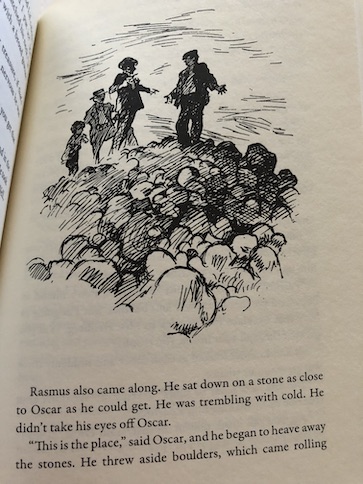
Rasmus and Oscar are colorful characters, and their journey through the Swedish countryside is full of adventure, with Oscar running from the law and Rasmus still searching for the home and family he desperately wants.  There are some moments of suspense in the story, but it all ends happily, and Rasmus does find a home that’s just right for him, although it’s not quite what he had originally pictured. Rasmus’s experiences on the road change him and his ideas of what he wants in life and a family. When he started his journey, he wanted to be chosen by someone else, but in the end, it’s the choice that he makes that determines his future.

One part of the story that particularly fascinated me was when Rasmus and Oscar hide in an abandoned village, and Oscar tells Rasmus that the reason that the village is abandoned is because, years before, the people in the village all decided to emigrate to America together, specifically Minnesota (a popular destination for Scandinavian immigrants).  I remember from my first degree in history that mass emigrations of that sort also took place in other countries.  The Library of Congress has more information about Swedish immigrants and the major periods of immigration.  I think that the event that Oscar referred to was during one of the periods of high population and famine in Swedish history. I love books with interesting historical details!

As a fun fact, this book is also one of those books that appears in Swedish on Ikea shelves, just to help demonstrate bookcases or dress up one of their mock rooms. I spotted it there once. If you look for the name “Rasmus,” you’ll recognize it. The next time you see it, you’ll know what it’s all about!

This book is available to borrow for free online through Internet Archive, but it’s also back in print and available for purchase through Plough. If you borrow the book and like it, consider buying a copy of your own. This one’s a keeper!
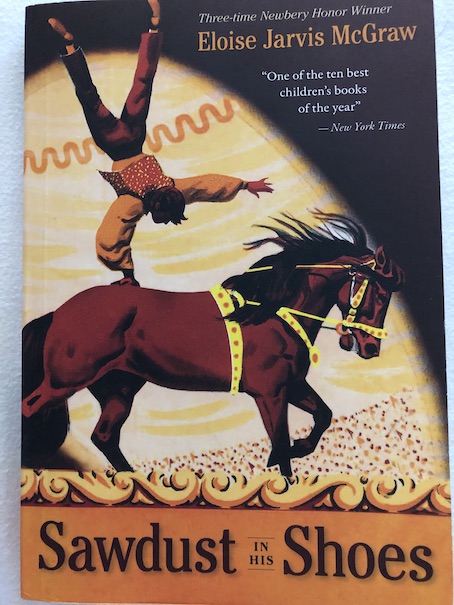
Sawdust in his Shoes

Sawdust in his Shoes by Eloise Jarvis McGraw, 1950, 1977.

Disclosure: I am using a newer edition of the book, published by Plough Publishing House.  Plough sent a copy to me for review purposes, but the opinions in the review are my own.

At fifteen years old, Joe Lang is a rising star in the circus, a trick rider. Circus life is the only life he’s ever known because his father is a lion tamer. Many of the children whose parents work for the circus also work for the circus, competing for the spotlight and top billing, and Joe loves that type of life, even though it means hard training, an element of risk, and constantly moving.

Unfortunately, things change for Joe when his father is killed during an accident in one of his performances. (Mercifully, the accident is not described in the book. Joe does not witness his father’s death. In the story, he hears screams from the circus patrons and is shortly informed that his father has been killed.) Because Joe is still only fifteen, his father’s death raises the question of who will have custody of Joe. Joe’s mother is dead, and his stepmother, who did not grow up with the circus herself, was never fond of circus life or of Joe. After the death of Joe’s father, his stepmother leaves to go live with her sister, and Joe never hears from her again. Mo Shapely, an older man who works for the circus as a clown, wants to assume responsibility for Joe, and Joe would be happy with that because Mo is an old family friend who helped raise and train him. However, the local authorities are not convinced that Mo is a suitable guardian for the boy because of his age, his unsettled lifestyle, and lack of savings.

Mo waits in town with Joe while the authorities make up their minds, but they soon run short of money, and Mo is forced to catch up with the circus and return to his job. Since Joe’s guardianship is still unsettled, the authorities send him to the County Industrial School for Boys, where he will stay until Judge Reynolds has completed his inquiries into Mo’s background. The boarding school offers vocational training, but Joe finds the place dull and bleak and the people unfriendly. When the other boys find out that he used to be with the circus, they are envious and tease him, and even the teacher mocks him. Only one boy tries to be friendly with him, and Joe asks him if any boys ever escape from the school. The boy tells him that some have tried, but no one has succeeded. However, Joe realizes that he just can’t stand life at the school, and all he wants to do is run away and try to rejoin the circus.

When Joe runs away from the school, he cuts across some farmland, loses his way, and ends up getting caught on some barbed wire, where he is found by the Dawson family. The Dawsons treat his wound, and Joe despairs, realizing that he has gone the wrong way and that he has no chance to catch up with the circus before they move on. The Dawsons ask Joe what his name is and offer to help him get home, but Joe is reluctant to tell them the full truth because he doesn’t want to be sent back to the horrible school. Instead, he tells them that he has no home or parents but that he’s worked before, since he was young, and that he hopes to find a job when he’s recovered from his wounds and exhaustion. The Dawsons are concerned about Joe and curious about his mysterious past and vague answers, but Mr. Dawson decides to offer Joe a position as farm hand. Joe is surprised at the offer and a little suspicious, and he asks Mr. Dawson why he’s so willing to take in a perfect stranger. Mr. Dawson answers him in an equally vague way, saying that if Joe really feels like he needs to steal their silver, he must need it more than they do, and he’s welcome to it. Joe decides to accept Mr. Dawson’s offer of employment.

Joe isn’t used to farm work, but he’s strong from his work with the circus (Mr. Dawson had noticed his athletic build), and he is good with horses and other animals. Although Mrs. Dawson is concerned that they know so little about Joe or his background, Mr. Dawson tells his family to allow Joe to have his privacy and not question him too much about his past. Still, Joe can’t resist showing off and trying one of his old tricks on horseback one day, accidentally making his injury worse because it isn’t healed yet. He begins to worry that the injury might be bad enough that he’ll never be able to be a trick rider again. By the time he has fully recovered, he is also long out of practice.

Eventually, Joe’s secrets are exposed, and he must make some choices about his future. Although Joe had lived many different places when he traveled with the circus, living on the Dawsons’ farm provides him with new experiences and broadens his horizons in unexpected ways. He had never had much respect for non-circus people before (partly because of his bad experiences with his non-circus stepmother). He still dislikes some of the Dawsons’ neighbors for their unfriendliness and suspicious toward him, but the Dawsons themselves are very different from most of the people Joe has met before. Joe comes to realize that he has not forgotten everything that he learned from his old life and that he can apply his old skills in new ways. He even starts to consider that there are more ways of living than he had previously thought, and he begins to see the appeal of non-circus life. Still, the circus is what he always loved first, and he feels torn between what he’s always wanted and the people who have loved and supported him when he needed it the most.

Children today probably don’t look at the circus in the same way as past generations. Some of the larger, mainstay circuses, like Ringling Brothers and Barnum and Bailey, have closed. People make jokes about how scary clowns are, and animal acts aren’t considered humane to the animals. Circuses still exist in the early 21st century, but they’re not quite what they used to be, and they aren’t looked at in quite the same way. Even when I was a young child, in the 1980s and early 1990s, I wasn’t particularly wild about the circus. A large part of that is temperament. I’m not fond of loud noises or large crowds, and I tend to avoid places where there are both. I’m very different from my grandmother, who absolutely loved circuses and parades and excitement of all kinds, dragging her children with her, even when they didn’t always feel like going. In my grandmother’s youth (1910s and early 1920s), there were few things more exciting than a circus coming to town!

However, this story isn’t just about love of circuses or a look back on the forms of entertainment that people used to enjoy. There’s always some nostalgia of that type to vintage books, but this book is about more than that. This is about a person finding his way in life and facing an unpredictable future, who has to decide what’s really important to him. I’m sometimes fascinated by people who seem to know what they want to do in life from an early age. They are born to parents with a profession they want to follow or who have connections to a profession they want to follow, and they start training very early for something they truly love. At first, that seems to be Joe’s situation in life. He loves the circus, he was born into that kind of life, he gets that early training, and there’s nothing else he would rather do. Some people like that become early success stories, just being lucky enough to be born in the right place and with the right connections for the life they want to live, and it all looks like smooth sailing. Most people aren’t that lucky, though, and even for people who think they know what they want, life has a way of throwing a monkey-wrench into their plans. That is what this story is really about.

Joe’s life abruptly changes when his father dies and his guardianship remains in limbo. Things often happen in our lives that we can’t fully control, taking us down paths we never thought that we’d travel. There are times when many of us start to question what we really want out of life, whether our first choices were really the best ones, or if there’s something else that we really want. Sometimes, these unexpected detours make us feel like we’re headed for a dead end, like when Joe fears that he has lost his skill and he’ll never live the life he once dreamed he would. However, sometimes, these things are just a temporary bend in the road. In some ways, an adult who has been through this sort of process would understand it better, but even children know what it is to have a dream and not know whether or not it will become reality.

Children need time to discover and develop their talents, and, as they grow and step into the wider world, they routinely discover that they have to make other decisions that they knew nothing about before. Children also know what it’s like to be at the mercy of adults who can either help guide them on their way or who stand as an obstacle to their dreams and efforts, like the judge who takes so long to decide what he thinks is best for Joe that Joe feels he must take his fortune into his own hands. Right up until the very end, Joe’s ultimate choice remains uncertain as readers wonder what he’s really going to decide to do and what his destiny is going to be. At first, Joe seems like he’s in a bad situation, with limited options, but his experiences show him that his options in life are broader than he thinks. It seems like saying yes to one of the choices confronting him means saying no to something else he cares about, but even that isn’t as straight-forward as it seems. I think this is one of those timeless books that can appeal to all ages because what it’s really about is a person finding his way in life and discovering that a difficult, unpredictable path may be just the path he needs to take.

In the end, it’s not just about what Joe chooses or where he ends up; it’s about what he does along the way. When Joe runs away from the school, he is the one who is injured and in need of help, but he also has a positive impact on the people who were kind enough to help him when he needed it. In fact, there are some situations that would have turned out much worse for everyone if Joe hadn’t been there and been able to help. Joe’s unexpected detour in life changed everyone else’s lives as well, and it was well worth doing, in spite of the struggle.

This book is available to borrow for free online through Internet Archive, but it’s also back in print and available for purchase through Plough. If you borrow the book and like it, consider buying a copy of your own!

What Eric Knew

What Eric Knew by James Howe, 1985.

After his friend, Eric, moves away, thirteen-year-old Sebastian Barth receives strange messages from him, hinting at a mystery in the small college town of Pembroke. Eric always used to rope his friends into investigating things and having adventures, but before his family moved away, he started acting strangely and suffered an accident falling downstairs and breaking his leg.

Sebastian shares the notes with his best friend, David, and with Corrie, the new minister’s daughter. Corrie’s family has moved into the house where Eric used to live, near the church and graveyard. Eric’s notes seem to refer to a local legend about the ghost of a prominent woman, Susan Iris Siddons, who used to live in their town and supposedly searches for her lost wedding ring. Corrie thinks she sees this ghost in the graveyard. There is also something mysterious going on in the church, where the Siddons family still maintains a tradition of ringing the bell regularly at 9 o’clock in homage to their ancestors, Susan and her husband, Cornelius.

The dark secrets of the past mix with the troubles still surrounding the Siddons family. Can Sebastian and his friends solve the clues and learn what their friend Eric knew?

The book used to be available to borrow online through Internet Archive, but when I checked recently, it was no longer there.

My Reaction

The story leaves some things unresolved. The kids are never entirely sure how much Eric discovered before he moved, but they do learn that he recruited a couple of friends to help create the appearance of the ghost, possibly to draw attention to the real problem in modern times, which has nothing to do with the supernatural, although there is another troubling secret about the past that the kids uncover, too.

Both sets of problems do center around the prominent Siddons family and the pressures that the current family members, especially the younger generation, suffer as they try to keep up appearances and live up to images of their supposedly perfect relatives. The past secret explains one of the reasons why the Siddons family isn’t as perfect as they had always pretended to be and helps to put the “ghost” of Susan Siddons to rest. This is not a mystery story for very young children because of the dark and serious nature of the problems with the Siddons family. I would say the book would be best for ages 10 and up. The only question at the end is how much of these things Eric really knew.

Disappearing Acts

Herculeah Jones

Disappearing Acts by Betsy Byars, 1998.

Herculeah’s friend, Meat, decides to take a comedy class at a local comedy club called Funny Bonz.  While he’s at the club for his class, he finds a dead body in the men’s restroom.  He quickly runs to get help, but when the club’s owner (who is also the teacher of the class), Mike Howard, goes to check, the body is gone.  It happens to be April 1st, so everyone assumes that it was just an April Fool’s Day prank.  However, Meat is sure that what he saw was a real dead body.

He tells Herculeah what happened, and he also remembers that he has proof of what he saw: a blue wallet that he picked from the floor near the body.  The ID in the wallet says is for a woman named Marcie Mullet.  Meat never got a clear look at the identity of the body because it was lying face down, but he remembers that it had a ponytail, so they assume that it was Marcie.  Marcie was supposed to be a student in the class, too, but she never showed up.  Meat and Herculeah assume that the body must have been Marcie.

However, Herculeah is somewhat preoccupied by something else.  She’s been getting strange vibes from a camera that she bought at a secondhand shop.  The camera was cheap, only a dollar, and there’s still a partially-exposed roll of film inside.  The camera was a great deal, but Herculeah’s hair is frizzling, and she senses danger approaching.

When she develops the film left in the camera, she realizes that the camera had once belonged to Meat’s mother, and the pictures show Meat’s father.  Meat has very little memory of his father because his parents separated when he was very young, and his mother has refused to talk about him for years.  Herculeah knows that Meat badly wants more information about his father, but she hesitates to show him the pictures because she doesn’t think that he’ll like what he sees.  He’s imagined that his father could have all kinds of cool professions, and she doesn’t know how he’ll react to his real one.

Self-perception is also very important to the solution to the murder.  Meat is the first to learn the killer’s true identity and is able to get the killer to confess and confide in him.  The killer was tired of the victim’s mean-spirited jokes, all of which were about the killer, who is fat.  The murder was unintended; the person just snapped when the victim gloated about using the mean-spirited comedy routine to become famous.  Meat understands how the killer feels because he hasn’t had a very good perception of himself and knows what it’s like to be fat.  There is a series of fat jokes in this part of the book, the meanest of which (the killer quoting the victim) are about a fat woman’s bra size.

When his father’s true identity is revealed, Meat is actually glad, which surprises Herculeah.  Meat’s father is very different from what he had imagined, but oddly, finding out that his father is a professional wrestler gives Meat something new to aim for.  Meat is sometimes self-conscious of his large size, but seeing his father makes him realize that he can change his fat to muscle and be really impressive.  The two of them meet, and Meat’s father apologizes for leaving so suddenly when Meat was young.  He explains that, much like his own father, he has trouble living anywhere for very long.  His own father had similarly abandoned his family when he was young.  Both of them just reached a point when they had an irresistible urge to pick up and move on.  However, Meat’s father makes it clear that he really does love him and is proud of him and says that he will continue to see him.  It’s a strange explanation, but Meat accepts it and forgives his father.

This book is available to borrow for free online through Internet Archive.

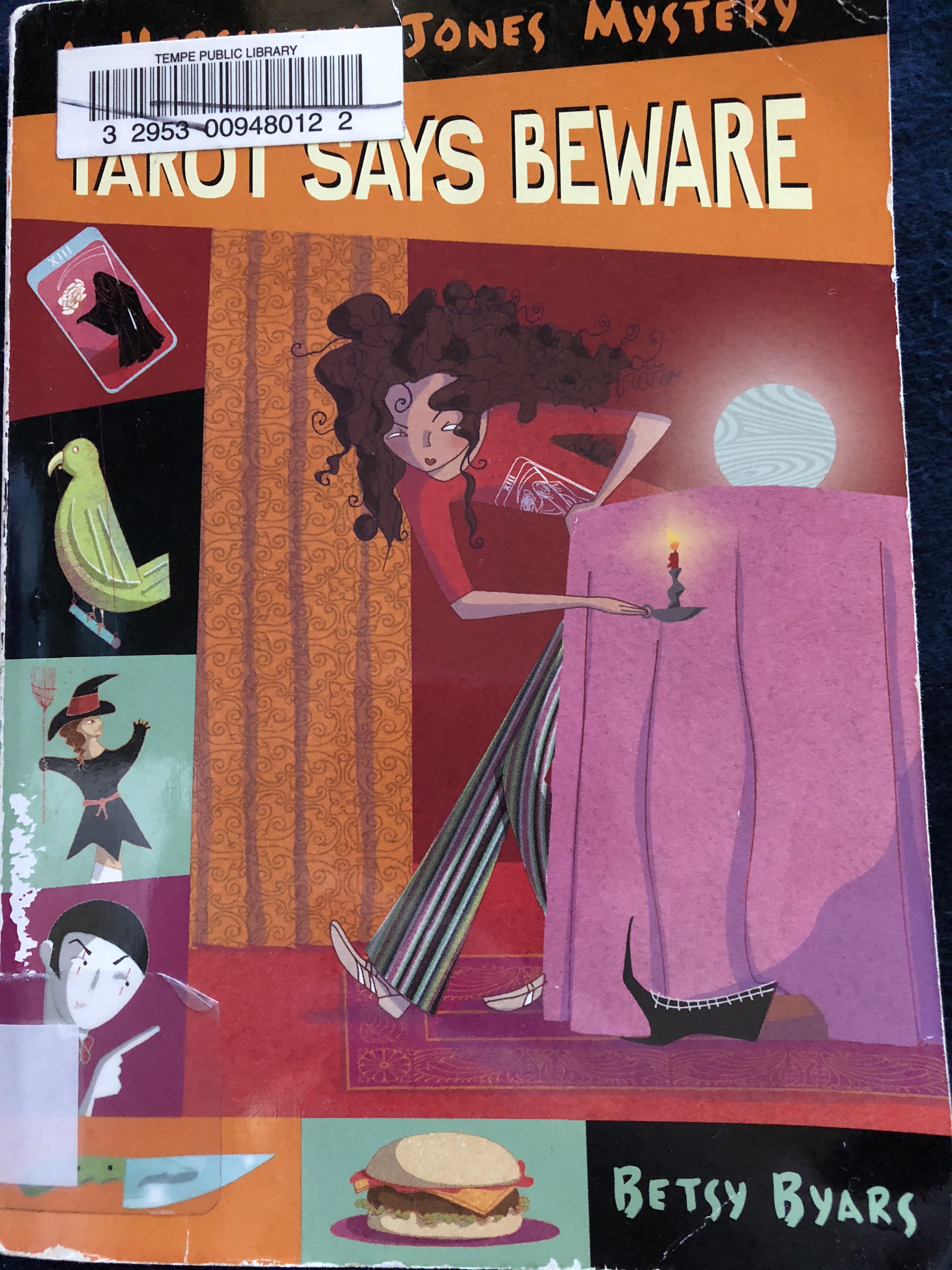
Tarot Says Beware

Herculeah Jones Mysteries

HJTarotBeware

Tarot Says Beware by Betsy Byars, 1995.

Madame Rosa is a fortune teller and one of Herculeah’s neighbors.  Herculeah has been taking care of Madame Rosa’s pet parrot, Tarot, when she goes out of town.  One day, Herculeah notices that Tarot has gotten loose and is sitting on the porch, so she goes to retrieve him.  When she takes the parrot back into the house, she doesn’t see Madame Rosa.  After investigating further, she finds Madame Rosa dead and calls her father, a police officer.

Herculeah is very upset about Madame Rosa’s death.  She had considered her a friend.  Even Meat said that he once consulted her for information about his father.  She told Meat that his father danced, and Meat’s mother was very angry when she found out because she never wanted Meat to know anything about her ex-husband.  She even said that she “could kill that woman.”  But, who would really want Madame Rosa dead, badly enough to murder her?  Was there someone else who didn’t like their fortune?  Did Madame Rosa know something that someone was afraid that she would tell?

It turns out that Herculeah’s mother holds an important clue.  Madame Rosa came to see her about a troubling client.  A woman visited Madame Rosa to ask if her son could kill someone.  The woman’s son had threatened her, and she wanted to know if he was capable of acting on his threats.  Madame Rosa had asked her to bring something that belonged to her son, and the woman brought her the knife that the son had used to threaten her.  That was when Madame Rosa had a vision of her own death.  It frightened her so much that she fainted, and when she woke up, the woman was gone.  Herculeah’s mother asked Madame Rosa what she’d like her to do, and Madame Rosa told her that she didn’t think anything could be done.  Later, Madame Rosa was murdered with a knife.

So, now Herculeah suspects that the woman’s son came and murdered Madame Rosa, but she has no idea who the woman or the son are.  Then, when Herculeah and Meat go to snoop around Madame Rosa’s house, Herculeah thinks that she sees Madame Rosa.  Is she a ghost, or could Madame Rosa really be alive?

The title of the book comes from the fact that Tarot the parrot always says “Beware” to strangers, but not to Madame Rosa herself.

The book is available to borrow for free online through Internet Archive (multiple copies).

Once Upon a Dark November

Once Upon a Dark November by Carol Beach York, 1989.

Katie Allen likes her part-time job helping Mrs. Herron with her housework. One of the best parts of the job is that she gets to see Mr. Herron, her English teacher, at home. Katie has a crush on Mr. Herron, although no one but her best friend knows it.

One day, while she’s at the Herrons’ house, Mrs. Herron tells her that her cousin Martin is coming for a visit. She says that Martin hasn’t been in Granville in years, although he used to live with their aunt when he was young. Their aunt is Miss Gorley, the creepy lady who lives across the street from Katie’s house. When Martin arrives, he turns out to be pretty creepy himself. He never says very much to anyone and spends a lot of his time just staring out the window. Mrs. Herron is not happy to have him there and wishes that he would leave.

One day, Martin disappears, and the next day, Miss Gorley is found murdered in her house. Did Martin return to Granville just to murder his aunt? Where is he now, and who is that mysterious person who tried to attack Katie at her house, dressed in a Frankenstein costume? Did Katie see something that she wasn’t meant to see?  Katie doesn’t remember seeing anything important, but now she has to figure out what it was before it’s too late!

This book is not for young children.  It would be best for kids in middle school (about 12 and up).  There is murder and attempted murder, including the attempted murder of Katie, who is a child, because the murderer of Miss Gorley thinks that she knows too much.  There is also some discussion of child abuse, which was part of the motive behind Miss Gorley’s murder.  Katie did see some things that are important to the case, but their full importance doesn’t occur to her until the attempt on her own life.  People are not quite who they seem to be, and some of Katie’s initial impressions were closer to the truth than someone wants her to know.

The book is currently available to borrow for free online through Internet Archive.

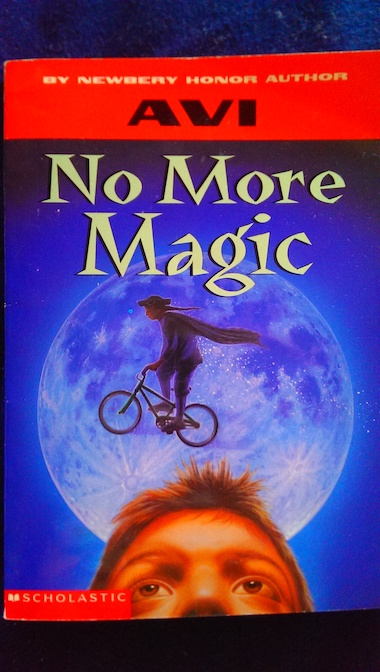
No More Magic

NoMoreMagic

No More Magic by Avi, 1975.

Chris has a fun time on Halloween with his best friend, Eddie.  The two of them are dressed as superheroes.  Eddie is Batman, and Chris is the Green Lantern.  However, the next morning he discovers that his bike is missing.

Chris loves his bike because of its wonderful green color.  He thinks of green as a magical color, and the bike has a great shimmery kind of green paint that reminds him of the Green Lantern.  Although his green bike was a little old and his mother gets a good deal on a newer yellow bike, Chris misses his old one and begins investigating, trying to figure out who could have taken it.

At first, the challenge seems difficult.  On Halloween night, lots of people were running around in costume.  However, Chris’s community isn’t too big, and he is able to identify many of the people who came to the house around the time that the bike disappeared.  One kid that he doesn’t know well is Muffin, a new girl at school, who came to the house in a nurse costume.  There was also a mysterious kid who came in a warlock outfit, with a cape and a tri-cornered hat.

When Chris interviews Muffin to see if she knows anything about his missing bike, he learns that the warlock costume originally belonged to her.  She had made it herself and was proud of it, but someone stole it while it was hanging up to dry.  The nurse costume was a last-minute substitute.  Chris thinks that whoever was wearing the warlock outfit is the most likely suspect for stealing his bike because the local police chief told him that a man had complained that someone riding a bike like his and wearing a costume like the warlock costume ran into him.  He suggests that the two of them team up to find the mysterious warlock/thief and get their stuff back.

Muffin is kind of a strange girl and is oddly evasive about her life and family.  At first, all she will tell Chris is that her real name is Maureen (but she doesn’t like that name) and that she has come to town to live with her aunt because her parents “aren’t around.”  Her aunt seems somewhat strict, and Chris donates some of his own money to Muffin to help her buy a used bike so the two of them can ride around together, looking for clues.

One of the first things they learn is that the person wearing the warlock costume won the prize for the best costume at the Halloween parade downtown.  Chris didn’t attend the Halloween parade, but his friend, Eddie, says that he went.  However, Muffin and Chris notice that Eddie’s name wasn’t on the list of attendees.  When they try to ask Eddie about it, he becomes strangely angry.  Chris doesn’t want to think that his best friend could have stolen his bike or the warlock costume or both, but why would he try so hard to avoid answering their questions if he didn’t have something to hide?

Then, Chris learns why Muffin is so secretive about her life.  The school counselor has noticed that Chris has made friends with Muffin, which she thinks is good, but she tells Chris’s mother about Muffin’s circumstances because she thinks that they should know.  Muffin’s parents recently split up.  For unknown reasons, her mother walked out on her father.  Muffin’s father was distraught when his wife left, and he decided that he should go after her and try to straighten things out with her.  He left Muffin with her aunt and went to try to find his wife, although no one really knows exactly where they went or when Muffin’s father might be back to get her.  The part that worries the school counselor is that Muffin seems to be blaming her parents’ problems and their mysterious absence on magic.  She thinks that magic made her mother go away and that magic is what’s keeping her father away.  The school counselor thinks that being friends with Chris, who is a pretty practical kid (even though he also believes in magic a little), will help bring Muffin down to Earth, and Chris’s mother encourages him to be nice to Muffin and bring her over for dinner.

Still, Chris can’t shake the thought of magic from his head.  He has the strange feeling that, somehow, his magic bike and the magic that Muffin is looking for to get her parents back are connected.  One night, he even thinks that he sees the warlock flying across the sky with his bike, although his father thinks that he dreamed the whole thing.  Neither of his parents believes in magic, and Chris even comes to question whether Muffin is to be trusted.  However, as Chris’s father says, it’s often a matter of asking the right questions before ending up with the wrong answers.

Muffin’s belief in magic comes from what her father said after her mother left.  He said that “the magic had gone,” and he blamed himself for being too self-centered to realize it.  Adults would realize that “the magic” the father was talking about is the romantic feelings that come with love, but Muffin had interpreted the phrase literally.  When her father decided to go after her mother and try to work things out, he said that he was going to “go and find the magic and make it work again.”  Again, Muffin believed that was literally what he was going to do.

It turns out that there are perfectly logical explanations for what happened to both Chris’s bike and the warlock costume, and the two missing objects are not necessarily connected.  Much of what happened on Halloween night involved a series of coincidences, deceptions, and misunderstandings, but even when the full truth becomes known, Chris and Muffin can’t shake the thought that there was a kind of magic behind it all.  Plus, as the kids had guessed, Muffins parents return when they find Chris’s magic bike.

The book is available to borrow online for free through Internet Archive.

In a Dark, Dark Room

In a Dark, Dark Room and Other Scary Stories retold by Alvin Schwartz, 1984.

This is a collection of classic scary stories based on folktales from around the world.  A special section in the back of the book explains more about where the stories came from.

This book was a favorite scary book of mine when I was a kid, and the stories are the type that kids commonly like to tell at camp or at sleepovers to spook each other.  Stories like these stay with you for years!

Sometimes, you can find individual stories from this book read aloud on YouTube. The book is currently available online through Internet Archive.

Stories in the Book:

The Teeth – A boy meets a series of strange people with increasingly long teeth.  Based on a story from Suriname. (Here is a video of someone reading this story as an example.)

In the Graveyard – A woman sees bodies carried into a graveyard. Based on the song “Old Woman All Skin and Bone.”

The Green Ribbon – A girl wears a green ribbon around her neck for her entire life, refusing to explain to even her husband why she wears it, until she is old and about to die.  Based on a European folk tale.  Originally, it was a red thread.

In a Dark, Dark Room – Classic slumber party story!  “In a dark, dark wood, there was a dark, dark house.”  What will it all lead to?  It is known in Europe and America.

The Night It Rained – A man gives a boy a ride home on a rainy night.  When he returns the next day to pick up the sweater he loaned the boy, he gets an eerie surprise.  Based on a class of ghost story known as “The Ghostly Hitchhiker,” which has many variants.

The Pirate – When Ruth visits her cousin’s house, her cousin tells her that her room is haunted by the ghost of a pirate.  Based on a British folktale.

The Ghost of John – A short poem. The author of this book first heard this from a young girl in California in 1979.

A Woggle of Witches

A Woggle of Witches by Adrienne Adams, 1971.

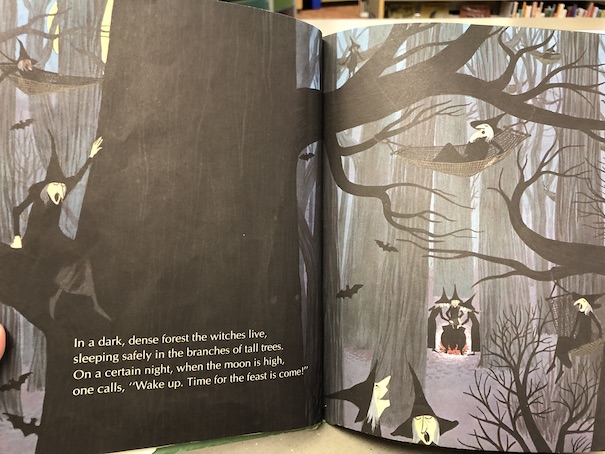
Witches live in a dark forest, sleeping in hammocks in the trees.  When they wake up on Halloween night, they have a feast.

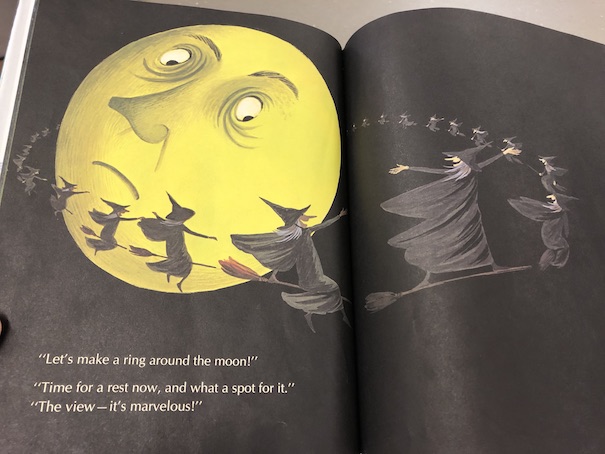
Then, they take to the skies and fly in fancy formations.  They fly in rings around the moon, even stopping on the moon to take a rest.

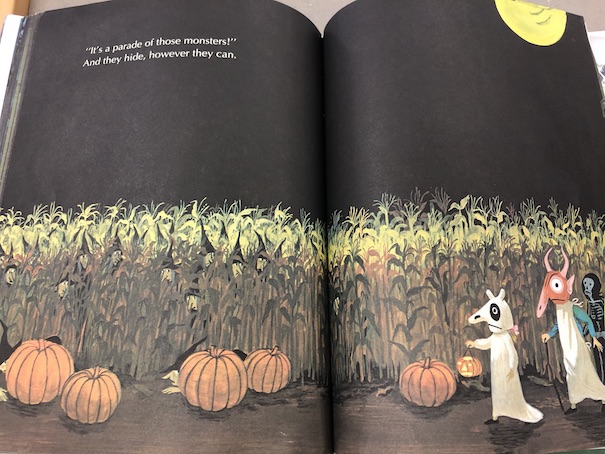
After they return to the ground, they are startled by some trick-or-treaters and hide from them, thinking that they’re monsters.

Finally, they return to their forest and go to sleep in their hammocks once again.

The story is minimal, but the pictures really make the book!

The book is available to borrow and read for free online through Internet Archive.

The Wicked, Wicked Ladies in the Haunted House

The Wicked, Wicked Ladies in the Haunted House by Mary Chase, 1968.

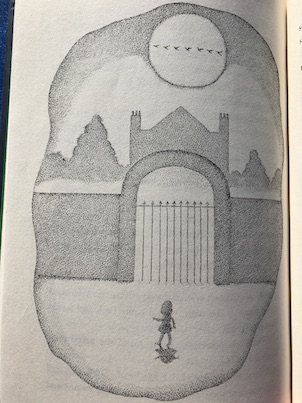
Nine-year-old Maureen Swanson has a bad reputation in her neighborhood, mostly deserved.  The other kids don’t like her because she tells lies and picks fights with them.  Maureen is fascinated by an old, abandoned house in her neighborhood where the wealthy Messerman family used to live.  Sometimes she likes to pretend that she lives there herself. 

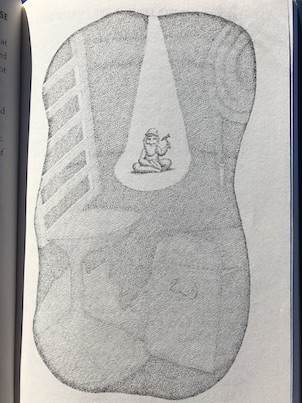
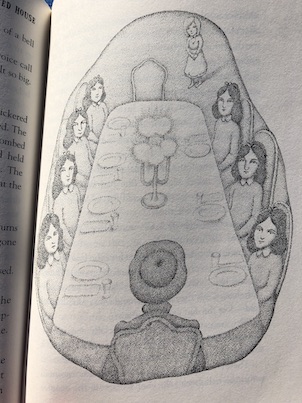
One day, while trying to avoid punishment for her latest antics, she finds her way inside the Messerman estate.  There, she meets a little man who turns out to be a leprechaun.  He tells her that she should leave immediately and not come back, but instead, she ends up exploring inside the house.  To her amazement, she finds paintings of the seven Messerman sisters, who disappeared from the house long ago, and the ladies in the paintings move when she turns her back on them.

When Maureen tries to tell others about it, no one believes it.  When she leaves the house, Maureen takes with her a strange bracelet that she finds on the ground, the same one that she had seen on one of the ladies in the paintings, a gold chain with pigeon feathers.  Later that evening, the same lady from the painting shows up at Maureen’s house, asking for her bracelet back.  The rumors Maureen has heard about the Messerman house being haunted are more true than she knows, and the wicked Messerman girls will stop at nothing to get what they want.

Years ago, the leprechaun came to the Messerman house along with a maid who was from Ireland.  Mrs. Messerman was a very kind woman, and Nora, the maid, was his friend, so he decided to stay.  However, the Messerman girls were always selfish and wicked.  One day, the eldest of the girls stole the leprechaun’s magic bag of tricks and turned herself and her sisters into birds so that they could always go where they wanted and do what they wanted without anyone stopping them.  Mr. and Mrs. Messerman were broken-hearted when their girls disappeared.  Years later, after their parents were dead, they finally returned.  They were not sad at all, but continued their selfish and wicked ways.  Because of the magic, they never age and can turn into birds whenever they like. 

Maureen is afraid to admit that she has the bracelet because she knows that her parents will punish her for trespassing on the Messerman property.  The next day, the women trick her into entering the estate again, only this time, Maureen enters the estate as it was in the past, when the girls were young.  Mr. and Mrs. Messerman are very kind to Maureen and offer to look after her until they can find where she lives.  Mrs. Messerman seems to know that her daughters are mean but doesn’t seem to know what to do about it.  She asks Maureen to help them if she ever has the chance.  It’s a touching moment for Maureen, who suddenly realizes that no one has ever asked her for help before.

Maureen, frightened by the girls, finally gives back the bracelet, and they all fly off again, leaving her alone in the past. How is Maureen going to get home?

This book also goes by the title The Wicked Pigeon Ladies in the Garden. It is available to borrow and read for free online through Internet Archive.

My Reaction and Spoilers

This is partly a story about personal transformation. Maureen has definitely been the resident mean girl, but she gains a new perspective on her own life and behavior when confronted with the frightening wickedness of the Messerman girls.

The leprechaun tells Maureen that the only way to get out of the pretend past created by the Messerman girls is to think about what is going on in the real world.  When Maureen thinks of her mother, she hears her mother calling her and returns to her own time.  The leprechaun catches the birds in a net and almost drowns them in a pond, but Maureen stops him, telling him that Mrs. Messerman had asked her to help them.  The leprechaun releases the birds and tells Maureen that they will continue to be, literally, flighty birdbrains, but that their mother’s love will always be with them.  Maureen, having seen how cold and cruel the sisters were, never appreciating their mother’s love, learns to appreciate her own family more and to behave better. At the end of the story, she acknowledges that she heard her mother calling her and that call, the product of her own mother’s love and concern for her, was what helped her to return home. Maureen ends up better off than the wicked and flighty Messermans because she not only has a home where people care for her but she has learned to appreciate that home and those people and will now treat them better.

One of the things that I appreciated most about this book was the unusual way the leprechaun was used in the story. The story starts out seeming like it will be about ghosts in a haunted house, but that’s not quite what’s happening. Also, when leprechauns appear in stories, they usually have a pot of gold or play tricks on people, but the leprechaun’s role in this story isn’t quite the same.