Knight’s Castle

Knight's Castle

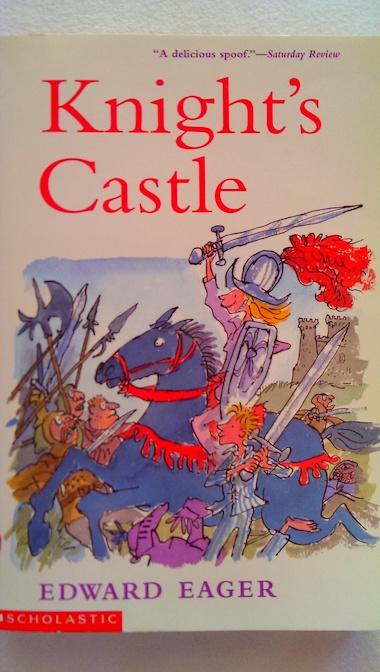
Knight’s Castle by Edward Eager, 1956.

Roger and Ann are the children of Martha from the previous two books in the series. Like their mother’s family when they were growing up, they live in Toledo, Ohio. Their Aunt Katharine (one of Martha’s older sisters) used to live close to them in the Midwest but now lives in Baltimore, Maryland. Roger and Ann don’t particularly get along with Aunt Katharine’s children, Eliza and Jack, because Eliza is bossy and Jack is only interested in photography. However, the four children end up spending the summer together when Roger and Ann’s father needs to have an operation at a hospital in Baltimore.

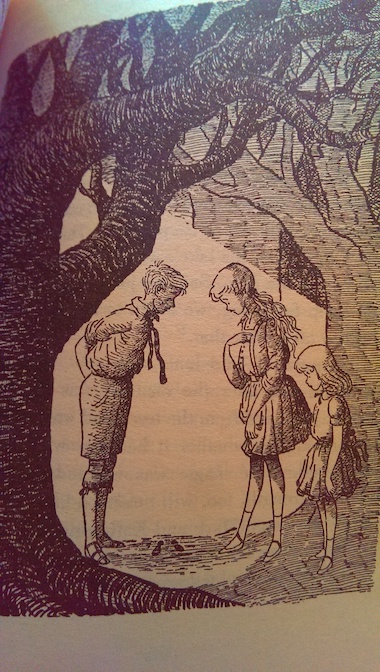
Like their mother and her siblings when they were young, Roger and Ann also like fantasy stories, which their father likes to read to them. Roger starts to believe in real magic when it seems like one of his toy soldiers comes to life at night. Roger collects toy soldiers, and he has over 200 of them, but this one is special because his father says that its been handed down in their family for generations. Roger calls it the Old One. It’s rather worn, so it isn’t obvious at first, but the Old One is actually a knight. Worried about his father’s illness, Roger takes the Old One to bed with him (which he thinks is more manly than taking a teddy bear to bed), and then feels it wriggling in his hand.

Knight's Castle Roger

Realizing that the Old One is magic and is coming to life when he holds him, Roger asks him if it’s part of his magic to grant wishes. If it is, then he wishes for his father to get well, and if possible, for him and his sister to have an adventure in Baltimore over the summer. The Old One doesn’t answer him immediately, but over time, he makes it clear to Roger that wishes have to be earned, and that will be the source of his summer adventure.

When the children arrive in Baltimore to stay with wealthy Aunt Katharine while their father is in the hospital, Aunt Katharine gives them presents. Ann gets a new dollhouse, and there is a toy castle for Roger. Since Aunt Katharine has also just taken all the children to the movies to see Ivanhoe, all of them become immediately interested in playing with the castle.

That night, Roger has a strange dream that he finds himself within the story of Ivanhoe, which is being acted out in his toy castle. The Old One is there as well, although he is mainly watching the action as Roger begins to take part in the story. When Roger comes face-to-face with the villain, he accidentally lets Ivanhoe’s plans slip to him. Things are looking pretty bleak when Roger suddenly realizes that the castle is still a toy and everyone around him is just a lead soldier. This revelation ends the magical adventure and brings him back to reality. However, Roger is disappointed that he ended the adventure so early when perhaps he could have done something really heroic.

Seeing the toy soldiers scattered around instead of poised for the battle they were planning the night before, Eliza and Ann think that Roger was just playing with the castle without them, but he explains to them what happened. The girls were just reading The Magic City by E. Nesbit, and they start building their own “magic city” out of random things from around the house, surrounding the toy castle. Roger is upset about the city because he says that it doesn’t fit in with the Ivanhoe story, and he’s sure that it will ruin everything, maybe from preventing the magic from working again at all. The Old One tells Roger that magic works by threes, so the next opportunity for magic will be in three days.

Knight's Castle Magic City

As it turns out, the city does end up becoming part of the story when the magic brings it all to life on the third night. Roger, Ann, and Eliza find themselves in the middle of the city, surrounded by knights attempting to drive modern cars. Ivanhoe has become a fan of science fiction books, via the public library in the city that the girls built. Although Ivanhoe has turned into something of a geek, the children persuade him to come on a mission to rescue the captive Rebecca, and they end up traveling in a flying saucer (made from a real saucer) to the Dolorous Tower, where the adventure ends as soon as Eliza remembers that the villain threatening them is still just a lead soldier.
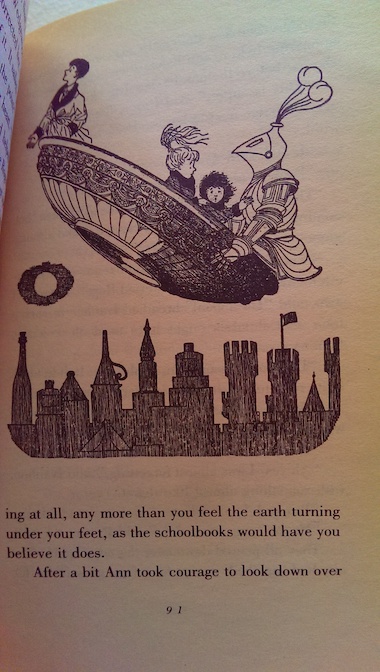
Knight's Castle Flying Saucer

It was an even weirder adventure than Roger’s first one, but by now, the children are starting to understand the rules that go along with the magic. Jack, who says he doesn’t really believe in magic, accompanies the other children on the next adventure, as they try to prove to him that it’s real. They end up having to rescue some of the others from the “giant’s lair”, which turns out to be Ann’s new dollhouse. The dolls are angry that Ann has been neglecting them, only paying attention to the dollhouse when she and Eliza needed to borrow things for their magic city. They manage to escape again by remembering that the dolls are just dolls.

However, Roger is still worried about their father, who is about to undergo his operation. The Old One had told him that wishes needed to be earned, and he doesn’t think that they’ve managed to accomplish much in their adventures. Roger thinks that they need to do something really heroic so that his wish for his father to get better will come true. The Old One gives Roger a rhyme, hinting at what the children need to do on their next adventure, but Roger doesn’t understand what it means, and he doesn’t know if he can figure it out in time.

Actually, it is Ann who eventually realizes what the rhyme means and provides Roger with the “wisdom” that he needs to earn his wish. All throughout the story, Roger was criticizing his little sister for things she did wrong, saying that she was too little and only a girl. Because Roger thinks of her as being just his little sister, he overlooks what she has to contribute to the adventure. Roger’s acquired wisdom is to value the contributions of others and not underestimate their ability to contribute. Ann, being young and shy, frequently doubts herself, but she also learns confidence when she realizes that she has the answer to the riddle. Jack and Eliza learn lessons as well. Doubting Jack learns to believe in magic, and Eliza learns that she can’t always be the boss, that sometimes it is better to let someone else take the lead when they’re the right person for the job. (Although, she does say at the end of story, “If that wouldn’t be just like that magic’s impudence! Trying to teach me moral lessons!”)

Like other books in this series, there are a lot of references to popular pieces of children’s literature and jokes about things that happen in children’s stories.

The book is currently available online through Internet Archive.
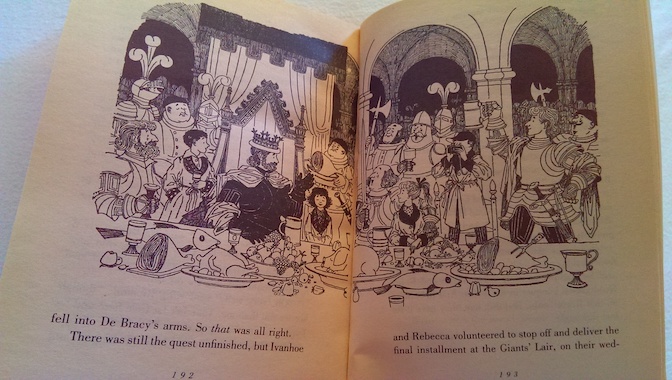
Knight's Castle Feast

Magic by the Lake

MagicByLake

Magic by the Lake by Edward Eager, 1957.

Jane, Mark, Katharine, and Martha are finally going to spend the summer at a lake with their mother and their new stepfather! The children were never able to do that before because their widowed mother always had to work during the summer. When they arrive at the cottage by the lake that their stepfather, Mr. Smith, has rented, there is a sign that says, “Magic by the Lake.” The children think that it could just be the name of the cottage because sometimes cottages are giving interesting or amusing names, but having had experience with magic before (this being the second book in the series), they consider the idea that they could be headed for more adventures. Of course, they are correct, but it turns out to be the lake that’s really magical, not the cottage.

MagicByLakeTurtle

The children are playing by the lake when they wish for more magic, and a talking turtle comes up to tell them that, because of their wish, the entire lake is magic. That sounds amazing, but too much magic all at once can be overwhelming. Fortunately, the turtle is also magical, and he has some ability to influence magic in the lake. The children make a deal with him that he can arrange for them to have adventures with magic in the lake, but only one at a time, because that’s what they feel that they can handle. Also, the adventures won’t happen every day, so they can have a chance to rest in between. The grown-ups around them won’t notice any of the magical happenings, and little Martha insists that nothing truly scary will happen to them. Jane protests at that request because she thinks that it will make their adventures as boring as overly-tame children’s books, but the turtle says not to worry because what he thinks of as “not scary” isn’t necessarily what Martha would think of as “not scary.” The turtle tells the children that when they’re ready for adventure, they should think about what they wish for and then touch the lake, and if the time is right for it to happen, it will.

That sounds simple enough, but what they consider the right time and what the lake considers the right time aren’t always the same thing, and just as before, their wishes and adventures don’t go quite as planned. In their first adventure, a mermaid takes them to an island of pirates, the stuff of high adventure. The children are delighted when they discover that the pirates, being adults, can’t really see them, as per their earlier wish for adults not to see their magical activities. It opens the potential for playing dirty tricks on rotten pirates, who seem to perceive them as some sort of ghosts. It’s all fun and games until the pirate captain decides to see if he can make ghosts walk the plank. Their turtle friend saves them by turning them into turtles, which, while magical, makes the rest of the day rather difficult for them because they have to go home and on errands with their mother. Walking on land can be difficult for turtles, and their mother has no idea that they’ve changed at all, still seeing them as children. Whatever magic the children get during the day seems to last until the sun sets, even when they wish it would end sooner.

MagicByLakeGrownUp

Then, while watching their mother and Mr. Smith at a dance, Jane and Katharine wish that they were old enough to join in, about age sixteen. Suddenly, the two of them are teenagers in evening dresses, getting attention from some teenage boys. The girls seem to enjoy the romance of it, but Mark and Martha follow them around, trying to convince the boys that the girls are really younger than they seem to be and dreading the moment when they will inevitably change back to themselves.

The children discover that they don’t even need to be at the lake in order to make the magic happen as long as they’re touching water from the lake. On a rainy date, when the roof of their cottage is leaking, the children realize that the rain water is also lake water. By making a wish on that, they end up at the South Pole in time to save a lost explorer and help him make an important discovery.

MagicByLakeDisappearance

The children enjoy their adventures, but they become worried about Mr. Smith, who has been making the commute back and forth from the lake to his bookshop, and it seems that business hasn’t been good at his bookshop this summer. They consider the idea of using the magic of the lake to solve Mr. Smith’s problems, perhaps by going back to the island where they saw the pirates bury a treasure chest. They figure that if they could bring Mr. Smith an entire chest of pirate treasure, he wouldn’t have to worry about money anymore.

But, of course, that idea doesn’t go as planned. When Martha argues with the others and goes to the island by herself to get the treasure, she breaks all the rules associated with the magic.   Because the rules that previous protected her and her siblings are gone, there is nothing to prevent her from being captured by the cannibals that live on the island. When her brother and sisters try to save her, they are also captured. It’s only the sudden appearance of Martha’s future children and Katharine’s future daughter (although they don’t know it yet), who are on a magical adventure of their own, in a cross-over from another book in the series, The Time Garden.

MagicByLakeTreasure

The children make one more attempt to get treasure for Mr. Smith in a kind of Arabian Knights adventure, but that doesn’t work, either. However, although the children seem to have used up their wishes on the lake, they have the feeling that the magic might allow them one last opportunity to get what Mr. Smith needs. It does in a way that may or might not be magical, although the buried treasure that they find and get Mr. Smith to dig up may be a representation of the pirates’ treasure and not of the old miser (now deceased) who was said to have lived at the old, abandoned cottage by the lake that the children decide to explore. It does seem like quite a coincidence that the old miser’s initials would match those of the pirate captain, and they are carved on the stone over the buried treasure, just like the marker the pirate captain left.

In the scene with the cannibals on the island, the cannibals are stereotypical “savage natives” (or “native savages”, or something generic of that sort, since the terms are used pretty interchangeably in the story). You find things like this pretty commonly in old children’s books, especially prior to the 1960s. But, what made this more palatable for me was that the entire scene is written as a joke on the usual stereotypical books that children of the era would have read. The cannibals speak kind of like American Indians in cheesy old Westerns, using words like “heap” for “very” and randomly adding “-um” to end of words. You know that it’s not really how anybody, even cannibals living on some remote island in an indeterminate ocean, would talk, but it might be how children raised on adventure stories and movies from the 1920s might imagine they would (adding to my earlier theory from the last book that at least some of the children’s adventures might actually take place in their own minds, not in their “real world”).  It may also be a reference to things in tv shows from the 1950s, the time period when the story was written. The best part for me is when the children try to remember what shipwrecked explorers do when confronted with cannibals in some of the stories they’ve read. They start throwing out random words that are meant to sound impressive combined with some gobbledy-gook in an effort to communicate/impress the cannibals. Then, Mark tries to convince them that he’s a powerful god with the ability to control fire. The cannibal chief is unimpressed, telling him that he recognizes what Mark has as an ordinary safety match, which he blows out. So much for the old adventure stories.

The book is currently available online through Internet Archive.

Half Magic

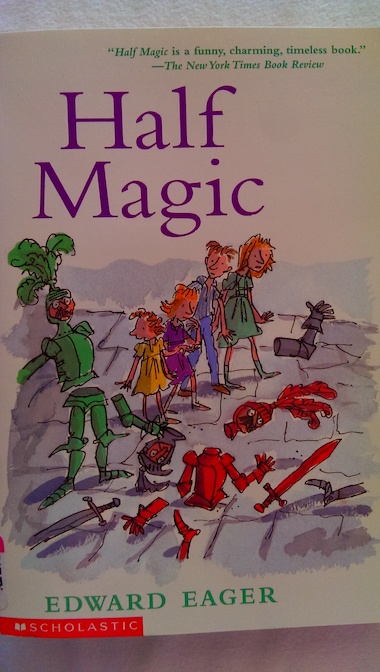
HalfMagicHalf Magic by Edward Eager, 1954, 1982.

Jane, Mark, Katharine, and Martha are siblings living in the 1920s. Their father is dead, and their mother works for a newspaper. While their mother is at work, Miss Bick takes care of the house and the children, although she isn’t really good with children. The children are often free to amuse themselves on their own during the summer, and they like to pick out books from the library for entertainment. They particularly enjoy the fantasy books by E. Nesbit (a real author, and they reference her real books during the story), and they wish that exciting, magical things like the ones that happen in her stories would happen to them.

They get their wish (and a great many others) when Jane finds a strange coin on the sidewalk that they mistake for a nickel at first. By accident, they discover that this coin grants wishes, but it has a peculiar habit of only granting half of what a person wishes for (and the coin seems to interpret the idea of “half” pretty liberally, depending on the type of wish, so results can be pretty unpredictable).

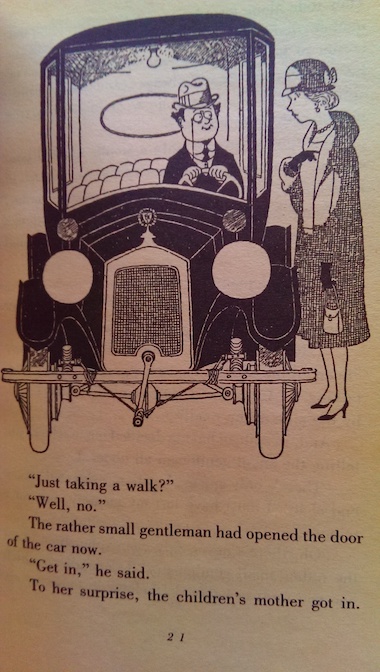
Jane is so bored after she finds the coin that she wishes that there would be a fire for some excitement. Suddenly, the children hear a fire engine and discover that a child’s playhouse had caught fire. It could have been coincidence, except that their mother borrows some change from Jane, getting the magical coin by accident. While she is visiting the children’s aunt and uncle and finds their conversation boring, she wishes that she were at home, but finds herself unexpectedly by the side of the road halfway home. She is confused but thinks that she must just be very tired or something and forgot that she was walking home. She ends up accepting a ride from a very nice man who happened to be passing her on the road and thought that she looked lost and confused.

HalfMagicChildrenThese early experiences and a series of odd wishes Mark makes when he doesn’t realize that he has the coin demonstrate to the children not only that the coin is magical but that they have to be extremely careful what they wish for when they have it. They have to word their requests very carefully, asking for twice as much of anything they want in order to counteract the half magic of the coin. Even so, they can’t help but make mistakes and get themselves into trouble.

When Katharine uses her turn with the coin to take them back to the days of King Arthur, she ends up causing trouble and disrupting history by defeating Lancelot in a tournament. Fortunately, Merlin realizes what the children have done and forces them to explain themselves and show him the magic coin. After inspecting it, Merlin gives the children a stern lecture about interfering with the natural course of history. He uses the coin’s magic to undo what the children have done and further uses it to restrict the children’s wishes to affecting only their own time period. He warns them to be more careful about what they wish for, keeping their wishes smaller and more personal, adding that the coin’s magic will eventually be exhausted, so they should save their wishes for what is important.

HalfMagicTheaterThere is one more disastrous experience when the children go to the movies (a silent film because this is 1920s), and Martha accidentally wishes that she wasn’t there while touching Jane’s purse, which holds the coin. Martha, of course, ends up being only halfway “not there,” almost like a living ghost, which terrifies onlookers. Straightening out that mess brings them into contact with Mr. Smith, the nice man who gave their mother a ride home. He owns a bookstore, and he enjoys fantasy stories as much as the children do. He becomes the only adult who knows that the children have been using magic, and he’s fascinated by it, enjoying witnessing their adventures.

When the children’s mother comes to pick them up, Mr. Smith is pleased to meet her again and invites the family to join him for dinner. Mr. Smith is obviously fond of the children’s mother, and most of the children like him, too. However, Jane is uneasy. It’s partly that she worries that Mr. Smith will interfere with their use of the magic coin and partly that she worries about his new relationship with their mother. Of the four children, only Jane, as the oldest, really remembers their father, and she can’t stand the thought that Mr. Smith might become their stepfather and take his place.

HalfMagicSmithWhen Jane argues with the other children about Mr. Smith and rashly wishes that she belonged to another family, the other children call upon Mr. Smith to help them rescue Jane from her foolish wish, her unsuitable new family, and from herself.

In the end, Mr. Smith does marry the children’s mother, and even Jane is happy with the arrangement, having come to appreciate Mr. Smith much better.  Once their mother and Mr. Smith each have what they wished for most — each other and a happy family with the children — they forget about the magic coin.  Although none of the children realize it, the coin also grants Jane one final half-wish in which her father comes to her in a dream-like form, letting her know that he approves of her mother’s remarriage and the children’s new stepfather because he wants them all to be happy.  This gives Jane the reassurance she needs to fully accept Mr. Smith.  The children, deciding that the coin has given them all the wishes it’s going to, leave it in a convenient place for a new owner to find.

You don’t find out what happens with the coin’s new owner apart from when the children see a young girl pick it up and realize that it’s magic when she makes her first wish. However, there is a cross-over scene in another book in the series, Seven-Day Magic, which explains a little more about what happens next.  Books in this series frequently reference and sometimes parody other children’s books that were popular at the time they written, and individual books in the series even sometimes reference each other, even when the main characters have changed.

Speaking of literary references and parodies in this series, sometimes it’s a little difficult to tell for certain which scenes are really meant as parodies and which aren’t.  Knowing a bit about vintage children’s fiction helps, but there may be some scenes in the stories which can make modern readers a little uneasy.  One scene in the book that bothered me was near the beginning, when Mark wishes to be on a desert island.  This was before the children fully realize that the coin only grants half of a wish, so the children just end up in a desert, but not on an island.  The part that bothers me is that they are briefly kidnapped by a kind of wandering Arab man who seems to be planning to ransom or sell them.  This scene is like an old stereotype out of the sort of silent movies that the children would have been watching, and because of that, it was a little painful to read.  The man’s name is Achmed (still in keeping with the stereotype), and they keep referring to him as “Achmed the Arab,” in case you need reminding that that’s what he is.  They get out of their predicament with him by wishing for something that would make him really happy so that he’ll forget about them.  By then, they realize that they need to double their request in order to make the coin work properly, so their wish works.  The coin ends up giving Achmed a beautiful wife and “six plump Arab children” (in case you forgot that Achmed’s children would be Arab as well) and generally improves what Achmed owns, so Achmed becomes a happy family man and gives up his earlier, shady ways.  It’s eye-rollingly stereotypical and cliche, so I think it’s worth telling potential readers that this scene is there.

The cliches and stereotypes (not to mention the constant, unnecessary repetition of the word “Arab” just to remind you that that’s what everyone is, in case you were confused) in that scene were annoying, but unfortunately, things like that crop up pretty regularly in children’s literature from the 1950s and earlier when there are scenes that take place just about anywhere outside of the United States, Canada, or Europe.  That being said, there are a couple of things that make this scene easier to bear.  One is that Mark, realizing that the magic coin can get them out of this situation and that they have the power to put Achmed at their mercy, decides not to do it because it occurs to him that Achmed is probably a desperate man because he is poor.  Mark decides that Achmed would be a better person if he had whatever would make him feel the most fulfilled in life, so he wishes for that for him.  It’s nice that Mark sees him as being a person whose well-being needs to be considered, not just an enemy to be defeated.  Also, it occurs to me that it’s not completely certain that the desert they’re in is a real-life one, even in the children’s fictional world.  I think the assumption is that it is, like we’re supposed to assume that the world of Camelot that they visit is a real part of history, but it may not be.  In fact, the children in different books in this series in general sometimes get philosophical about their magical adventures, wondering about how their magical adventures fit into the real world around them or if they really do, and they never fully get all the answers.   Perhaps the coin took the children to their idea of what a desert or what Camelot would be like, not to those real places.  In 1921, there was a famous silent movie called The Sheik in which Rudolph Valentino played an Arab sheik named Ahmed (Achmed’s name could be a joke on that).  It’s not a movie for children, but it was very popular in the 1920s, and it inspired other movies with Arabian themes, at least a couple of songs, and probably a number of the stereotypes about Arabs of the time.  So, if the kids in the story were imagining an Arabian desert, it would probably be something resembling what they’d seen in movies like that.  This little adventure may have only taken place in the imaginary world, even from the children’s perspective, and the author may be poking fun at the notions children get from popular culture.  Even in the end, the children admit that there are many things they don’t understand about the coin and how it works, like where the other half of Martha went when she was only half there.   In a world where magic works, pretty much anything is possible.  Then again, since the entire book is fictional, it may be best not to worry too much about it.  Still, I just plain didn’t like this scene.  The rest of the book wasn’t so bad.

Overall, it’s a fun story.  Part of the fun for book lovers is in spotting the various literary references in the story because the children talk about the books they like and read and compare their adventures to ones they’ve read about.  The concept of the half-wishes also makes you think.  It’s worth pointing out that, although the children enjoy the general adventure of the coin, most of the children’s wishes, no matter how carefully they word them, don’t turn out the way that they expected, even when they get exactly what they asked for.  Mr. Smith marrying their mother is actually the best wish that comes true in the whole book.

The book is currently available online through Internet Archive (multiple copies).

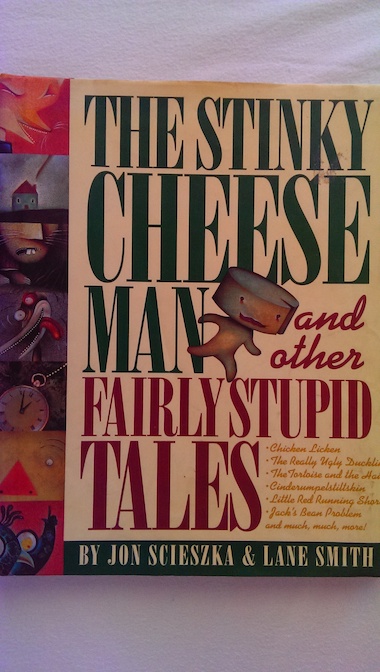
The Stinky Cheese Man

StinkyCheeseMan

The Stinky Cheese Man and Other Fairly Stupid Tales by Jon Scieszka and Lane Smith, 1992.

StinkyCheeseManDuckThis book is a spoof on a number of classic fairy tales. As it explains in the introduction, the short stories included in the book are more Fairly Stupid Tales than Fairy Tales, giving the example of Goldilocks and the Three Elephants: A girl smells peanut porridge and wants to enter the elephants’ house to eat some and try out their furniture, but elephant furniture is too big for her to climb up on, so she just leaves, The End. That incredibly short story isn’t found anywhere else in the book, but it’s a good example of what the other stories are like.

Even the set up of the book is a joke, with the Little Red Hen showing up to demand help with her wheat only for Jack the Narrator to tell her that it’s too soon because they haven’t even had the title page yet. The title page has the words “Title Page” larger than the title itself, and the dedication is upside down because who would actually read it anyway? Then, Chicken Licken thinks that the sky is falling and that everyone should run and tell the President, but it turns out that what’s falling is actually the Table of Contents, which squashes everyone before Foxy Loxy can eat them.

Then, the rest of the stories begin:

StinkyCheeseManMattressesChicken Licken – As described above

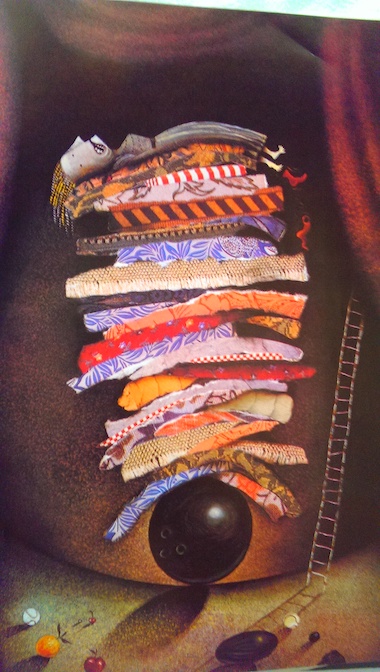
The Princess and the Bowling Ball – parody of the Princess and the Pea – Starts off like the original story with the prince’s parents testing princesses to see if they can feel a pea through a whole bunch of mattresses, but none of them ever do, so the prince takes matters into his own hands to rig the test in favor of the girl he really wants to marry.

The Really Ugly Duckling – parody of The Ugly Duckling – When the really ugly duckling grows up, he’s basically just an ugly duck. The End.

The Other Frog Prince – parody of The Frog Prince – The frog isn’t really a prince. He just said that because he wanted a kiss.

Little Red Running Shorts – parody of Little Red Riding Hood – Jack the Narrator accidentally spoils the story by revealing too much in his introduction to it, so the characters feel like there’s no need to act it out, and the Little Red Hen fills up the extra space, demanding to know why they haven’t gotten to her story yet.

Jack’s Bean Problem – parody of Jack and the Beanstalk – Jack the Narrator starts to tell his own story about defeating the Giant, but the Giant protests because he doesn’t like always being tricked and takes control and reads a story that he “wrote” himself, cut out of pieces of other random stories from different books. When the Giant threatens to eat Jack if he can’t tell a better story, Jack tells a story that constantly repeats until it transitions into the next one.

Cinderumpelstiltskin – parody of Cinderella and Rumpelstiltskin – Starts out like the usual Cinderella story, but Rumpelstiltskin shows up and offers to teach her how to spin straw into gold. Cinderella doesn’t see how that can possibly help her since he doesn’t have a gown for her to wear to the ball, so she ends up without either a gown or any gold.

The Tortoise and the Hair – parody of The Tortoise and the Hare – A rabbit tells the tortoise that he’s so slow that he can grow hair faster than the tortoise can run. By the end of the story, the tortoise is still running, and the rabbit is still growing hair.

The Stinky Cheese Man – parody of The Gingerbread Man – An old couple make a “child” for themselves out of stinky cheese. When he takes on a life of his own and run away, they don’t bother to chase him because they can’t stand the smell. Nobody else wants to chase him, either.

StinkyCheeseManCinderSo, why isn’t there a Little Red Hen story listed? At the end of the book, she shows up to complain about how she had to do everything herself to make the bread and nobody even saved space for her story (because Jack had to sneak away from the Giant after he fell asleep). The Giant wakes up and decides to make a chicken sandwich with the bread.

Understanding the jokes in the book requires a knowledge of the stories they’re spoofing, so this isn’t a book for very young children. Any kid who reads this should already know the classic fairy tales and be old enough to appreciate the humorous twists. I think kids feel clever when they realize that they can recognize the references in the stories and know where and how the parodies are different from the originals. Some of the humor has to do with the abrupt endings, simplifying issues that are more drawn-out in the original stories.  I remember liking this book when I was in elementary school!

The art style is very distinctive, with a number of cutout elements with different textures. It’s fascinating to see the way that the pictures were put together.

The book is currently available online through Internet Archive.

The Paper Bag Princess

PaperBagPrincess

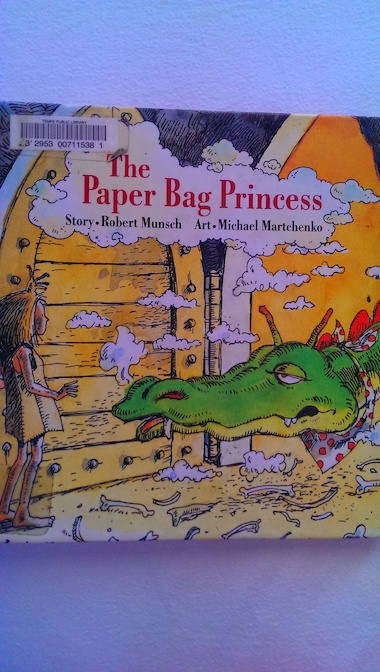
The Paper Bag Princess by Robert Munsch, 1980.

Princess Elizabeth is a stylish young princess, engaged to the handsome Prince Ronald. But, one day, a dragon attacks her castle, incinerating all of Elizabeth’s fine clothes and carrying Ronald off to its lair.

Donning the only thing she can find to wear, an old paper bag, Princess Elizabeth tracks the dragon down to rescue Ronald.

In this unconventional fairy tale story, Princess Elizabeth must defeat the dragon in a duel of wits in order to rescue her prince, but in a humorous twist ending, Ronald is somewhat less than grateful for her help because Princess Elizabeth is no longer stylish in her old paper bag.

The book is available to borrow and read for free online through Internet Archive.

PaperBagPrincessRonaldRescued

My Reaction

Books like these can be a good antidote to people who are tired of prissier princess stories with flamboyant gowns and a wedding (or at least kissing) at the end. The story is deliberately humorous and correct in pointing out that people who worry more about the clothes you’re wearing than the things you do for them are not worth bothering with.  Prince Ronald is shallow. He has the look of a prince but not much substance, caring more about appearances than about what his princess went through for his sake.

The Ninth Jewel of the Mughal Crown

BirbalTales

The Ninth Jewel of the Mughal Crown: The Birbal Tales by James Moseley, 2001.

BirbalTalesRealBirbalThe characters in the stories, Emperor Akbar and his friend and advisor Birbal (birth name Mahesh Das) were real people who lived in India during the late 16th century. Over the years, stories and legends have grown up around them, although the truth is pretty incredible by itself.

This book, which is a collection of some of the stories about Akbar and Birbal, begins by explaining a little about their history, and there is another section in the back that explains more about their lives.  The book’s introduction says that Akbar’s father died when he was young and that Akbar’s reign was considered a Golden Age in India’s history, although it mostly focuses on his “Nine Jewels.”  The section in the back gives a little more context.

To begin with, Akbar was one of the Mughal Emperors.  The book doesn’t explain much about what that means, but understanding it helps to set the stage for the stories.  The Mughal Empire consisted not only of modern day India but also some of the surrounding countries.  The empire was first established by Akbar’s grandfather, Babur, through conquest.  Babur was born in the region that we now call Uzbekistan, although his family’s origins were Mongolian.  They were distantly descended from Genghis Khan.  They were also descended from Tamir (sometimes called Tamerlane), giving them Turkic and Persian connections.  The early years of the Mughal Empire were unstable, but when Akbar’s father died and Akbar became emperor at a young age, his regent helped him to stabilize the empire and expand it through a mixture of further conquest and diplomacy.  The reputation of wealth and power in the Mughal Empire eventually led to the adoption of the word “mogul” in English to describe a wealthy and powerful person, especially one who has high standing in a particular field of expertise (something which, as you’ll see, was of particular importance to Akbar).  Using the riches and resources gained through his territorial expansion, Akbar worked to develop the economy of his empire and to support the arts and learning.

BirbalTalesRealAkbarAkbar had a great love of learning, but unfortunately, was dyslexic at a time when people didn’t understand the condition very well.  (To put it into context, Akbar was a contemporary of Elizabeth I of England.)  Even though, like the European Emperor Charlemagne (who lived much earlier but was also apparently dyslexic), he wanted to learn to read, he struggled with it throughout his life because of his condition.  Akbar didn’t want his reading difficulties to interfere with his learning or his love of the arts, so he found another way around the problem.  In a way, it’s similar to what Charlemagne did, surrounding himself with learned advisors who would read to him and discuss important topics with him, verbally teaching him whatever he wanted to know.  Akbar chose his advisors very carefully, seeking out people who had demonstrated excellence in subjects that were important to him. Akbar’s advisors became famous for their fascinating and unusual skills and personalities.  He had nine special advisors who were close to him, which is why they were called, “The Nine Jewels of the Mughal Crown.”  Legends grew up around these men and their abilities:

Tansen – An expert in music, whose singing voice was said to be so amazing that he could make candles burst into flame with a song.

Daswant – A master painter.

Todar Mal – An expert in finance.

Abul Fazl – A great historian.

Faizi – Brother of Abul Fazl, a famous poet.

Abud us-Samad – A master at calligraphy, he also designed the imperial coins.

Man Singh – A great military general.

Mir Fathullah Shirazi – A man of many skills, including the fields of medicine, astronomy, philosophy, and finances.

Birbal – Akbar’s Minister or Raja, who had a reputation for cleverness, quick wit, and the service of justice.  He was the “Ninth Jewel”, and his stories are the focus of this book.

BirbalTalesMeetingThere are many more stories about Birbal than the ones included in this book, but they are all about how Birbal uses his wits to serve Akbar and aid the cause of justice.  Like all good legends, the stories are partly based in fact, but have grown with each retelling to the point where it can be difficult to say where the real people leave off and the legends begin.

In the first story in the book, Akbar meets Birbal when he is still a child.  Fascinated by the boy’s combination of courtesy and boldness and his unusual wit, he gives the boy a ring and tells him that when he is grown, he should come to his palace at Fatehpur Sikri.  Years later, Birbal does go there, but when he shows the ring with the emperor’s seal on it to the guard on duty, the guard refuses to let him in until he promises to give him half of whatever the emperor gives him.  When Akbar sees Birbal, he is pleased to meet him again but stunned when Birbal asks him to give him 100 lashes.  When Birbal explains the reason for his bizarre request, it not only gets the laughter of the court, but the approval of Akbar, who appreciates this bold approach to the problem of bribery.

BirbalTalesPortraitFrom then on, Birbal gains a reputation for his ability to mediate disputes and find unusual solutions to problems.  His favored position at court gives him some jealous enemies, but he handles them with the same cleverness that he uses to solve every problem.

In one of my favorite stories, one of the noblemen at court attempts to cheat Daswant out of his rightful fee for painting his portrait by changing his appearance (shaving his beard, shaving his mustache, etc.) after each portrait sitting and then claiming that the portraits Daswant paints do not really look like him.  When Daswant explains the situation to Birbal, he gets the nobleman to promise to pay for an “exact likeness” of himself in the presence of Akbar.  Then, Birbal shows him a mirror, which Akbar agrees contains an exact likeness of the nobleman and deserves payment.

BirbalTalesCoinPurseIn another of my favorite stories, Birbal determines who is the true owner of a coin purse when a flour merchant and an oil merchant each claim that it belongs to them.  He pours the coins into a pot of boiling water and notes the oil that bubbles to the surface.  Because the coins are covered in oil, they obviously belong to the oil merchant.  If they had belonged to the flour merchant, they would have been covered in flour.

One of the interesting aspects of Akbar’s friendship with Birbal was their religious differences.  Akbar, like the rest of his family, was Muslim, and Birbal was from a family of Hindu Brahmins. The Mughal Empire was a multi-cultural society, and Akbar was aware of it.   At one point, he attempted to develop a new religious movement that combined aspects of Islam and Hinduism in order to further unite his subjects, but it never caught on as a mainstream religion, possibly because Akbar’s own strong personality as its leader was one of the most attractive features.  Akbar did seem to genuinely believe in religious tolerance and promoted widespread education among his subjects.

Birbal, the historical person, was eventually killed in battle, and Akbar greatly mourned his loss.  The Mughal Empire continued for generations beyond Akbar, although it eventually collapsed through a combination of military, administrative, and economic decline; the decentralization of power in the empire; internal discord; and interference from outsiders that paved the way for the British colonization of India.  That’s kind of a simplistic description of a long, complicated period of history, but the end of the Mughal Empire was marked by the beginning of British rule in India.  In 1858, the British East India Company deposed the last of the Mughal emperors, sending him into exile, around 300 years after the reign of Akbar began.

Ella the Elephant

EllaElephant

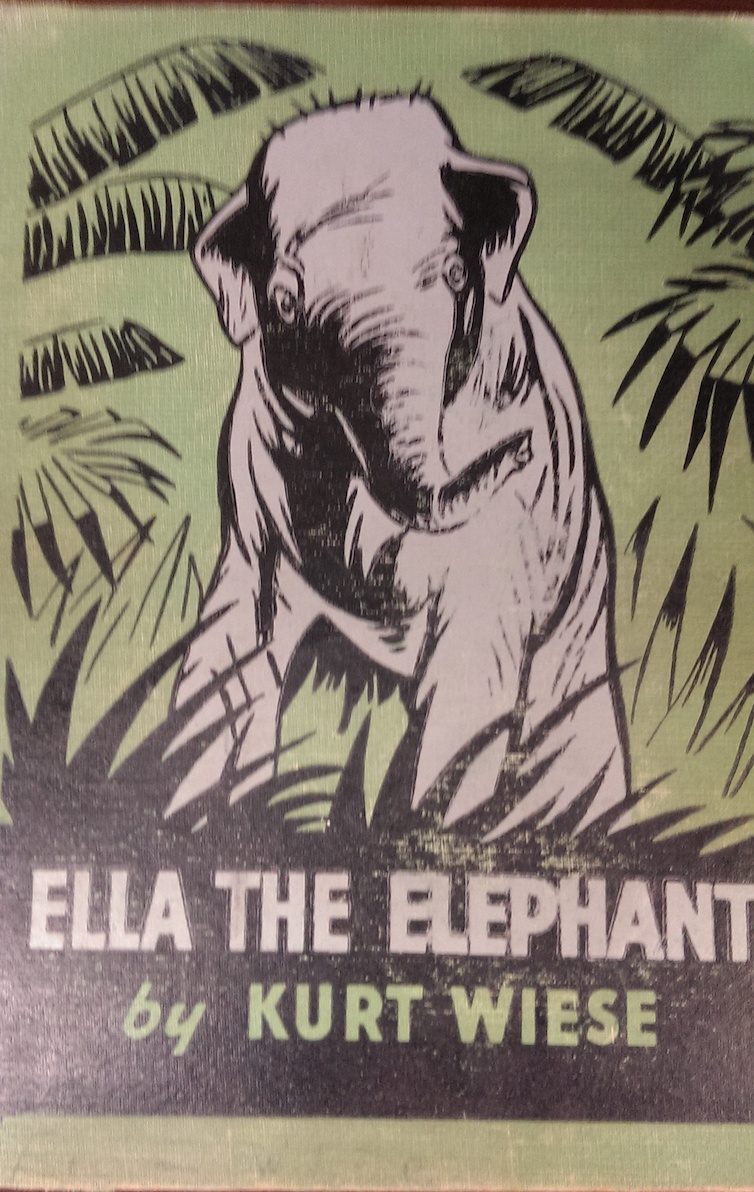
Ella the Elephant by Kurt Wiese, 1931.

EllaElephantMotherElla is a happy baby elephant in India.  Her mother takes good care of her, and she enjoys moving with the herd.  However, Ella’s carefree life with her mother ends abruptly when the herd is captured by humans!

Because Ella is small, she is able to escape when the other elephants can’t, but she finds herself alone and frightened in the jungle.  She doesn’t know what has happened to her mother, and she is in danger from predators in the jungle.

Other jungle animals help her, warning her of dangers and helping her to find out where her mother is.  She knows to look out for crocodiles in the river, and a peacock and some monkeys warn her about the presence of the tiger.  A kind water buffalo looks after her at night, using its size to intimidate and keep away the tiger.  The parrots help her to find the village where her mother is being held.  Eventually, she reunites with her mother in the human village after she is captured a second time.

I found this book at an antique store and included it here because I’d never seen it before, but I have mixed feelings about it.  The part about other animals helping little Ella is fun, but it’s somewhat disappointing that the story ends with both Ella and her mother in captivity.  The story ends with Ella’s reunion with her mother, and we don’t know exactly what happens to them after that. It appears that Ella and her mother will both be treated well by the humans who now have them, and they are relieved to see each other.  Still, to have them now living in captivity seems anti-climactic.

Why Mosquitoes Buzz in People’s Ears

Mosquitoes

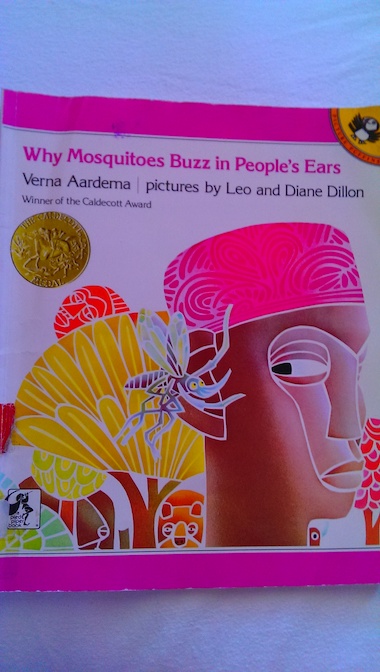
Why Mosquitoes Buzz in People’s Ears retold by Verna Aardema, pictures by Leo and Diane Dillon, 1975.

The story comes from a West African folktale, and all the characters are animals.

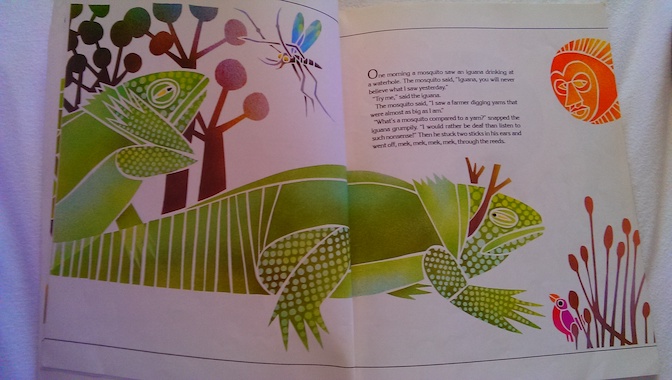
In the beginning, a grumpy iguana gets tired of hearing a mosquito telling tall tales. He sticks a couple of sticks in his ears so that he won’t have to listen anymore, and this decision leads to a series of unfortunate events that leads to the accidental death of a baby owl.

MosquitoesIguana

It starts with a snake trying to talk to the iguana, who does not hear him. The snake, thinking that perhaps the iguana is angry with him, goes to hide from him in a rabbit hole, startling the rabbit out. The chain reaction of events continues, with different animals startling each other, until a frightened monkey crashes through a tree branch, which breaks, killing the baby owl.

MosquitoesMonkeyTree

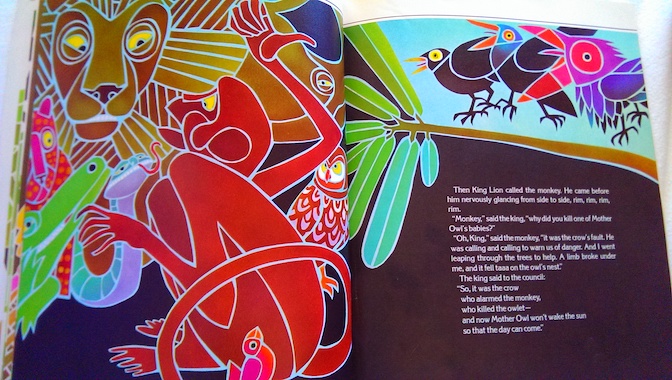
The Mother Owl is so distraught at the death of her baby that she doesn’t wake the sun so that dawn can come, as she usually does. When the other animals realize that dawn isn’t coming, King Lion calls a meeting to determine the reason why. Together, they trace the events backward to the iguana. The iguana is not at the meeting because he still has sticks in his ears and hasn’t heard a thing about it.

MosquitoesMeetingMonkey

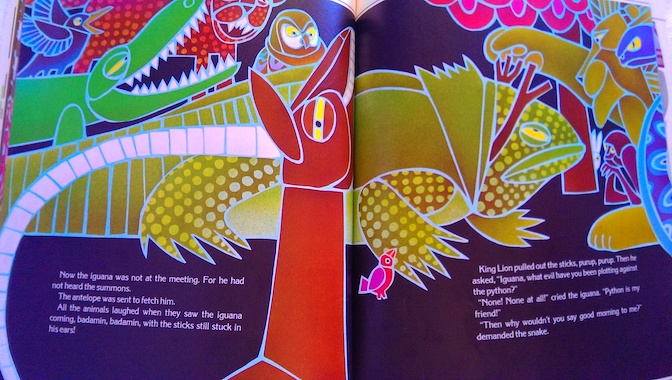
When the other animals track down the iguana and take the sticks out of his ears, they demand to know why he wouldn’t talk to the snake. When he tells them that he had sticks in his ears because he couldn’t stand listening to the mosquito’s stories anymore, the mosquito ends up taking the blame for everything. The Mother Owl is satisfied with the explanation and hoots to wake up the sun, although the mosquito escapes punishment by hiding. So, ever since, the mosquito whispers in people’s ears to find out if everyone is still angry.

MosquitoesMeetingIguana

The art style in the book is a little unusual. When I looked at the pictures the first time, I thought of them as looking stenciled. However, there is a note in the beginning of the book, near the copyright information, that says that the pictures are a combination of watercolors and india ink. The artists used an airbrush and pastels, and they created the “cut-out effect” with frisket masks and pieces cut out of vellum.

This book is a Caldecott Award winner. It is currently available online through Internet Archive.
The Great Kapok Tree

KapokTree

The Great Kapok Tree by Lynne Cherry, 1990.

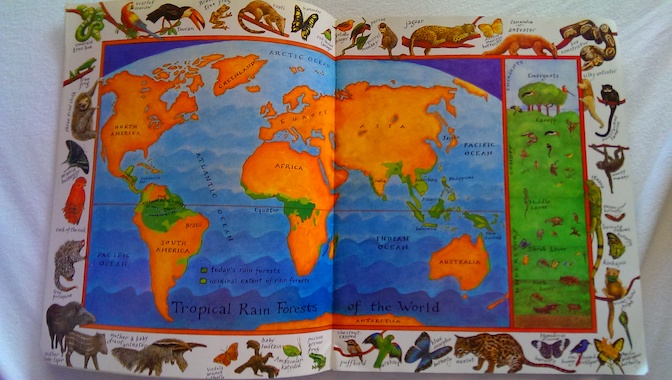
The book begins with a letter from the author, saying that she wrote the book in order to explain to people the importance of rain forests and why they should be preserved.

KapokTreeMap

Two men are walking through a rain forest. They are there to cut down the trees (probably for farming). The animals watch as one of the men begins chopping at a great Kapok tree with his axe. It’s hard work, and before the man gets very far with his chopping, he has to stop and rest.

As the man sleeps, the animals come to him and whisper to him not to chop the tree down. The boa constrictor tells him that his ancestors have lived there for generations. The monkeys tell him that if he chops all the trees down, there will be no tree roots to hold the soil in place, and it will wash away, eventually changing the land into a desert. The birds are worried because people use fire to help clear the forest, and it destroys everything. All of the animals are worried about where they will live and what they will eat if the forest disappears.

KapokTreeButterflies.jpg

The animals also point out to the man that destroying this forest would also be destroying his own future and that of his children. The forest produces oxygen for humans to breathe.

KapokTreeChild

Finally, a human child from the Yanomamo tribe that lives in the forest asks the man to wake up and look at him and all the animals. The man is startled and amazed by what he sees. He thinks about continuing his work, but seeing the child and all of the animals staring at him silently, hoping that he won’t, he decides that he can’t bring himself to do it and leaves.

KapokTreeEnd

I don’t remember reading this book when I was a kid, but I remember other stories very much like it.  Environmental issues like this were common topics of discussion when I was in elementary school during the early 1990s.  One of the movies of my childhood, FernGully, came out in 1992, a couple of years after this book was first published.  That movie is also based on a book, although it has even more fantasy elements than this story, which has talking animals.  Both of these stories demonstrate how many children during the 1990s were raised to be environmentally aware.

This is a Reading Rainbow Book. It is currently available online through Internet Archive (multiple copies).

Tawny Scrawny Lion

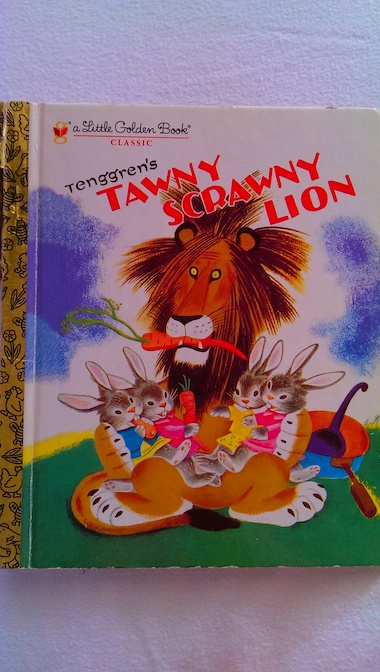
TawnyScrawnyLion

Tawny Scrawny Lion by Kathryn Jackson, illustrated by Gustaf Tenggren, 1952.

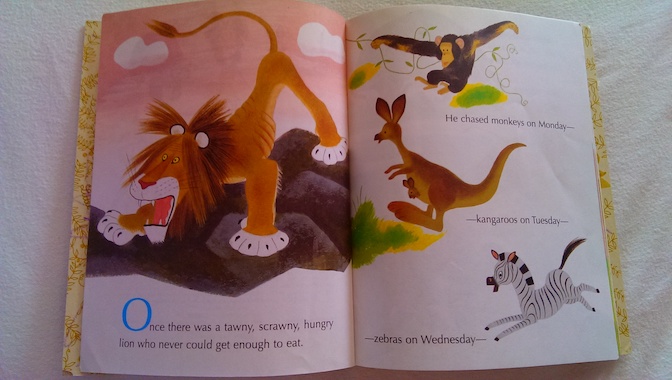
The tawny, scrawny lion can never get enough to eat! No matter how much he hunts and eats, he’s always hungry, and his ribs are showing. He thinks that it’s because hunting is so much work that he wears off anything he eats right away. If only the other animals didn’t run so much, trying to get away from him! (Gee, I wonder why.) He tries to tell the other animals that if they would just not run so much, he would have to eat less of them. Needless to say, that argument doesn’t impress them much.

TawnyLionHungry

Trying to get the lion to stop chasing the rest of them, the other animals convince the fat rabbit to go “talk things over” with the lion, thinking that if the lion eats the fat rabbit, he’d get fat for awhile and leave the rest of them alone.

Seeing how scrawny the lion is, the rabbit decides to invite the lion to join him and his siblings at his house for dinner. The lion likes the idea of going to the rabbits’ house, thinking of the nice dinner he could have on all the fat little rabbits, but things don’t turn out the way that the lion thinks they will.

TawnyLionRabbitTalk

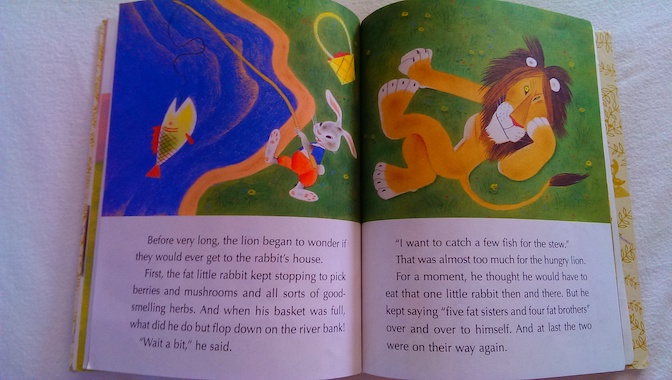
The rabbit tells the lion that they are making carrot stew tonight, but before they can eat, they need just a few more things for the stew. The lion follows the rabbit around as he gathers berries, mushrooms, and herbs and catches a few fish to add to the stew. By the time they’re done with all of that, the lion is too hungry and exhausted to chase the rabbits, so he accepts some of their stew instead.

TawnyLionFishing

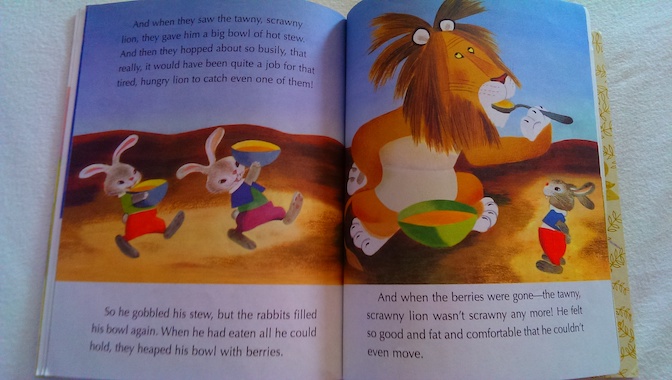
To the lion’s surprise, the stew is actually very filling, and when he has eaten it, he isn’t hungry anymore. For the first time, he feels fat and satisfied. Because of that, the lion ends up not chasing the other animals anymore but helping the rabbits catch fish and gather berries for more of their amazing, wonderful stew!

TawnyLionStew

This is a popular Little Golden book that kids have loved for generations! The stakes are high for the rabbits, who could be eaten by the lion, but I think kids know that the rabbits are going to find a clever way to satisfy the lion without getting eaten. I think it’s also not bad to have a story that points out that, if you aren’t healthy eating the things you’re eating, it’s okay to change.

It is currently available online through Internet Archive (multiple copies).