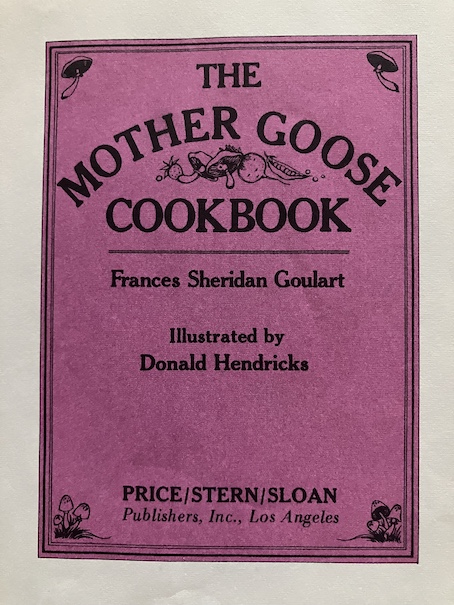
The Mother Goose Cookbook

I remember reading this book from my local library when I was a kid, and I had to look it up again because there were a couple of things that stuck in my mind about it. First, the recipes in this book are also based on songs and fairy tales, not just nursery rhymes, and second, while there are other cookbooks that use nursery rhymes and fairy tales as themes, this one chooses some of the more unusual ones. There are some common rhymes and references in the book, like using Humpty Dumpty for an egg recipe and referencing Little Miss Muffet for Curds and Whey, but there also less common ones, like Aiken Drum. Overall, I liked the variety of nursery rhyme and fairy tale references in the book, and I think the recipes generally fit the references well.

Second, some of the recipes sound a bit fancy for a child’s cookbook, but as a kid, I found them intriguing because they had a kind of old-fashioned quality that I thought made them seem more like nursery rhyme and fairy tale foods. Because, as a kid, I rarely ever had the patience to read the introductions to books before plunging right in, I missed some of the historical information behind some of these recipes and rhymes that the book explains in its introduction. Rereading this as an adult, though, I really appreciated the thought that the author put into the history of food in nursery rhymes.

The introduction begins by posing the question that many children have asked when hearing or reading nursery rhymes, “What are curds and whey, anyway?” I certainly wondered that when I was a kid, and the book notes that many parents also don’t know the answer. It goes on to explains that the “Mother Goose Era” (not really defined but probably the era when the rhymes were first composed) spans roughly from 1600 to 1800, and the foods mentioned in the rhymes is a mixture of real foods and imaginary ones. The author researched real, historical recipes and adapted them for modern use, while trying to remain as faithful as possible to the original nature of the dishes. In the cases where the author couldn’t find information about the dishes or where the foods mentioned seem to be imaginary, she created original recipes to represent them.

Although the author intends this book for children, I personally thought that the nature of some of the recipes and the difficulty of some of them make them more suitable to nostalgic adults.

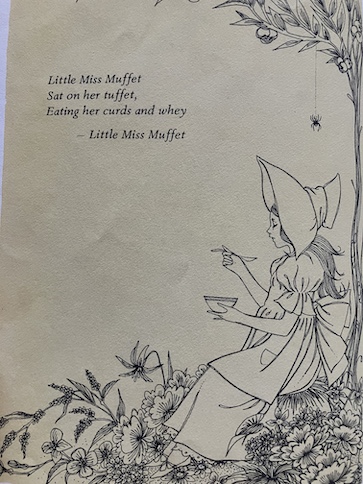
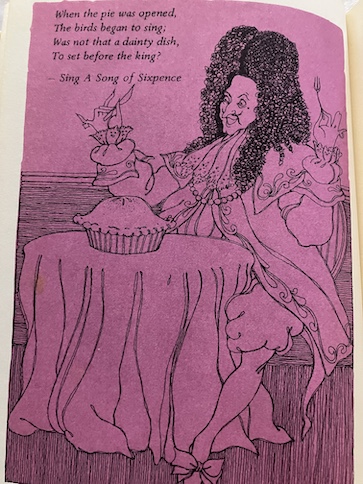
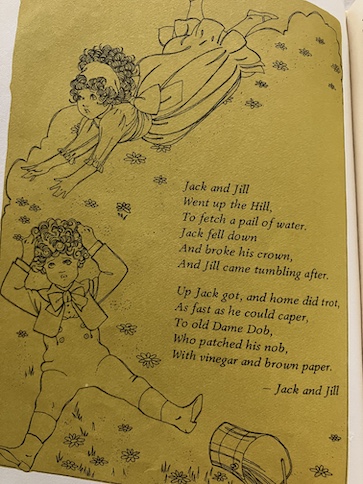
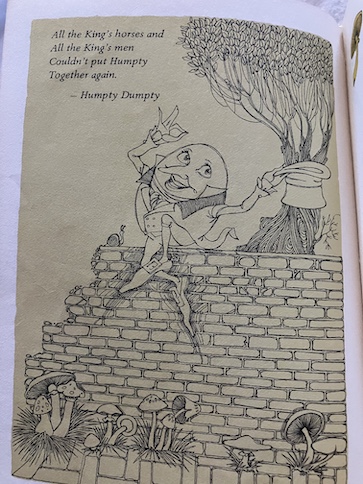
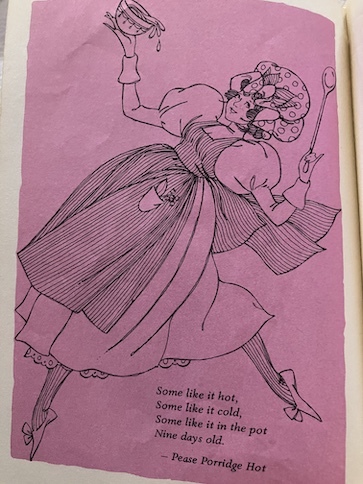
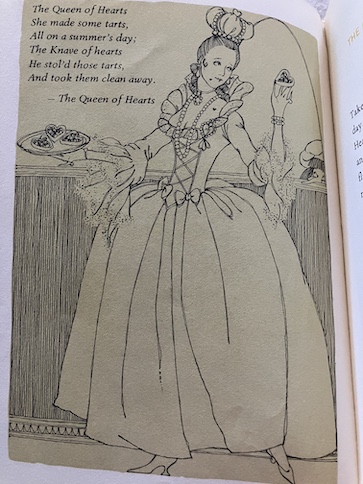
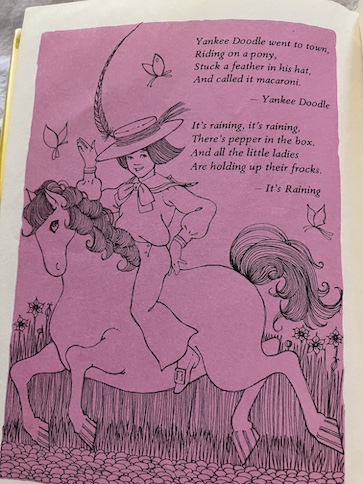
The recipes in the book are sorted in alphabetical order, skipping a few letters of the alphabet that they didn’t have recipes to match. Each of the recipes is accompanied by a pen-and-ink picture of the nursery rhymes or fairy tale connected to the recipe, and the pictures are on backgrounds of varying shades of purple and light green.

The book is available to borrow and read for free online through Internet Archive.

A is for:

Aiken Drum’s Glum Gallimaufry – This is a kind of stew made with mutton and vegetables, one of the dishes that I would think more suitable to an adult than a child. Stews in general aren’t too hard if you start with pre-chopped meat and veggies, but I don’t think many modern children are accustomed to eating mutton or would be interested in doing so. At least, in the United States, mutton isn’t a very common food.

B is for:

Betty Pringle’s Pastry Pigs

Bubble and Squeak, a la Bo-Peep – This is a dish made with lamb and cabbage.
C is for:

Cock Robin en Cocotte – I never liked this rhyme, and the recipe is for cooking small poultry.

Curds and Whey, One Way – It doesn’t precisely define what “Curds and Whey” are, but it’s a dairy dish made with soured milk and oatmeal.

Curds and Whey, Another Way – There’s a second method for making it.

D is for:

Daffy-Down-Dilly’s Jolly Jelly

Dappled Grey’s Farthing-a-Mare Gingerbread
E is for:

Elsie Marley’s Nine O’Clock Barley

F is for:

The Fatted Figs from Budleigh Fair – This one asks you to fry figs in fritter batter, but it doesn’t give you the recipe for the batter.

Four-and-Twenty Blackbird Pye – This is another recipe that I think only an adult might try. The “blackbirds” are made from beef liver.

G is for:

Good Pulled Bread for Tommy Tucker

H is for:

Hickory Dickory Flummery – A flummery is a type of old-fashioned dessert.
I is for:

Intery Mintery Cutery Corn

J is for:

Jack-a-Dandy Kissing Candy – This is a very old-fashioned candy – candied rose petals and violets. I think I have had candied flowers at a living history museum, but I’m not sure where to get the rose petals and violets to make any myself.

Jack and Jill Johnnycakes – This recipe is accompanied by a vinegar pudding sauce.

K is for:

King Arthur’s Bag Pudding en Croute

King Boggen’s Three-Farthing Turnips

L is for:
Little Betty Botter’s Better Butter Batter – This is a shortbread recipe

L’Orangerie St. Clemens

M is for:

Margery Daw, Petit Pois – This is a dish of peas, but there’s a little game as a twist. You add either a corn kernel or a small onion to the peas, and whoever gets the corn or onion on their plate has good luck.

O is for:

Oeufs a la Humpty Dumpty – “Oeufs” is the French word for eggs. This recipe wants you to serve it with Bechamel sauce, but there’s no recipe for the sauce.
P is for:

Pease Porridge Chaud-Froid – This porridge is made with oatmeal instead of peas.

Peter’s Pickled Peppers

Pippin Hill Ladyfingers – This is a dessert made with apples.

Punch and Judy Rolling Pin Pie – This is an apple pie recipe.
Q is for:

Queen of Heart’s Purloined Tarts – These are heart-shaped cherry tarts.

R is for:

Rowly Powly’s Roly-Poly – The name of this rhyme is unfamiliar to me, but I know a variation of it under the name Georgie Porgie.

S is for:

A Salamagundi for Solomon Grundy – This is a dish with potatoes, carrots, and onions.

St. Dunstan’s Belfry Bacon

St. Swithin’s Rainwater Tea – This is a recipe for an herbal tea made with actual rain water. I’m not sure that I would recommend people actually gathering and drinking rain water, but the herbal tea sounds nice, and this section does explain a little about St. Swithin and the tradition behind the rhyme that goes with it.
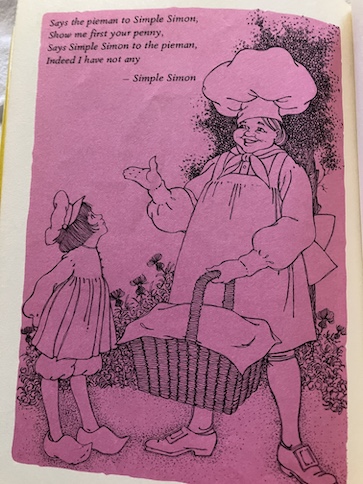
Simple Simon’s Ha’Penny Buns

Slitherum Slatherum Soul Cakes – I was fascinated by the recipe for Soul Cakes, an old tradition from Halloween, All Saints Day, and All Souls Day. The book says that they should be made on the eve before All Souls Day (evening of November 1) rather than Halloween. However, from my earlier Halloween research, I know that different countries and regions had their own traditions and their own recipes for Soul Cakes. There is no single, universal recipe for Soul Cakes.

T is for:

Three Men in a Tub Pommes de Terre – This is basically a recipe for french fries, using three potatoes soaked in a tub of ice water before being fried in hot fat. (The book doesn’t explain why, but I know that doing that makes them crispier.)

Tuppeny Rice – This is a sweet rice dish made with cinnamon and sugar and marmalade.
Tweedle Dee’s Dumplings a Deux – These dumplings include cow’s liver.

W is for:

Willy Wood’s Wondrous Pennyloaves

Y is for:

Yankee Doodle’s Pepperbox Noodles

Z is for:

“sleeping after all this good eating!”

Mother Goose Rhymes

Mother Goose Rhymes, illustrated by Eulalie, 1950-1953.

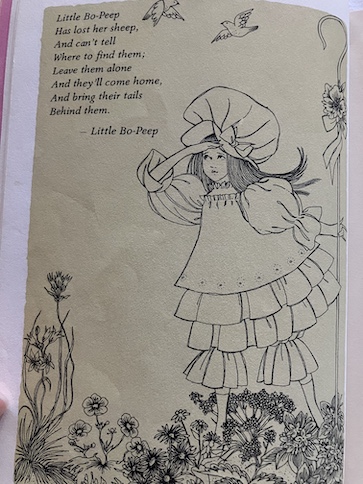
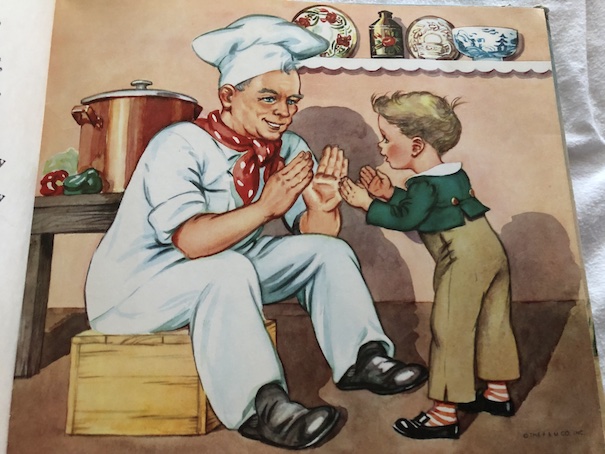
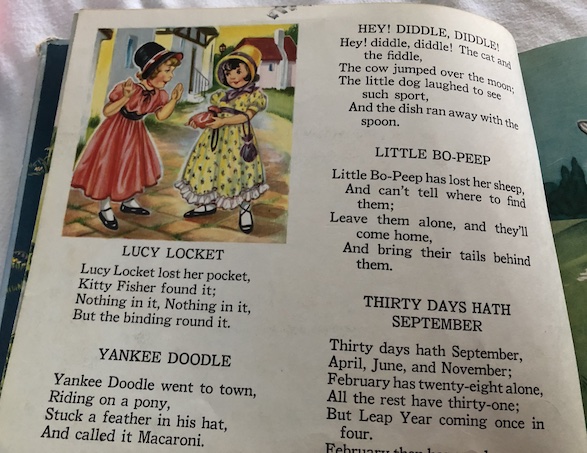
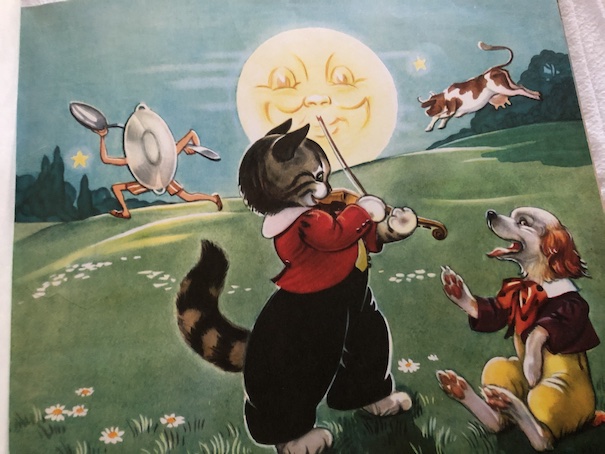
This was one of my first books of rhymes and poems as a child. We’ve had this book for as long as I can remember. I always loved the illustrations in the book, which are realistic in style, and like the illustrations in old Kate Greenaway books from the late 19th century, showing children in clothes that would be appropriate for the early 19th century, with high waists and short jackets. I suspect that Kate Greenaway’s work may have been some of the inspiration for the illustrations in this book. Some of the illustrations are small ones that appear in corners of the pages, surrounded by the text of the rhymes. Other illustrations take up a full page. All of them are full color illustrations.

People can recite popular nursery rhymes like Mary Had a Little Lamb, Old Mother Hubbard, Little Bo-Peep, and Lucy Locket from memory because many of us heard and memorized them early in life. But, since we’re on the subject, who is/was Mother Goose and what are these rhymes about really?

Mother Goose rhyme books don’t really have an author because the rhymes are short little folk poems with no known original author. When an “author” is credited for a collection, they are credited as being “collectors” of the rhymes included, not as the original creators of those rhymes. The first person to collect and describe folk and fairy tales as being “Mother Goose” stories was the French author and folk tale collector Charles Perrault. In 1697, he published a collection of stories called Stories or Tales from Past Times, with Morals or Mother Goose Tales. It isn’t completely clear how many of the stories in this book were completely Perrault’s own creation, based on common themes often found in folk and fairy tales, and how many were stories he collected from other sources and modified to fit his style and purpose. The stories included in this original Mother Goose book included many fairy tales that are now childhood classics, like Cinderella, The Sleeping Beauty, Puss in Boots, Little Red Riding Hood, and the scary Bluebeard. This collection of stories was not meant for children. The stories were intended for adults because fairy tales were in fashion among the aristocratic literary circles in Paris at the time the book was published. The exact reasons why Perrault decided to use the imaginary “Mother Goose” as the supposed source of these stories or even who “Mother Goose” once was are uncertain. American legend sometimes cites “Mother Goose” as being the wife of Isaac Goose and the mother Elizabeth Goose, who lived in Boston in the 17th century and told stories and sang songs to her (a story referenced in The Only True Mother Goose Melodies published in Boston in 1833), but it’s unlikely that Perrault was referencing her. A more likely theory is that “Mother Goose” was a reference to a somewhat forgotten figure of French folklore who would have been more familiar to people living in the late 17th century who studied folk and fairy tales. There was a French legend from the Middle Ages about a queen who told stories that amazed children and was sometimes called “goose-footed”, and possibly, this story or a similar figure from French history or legend became known as “Mother Goose.”

In the 18th century, Perrault’s book was translated into English, and English authors began putting together their own “Mother Goose” books that included English nursery rhymes. The book that shifted the association of “Mother Goose” from stories to rhymes was Mother Goose’s Melody, or, Sonnets for the Cradle, a collection of English nursery rhymes published by John Newbery, a famous English publisher of children’s literature in the 18th century who was nicknamed “The Father of Children’s Literature” and who would later become the namesake of the Newbery Medal for excellence in American children’s literature. Mother Goose’s Melody popularized the association of “Mother Goose” with children’s nursery rhymes in both England and America, and ever since, it has been used in the title of collections of nursery rhymes. Many of the popular Mother Goose rhymes are centuries-old ones from England, although some later classics, like Mary Had a Little Lamb, were added to American books of nursery rhymes in the 19th century.

But, what do these rhymes mean, or do they mean anything? Are they just nonsense rhymes for children about things like a cow jumping over the moon or a boy and girl falling down the hill, or is there some additional meaning behind these rhymes that have kept them in the public consciousness for so many centuries? The exact origins as well as the original authors of many old nursery rhymes have been lost to time, but there are indications that various nursery rhymes may have begun as folk songs or rhymes referencing current events that were happening at the time they were originally composed. Although they sound like harmless and innocent nonsense, people who heard them at the time when they were first composed would have recognized references or pieces of dark humor about real events or scandals that were public knowledge. In modern times, there is some debate about the exact meaning behind some of these rhymes because, while the references in the rhymes may have seemed clever and humorous to people at the time of their creation, they are too esoteric for modern people, who are centuries removed from the events they were referencing. For generations, people passed on the rhymes to their children but not the explanations of their meaning, so most were simply forgotten. However, there are articles that you can about The history lessons that may be hidden in nursery rhymes and The Dark Side of Nursery Rhymes, which discuss what we know about the creation of these nursery rhymes and theories about their original meanings. Sometimes, there are multiple theories about certain rhymes because there just isn’t enough evidence to firmly settle on one, and also, it’s possible that rhymes could be inspired and shaped by more than one event or source.

This particular book of Mother Goose Rhymes is available to borrow and read for free online through Internet Archive. However, there are also many other books of Mother Goose rhymes available through Internet Archive and Project Gutenberg, including Perrault’s Tales of Mother Goose.

Tortillas Para Mama

Tortillas Para Mama selected and translated by Margot C. Griego, Betsy L. Bucks, Sharon S. Gilbert, and Laurel H. Kimball, illustrated by Barbara Cooney, 1981.

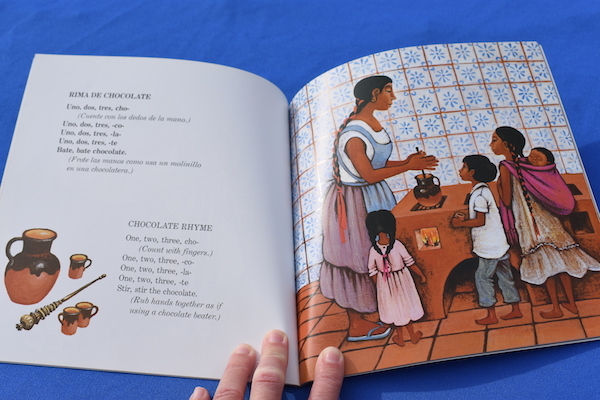
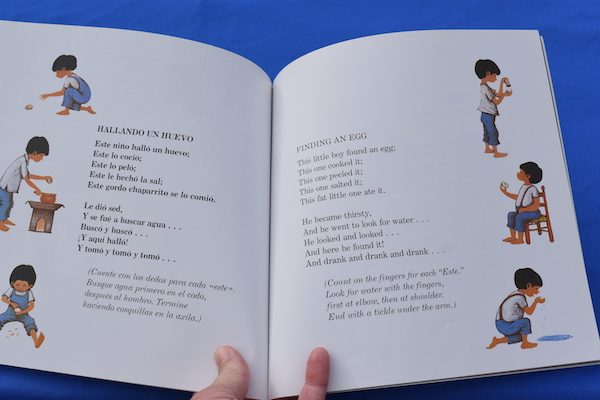
This is a collection of Spanish lullabies and nursery rhymes in the Americas.  The introduction to the book explains how these traditional rhymes have been passed down through the generations of families.  They are not specific to any one country, more generally known where there are Spanish speakers. The rhymes are in both in English and Spanish.

Like children’s rhymes everywhere, they are about small, everyday things, like family, animals, cooking, and other things people do every day, like helping little kids to get dressed.

There are rhymes and songs that involve counting on fingers or making hand motions.

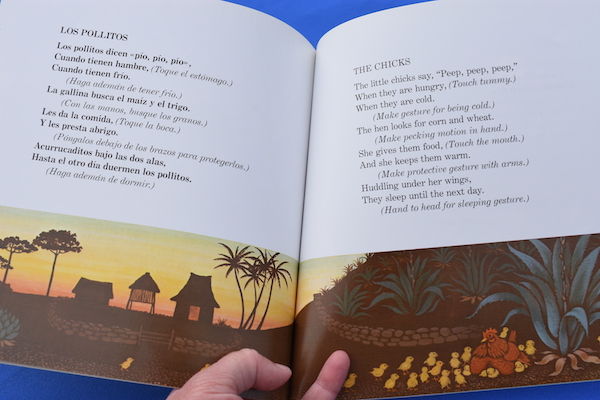
My favorite is the lullaby Los Pollitos (The Chicks), which I first heard when I was little through Kidsongs. I always liked that song.

The illustrations, paintings by Barbara Cooney, are beautiful.  Some people may recognize the art style from her other works like Miss Rumphius and Roxaboxen.

Meg Mackintosh and The Case of the Missing Babe Ruth Baseball

Meg Mackintosh Mysteries

MMBaseball

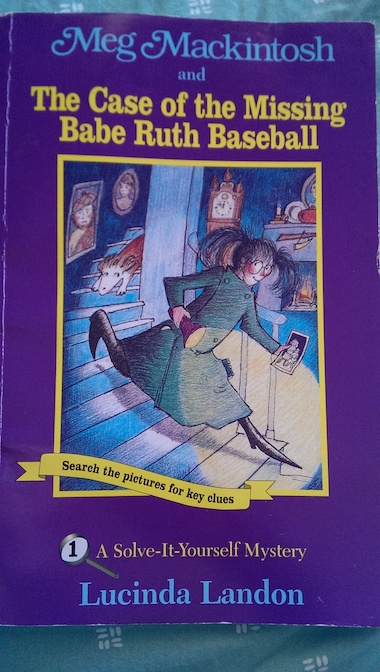
Meg Mackintosh and The Case of the Missing Babe Ruth Baseball by Lucinda Landon, 1986.

MMBaseballAlbumThis is the first book in the Meg Mackintosh series, and it was the first mystery story that I ever read, when I was about seven years old.  It started a life-long love of mysteries!

Meg’s grandfather shows Meg and her friend Liddy some old family photographs and tells them about the time when his cousin Alice took his prize possession: a baseball autographed by Babe Ruth.  Alice was a bossy girl who always liked to tease him, and so she created a kind of treasure hunt, challenging him to solve it in order to get the baseball back.  Unfortunately, he could never figure out the clues and still doesn’t know what happened to the baseball.

Meg’s brother, Peter, has a Detective Club, but he refuses to allow Meg to join, saying that she needs to prove that she can solve a mystery.  Seeing this as her chance, Meg decides that she’s going to solve this old puzzle and find the Babe Ruth baseball!  However, she also has competition from Peter, who thinks that he’s the better detective and tries to send Meg off in the wrong direction.

The book is currently available online through Internet Archive.

My Reaction

All of the books in the Meg Mackintosh series allow readers to try to solve the mysteries along with Meg, stopping periodically to ask them if they’ve noticed a clue that Meg has noticed or if they know what the significance of a clue is.  There are pictures to help, and readers are invited to stop and study the details before moving on. I think this is a good way to introduce children to puzzle-solving and help them develop critical thinking skills and an ability to notice details. I would recommend adults reading these books, or at least the first one or two along with children, so they can discuss the stories and clues with them, helping them spot clues as they begin to get used to the format of the books.

This is an excellent series for introducing children to the mystery genre for the first time! When I was young and just learning what mysteries were, I was fascinated to discover that I already had all of the knowledge I needed to solve this mystery along with Meg because all of the clues to Alice’s treasure hunt had to do with nursery rhymes. If you can recognize the rhymes in the book, you’re well on your way to solving the mystery!