
Meet the Men Who Sailed the Seas by John Dyment, 1966.
This book is part of a series of historical biographies for children. Unlike other books in the series, the book doesn’t focus on a single person, talking about the lives of many famous sailors and explorers with some historical information about sailors and sailing ships in general.
When I was a kid, I went through a phase where this was a favorite book my mine, and I carried it around and read it constantly. It’s a little surprising that I became so attached to this particular book because I grew up in Arizona, in the middle of a desert, miles from the nearest ocean. I was seven years old before I even saw an ocean and a sailing ship in real life, and even then, it was a matter of years before I saw these things a second time. Because of that, as a child, I wasn’t particularly attracted to boats or interested in ocean travel. I wasn’t even a very good swimmer (liked it, just not good at it because I didn’t get a chance to do it much when I was young), and I was kind of afraid of deep water. We learned about Christopher Columbus in school, but I thought that Columbus Day was the most boring holiday on the calendar (there was no candy and no dressing up in costumes, and I’m not even sure that we got that day off of school, which were my requirements for what made a really good holiday), and Christopher Columbus was not remotely my most favorite historical character. So what was it about this book that caught my attention? Why did I like it so much?
There are a number of things about this book to like. When I was a young kid, I wasn’t fond of nonfiction books because it was a little too much like school, but this book was different. It was one of the first nonfiction books that I really wanted to read. The large, friendly type is encouraging to younger children who are just starting to read nonfiction chapter books, and the detailed drawings are fascinating. Best of all, it’s a journey through time as well as across oceans. I always liked history.

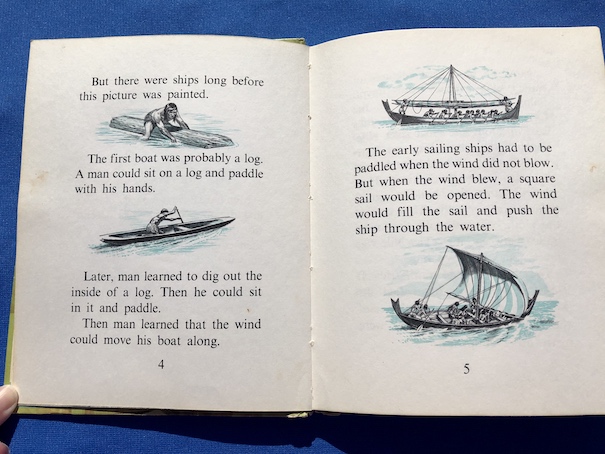
The book starts off by explaining how early sailors might have traveled. It speculates that people first realized that they could travel by water by floating on logs and then realizing that they could carve those logs into canoes and paddle them to move in the direction they wanted to go, eventually adding sails to move even faster with less effort.
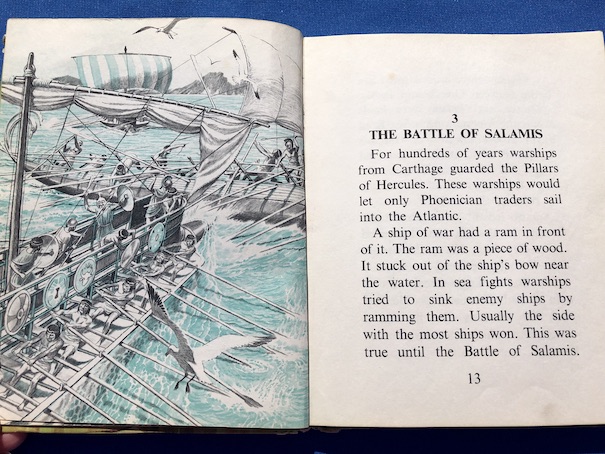
It then describes how ancient civilizations such as the Egyptians and Phoenicians traveled by ship. There is a chapter about Hanno of Carthage, a Phoenician who commanded a fleet of ships and was known for sailing around the coast of Africa. (That section and the next one use the old name for the rocks at the Strait of Gibraltar, the Pillars of Hercules.) The next chapter describes the Battle of Salamis between Greece, led by Themistocles, and Persia, led by Xerxes. This battle is particularly notable because the Greeks defeated the Persians through a clever trick even though they were out-numbered, proving that a good battle strategy could allow even smaller fleets to gain the upper hand in battle. There is also a chapter about Pytheas, a Greek sailor who sailed to Britain in search of tin and “Thule” (it’s not completely clear what he meant by Thule, although it was apparently a place north of Britain) and wrote a book about his travels.
In the early Middle Ages, Viking raiders began attacking Britain. The chapters about Vikings describe Eric the Red and his adventures in Iceland and Greenland, where he founded a colony of people from Iceland. Vikings also established a colony in the Americas that they called Vinland. However, they eventually abandoned Vinland because of conflicts with the people they called Skraelings (Native Americans). (The exact location of Vinland was in dispute for some time, and some people speculated that it might actually refer to multiple locations, but the likely site is at L’Anse aux Meadows in Newfoundland.)

The other explorers and adventurers described in the book are Marco Polo, Christopher Columbus, Ferdinand Magellan (known for sailing around South America to the Pacific), Francis Drake (his section includes an account of the battle with the Spanish Armada), and Captain Cook (known for sailing to Australia and New Zealand and claiming them for England and for insisting that his sailors eat cabbage and onions to prevent scurvy, later killed in Hawaii).

The book also discusses the Mayflower and Pilgrims, and there are chapters about American ships and sailors, like John Paul Jones, and the roles they played in the American Revolution and the new United States shortly after. Because the focus of the book focuses on sailing ships, it ends with Robert Fulton‘s steam ship, the Clermont, and Joshua Slocum, who sailed around the world alone.

So, the reason why I’m still kind of attached to this book, which was old even when I first read it, is that it was my introduction to a world that I wasn’t even really interested in at first, a world that became more interesting after seeing the history and other countries connected to it. I’m still more of an armchair explorer than anything else, but this book added a dimension to my early armchair travels that probably wouldn’t have occurred to me before. As a side note, I don’t think that the book mentions that the navigation instrument that one of the men on the front is holding is an astrolabe, but I now own one of these myself. If you want to try one, you can make a simple version at home yourself. They can be used on land as well as sea!




 Jestress's Forgotten Books and Stories