
Mystery of the Angry Idol by Phyllis A. Whitney, 1965.
Janice Pendleton is sad and nervous because the rest of her family will be moving overseas for at least a year, and she is staying in the United States to go to school. Her father is a consultant to the government, and his latest assignment is in Saigon in Vietnam. (This book is set contemporary to the time when it was written, in the 1960s. The Vietnam War lasted from 1955 to 1975, which is probably why Jan’s father is going there, although he is going as some kind of government consultant instead of an ordinary soldier. This book was written after the Bay of Pigs Invasion and President Johnson’s continuing escalation of the conflict in Vietnam.) However, things are dangerous in Saigon, so Jan’s mother and younger brothers, a pair of twins, will be living in Okinawa, Japan, so her father will able to visit them sometimes. (There’s a US Air Force base in Okinawa, Japan, and I know it existed and was in operation during the 1960s because, coincidentally, my older cousin was born there while my uncle was stationed in Japan in the 1960s. The book doesn’t mention this, but I thought I’d tell you that there’s an American presence there, including civilian relatives of military personnel, so Jan’s mother and brothers will likely be among other Americans during their stay there.) Twelve-year-old Jan could have gone to Japan with them, but she is much more advanced in school than her young brothers. They are so young than their education won’t be disrupted much by living in another country for a year or two, but Jan is older, and her family was worried about her losing her place in school.
Instead of going to Japan, Jan will be living with her grandmother and great-grandmother in Mystic, Connecticut and attending school there while her family is gone. It’s summer now, so until school starts, she will be spending her time adjusting to her new living situation and getting to know her relatives. Jan doesn’t know her grandmother very well, and she’s never even met her great-grandmother before. At least when she’s with them, she will be with family. However, her grandmother is a little worried about her great-grandmother’s health. Great-grandmother Althea doesn’t really leave her upstairs rooms anymore, and although she was much more lively and interested in people when she was younger, she doesn’t seem to have much stamina for meeting and talking to people these days. Jan is told that she will have to be careful and behave herself because, if she upsets her great-grandmother too much, she won’t be allowed to stay with them in Connecticut anymore. Instead, she would have to attend a boarding school in Boston. If she goes to Boston, she will be there alone, without any friends and family nearby, and she is nervous about that. She already knows that, by going to Connecticut, she will be removed from her parents and siblings and her friends in California, where she grew up.
To help her feel better, her father tells her more about her family’s history and great-grandmother Althea. When she was younger, Althea traveled through Asia because her father, Jan’s great-great-grandfather, was a merchant dealing in Asian art. (This is very similar to what the author’s father did for a living and why she spent most of her youth in Asia. More about that below.) Althea spent years living in China with her parents while her father bought and commissioned pieces of Chinese art and sculpture that he could sell and collect for himself. However, after her mother died, Althea was sent to a boarding school in Boston. Her father was later killed during the Boxer Rebellion. Althea was in China at the time when they realized that trouble was coming. She survived and escaped to the United States because her father sent her to stay with some friends of his. She took some of the smaller pieces from his collection with her.
Now, Great-grandmother Althea has an impressive collection of Asian art herself, including some of the pieces that she managed to smuggle out of China when she had to flee. There is one piece in her collection that seems particularly mysterious, an ugly statue in the style of a Chinese idol that she keeps turned to the wall. (The “idol” was never used as an object of worship, for those worried that Althea’s father may have looted a temple or appropriated a Chinese national treasure of some kind. Althea says that one of his artist friends made the statue specifically for him. It’s important to the story that it is in the style of an idol but that it is also genuinely ugly and of little intrinsic value.) Jan’s father implies that there is some kind of mystery surrounding that statue, but he doesn’t really explain what it is. Jan’s father worries a little about Althea because she always used to be such a lively woman, and he says that, in her old age, she has become a kind of hermit who has shut herself away from the world and lives like a “vegetable.” He hopes that Jan’s youthful presence in the house will help her become more interested in life again, although Jan doesn’t see how that can happen when she risks being sent away to boarding school if she “bothers” Althea too much.
When Jan arrives in Connecticut, everything is awkward because she doesn’t get her own room in the house. Instead, she has to sleep on a cot in the living room. Her great-grandmother doesn’t even want to see her right away. There is a storm that night, and Jan has trouble sleeping. The next day, she sees a neighbor boy outside and decides to try making friends with him because she really needs someone her own age to talk to. The boy, Neil, doesn’t seem entirely friendly, but he does talk to her down by the nearby boat dock. He tells her that, the night before, he noticed a strange, suspicious-looking man hanging around her family’s house, and he wonders if anything from the house was stolen. Jan says that she doesn’t think so and that she didn’t hear anyone come in, but because of the noise from the storm, it’s hard to say for sure if someone tried to get into the house. Neil points out that the mysterious stranger is still hanging around the house, and Jan sees a man with a beard hanging around nearby.
Their conversation is interrupted by the arrival of a boy in a boat. Neil and the boy in the boat don’t seem to like each other, and the boy in the boat seems to immediately resent Jan for talking to Neil. He tells her that she’d better not try to get into his boat because Neil tried to get in uninvited earlier. Jan is insulted by this rude boy and returns to her relatives’ house. There, she learns two surprising things. The first is that the boy with the boat, Patrick, is actually the son of Mrs. Marshall, the housekeeper, so they will be seeing a lot of each other. Jan’s grandmother had hoped that Jan and Patrick would be friends. (So far, they haven’t gotten off to a good start.) The second is that it looks like something may have been stolen from the house last night. The mysterious statue is missing. Jan tells her grandmother and Patrick about the strange man that she saw and what Neil said. Her grandmother has trouble believing that a theft really occurred. She thinks that great-grandmother Althea may have just moved the statue and forgotten, but Patrick is interested in the mysterious man.
When Jan goes upstairs to meet her great-grandmother for the first time, she discovers that Althea is not the “vegetable” that she’s been lead to expect. Althea is physically feeble and stays upstairs because her knees are bad and can’t handle stairs anymore. However, she is mentally sharp and highly observant. She talks to Jan about her family’s past and her own past. She understands that Jan didn’t really want to come to Mystic and be separated from her family, but her father wanted her to come and learn more about her family’s history. Althea explains that she spent a large part of her youth living in Shanghai until her mother’s death, when her father sent her to a school in Boston, and she really hated it. This is reassuring because Althea is less likely to send Jan away, remembering her own youth.
Althea also explains that she isn’t unhappy with her relatively isolated life in the upper rooms of the house, surrounded by the pieces of Asian art in her collection. She says that it’s just another phase of life. Life moves in phases, and a person knows when they’re ready for the next phase. When she was a little girl, she loved paper dolls and couldn’t imagine life without them, but as she got older, playing with paper dolls became dull, and she was ready for new activities. Similarly, when she was young and active, she couldn’t imagine a life without travel and meeting other people. Now that she can’t get around as well as she used to, she has entered a new phase of life where she enjoys quiet time alone and thinking and remembering. She is still somewhat in touch with the world because her rooms have a nice view of the Mystic Seaport, but she no longer has to deal with crowds and traffic and bothersome household chores and schedules. Jan is still young and active, so she has trouble fully understanding Althea’s isolated life of reflection, but Althea says that she will understand someday, when she’s ready for that phase herself.
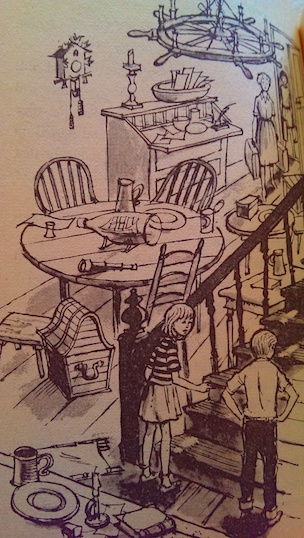
Jan is interested in the objects in Althea’s collection, and Althea shows her some pieces and explains a little about their history. There are some pieces of scrimshaw that Jan’s great-grandfather carved himself, like a carving of a woman’s hand that Althea says was originally meant as a paperweight but which she had mounted on the head of one of her canes. Her other cane has a carved cat. Althea also owns a chess board with red and white pieces made of ivory and cinnabar, with the figures carved in an Asian style. Jan notices an empty shelf in the room and wonders if that’s where the missing statue is supposed to be.
While Jan and her grandmother are standing on an upper porch, looking at the view, they look down and see the mysterious man talking to Mrs. Marshall, who seems worried and upset. Mrs. Marshall and the man notice that they’re being watched, and the man waves to Althea and greets her. Even though the greeting is friendly, the man seems to upset Althea. When Jan asks about him and tells Althea what Neil said, Althea says that the man’s name is Eddie. She loved Eddie when he was a little boy, but she thinks he’s become a scoundrel. She says that Eddie came to see her the night before, but she didn’t want to see him and sent him away. Althea thinks he probably took the missing Chinese idol, but she also says that she always hated that statue. It had such a reproachful expression on its face that she turned it to the wall so she wouldn’t have to see it. Rather than dealing with Eddie or discussing the situation further, Althea says that she would rather just forget about it all.
Jan spends more time with Althea, until Althea gets tired. Althea shows Jan other pieces from her father’s collection of jade objects, explaining the different colors of jade and their relative values and the connections the pieces in the collection have to Chinese folklore and mythology. She says that her daughter-in-law, Jan’s grandmother, worries about robbers breaking into the house to steal these things, but Althea prefers to keep her collection close rather than locked away somewhere. The pieces in the collection bring back happy memories for her.
Jan’s grandmother owns a book store in a local historical district. When Jan goes to see the book store, her grandmother allows her to explore the area and tells her to be sure to visit Patrick’s grandfather at the rope walk (the place where they make rope). Jan goes there and encounters Eddie again. Eddie seems to want to speak to her, but Jan is afraid of him and avoids him. Grandfather Marshall had just been arguing with Eddie, and he’s in a bad mood when Jan darts inside. At first, he snaps at her when she rushes in. When Jan introduces herself and explains that she was startled by Eddie, Grandfather Marshall calms down and apologizes for snapping at her. Jan tries to ask him more about Eddie, but all he says is that he doesn’t want to talk to him, and he advises her to keep avoiding him. He shows her around the rope walk and explains to her how rope is made, and he also shows her a model ship he’s making for Althea that looks like the sailboat her husband used to own called the Happy Heart.
On her way back to her grandmother’s book store, Jan meets Eddie again. He explains to her that he’s actually Patrick’s older brother and the black sheep of their family. He also used to be friends with Jan’s father when they were both young, although Jan’s father was older than he was. Eddie badly wants to communicate with Patrick. He asks Jan if she’ll take a message to Patrick for him, and he hands her a note, leaving quickly before she can say anything. Jan shows the note to her grandmother and asks her what she should do about it. Without going into specifics, Jan’s grandmother says that Eddie was always a wild child, and years ago, he did something that was very scandalous, and he had to leave town. That’s why most people in town don’t want to see him or talk about him in public, although there’s been plenty of private gossip about what he did. The Marshalls have been friends with the Pendletons for years, and Jan’s grandmother thinks that it’s probably time to forgive and forget what Eddie did, which is why she doesn’t want to pass on gossip about him and make things harder for him and his family. She tells Jan that it’s fine to give Patrick the note from Eddie.
Jan’s delivery of the note thaws her relationship with Patrick a little, and he gives her a ride back across the river to her family’s home in his boat. There, Mrs. Marshall tells Jan that, because her meeting with her great-grandmother went well, Althea has decided that she can be trusted, so she will now have a room upstairs in the house. Jan just needs to be quiet whenever she’s upstairs because Althea likes to nap. Jan begins to feel a little more at home and less like an awkward visitor.
However, strange things are still happening in and around the house. Eddie is still lurking around, and nobody wants to tell Jan what he did to turn himself into such a black sheep. She overhears a late night conversation between Althea and Eddie where the two of them seem to be discussing secrets and playing cat and mouse with each other. Yet, Althea gives Eddie a job doing yard work and seems to be trying to help him redeem himself. He returns the statue that Althea never liked but seems to take other things. Althea tries to send him away when he causes problems, but he insists on hanging around and claims that he’s trying to help Althea. Like others, he believes that there is a secret behind the ugly statue that seems to make Althea nervous, although Althea doesn’t think that the statue contains any real mystery.
As Jan struggles to understand what’s happening around her, she risks getting on the bad side of the reclusive and temperamental Althea just as her great-grandmother seems like she’s becoming fond of her. The Pendleton house isn’t entirely a happy one, and the reasons why are buried in Althea’s past as well as Eddie’s. The clues have been right in front of Althea the entire time, but although Althea is intelligent and thinks she understands everything, there’s something critical that she’s overlooked all along, which changes everything.
My Reaction and Spoilers
Background of the Book
Many of the themes of Phyllis A. Whitney‘s juvenile mysteries come from her own life. When she was young, she lived with her family in Japan and other countries in Asia because her own father was working overseas. She was born in Japan, and her middle initial stands for Ayame (the Japanese form of the name Iris). Whitney’s parents were American, but she didn’t live in the United States until she was a teenager. Both of her parents died while she was a teenager, and she went to live with an aunt in Chicago, so she understood the feelings that kids could have, moving around, living in different countries, being separated from parents, and living with relatives. Because of her upbringing in Asia, many of her books, even those set in the United States, include some mention or aspects of Asian art or culture, especially Japan.
I think both Jan and Althea are reflections of the author and her life. They both share some aspects of their lives with the author, but Jan is probably more like the author in her youth, and Althea is the older version, looking back on her life and remembering what it was like to be young with the knowledge of what it’s like to be old.
The Atmosphere
I really liked the atmosphere of the story! It’s a lovely, old-fashioned house. Althea’s museum-like collection room is fascinating, and the room that she gives to Jan is cozy. Jan’s upstairs room has rosebud wallpaper and a four-poster bed and rocking chair. The room is a little worn and shabby, but Jan loves it. Her grandmother gives her milk and gingerbread on a china plate decorated with violets as a bedtime snack, and she reads old-fashioned children’s books, like A Little Princess by Frances Hodgson Burnett. Jan doesn’t usually read older children’s books, but there’s a collection of them in the house, left by the generations of children in her family who had grown up there.
Relationships
When Jan first meets Neil and Patrick, she realizes that neither of them is really the ideal friend for her. She continues to associate with them partly because she can’t help it. They’re both always around because Patrick’s mother is the housekeeper at Jan’s relatives’ house, and Neil’s family lives next door. Also, Jan doesn’t have anyone else her own age to talk to, although she is realistic and thinks that she should look for other friends in this town because both of the boys are difficult in different ways. Patrick is impulsive and temperamental (a bit like his grandfather the day Jan meets him – snapping at her just because he’s in a bad mood at someone else), and he has a chip on his shoulder because of his brother’s troubles.
However, Neil is even more temperamental. Jan quickly notices how Neil’s mood can abruptly shift from pleasant to irritable and how he doesn’t seem to have much compassion for other people. She later realizes that he’s most charming when he wants something from her or someone else. Neil’s ambition in life is to be a radio interviewer. His uncle is a radio announcer and has encouraged Neil’s ambition. Neil’s hobby is interviewing people and recording his interviews for practice. Some of his teachers have found his interviews fascinating and have played them in class because, while he has never interviewed anyone famous, Neil has interviewed people who have done some really interesting things, like the janitor who was once a prisoner of war during WWII. Neil’s also a little sensitive about his interviews because his father doesn’t think much about his ambitions and would rather that Neil go into his business when he grows up, and sometimes, other kids tease him. Part of the reason why Neil is interested in being friends with Jan is that he would love to interview her great-grandmother because she had a fascinating early life in China. He is also aware that there is some secret about the angry-looking idol in her collection, which she has always felt compelled to keep even though she doesn’t like it. Neil is obsessed with his life’s ambition and is willing to do just about anything to promote it. He also has a chip on his shoulder toward Patrick and Eddie and others who have made fun of what’s important to him and tried to discourage him from doing what he wants to do.
In the end, as Jan comes to know the two boys better and both confronts them over their behavior and helps them through the troubling situations they have, the relationships between the three of them improve. After everything that happens, they all come to realize that each of them has done something wrong or misjudged someone else. This doesn’t completely absolve any of them from things they’ve done because some of them could have had serious consequences for other people as well as themselves. There are things that each of them has to do to make things right, but because each of them has something they need to do to fix things, something to learn, or something they need to apologize for, they realize that they are willing to let each other make amends and to accept each other’s efforts to change. These feelings also extend to others in the story, especially Althea and Eddie. Everyone in the story has misjudged someone or the situation, and everyone has something they need to learn, understand, and change.
Happiness and Redemption
Themes about happiness and redemption run all the way through the story. Eddie’s part of the story focuses on redemption. Part of his troubles are of his own making, but Jan learns that he’s also been falsely accused and badly misjudged. Like others in his family, he has a quick temper and needs more impulse control, and he used to be pretty wild and hung out with a bad crowd. What others know about him and are initially reluctant to tell Jan is that Eddie went to prison for being involved in a robbery and is now out on parole. However, as both Patrick and Eddie explain, Eddie wasn’t actually involved in the robbery. Some of the friends he used to hang out with did it, and they implicated him out of spite when they got caught because he refused to go along with their plan. Althea believed him when he said he didn’t do the robbery and paid for his legal defense, but he was convicted anyway because of his history with the people who committed the crime and because witnesses misidentified him as one of the people who was there.
Althea still doesn’t really believe Eddie was involved in the robbery, but she does know that he causes trouble because he lacks self-control and has lingering resentment about the way people look at him because of the trouble he’s been in. Eddie later says that he’s unfriendly to other people because they’re not friendly with him, although I think it’s fair to point out that people believe badly of him because he’s lived the kind of life where everything he’s been accused of doing are completely credible. That means that, even before he was falsely accused of robbery, the way he lived and the way he treated other people made almost everyone he knows in his home town willing to believe that he was a criminal. There seem to have been significant lifestyle and behavioral choices on Eddie’s part that created his bad boy image and led up to this situation. He may not look at it this way, but he kind of set himself up almost as much as his supposed friends did because of the choices he made with his life, his choice of friends, and his neglect of people who once might have believed in him. Even his own parents believe the worst of him at the beginning of the story, and the way he’s been acting ever since he reappeared in Mystic supports the view that he’s still the kind of person he used to be and people think he is.
As my grandfather used to say, it’s easier to keep a good reputation than to redeem a bad one. It’s not impossible to redeem a bad reputation, but it takes both work and time, and Eddie doesn’t have much patience with the people whose patience he’s already exhausted. He’s only just reappeared in town, but he’s already angry that people are looking at him suspiciously for just showing up. He’s upset that other people aren’t giving him a chance or instant forgiveness and acceptance, but at the same time, he really isn’t giving them much of a chance to see that he’s changed or giving himself enough time to demonstrate that change. Fortunately, some people, like Jan’s grandmother, are willing to drop the matter and give Eddie the chance to prove that he’s changed, and Althea tries to help Eddie by giving him jobs and letting him stay with them in the house for a while.
For a while, Eddie tries to prove that he’s a hard worker and a steady person, but, when Eddie loses his temper with Neil for carelessly wrecking his yard work while trying to catch his runaway dog and turns the garden hose on Neil, Miss Althea starts to think that she’s made a mistake. She craves peace and solitude, and Eddie is one disaster and temper explosion after another. At one point, she tries to send him away, telling him that it would be easier for him to start over somewhere else, where people don’t know his history, and he can cultivate a completely new life and image. Eddie moves out of her house, but he refuses to leave town. He has another job now, thanks to Althea’s recommendation, and he refuses to leave town as if he’s in disgrace when he hasn’t done anything wrong. I didn’t really like Eddie, particularly in the beginning, because he doesn’t really see the way he has made his own reputation and provoked other people, but I think his redeeming characteristics are his determination and perseverance. His attempts to change his reputation are clumsy and impatient. I think he expects too much of other people too soon as he tries to rebuild his relationships with the people he’s offended and pushed away before, but I appreciate that he still cares enough to keep trying until he gets it right.
In facing up to the situation with Eddie and with Jan’s clumsy efforts to figure out what’s going on and make things right, Althea also comes to some realizations about herself and the way she’s been living. Enjoying some solitude and a slower pace of life is fine as a person gets older, but Althea comes to the realization that the way she’s been going about it has been selfish and has cut her off from the people around her. She is out of touch with the lives of people who were once close to her and has failed to understand them and appreciate what they’re going through because of her determination to avoid becoming involved with other people’s problems or deal with anything unpleasant.
The reason why she doesn’t like the ugly statue is because her father carved a message in the back of it, telling her to find a “happy heart.” The theme of happiness used to be one of her father’s favorite topics of discussion when he was alive, and he often lectured her on how to be happy. Althea never liked it when he would lecture that happiness is based on the way a person lives and the choices they make, pointing out times when her own choices or priorities were making her unhappy. She always thought that her father sent her that ugly statue with the “happy heart” message before his death because he wanted to tell her, yet again, to be happy, and she felt like the statue’s ugly snarl was like a rebuke every time she wasn’t happy or made bad decisions. Being lectured and rebuked doesn’t make a person feel good when they’re already feeling bad, as Eddie knows from his experiences. However, Jan and Althea both come to realize that Althea has misunderstood her father’s message and intentions on multiple levels for most of her life.
Althea gets extremely upset one day when Jan says that someone tried to steal one of her most precious jade statues. At first, Jan’s grandmother thinks that Jan’s imagination is running away with her and that her presence in the house is too disturbing for Althea to handle, talking again about sending Jan to boarding school, but Althea later explains that Jan isn’t the reason why she’s upset. She’s upset with herself. She realizes that Jan was wrong about the person taking the statue because she herself had given the statue to Eddie, telling him to sell it to get money to start over somewhere else. However, part of the reason Eddie wants to stay in town is to help Althea, to pay her back for paying his legal bills when he was in trouble. When she sees that either Eddie or Patrick returned the statue because Eddie cares more about struggling to restore his reputation and relationships than about money, she feels terrible that she tried to bribe Eddie to leave out of her own selfish desires.
Happiness and peace of mind can’t be bought, either with money or precious objects, and it doesn’t come from avoiding the parts of life that are unpleasant. Happiness comes from embracing life, all of it, even the parts that are hard, and from maintaining meaningful relationships with people you love, even through their struggles. You have to take the bad with the good to experience life fully. Once Althea comes to these revelations about the life that she’s been living and the life she really wants to live, she feels the peace of mind she’s been seeking and no longer fears the gaze of the statue or the rebukes that she thought that her father was giving her through the statue. Her life doesn’t have to be perfect, every choice she makes doesn’t have to be perfect, other people don’t have to be perfect, and her happiness doesn’t have to be perfect and constant for it to be real happiness. However, there are a couple of other mysteries surrounding the story that Jan manages to clear up, including the fact that Althea’s father had something else in mind with his last message. Althea was so sure she knew what her father was telling her that she didn’t look deeper, but Jan does and discovers the treasure that Althea has been ignoring the whole time.











 General Butterfingers by John Reynolds Gardiner, 1986.
 Mrs. Wilson and Walter talk to a lawyer, but he says that, since the General apparently didn’t leave a will, the estate has to go to his nearest relative, which is Ralph. As far as he’s concerned, there’s nothing they can do about, even though the General made a verbal promise to the men that they could stay in his house for the rest of their lives.
 In some ways, you could feel sorry for Ralph, who is a very unhappy person. Because of his meanness and selfishness, his father spent years giving him pretty much anything that he wanted on the condition that he not come around to see him. Ralph is hurt at his family’s avoidance and disdain for him, which is why Walter, at one point, invites him to come for dinner and be their friend. However, Ralph’s motives are always selfish, and that causes him to suspect that the same is true of everyone, so he refuses their kindness. It gives the impression that he’s probably done the same for many others over the years, for the same reasons.




 Jestress's Forgotten Books and Stories