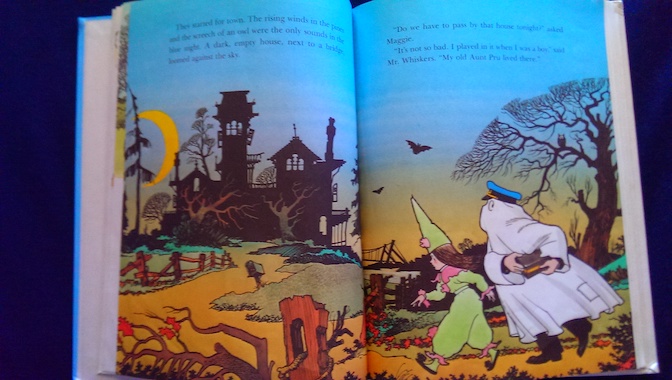
Mystery of the Melted Diamonds

Mystery of the Melted Diamonds by Carol Farley, 1986.

This is the last book in the Kipper and Larry mystery series.

This time, Larry has come to visit Kipper and his family on their farm in Kansas while his father attends a police convention in Florida and will be spending Christmas with them. At first, Kipper thinks that Larry probably regrets this visit because Kansas isn’t very exciting, and it’s snowing while Larry’s father is in sunny Florida.

The situation gets worse when Kipper gets into a fight with his friend Scooter when Larry and Kipper were supposed to be spending the night at Scooter’s house. Scooter apparently cheated at a game, and Kipper got so mad that he said that he and Larry would just go home. The problem is that the boys have to walk a couple of miles to reach the farm where Kipper’s family lives, and the snow has turned into a blizzard.

The boys start to get scared that they might freeze to death when Larry spots a light from a house nearby and heads toward it. Kipper thinks that it’s a dangerous mistake because the house with the light is the old Morgansterne house, and it’s been empty for years. However, when the boys reach the house, there are oil lanterns burning in the windows and a fire in a wood-burning stove. Out of desperation, the boys let themselves into the house to warm up, but then they start to wonder who lit the fire and the lanterns. They search the house to see if there’s anyone there, but they don’t find anyone. The only thing they find upstairs is an old box of Christmas ornaments.

The boys spend the rest of the night in the house without seeing anyone and continue to the farm in the morning. When they explain to Kipper’s mother what happened and where they spent the night, she’s concerned, both because the boys were out in the snowstorm and because nobody should be in the old Morgansterne house. Old Miss Morgansterne, who owns the house, has been living in a retirement home, and no one else is supposed to be there. Kipper’s mother decides to call the sheriff and have him look into it.

The sheriff comes and questions the boys about what they saw in the house, and they ask him about a robbery at a jewelry store in town that the family heard about on the radio while waiting for him to arrive. Larry wonders if there’s a connection between the robbery and the supposedly empty house that seemed to be occupied by someone before they arrived. The sheriff doesn’t see why there would be a connection between the two events, but Kipper’s younger brothers think that maybe the robbers were in the house the whole time, hiding in some kind of secret passageway, like in books and movies. The sheriff thinks that the boys have overactive imaginations.

However, there is more to the theory that the house and the robbery are connected than the sheriff thinks. Soon, the sheriff is alerted that the car that is believed to belong to the robbers has crashed into a pond near a dangerous curve in the road and the two men inside the car are dead. When they search the car, they find some of the jewelry from the robbery, the less expensive costume jewelry, so it seems that they were correct that these men were the robbers, but strangely, the most expensive jewels from the robbery, diamonds, are still missing. The sheriff says that it’s almost like they melted away, like the diamond-like snow that Larry commented on earlier.

It makes sense to the boys that the robbers were in the Morgansterne house before they were. They remember seeing a car like the robbers’ car along that road before the snow storm got bad, and it would explain why the house was empty all that night. The robbers accidentally saved the boys’ lives by lighting the stove in the house for them, but they never returned to their hideout in the empty house because they had their car accident. But, somewhere along the way, the diamonds they stole seem to have vanished. Can the boys figure out how?

The book is available to borrow and read for free online through Internet Archive.

My Reaction

Overall, I liked the story. I had more than one theory about where the diamonds were, and one of them turned out to be correct, but there was enough doubt in my mind to keep the story interesting until the end.

Cranberry Halloween

CranberryHalloween

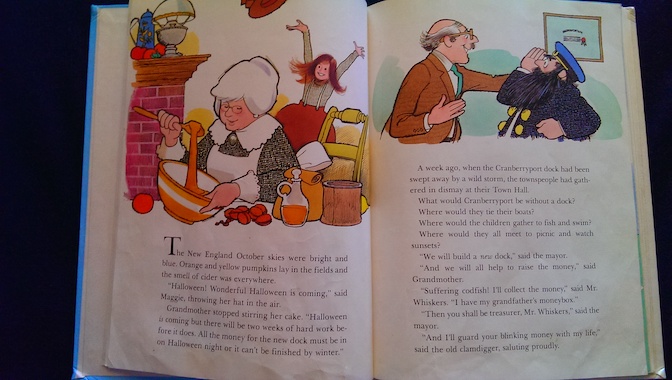
Cranberry Halloween by Wende and Harry Devlin, 1982.

The citizens of Cranberryport need to raise money to build a new dock after theirs was destroyed in a storm. Almost everyone in town volunteers to help, and Mr. Whiskers volunteers to keep the money they raise in his grandfather’s old moneybox.

CranberryHalloweenRaisingMoney

Mr. Grape, a rather cranky old man, not only refuses to donate money to the cause but he insists that it is a mistake to trust Mr. Whiskers with the money because he is a sloppy and careless person. However, Maggie’s grandmother speaks up for Mr. Whiskers, and he gets the job of treasurer for the fund.

CranberryHalloweenSpookyHouse

On Halloween night, Mr. Whiskers and young Maggie make their way to the town party, where Mr. Whiskers will present the money for the dock at the town hall.  As they pass by the spooky old house where Mr. Whiskers’s aunt used to live, two men in pirate costumes try to steal the money from them.

CranberryHalloweenPirates

Mr. Whiskers and Maggie hide in the spooky old house, but the pirates are still waiting for them outside. What are they going to do?

CranberryHalloweenTrapped

Mr. Whiskers uses his memories of the old house to find a way out, and it isn’t long before they uncover the villain who put the pirates up to the attempted theft.

The book includes a recipe for Cranberry Dessert in the back.

CranberryHalloweenRecipe

The Dreadful Future of Blossom Culp

DreadfulFutureBlossomCulpThe Dreadful Future of Blossom Culp by Richard Peck, 1983.
This book is part of the Blossom Culp Series.

It’s 1914, and Blossom Culp is just starting high school. Although the principal of her old school tells her that this is a chance for her to make a fresh start, it looks like Blossom’s future is going to be very much a continuation of her immediate past.  In high school, she’s still a social outcast, looked down on by girls from better-off families, like Letty, the class president.  Also, despite her principal’s assertion that Blossom’s previous forays into the occult were imaginary, the product of the mental confusion that accompanies puberty, and that she is bound to grow out of them, Blossom knows that her psychic abilities are a natural gift and will not be ignored.

Blossom begins high school friendless because Alexander Armsworth has been ignoring her lately because of his important new position as class vice-president, his infatuation with Letty, and his friendship with a couple of local hooligans, Bub and Champ. Alexander is looking forward to his role in planning the school’s Halloween Festival, telling Blossom that he’s over their earlier, childish occult escapades and the Halloween pranks he used to pull.  Meanwhile, all of the other girls in school are infatuated with their handsome history teacher, Mr. Lacy, and so is the girls’ gym teacher, much to Blossom’s disgust.  Blossom thinks that Mr. Lacy is full of himself and denies that she has any such silly crush on Alexander.

Blossom makes an unexpected friend in a girl called Daisy-Rae, a girl from the country who has brought her younger brother into town to attend school and hoped to get an education herself but has been too afraid of the big town to actually attend classes.  Daisy-Rae hides in the school during the day and lives alone with her brother at night in the old chicken coop at the abandoned Leverette house.  It is through Daisy-Rae that she learns that Alexander and his friends aren’t so above childish pranks as they claim to be.  Blossom also discovers that Mr. Lacy has been romancing her old principal.  Mr. Lacy isn’t quite what he appears to be and has some unsavory secrets in his past.

Matters come to a head when Alexander (at Letty’s urging) tries to persuade Blossom to dress up and become the fortune teller for the haunted house that the freshmen class is doing for the Halloween Festival.  The haunted house is also a fundraiser, and Letty figures that they can get extra money from people if they’re willing to pay to have their fortunes told, and who would be better for the job than Blossom?  However, Blossom isn’t one to go out of her way to please others, especially Letty, and it turns out that they’re holding the haunted house in the Old Leverette place.  For some reason, that old house makes Blossom’s mother uneasy.  She seems to think that it’s haunted, but in an unusual way.  Blossom tells Alexander that she will not agree to be their fortune teller until he agrees to check out the house with her before Halloween and find out what’s wrong with it.  She figures that, since both of them are psychic, they can learn what’s so unusual.

As Blossom learns, her abilities don’t confine themselves to the past and people who have died but extend to the future and the people who haven’t yet been born.  Inside the Old Leverette house, Blossom suddenly finds herself entering the distant future, the 1980s.  In the 1980s, the Leverette house is once again lived in, and Blossom meets a boy named Jeremy who is a lonely social outcast, like herself.  Jeremy is a computer nerd, living with his divorced mother.  He takes Blossom on a tour of their town as it is in Blossom’s future, much larger than it used to be and with many familiar landmarks missing.  However, what Blossom sees in the future gives her the inspiration she needs to solve her problems in the past and hope that things will improve.  In return, she also proves to Jeremy that he is far from alone and has had a friend for longer than he ever imagined.

The time travel to the 1980s comes off as being a little corny (or so it seemed to me), but the writing quality of the book is excellent.  The author has an entertaining turn of phrase, and the book, like others in the series, is humorous and a lot of fun to read.

Besides being a kind of fantasy story, there are some interesting tidbits of history in the book, showing how people lived in the 1910s.  Blossom explains about the things she and her classmates did at school, like wearing beanies on their heads to show which year they were (freshmen, future graduating class of 1918).  At one point in the story, Blossom takes Daisy-Rae and her brother to their first movie, a silent film with an episode of The Perils of Pauline serial.  While Blossom worries about the future, readers can get a glimpse of the past!

As for what Blossom learns about her own future, she avoids finding out too much because she’d rather not know the details.  However, there are implications that she and Alexander may eventually marry and live in his family’s old house.

The book is currently available online through Internet Archive.

What’s a Ghost Going to Do?

WhatGhostDo

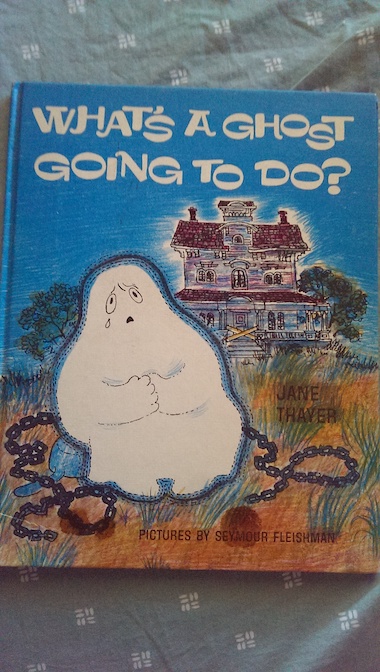
What’s a Ghost Going to Do? by Jane Thayer, 1966.

Gus is a friendly ghost who lives a quiet life alone in his old house, which is run-down and shabby, with winter visits from his mouse friend.  However, Gus discovers one day that the property is being sold.  The government wants the land to turn into a park, and if that happens, Gus’s house will be torn down!  If they decide to tear the house down, where will he go?

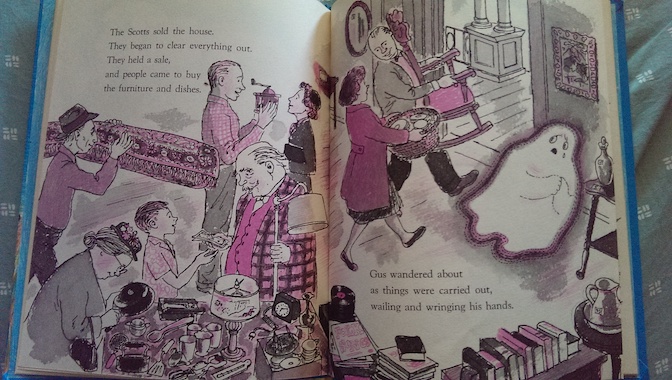
WhatGhostDoSale

For a time, Gus tries living with another ghost in another old house nearby, but that arrangement doesn’t work because the other ghost doesn’t like Gus rattling chains.  Then, Gus tries living in a hole with his mouse friend, but it’s really too small for him.  The only place that seems right for Gus is his old house, which is in danger of being destroyed!

WhatGhostDoHints

In desperation, Gus whispers in the ears of the man in charge of preparing the park for the government, Mr. McGovern, trying to get him to notice the virtues of his house.  Fortunately, Mr. McGovern accepts Gus’s vision of the house as a beautiful piece of the past and finds a way to restore it to its former glory so that Gus can keep his home and others can appreciate it, too.

WhatGhostDoRepairs

Gus’s house becomes a museum in the park, and Mr. McGovern also officially acknowledges Gus as the resident ghost.

The book is available to borrow and read for free online through Internet Archive. It’s part of a series.

WhatGhostDoMuseum

My Reaction

I’ve had this book since I was a little kid. I always felt sorry for poor Gus throughout the book, but the story has a nice ending, with Gus and Mr. McGovern finding a creative way to restore the house and put it to good use, filling it with antique furniture for both Gus and the public to enjoy. I haven’t read any of the others in the series yet because this is the only one I’ve ever had.

Old Black Witch

OldBlackWitch

Old Black Witch by Wende and Harry Devlin, 1963.

OldWitchChimneyA boy called Nicky and his mother are looking for a new place to live somewhere in New England.  The mother wants to buy an old cottage with the idea of turning it into a tea room.  At first, they have trouble finding a place, but finally they buy an old house that badly needs fixing up, not knowing that there is an old witch living there.
The witch (whom they call Old Black Witch, since she’s dressed all in black and sooty and doesn’t seem to have any other name) has been sleeping in the chimney of the house for about a hundred years, and they wake her the first time they try to start a fire in the fireplace.

The witch is furious to discover that the house has new owners and worried about where she’s going to live because she needs an old house to haunt.  Nicky and his mother invite her to stay and live in the attic, which has enough dust and cobwebs to satisfy her tastes, while they clean up the lower part of the house for the tearoom.

The locals have heard stories about the house being haunted, but the nice tearoom soon becomes popular with ladies in the area, especially after Old Black Witch decides to help out Nicky’s mother in the kitchen.  Old Black Witch’s blueberry pancakes are wonderful and win many fans for the tearoom.

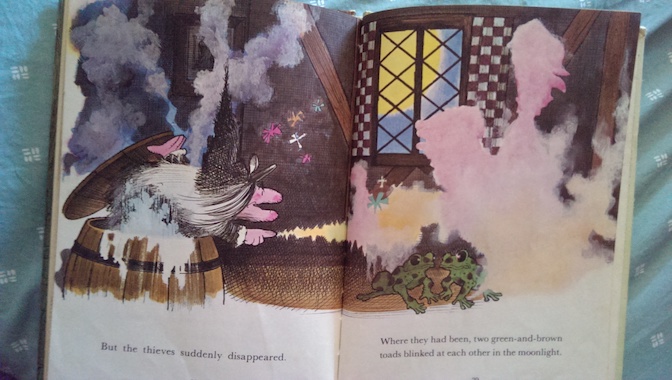
Then, one night, a couple of burglars break in.  Since Old Black Witch is kind of evil herself, she can’t really fault them for wanting to rob the place . . . until she suddenly realizes that they’re stealing from her, too, and uses her magic to fix the burglars for good and give herself the pet toads that she’s been wanting.

This book is available to borrow and read for free online through Internet Archive.

OldWitchToads

My Reaction

One of the things that I like about this story, which was a favorite of mine when I was a kid, is that Old Black Witch isn’t particularly evil although she isn’t too nice, either.  She’s as bad and disagreeable as a cranky old witch who’s lived in a chimney for over 100 years ought to be, but not so bad that she can’t make some new friends and help them out once in a while.  Friendly enough for the kids, but not too sweet to be a real witch.  It’s part of a short series, although I haven’t managed to find any of the other books yet.  Some of the pictures are in full color and some are in black and white.  Don’t ask me why she has a spoon in her hat because I’ve never been completely sure, either.  Somehow, on her, it looks good.

The back cover of the book has the recipe for the blueberry pancakes.

OldWitchPancakeRecipe

There was a short film version of this story from 1969 called Winter of the Witch.  It follows the book fairly well, but with some variations (there were no burglars).  In the film, the pancakes have the power to make people happy, and that’s what gives Nicky’s mother the inspiration to open a pancake parlor in their house.  The witch finds a new sense of purpose, although she still plans on going back to her old, wicked ways once the world is happy enough to need a good, old-fashioned scare.  I don’t think that it was ever released on dvd, but it is possible to see it on YouTube and Internet Archive.