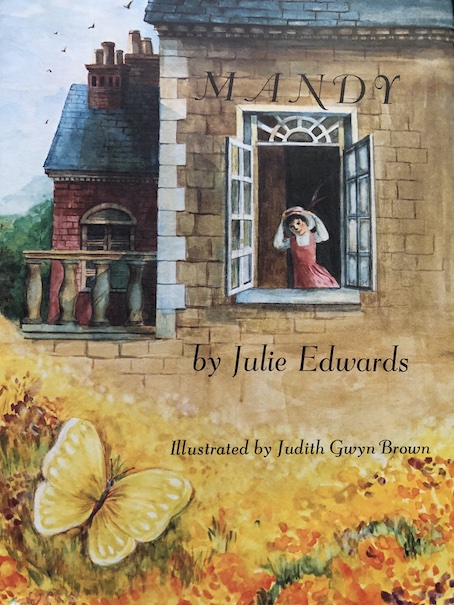
Mandy by Julie Andrews Edwards, 1971.
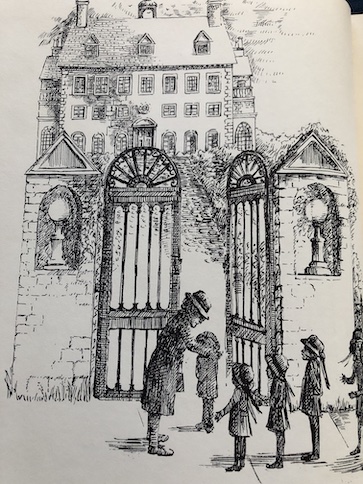
At St. Martin’s Orphanage, there are usually about 30 children at a time, and the matron does her best to nurture her parentless charges. Mandy is a ten-year-old girl who has lived in the orphanage her entire life. She is intelligent, and she loves reading and daydreaming. She is allowed to work part time at a grocery store, and she spends most of her money buying books. She also loves nature and taking walks by herself. She enjoys spending time alone because she likes to daydream and admire flowers and other beauties of the natural world.

However, Mandy isn’t really happy, either. Even though the orphanage is kind to her, she gets along well with the other orphans, and she has her books and other things to keep herself busy, she is lonely and still misses having parents and the family life she’s never known. Because she has no memory of these things, it’s difficult to say whether she truly understands what she’s missing, but she definitely feels the lack of them in her life. As she gets older, she begins to feel more and more melancholy about it. She knows only that something is missing from her life, and she becomes more desperate about it. She craves a place that she can call her own, a place where she really belongs.
There is a wall behind the orphanage, and Mandy, with her vivid imagination, becomes increasingly curious about what’s on the other side of the wall. She asks Ellie, the maid at the orphanage about it, but as far as Ellie knows, it’s just more of the countryside. She’s never actually explored it herself. Mandy likes to imagine that there might be a castle and a unicorn beyond the wall.
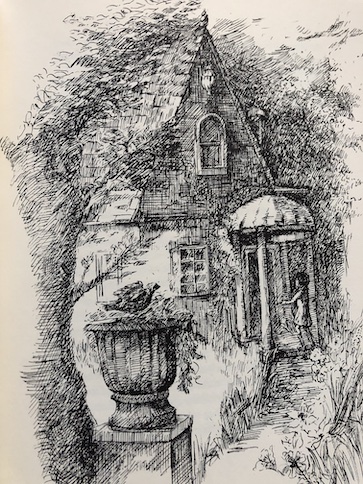
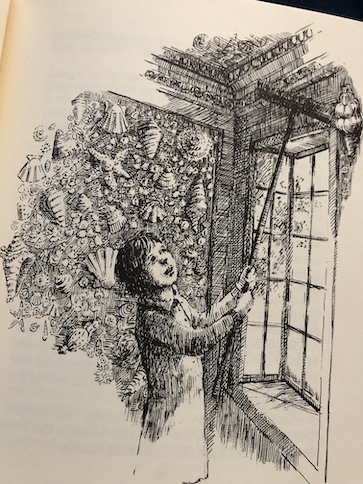
One day, Mandy decides to try climbing over the wall to see for herself. What she sees is an apple orchard and a path through it. When she climbs down from the wall and follows the path, she finds an old, disused cottage with the remains of a garden. The cottage is empty of furniture. Mandy lets herself into the cottage and finds it dusty and in need of repair, and there’s no sign than anyone has been there for years. However, there is a marvelous room in the small house that is decorated with real seashells! Mandy is fascinated, and she wonders who used to live there.
The idea comes to Mandy that she could “adopt” the house and care for it as if it was her own. Obviously, nobody has been there for a long time, and nobody would know or care if she cleaned it up, but she would feel good, having a place of her own and something to care for. When she returns to the orphanage, Ellie tells her that she asked the matron what was on the other side of the wall, and she says that it’s a large, old estate, where nobody lives anymore. Mandy is pleased with that because, if no one lives on the estate where the cottage is, there will be no one to notice when she goes to visit the cottage.
She asks for gardening advice from the gardener at the orphanage without telling him exactly why she wants to know, and he even lets her borrow some tools. Mandy loves tending to her very own garden, and she uses some of her pocket money from the grocery store to buy seeds for the garden and some things for the house. Mandy loves seeing how the cottage and garden improve under her care, but her roommate, Sue, begins to wonder where she keeps disappearing to, and the adults begin to wonder what she is doing with the things she buys and borrows.

The matron tells Mandy that she’s worried about what Mandy is doing because it could be dangerous for her to go off alone where nobody knows where she’s going. Mandy lies to her, saying that she had a project of making a garden for herself but that she gave it up because it was too much work. The matron says that she understands why she would want to have a place to call her own and offers her a spot in the orphanage garden to tend as her own. Mandy feels terrible about lying to the matron, but the thought that the matron might make her give up the special place she’s found because it doesn’t really belong to her or because it’s too dangerous for her to go there alone is just too much.

As the seasons change, Mandy enjoys slipping away to her cottage whenever she can, working in her garden and watching the animals that live nearby. However, the matron has become increasingly suspicious of Mandy’s odd behavior, Sue is angry with her for keeping secrets from her, and there are signs that someone has been at the cottage while she wasn’t there. There are footprints outside the cottage and the hoofprints of a horse, and there are signs that someone has been fixing things. Fortunately, this mysterious person doesn’t seem to mind her being at the cottage. Her mysterious friend leaves little presents and notes for her. More and more, Mandy fears that her secrets will be discovered, but when she becomes ill and needs help at the cottage, she becomes grateful for the help of a friend who knows where she is. Having a place to call your own is good, but having friends and a family who care make a place a real home.
The book is available to borrow and read for free online through Internet Archive (multiple copies).
Update: A site reader pointed out that I should have explained that Julie Andrews Edwards is the same Julie Andrews who played Maria Von Trapp in The Sound of Music, Mary Poppins in the Disney musical, and the queen in The Princess Diaries movies. When I was younger, I didn’t realize that she also wrote children’s books. She is also known for writing The Last of the Really Great Whangdoodles, which I haven’t covered yet. Julie Andrews’s early life was difficult because her parents divorced and each married other people during WWII. At various times, Julie Andrews lived with each of her parents and stepparents and traveled around as she began performing with her family as a child. Her family was poor, and she later described her stepfather as being a violent alcoholic. Her chaotic early life may have been a factor in this story about a lonely girl looking for a place to belong and a real sense of family.
My Reaction and Spoilers
This is a sweet story about having a place to call home and a real family. Mandy craves for these things, even before she truly understands what it means to experience them. Parts of the story are sad and sentimental, but others are just enchanting. This book fits well with the Cottagecore aesthetic. The cottage in the orchard is charming, and Mandy’s care for it reminds me of other children’s books, like Dandelion Cottage, where children have their own secret places to fix up and care for.

Mandy gets wrapped up in her special secret place, tending the garden and watching the animals there, but it gets her into trouble with her friend and roommate, Sue, and with the matron of the orphanage because of the secrets she’s keeping and the way she keeps helping herself to things she really shouldn’t take and slipping away to spend time at the cottage without telling anyone where she’s going. Mandy loves the cottage because she can imagine it as her own home, a place that belongs to her and where she belongs, but Mandy needs people, too. Sue’s friendship for her helps her when she gets into trouble, the matron turns out to be more understanding than Mandy feared, and Mandy’s adventures with her cottage bring her into contact with people who become the family Mandy really needs. Once Mandy has the family she needs, she no longer feels compelled to keep the cottage all to herself, and she decides to share it with the other girls at the orphanage. Mandy’s new home with her new family is every bit as charming and magical as her cottage. It’s a big, old house with secret passages that she explores with her new brother.

However, I think that it’s important to note that not everything in the story is easy and happy for Mandy. All through the story, she struggles with her emotions, experiencing sadness and loneliness and trying to understand what they mean. Her new family doesn’t fully accept her immediately, either. They are never mean or rejecting of her. They are friendly and helpful people from the first time they meet Mandy, but it takes some time of them getting to know her before they decide that they want her to be a permanent part of their family. There isn’t a lot of high drama, and her new brother is never jealous of her or mean to her. However, the family does take some time to make their decision after Mandy spends Christmas with them, and that adds to Mandy’s inner distress.
There are points in the story when Mandy’s fate seems uncertain, and she considers running away from the orphanage. The headmistress becomes concerned about Mandy because of her melancholy and tells the family considering her that Mandy has begun asking her questions again about her parents and how they died, something that she hasn’t done for years, showing that she has become preoccupied with the concept of family life and her lack of it. The family is concerned for Mandy and understanding of her feelings, but I thought that having the family take time to get to know Mandy and to consider what having her join their family would mean was realistic. I think the drama was softened a little to keep the gentle feel of the story, but there’s enough emotion and inner turmoil that it doesn’t feel like Mandy’s problems resolve too easily.
Sue and Mandy bring up the question about whether Mandy’s discovery of the cottage and her new family was a matter of luck. Sue is envious because it seems like everything happens to Mandy. Mandy asks her new father if that’s a matter of luck, but he says that Mandy is special and that things happen to her because she is brave and goes looking for them. She is a quiet person, but she takes her life into her own hands and pursues what she wants, where other people might be too timid to do it. Technically, Mandy broke rules and took some risks to care for her secret cottage, but she did it because it was important to her, and it worked out in the end. Her new father seems to appreciate Mandy’s spirit and determination.



 Jestress's Forgotten Books and Stories