Changes for Samantha

American Girls

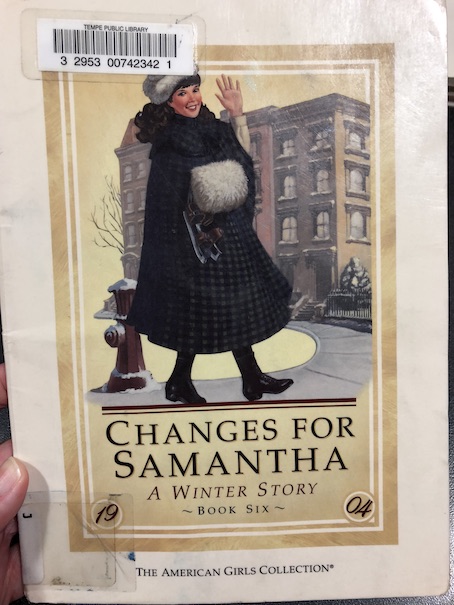
Changes for Samantha by Valerie Tripp, 1988.

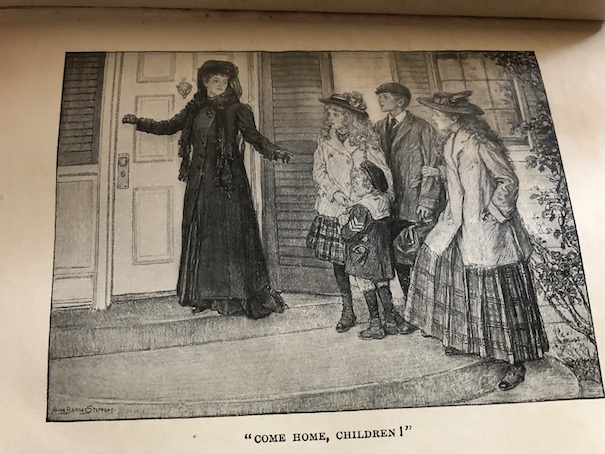
This book is part of the Samantha, An American Girl series. This is the last book in the original series of Samantha’s stories and explains the changes in the lives of Samantha and her friends, especially Nellie. When Samantha met Nellie in the first book in the series, Nellie was a poor girl working as a servant girl in a neighboring house. Later, Nellie and her family moved to Samantha’s town, Mount Bedford, and Nellie and her sisters were able to attend school for the first time.

Now, Samantha has moved to New York City to live with her Uncle Gard and his new wife, Aunt Cornelia. Samantha likes living with them, although their housekeeper, Gertrude, is strict and often makes her feel like she’s doing things wrong. Samantha’s grandmother, a widow, has remarried to her long-time friend, the Admiral. Samantha’s life has changed considerably since the first book. Since her move to New York City, Samantha hasn’t seen Nellie or her sisters, but their lives have also changed, and not for the better.

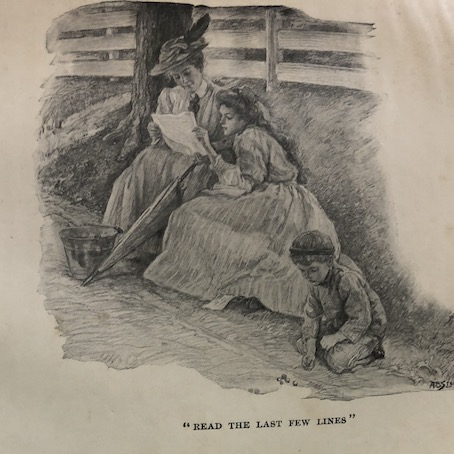
When the book begins, Samantha and Aunt Cornelia are making Valentines to give to friends and family. Samantha receives a letter from Nellie that says that her parents have died of the flu and their employer, Mrs. Van Sicklen, is sending her and her sisters to New York City to live with her Uncle Mike. Nellie says that she’ll try to visit Samantha in New York City soon. Samantha is upset to hear that Nellie’s parents are dead, but Uncle Gard and Aunt Cornelia reassure her that Nellie’s uncle will take care of her and that she’ll soon be living much closer to Samantha.

After some time goes by and Samantha doesn’t hear any more from Nellie, she begins to worry about her. Uncle Gard decides to call Mrs. Van Sicklen and find out Nellie’s new address, but she doesn’t know where Nellie’s uncle, Mike O’Malley, lives. All Mrs. Van Sicklen knows is that he lives on 17th or 18th Street, but New York City is so big, that doesn’t help much. Uncle Gard and Aunt Cornelia say that maybe Nellie has had to get a job or look after her sisters and that she’s just been too busy to visit, but Samantha is still worried that something is very wrong.

Samantha decides to start asking around 17th and 18th Streets to see if she can locate Mike O’Malley, and she finds a chestnut seller who knows Mike O’Malley. However, he warns Samatha not to get involved with him because Mike O’Malley is a “hooligan.” Samantha worries about that, but it’s just another reason for her to want to check on Nellie. When she reaches the apartment where Mike O’Malley last lived, he isn’t there anymore. His neighbor explains that Mike O’Malley was a drunk who simply abandoned his nieces in his old apartment. The neighbor took the girls in for a while, but she is a poor woman with children of her own to raise, so she had to turn Nellie and her sisters over to an orphanage, the Coldrock House for Homeless Girls.

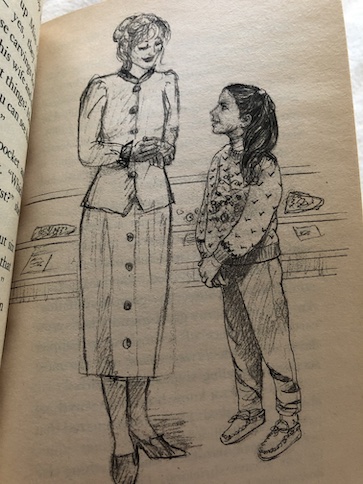
Samantha tells her aunt and uncle what she’s learned, and they’re upset that she went to such a dangerous part of the city alone. However, Aunt Cornelia agrees to take Samantha to the orphanage to see Nellie. The directoress, Miss Frouchy, is a stern and sneaky woman, but she agrees to let Samantha see Nellie, even though it isn’t a visitors’ day. It is difficult for the girls to speak candidly with Miss Frouchy watching them and monitoring everything that Nellie says. When Aunt Cornelia asks if Nellie and her sisters need anything, Miss Frouchy interrupts and says that they don’t. However, Samantha notes how thin Nellie looks and suspects that there is more going on than Nellie is being allowed to say, and Miss Frouchy even confiscates the cookies meant for Nellie and her sisters right in front of Aunt Cornelia and Samantha.

Aunt Cornelia asks Miss Frouchy for a tour of the orphanage so that Nellie and Samantha can be alone, and so the girls are able to speak openly. Nellie confirms that things are hard at the orphanage and her sister, Bridget, isn’t strong. Miss Frouchy thinks that Bridget is lazy and doesn’t want to work, so Nellie tries to cover Bridget’s chores as best she can. Samantha says that Nellie could come and stay with her and her aunt and uncle, but Nellie says that they probably don’t need any more maids. Samantha offers to hide Nellie and her sisters, but Nellie thinks that plan is too risky. More than anything, Nellie wants to keep her sisters together. She says with a little more training, she could find a job as a maid and support them.
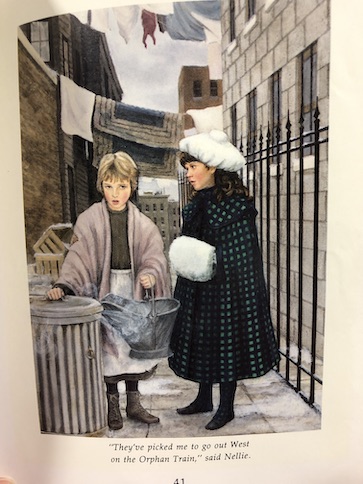
Samantha returns to the orphanage again with her aunt and uncle to visit all three girls, and she and Nellie arrange to meet secretly at the time when Nellie is supposed to take the fireplace ashes out to the alley for disposal. At their next meeting, Samantha finds out that Miss Frouchy took the gloves that they had given Nellie and even punished her for having them because she said that she must have stolen the gloves. However, there is worse to come. Soon, Nellie tells Samantha that she has been chosen to be sent out west on the Orphan Train, but because her sisters are too young to go, they’ll be left in New York alone. With the sisters about to be split up, Samantha’s plan to help the girls run away and hide is looking better.
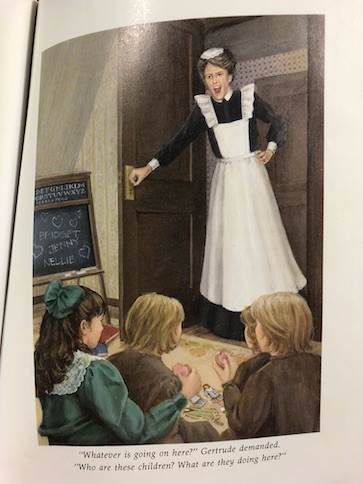
Together, Nellie and Samantha help to sneak the younger girls out of the orphanage, and Samantha hides the three of them in an upstairs room in the aunt and uncle’s house that isn’t being used. She sneaks food and toys upstairs to them, and Nellie sneaks out during the day to go looking for work. However, Gertrude soon gets suspicious about how much food Samantha seems to be eating and how she seems to be sneaking around with it. When the girls are finally caught, Samantha owes her aunt and uncle some explanations, but admitting the truth of what has happened changes things for the better for all of the girls.

In the movie version of the Samantha series, which combined all the stories from the Samantha books into one, the story ends at Christmas, but in the book, it’s Valentine’s Day. The Christmas ending is nice, but Valentine’s Day does make for a nice difference, and love is appropriate to the theme of the story. Uncle Gard and Aunt Cornelia end up adopting Nellie and her sisters, so they officially become part of Samantha’s family. Unlike other characters in the story, who see the orphans as either an inconvenience or a source of cheap labor, Uncle Gard and Aunt Cornelia genuinely love them and want to raise them.

Something that struck me about the book was that both Nellie and Samantha are orphans, but their lives were very different at the beginning of the story because Samantha is from a wealthy family with an uncle who loves her and Nellie is a poor girl with an irresponsible uncle. If Samantha had been poor, she might have been destined for an orphanage or the orphan train herself. Because she wasn’t and because her family looks after children well and is willing to share what they have with others, Samantha has a secure future, and Nellie and her sisters become part of their family.

The book ends with a section of historical information about all the changes taking place in Samantha’s time, from technological changes, such as the first airplanes and new cars, to the increasing sizes of cities and new immigrants arriving in the United States.

As girls like Samantha grew up, society continued to change. In earlier books, Samantha’s grandmother talked about how young ladies aren’t supposed to work but learn how to be ladies and take care of a household. By the time Samantha was an adult, in the 1910s and 1920s, it was becoming more common for women to hold others jobs, although they would often stop working when they got married so they could focus on raising their children. The profession of social work evolved to help care for children like Nellie and her sisters. Some social workers also helped immigrants to learn English and train for new jobs when the came to the United States. The book specifically mentions Jane Addams, who founded the settlement house, Hull House.

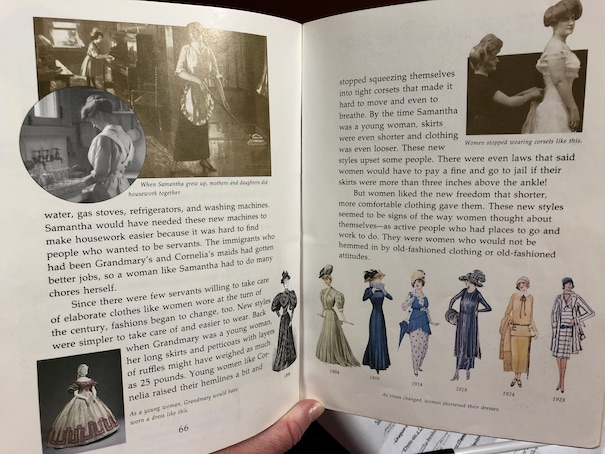
Change is a major theme of all of the American Girl books, and a girl like Samantha would have seen some drastic changes in the ways that people lived as she got older. Over time, fewer immigrants looked for jobs as domestic servants, and newer forms of household technology, like washing machines, made it easier for housewives to do more of their domestic chores themselves. The section of historical information ends with examples of the changes in styles of women’s clothing through the 1920s, explaining how the changes in clothing styles were part of the changes in the types of lives the women wearing them were leading.

Although the book doesn’t go into these details, I would just like to point out how old Samantha would have been at various points in the 20th century. She was born in 1894, and ten years old in 1904, so that means that she would have been:

  • 23 years old when the US entered World War I in 1917
  • 26 years old when the 19th Amendment granted women’s suffrage in the United States in 1920
  • 30 years old in 1924 (Jazz age and Prohibition)
  • 35 years old when the stock market crashed in 1929, the beginning of the Great Depression
  • 47 years old in 1941, when the attack on Pearl Harbor occurred, and the US entered World War II, and 50 years old in 1944, when the Molly, An American Girl series takes place.
  • In her 50s during the early days of the Cold War. She would have to live to be 95 to see the end of it.
  • In her 60s through her early 70s during the Civil Rights Movement.

I like to think about these things because it puts history in perspective, and it gives us some sense of what Samantha’s future life might have been like. When she was a young woman, she may have joined the women’s suffrage movement with her Aunt Cornelia. She probably knew young men her age who went to fight in World War I. (Eddie, the annoying boy who lived next door to Samantha’s grandmother, would have been old enough to fight and may have been a WWI soldier himself.) Perhaps, Samantha’s future husband was a soldier. When she was older, Samantha could have either joined the temperance movement behind Prohibition or visited a speakeasy or at least knew people who did. It’s difficult to say what happened to Samantha’s family during the Great Depression. Depending on their professions and what they may have invested their money in, they may have lost their fortunes in the stock market crash, or they may have ridden out the whole thing in relative comfort. By World War II, Samantha may have had a son who was old enough to fight. One of the things I find interesting about historical novels with children is imagining what their future lives may have been like, and Samantha was born at a time when she would have witnessed many major events throughout her future life. The book shows how women’s fashions changed as Samantha grew up, but I’m fascinated by the events in Samantha’s life that I know must be coming, just because of when she was born. By the end of her life, the world would be a very different place from what she knew when she was young.

The book is available to borrow for free online through Internet Archive.
The School at the Chalet

The School at the Chalet by Elinor M. Brent-Dyer, 1925.

This is the first book in the Chalet School Series.  This series is uncommon in the United States.  People from Britain or countries with heavy British influence would be more familiar with this series.  It’s considered classic!

When the story begins, Madge and Dick Bettany, who are brother and sister, a set of twins, are discussing their family’s situation.  Their parents are dead, and they have very little money and no family members they can rely on.  Madge and Dick are grown and are ready to begin making their own way in the world, but their younger sister, called Joey, is still a child, and her heath has been poor.  Dick has a job, but he really can’t afford to support his sisters.  However, Madge has had an idea: she wants to start a school.  Dick worries that they don’t have the capital necessary to start a school, but Madge says that she could start one in continental Europe instead of England, where they are from, because the costs would be lower.  She even has a specific place in mind, a chalet near a lake, close to a town called Innsbruck in the Tiernsee (Austria).  Joey could live with her at the school and continue her education in the company of the other students, and Madge thinks that the climate there might even be better for her than England.  She has already written a letter to find out if the chalet is available, and it is.  If they sell most of what they own in England, Madge thinks that they’ll have enough to buy what they need in Europe.  Madge says that she thinks she could handle about a dozen girls, between the ages of twelve and fourteen or fifteen.  She knows someone who could help her teach, Mademoiselle Lepattre, and between them, they are qualified to teach French, German, sewing, and music.  Dick is still a little concerned about whether or not Madge can pull off the school, but he agrees that she should go ahead with her plans (since she likely will anyway) and says that if she runs into trouble, she should contact him for help.

Madge even knows who her first pupil at the boarding school will be: Grizel Cochrane.  Madge has already had her as a student, and she is friends with her family.  She knows that Grizel has been unhappy at home since her father remarried because she and her stepmother do not get along.  Grizel’s stepmother has already been pressuring her father to send her away to boarding school, but he loves her and has been reluctant to part with her.  However, Grizel has been miserable, and her father decides would be more willing to send her away with someone he already knows.  Grizel is pleased at the idea of joining Madge and Joey at a school in Europe, and the Madge gains her first student.

Dick and Mademoiselle Lepattre go to the chalet first to take the larger trunks and belongings and begin getting settled, while Madge, Joey, and Grizel follow them.  Along the way, they see some of the sights of Paris.  By the time they arrive at the chalet, Mademoiselle Lepattre’s young cousin, Simone Lecoutier, has arrived at the school to be a pupil, and Madge has arranged to accept an American girl named Evadne Lannis, who will arrive later.  These four girls, Joey, Grizel, Simone, and Evadne, are the school’s first boarders.  The school soon acquires a few day pupils who live nearby: Gisela and Maria Marani (a pair of sisters), Gertrud Steinbrucke, Bette Rincini, Bernhilda and Frieda Mensch (also sisters).  Maria is much younger than the other girls, only nine, but her mother asked that she be admitted along with her older sister. There are public schools for children in Innsbruck, but the father of one of the new local pupils thinks that the Chalet School might be healthier for his daughter because, while he doesn’t think much of English educational standards (Grizel takes exception to that comment), they shorten the school day (compared to the average school day of Austria or Germany of the time) and encourage participation in sports and games. The local girls are curious to see what things are going to be like at an English style school, and if it will be like other English schools they’ve heard about.  The school also soon gains more students and boarders:

  • Margia and Amy Stevens – ages 8 and 11, their father is a foreign correspondent from London who needs to travel for his work, and the girls’ parents wanted to find a stable place for the girls to stay.
  • Bette Rincini’s cousins, who have come to stay with her family
  • A pair of sisters from another town across the lake
  • Two more children from a nearby hotel
  • Friends of Gisela from Vienna
  • Rosalie and Mary, two girls Joey and Grizel know from England

As the school grows and the girls settle into life at the school, they make friends with each other, although it’s awkward in some cases.  Madge notices that Simone is often by herself and she asks Joey if she and the other girls are being nice to her.  Joey says that they try, but Simone often sneaks off alone, and she doesn’t know where Simone goes.  Joey tries to ask Simone if she’s unhappy, and Simone tries to deny it.  The truth is that Simone is really homesick.  Joey finds her crying by herself later and comforts her, and Simone finally admits how much she misses her mother.  Simone also says that she feels left out because everyone else at the school has someone to be close to.  Other girls at the school share nationalities with at least some of the other students.  Simone is the only French girl at the school.  The Austrian girls are close to home, and Joey and Grizel already knew each other before they left England.  Seeing the other girls being such close friends makes her feel more left out.  Joey apologizes for making Simone feel left out and assures her that she will be her friend.  Simone asks her to be her best friend because she really needs someone to confide in, and Joey agrees, although she finds Simone rather needy and clingy. 

It turns out to be a difficult promise because Simone gets very jealous when Joey makes friends with other girls, and she tries to convince Joey to only be friends with her.  Simone is very dramatic, and she even ends up cutting off her long braid in an effort to impress Joey and get her attention when she learns about the other girls who will be coming from England.  Simone is so desperately lonely and finds it so difficult to make new friends that she is terrified that Joey will abandon her completely when she has other friends.  Joey gets fed up with her behavior and tells her that she’s being selfish. Joey knows that Simone would find it easier to make more friends herself if she would stop moping and being sad and gloomy.

After Juliet Carrick, another English girl, joins the school, Gisela is made head girl, and other girls are made prefects.  Bette is a sub-prefect, and one day, when she tells Grizel to put her shoes away, Grizel is rude to her, and Juliet laughs.  Gisela and the prefects discuss the situation and agree that Grizel, who wasn’t causing problems before, is now acting up because Juliet thinks that it’s funny.  When Gisela sends someone to bring Grizel to the prefects’ room to talk about it, Grizel refuses to come and see them, and she realizes that something needs to be done.  If the head girl and prefects let a girl get away with disrespecting them or not following the rules, the prefect system and student government would fall apart.  Grizel feels a kinship for Juliet because neither of them has a happy home life. Juliet has been raised to believe that the English are superior to everyone else, and she has no shame in showing it.  Juliet encourages Grizel to adopt her prejudices, but at a school in Austria with students of varying nationalities, that can’t be allowed.  Madge supports the prefects, and Grizel is punished for her behavior.

Juliet is still a bad influence, sometimes encouraging other girls to act up with her. When Madge refuses to allow the girls to pose by the lake for some film makers, Juliet convinces some of other girls to sneak away with her and volunteer to be filmed without Madge’s knowledge.  However, the father of one of the local girls catches them. He explains to the film makers that it would be inappropriate to film the girls because they don’t have permission from either the girls’ parents or teachers, and he takes the girls back to the school.  Grizel’s temper and excessive patriotism also get the girls into trouble when they encounter a German tourist who makes it plain that she is disgusted at the presence of the English girls. (This is after The Great War, World War I, so that may be the reason.)  While the German woman was being deliberately rude and insulting to the girls, Joey points out that Grizel’s hot-headed reply to her has now caused them more trouble.  Grizel does apologize for not using more restraint.

Juliet’s home life turns out to be even worse than the other girls know, but they learn the truth when Juliet’s father sends a letter to Madge saying that he and his wife relinquish their custody of Juliet to the school.  The letter says that Madge can do whatever she likes with Juliet.  If she wants to keep Juliet at the school and have her work for her future tuition, that will be fine, and she is also free to send Juliet to an orphanage.  The point is that her parents have left the country, they consider Juliet a burden that they would rather not bring with them, and while they might one day feel able to reclaim her, chances of that are not looking good.  When Juliet learns about the letter, she cries and says that she had been afraid that they would do something like this.  Her parents tried to abandon her at a different school once before, but the school had insisted that they take her back.  Madge now has no idea where Juliet’s parents are.  However, she can’t bear to turn Juliet over to an orphanage, so she promises Juliet that she will keep her and that she can help to pay for her tuition by working with the younger children at the school.  Although Juliet’s behavior hasn’t been very good up to this point, Juliet is grateful to Madge and does earnestly try to please her and to maintain her place at the school. Before the end of the book, Juliet’s parents die in an automobile accident, giving Madge and the school permanent custody of her. Most of the other students (except for Joey) do not know that Juliet’s parents tried to abandon her before they died.

Through the rest of the book, the girls have adventures together and forge the new traditions of their school.  They celebrate Madge’s birthday, get stranded in a storm and have to spend the night in a cowshed, start a magazine for the school, and play pranks on each other. When Grizel’s pranks and disobedience go too far and she is punished harshly for it, she gets angry and runs away from the school, becoming stranded on a nearby mountain. Joey goes after her to save her, and both girls are ill after their experience.

The book ends with Madge and a few of the girls caught in a train accident. Fortunately, they escape the accident without serious injury, and they also manage to help the German woman who had insulted the girls earlier. A man named James Russell helps them. The book ends at this point, and the story continues in the next book in the series. James Russell is a significant continuing character.

The book is currently available to borrow for free online through Internet Archive.

Linda Craig and the Clue on the Desert Trail

Linda Craig

Linda Craig and the Clue on the Desert Trail by Ann Sheldon, 1962.

Linda and her friend, Kathy, are exploring Olvera Street in Los Angeles before a horse show when Kathy notices a strange man watching them.  While the girls were shopping, Linda bought a small horse statue that reminded her of her own horse.  As the girls finish lunch, Linda notices an odd symbol on the statue that looks like an arrowhead, but before she can study it more, the man grabs the horse and runs off.  Linda tries to chase him down to get the horse back, but the man drops it and breaks it.  Linda picks up the horse’s head and decides to go back to the shop where she bought it to see if she can get another one.

The shop doesn’t have another horse like the one Linda bought.  It was unglazed, and the others are glazed.  Disappointed, Linda goes on to the horse show, where she is taking part, along with her brother Bob and his friend Larry.  At the show, they see the mysterious man again, and he apparently steals the broken head of the horse statue that Linda had kept.  Bob thinks that maybe the man is some kind of smuggler and that there was something hidden in the head that Linda hadn’t noticed.

Linda goes back to the shop to talk to the owner again, and he tells her that the horse was a special order from Mexico for a man named Rico.  Rico said that he was a traveling salesman and that he would collect the horse at the shop, but when he didn’t turn up to get it, the shop owner decided to sell it. Linda asks the shop owner to send her another horse statue like the broken one if one comes into his shop and reports all of this information to the police.  Then, when she returns to the horse show, she finds a threatening message, warning her to “Beware. Stay away from C. Sello.”  The note is signed with the symbol of an arrowhead, similar to the one on the horse statue.  Linda also reports this note to the police, but she can’t resist trying to figure out who C. Sello is and how this person fits into the mystery of the possible smugglers.

Soon after, the shop owner calls Linda to say that another horse statue did come into the shop and that he has sent it to her but now someone has broken into his shop and smashed every horse statue he has. Realizing that what they wanted was not in the shop, the bad guys are soon on Linda’s trail, even kidnapping one of her friends by mistake, thinking that it’s her. They even try to poison Linda’s horse!

At the end of a desert trail, the Mojave Trail, there is a ghost town with sinister characters and old cliff dwellings with Native American petroglyphs that may hold part of the secret to the mystery.

The story contains some anecdotes about California history, which is interesting. I have to admit, though, that I thought that the warning note for Linda was pretty silly. C. Sello turns out to not be a person but a clue about what the smugglers are smuggling, and they didn’t have to tell Linda what it was because she hadn’t heard about it at that point and wouldn’t have any reason to know what they were talking about. If they really wanted to get her to leave them alone, they could have left a more vague warning that didn’t include any clues like “Go home!” or “Go away!”

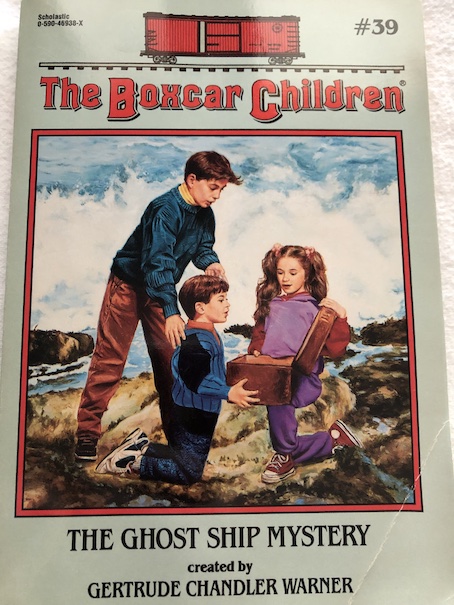
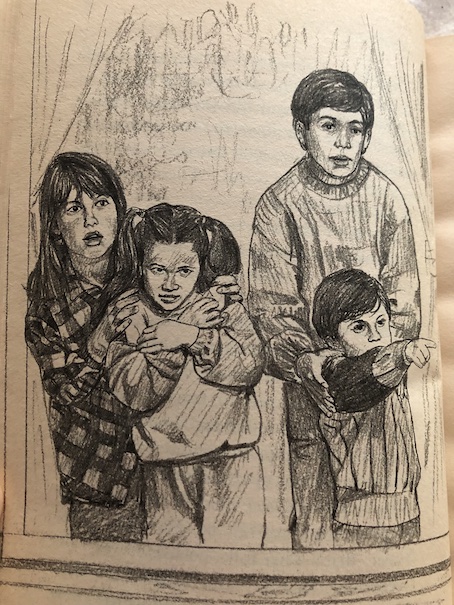
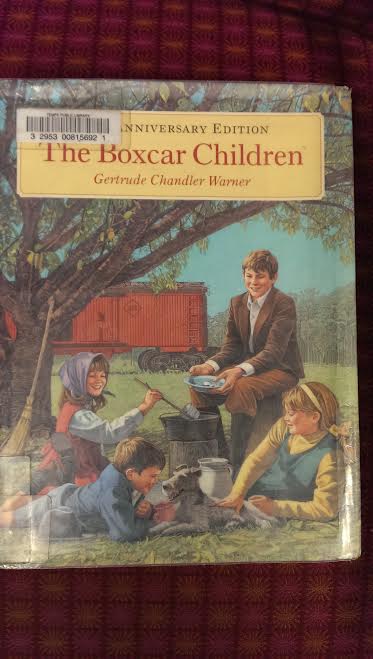
The Boxcar Children

The Boxcar Children

BoxcarChildren#1 The Boxcar Children by Gertrude Chandler Warner, 1924, 1942.

“One warm night, four children stood in front of a bakery.  No one knew them.  No one knew where they had come from.”

These are the words that begin not only this story but a series that has been loved by generations and continued well beyond the death of the original author.

The four Alden children are on the run following the deaths of their parents.  Their nearest remaining relative is a grandfather they have never met, and although he should have custody of the children now, none of the children want to go live with him.  All that they know about him is that he is apparently a mean old man who opposed their parents’ marriage.  Henry, the eldest at fourteen, and Jessie, who is twelve, have taken charge of the two younger children, ten-year-old Violet and seven-year-old Benny.  They have a little money, and they’re now traveling on foot in search of a new home.

The first place they stop is a bakery in a nearby town where no one knows who they are.  They don’t have much money, but they know they are going to need supplies for their journey.  The stingy baker and his wife agree to give the children some food and a place to sleep for the night in exchange for some help in their shop.  The children are willing to work and accept the offer.  However, Henry and Jessie overhear the couple talking about them.  They like having the children to help in the shop, but Benny is too young to be of much help.  They are considering taking Benny to an orphanage and keeping the others.  Not wanting to be separated, Henry and Jessie wake Violet and pick up Benny, moving on.  Now, they have a second set of people they’re avoiding, besides their grandfather.

Seeking a place where they can stay while not being noticed by people around them, the children eventually find an old, abandoned boxcar on a disused piece of train track on the edge of some woods.  They take shelter there from the rain and decide that they can turn it into their new home.  There are blackberries growing nearby that they can eat and a stream where they can keep milk cold.  Henry finds odd jobs in a nearby town to earn more money, and the others discover an old dump where they retrieve some old, cracked dishes and other useful items.

It seems like an idyllic life at first.  The children are free of adult control, although they do have to work to create a household for themselves and find food.  They adopt a stray dog they call Watch (he’s their new watchdog), and Henry makes friends who appreciate what a hard worker he is.  However, some of these new friends start to wonder about Henry, where he comes from, and where his parents are.

The children soon realize that someone is spying on them.  Is it someone from the town?  Could the baker and his wife still be looking for them?  Or is it someone sent by their grandfather?  When Violet is suddenly taken ill, the others realize that they need help and someone to trust.

Getting help for Violet does mean that the children’s secret is revealed to everyone, although they learn some important things in the process.  They discover who was spying on them and why and also discover that their grandfather is a nicer person than they thought and truly cares for them.

Although this series is very popular, most people don’t know that the story they read as children was actually a shortened version of the original story that was written in 1924.

The newer, popular version of the book is available online through Internet Archive.  The older version is now public domain and available online through Project Gutenberg.

Comparisons to the Older Version and My Reaction

Along with shortening and simplifying the story from original the 1924 version, the newer version from 1942 changed some of the characters’ names (the children had the same first names, but their family name was originally Cordyce, not Alden) and removed some parts that might be objectionable for young children.

Although the original story doesn’t completely clear up some questions that were left unresolved in the current version, like what the children’s parents were like, precisely how they died, and why they quarreled with the children’s grandfather in the first place, it did supply a few more details in the first chapter.  The original story begins when the children move to a new town with their father.  No one knew exactly where they came from, and the children pointedly refuse to say.  However, they do tell their neighbor, a baker, that their mother is already dead.  Their father is drunk, and the baker thinks that he looks like he’s in such bad condition that he isn’t likely to last much longer.  That turns out to be true when he dies (apparently from alcohol-related causes) soon after.  When they question the children about whether or not they have other relatives, young Benny blurts out that they have a grandfather before the others silence him.  The adults press the children for answers, and they reluctantly admit that there is a grandfather, but they say that he did not like their mother and would treat them cruelly if they were sent to him (or so, apparently, their parents had led them to believe).  The only one of the children who has even seen the grandfather is Jessie (actually called Jess in this version of the story), and it was only from a distance because her father happened to see him passing by and pointed him out.  Later, the children hear the baker and his wife talking, saying that they have no choice but to try to find the grandfather, and the children decide to run away to avoid going to live with him.  The questions of how their mother died and why the grandfather didn’t like her in the first place are never answered.

James Cordyce (the children’s grandfather in the original book, their grandmother is also apparently dead) is a wealthy man who owns steel mills, and he is impressed by the children’s ingenuity and resourcefulness at managing their own affairs while living on their own.  He tells Henry that he wants him to take over the steel mills one day, and the book says that Henry does so when he grows up and does a wonderful job of managing them.  Mr. Cordyce tells the other children that he wants them all to go to college, and then they can do whatever they like when they grow up, which the book says also happens.

Although the books never actually say so, my theory is that Mr. Cordyce/Alden was a hard-headed businessman, particularly when he was younger, driven to succeed and not emotionally demonstrative, and that this attitude caused a rift between him and his son, who may not have shared his father’s business skills and interests.  The grandfather may have wanted his son to follow in his footsteps when the son had other ambitions.  The son may have seen his father as a cold and ruthless businessman and conveyed that impression to his own children after marrying a woman his father disapproved of (Because her family was poor? Because they were unambitious?  Because she had some objectionable personal habit?  There’s no telling), but because he may not have told the children the whole reason why he thought that the grandfather was cruel, the children imagined that he was worse than he really was.

We don’t know what the children’s father did for a living after his feud with his father or exactly where they lived (perhaps in Greenfield or close by so that Jessie was able to catch sight of her grandfather one day).  Why the father took to drinking is also never explained, but I think it may be implied that he did so out of grief for his dead wife.  I think that Henry and Jessie probably had to manage the household for their parents following their mother’s death (and maybe before that if she suffered from ill health), which is part of the reason why the children are so self-sufficient and seem more tied to each other than to any adult.  In any case, the original book says that Mr. Cordyce is interested when the doctor who befriends the children says that Henry and Jessie have business management skills, so I think it sounds like he was thrilled to find out that he might have more in common with his grandchildren than he did with his son and hopeful that Henry would make a better successor in the family business.  But, that’s just the way I read it.

One other point that the original book covered was Watch’s origins.  The later version just has Watch as a stray who the children adopt, but the original story explained that he had just been purchased from a kennel by a wealthy woman when he was lost.  The kennel owner tries to reclaim the dog (kennel name Rough No. 3) on behalf of the woman, but the grandfather offers to buy the dog for much more than the original price.  The kennel owner says that it’s up to the woman who bought him, and they invite the woman to the house.  After hearing how attached the children have become to Watch, the woman allows them to keep him.

Mother Carey’s Chickens

MotherCareysChickens

Mother Carey’s Chickens by Kate Douglas Wiggin, 1911.

The book begins with a quote from an older children’s book, Water Babies:

“By and by there came along a flock of petrels, who are Mother Carey‘s own chickens…. They flitted along like a flock of swallows, hopping and skipping from wave to wave, lifting their little feet behind them so daintily that Tom fell in love with them at once.”

This book is very different from the story in Water Babies (which is actually a very dark book for children), but the quote is foretelling some of the events of this story, and the characters refer to the story now and then throughout the book.  Mother Carey’s Chickens is the book that the Disney movie Summer Magic was based on.  The basic premise of the story is the same between the book and the movie, but there are also many differences in details.  For example, in the movie, the Carey family had only three children, and in the book there were four.  The oldest children in the family also seem older in the movie than they were in the book, and their stuck-up cousin Julia was also much younger in the book.

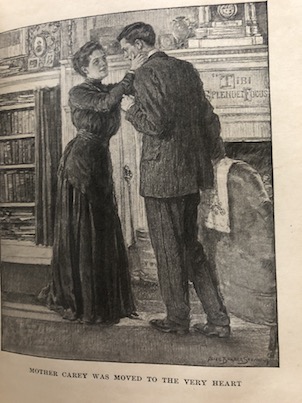
When the book begins, Mrs. Carey is not yet a widow, but she has received news that her husband, a Navy captain, is ill with what appears to be typhoid.  She has to go to him, leaving her four children Nancy, Gilbert, Kathleen, and Peter, at the house with their two servants.  (Kathleen was the child who did not appear in the movie.)  She gives them some instructions to call on their relatives if they need any further help and refers to them as her “chickens” in reference to the bit of seafaring folklore that the earlier quote mentioned.  They explain that this nickname for the children was based on a joke made by their father’s Admiral back when Nancy turned ten years old.

Nancy is the eldest of the Carey children (played by Hayley Mills in the movie), and from the way that the book describes her, I suspect her to be something of a Mary Sue for the author.  Nancy has a knack for making up and telling stories, and at one point, the book says, “… sometimes, of late, Mother Carey looked at her eldest chicken and wondered if after all she had hatched in her a bird of brighter plumage or rarer song than the rest, or a young eagle whose strong wings would bear her to a higher flight!”  Nancy and her younger sister, Kathleen, are both pretty, but Nancy is definitely the center of attention and a much livelier personality.  The book is complimentary to all of the children, however.  Gilbert is described as a “fiery youth” and little Peter, the youngest, as “a consummate charmer and heart-breaker.”  Although Peter is only four years old, the book says, “The usual elements that go to the making of a small boy were all there, but mixed with white magic. It is painful to think of the dozens of girl babies in long clothes who must have been feeling premonitory pangs when Peter was four, to think they couldn’t all marry him when they grew up!”  So, the Carey children are generally idealized as children, something pretty common in older children’s literature, especially in stories that are meant to teach certain lessons or morals, as this one does.

While the children wait for their mother to return home, they are on their best behavior even more than usual, with Nancy and Kathleen having the following conversation:

“It is really just as easy to do right as wrong, Kathleen,” said Nancy when the girls were going to bed one night.

“Ye-es!” assented Kathleen with some reservations in her tone, for she was more judicial and logical than her sister. “But you have to keep your mind on it so, and never relax a single bit! Then it’s lots easier for a few weeks than it is for long stretches!”

“That’s true,” agreed Nancy; “it would be hard to keep it up forever. And you have to love somebody or something like fury every minute or you can’t do it at all. How do the people manage that can’t love like that, or haven’t anybody to love?”

“I don’t know.” said Kathleen sleepily. “I’m so worn out with being good, that every night I just say my prayers and tumble into bed exhausted. Last night I fell asleep praying, I honestly did!”

“Tell that to the marines!” remarked Nancy incredulously.

So, the kids are pretty good, but perhaps not perfect. Still, Mary Sue characters usually do have a flaw that’s not really considered much of a flaw, making them more endearing.

Even if you don’t know the story from the movie, you may have guessed that when the children’s mother returns home, it is with the news that their father has died.  With the father’s death comes many changes for the Carey family, which is the point in the story where the movie begins.  Without the father’s salary, and with all four children less than fifteen years old, the family has to cut expenses, letting the servants go.

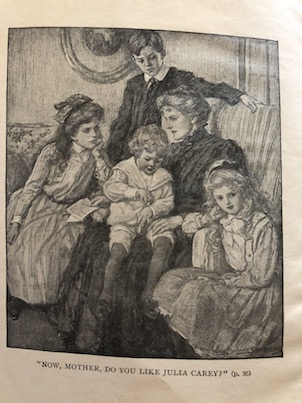
MotherCareysChickensJuliaComingThen, the family receives word that Captain Carey’s brother is in failing health and that his business partner, Mr. Manson, is seeking to place his daughter, Julia, with a relative.  Mr. Manson has already spoken to a cousin of the family about Julia, but this cousin has refused to take her.  The now-fatherless Carey family knows that taking on another relative will be an added burden on them, but Julia has no other family and nowhere else to go, so they see it as their duty to help her.  Admittedly, none of them likes Julia very much.  They remember her as a spoiled child who was always bragging about the wonderful things that her wealthier friend Gladys Ferguson had or did.  Even now, the Ferguson family has invited Julia for a visit before she goes to live with her aunt and cousins, but unfortunately, they have no intention of adopting her or even trying to care for her until her father is well themselves.  Nancy sees them as simply spoiling Julia and preparing her for a life that the Carey family can’t possibly support.

Then, Nancy has an idea that changes everything for the family.  She reminds them all of a trip that they took to Maine years ago and a beautiful old house that they saw in a small town called Beulah.  The memories of that happy time and idyllic house and small town call to them, and Nancy and her mother wonder what happened to the house.  They decide to talk to a friend of Captain Carey’s who had a small law office in the area, sending Gilbert to Beulah to find him.  In Beulah, Gilbert learns that the Yellow House (as people commonly call it, although it also has the name Garden Fore-and-Aft) belongs to the wealthy Hamilton family, who don’t live there but have used it as a kind of vacation home.  The father of the family, Lemuel Hamilton, is in diplomatic service and lives overseas.  During the last few years, the younger Hamiltons had used the house to host house parties of other young people they knew from school, but now the young people are living all over the world, and the house has been empty.  Gilbert’s father’s friend, Colonel Wheeler, and a local store owner, Bill Harmon, describe the house’s current condition to Gilbert.  Since the younger Hamiltons renovated the barn and put in a dance floor for their parties, it’s too fancy and no longer usable for its original purpose, which is why no farming families have been interested in the house themselves.  The men say that they can rent the house to the Carey family on behalf the Hamilton family (who, after all, still have to pay taxes on the property and wouldn’t mind a little extra money to cover it) for a sum much less than the rent of their current house.  The house could use a few minor repairs, and the barn is more fixed up for holding dances than keeping animals, but that’s no problem for the Carey family.  Living there would save the family a lot of money until the children are grown and able to start earning their own livings.  Even though Gilbert is only about fourteen, he is able to rent the house on his mother’s behalf.

MotherCareysChickensHome

The entire family is pleased, except for Julia, who is still a snob.  The book explains that Julia had always been a very well-behaved little girl although neglected by her somewhat flighty mother.  (The book doesn’t say exactly what happened to Julia’s mother, although she is no longer part of Julia’s life.  She may be dead, or she may have run off a long time ago.)  Because she was an only child and always seemed the “pink of perfection” (which provides the title of a song about Julia from the movie version of the book), always seeming to say and do the right thing, her father spoiled her from a young age, giving her every possible advantage he could.  When Julia first arrives at the Yellow House in Beulah to stay with her relatives, she still prattles on about her wonderful friend Gladys and all the luxuries she has.  The book says, “She seemed to have no instinct of adapting herself to the family life, standing just a little aloof and in an attitude of silent criticism.”  So, if Nancy sounded a little too wonderful in her earlier description, understand that Nancy thinks that Julia is too sickeningly perfect and smug.  Julia’s problem, as I see it, isn’t so much that she’s too perfect as she expects the rest of the world to be too perfect.  Because she is so focused on perfection, she isn’t sympathetic enough to other people or accommodating to imperfect situations.  As the book says, “She seldom did wrong, in her own opinion, because the moment she entertained an idea it at once became right, her vanity serving as a pair of blinders to keep her from seeing the truth.”  Besides being spoiled, she is very naive and rigid in her thinking.  She thinks that she knows what’s what and how things ought to be, and that’s all there is to it.

A major part of the story deals with Julia’s adjustment to family life and the realities of the family’s situation.  At first, she thinks that Mrs. Carey should save up for college for Gilbert and a proper coming-out for each of the girls in the family to give them all the advantages that life has to offer.  She’s sure that her father will get better and be able to help pay for everything when the time comes.  However, Mrs. Carey doesn’t want to wait on that hope.  She says that she’s sure that the children will be able to make something of themselves even without the advantages.  Matters come to a head with Julia when Kathleen gets tired of Julia complaining about everything and everyone and says that if her father hadn’t lost so much of her parents’ money as well as his own, the whole family would be better off.  Julia demands to know from Mrs. Carey if that is true, and Mrs. Carey says that she and her husband did invest in her father’s business, an investment which he may never pay back, due to his poor health.  She also tells Julia:

“You are not a privileged guest, you are one of the family. If you are fatherless just now, my children are fatherless forever; yet you have not made one single burden lighter by joining our forces. You have been an outsider, instead of putting yourself loyally into the breach, and working with us heart to heart. I welcomed you with open arms and you have made my life harder, much harder, than it was before your coming. To protect you I have had to discipline my own children continually, and all the time you were putting their tempers to quite unnecessary tests! I am not extenuating Kathleen, but I merely say you have no right to behave as you do. You are thirteen years old, quite old enough to make up your mind whether you wish to be loved by anybody or not; at present you are not!”

It’s an awful thing to say to a child that she isn’t loved, but it is something of a wake-up call to Julia to realize that the way that she was behaving was making herself unlovable to the people who should have been closest to her.  When she tells Mrs. Carey that Gladys loves her, Mrs. Carey says, “Then either Gladys has a remarkable gift of loving, or else you are a different Julia in her company.” Mrs. Carey tells her to consider what the Bible says about “the sin of causing your brother to offend.” It’s probably the first time that Julia was ever criticized for anything, breaking her perfect record of apparent perfection.  Julia has greatly provoked the rest of her family and realizes that she has earned whatever bad feelings they have toward her.  She has ignored their difficulties because she was too focused on what she wanted for herself and the way that she thought that life should be, not realizing how much harder she had made things for everyone.  For the first time in her life, Julia admits that she is not perfect and asks for another chance to make things right, marking a real change in her character.  Personally, though, I think that some of this drama could have been avoided if, knowing Julia and her behavior as she does, Mrs. Carey had spoken to her when she first came to live with the family, explaining the family circumstances in a straight-forward way and making it known that she expects certain standards of behavior from Julia when she’s in her house.  Making the rules and enforcing them them from the beginning may have prevented a lot of stress and saved Kathleen from exploding emotionally.

MotherCareysChickensLatinA character that appears in the movie, Ossian “Osh” Popham, is also in the book, although instead of being the store owner, he’s a local handyman who helps the family get the house in order.  His children, also characters in the movie, are in the book, too, although I didn’t like the way the book described his daughter, Lallie Joy.  It says that “she was fairly good at any kind of housework not demanding brains” and that she “was in a perpetual state of coma,” in case you didn’t understand that she’s basically stupid.  I always hate it when stories make a character intentionally stupid.  I did appreciate her explanation of her name, though: “Lallie’s out of a book named Lallie Rook, an’ I was born on the Joy steamboat line going to Boston.” I had wondered where the name came from.

While the family continues fixing up the house to make it nicer to live in, Nancy writes a letter to the owner of the house, 50-year-old Lemuel Hamilton, who is an American consul in Germany, telling him about her family and their life at the house.  Lemuel Hamilton finds her letter charming.  Seeing the picture of her family that Nancy encloses with the letter makes Lemuel think of his own family, scattered to the four winds, the children grown or nearly grown, either away at school or starting their first business ventures in various parts of the world.  He’s lonely for the comforts of having all of his family living together and surprised at how happy this much-poorer family looks in the old house in the small town that his ambitious, social-climbing wife always thought was beneath them.  Then, it occurs to him that his sons are of an age when they’ll start thinking about marriage soon, and he wonders what wives they’ll choose and what their family lives will be like.  On an impulse, Lemuel writes to the Carey family, telling them that they can live in the house rent-free as long as they continue with the household improvements, and he also forwards Nancy’s letter to his younger son, Thomas (tying the story back to the quote at the beginning of the book), who is living in Hong Kong and who was the one who always liked the Yellow House the most.

MotherCareysChickensLetter

MotherCareysChickensTomRosesWhen Lemuel tells the Careys that they can stay in the house for as long as they like, unless his son Tom wants the house, Nancy begins thinking of Tom as a possible threat to her family’s happiness.  (She thinks of him as “The Yellow Peril” in a reference for the old xenophobic term used by people who were afraid of immigrants from Asia, since he would be coming from China, and as a pun on the Yellow House that they might be competing for. This term is also mentioned in the Disney movie.)  Of course, Tom turns out to be no threat.  Tom has been lonely pursuing his tea business in China, and Nancy’s letter and happy family life call him home to a romance that will change the lives of the Careys as well.  By the end of the book, Nancy is seventeen years old, old enough for romance and charmed by the romantic Tom.

The lessons that the story emphasizes are the importance of family relationships and togetherness over personal ambition and developing the ability to triumph over adversity instead of waiting for life advantages that may never come.  Like other books from the early 20th century, the values of hard work and cheerfulness are emphasized, and there is the implication that important people will recognize and reward these qualities when they see them.  Pretentiousness and snobbery are criticized.  A settled, happy family life is the ultimate goal.

Overall, though, I really prefer the movie to the book.  I think that cutting down some of the side plots improved the story.  Besides removing the younger daughter, Kathleen, from the story, the movie also eliminated other side characters, like Cousin Ann and the Lord siblings, Cyril and Olive, who also live in Beulah and become friends of the family.  Also, making Julia older than she was in the original book, closer to Nancy’s age than Kathleen’s, improves the sisterly relationship that the girls eventually have.

My copy of the book originally belonged to my grandmother, who was born the same year that this book was originally written.

The book is now public domain and available online through Project Gutenberg.

Escape to Witch Mountain

EscapeWitchMountain

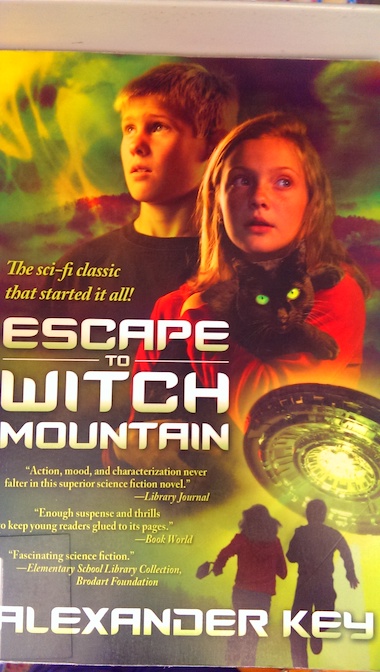
Escape to Witch Mountain by Alexander Key, 1968.

This is the book that the Disney movie of the same name was based on.  In fact, there have been three movie renditions of this book, although the 1975 Disney version is the one I know the best, and it’s the only film version to call the children by their original book names, Tia and Tony (other versions use the names Danny and Anna or Seth and Sara).  There are some major differences between the book and each of the the movies.  For one thing, most people in the book think that Tia is mute because she speaks at a frequency that ordinary humans can’t hear.  Only her brother, Tony, can hear what she’s saying.  She uses the little case with the double star emblem that she’s had ever since she can remember to carry paper and pencils so that she can write messages in order to make herself understood by other people.  In the 1975 movie, Tia can speak to Tony telepathically, but both children can speak aloud normally and be understood by everyone.

When the book begins, Tia and Tony know that they’ve always been different from other children.  They look different: they have olive skin, pale hair, and very dark blue eyes, which is a somewhat unusual combination. They can do things that others can’t: Tony can make things move with his mind, Tia can open locks without using a key or any other device, and only Tony can understand the strange way that Tia talks that others can’t even hear. They can’t remember any other home than the one they had with Granny Malone, the woman who adopted them, but now that she’s dead, they find themselves wondering who they really are and where they came from.  Tia has shadowy memories of a time before they came to Granny Malone, when they were on a boat and something bad happened to them, but she can’t quite remember what.

With no known relatives to go to, the children are taken to an orphanage, Hackett House, after Granny Malone’s death.  It’s a tough, inner-city environment, where no one has any patience with Tia and Tony’s strangeness.  However, when the children from the orphanage are sent to Heron Lake Camp in the mountains during the summer, a nun recognizes the double star symbol on Tia’s case as one that she had seen before on a letterhead, giving the children their first clue to finding their origins.

Then, a figure from one of Tia’s memories, Mr. Deranian, comes to the orphanage to claim them, saying that he’s their uncle. The children can tell that he’s no relative of theirs. They run away to see a kind priest, Father O’Day, an associate of the nun they met earlier. Father O’Day is the only one who believes the children when they talk about what they remember of their past and isn’t frightened by their strange mental powers. When the children show him a map that they found in a hidden compartment in Tia’s case, he offers to help them find the place marked on it and, hopefully, someone who knows who the children are and where they belong.

The book is currently available online through Internet Archive.  There is a sequel to this book which was also made into a movie, Return from Witch Mountain.
My Reaction and Spoilers

As the children and Father O’Day try to elude Deranian and the others who are chasing them, more of Tia’s memory returns. The children are from another planet. Years ago, their planet was destroyed when it crashed into one of their twin suns. Their people, who call themselves the Castaways, knowing that their planet would not be habitable for much longer, had already begun looking for a new home. Earth was the nearest habitable planet, so some scouts arrived early and began to create a home for them in the mountains of North America, which was the closest environment to their former home.

Unfortunately, when the rest of the children’s people came to Earth, the group that Tia and Tony were with crashed in Eastern Europe. The book was written during the Cold War, so the place where they crashed was controlled by Communists. When the Communists realized the powers these people possessed, they planned to make use of them themselves. One of Tia and Tony’s people escaped with the children and managed to get them aboard a ship heading for America. Before he died of a gunshot wound, he placed some money and a map in Tia’s case so that the children would know where to find the rest of their people. However, the children were traumatized by the experience, and Tia blocked the memory out of her mind. The ship’s captain, upon reaching the United States, gave the children to Deranian, a friend of his. Deranian, not knowing who the children were or what powers they possessed, gave them to Granny Malone to raise. Later, he found out about the children’s abilities from his contacts in Eastern Europe and tried to get the children back.

In the end, Father O’Day manages to reunite the children with the rest of their people, who take them to the community they have built on Witch Mountain, a place where locals are too superstitious to go, named for the odd things they’d seen there when the Castaways first arrived. Father O’Day plans to go there and join the community along with the children someday.

In spite of the Communists being enemies during the Cold War, Tia and Tony say that one of the reasons why their people had trouble establishing themselves in America at first was that they were unaccustomed to the idea of having to buy land to live on.  On their world, no one owned land; land was just there for people to live on and care for.  Their people’s early scouting expedition included selling pieces of their ships in order to raise enough money to buy some land in order to build their community.  Father O’Day is impressed with the Castaways’ commitment to the common good of all people and unselfish sharing.  So, although the oppressive Communist regimes of the Cold War are enemies in the book, some of the ideals of sharing and supporting the common welfare of everyone are still attractive ideals in the book.  The implication in the book is that Tia and Tony’s people are socially as well as technologically advanced and have created the best of all possible systems, a blending of ideals to create the ideal balance.

I can understand why the movies did not include Tia speaking at a frequency no one else can hear and appearing mute.  That would be difficult to show in a movie that relies on characters being able to communicate with each other, and it makes sense to replace it with an ability to communicate telepathically by choice instead.  None of the movies include the Cold War references that were present in the book, and the character of O’Day or the person who helps the children to reach Witch Mountain changes from movie to movie, but the plot of the 1975 Disney movie is still the closest to the original book.

Seven-Day Magic

SevenDayMagic

Seven-Day Magic by Edward Eager, 1962.

John and Susan are brother and sister, living in a perfectly ordinary town in Connecticut. They are tall, good-looking, and good in school and at sports, so they are generally popular and are often chosen for positions like class president. However, their home life is unusual because they are orphans who live with their grandmother, who sometimes requires them to look after her as much as she looks after them. Their grandmother isn’t very strong, but she is spirited and is sometimes tempted to do things that she probably shouldn’t do at her age, like climbing trees. Because John and Susan feel like they have to look after their grandmother, it’s sometimes difficult for them to get out and do some of the things that other children their age are doing, like going to parties. They’re glad when Barnaby and his sisters move to a house nearby because they make life more exciting.

SevenDayMagicChildren

Barnaby and his sisters, Abigail (called Abbie) and Fredericka, become friends with John and Susan. Their father is a singer in advertisements, and their mother is a realtor. Because their parents work a lot to make ends meet, the children are often left to their own devices.  Barnaby is opinionated, stubborn, and sometimes hot-tempered, which causes him to get into fights at school, but John likes him because he’s imaginative and full of interesting ideas.

Barnaby wants to be a writer. He’s secretly writing a story of his own, and he encourages the others to read more. Before meeting Barnaby, John hardly read anything at all, and Susan was mostly into the Sue Barton books, about a young woman who becomes a nurse (a real series that was popular in the mid-20th century, realistic fiction). Barnaby introduces them to a whole new world of fantasy stories, full of adventure. One day, while visiting the library together, the children talk about the kinds of stories that they like and wish that they could find a really good book full of magic and kids that are like themselves. Their wish comes true in a peculiar way.

On impulse, Susan checks out a rather worn-looking book with a red cover, not really knowing what it’s about but thinking that it just looked kind of interesting. The librarian seems a little uneasy when she takes it and warns her that she can only keep that particular book for seven days, which is surprising because that’s the limit usually imposed on new books, not old ones.

On the way home, the children show each other what they got and read parts of their books aloud to each other. When Susan opens the red book, they are all startled to find out that the book is about them. It starts out just like the real life book and tells about their lives and backgrounds and has their conversation about books they like, word-for-word. The children can tell that this is a magic book, but even while the idea is thrilling, it makes them uneasy. There is nothing written beyond their conversation about books, and the book won’t let them turn pages to see what might come next or how their story will end.

As much as the children like the idea of being the stars of their own magical book, it’s worrying. They don’t know what they’re in store for, and they even worry briefly that maybe their entire lives are fictional, that they might just exist in someone’s imagination, although they don’t really believe that because they can remember their lives before the story began. Barnaby points out that the book specifically mentions that he and his sisters recently moved to the area, but he remembers having lived elsewhere before that.

The children carefully consider everything they had originally wished for in a book: that children, just like themselves, would be walking home from somewhere and a magical adventure would start before they even realized that it was happening and that they would have to figure out the rules of the magic in order to use it for their own purposes. Since the first part of their wish has literally (very literally) come true, they decide that they’re going to have to figure out what the rules of this magic are before they decide what to do next. Since looking ahead in the book seems to be against the rules, they decide that they will have to be very careful about anything they wish for next because their wishes seem to be what writes the story, and they need to discuss it first and come to an agreement about it.

SevenDayMagicDragon

Unfortunately, little Fredericka (the youngest of the children) is too impatient for discussion and immediately wishes for an adventure with wizards, witches, and magic, and she wants it to start right away so that they’ll know that the magic is really working. A minute later, a dragon suddenly appears and scoops up Fredericka, flying away with her!

The others try to figure out where the dragon came from, and it turns out that a stage magician who lives nearby was practicing his act at the time that Fredericka made her wish. When she wished for a magical adventure, the rabbit that the magician was supposed to pull out of his hat turned out to be a dragon. The magician, The Great Oswaldo, is mystified, but he’s destined to play the part of Fredericka’s requested wizard. The children ask him to help them, and he says he’ll try, although he’s not sure how.

As Oswaldo tries various tricks in his magic supplies, they don’t work in the way they usually do. Finally, he is able to make his landlady’s house fly after the dragon, much to the landlady’s horror (she’s cast in the role of the witch in Fredericka’s story). In the magical land where the dragon lives, the peasants inform them that the dragon is always carrying off girls and young women to eat them, and they have to think of something fast before Fredericka becomes his next meal!

This is where the children discover that the contents of the magical book change depending on who reads it. When the magician reads it, it’s full of magic spells. When the landlady, Mrs. Funkhouser, takes it from him, it has household hints. For the dragon, it’s all about dragons. Surprisingly, it’s Mrs. Funkhouser’s household hints that save the day, although it’s Oswaldo who gets most of the credit because one of his pet cats eats the dragon after Mrs. Funkhouser shrinks it.

Oswaldo and Mrs. Funkhouser decide to stay in the magic land (which the children think might actually be Oz, in its early days), where they are hailed as heroes, sending the children home by themselves with the help of Mrs. Funkhouser’s vanishing cream. As expected, this adventure is now written in the magic book when the children have another look at it (although Fredericka argues that the illustrations don’t really do her justice).

SevenDayMagicCoin

Susan, as the borrower of the book, says that she wants their next adventure to be calmer, the kind of everyday magic that just creeps up on you. This is the part of the story where it crosses over with the events in Half Magic (another book in the same series as this one). In these children’s world, Half Magic is a fictional book that they’ve read and liked. Susan’s requested adventure picks up where Half Magic left off, explaining what happened after the other four children (Jane, Mark, Katharine, and Martha) left their magic coin to be discovered by a new owner. Susan and her friends delight in explaining to the young girl who found the coin what it does. The girl says that she had thought that the coin might be magic, but was confused because she didn’t get her wish to go into the future and meet some other children. Because the coin only grants wishes by halves (interpreting that pretty liberally), Susan and her friends (who live in the future), came to meet her instead.

Once again (as is common in this series), it leaves the matter of what is fiction and what is reality open to question. Was it the girl’s wish that brought the other children to her, or their wish that took them into her story? Or Both? Was that fantasy story secretly real, or are Susan and her friends more fictional than they like to think? The author likes posing questions like this, but of course, you never completely know the answers, and in some ways, it hardly matters because the adventure doesn’t require anyone’s understanding for them to take place, which is something that, ironically, it has in common with real life – things frequently happen regardless of whether or not you understand the reasons why. Sometimes, figuring out how things work and to deal with them is about all you can do, never getting the complete “why” behind everything.  That’s pretty much how all the stories in this series go.

After the children explain to the girl what the coin is and how it’s supposed to work, she makes a more careful, doubled wish to go to the future with the other children. Unfortunately, when they get there, she panics when she realizes that she forgot to bring her one-year-old baby brother with her and makes a hurried half-wish for him to be there, too.   Because she didn’t wish right, what she gets is her brother at the age he would be in the other children’s time (about age 37) but still mentally the baby he was back in 1924 (the girl’s time). The “baby” is amazed when he realizes that suddenly he can walk and talk much better than he could before and that he’s suddenly much bigger and stronger than he used to be. He gets hold of the coin and refuses to give it back, telling his little “big” sister that he can do what he wants now, not what she tells him to do. Noting that he can even pick her up and carry her around now, he does that, with the others chasing after him to get the charm and bring him under control. (A somewhat similar incident, where a baby grows up too fast and is dangerously immature, happens in E. Nesbit’s Five Children and It – another instance of Edward Eager playing off her books.)

It’s chaos for awhile because a 37-year-old man who acts like a 1-year-old can’t help but attract attention, especially when he gets it into his head that he wants to drive a train. Eventually, they get the “baby” back under control and to his proper age, allowing his sister to take him back to their own time and plan her future adventures with the coin.

Then, Susan and John’s grandmother gets hold of the book, and it takes her and her grandchildren back in time, to when the grandmother was a young woman working as a prairie schoolteacher. Susan makes a wish for the other children to join them, and they help their grandmother and her students to survive a sudden blizzard. They come to appreciate their grandmother’s youthful personality and formidable spirit even more from the experience. They even get to meet their grandfather, who died before they were born, seeing him rescue their grandmother and her students when he was a young man.

SevenDayMagicPlaywright

Then, Abbie decides that she wants to try to help her father’s singing career. He typically has to work long hours and never makes very much money, just being part of the chorus on advertisements. She thinks things will be so much better if they can help him to be discovered as a great talent. The others are kind of doubtful about her plan because the book seems to send them on rather “bookish” adventures, related to other stories they’ve read or people’s memories, like in their grandmother’s case because her early life actually did somewhat resemble things from the Little House on the Prairie series (a series which the grandmother enjoys reading for that reason). The other children just don’t know what would happen if Abbie tries to use the book for something more modern and everyday, like their father’s career. She tries it anyway, with some unpredictable results.

During a recording at a television studio (which the children are present to witness), the magic makes their father sing wonderfully but he also does his singing part out of sync with the other singers. He’s sure that he is singing his part at the right time, but for some reason, the other members of the chorus are silent when he sings. The director gets mad at him for singing out of sync and messing up the performance, and the singer who was supposed to be the star gets mad about being upstaged, but the reviewers end up loving the performance. So, while at first it looks like the father is going to be fired, he ends up with more singing parts because of the episode. The only problem is that all the singing parts are silly jingles, like the typical advertising jingles he gets. While he’d welcome more money, he always dreamed of being able to get better parts. However, the magic isn’t quite done, yet. When Abbie meets a playwright who is looking for a new talent to sing in his play, it turns out that he has seen Abbie’s father on tv and likes his voice.

SevenDayMagicWings

Abbie’s wish is so great and does so much for their family that the kids start thinking that it might be the end of the magic. The seven days are really up, and the book has to go back to the library the next day. However, John and Barnaby haven’t had their chance to wish yet, and each of them wants to have a turn before the book goes back. Barnaby even suggests that perhaps they can keep the book an extra day, turning it in late. Surely a little late fee isn’t too much to ask for an extra day of magic, is it? Abbie is afraid, though, that keeping the book overdue would be breaking the rules and that the magic might go all wrong. She’s right.

Even with the idea of keeping the book for extra time, John and Barnaby argue over which of them will get to go first. The book’s magic, angry about not being returned to the library, turns sour on them, causing them to fight. John angrily tells Barnaby that just because he’s usually the group’s idea man doesn’t mean that he’s the only one who’s allowed to have ideas. (Which, in a way, is something that Barnaby needs to hear because that’s part of the reason why he often gets into fights – he always thinks he knows best.) John and Barnaby fight over the book, and the book gets torn. John ends up with a few pages, and Barnaby gets most of the book, which he uses to make a wish that he refuses to tell to the others. Barnaby disappears, and the others realize that the pages that Barnaby is holding are the last few pages from the end of the book, still blank. Without them, the book can’t end, and Barnaby could end up stuck in the book forever! Can the others find him and get him (and the book) back before it’s too late?

Before the end of the book, John does prove that, although he might not be as quick to come up with ideas as Barnaby is, he does get good ones. After he and the others find Barnaby, John uses his wish to get them back home and to return the book to the library in a most unusual way.  (Actually two unusual ways because he couldn’t quite make up his mind about which was best.  Both of them are homages to incidents in E. Nesbit’s books.)

The book is currently available online through Internet Archive.

Mystery Behind Dark Windows

MysteryDarkWindowsMystery Behind Dark Windows by Mary C. Jane, 1962.
Recent years have brought misfortune to the formerly wealthy Pride family.  First, Tony and Ellie’s father was killed while on a business trip on behalf of the family’s mill.  Then, the workers in the mill went on strike, and the children’s grandfather died.  Their Aunt Rachel blames the strikers for putting stress on her father while he was still grieving for his son, thereby causing his death.  Because of that and because she doesn’t believe that she can handle the running of the mill herself, she has closed down the mill, putting all of the workers out of a job.

The townspeople of Darkwater Falls struggle to get by without the mill and are angry with the remaining members of the Pride family for the lay-offs, but Aunt Rachel thinks that their suffering is earned and so does nothing to help.  If Aunt Rachel would be willing to sell the mill to someone who would put it back into good use and employ people, the community’s problems would be solved, but Aunt Rachel can’t bring herself to do that, in spite of the offers she’s received and the urging of the family lawyer, Mr. Ralph Joslin.  She has high hopes that Tony might revive the mill one day when he’s grown up, and in the meantime, she wants to punish the strikers with unemployment and underemployment.  However, Aunt Rachel, absorbed in her personal pride and bad feelings, is ignoring some serious issues.  The taxes on the disused mill are costing the family dearly, the equipment is rusting, and Tony isn’t even sure that he wants to go into the family business.  Tony and Ellie are unhappy with their family’s situation, their aunt’s bitterness, and the way many of the townspeople now look at them, but they’re not sure what to do about it.

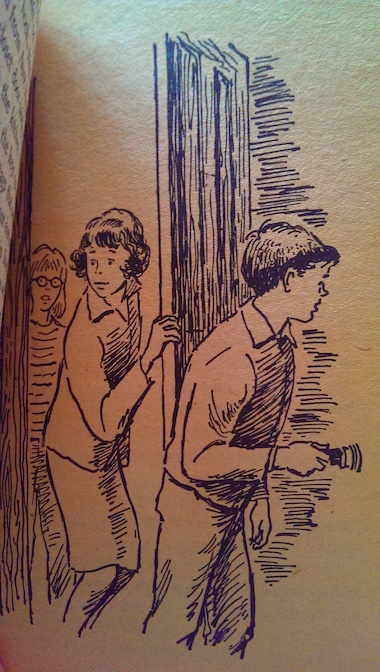
MysteryDarkWindowsMillSearchThen, one night, Ellie goes out to look for her aunt’s missing cat and hears someone in the old, supposedly empty mill.  When she tries to tell Tony, he doesn’t take her seriously, but Ellie knows what she heard.  Ellie later goes back to the mill to take another look at the place, and she sees Jeff, a boy from Tony’s high school, hanging around.  Later, she confides what she’s heard and seen in Hank, an old friend who lives on the other side of the river, and Violet, another girl from her class whose family has suffered since the closure of the mill.  The two of them start helping Ellie to investigate.

Some people in town have become concerned about children in the area getting into trouble, and they think that maybe some of the local youths have formed a gang.  Ellie worries about Tony, who has started sneaking out of the house at night to hang out with friends.  Is he now part of a gang?  Are he and his friends the ones who were sneaking around the old mill? Or could it be some of the disgruntled townsfolk, bitter about the mill remaining empty and not providing much-needed jobs?

While the kids have a look inside the mill, they discover that someone has been using the place as a hideout.  A fire at the mill reveals a number of secrets and sheds light on a town and a family caught in a cycle of bitter feelings and revenge.  Aunt Rachel is stunned when some of the townspeople accuse her of setting the fire herself in order to get insurance money for the mill.  The fire was clearly arson, and since Aunt Rachel has gone out of her way to make life difficult for people in town, many of them would be ready to believe just about anything of her.  It’s up to the young people to put the pieces together and reveal the true arsonist before the mill, the town, and the Pride family are completely destroyed.

Many of Aunt Rachel’s decisions are guided by a mixture of grief and anger, but she is also stubborn and prideful.  The Pride family was aptly named.  Although they have suffered misfortune, their privileged position as the (former) main employer of the community has given Aunt Rachel the sense that she and others in her family could do no wrong.  Aunt Rachel is absorbed in herself, her own feelings (which she places above others), and the past to the point where she feels justified in deliberately causing harm to her community and the people in it, failing to see the consequences of her actions, even the effects that her attitude has on the orphaned young niece and nephew in her charge.  Ellie feels like they don’t have a real family because her aunt’s bitter feelings prevent her and her brother from getting close to their aunt.  Her aunt’s actions have also made it difficult for her and Tony to get along well with other members of the community, further isolating them from comfort in their own grief.

In a way, the fire brings Aunt Rachel back to reality, forcing her to see the consequences of her actions (and inaction).  It comes as something of a shock to her that, while she felt fully justified in her bad feelings for the town, they are also fully justified in feeling badly about her.  Somehow, it never occurred to her how someone, doing the things she’s been doing and saying the things she’s been saying, would look to the people she deliberately set out to hurt.  For most of the story, the only feelings that were real to Aunt Rachel were her own.  Even when she thought about how people hated her, she didn’t think that what they thought would matter until she began to see how it was affecting Ellie and Tony as well as the other children in town.  Ellie can see that many things would have been resolved sooner if both her aunt and her brother could open up and discuss things honestly, both within the family and with other people.  Although neither of them set the fire, their secretiveness and self-absorption at first create the impression that they did.  Ellie’s eventual outburst at her aunt and the real guilty person force both of them to acknowledge the reality of their actions and motives.

I was somewhat fascinated by the motives of the arsonist, who understands the effects that Aunt Rachel’s bitterness and revenge have been having on the young people in town, even her own nephew, better than she does.  This person was wrong in the path he tried to take to fix the situation, but he does correctly see that unemployed men not only lack the money they need to properly take care of their families but may also set a bad example for boys and young men, either through the habits and attitudes that they let themselves fall into or by becoming too absorbed in their difficulties to see what’s happening to their own children.  I also agree with his assertion that those responsible for putting people out of their jobs bear some responsibility for the results of their actions, something which resonates in today’s economy, where many people are still unemployed or underemployed.  The Pride family’s previous high standing in the community was directly because of their ability to employ people and improve the lives of others.  When they began making life hard for others and refused to use their ability to help people, they lost that standing.  Aunt Rachel was just the last to realize it, which was part of the reason why she was surprised to discover just how badly the town thought of her.  She didn’t have a good reputation because she had done nothing to earn one, no matter what her family used to do.  She was no longer using their powers for good, so she turned herself into a villain.  However, it’s important to point out that the arsonist isn’t really in the right himself because, as Ellie points out, the spirit behind his actions isn’t much different from her aunt’s.

Ellie is correct in pointing out that both her aunt and the arsonist were wrong, not just because of what they did, but because of the feelings and motives behind it.  In their own way, each of them set out to deliberately hurt others because they had each been hurt.  Which of them was hurt first or hurt worse ultimately doesn’t matter.  Their mutual desire for vengeance against each other not only hurt the people around them but kept each of them from doing what they needed to do in order to heal their own wounds.  That is also a message that resonates today, in these times of political division, with two large parts of society trying to one-up each other and even actively harm one another, largely because they can’t stand the idea of someone wanting something or believing something that they don’t.  Whatever the circumstances, when people focus on winning on their own terms, no matter what the cost, everyone loses in the end.

Toward the end of the story, as Aunt Rachel and the arsonist begin making grudging apologies to one another and reluctant steps to fix things, Ellie decides that grudging and reluctant aren’t good enough and finally gets up the nerve to tell them what she really thinks, what they most need to hear:

“Just selling the mill won’t make things better . . . It’s the way [they] feel about it that’s wrong. That’s what made them act the way they did in the first place. They just wanted to get even with people, and hurt people, because they’d been hurt themselves. And they feel the same way still. You can see they do.”

How much can people help what they feel? It partly depends on what people choose to do about their feelings.  Actions guide feelings, and feelings guide actions.  Aunt Rachel and the arsonist indulged their bad feelings, nursing them, amplifying them, and making them their first priorities, the guiding force of their actions.  As long as they keep doing that, Ellie knows that the problems aren’t really over, and everyone will remain trapped in this bad cycle.  Ellie’s honest outburst finally breaks through to both of them, showing them what they really look like to others and making them reconsider their feelings and priorities.

One of my favorite characters in this story was Mr. Joslin, the lawyer.  Although he looks a little suspicious himself for a time, he is actually a good man, who looks after the family’s interests and genuinely cares about them as well as about the town.  He is the one who convinces Tony to be honest with his aunt about the friends he hangs out with and helps persuade Aunt Rachel to see things from others’ point of view.  He loves Aunt Rachel, in spite of her faults, and is honest with her about those faults, telling her what she needs to hear.  Of all the characters, with the exception of Ellie, he seems to have the most insight into other people’s feelings and situations.  He supports what Ellie says, quoting Lord Bacon, “A man who studieth revenge keeps his own wounds green, which otherwise would heal and do well.”