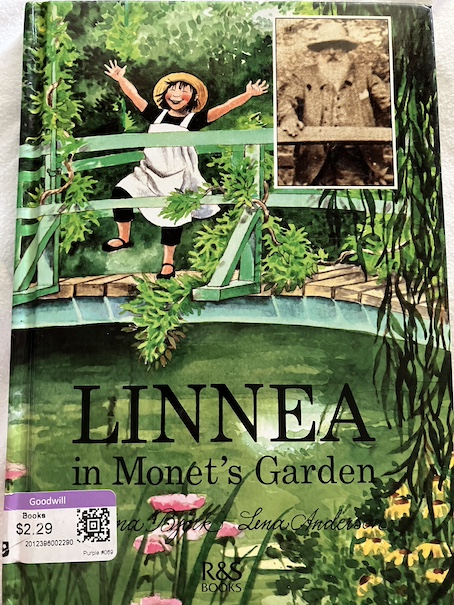
Linnea in Monet’s Garden by Christina Bjork, drawings by Lena Anderson, 1985, 1987.
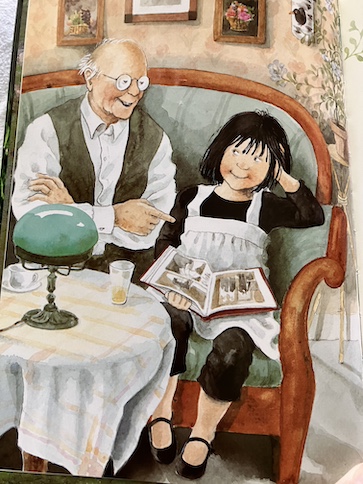
Young Linnea loves plants and flowers. Linnea’s upstairs neighbor, Mr. Bloom, used to be a gardener before he retired. He knows all about plants, and she likes to talk to him about them. Mr. Bloom has a particular book that Linnea likes about the French artist Claude Monet and his garden. Monet was famous for his paintings of the flowers and water lilies in his garden, and the book also has photographs of him, his wife, their children, and their garden. When Linnea looks at that book, she likes to imagine that she really knows the Monet family and that she’s visiting their garden.
One day, Mr. Bloom tells her that it’s possible to really go visit the garden because it still exists. Monet’s house had become run down and the garden was overgrown, but they have since been restored and turned into a museum. They could visit the garden if they go to Paris. They live a long way from Paris, but Mr. Bloom arranges with Linnea’s family for her to go on the trip with him.
Linnea and Mr. Bloom stay at a tiny, old hotel on the River Seine in Paris that was built in 1640. They can see the Notre-Dame Cathedral from the hotel, and it reminds Linnea of The Hunchback of Notre-Dame.

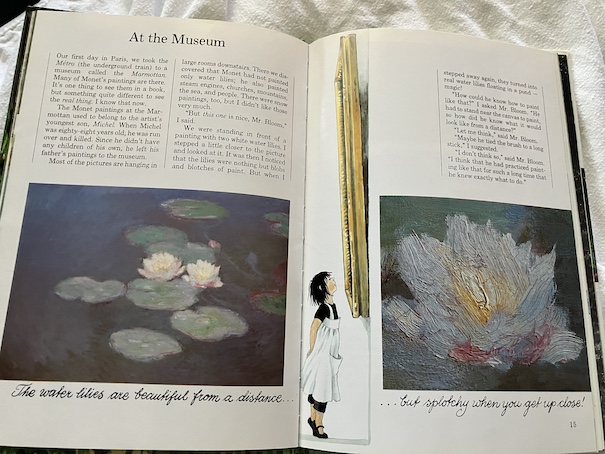
On their first day in Paris, Linnea and Mr. Bloom go to the Marmottan Museum to see Monet’s paintings. Monet’s youngest son left his father’s paintings to the museum when he died because he had no children of his own to inherit them. Mr. Bloom explains to Linnea that Monet painted in the impressionist style, which means that he tried to capture the rough images and impressions of the moment rather than creating detailed, completely realistic paintings. (I’m nearsighted, so impressionist paintings always look to me like what I see when I’m not wearing my glasses. I see colors and rough shapes, but everything is fuzzy with no sharp lines or fine details. I can still tell what objects are without my glasses, but nothing is distinct. I have impressions of things.) Mr. Bloom says that Monet particularly liked to show how light reflects off water and other objects in his paintings.
The next day, they take a train to the town of Vernon, and from there, and from there, they take a taxi to Giverny, where the Monet house and garden are. Along the way, they also buy some food for a picnic. Then, they go to see Monet’s garden.

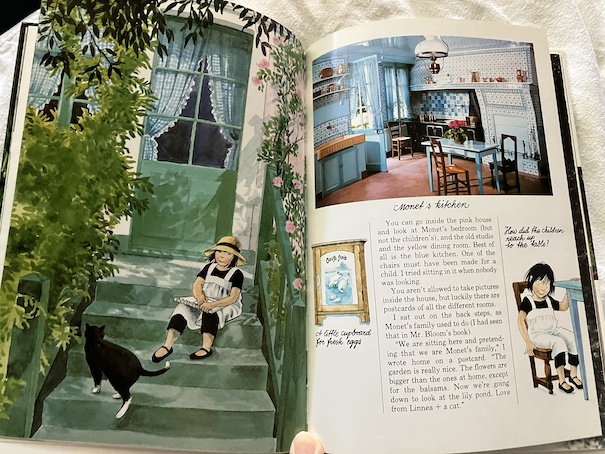
When Linnea sees the garden in person for the first time, it’s much bigger than she had imagined from the pictures in the book. Mr. Bloom tells Linnea all the names of the different flowers, and they take pictures of them. Then, they go inside Monet’s house. They’re not allowed to take pictures inside the house, but they get some postcards of the house’s interior.
One of the best moments for Linnea is that she is able to stand on the Japanese bridge in the garden, over the lily pond, as she always imagined she could do when she looked at the pictures in Mr. Bloom’s book! Monet painted pictures of that bridge multiple times. Each painting looks different because he painted them at different times and in different weather, so had different impressions of the bridge each time. The book shows Monet’s paintings of the bridge and how different they are from each other, and Linnea tries to capture her own impressions of the bridge.
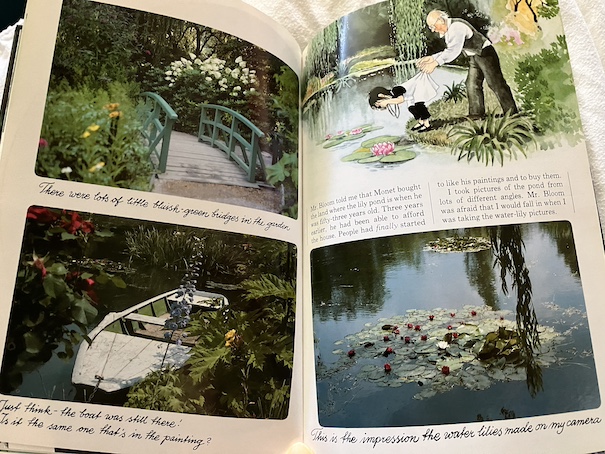
They aren’t allowed to have their picnic lunch inside Monet’s garden, so they have lunch by the nearby river. Then, they return to Paris.

Back in Paris, they visit the Jeu de Paume museum to see more impressionist paintings. At the Orangerie, they try to see Monet’s giant water lily painting in the Water Lily Rooms. At first, they are told that the exhibit is closed for repairs, but when Mr. Bloom explains that they have come a long way to see them and Linnea starts to cry, the museum staff decide to make an exception.
For the last day of their trip, Linnea and Mr. Bloom decide that they want to return to Giverny. When they make their second visit, a man recognizes them as return visitors, and he turns out to be a member of Monet’s family, his step-great-grandson, Jean-Marie Toulgouat. He lives nearby, and he is also an artist, although his art style is very different from Monet’s. He talks to them about Monet’s life and family, and it also turns out that his wife was the author of the book about Monet that inspired Linnea and Mr. Bloom to take this journey!
When they return home, Linnea and Mr. Bloom go through all the pictures they took in France, and Linnea puts up a bulletin board with postcards and pictures from their trip. She also has a little wooden box with other souvenirs.

In the back of the book, there is a family tree for the Monet family and a timeline of events from Monet’s life. There is also a section of information about museums and sites in Paris and a list of books about Monet.
The book is available to borrow and read for free online through Internet Archive (multiple copies, including one in Chinese). The book was originally written in Swedish and published in Sweden in 1985. The English translation was published in 1987.
My Reaction
This is a lovely book about travel, art, and the beauty of nature and plants. Initially, Linnea becomes interested in Monet because of her love of plants and flowers, and when her neighbor says it’s possible to visit the garden Monet painted, she becomes interested in Monet’s life and work. I grew up learning about art and famous artists because my mother used to teach art lessons through a special program at my school. I don’t remember seeing this book at that time, although it is old enough that I could have. I found it by accident at a thrift store, and it reminded me of the art books that my mother kept around the house when I was a kid.
I enjoyed how the book brought a historical person to life, explaining Monet’s life story as well as his art and showing child readers that it’s possible to see the setting of his paintings in person. The book shows pictures of Monet’s art and photographs of the garden and flowers he painted so children can see the connection between the artwork and the real places and objects. Although not everyone can go to France just on a whim, the book does show what such a trip would be like, and it also shows kids how they can delve deeper into subjects that interest them and even go to places connected with their passions. The journey in the book is a magical trip that even adult armchair travelers can enjoy!


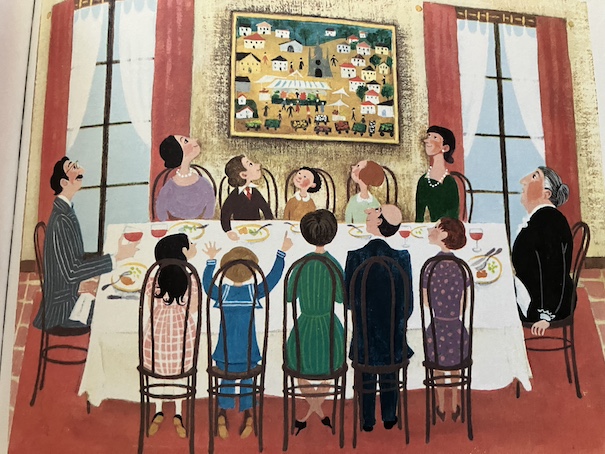


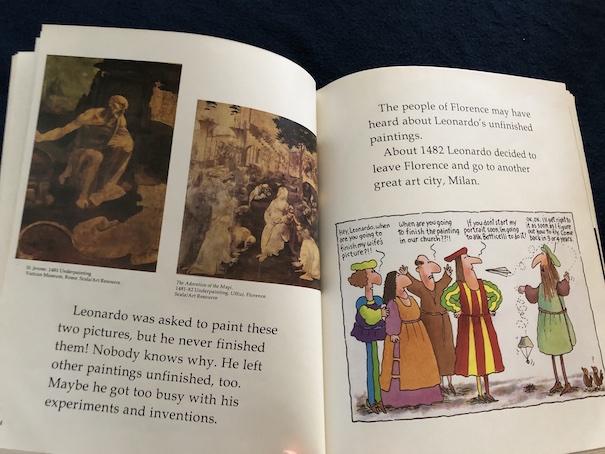
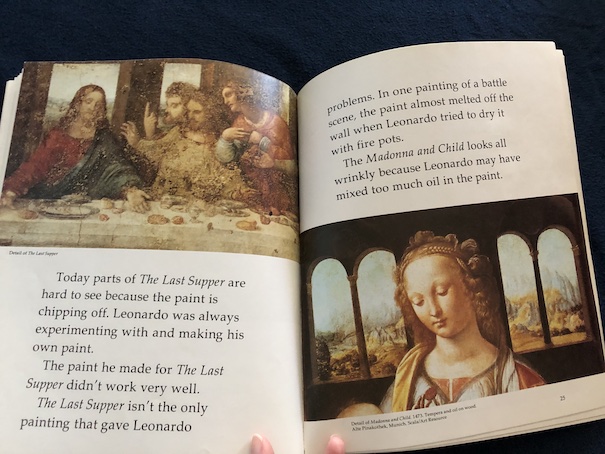











 Mystery Back of the Mountain by Mary C. Jane, 1960.
 When they get to Maine, they meet Uncle James’s lawyer, Mr. Palmer, to collect the key to the house. Mr. Palmer tells them that the house has a few items in it that could be considered valuable antiques, including a portrait of the woman that Uncle James had wanted to marry, Drusilla Randall. The children’s father asks Mr. Palmer more about Drusilla Randall, and he says that all he knows is that she had an argument with Uncle James and then disappeared. He thinks that she just left town, although he says that there are rumors that Uncle James may have murdered her. Mr. Palmer thinks that the rumors are ridiculous and doesn’t take them seriously, but Stevie and Anne are disturbed at the idea that their relative may have been a murderer, or that people thought he was. Mr. Palmer also mentions that Drusilla’s sister, Marion, has decided to return to her family’s old house for the summer as well, so she’ll be living close to their farm.
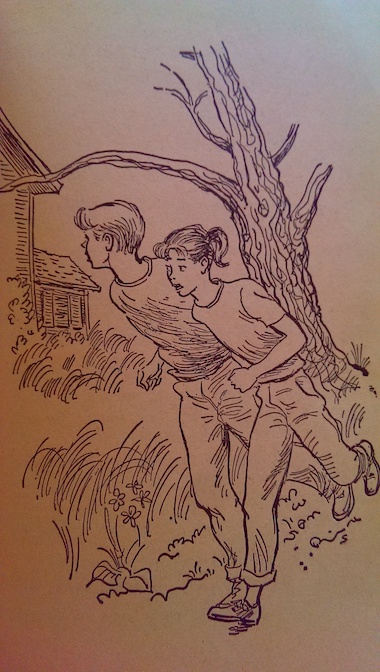 The house is certainly an isolated place, and their closest neighbors, the Hodges have an old grudge against Uncle James. The unethical business deal that Uncle James did years ago involved buying some of the Hodges’s family’s best land. Bert Hodges, who was young at the time, says that the deal ruined his father’s life, and it’s making his miserable, too, because he really needs that land to make his farm profitable. Anne hears this from Bert’s young niece, Oleva, an orphan who has come to live with her aunt and uncle. Although Uncle Bert is strict with her and somewhat bitter about the past and the family’s circumstances, Oleva likes her aunt and uncle and wishes they would adopt her, giving her the stable home she’s longed for since her parents died and she began being traded around among her relatives. However, Bert doesn’t have much faith in other people, and even though he likes his young niece, is afraid to commit to adopting her.
 Anne feels badly that Uncle James’s land deal seems to have ruined people’s lives. Oleva also tells her something disturbing about Drusilla, the girl that Uncle James loved. They were supposed to be married when Drusilla turned twenty, but she disappeared before that happened, and most people think that she drowned in the natural pool on Uncle James’s property. It’s deeper than it appears at first, and some things belonging to her were found nearby, so everyone thinks that she probably drowned and that her body is still somewhere at the bottom of the pool. Whether her death was an accident, suicide, or murder is still unknown.
 Mystery on Nine-Mile Marsh by Mary C. Jane, 1967.
 Lucille and Brent take a bike ride out to the island, but a noise in the barn frightens them away. It isn’t that they really think there’s a ghost, but they’re concerned that someone may be trespassing on the property. They decide to keep an eye on the house to see if they can see anyone sneaking around, but they don’t.
 Mr. Linsday has also heard strange noises around the Moody house, and he asks the children what they know about it. They tell him the ghost stories about the Moody place, but they say that they don’t really believe that there’s a ghost. Mr. Lindsay is fascinated by the stories. He says that his impression was that the noises he heard came from the cellar, but he didn’t see anything when he investigated. He invites the children to help him investigate further sometime.
 Barbara’s father owns a clothing store in town, and she says that some of his customers have been saying bad things about Mr. Lindsay. Some of them have even said that he might be a spy. Lucille thinks that’s ridiculous and that they’re only saying things because they wanted to buy the property or see it go to Clyde. Lucille has to admit that she doesn’t know much about Mr. Lindsay, so she can’t swear that the rumors aren’t true, but she still thinks that he’s probably just a nice guy, and she wants to see him keep the house so that Pedro will have a safe place to live.
 A Ghost in the House by Betty Ren Wright, 1991.
 Mystery on Taboga Island by Patricia Maloney Markun, 1995.
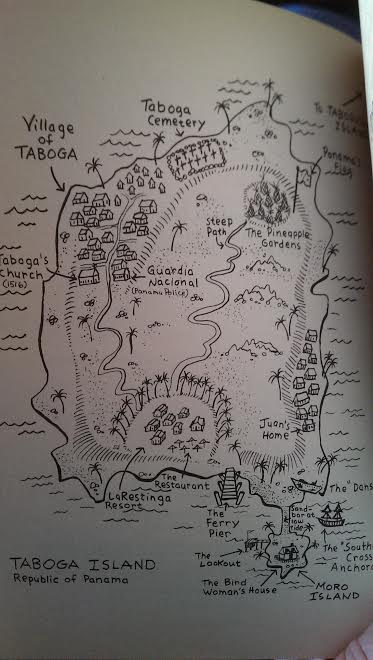 They also introduce Amy to Madame Odelle, who people call The Bird Woman because of all the birds she keeps around her house. She is a widow who lives alone and hardly ever sees people, but she invites the children in and when she learns that Amy is interested in art, she shows them a special painting that her family has had for generations. Madame says that her grandfather bought the painting years ago from a traveling Frenchman who was in need of money. Amy thinks that it looks like one of Paul Gauguin’s paintings, and she knows that some of his work is unaccounted for. However, the initials on the painting are PGO. What could the ‘O’ stand for?
 Jestress's Forgotten Books and Stories