Famous French Painters by Roland J. McKinney, 1960.
This book is part of a series of Famous Biographies for Young People. Reading older non-fiction books can be problematic because non-fiction books are often updated with new information. In this particular book, there are people who are described as being still alive because they were at the time of the book’s publication, but they are not alive anymore. However, older non-fiction books sometimes interest me both because they are an indication of what people knew and studied at the time of publication and they sometimes cover odd topics that don’t commonly appear in new books. So far, this is the only book I own from this particular series, but the other biographies in the series
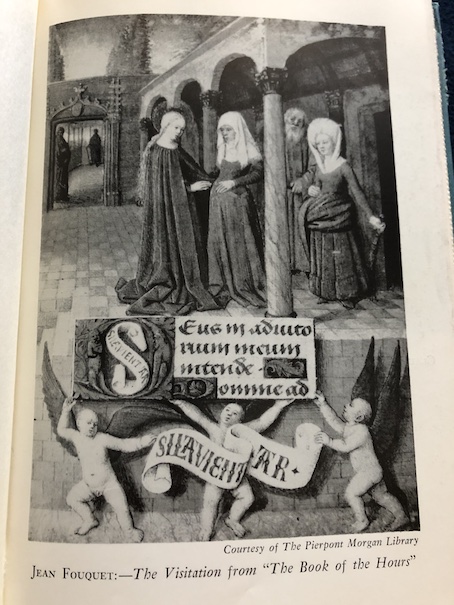
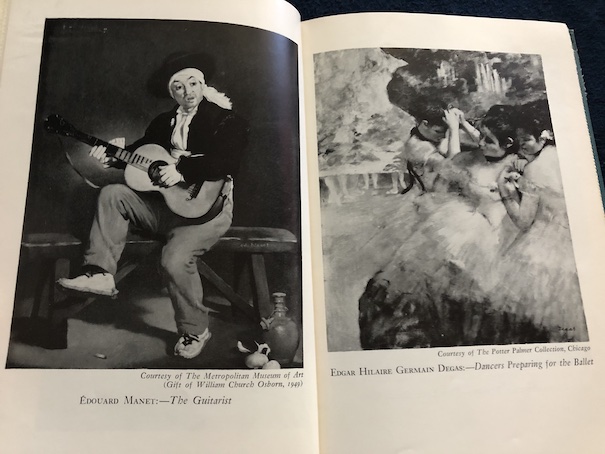
It begins with a section of black-and-white prints of famous French paintings and an introduction to the history of French painting in general. The introduction begins with a discussion of illuminated manuscripts in the 15th century and the artistic and architectural endeavors promoted by King Francis I in the 16th century. Francis I was particularly fascinated by Italian art, and he hired artists of the Italian Renaissance, including Leonardo da Vinci, to work at his court. Francis I helped to fuel an increasing interest in the arts in France called the French Renaissance. Although the French Renaissance was initially heavily influenced by the Italian Renaissance, French artists continued to develop their own styles. Popular subjects in French art were portraits, realistic landscapes, scenes from Classical mythology, and religious themes. The introduction ends with artists who painted during the late 18th century and early 19th century, explaining how their departure from neoclassical styles led to the development of new art styles.
After the introduction, there is a series of short biographies of famous French artists, beginning in the early 19th century and leading into the early 20th century. One of the first things that struck me about the list of artists included in the book is that, when their birth and death dates are included, none of the artists were born later than the 1880s, and the last two in the book have no death dates listed. Since the book was published in 1960, those last two artists were still alive at the time of publication, although they have died since then.
The artists included in the book are:
Eugene Delacroix (1798-1863) – He was a leader in the Romantic style of painting and one of the first French artists to use watercolor paints, which the French learned from English artists.
J. B. (Jean Baptiste) Camille Corot (1796-1875) – Originally, he trained in business, but he didn’t think he was suited to business and decided that his future was in art. He was particularly known for his landscapes, which were his specialty. He was also known as a charitable benefactor.
Edouard Manet (1832-1883) – Manet’s parents originally wanted him to become a lawyer, but it soon became apparent that he did not have the interest or temperament for a law career. When he first began his art studies, he quarreled with his teacher over the teacher’s strict insistence on realism in art because Manet preferred a more creative form of expression. He eventually developed a more simplified realistic style that did not focus on small details, a style that contributed to the development of impressionism.
Edgar Hilaire Germain Degas (1834-1917) – His specialty was portraits, and following the lessons that his teacher impressed on him, he emphasizes the importance of lines and drawing in his work. Much of his work was in oil paint, but he switched to pastels because he found that it was easier to work with and less of a strain on his eyes. Some of his best known works were of ballet dancers.
Paul Cezanne (1839-1906) – He initially doubted his own artistic talents, but a fellow painter, Pissarro, advised him to stop trying to imitate others and put his focus on studying nature. Cezanne’s association with Pissarro helped him to develop his own style.
Pierre Auguste Renoir (1841-1919) – Early in his life, Renoir was known for his singing ability, but his parents insisted that he learn a trade. He started learning how to decorate china, but this was the era when factories began using machines to decorate china. For a time, Renoir decorated fans and window shades, but his focus on improving his drawing abilities led him to a career in art. He became a friend of Monet, and the two would discuss art techniques with each other, although they had different styles.
Vincent van Gogh (1853-1890) – He was originally from the Netherlands but lived in France. He was a contemporary of Gauguin, and the two were even friends. Unfortunately, van Gogh was plagued by mental illness, leading to the fit where he cut off part of his ear after an argument sparked by ridicule from Gauguin. Eventually, he committed suicide. He was not a famous artist during his lifetime, partly due to his mental illness and early death, but his work became famous after his death.
Paul Gauguin (1848-1903) – Although he was originally from France, Gauguin is known for his travels to islands in the South Pacific, where he eventually died. Much of his work was inspired by his travels in the South Pacific.
Henri Matisse (1869-1954) – He was a leading figure in a group of artists known as the fauves, which mean “wild beasts.” They painted in an unorthodox way that included few details and ignored perspective.
Pablo Picasso (1881- ) – Picasso was originally from Spain, but he lived in France for most of his adult life. He began studying art at a young age and is known for his work in surrealism and cubism. He was alive at the time this book was written, but he died in 1973.
(Odd fact not included in the book – Picasso was actually born one day before the shootout at the OK Corral in Tombstone, AZ. It doesn’t mean anything and isn’t important, but I noticed the date and just thought I’d tell you.)
Georges Braque (1882- ) – Braque was a contemporary of Picasso, and the two artists were instrumental in the development of cubism, although they each did their own work. The collaboration between the two artists was interrupted by the outbreak of WWI. Braque was alive at the time this book was written, but he passed away in 1963. On the subject of limitations in art, he once said, “Progress in art does not lie in extending its limits, but in knowing them better.”
Something that struck me was how much artists who were contemporaries of each other worked together, met to discuss and analyze each other’s art, and were actual friends. I prefer collaboration to competition, and I like that many of these artists seemed to appreciate and learn from each other’s skills and techniques.
I was also surprised at the number of artists whose parents initially wanted them to become lawyers, like Manet, Degas, Cezanne, and Matisse.
The book is available to borrow and read for free online through Internet Archive.





 Jestress's Forgotten Books and Stories