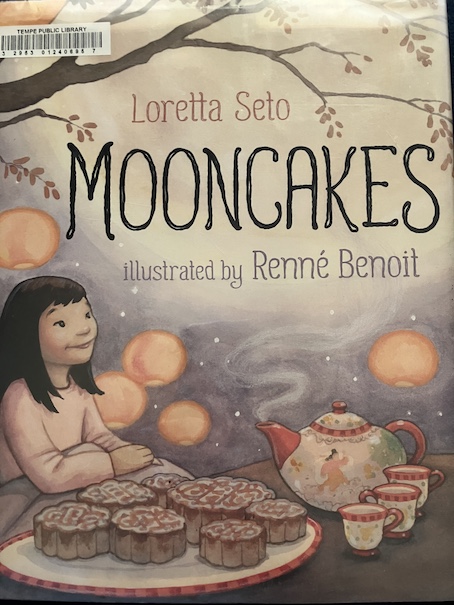
Mooncakes by Loretta Seto, illustrated by Renne Benoit, 2013.
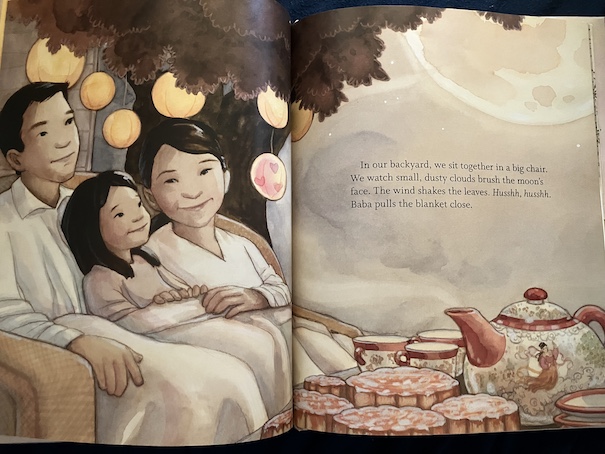
A young girl is excited because tonight is special, and she will be allowed to stay up late and eat mooncakes with her parents for the Chinese Moon Festival. They decorate with paper lanterns, and they spend the evening looking at the night sky from their backyard.
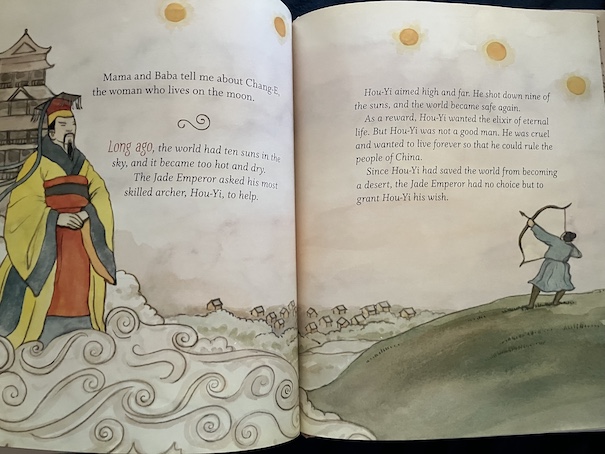
Her parents, called Mama and Baba, tell her stories from Chinese legends. The book includes the stories they tell, like the story of Chang-E (who was a woman who escaped from her cruel husband with the elixir of life and now lives in the Jade Palace on the moon), the story of the woodcutter Wu-Gang (who chops wood forever on the moon in his quest for eternal life), and the story of the Jade Rabbit (who lives on the moon with three magicians and brings food to people who need it).
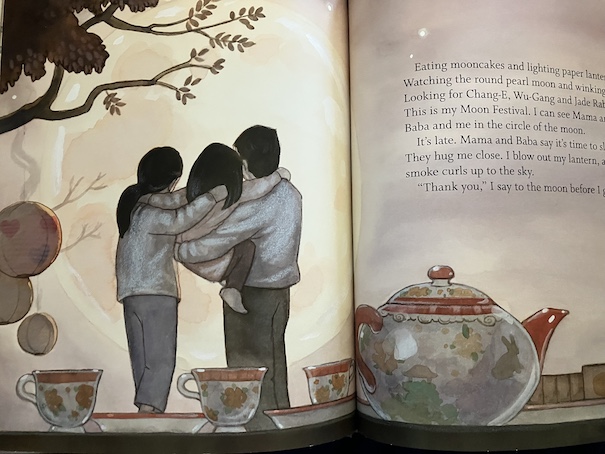
As they tell stories, the girl and her parents drink tea and eat mooncakes. The girl tries to look for the characters that they talk about on the moon until it’s time for bed.
There’s an Author’s Note in the back of the book that explains a little more about the Chinese Moon Festival. It’s a harvest festival that takes place in the eighth month of the lunar calendar. It also honors family, and even family members who can’t be together will remember that the rest of their family is looking at the same moon, no matter where they are.
My Reaction
I know that I’m presenting this story out of season because the Chinese Moon Festival is in autumn. Because it’s based on the lunar calendar, it sometimes happens in September and sometimes in October. I did my review at this time of year because it fit best with my blog’s schedule.
I enjoyed experiencing this lovely festival through the eyes of a young girl, having a gentle celebration with her parents. It’s an idyllic evening of cozy story-telling, and I really enjoyed the three folktales introduced in the book! I enjoy folk tales from different countries, and I liked these brief stories. I think this book would make a good beginning introduction to Chinese folklore for young children.
The focus of the story and the pictures in the book alternate between the stories the parents tell and the girl and her parents as they enjoy their evening together. I think this would make a great bedtime story.
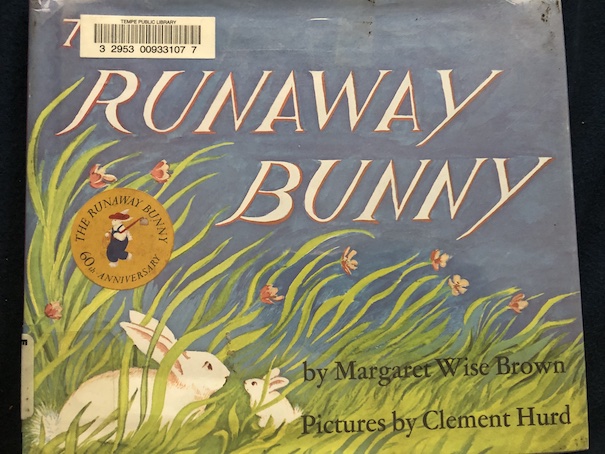
The Runaway Bunny by Margaret Wise Brown, pictures by Clement Hurd, 1942.
A little bunny tells his mother that he’s thinking about running away, but his mother assures him that, no matter where he goes or what he does, she would always come after him because he’s her little bunny, and she loves him.
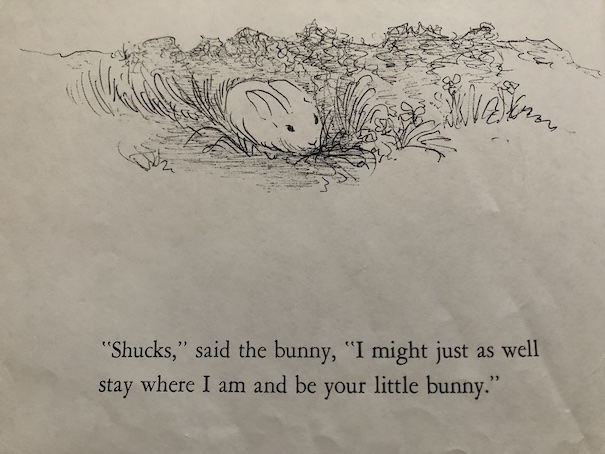
The pictures where the little bunny talks about all of his ideas for running away and evading his mother and where his mother explains what she would do to follow him are in black-and-white.
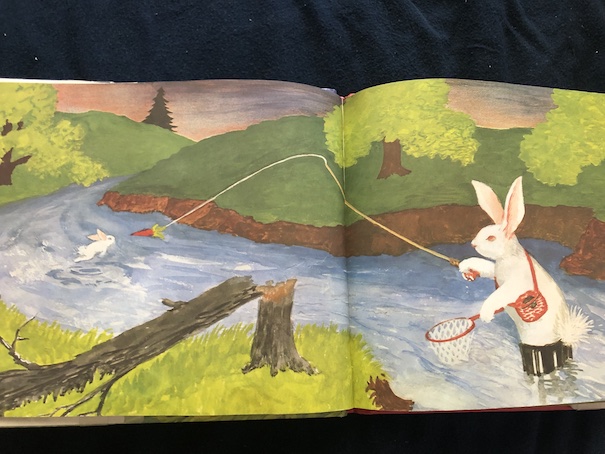
However, there are large, full color pictures after each of these sections showing what would happen as the mother follows her little bunny.
The little bunny’s plans for running away become increasingly imaginative and outlandish, from going up a mountain and joining the circus to transforming himself into a fish, a bird, or a sailboat.
No matter what the little bunny thinks of for running away and changing himself into something else, his mother assures him that she would find a way to come after him and be there for him. In the end, the little bunny decides that he might as well stay with his mother, just as they are.
The book is available to borrow and read for free online through Internet Archive (multiple copies).
My Reaction
This is a very well-known and much-loved book about parental love and the lengths that parents will go for their children. The mother bunny is determined to be there for her child, even when the child wants to run away. We don’t know why the little bunny was talking about running away from his mother, and without that, it seems just like the little bunny was just trying to provoke his mother to find out how much his mother loves him. When she tells him all the things she would do to reach him if he ran away, he seems reassured and content to remain her little bunny.
This book was originally published during WWII and is a calm and reassuring story that probably comforted many children living through unsettling times. It has never been out of print since its original publication.
The author and illustrator of this book also later wrote and illustrated Goodnight Moon. The scene where the little bunny imagines himself as a boy in a house and his mother says that she would still be his mother reminds me of the illustrations in that book, and I wonder if the mother and child rabbits in that book came from this one.
The Mystery in the Snow by Gertrude Chandler Warner, 1992.
The Alden children are disappointed because there is still no snow this winter, and they’ve really been looking forward to snow. Their grandfather tells them not to worry because, soon, they’ll have all the snow they want. A friend of his, Mr. Mercer, owns a ski lodge and has been urging him to visit and bring his grandchildren. There’s going to be a winter carnival there. The children are eager to go and have fun in the snow!
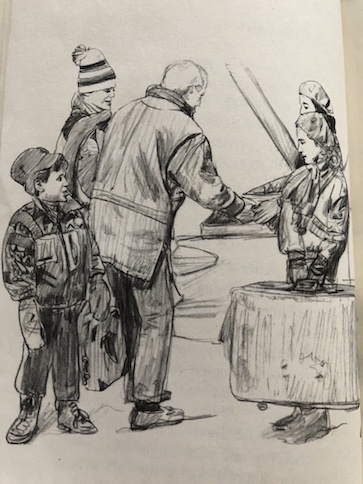
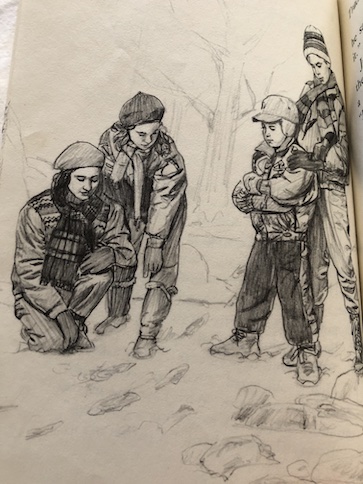
At the ski lodge, the Alden children meet a boy named Jimmy. Jimmy is a regular visitor to the lodge, but for some reason, he says that his parents never stay. There is also a girl called Freddie, which is short for Fredrica. Her parents aren’t at the hotel, either, because they’re visiting her sister, but she says that they will come later. Freddie could have gone to visit her sister, too, but she didn’t want to miss the fun at the ski lodge. She and Jimmy are both team captains for the winter games, which include skiing, skating, sledding, snow sculpting, and ice carving. Strangely, when the team captains get the box where kids are supposed to submit their names to join the teams, they can’t find the keys. The loss of the keys is worrying because, if they can’t find them, they won’t be able to get into the equipment shop for the equipment they need for the games. They still manage to put together the teams, and the Alden children also join.
Then, Mr. Mercer discovers that all four of the tires on his truck are flat. Grandfather Alden offers to drive him into town to get a pump for the tires and to talk to a locksmith about getting into the equipment shop.
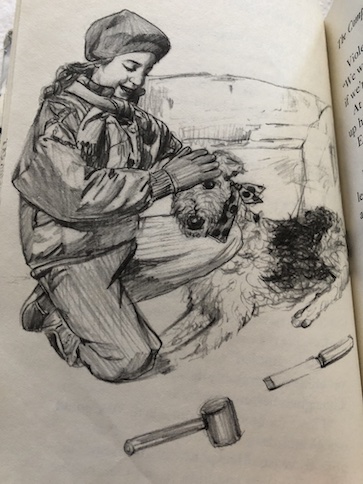
While the adults tend to that, the kids talk about the try-outs for different events. The Aldens are all excited about different events. Violet notices that one girl, Nan, isn’t enthusiastic about the events at all and doesn’t want to try out for anything. Violet asks her why, and Nan says that joining in the games was her parents’ idea, not hers. They say it will be fun, but she never really enjoys herself at these things. She doesn’t think there are any events she can do, and she’d hate to be the one to lose an event for her team. To encourage her and build up her confidence, Violet suggests that they both sign up for the ice carving event, which doesn’t require a try out. Violet says that she doesn’t know how to do ice carving, and Violet says that’s fine because she doesn’t, either. She says that it would just be fun to try it out together. Nan points out that they would be competing against each other because they’re on opposite teams, but Violet says that doesn’t matter because they’re both equals, neither one of them knowing what they’re doing. Nan is cheered by Violet’s friendliness and signs up for ice carving.
Nan isn’t the only unhappy child involved in the games, and the Aldens begin to feel that the focus on competition instead of simply having fun in the snow is partly to blame. A boy named Pete is upset that he didn’t get selected for any of the events he tried out for, and he says he doesn’t want to be the time team’s time keeper, which is the default position. Pete says he no longer wants to be involved in any of it. Freddie is angry because she and Jimmy drew names for their team members at random, and she thinks that Jimmy ended up with most of the really good team members. She wants a way to even things out. When the Aldens ask Jimmy if his parents will come to the awards dinner at the end of the games, he seems upset and doesn’t want to talk about it much. They’re not sure if Jimmy is more upset about his parents not being there than he pretends or if he’s worried about the awards ceremony in general.
It soon becomes apparent that someone is intentionally trying to sabotage the winter games. Someone smashes the snow sculptures that the Aldens made for their team. Then, someone steals a skier’s skis and ruins the ice sculpture made by the other team. The entire skating event has to be postponed when someone ruins the ice.
Who is doing these things and why? It could be someone who’s trying to make their team win the competition, but the sabotage has been aimed at both teams and at the event in general. Is it a kid who is unhappy with the contest or their position on their team? Jimmy seems eager to cancel events every time something goes wrong. Can the Boxcar Children figure out who is responsible?
The book is available to borrow and read for free online through Internet Archive (multiple copies).
My Reaction
There are themes in the story about competition and family. The Aldens aren’t accustomed to thinking competitively about other people because they’re used to doing things with each other cooperatively, as a team. Because they’re accustomed to thinking cooperatively, they are friendly with people on the other teams, like Nan, and they’re more focused on the fun of the events than on winning. That makes them different from some of the other kids, who are concerned about winning, but there are other issues in the book besides competition that matter more.
There are indications in the story that the parents of the children in the competition don’t always want the same things that their children want. Nan, for instance, didn’t even want to join contest, but her parents urged her to do it. Also, some of the children aren’t as good at others at conveying to their parents what they really want. When the most troubled child in the group finally manages to say what they really want, many things get straightened out.
I feel like there are many stories where the conflicts revolve around people who don’t really communicate with each other. In this story, there’s a character who blames others for not understanding how they feel, but even they have to acknowledge that they haven’t actually explained their feelings. They’ve just been expecting everyone else to know what they’ve been feeling. Some honest communication straightens out the problem, and that’s a good life lesson for kids and families.
This fun picture book is written in comic book form. Almost all of the text is in speech bubbles in the pictures.
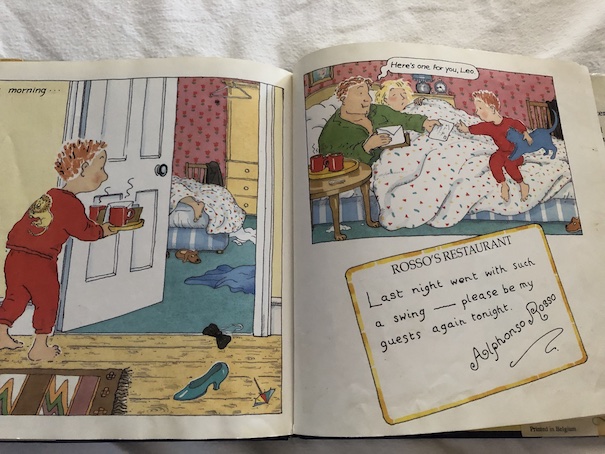
One morning, Leo finds an unexpected prize in his cereal box: an invitation to dinner at a fancy restaurant! He and his parents decide to accept the invitation, getting dressed up for the occasion.
The food is great, and Leo notices that there is a band playing. He asks his mother if she’s going to dance, and on a whim, she decides to dance with the waiter with the dessert cart.
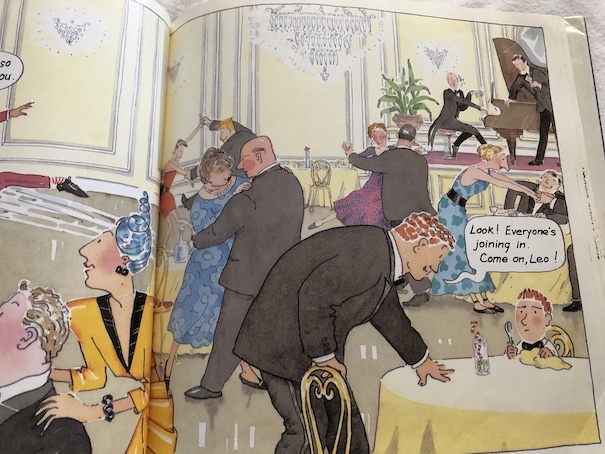
From there, the evening goes from good to great for everyone! The restaurant turns into a party with everyone dancing, Leo’s mother swinging from the chandelier, and the musicians having the time of their lives!
Then, a lady who is a dancing with Leo loses one of her diamond earrings. Leo volunteers to find it for her, and it turns up in an unexpected place.
The evening is such a success that the owner of the restaurant invites them to dinner the next night, too!
The book is available to borrow and read for free online through Internet Archive. It was first published in Great Britain.
My Reaction
In real life, fancy adult restaurants tend to serve foods that kids don’t like and require a level of etiquette that kids often find stifling, but in this fun, comic book style story, Leo and his parents have the time of their lives on this fun evening out! All of the adults in the story are open to some zany fun, and even the owner of the restaurant enjoys himself so much that he’d love to have them back the next day.
Like all picture books, it’s the details in the pictures that really make the story. The story doesn’t tell you that the reason why the cereal box prize was an invitation to this restaurant is that the restaurant owner also owns that brand of cereal, but it’s shown in the pictures, with his name on the box. When Leo and his parents arrive at the restaurant, the owner meets them and compliments them on their taste in cereal. Later, he’s shown eating a bowl of his cereal himself. I also loved the picture that includes Leo’s mother letting loose and swinging on the chandelier. The other people in the restaurant are also eccentrics. One of the dancing women is wearing a dress with a banana print and a matching hat with a banana on it, and while Leo is searching for the lost earring, he finds a lady in an elephant print dress and fuzzy slippers. There’s nothing dull about this elegant dinner or the people enjoying it!
Mystery of the Inca Cave by Lilla M. Waltch, 1968.
Thirteen-year-old Richard Granville has been living in Peru for the last two years. His family moved from California to a mining town in the Andes because his father is a manager for a mining company. Richard enjoys living in Peru because he’s developed an interest in archaeology and the history of the Incan civilization. Richard feels like the mountains are a connection to the distant past, and he loves the historical feel of the place. His parents don’t understand how he feels and would rather see him work harder at his schoolwork instead of spending all of his time exploring the mountains. Richard’s father tells him that he won’t become an archaeologist if he doesn’t apply himself to his studies, and his mother worries that something could happen to him in the mountains. They think he should finish school first and then decide if he wants to go into archaeology or not, but Richard’s mind is already made up, and he doesn’t want to waste this golden opportunity to do what he loves most right now. Richard feels hurt that his parents don’t really listen to him, don’t share his interests, and don’t appreciate the finds he’s already made.
Richard loves to explore the area with his friend, Todd Reilly, and see if they can find pieces of Incan relics. They’ve found some interesting bits of pottery and broken tools, but one day, they make a particularly exciting discovery – an ancient stone road mostly covered with grass. Although Richard knows that there are many other remains of Incan roads, this one is particularly tantalizing because it seems more hidden than most. Richard is fascinated with how neatly the stones of the road fit together so precisely without mortar, and he wonders where the road leads.
The boys explore the old road further, but they discover that at least part of the road was buried in a landslide. Todd doubts that they’ll ever be able to find where the road leads, but Richard wants to keep trying. When they return to the spot to try again, Richard spots the remains of an ancient building! Richard is sure that the building was once a chasqui station (also called tambos), which was a place where Incan messengers could stop, rest, and trade off with other messengers, who would continue to carry messages along the route, like the members of the Pony Express used to trade off with each other. Richard knows that stations like that were placed about 2.5 miles apart along roads, so there might be other stations located along this route.
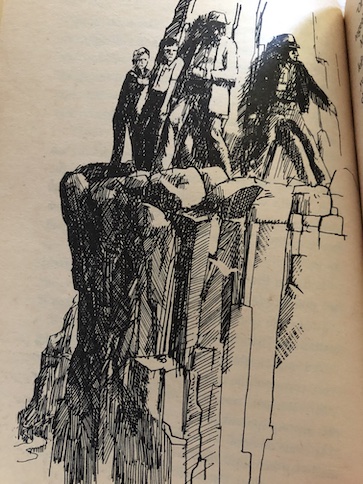
The boys go a little further and find a stairway leading up the side of a cliff to a cave. On the stairs, Richard finds a small doll. The doll is puzzling because Richard isn’t sure if it’s an Incan relic that somehow managed to survive or if it’s a more modern doll made by the South American Indians in the area. He has trouble believing that any more modern person could have been at this spot recently because it’s pretty isolated and rough territory. It looks like other landslides could happen. He can’t tell his parents about his discovery because they probably wouldn’t let him return to the area to explore it further if they knew how dangerous it was, and he can’t bring himself to abandon the most exciting discovery he’s ever made.
On a trip to the marketplace, Richard and Todd spot a mine foreman, Jeb Harbison, yelling at a boy in Quechua. He stops as soon as he sees the other boys watching, and they wonder what that was about. Then, the boys spot a merchant selling dolls that are similar to the one they found at the ruins. They ask the merchant where the dolls came from and who made them, and he gives them the name of the doll maker, a woman named Deza. Todd thinks that the most likely explanation for the doll they found is that some young girl living in the area got a doll from the same doll maker, and she lost it while playing around the cave. However, Richard doesn’t think that’s likely because the cave is such an out-of-the-way place, not somewhere a young child could easily reach alone.
On another visit to the area of their discovery, the boys find a mine shaft that doesn’t belong to the company their fathers work for, even though it’s on land that they know the company owns. There are signs that someone is actively mining there, but who?
The boys also discover that the activity at the cave is connected to the mine when they see some men there, breaking up rocks and stuffing them inside of little dolls, like the one they found earlier. It seems like the miners are smuggling gold or other minerals in the dolls, but when the boys talk to Richard’s dad about what they’ve seen, the situation points to a possibly larger conspiracy.
The book is available to borrow and read for free online through Internet Archive. The book was originally titled Cave of the Incas.
My Reaction
The first thing that I liked about this book was the pieces of information about the ancient Incas. Our knowledge of ancient civilizations has increased since the 1960s, but the information in this book is still good. I liked the book’s descriptions of Inca building techniques, how they used closely-fitted stones instead of mortar, and how their system of messengers was organized. There are also points where the characters notice parallels between the way the ancient Incas lived and the way their descendants live, such as their system of cooperative farming.
However, this story is also about human relationships as well as adventure, mystery, and ancient civilizations. Through most of the book, Richard is troubled about his relationship with his parents, especially his father. His parents are frustrated with him because he is absorbed by his interest in archaeology and exploring the countryside and isn’t applying himself to his schoolwork. At the same time, Richard hates it that his parents don’t understand what interests him and only seem to want him to focus on what they want. They’re having a clash of priorities.
When I was a kid, I hated homework with a vengeance. That might be a surprising revelation about an adult who willingly does what are essentially book reports on a regular basis as a hobby. Reading is fun. Research produces interesting information. I like knowing things and writing to other people about them. Basically, I was always good at the skills necessary for homework, so that wasn’t the problem. The problem is that there were many other things I wanted to do, and homework got in the way. I didn’t always get to read about what I wanted to read about in school because someone else was always choosing the school material for me, and I frequently hated their choices. Even the arts and crafts weren’t always the ones I wanted to learn, and I was usually told what to make instead of getting to make what I wanted. Because I was a good student, I ended up in the honors classes, so I always had more homework to do than everyone else. I was proud that I was a good student, but at the same time, I also hated it because I found it stifling. I’ve always been interested in many different subjects and handicrafts, but all through my childhood, I felt like I could never just take up all the different projects I wanted to do because I had to do my never-ending supply of homework first. Everything I wanted to do always had to wait. Even after I graduated, it was difficult for me to shake off the feeling that I had to wait on things I wanted to do , which was also kind of irritating.
I could sympathize with Richard’s attitude toward his own studies. He knows what he really wants to do, and he finds it infuriating that his parents want him to put it off and finish his homework and his education first. There is something to be said for making the most of finding himself in the very place he wants to be with direct access to what he knows he wants to study seriously. The move to Peru was an enriching experience for Richard that gave him a direction and life ambition, and I think he would regret it forever if he didn’t use this opportunity to explore it as much as possible. At the same time, though, my adult self knows that there is truth to what Richard’s parents say about his explorations in the mountains. The mountains are dangerous, like Richard’s mother says, and even Richard knows it. Also, Richard’s father is correct that if Richard seriously wants to be a professional archaeologist, he’s going to have to finish his education.
Nobody in modern times becomes a serious, professional archaeologist without a college degree, and even archaeologists need to study things beyond their specialist field. Archaeology isn’t just wandering around, digging, and seeing what you find. You have to recognize what you find, study its context, understand its significance, and know how to treat it to preserve it. You can’t study past lives and interpret artifacts without having real life and world knowledge. Archaeology is also where science and history intersect. Archaeologists need to know mathematics, geology, and how humans are affected by climate (which can and does change over time, for various reasons) and access to resources. There are legal and ethical principles to archaeology that Richard will also have to understand. Archaeologists can also benefit from learning drawing and photography to record and interpret finds and perfecting their writing skills to present their findings to the world. Richard has made a good start in his field of interest, but to get serious about it, he will need more education and greater depth and breadth of knowledge.
As annoying and stifling as homework feels, the skills it imparts are necessary for doing many more interesting things. Getting through the studying phase can be a pain, but sometimes, you really have to lay a solid foundation before you can build something solid on it. I still think that my past school assignments could have been more interesting and less stressful if I’d had more flexibility about them and more time for personal projects in between. However, I have realized over the years that, once you’ve really learned something, you will use it, even if you only use it indirectly as part of something else. I don’t regret learning the things I learned because, as hard as it was along the way, I have used things I learned in more interesting ways later in life. I’ve also realized that, if I had spent less time and emotions complaining about how stifling my homework situations were, I also could have used the time I spent lamenting about homework and procrastinating about it to accomplish some of the other things that I complained that I never had enough time to do. Not all of them, but more than I did when I was too busy being upset and resentful about homework. That’s also a lesson that Richard learns in the story.
At one point, Richard talks to Todd about his relationship with his own father, and Todd says that they get along pretty well. Richard realizes that Todd and his father don’t fight over his studies because Todd is an easy-going type who doesn’t mind doing his homework much and takes care of things without making anybody nag him to do it. Todd just accepts that there are some things that just need to be done, so he doesn’t waste time complaining or procrastinating about them. That’s harder for Richard because he feels the strong pull of what he really wants to do.
Todd admits that he and his parents don’t always get along perfectly because he doesn’t always do what he’s supposed to do. There are times when he leaves messes or physically fights with his brother or talks back to his mother, and his parents get angry or irritated about it. When Richard asks Todd what he does in those instances, Todd says that, eventually, after the initial argument, he typically apologizes or cleans up his mess or does whatever he needs to do to fix the situation. Todd’s reasoning is that, while people aren’t perfect and don’t always do what they should, “when you’re wrong, you’re wrong.” He accepts that, sometimes, he screws up and needs to do something to fix it without getting too overwrought about having been in the wrong. He sees it as just a normal part of life. When it happens, he can correct himself and move past it.
In the case of Richard and his father, each of them has to admit to being a little wrong and accept that the other is partly right. Both of them have to do some work to fix their relationship. Richard has to admit to his father that he does need to continue his education and apply himself to getting his work done. In return, his father needs to try harder to understand Richard’s interest in archaeology and allow him some time and opportunities to make the most of his time in Peru, getting the firsthand knowledge and experience he needs for the future he really wants and that won’t come from the standard classes he’s taking.
Through their adventures in the course of the story, Richard and his father come to a better understanding of each other and have an honest conversation about how to manage the conflicts in their relationship. Richard’s father admits that he needs to stop looking at his son as being just a younger version of himself and to see Richard for the independent person he is, with his own interests and goals in life. Meanwhile, Richard connects somewhat to his father’s interests through their investigation of the illegal mining operation he and Todd discovered.
This mystery story is a little unusual for children’s books, where kids often investigate mysteries on their own, having adventures without the adults, because Richard’s father joins the boys in their investigations and he stands up for them and what they’ve discovered when their discovery is challenged. The shared adventure becomes a bonding experience for Richard and his dad. At the end of the story, Richard’s father helps Richard connect with a museum curator, who helps the whole family to see the true value and significance of Richard’s archaeological finds. The curator also emphasizes to Richard that, while he has the potential to excel in his chosen field, he’s going to have to study and move on to higher education to get where he wants to go. Richard agrees, now having a greater understanding of its importance and satisfied that his parents understand the direction he’s chosen for his life.
The Lancelot Closes at Five by Marjorie Weinman Sharmat, 1976.
“Camelot” is the name of a new housing development being built in Shady Landing, New York. In the beginning of the story, Camelot has only three model homes, demonstrating what the houses in this new neighborhood are going to look like. In keeping with the Arthurian theme, the three model homes are called “the Excalibur”, “the Lancelot”, and “the Guinevere.” Abby’s family decides that they will buy a house there on the Excalibur model because they are tired of their crowded apartment in Brooklyn and Abby’s parents think that buying a house sounds like a good investment for future.
The move isn’t easy for Abby and her family. Abby doesn’t like leaving her old friends behind. There are several things wrong with the new house, including windows that are nailed shut, doorknobs that fall off, and a flooded basement. Also, the people who live in the village of Shady Landing don’t like the newcomers because trees were cut down to build Camelot.
However, Abby soon finds a friend, Heather Hutchins, who likes to be called “Hutch.” Hutch also lives in the new Camelot neighborhood. Hutch’s family is very health-conscious, believing in all-natural foods, which is why Abby doesn’t usually like to eat at their house, and Hutch’s mother is a very competitive person.
Then, Hutch springs a surprise on Abby. Hutch tells Abby that she wants to run away from home. She doesn’t want to be gone for long, just about day during the Memorial Day weekend. She doesn’t want to go far, planning to spend a night in the Lancelot model home. But, she wants Abby to come with her so she won’t be alone.
At first, Abby is a little reluctant, but Hutch is very persuasive, the idea does seem like a fun adventure, and hiding out secretly so close to home doesn’t seem too dangerous. In fact, since the public is invited to come and walk through the model homes, it doesn’t even seem like trespassing. Abby agrees to do it. The girls’ plan is to tell their families that they’re spending the night with each other but conveniently not mention where so they’ll assume that they’re just having a normal sleepover at each other’s house. Then, they plan to visit the Lancelot and hide there until it closes and all the other people leave.
When she proposes her plan, Hutch doesn’t explain her motives for wanting to run away for a day, and Abby decides not to question her, thinking that Hutch will tell her when she’s ready. She does note that Hutch doesn’t seem to get along well with her mother. Hutch’s mother doesn’t seem to connect well with other people in general, being more focused on what she wants them to do than on just acknowledging them or building relationships with them. Worse still, Hutch’s mother is what Abby calls a “scorecard mother,” always comparing her child to everyone else’s child, constantly keeping track of where Hutch is ahead and where she’s behind. Hutch’s mother has overly high expectations of Hutch and pushes for perfection. Hutch’s mother sometimes quizzes Abby about what she does to help out at home and how each of the girls are doing in school so she can compare them. Abby sometimes feels like she’s in the uncomfortable position of defending Hutch to her own mother.
The Lancelot model home is decorated in a fakey pseudo-Medieval style, in keeping with the Camelot theme. When Abby and Hutch sneak in, they pretend to be part of a family group touring the house and then hide under a bed until everyone else leaves. Their plan works, but staying in the house isn’t quite what Abby imagined it would be. The furniture is uncomfortable because it’s made to be looked at and not actually used. Not all of the appliances even work, like the tv, because they’re just for show and not for using. For their “supper”, Hutch has brought candy bars and pastries, things which her mother normally forbids her to have because they aren’t natural and will rot her teeth. Abby still can’t have some of them because she has food allergies and braces, but Hutch brings pound cake for her.
Hutch finally admits to Abby that her main reason for wanting to have this adventure is just to have the chance to do something for no other reason than she just wants to do it. Abby is right about Hutch’s mother. Everything that she wants Hutch to do is centered around gaining something – recognition, awards, physical health benefits, learning things and getting a mental edge. Hutch just wanted the chance to do something without a particular motive other than just wanting to do it and the fun of planning it out and pulling it off by herself, with the help of her friend.
Unfortunately, Hutch gets carried away with the success of her plan and turns on the lights, which attracts the attention of a passing police car, although the police just try the doors, decide that the lights were left on by accident, and leave without finding the girls. Then, Hutch doesn’t want to go to sleep and stays up, eating candy bars in bed, just because she’s normally not allowed to do that. Abby is uncomfortable in the big, fancy bed that isn’t meant to be slept in and can’t sleep, so she leaves and goes home, making Hutch mad. Abby spends the rest of the night sleeping in her sleeping bag in her family’s basement (which is no longer flooded) so she won’t give away Hutch’s secret.
Later, Abby feels guilty about abandoning Hutch, so she sneaks out early in the morning to check on her. Hutch got out of the Lancelot without being noticed, but she’s still mad at Abby for leaving her when she was trying to do something that was important to her. However, there is worse to come. The police hadn’t forgotten about something strange happening at the model home that night, and now, there’s a rumor in the neighborhood that the house was “vandalized” during the night (meaning the mess that the girls left in the house from the food they ate, trying to sleep in the bed, and using the bathroom). Abby is naturally a more timid person than Hutch, and while she has started to appreciate Hutch’s attempts to help her be more bold and take more chances, it makes her nervous that she and Hutch are the “vandals” whose escapades have now made the local paper. Abby’s father, an author, is even attempting his own investigation into the matter.
Abby is not only worried about repairing her friendship with Hutch but not getting found out for what they did. Then, one of the boys at school starts bragging, claiming that he and his friend were the ones who snuck into the Lancelot to hang out that night. He’s not the only one trying to claim credit for the stunt, either. Abby hopes that the whole thing will just die down and be forgotten, but Hutch doesn’t feel the same way. Even though she originally set out to do something just on a whim without looking for recognition, the idea that someone else might claim recognition for what she did galls her. What will happen when Hutch tries to reveal her role in masterminding the night in the Lancelot?
I purposely sought this book out online because I never owned a copy and I remembered it from when I was in elementary school, but the funny thing is that I don’t remember ever hearing the entire story when I was a kid. I think that my class might have just read a selection from the book, maybe as part of one of those story collections that has excerpts from books to demonstrate certain concepts and give samples of stories. I can’t quite remember now. All I remembered was that the main escapade was just a part of the story that took place at the beginning of the book, and the rest was about what happened because of the girls’ secret nighttime excursion. It makes the book a bit different from other children’s books about kids running away and hiding in usual locations, like From the Mixed-Up Files of Mrs. Basil E. Frankweiler, where most of thebook takes place during the kids’ adventure and the kids’ parents are barely seen. In this book, the girls are mostly at their own homes, and the parents have prominent roles.
Runaways generally have two motives – getting away from something or going in search of something, and when you really think about it, they frequently have both. Hutch’s adventure is both about escaping from her mother’s oppressive rules and emphasis on perfection as well as undertaking something unusual and pulling it off for the sense of personal achievement. However, even though Hutch at first insists that she wanted to do it just for the sake of doing something that she wants, with no expectation of recognition or reward, it turns out that isn’t completely true. Part of the reason why she wanted Abby along was to get a sense of recognition from her for the accomplishment as well as her company. Her bad feelings toward Abby for abandoning their adventure and going home were partly because Abby didn’t value that type of uncomfortable adventure as much as she did and didn’t fully acknowledge the cleverness of her plan. Even if it started out as just a fun escapade, undertaken as a brief chance to break a few rules in secret, Hutch badly craves acknowledgement, just not in the form of the constant comparisons he mother makes between her and other people. What Hutch really needs is just to be acknowledged for being herself and to feel valued, no matter how she compares to others. In her attempt to make things right with Hutch again, Abby does something that she never thought that she would ever be bold enough to do: give Hutch’s mother a piece of her mind.
The book is available to borrow and read for free online through Internet Archive.
Ramona and Her Father by Beverly Cleary, 1975, 1977.
It’s September, and second-grader Ramona Quimby is already making out her Christmas list. However, Christmas this year might not be what Ramona expects. Her father comes home and explains that he’s been laid off from his job because a larger company bought the company he worked for and laid off the extra workers. Mrs. Quimby has a part time job, but it doesn’t pay much. Everyone in the Quimby family soon becomes worried about money.
Mrs. Quimby finds another job that’s full time, but Mr. Quimby still struggles to find work. Ramona doesn’t like to see her father so worried and stressed, and she tries to think of some way she could also earn money. When her father comments about how much money a boy on a television advertisement must have made, Ramona sets herself to memorizing various advertising phrases and repeating them, hoping to be discovered and hired to make an ad herself. Unfortunately, things that people say on ads don’t work in real-world settings, especially when you tell your teacher that her wrinkled stockings look like elephant skin.
The family has to eat food that they don’t particularly like in order to save money, and they start buying cheaper cat food for their cat. Picky-picky refuses to eat the cheap cat food, and before Halloween, he eats part of the girls’ jack o’lantern in desperation. Beezus, upset at the idea that their cat is apparently starving and desperate, angrily asks her father why they can’t afford Picky-picky’s usual cat food when they seem to have enough money for his cigarettes. (It’s a valid question. During my first semester of college, I totaled up a classmate’s expenses on cigarettes and realized that what she spent on them for a year was about the same as full-time student tuition at our community college, by early 2000s standards.) Her father tells her that’s none of her business, and Beezus retorts that it is her business. Cigarettes are harmful, and Mr. Quimby is spending money on them that the family desperately needs.
Ramona is worried because this is the first time that she’s heard that cigarettes are bad, although Beezus says that she learned it in school. Ramona tries to ask her father if what Beezus said is true, and he just says that he expects to be an old man someday, the kind that tells reporters on his hundredth birthday that he owes his longevity to cigarettes and whisky. This joke doesn’t reassure Ramona. Ramona decides that she’s going to get her father to stop smoking.
Ramona gets Beezus to help her make anti-smoking signs. At first, their father tries to ignore the signs, and then he starts getting annoyed with them. Ramona worries that she’s been mean to her father and upset him too much, but he later admits that she was right and that he’s going to try to quit smoking. Ramona takes him at his word and throws his cigarettes away, although he said that he would rather have cut down gradually. Still, his wife and daughters are happy about him quitting. For awhile, Mr. Quimby is edgy and irritable as he tries to get used to not smoking as well as still looking for a job.
As Christmas approaches, the girls’ Sunday school begins preparing to put on a Nativity play. Beezus gets cast as Mary, which pleases her because Henry Huggins is going to play Joseph. Ramona is so excited about the play that she wants a creative role for herself, and after the shepherds are cast, she says that she wants to be a sheep to go with the shepherds. The Sunday school teacher says that sounds like a good idea, but they’ve never had any sheep in the play before and don’t have a costume for her. Ramona says that her mother could make her one, and other children also say they want to be sheep.
However, as Beezus points out, now that their mother is working full time, she doesn’t really have time to sew a costume. Their mother also says that they can’t afford to buy new cloth for a costume, and the best she can do is an old white bathrobe that she might be able to alter into costume. Ramona’s father snaps at her that she’s been inconsiderate for expecting her to do something like this without asking first. Ramona feels badly and overhears her father calling her a spoiled brat. With his irritability, he’s been picking at her for various things, and one day, Ramona argues with him when she comes home from school and smells cigarette smoke.
Ramona’s father reassures her that he hasn’t purchased any new cigarettes. He just found an old one in a pocket that he forgot that he had and decided to smoke it to see if it would help him feel better. The two of them have a heart-to-heart talk about Ramona worrying about why they can’t be a happy family. Ramona’s father tells her that their family is happy. It’s just that no family is perfect and nobody’s life is perfect, and everyone goes through hard times now and then. The people in Ramona’s family still love each other and do their best for each other even when things are hard and they don’t always get along.
Things improve for the Quimbys as Christmas approaches. Mr. Quimby finally finds a new job. Ramona almost backs out of the Nativity play because her mother didn’t have time to make her a full costume, and she feels silly with what she’s wearing, but she changes her mind with the help of three older girls who were recruited to replace the Three Wise Men who backed out of the play.
One thing that kind of surprised me in the story was that Ramona’s parents seemed mildly scandalized when Ramona and Howie sang “99 Bottles of Beer on the Wall.” Beezus, who learned the song at summer camp and taught it to Ramona says that the neighbors will probably think they’re beer guzzlers after hearing Ramona and Howie sing it all up and down the street. It struck me as weird because I remember that everyone knew that song when I was a kid in the 1980s and 1990s, and nobody thought anything of it. I certainly never heard of anyone being scandalized by it. It’s just a silly counting song, and nobody really thought that any kid singing it had ever had beer. In fact, it was a common song for parents to get their kids to sing on long car trips because it takes a long time to finish, and during that time, the kids aren’t complaining or asking, “Are we there yet?”
The book is available to borrow and read for free online through Internet Archive (multiple copies).
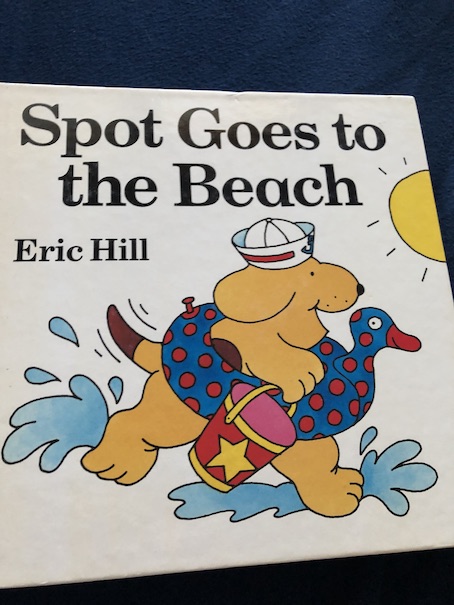
Spot’s parents take him to the beach to spend the day there. When they get to the beach, Spot wants to get a sailor hat from a stand selling beach equipment, and his father also buys him some beach toys.
Spot plays with a beach ball, builds sand castles, and buries his father in the sand.
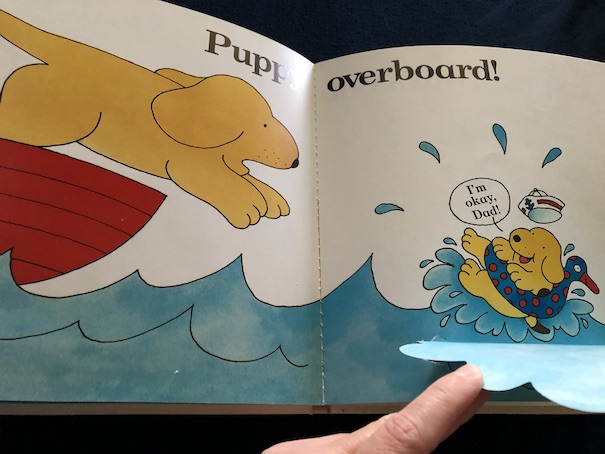
Spot and his father later go fishing, and Spot falls in the water, but Spot is fine because he’s wearing a pool float.
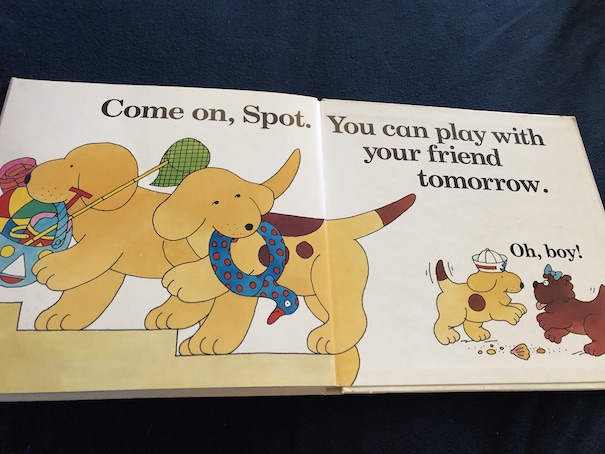
Before they leave the beach, Spot also makes a new friend, another puppy!
This is just a cute book for children about the fun things that they can do at the beach.
Like other Spot books, this book is a lift-the-flap picture book. The British version of the title is Spot Goes on Holiday. It’s available to borrow and read for free online through Internet Archive (multiple copies).
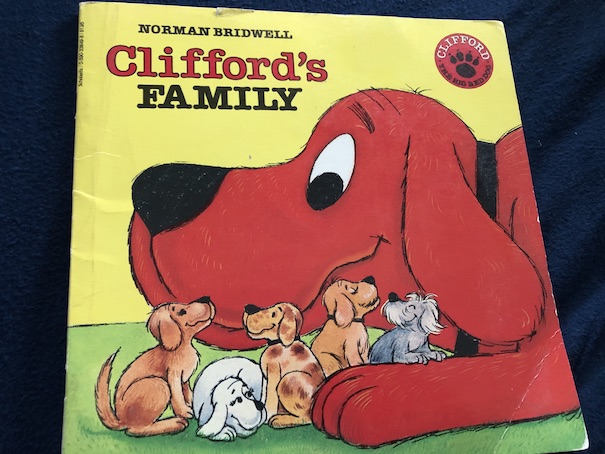
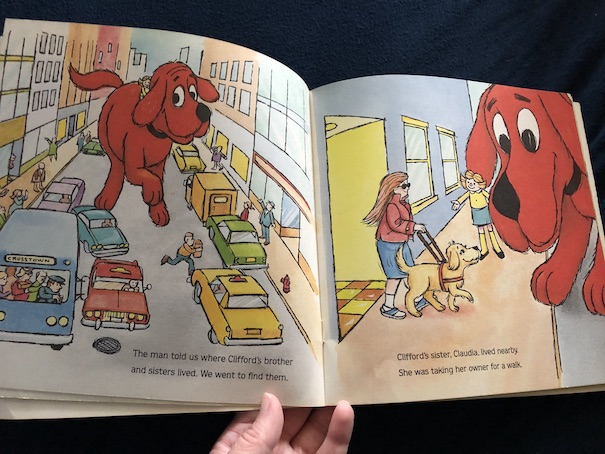
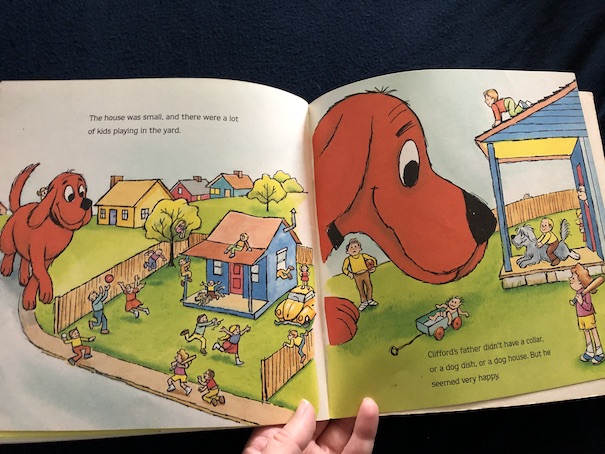
Emily Elizabeth and her enormous dog, Clifford, were both born in a big city, although they live in a smaller town now. They decide to go back to the city and visit Clifford’s mother, who is still there.
Clifford’s brothers and sisters all live with different people now, so they decide to visit them, too. Clifford’s sister, Claudia, has become a seeing-eye dog.
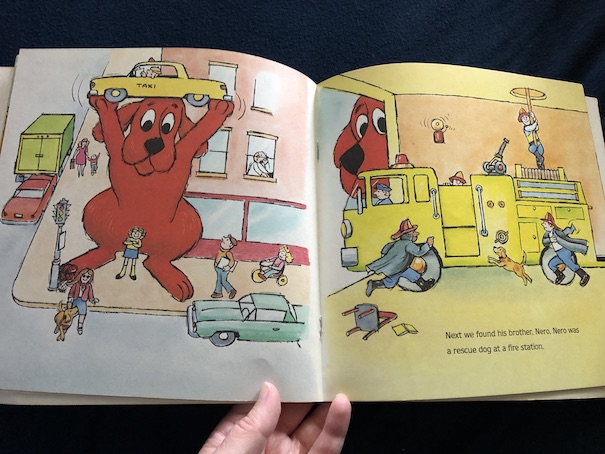
His brother, Nero, is now a fire rescue dog.
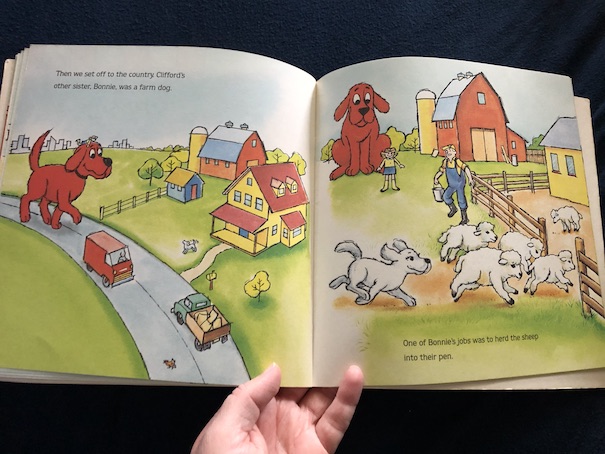
Clifford’s other sister, Bonnie, lives on a farm and herds sheep.
Clifford’s father doesn’t live with his mother. He lives in a house in another town with a lot of children, and he loves playing with them.
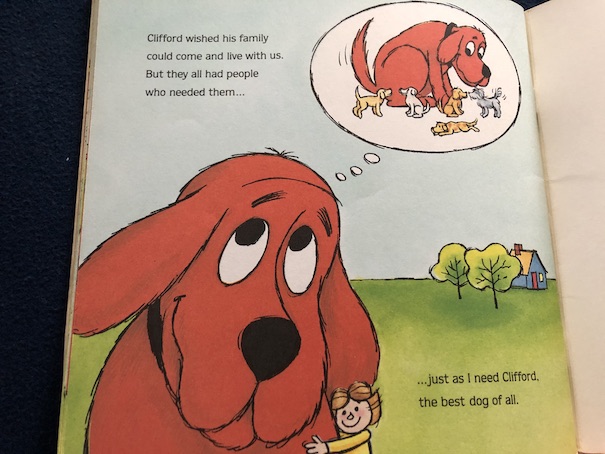
Clifford wishes that his family could live together, but he understands that every member of his family has other people who also need them.
I thought that this book did a good job of pointing out some of the jobs that dogs do, like seeing-eye dog, rescue dog, and herding dog. Clifford and his parents are all companions animals, like most pet dogs, but his siblings all have specific jobs to do for their owners.
The book is available to borrow for free online through Internet Archive.
#17 Elves Don’t Wear Hard Hats by Debbie Dadey and Marcia Thornton Jones, 1995.
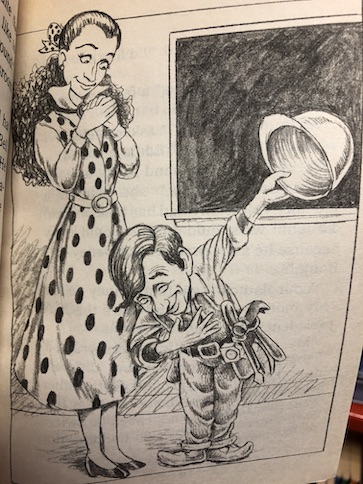
The playground equipment at Bailey School is old and breaking, so the PTA has decided to fund a new playground for the children. The playground is going to be built by the Bell Construction Company, and when the children meet the owner, Hollis Bell, he is an odd little man with curly-toed work boots. In fact, all of his men are unusually short. However, Mr. Bell promises to build the children the best playground they can imagine.
However, the parents at the school are arguing about the playground, how much it’s going to cost, and whether it really needed to be replaced at all. There’s not a lot of Christmas cheer going around, but Mr. Bell puts up Christmas trees and tells the children that they have their own kind of magic that can help fix their parents’ arguing.
One day, Mr. Bell comes to the third grade class to interview them about what they would like to have on their playground. All of the kids have different ideas, and they end up arguing about the things they’ve heard their parents say about what the playground should be like. However, Mr. Bell urges them to calm down and work together. He tells the children that they should make a list of what they all want and “check it twice.” One of the kids in the class says that it’s impossible to give everyone what they want, but Mr. Bell says that he’s in the business of making wishes come true. Liza asks what happens if someone puts down a really bad idea, and Mr. Bell says that he’ll know if an idea is a bad idea. Because Mr. Bell is short, his tools jingle like jingle bells, and he acts like he can grant their Christmas wishes, the kids start thinking that he might be an elf.
The kids are allowed to watch the workmen work, but Mr. Bell makes it clear that they’re not allowed in the trailer that’s attached to his truck. Naturally, the kids get curious about the trailer. They can’t help but sneak a look inside, and when they do, they find out that it’s a workshop full of toys!
As the children try to figure out if the construction crew might really be elves, they decide to ask the department store Santa more about elves. The kids debate about the department store Santa really being Santa, and the Santa makes a comment about how he’s been meaning to pay a visit to their school, seemingly ignoring a previous book in the series, when Santa apparently became their school’s janitor. However, later in the book, Howie refers to the “new janitor who keeps turning down the heat,” referring to what happened in the previous book, which is confusing. The department store Santa explains that his elves like to fix things, and they are particularly concerned with fixing people who can’t get along, hinting that the arguments over the school’s playground are what brought the elves to the school. Santa’s advice is for the children not to worry because the elves will disappear on their own “when the time is right.”
The deadline for submitting the plan for the new playground is approaching, and the kids realize that if the adults can’t agree on something, they might end up with no playground at all! When the “elves” leave to take care of a job “up north,” and the playground issue still isn’t resolved, the kids think that they probably weren’t magical elves and that they didn’t fix anything, but the kids aren’t ready to give up yet.
When Eddie suggests that they all just build their own playground out of wood and begins drawing his vision of it, it attracts the attention of the adults. At first, the kids think that they’ll have to do all the work on their playground themselves, but the more the adults hear them talk and study the picture Eddie drew, the more involved they become. When the adults were in charge, they each wanted to be considered the leader and authority on the project, with their ideas overshadowing everyone else’s, but with Eddie in charge, the project moves forward. Even though Eddie is a child, he’s the one with the vision to carry the project through, and he neutralizes the adults’ competing egos. The project ends up being finished unexpectedly fast, and in the end, no one knows who actually completed it, hinting that the Mr. Bell might really have been an elf and that he and the other elves secretly returned once everyone came to an agreement about what they really wanted. As always with this series of books, readers are left to draw their own conclusions.
The book is available to borrow for free online through Internet Archive.



















 Jestress's Forgotten Books and Stories