For Those Thinking of Notre Dame …

Sometimes, current events remind me of the events of children’s books. I debated about bringing this one up because I haven’t gotten hold of this particular book recently (partly because I’m probably not the only person who’s thinking about it right now), and I don’t have a proper post prepared for it, but years ago, a teacher introduced my class to Cathedral by David Macaulay. David Macaulay wrote a series of children’s books, explaining the architecture of historical buildings, including one about the construction of Gothic cathedrals, like Notre Dame in Paris.

The pictures in these books are fascinating, which is why I’m sorry that I don’t have a proper post prepared with example pictures. (I’ll probably do one later, when I can get hold of the book again) The book is available in multiple copies through Internet Archive, although there is a waiting list to get it right now.

However, the book was also made into a documentary film. Part of the story-line involves a fictional Medieval town replacing their cathedral after their first cathedral was destroyed by fire. (In the book, the cathedral was damaged by lightning, not destroyed by fire. The two stories aren’t the same.) This fictional cathedral serves as an example of the process of constructing a Medieval cathedral and the difficulties and dangers it might involve. The story of the town alternates with explanations about the history and architecture of cathedrals. This short clip explains the basic architecture of a Gothic cathedral, using Notre Dame as an example toward the end.

One of the aspects of the story that I find most inspiring is the dedication that the people who funded and built the cathedral showed. The construction of a cathedral in the Middle Ages could take a lifetime or even longer, and not everyone who began the task would live to see its completion. Their motivation was not mere personal gain but a glorious accomplishment that would both honor their beliefs and last far beyond them.

I’m not sure how long it will take to complete the renovations after the fire that damaged Notre Dame, but whatever it takes, I’m sure it will be worth it.

Mirette on the High Wire

Mirette

Mirette on the High Wire by Emily Arnold McCully, 1992.

About 100 years ago (the book says, so it’s around the 1890s), a young girl named Mirette and her widowed mother run a boardinghouse in Paris. Most of the people who live there are actors and performers of various kinds.

MiretteBoardinghouse

One day, a strange, quiet man named Bellini comes to stay at the boardinghouse. Most of the time, Bellini prefers to keep to himself, but then Mirette catches him walking on the rope they are using for clothesline in the courtyard of the house. It turns out that Bellini is a tightrope walker. Mirette begs him to teach her how to do it, but he refuses.

MIretteRequest

Not to be daunted, Mirette begins experimenting with tightrope walking herself. After repeated falls, Mirette eventually learns to balance on the rope. When she shows Bellini that she can walk the length of the rope, he is impressed with her perseverance and teaches her more things to develop her skills. However, he becomes very upset when she boasts that she will never fall again.

MirettePractice

Mirette learns that Bellini was a world-famous tightrope walker until a friend of his was killed in a fall, and he lost his nerve. She talks to Bellini about it, and he says that he doesn’t know how to get over being afraid. Seeing Mirette’s disappointment and worry, however, gives Bellini the courage to try once again.

MiretteBellini

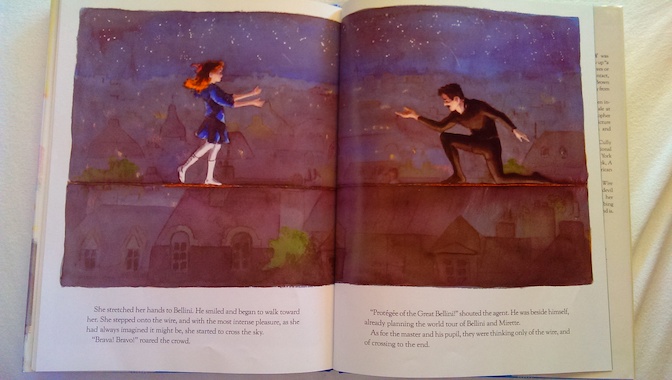
After talking with a performing agent staying at the boardinghouse, Bellini arranges a performance where he will walk a tightrope over a Paris street. When Mirette sees him hesitating at the beginning of the performance, she joins him on the wire, bolstering his courage and realizing her own dreams of becoming a real tightrope walker.

MiretteBelliniTightrope

There are other books in a series about Mirette and Bellini, where they perform tightrope acts and have adventures around the world, but I think that the first book is really the best.  The pictures are beautiful, done in an impressionistic style.

This book is a Caldecott Award winner.  It is currently available online through Internet Archive.

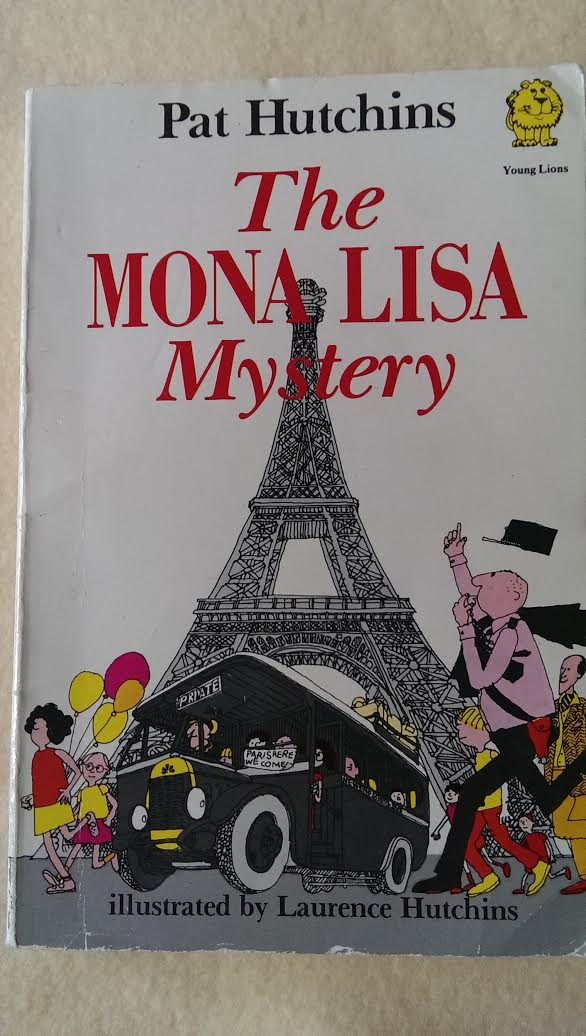
The Mona Lisa Mystery

monalisamystery

The Mona Lisa Mystery by Pat Hutchins, 1981.

Class 3 from Hampstead Primary School is taking a trip to France with their teacher, Mr. Jones. Miss Barker, their headmistress, was supposed to go with them, but she became ill, so their substitute French teacher, Miss Parker, will be going with them instead.  The kids aren’t happy about the substitution because they really like Miss Barker, and Miss Parker isn’t nearly as nice.

From the very beginning of the trip, strange things start happening. A black car follows them to the ferry and even around France. A doctor they meet on the ferry takes a room at their hotel, and unusual characters follow them everywhere they go, some of them in disguise. One of them even enters Jessica and Avril’s hotel room in the middle of the night.

At first, the children think that someone may be trying to kidnap Miss Parker since the mysterious strangers are showing unusual interest in her.  Then, the Mona Lisa is stolen while the children visit the Louvre!  The thief temporarily holds Jessica hostage before making his escape. Later, the painting shows up at their hotel, and Mr. Jones is arrested as a conspirator in the crime!

The children struggle to unravel the clues and the tangled mass of identities and prove their teacher’s innocence.  Who was really following who, who is the real conspirator, and can the children prove it and find the missing painting?

The book is available to borrow and read for free online through Internet Archive.

monalisamysterypic2

My Reaction

When I was a kid, I wished that my class could take a field trip to a foreign country! Technically, I suppose we could have since I live in a border state, but there’s nothing to see in the border towns here that would be as exciting as the Louvre. But, part of the fun of reading books like this is vicariously experiencing things you otherwise wouldn’t do.

This mystery story is the kind I think of as a fun romp – the characters are traveling around a bit and hijinks ensue as the students try to solve the mystery and save both the Mona Lisa and their teachers. One of my favorite parts as a kid was the running gag with the ketchup bottle.