Mary Poppins in the Park

Mary Poppins in the Park by P. L. Travers, 1952.

This Mary Poppins book is supposed to take place during the first three books in the series. It’s a collection of incidents that take place in the park. Each chapter is a short story, and each of the stories can stand alone.

I thought that the stories were fun, but there are a few instances of racial language that I didn’t like in the original version of the book. At various points throughout the original version of book, Mary Poppins chides the children for things they’re doing by calling them “Blackamoors”, cannibals on an island, or “Hottentots. ” In other words, she’s implying that they’re being “savages.” I know that notions of “savage natives” appear in other old children’s books, but I don’t think it’s a good idea to give modern children these ideas, and I don’t like it that Mary Poppins uses racial words as insults for the children in the story. Fortunately, later printings of this book rewrote these scenes to remove inappropriate racial language.

When I was writing this review, I told my brother the plot of one of the stories in the book,Lucky Thursday, and we had a good laugh over it. It was a pretty funny story to read. My brother asked whether the story was supposed to have a moral or teach children anything. I thought about it, and I suppose that part of the moral could be “Be careful what you wish for”, but in the end, I don’t think any real lessons were learned.

The book is available to borrow and read for free online through Internet Archive (multiple copies).

Stories in the Book:

Every Goose a Swan – When everyone seems to be daydreaming and pretending that they’re someone they’re not, Mary Poppins tells the children a story about a vain goose girl and the others around her who have grand ideas about who they think they really are. When someone points out the realities of being the people they like to think they are, they all decide that maybe it’s better to just be themselves.

Faithful Friends – Miss Andrews, a neighbor of the Banks families, has been advised to go traveling for the sake of her health by her doctor. Before going away, she asks the Banks family to look after her “treasures” during her absence. Mrs. Banks puts them in the nursery because she knows that Mary Poppins will look after them, although Mary Poppins is a little put out by this extra duty. The “treasures” turn out to be a collection of random knickknacks, battered and incomplete. The children are particularly interested in a pair of hunters with lion friends, but one of them is mostly missing, and they think that the lion missing his hunter looks rather sad. By coincidence (apparently), they meet a couple of policemen who are reminiscent of the hunters. One of them used to live near a jungle but had to return home because he lost a foot, like the knickknack hunter. He’s been sad since he got back because he says he’s missing a friend. However, he gets his friend back when a loose lion suddenly appears in the park. When children get home, the missing hunter is back in the knickknack, and the lion looks happy.

Lucky Thursday – Michael is unhappy because the other children got to go to the park while he had to stay home with a cold. The only interesting thing that happens is that he sees a strange cat out the window. Michael goes to bed in a bad mood, but the next day, all sorts of lucky things begin happening. However, it turns out that it’s not quite as lucky as he thinks. First, he doesn’t take care of some of the nice things he receives and loses them. Then, the mysterious cat leads him on what seems like a magical journey from the park to a castle of cats, and he is told that everything he’s received has been because he wished on the Cat Star the night before. Part of what he wished was just disgruntled grumblings, though, and part of the cats’ idea of fun and games is to make Michael answer riddles. If Michael answers the riddles correctly, he’ll get to marry one of the cat princesses, and if he doesn’t, he’ll have to work in the kitchen of the castle with other children who made foolish wishes. Michael does answer the riddles correctly, but he doesn’t want to marry a cat, and he has a desperate struggle to escape from the castle of the cats. He only manages to escape when he blows Mary Poppins’s whistle.

The Children in the Story – The park keeper isn’t very happy about the fair set up near the park because it always leaves such a mess. Mary Poppins and the children are also in the park, and Jane is reading aloud from The Silver Fairy Book. She and Michael start talking about the princes in one of their favorite stories. Then, the three princes come out of the story to see Jane and Michael. The princes say that Jane and Michael are the children in the stories they read, and they’ve entered their own book to visit them. They say that they’ve visited generations of other children before.

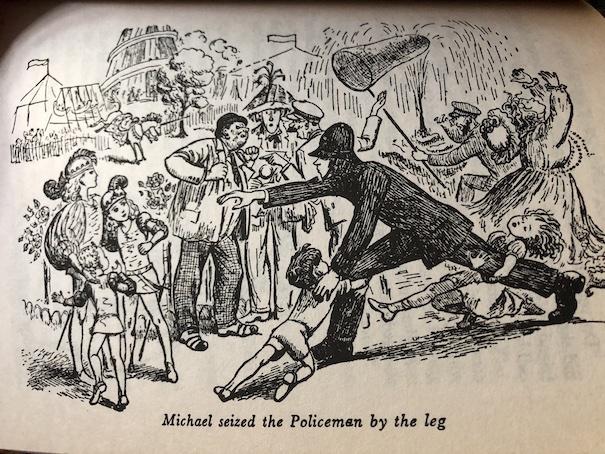
The princes have brought their unicorn with them, and when adults around them start noticing that there’s suddenly a real unicorn in the park, they start panicking and arguing among themselves about whether the unicorn belongs in the zoo, in a museum, or as a sideshow at the fair. The adults seem to feel like the princes and unicorn are vaguely familiar, but they can’t seem to remember why. Most adults forget about the princes when they get older, but not all. Bert the matchman remembers, and it turns out that Mary Poppins has also been nanny to the princes.
The Park in the Park – The children are playing in the park on a hot day. Jane is making little figures out of plasticine and a little park for them all. Michael is hungry, and the baker figure comes to life and gives him pie. The children get to know the other figures, and Jane is amazed that the characters have lives that she didn’t create for them. The figures don’t seem to remember that Jane made their little world, and Jane and Michael are astonished to realize that they have now become child-size in the little park she created.

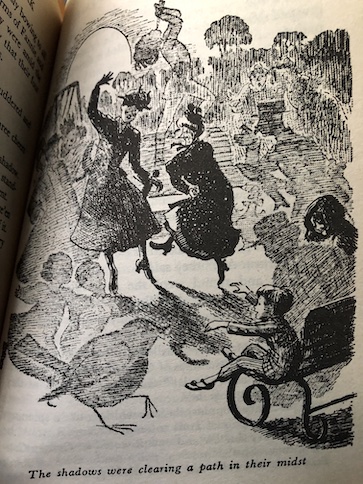
Hallowe’en – On Halloween, as the children are heading home with Mary Poppins with nuts and toffee apples, they meet the strange Mrs. Corey and her tall daughters. The children are told to be careful of stepping on shadows and that they should take care of their own shadows so they don’t run away. Mary Poppins hurries the children home and to bed, but the children find leaves that seem to be invitations to some kind of party. The children look outside and see shadows without people in the garden. The children follow the shadows, including their own, to the park. There, they see the shadows of everyone they know and even nursery rhyme characters. Mrs. Corey, her daughters, and Mary Poppins are there, and they explain that it’s the night before Mary Poppins’s birthday, and that’s what the celebration is about. They all dance with the shadows until Mrs. Boom arrives, upset, because her husband is distressed that his shadow is missing. Soon, other people also arrive to reclaim their shadows.

The Camp-Out Mystery

The Boxcar Children

#27 The Camp-Out Mystery by Gertrude Chandler Warner, 1992.

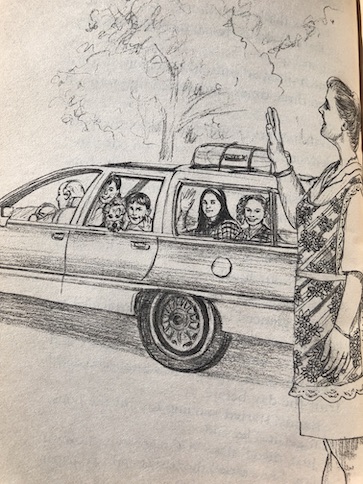
The Alden family has decided to go on a camping trip to a campground at a state park.  From the moment that they arrive, though, strange things seem to be happening.  When they stop for supplies, a woman Mr. Alden knows, Doris, seems oddly evasive when he tries to ask her about her sister, Hildy, and she makes the odd comment that she hopes nothing will spoil their trip.  As they pull into the state park, they discover that the arrow on the sign pointing to the rangers’ station has been reversed to point the wrong way.  Mr. Alden shrugs the incident off as a prank, but it’s only the beginning of the strange happenings.

The Aldens get to their camp site and notice that the place is a mess.  Either the previous campers were pretty messy, or they left in a hurry.  The Aldens clean up the site and set up their tents.  (The description of how they set up camp is actually somewhat educational because they talk about things to look for when choosing a campsite, how they have to check the ground for rocks and tree roots before setting up their tents and why they should avoid places where it looks like rain water might pool and why it can be dangerous to set up a tent under a tree if there is a lightning storm.)  Later that night, Violet is woken by the sound of music.  At first, she thinks that it must be some nearby campers, but it sounds too loud and too close.  When she and Jessie get up to investigate, the sound stops.

Later, the kids see strange lights in the woods, and things disappear or are moved around at their campsite.  When Mr. Alden realizes that someone has been sneaking into their camp and taking things, he suggests that they might want to leave the park, but the kids say that they’d rather stay because they’re still enjoying themselves.  Then, Mr. Alden injures his ankle when he’s startled by another blast of loud music and part of the path he’s on gives way because the dirt was loosened by rain.  The children are prepared to leave when their grandfather is injured, but to their surprise, Mr. Alden says that he’d rather stay, too.

Who is doing all of these things and why?  Is it the unfriendly Hildy, who lives alone in a cabin and wants everyone to leave her alone?  Or maybe her seemingly-helpful neighbor, Andy, for reasons of his own?  Could Doris be responsible?  What about the Changs, a family camping nearby who seemed disappointed that they didn’t have the campground to themselves?

There are some environmental themes and lessons in the story.  The Aldens frequently pick up litter that other campers and hikers leave behind.  There is also an explanation that the reason why part of the path Mr. Alden was on collapsed due to erosion because there are no trees along that section of path; tree roots help secure the soil so that it doesn’t wash away.  After the mystery is solved, Mr. Alden decides to donate some trees to the park, and the kids talk about adding more trash cans and a recycling center to help solve the litter problem.

The book is available to borrow and read for free online through Internet Archive.

The White Marble

WhiteMarble

The White Marble by Charlotte Zolotow, 1963.

WhiteMarbleGoingToPark

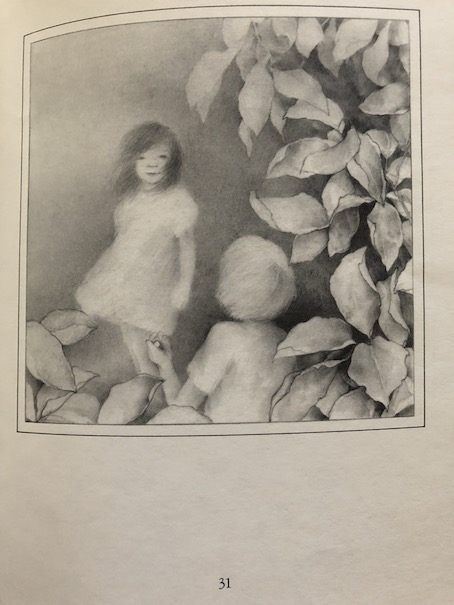
It’s a hot night in the city, and John Henry’s parents decide that they should go to the park to cool off.  John Henry is a little thrilled to be out with his parents at night, stopping to pick up a beautiful white marble he finds as they enter the park, but disappointed when he realizes that he is the only child there.

Then, a little girl he knows from school, Pamela, comes to the park with her mother.  John Henry is pleased to see her because only another child could understand how magical this night in the park really is.  He calls to her to come run with him, and the two children run off to play in the park together.

WhiteMarbleTwoKids

The children kick off their shoes and run barefoot in the cool grass.  They lie in the grass for awhile, drink water from a fountain, and have ice sticks (we always called them popsicles when we were kids) from the ice cream man.

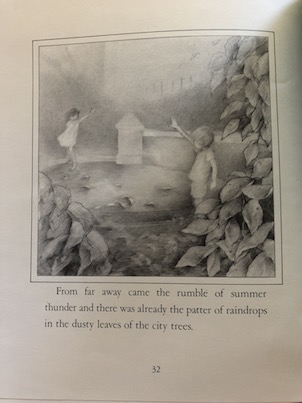
John Henry shows Pamela the little white marble he found.  Pamela thinks it’s as beautiful as he does, and John Henry realizes that no adult could understand how beautiful a small, simple thing like that could be, only another child.  That’s what binds John Henry and Pamela together.  As children, they can still appreciate the simple pleasures of life and the beauty and magic of small, ordinary things that adults take for granted, like a small white marble someone forgot in a park or how nice an evening can feel as rain moves in after a hot day.

WhiteMarbleGoodNight

When it’s time to go home, John Henry gives Pamela the white marble, a memento of this special night.

The pictures in this edition of the book are different from the ones that I remembered from the first time that I read it as a child.  This edition of the book, available through Internet Archive, shows the pictures that I remember.  The pictures in the later edition of the book are black and white, but the ones in the original edition are done in three colors: black, white, and blue.  Of the two, I really prefer the original drawings.  They capture the magic of a lovely night shared with a friend.

The Haunting of Cabin 13

Cabin13The Haunting of Cabin 13 by Kristi D. Holl, 1987.
Thirteen-year-old Laurie is looking forward to her family’s vacation. They’ve rented a cabin for a week, Cabin 13, by the lake at Backbone State Park (It’s a real state park in Iowa. Link repaired 10-19-22.), and her friend Jenny is staying there with them. Laurie’s mother isn’t looking forward to the trip. She hates dirt and bugs and doesn’t like the cabin when they arrive. As everyone starts unpacking, Laurie looks around the cabin and finds a note that warns them to leave because the cabin is haunted. Supposedly, it was written by the ghost herself. The note is signed “Eleanor.” Laurie’s mother thinks that they should leave right away, but Laurie and the rest of the family persuade her that it’s just a joke. At first, Laurie’s sure that’s all it is.

Then, the park ranger tells the family that the other families who have tried to stay in that cabin this summer also found similar notes. It might be just a prank, but it might not. He also tells them that a girl named Eleanor, the same age as Laurie and Jenny, drowned there the summer before, and strange things have been seen there since, like lights around the lake. Laurie’s brother, Ricky, thinks it sounds cool that they’re staying in a haunted cabin by a haunted lake. Like others, Laurie thinks that the notes are the product of a prankster, but what would be the point behind it?

The girls meet a pair of brothers who are staying nearby, Kevin and Matt. When they tell them about the note, Matt is eager to investigate. Jenny enjoys flirting with boys, and she’s mostly interested in flirting with good-looking, athletic Kevin. Matt is in a wheelchair, so Jenny doesn’t pay much attention to him. She just makes an awkward comment about cripples being able to contribute to society that makes everyone feel uncomfortable. Although Laurie knows that Jenny’s comment was inappropriately personal and callous, Laurie also underrates Matt’s ability to help with their note mystery at first, and she’s shy about talking to him because she’s often shy around boys. However, needing someone to confide her thoughts in when Jenny isn’t interested, Laurie talks to Matt about her theories about the mysterious notes. Matt turns out to be easy to talk to, helping Laurie get over her nervousness about talking to boys.

At first, Laurie tells Matt that she thinks that the prankster is trying to drive people away from Cabin 13 because something important is hidden there. However, as she starts asking questions about Eleanor, she learns that the notes haven’t just been directed at Cabin 13. Staff at the park have also received notes from “Eleanor.” Laurie also sees a figure in black sneaking around the park, who she is sure is not a ghost.

It isn’t long before Laurie receives more notes from “Eleanor,” hinting that she might be in danger, and she and Jenny see the mysterious lights that people have been talking about. Then, when the children are out in a canoe together, it develops a leak and sinks. Matt panics because his legs are paralyzed, and he can’t swim, but Laurie saves him with the help of some people in another boat.

Was that accident just an accident, or could it have something to do with Eleanor’s “accident” last year? There are plenty of suspects who might have reasons for playing ghost and stirring up trouble at the lake. Matt’s father blames the park ranger for the accident that paralyzed Matt. At a previous visit to the lake, Matt was crossing a road with his father and brother and was struck by a speeding car. Matt father says it wouldn’t have happened if the roads had been policed properly. Laurie realizes that he might have a motive for revenge. Then again, some people have been coming to the lake, drawn by the ghost stories and hoping to see the mysterious lights. Could the ghost be a publicity stunt to drum up business?

The book is available to borrow and read for free online through Internet Archive.

My Reaction and Spoilers

When Laurie discovers that Eleanor’s half sister has come to the lake to investigate Eleanor’s death herself, she thinks that she has the mystery solved, but she’s only half right. It’s true that Eleanor’s sister has been responsible for some of the things happening at the lake, but not all of them.  She explains to the kids that Eleanor loved mystery stories and was always playing detective games, but she thinks that perhaps the game got too real for Eleanor the summer that she died.  There is something sinister going on at the lake, something that Eleanor also realized before her death, and there is more to Eleanor’s death than most people know.

At the end of the book, Matt gets a chance to be a hero and stop the bad guy from escaping, using his wheelchair to his advantage because a person on wheels can sometimes move faster than a person on foot.  Even before that, Laurie had gained an appreciation for Matt and his sensible thinking, realizing that a person who is impaired in one way can still have great abilities in other areas of life.  She also comes to think of Matt as being brave for coming back to the site of the accident that made him a paraplegic.  Matt says that he had to come in order to prove to himself that there was nothing inherently bad about the  place and to stop the nightmares he was having about his accident.  Matt and Eleanor’s sister both make Laurie realize that everyone has something difficult or frightening that they have to deal with in their lives; it’s just that some people’s problems are more obvious than others.  Everyone can see what Matt’s dealing with at first glance because he’s in a wheelchair, but no one knew about the pain and fear that Eleanor’s sister was carrying around with her until she admitted it.

I consider this story a pseudo-ghost story because the obvious parts of the haunting were caused by living people, for reasons of their own.  However, Laurie seems to feel that Eleanor’s spirit was there with them, waiting to see the mystery of her death solved.  It’s left open to interpretation, but if Eleanor was there, it was only seen in the odd feelings that Laurie had from time to time, not in any more obvious or physical way.

Something that confused me a little in the book is that, at one point, Jenny tells someone that Laurie already has a reputation for being an amateur detective, having discovered that Jenny herself had been kidnapped when the authorities thought that she had run away from home. Jenny gives full details of the time when she was kidnapped, including who kidnapped her and why and how Laurie figured out where she was. When I read that section of the story, I thought at first that the author was talking about a previous book that she had written with these two characters, but I had trouble figuring out which it was, if any.

Interesting fact: some of the children in the story are named after the author’s own children.

What’s a Ghost Going to Do?

WhatGhostDo

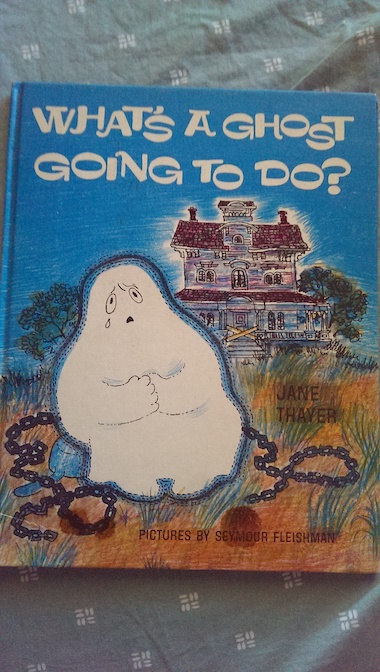
What’s a Ghost Going to Do? by Jane Thayer, 1966.

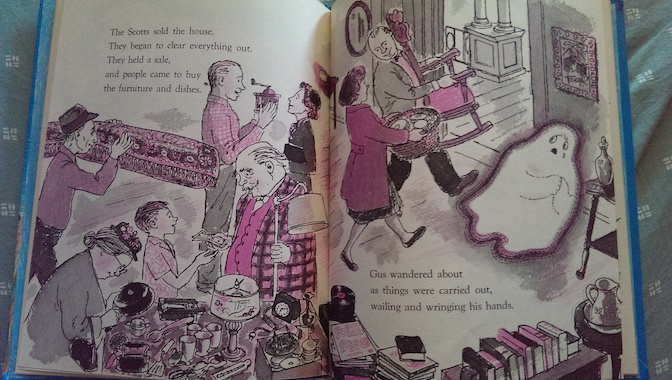
Gus is a friendly ghost who lives a quiet life alone in his old house, which is run-down and shabby, with winter visits from his mouse friend.  However, Gus discovers one day that the property is being sold.  The government wants the land to turn into a park, and if that happens, Gus’s house will be torn down!  If they decide to tear the house down, where will he go?

WhatGhostDoSale

For a time, Gus tries living with another ghost in another old house nearby, but that arrangement doesn’t work because the other ghost doesn’t like Gus rattling chains.  Then, Gus tries living in a hole with his mouse friend, but it’s really too small for him.  The only place that seems right for Gus is his old house, which is in danger of being destroyed!

WhatGhostDoHints

In desperation, Gus whispers in the ears of the man in charge of preparing the park for the government, Mr. McGovern, trying to get him to notice the virtues of his house.  Fortunately, Mr. McGovern accepts Gus’s vision of the house as a beautiful piece of the past and finds a way to restore it to its former glory so that Gus can keep his home and others can appreciate it, too.

WhatGhostDoRepairs

Gus’s house becomes a museum in the park, and Mr. McGovern also officially acknowledges Gus as the resident ghost.

The book is available to borrow and read for free online through Internet Archive. It’s part of a series.

WhatGhostDoMuseum

My Reaction

I’ve had this book since I was a little kid. I always felt sorry for poor Gus throughout the book, but the story has a nice ending, with Gus and Mr. McGovern finding a creative way to restore the house and put it to good use, filling it with antique furniture for both Gus and the public to enjoy. I haven’t read any of the others in the series yet because this is the only one I’ve ever had.

Make Way for Ducklings

MakeWay

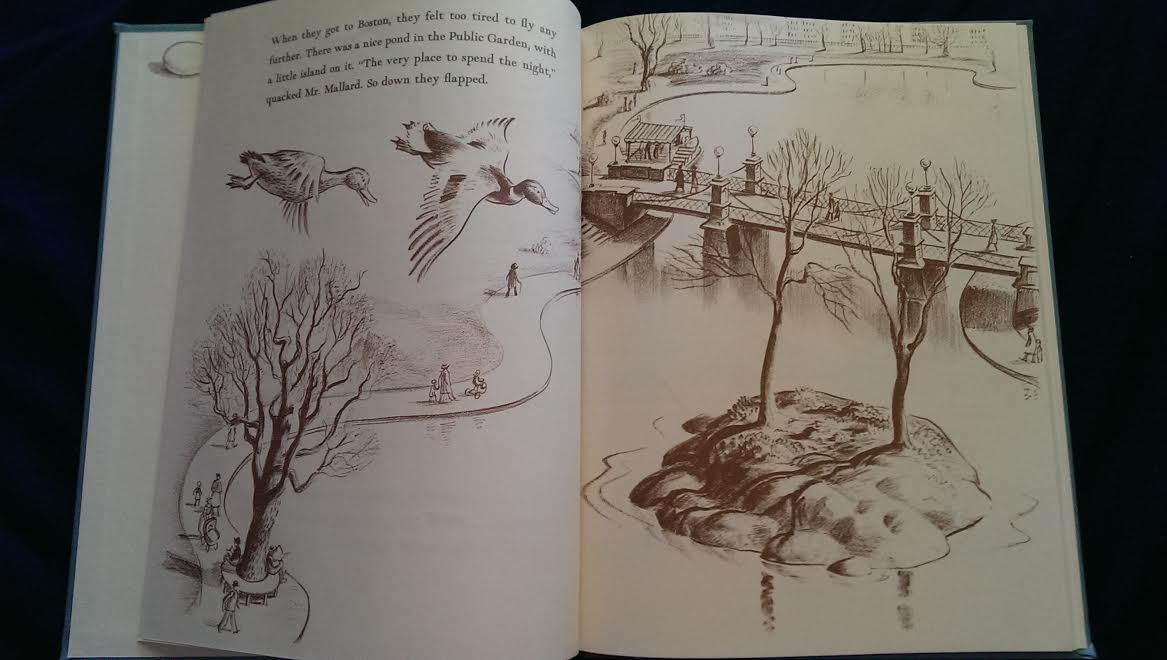
Mr. and Mrs. Mallard are looking for a new home where they can raise their babies.  After trying several places, they finally find a place that seems right on an island in the Charles River, not far from the Public Garden where people fed them peanuts.

MakeWayPic1

Then, one day, Mr. Mallard decides to take a trip to explore the river, leaving Mrs. Mallard and their ducklings on the island.  The two of them agree to meet again with their ducklings in the Public Garden in a week.  However, the journey from the river to the garden is perilous.  Mrs. Mallard and her ducklings need the help of some friendly policemen to make it safely through the city!

MakeWayPic2

The classic children’s picture book is cute and gentle with a happy ending for the Mallard family. This book is a Caldecott Medal winner and the Official State Children’s Book of Massachusetts.

MakeWayPic3

The book is available to borrow and read for free online through Internet Archive (multiple copies).