The Haunted House

Peanut Butter and Jelly
PJHauntedHouse

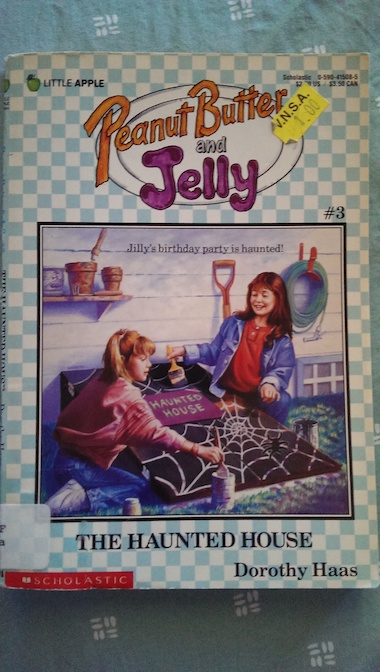
#3 The Haunted House by Dorothy Haas, 1988.

PJHauntedHouseCostumesJilly was sick on her birthday and couldn’t have a party, so she and Peanut decide to hold an haunted house party, just for fun and invite all the kids in their class. The girls’ nemesis, Jennifer, and her friends are in another class and won’t be invited to the party, but when they hear about it, they make it a point to tell Peanut and Jilly how childish it sounds.  However, no one else seems to think so, and the girls’ classmates are eager to come.

Peanut has fun making Halloween-themed food, and the girls decorate the fruit cellar in Jilly’s basement as their haunted house. They tell everyone to come in costume, and promise a prize to the person in the best costume.  Peanut also tells everyone to bring un-birthday presents to surprise Jilly and make up for missing her actual birthday.

Everyone is excited about the party, but when it starts, some strange things happen. First, it looks like more people show up than they expected.  Then, a mysterious, glowing ghost comes and tells them the tragic story of his death. What is going on?

This is just a fun book about a group of friends and a fun haunted house party they had together.  It doesn’t actually take place on Halloween (the girls get a fake skeleton on sale that was left over from Halloween), but it makes a nice Halloween-type story.  When I was a kid, I liked reading about the creative ways the girls set up the various surprises in the haunted house: making people crawl through a tunnel they’d made, having a skeleton pop out of a trunk by attaching elastic to it, and using a rubber glove filled with water and frozen as a ghostly hand reaching out to touch people, etc.  They also describe how Peanut made “frogs’ noses” out of shell pasta that was dyed green and covered with salad dressing as scary food for the party guests.

The book is currently available online through Internet Archive.

How to Haunt a House for Halloween

HauntAHouse

How to Haunt a House for Halloween by Friedhoffer, the Madman of Magic, with Harriet Brown, 1988.

This book was written by a magician to provide tips for setting up a haunted house for a party, either in your house with friends or in a more public setting, like a school, camp, or church party or carnival.  It starts with basic preparation tips, like deciding the type of haunted house you want, making sure that you have permission for the project from the person in charge (whether it’s parents or a school principal), mapping out the available space and what you would like to put in it, and making lists of invited guests.

The book advises setting a mood and storyline for the haunted house, with a script to follow based around the type of ghost story you have in mind surrounding the house.  A well-told story with the proper atmosphere helps to draw the audience in and keep them in the right frame of mind.

There are tips to appeal to different senses with the haunted house effects, including sound (spooky noises) and touch (things people will feel as they walk through the house but not necessarily see).

Many of the haunted house tricks described are basically magic tricks, which makes sense for a book written by a magician.  Some are costumes for “ghosts” in the haunted house like an “Elongating Ghost” (a ghost that can grow unnaturally tall) and a headless man.  The last section of the book describes how to hold a fake seance.  The beginning emphasizes that it’s more important to perform simple effects well than to have fancy effects.

The book is currently available online through Internet Archive.

Which Witch is Which

WhichWitch

Which Witch is Which by Pat Hutchins, 1989.

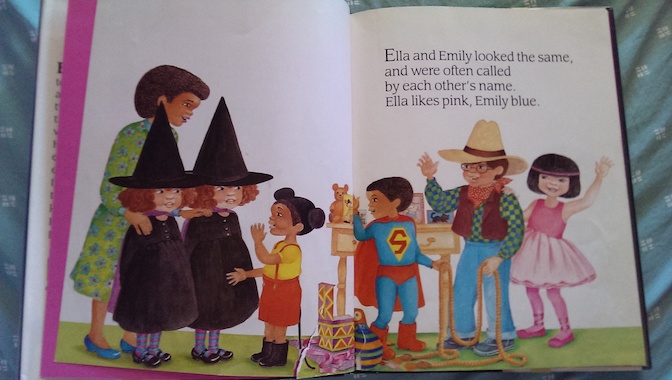
This is a cute picture book/puzzle book.  A pair of twins, Ella and Emily, are invited to a friend’s costume party, but they come dressed as witches in identical (or nearly identical) costumes.  Throughout the party, as the girls play party games, eat the party snacks, and give presents to their host, readers are invited to figure out which twin is which.

WhichWitchIntro

The main clue to the girls’ identities is that Ella’s favorite color is pink while Emily prefers the color blue.  Things that the girls have in those colors or objects that they select give away their identities

WhichWitchPresents

However, there are also other hints, like we are told what each of the girls ate at the party so that we can use the crumbs left on their plates (or the lack of crumbs) to determine which witch is which.

WhichWitchCake

The text of the book rhymes.  The illustrations are cute, and it’s a good book for teaching children how to notice details.

The book is available to borrow and read for free online through Internet Archive.

WhichWitchPlates

Something Queer at the Birthday Party

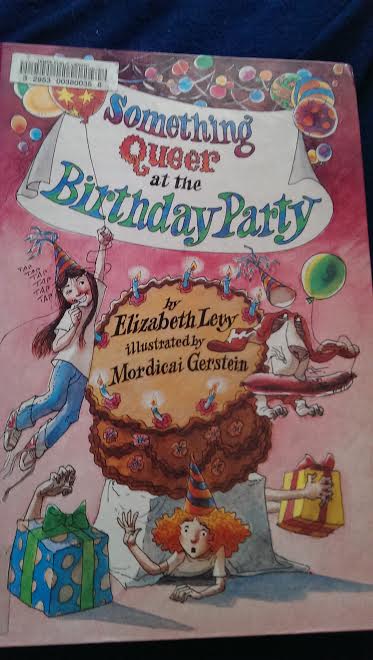
SQBirthdaySomething Queer at the Birthday Party by Elizabeth Levy, illustrated by Mordicai Gerstein, 1989.

Jill and some other friends are throwing a surprise birthday party for Gwen. They send out invitations secretly and create a mystery game for Gwen with a series of clues to lead her to the party.  As part of the game, Jill pretends that someone broke into her house and stole a painting of her and her dog, Fletcher.  The clues to the thief lead Gwen into the room where all of their friends are hiding, waiting to surprise her.

Gwen loves their little mystery and the surprise, and the party seems a success. But when it’s time to bring out the cake and open presents, Jill discovers that they are missing from the closet where they were hidden. At first, Gwen thinks that it’s just another mystery game, but Jill tells her that the presents really are missing. Who took the presents, and where are they now?

SQBirthdayPic1Gwen takes her party and all the guests on a hunt across town for her missing presents, but the big clues turn out to be right back where they started, and Fletcher leads them right to what they’re looking for.

The solution to this mystery touches on a problem that children with a birthday near Christmas understand: When your birthday is near a major holiday, people don’t pay as much attention to it or give as many presents.  My grandmother said it was the same with her when she was young, and she was also the eldest child in a large family, so her birthday was never quite what it should have been.  In the story, one of the girls’ friends had this problem, and it was the motive behind this temporary theft.  The culprit didn’t mean to keep the presents forever, they just wanted to pretend that they were all theirs for a little while.  Gwen forgives the culprit and shares the rest of her birthday with this person.

The book is part of the Something Queer Mysteries.

The Mysterious Visitor

Trixie Belden

tbvisitor#4 The Mysterious Visitor by Julie Campbell, 1954.

Now that school has started again, Trixie and Honey see more of the other kids who live in Sleepyside, including a girl named Diana Lynch. Trixie has known Diana for a long time, but ever since her father made a lot of money, Diana has been distant.

Di is deeply unhappy because her parents, particularly her mother, have been trying to live up to their new status by having the household run by fussy servants who don’t care much for children. Diana always has to wear formal clothes, she doesn’t get to play with her younger siblings as much, and she finds it increasingly hard to just relax and have fun with friends.

When Honey and Trixie invite Diana to become a member of the Bob-Whites, she tells them about her long-lost uncle who has recently come to visit her family. Her mother is happy about finally meeting the brother she has not seen since she was a baby, but Uncle Monty has been making Di’s life miserable. Whenever she makes plans to have a Halloween party or do things with friends, he tries his best to interfere and ruin everything. Uncle Monty is rude and offends people. Trixie is convinced that Di’s Uncle Monty is not what he seems to be, but she’s not sure how to prove it.

I love the description of the Halloween party that the kids have at Diana’s house!

The book is currently available online through Internet Archive.