Hand Shadows

When I first read and started playing with this book as a kid, I didn’t stop to read the preface in the book or look at the publishing date, so I completely missed the fact that this is a reprint of a book from the late 1850s. The author, Henry Bursill (link repaired 9-11-24), was a professional artist

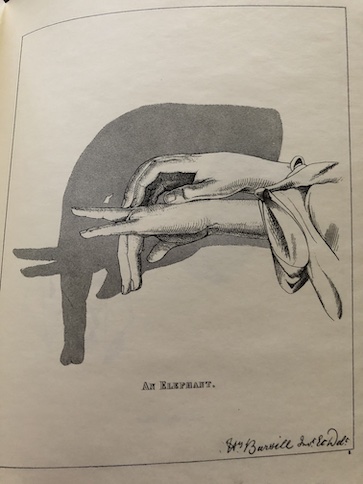
In the preface, Bursill refers to a well-known print from the early 19th century called The Rabbit on the Wall, which shows a father making shadow figures on the wall with his hands to amuse his children. Bursill says that there have been other books about hand shadows before his, but he emphasizes that his book is not the same as theirs because he has worked out his own hand shadows through experimentation. He says that it will take some practice for people making hand shadows to get them perfectly, but he encourages people to practice and not be afraid to work out new hand shadows of their own through experimentation. Bursill did the illustrations for the book himself, and he says that he began sketching some of the designs during his time as an art student and that he would amuse some fellow students by making hand shadows on the wall of his studio.
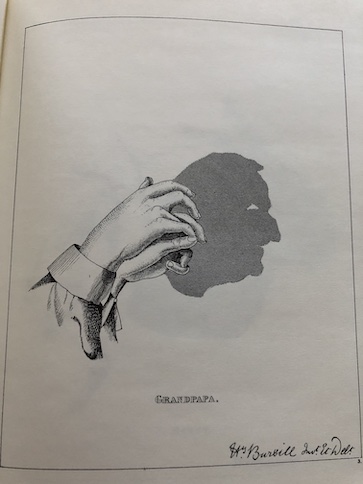
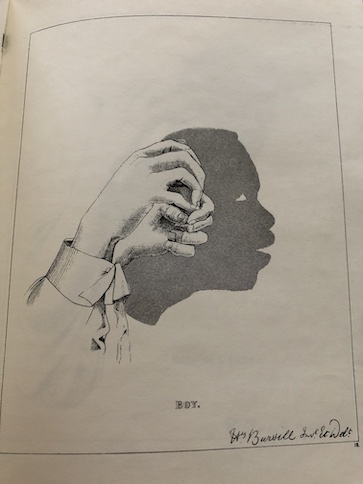
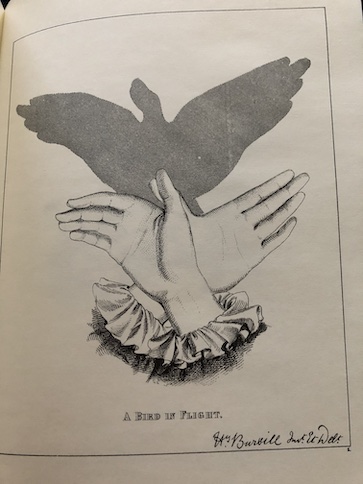
Other than the preface, the only words in the book are the captions on each of the pictures. I’ve tried some of the hand shadows in the book, and I had a more difficult time than the preface makes it sound. The only ones I’ve really been able to do well were the bird and the greyhound. I haven’t given up on mastering some of the more difficult ones someday, though!
The book is available to read for free online through Project Gutenberg and Internet Archive (multiple copies).

Cat’s Cradle String Games

Cat’s Cradle String Games by Camilla Gryski, 1983.

Back when I was in middle school, I went through a phase where I was really into cat’s cradle. I’m one of those people who like to have something to fiddle with in their hands, and it was easy to carry a loop of string in my pocket. If I lost the string, I could always make another string loop and carry that. This was the book that I used to teach myself how to make cat’s cradle string figures.

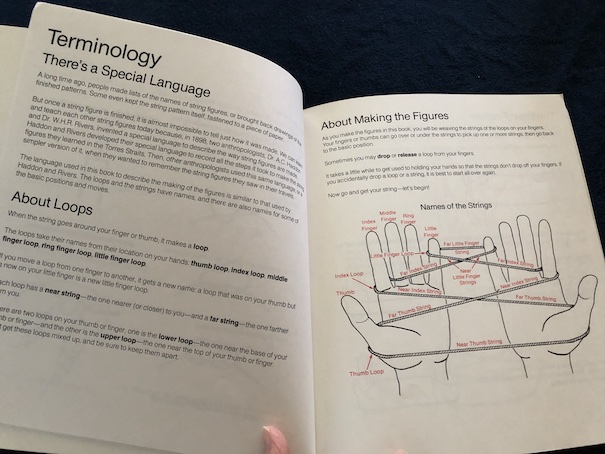
The book begins with a section that explains the terminology of making string figures and how to start out with the string in a basic position on the hands.

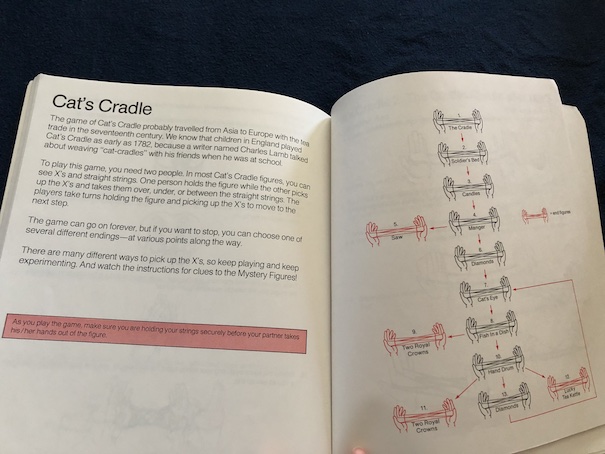
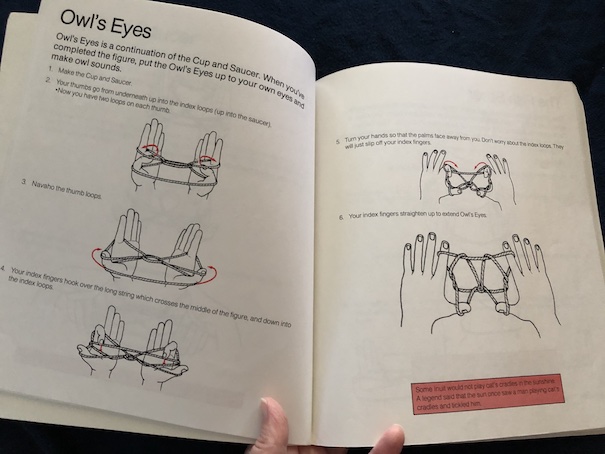
From there, the book covers how to make various string figures. As the book demonstrates how to make different figures, it explains a little about which cultures use them. Cat’s cradle and similar string games are played around the world, and different cultures have had different names for some of the same figures. For example the “cup and saucer” figure can be called a saki cup or maybe a house if it’s held upside down.

Some figures can be made independently of each other, but what turns making string figures into the game of cat’s cradle is the fact that some figures can be turned into other figures in a sequence. The book demonstrates the sequence of making figures involved in playing a game of cat’s cradle. It’s a game for two players with the players each taking the string from each other to form each of the figures. The game ends when one of the players forms one of the ending figures that doesn’t lead to any other figure.

The book is available to borrow and read for free online through Internet Archive.

Stop the Watch

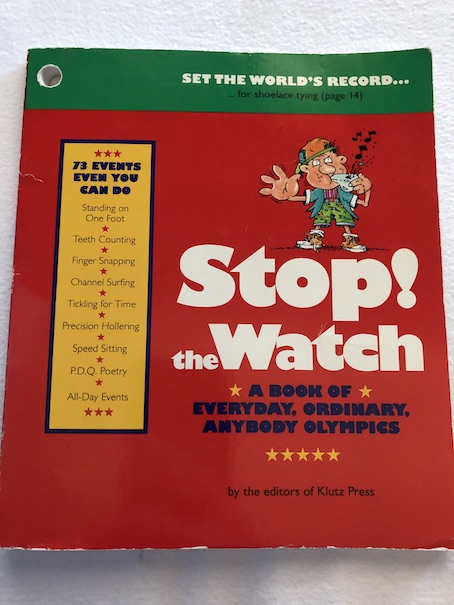
Stop! the Watch by the Editors of Klutz Press, 1993.

This book is part of the classic children’s hobby and activity series from Klutz Press. Originally, this book came with a working stopwatch in bright colors, which was attached to the book at the hole in the upper left corner. Unfortunately, I broke my stopwatch years ago, but I liked the book, and I got a new stopwatch to use with it.

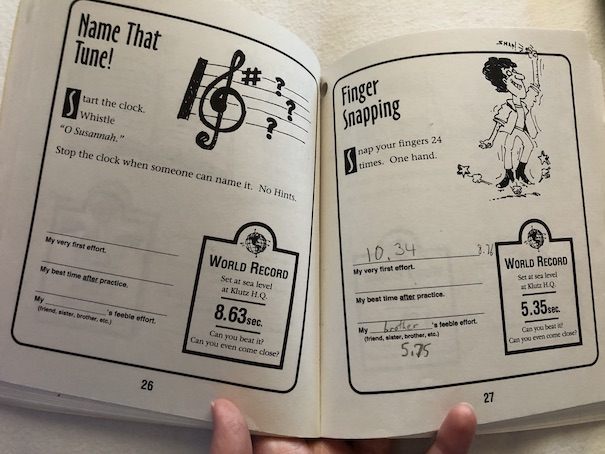
The book begins with instructions for using the stopwatch and then offers various timed activities and goals for kids to reach while using the stopwatch. Most of the activities involved kids performing various simple stunts and trying to do them as fast as possible, like counting to 126 by 7s, writing a verse from The Song of Hiawatha, tying shoelaces, singing “Happy Birthday” to Rumpelstiltskin, walking up a flight of stairs with a book balanced on the head, and drawing a picture of a gorilla. There are places in the book to record your efforts and your own time records and the records of your friends. (You can see in my copy where I made notes.)

There are also activities that participants are supposed to perform for a very specific amount of time, trying to keep as close to the allotted time as possible without actually watching the watch. For example, one of the events is hollering the word “Eeeeellllllskin” for exactly 17 seconds.

There are also some events that are meant to be completed by two people acting as a team, like leapfrogging, carrying your partner ten steps, singing “Jingle Bells” while alternating words between partners, and throwing something weird back and forth.

The original edition of this book included time records set by the author and others at Klutz HQ. Readers could compete against these records and try to beat them, and later editions of the book were printed with new records set by readers who reported their results.

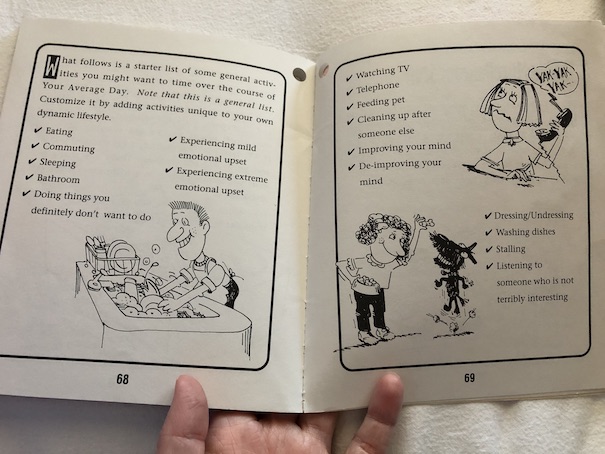
In the back of the book, there is a section explaining how to time daily events and predict about how much time you will spend doing those things throughout your life, like how much time you spend in the bathroom. Some of these things can be enlightening, like how much time you spend watching tv (Is it too much?), being emotionally upset (Have you been stressing too much?), or stalling when you’re supposed to be doing something else. There are also some educational ways of using time. The book explains how to tell how fast the car you’re traveling in is driving without looking at the spedometer by timing the distance between mile markers. It also explains how to tell how high you’ve tossed a ball by timing how long it takes to hit the ground.

The book is available to borrow and read online through Internet Archive.

Games People Play: China

Games People Play: China by Kim Dramer, 1997.

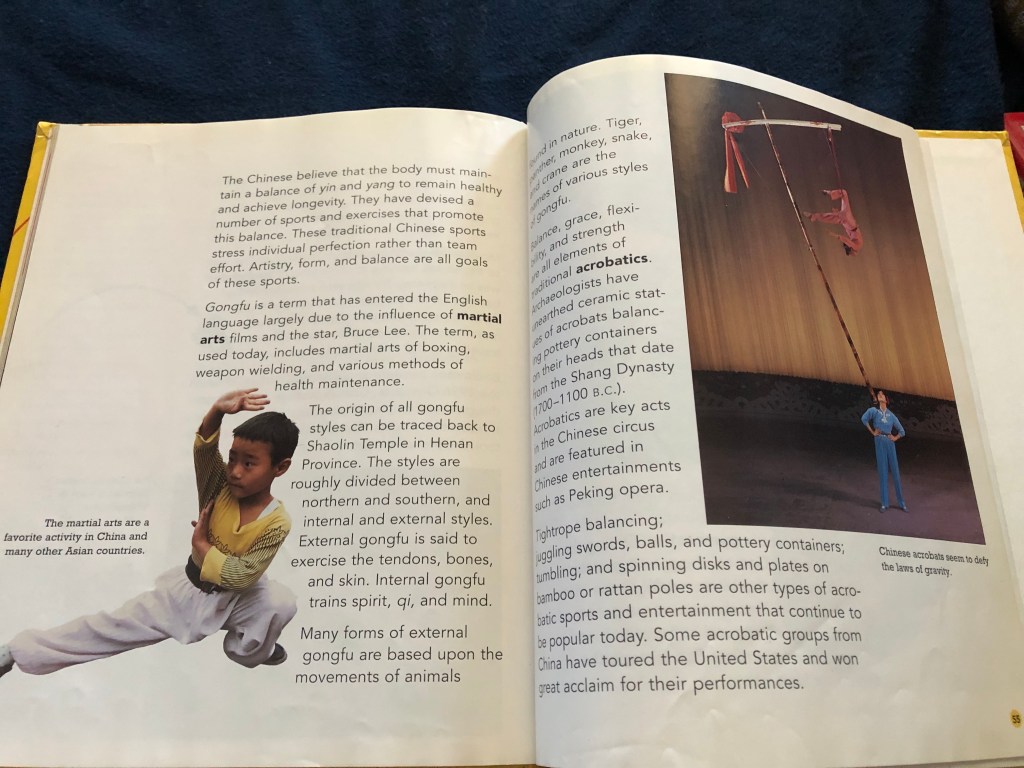
This book is part of a series about games played around the world. The series also covers sports and other, related activities. This book is specifically about the traditional games and sports of China.

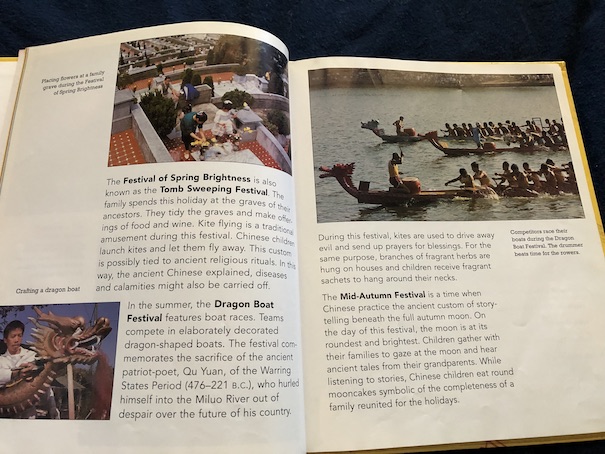
China’s history goes back thousands of years, and so does the history of games and toys enjoyed there by generations of children. The book begins with a brief history of China. This book was written in the 1990s, and it contains a brief description of China’s one-child policy, which controlled the sizes of Chinese families and impacted the way in which children were raised. It also explains some important Chinese festivals, such as the Lunar New Year, Lantern Festival, and Dragon Boat Festival. It explains the origins of these festivals and how people celebrate, including the roles of children in the celebrations.

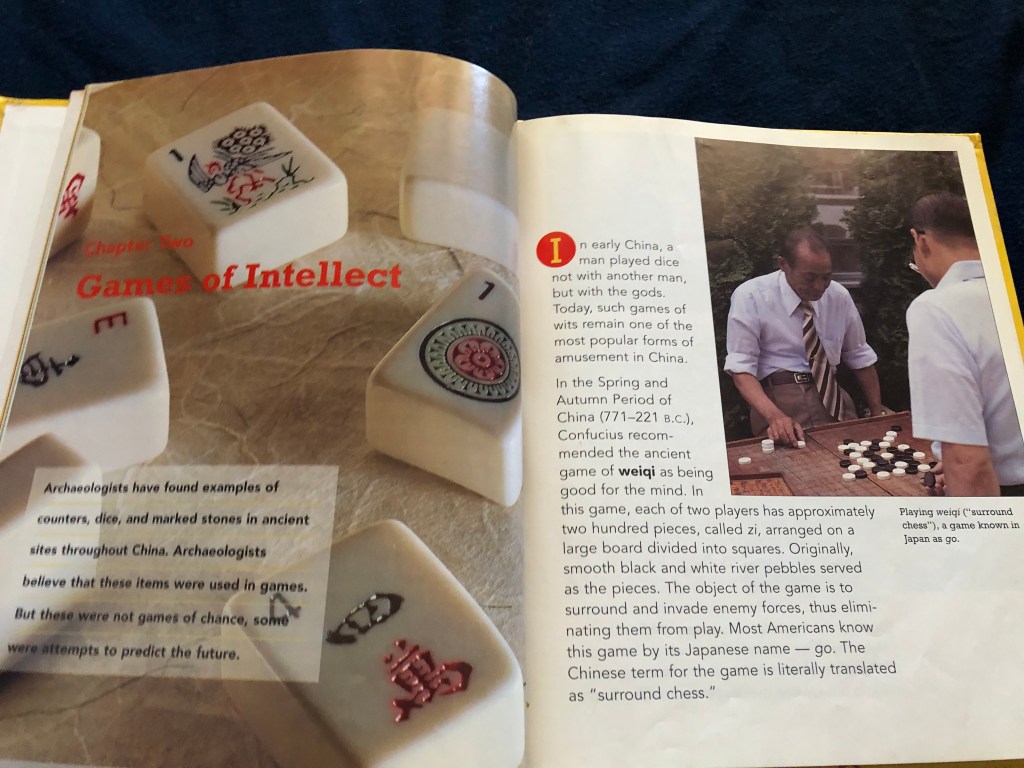
I most enjoyed the sections about board games. Some of the oldest board games in the world come from China. Some of these games are also played in Japan under different names. For example, the game Weiqi is known as Go in Japan, and this is the name that is also most familiar to Americans. Chinese Chess uses different pieces from the international form of chess. The book mentions Chinese Checkers also, but it doesn’t explain that it was not actually invented in China, even though it is played there today. (The “Chinese” in the title was a marketing gimmick in the United States, to make the game seem more exotic. It’s actually a German variation of the American game Halma, which was based on an older English game called Hoppers.) Majiang (called Mah-Jongg in the United States) is another well-known Chinese game. Sometimes, in the United States, people play it as a solitaire game on their computes, but the real-life board game is a multiplayer game with several variations.

When I was in school, I had a teacher who was fond of tangrams, which is a kind of puzzle game that involves using a set of basic shapes to produce different forms or pictures of objects. The book demonstrates how to make a tangram set and how to use it.

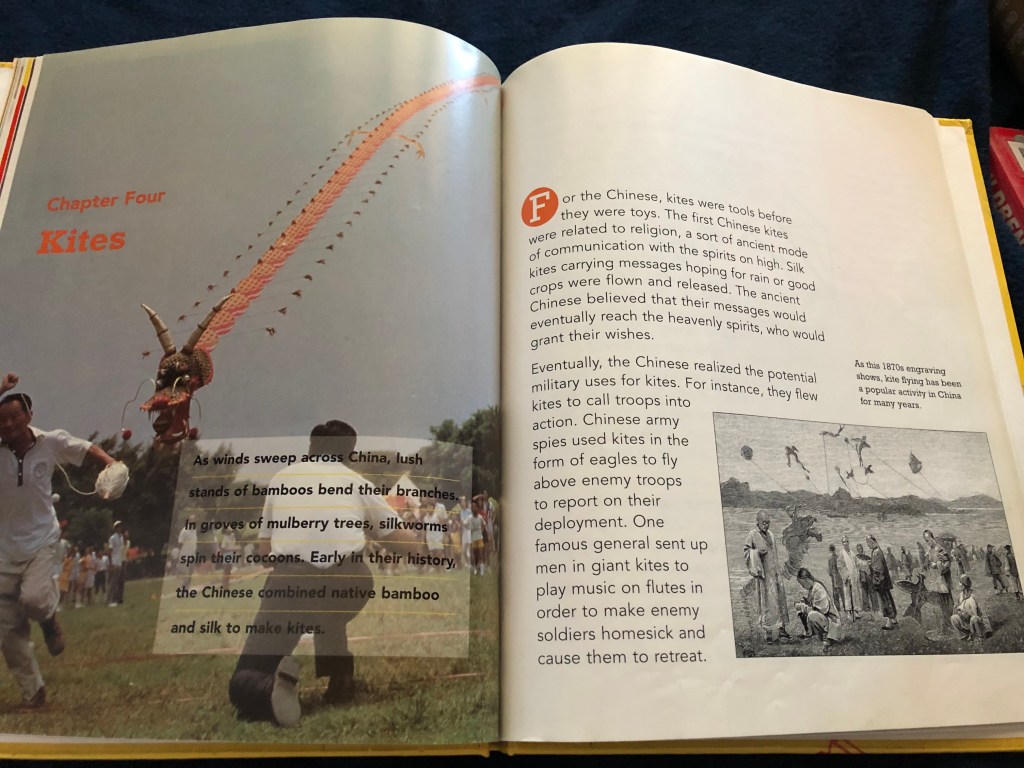
The earliest kites made in China were made for serious, religious purposes, sending prayers, signs, or messages to the heavens. Later, the Chinese also used them to give military signals. Later, paper kites became a popular form of amusement and folk art. They can be made in many different forms. Some of them even make musical sounds, caused by the wind passing over holes placed in the bamboo frame of the kite.

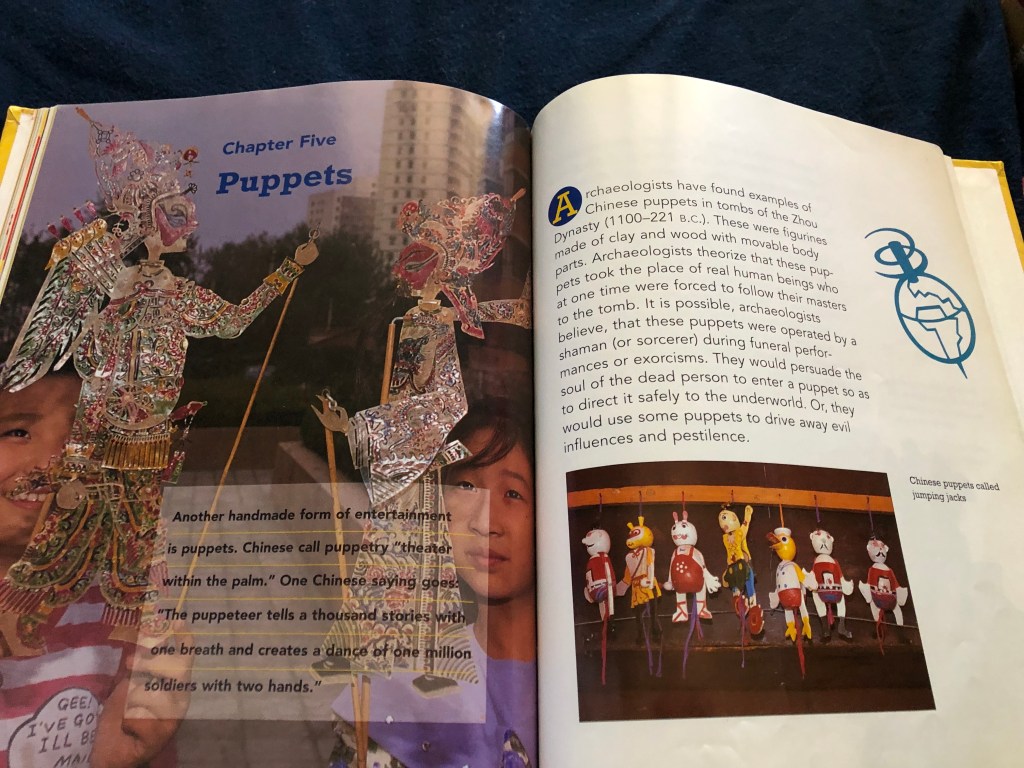
The Chinese also use puppets in different styles. The history of puppet theater also goes back thousands of years, and puppets made for puppet theaters can be very elaborate. Sometimes, plays are performed with shadow puppets controlled by sticks and sometimes with marionettes or hand puppets. The appearance of a puppet and provide clues to the puppet’s character. For example, puppets with red faces represent brave characters while ones with white faces may be cunning and treacherous and ones with black faces are loyal.

Popular sports in China include soccer (called “football” everywhere but in North America) and badminton. China is also famous for its martial arts and some spectacular forms of acrobatics.

Kate Greenaway’s Book of Games

Kate Greenaway’s Book of Games by Kate Greenaway, 1889.

A book about children’s games with rules and general pastimes. The book doesn’t distinguish between the two, but I do because, to me, games have specific rules whereas more general pastimes and toys do not.

Many of the games and pastimes would be familiar to people in modern times and are still popular. Some games are like playground games (some of them are even still played on playgrounds today) that require running and motions, and others are more talking games (some of those have become classic road trip games, played in the car). Pastimes include making soap bubbles, flying kites, and using swings.

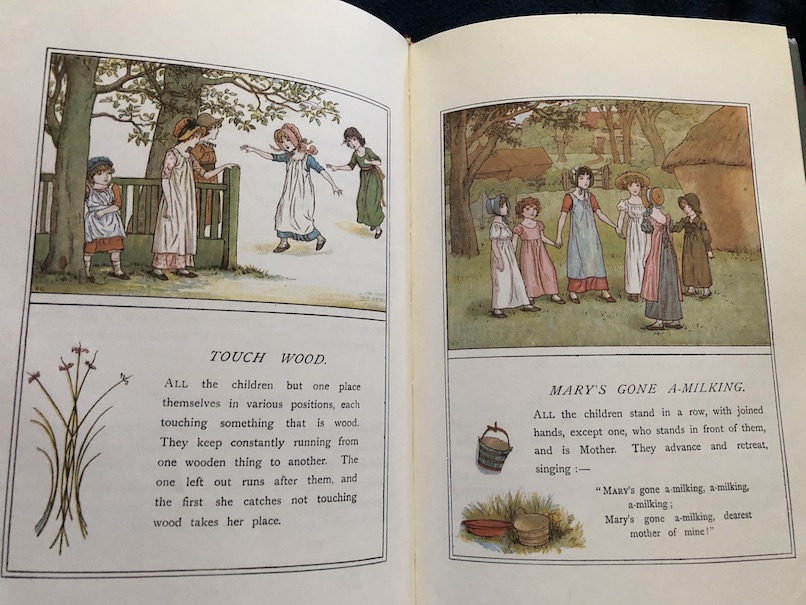
The book includes games like I Love my Love with an “A”, Blind Man’s Buff, Frog in the Middle, Russian Scandal (This is an old name for the Game of Telephone, before the invention of the telephone became really popular. I’ve also heard it as Russian Gossip, although I don’t know why it’s specifically “Russian.”), French and English (which is basically Capture the Flag), Oranges and Lemons (which is played like London Bridge is Falling Down, only with a different rhyme), and Twenty Questions. Some of the less familiar ones, especially to young Americans today, might be Puss in the Corner (a game that involves players running and changing places with each other and the person who is left without a place being “it” or the “puss”), Mary’s Gone A-Milking (a chase game with a song), What Is My Thought Like? (a talking/guessing game that involves creativity), and The Old Soldier and Judge and Jury (which are both talking games with words that are forbidden to say).

One of the interesting things about this book, besides noticing which games are still played and which are more obscure now, is that the children in the pictures are actually wearing clothes that are from an earlier part of the 19th century from when the book was written. This is a classic feature of Kate Greenaway’s illustrations, also seen in her other books. Modern people who are less familiar with the evolution of 19th century clothing might not notice that detail.

This book is still in print in modern times. It also available to borrow for free online through Internet Archive (multiple copies).
For more information about Victorian games in general, see the Victorian Games section of my Historical Games site. History and games are both hobbies of mine.