The Clown of God

The Clown of God by Tomie dePaola, 1978.

The book begins with a note that the story is based on an old French legend, although the story actually takes place in Italy.

A young boy named Giovanni has no parents and must live as a beggar, but he knows how to juggle. He juggles fruit and vegetables in the marketplace, and the produce sellers give him food in exchange for drawing people’s attention to their wares.

One day, Giovanni sees some actors putting on a play, and he asks for a job with the troupe. After he demonstrates his juggling ability, they agree to take him on in exchange for food and a place to sleep.

Over time, Giovanni’s juggling act becomes more elaborate. Eventually, he becomes famous in his own right and leaves the troupe to become an entertainer for many important people.

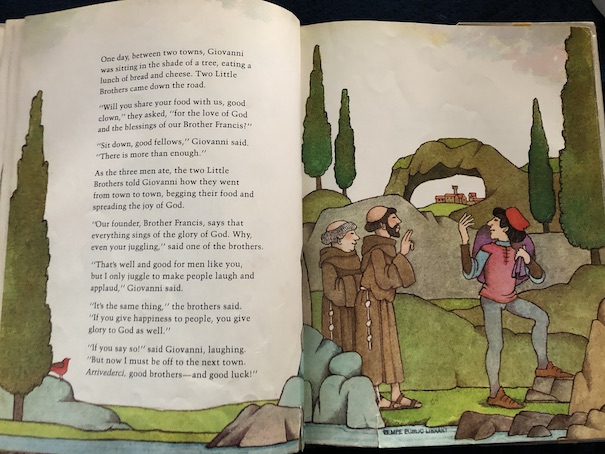
During his travels, he meets two monks, who ask him if he is willing to share his food with them. He agrees, and they tell him about Brother Francis, the founder of their order. (St. Francis of Assissi. They are Franciscan monks.) They say that everything in the world is a sign of God’s glory, even Giovanni’s juggling. Giovanni says that he never thought of it like that before. He just likes making people happy with his performance. The monks say that making people happy is a way of glorifying God.
Giovanni continues his performances, but as he gets older, people get tired of his act, and one day, he actually drops one of his juggling balls. For a time, he has to live as a beggar again. However, he eventually finds his way to the monastery where the Franciscan monks live.
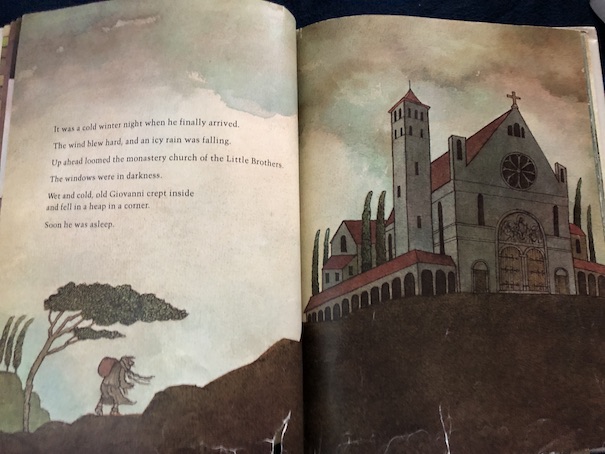
He arrives at the monastery at Christmas, and there is a special procession where people are offering gifts to the Christ Child, placing them in front of a statue of Jesus and Mary. Giovanni is struck by how serious the Christ Child looks in the statue, and so he decides to perform the act that used to make everyone smile.
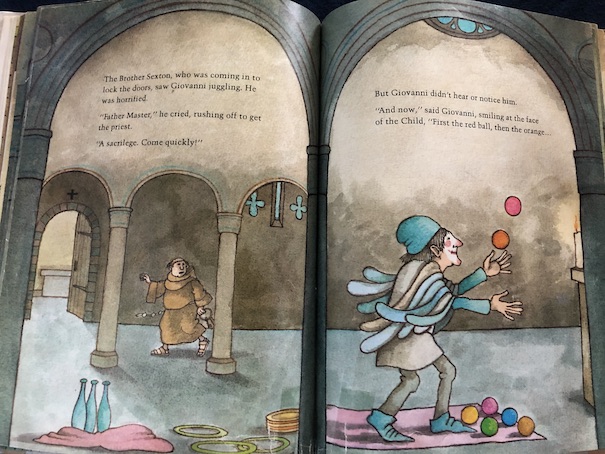
When one of the monks sees him juggling in front of the statue, he thinks that it’s a sacrilege and calls the priest to come see what Giovanni is doing.

The story is sad because Giovanni’s exertion in giving the best performance of his life causes him to have a heart attack and die. However, the priest and the monk notice that, suddenly, the statue is smiling and holding Giovanni’s special golden ball.

The story is about using talents to the fullest. The juggler’s talent, as the monks said, was a gift from God. For as long as he could, he used it to make people happy, and when he was too old to do so anymore, he gave his last, finest performance for Jesus.

The book is available to borrow and read for free online through Internet Archive.

Amazing Grace

Amazing Grace by Mary Hoffman, 1991.

Grace loves stories, both hearing them and acting them out. She is imaginative, and likes playing games of pretend and acting out adventures.

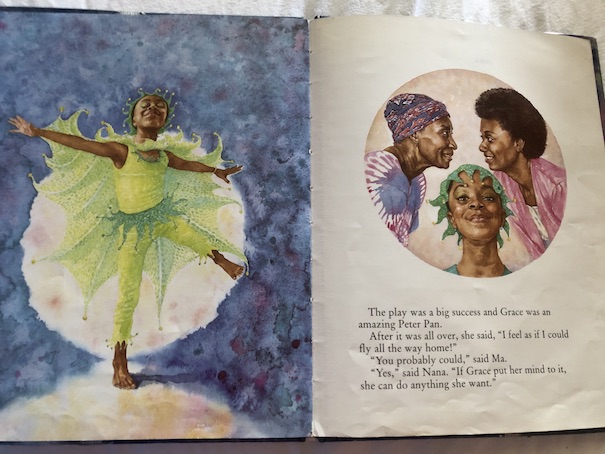
When Grace’s teacher tells the class that they are going to perform the play Peter Pan and will be holding auditions for parts in the play, Grace wants the title role of Peter Pan. A couple of the other kids think that it’s odd for her to want to be Peter Pan because she is both a girl and black, which is exactly the opposite of how they usually see the character.

However, Grace still wants to play Peter Pan. When she tells her mother and grandmother what the other kids said, they reassure her that she can get the part if she really wants it and puts her mind to it.

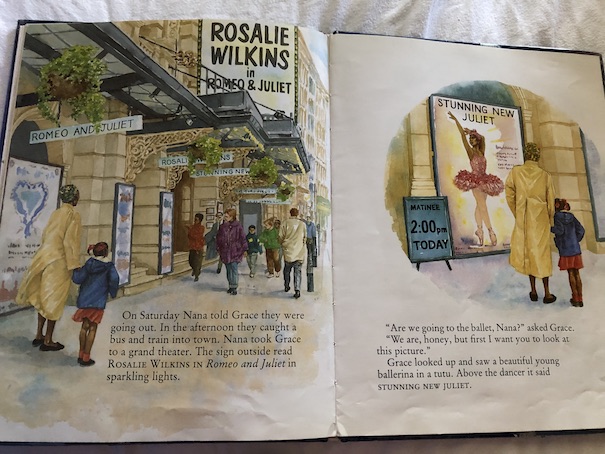
To prove to Grace that a young black girl can get starring roles, her grandmother takes her to see a ballet where the granddaughter of a friend of hers from Trinidad is playing the role of Juliet in Romeo and Juliet.

Seeing the performance cheers Grace up and gives her the confidence to audition for the part of Peter Pan. When her classmates see how good she is when she performs, they all agree that Grace should have the role of Peter Pan.

The message that young girls like Grace can do what they set their minds to, even if the roles they want in life aren’t quite traditional, is a good one. As I read the story, I was also thinking that the objection that Grace can’t be Peter Pan actually doesn’t make much sense if you know that Peter Pan, of all roles in plays, is one that is often played by a female. I remember that when I was a kid in elementary school, there was a girl who played the part of Peter Pan, and one of the teachers explained that women sometimes play Peter Pan, especially when the actors are all adults, because women have the higher-pitched voices that the part really needs. I would liked it if the teacher in the story also mentioned that. Also, acting is about capturing the spirit of the character in the story, thinking and feeling like they would think and feel and acting the way they would act. I would have liked it if they had mentioned that. Grace may not look quite the way people might picture Peter Pan, but if she can capture the character in her performance, she’s a good actor.

I liked the pictures in the book for their realism. In a couple of the pictures which show how Grace like to act out fantasies, she is shirtless, but she is very young and it isn’t possible to really see anything, so I don’t consider it inappropriate, but I thought that I would mention it.

This is a Reading Rainbow Book.

Mirette on the High Wire

Mirette

Mirette on the High Wire by Emily Arnold McCully, 1992.

About 100 years ago (the book says, so it’s around the 1890s), a young girl named Mirette and her widowed mother run a boardinghouse in Paris. Most of the people who live there are actors and performers of various kinds.

MiretteBoardinghouse

One day, a strange, quiet man named Bellini comes to stay at the boardinghouse. Most of the time, Bellini prefers to keep to himself, but then Mirette catches him walking on the rope they are using for clothesline in the courtyard of the house. It turns out that Bellini is a tightrope walker. Mirette begs him to teach her how to do it, but he refuses.

MIretteRequest

Not to be daunted, Mirette begins experimenting with tightrope walking herself. After repeated falls, Mirette eventually learns to balance on the rope. When she shows Bellini that she can walk the length of the rope, he is impressed with her perseverance and teaches her more things to develop her skills. However, he becomes very upset when she boasts that she will never fall again.

MirettePractice

Mirette learns that Bellini was a world-famous tightrope walker until a friend of his was killed in a fall, and he lost his nerve. She talks to Bellini about it, and he says that he doesn’t know how to get over being afraid. Seeing Mirette’s disappointment and worry, however, gives Bellini the courage to try once again.

MiretteBellini

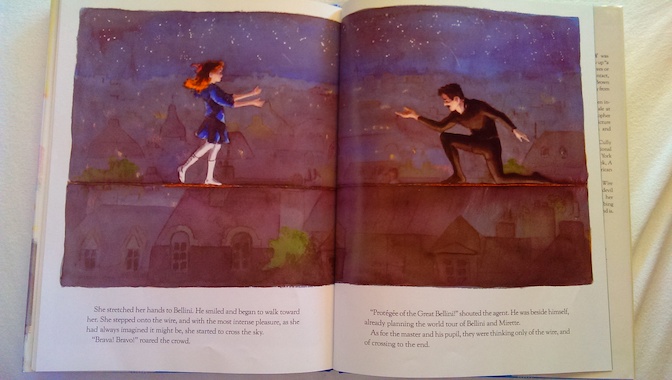
After talking with a performing agent staying at the boardinghouse, Bellini arranges a performance where he will walk a tightrope over a Paris street. When Mirette sees him hesitating at the beginning of the performance, she joins him on the wire, bolstering his courage and realizing her own dreams of becoming a real tightrope walker.

MiretteBelliniTightrope

There are other books in a series about Mirette and Bellini, where they perform tightrope acts and have adventures around the world, but I think that the first book is really the best.  The pictures are beautiful, done in an impressionistic style.

This book is a Caldecott Award winner.  It is currently available online through Internet Archive.