
Amazing Grace by Mary Hoffman, 1991.
Grace loves stories, both hearing them and acting them out. She is imaginative, and likes playing games of pretend and acting out adventures.

When Grace’s teacher tells the class that they are going to perform the play Peter Pan and will be holding auditions for parts in the play, Grace wants the title role of Peter Pan. A couple of the other kids think that it’s odd for her to want to be Peter Pan because she is both a girl and black, which is exactly the opposite of how they usually see the character.

However, Grace still wants to play Peter Pan. When she tells her mother and grandmother what the other kids said, they reassure her that she can get the part if she really wants it and puts her mind to it.
To prove to Grace that a young black girl can get starring roles, her grandmother takes her to see a ballet where the granddaughter of a friend of hers from Trinidad is playing the role of Juliet in Romeo and Juliet.
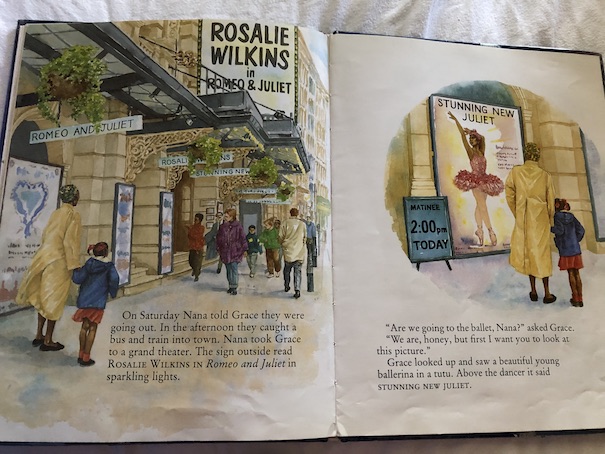
Seeing the performance cheers Grace up and gives her the confidence to audition for the part of Peter Pan. When her classmates see how good she is when she performs, they all agree that Grace should have the role of Peter Pan.

The message that young girls like Grace can do what they set their minds to, even if the roles they want in life aren’t quite traditional, is a good one. As I read the story, I was also thinking that the objection that Grace can’t be Peter Pan actually doesn’t make much sense if you know that Peter Pan, of all roles in plays, is one that is often played by a female. I remember that when I was a kid in elementary school, there was a girl who played the part of Peter Pan, and one of the teachers explained that women sometimes play Peter Pan, especially when the actors are all adults, because women have the higher-pitched voices that the part really needs. I would liked it if the teacher in the story also mentioned that. Also, acting is about capturing the spirit of the character in the story, thinking and feeling like they would think and feel and acting the way they would act. I would have liked it if they had mentioned that. Grace may not look quite the way people might picture Peter Pan, but if she can capture the character in her performance, she’s a good actor.
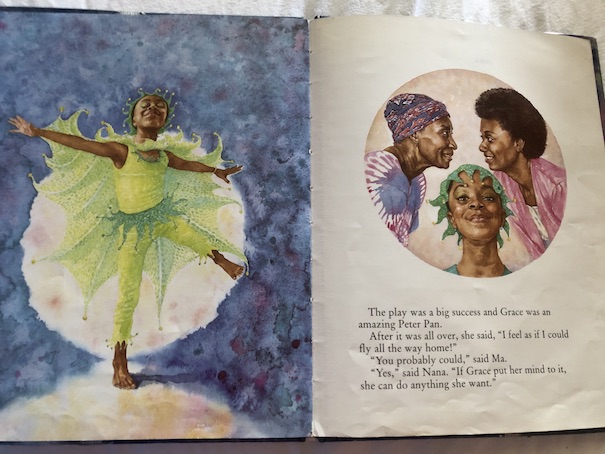
I liked the pictures in the book for their realism. In a couple of the pictures which show how Grace like to act out fantasies, she is shirtless, but she is very young and it isn’t possible to really see anything, so I don’t consider it inappropriate, but I thought that I would mention it.
This is a Reading Rainbow Book.



 Jestress's Forgotten Books and Stories