The Midwife’s Apprentice

The Midwife’s Apprentice by Karen Cushman, 1995.

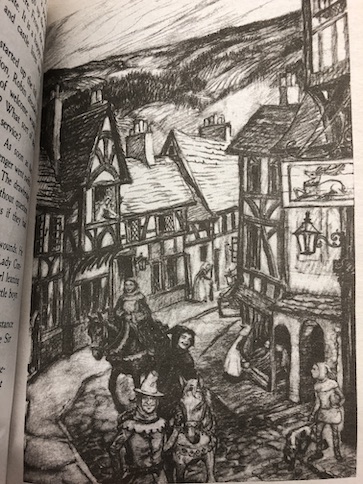
The story focuses on a young girl in Medieval England. She is about twelve or thirteen years old, but she doesn’t know her age or even her real name. Everyone just calls her Brat. For as long as she remembers, she’s always been alone, a homeless orphan traveling and begging from town to town. When a midwife finds her sleeping in a dung heap, she takes the girl on as a servant and apprentice. It isn’t as a kindness. The midwife just realizes that she can get some cheap labor out of the girl as long as she feeds her. Also, because the girl isn’t very bright or experienced, she is no professional competition for the midwife. People begin calling the girl Beetle because she was in the dung heap like dung beetle.

The midwife, Jane, became a midwife because she had six children of her own, although none of them survived. Beetle wonders if she could be a witch because of her strange mixtures, but really, she’s just a midwife. Whenever a woman in the area gives birth, Beetle goes to help carry things for Jane. Beetle is not allowed to watch the births herself, just stand by to fetch and carry. Beetle realizes that part of the reason she is not allowed to watch the births is so Jane can keep her professional secrets, although Beetle soon begins learning about plants and how to make medicines from them and she sometimes spies on births when she can to learn more.

People in town aren’t nice to Beetle. Jane is stingy and never helps anyone who can’t pay her fee. The local people don’t like her, but they tolerate her because they have need of her skills. Beetle often has to deal with the anger that people are afraid to show to Jane. Beetle’s best friend is a cat who was nearly killed by some mean local boys. She talks to the cat. Both of them are abused by locals, especially the mean boys.

Then, Beetle begins to notice that Jane keeps slipping away on mysterious errands, giving excuses for her absence that make no sense. Beetle begins to follow Jane to find out what she is doing. What Beetle learns is that Jane is having a love affair with a married baker.

One day, the miller comes looking for the midwife, but she isn’t home. Desperate for help with his wife’s birth, the miller makes Beetle come with him. Beetle doesn’t know what to do, and the miller’s wife angrily throws things at her until Jane comes to take over. Jane insults and abuses Beetle, too.

It seems like taking abuse is Beetle’s lot in life and that she has to take it or be thrown out into the street again. Her life starts to change when a kind merchant at a fair compliments her curls and gives her a wooden come with a cat carved on it. Then, another man mistakes her for a girl named Alice who can read. Beetle begins to look at herself in a new light. She realizes that at least some people see her as a person who can be pretty and smart, and maybe, she really can be pretty and smart. Liking the name Alice, Beetle decides that she will take the name for herself so she can gave a proper name.

When she returns to the midwife and the midwife abuses and insults her again, Beetle confidently tells her that her name isn’t dung beetle or brat but Alice. The midwife isn’t impressed and even people in town laugh at her for it, but Alice retains her new sense of confidence. She gives the cat a name, too, calling him Purr.

Without Jane realizing just how much Alice has been learning, Alice gradually begins helping people on her own. After saving the life of one of the local bullies, who almost drowned while chasing her, the boy starts treating Alice better. When his cow is having a difficult birth, the boy gets Alice to help him tend to the cow, increasing her knowledge of births.

Then, during one very difficult human birth, Jane leaves Alice to tend to the woman alone while she goes to tend to the lady of the manor, who is also giving birth. Alice protests that she doesn’t know what to do and can’t manage on her own, but Jane tells her she doesn’t have to do anything because this baby is likely to die. Jane just wants Alice to stay to cover for her so she can go earn another, even better fee. However, to everyone’s surprise, Alice saves the baby in Jane’s absence by applying what she has learned so far. The grateful mother names the baby after Alice, and the father refuses to let Jane take credit for Alice’s work. Jane is angry and jealous, especially when another mother insists that she wants Alice and not Jane to tend to her during her birth. Jane throws a fit and accuses Alice of stealing her customers.

Unfortunately, that birth doesn’t go well, and Jane has to step in to help and save the baby. In despair at what she sees as her failure, Alice runs away, convinced that she is just a nobody and too stupid to be anything, even a midwife’s apprentice.

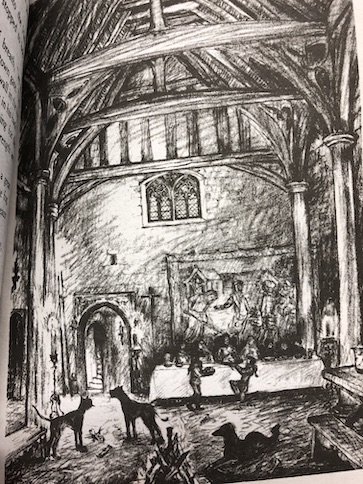
At first, she wants to give up and die, but with the company of Purr the cat, she finds her way to an inn where she finds work. It’s enough to keep her alive, but Alice finds it difficult to shake her feeling that she is nothing and will never be anything. Alice really misses her work with the midwife, although not really the midwife herself, but she has trouble getting over the sense that she is just a failure. It takes a few lessons in reading from a scholar staying at the inn, the realization that she has been a help to someone else in a difficult situation, the encouragement of the boy who was one of her former bullies, and even some surprising comments from Jane the midwife herself to help Alice realize what she needs to do.

The book is available to borrow and read for free online through Internet Archive (multiple copies).

My Reaction

I found this story stressful because there were so many mean people in it. I hated the casual cruelty of the local boys and how they almost killed the cat. I hated Jane, who used and abused a vulnerable orphan girl. I also hated the townspeople in general because this seems to be entirely a town of people who are looking to use and abuse anybody they can and who will also allow other people to abuse the vulnerable, both human and animal, if they can use the abuser for their purposes. For much of the book, I looked for a character other than our heroine with some redeeming quality of some kind and didn’t find one.

The first character I actually liked was the kind merchant who gave Beetle/Alice the comb, but I still felt like the town is the town of the damned because nobody there was really nice. Almost every interaction Alice has with anybody there is unpleasant to some degree until she does something to buy their goodwill or at least civility. The innkeepers are nicer to Alice, although she knows that they’re not entirely honest in the way they run the inn. The scholar was one of my favorite characters because he sees Alice’s potential and gives her lessons in reading by first explaining things to her cat to get her interested. His kindness didn’t need to be bought with anything. The scholar is also the first person who cares about what Alice wants out of life and gets her to consider what she really wants, which builds her confidence and her feeling that she is a real person with wants that matter.

William became nicer after Alice saved his life, which is a kind of cliche in stories about bullies and is still a form of being bought. He’s still not completely nice after that, although he does teach Alice a couple of useful lessons, and he tells Alice that he doesn’t think that she’s a failure as a midwife just because she didn’t know everything and still needed some help. Even better, he points out that Jane doesn’t really know everything, either; she just acts like she does.

I never grew to like Jane. When Alice overhears Jane talking about her, Jane actually says that Alice is bright, which is a surprising compliment, given all of the insults and abuse she constantly heaped on her and her fear and resentment that Alice might steal her customers. Jane doesn’t regard Alice as a failure for not being able to handle a birth on her own, but she says that Alice gives up too easily. She wants an apprentice who is willing to take everything she heaps on her and won’t give up, no matter what. While persistence is an important quality, I was angry with this character for trying to wrap up her own abuse nicely like it was all part of some important, intentional lesson. Jane never had any notion of turning Alice into a fully-trained midwife. She more wanted a cheap drudge than an honest apprentice to learn her craft. In fact, she actively tried to avoid telling Alice much because she was always afraid of training a competitor. Jane wasn’t trying to teach Alice to persevere at any point before she said that. She wasn’t trying to teach her any more of anything than she absolutely had to in order to get the cheap labor she wanted! Her attempt to wrap this whole mess up neatly like a PSA just didn’t work for me because she’s nothing but an abusive employer who screams and throws pots and doesn’t actually want her “apprentice” to progress enough to do as well or better than she does. While Alice does return to be her apprentice because she knows that she really does want to be a midwife and that there are still things she can learn from Jane, including the value of persistence, I still hope that Alice will eventually leave Jane and find a better community to exercise her skills and employers and clients who are better behaved, more appreciative, and generally less toxic and abusive.

Because of the content of this book, it is not for young children. It would be best for tweens and teens.

The Door in the Wall

The Door in the Wall by Marguerite de Angeli, 1949.

The story takes place in Medieval England. Robin is the son of a noble family. All his life, there has been the expectation that Robin would learn to be a knight, like his father. Soon after Robin turns ten years old, Robin’s father goes away to fight in Scotland, and Robin’s mother arranges for him to be sent away to begin his training as a knight while she takes a position as lady-in-waiting to the queen. However, soon after his parents’ departure, Robin becomes terribly ill and loses the use of his legs.

Now, Robin is miserable and wishing that his mother was still with him to help him get over his illness. Instead, he is looked after by servants. Then, after Robin throws a fit and refuses to eat, his servants disappear. The next person Robin sees is Brother Luke, a friar from St. Mark’s monastery. The friar tells him that his servants were ill and have fled from the plague, but one of them sent him to care for Robin. He feeds Robin and tells him that he will take him to St. Mark’s and continue to care for him there. Robin tells Brother Luke about how he was supposed to be taken away for training but that he was unable to go because he was ill, and he asks how they will get to St. Mark’s because he cannot walk. Brother Luke says that the man who was supposed to escort him to the castle where he would live and be trained as a knight may be unable to get back into London because travel is restricted due to the plague, so Robin’s training will have to wait. As for how they will travel, Brother Luke has a horse that they can ride.

Before they leave, Brother Luke asks Robin to remember the wall around his father’s garden and the wall around the Tower. He points out that all walls have a door in them somewhere and that if you follow a wall long enough, you will eventually find the door. At first, Robin doesn’t understand what Brother Luke is trying to tell him, but the metaphor is the theme of the book and it becomes clear through the adventures that follow. The wall stands for adversity, and the door stands for solutions to problems, other paths to take, and ways to move forward in life. What Brother Luke is trying to say is that there are many types of problems in life (the walls), but that problems have solutions (doors). There are ways around obstacles, and if you persevere, you will find them. He reminds Robin of this throughout the story.

At St. Mark’s, Robin stays in Brother Luke’s quarters, and Brother Luke takes care of him. When Robin is a little stronger, Brother Luke gives him wood to whittle. When he grows stronger yet, Brother Luke gives him writing lessons. As the plague begins to pass and there are fewer patients to tend to, Brother Luke begins to carry Robin around or push him in a cart, taking him to visit other parts of of the monastery.

Since Robin still cannot walk, Brother Luke thinks it’s important to keep his mind and hands busy, one of the first “doors” that he finds for Robin around his current limitations. Brother Matthew oversees Robin as he learns and practices carving wood, teaching him patience when he has a temper tantrum on ruining one of his first projects. Brother Luke helps Robin to write a letter to his father, in which Robin explains his current situation, and a traveling minstrel, John-go-in-the-Wynd, will carry it to Scotland when he goes there with some soldiers. Later, Brother Luke even takes Robin to go fishing and begins teaching him to swim. In spite of these improvements, Robin still worries about his inability to walk and how it will affect his future and his father’s hopes for him to be a knight.

When John-go-in-the-Wynd returns with a reply from Robin’s father, Robin’s father says that he is distressed to hear that Robin has been ill, although he thankful that Robin did not get the plague and die with so many others. Robin’s illness was severe, but he is already showing signs of recovering. His father has made arrangements for him to travel to the castle of Sir Peter in Shropshire, who is Robin’s godfather and where he was meant to go for his training, accompanied by Brother Luke and John-go-in-the-Wynd, as soon as he is well enough to travel. Since Robin has already become well enough to make himself a pair a crutches with his new woodworking skills and has begun to use them, they decide to proceed with the journey.

On the journey to Sir Peter’s castle, they have adventures, narrowly escaping from thieves and visiting a fair in Oxford. Robin encounters Welsh speakers for the first time. Although Robin is worried about what Sir Peter will think of him when he sees his condition, Sir Peter welcomes the travelers gladly. He has recently been injured in battle and still recovering himself. Robin says that he doesn’t think that he will make a very good page because of his difficulties in walking but that he can read, write, and sing to provide entertainment. Sir Peter says that there are many ways to serve others and that people must do what they can.

Brother Luke and John-go-in-the-Wynd stay at the castle to help Robin settle in, and Sir Peter gives Robin duties that he can perform. Robin asks Brother Luke if he thinks that he will ever be able to walk normally again, and Brother Luke admits that he doesn’t know but that he is sure that Robin will have a fine life ahead of him. People are not perfect, but everyone has to do the best they can with what they have. Robin soon learns to get around well enough to navigate the castle easily and play with the other boys, but he is still bent and unable to walk without crutches. Robin’s disability and the craftsman skills he learned from the monks have taught him patience and that he feels better after accomplishing difficult tasks.

Then, one foggy day, the Welsh surround and attack Sir Peter’s castle. The defenders hold out in the keep, but they begin to run low on food, and strangely, the well seems to be running dry. As they run low on water, hope seems to be lost. They begin to devise a plan for someone to slip out and go for help. Robin volunteers to go. He knows where John-go-in-the-Wynd is staying with his mother nearby, and he can tell him about the situation in the castle and where to go for help. Robin knows that if anyone catches sight of him, he will look like a poor, lame, shepherd boy, and no one will suspect him of coming from the castle.

Robin has felt badly about his new disability, but his youth and disability are actually what allow him to pass unchallenged through the enemy lines. Suddenly, his disability actually becomes an advantage, allowing him to do what others cannot. Robin’s future may not be the one that he first expected, but he has found ways to move forward in his life and ends up a hero!

The book is a Newbery Award Winner. It is available to borrow and read for free online through Internet Archive (multiple copies).

The Silver Slippers

Magic Charm Books

The Silver Slippers by Elizabeth Koda-Callan, 1989.

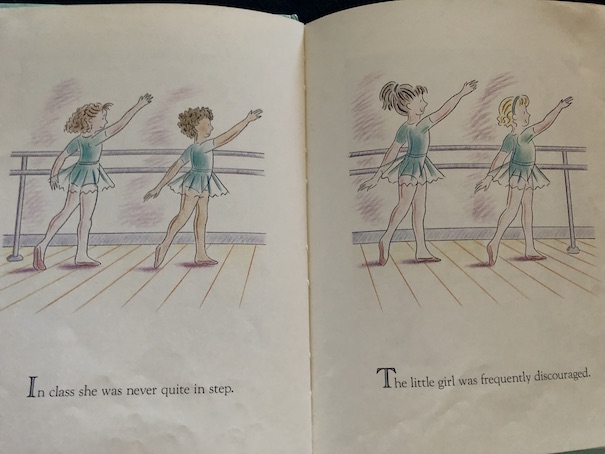
A little girl (unnamed, like the other girls in this series) wants to be a ballerina. She takes ballet classes, but she never seems quite good enough, like the ballet posters on the walls of her room. She feels discouraged because she is not perfect.

When her ballet teacher tells the class that there is going to be a dance recital and that one girl in class will be chosen to be the prima and lead the others, the girl doesn’t think that she has a chance to be chosen because her dancing isn’t good enough.

The girl tells her mother about the recital and her doubts about being chosen to be prima, and her mother tells her that it depends on how much she wants to be prima and how much she is willing to practice to improve. If the girl is willing to put in extra practice, she still has a chance to be prima. To remind her of her goals, her mother gives her a silver charm in the shape of a pair of ballet slippers.

In order to improve her dancing, the girl has to focus on her goal and give up participating in other activities to find more time to practice. However, her practicing pays off, and she gets the role of prima. On the night of the recital, she is nervous, but her silver slippers charm reminds her of her dream of being a real ballerina and gives her the courage to go on with her performance.

All of the books in this series originally came with charms like the ones described in the stories. This book originally included a little silver slippers charm for the reader to wear. The hole in the cover of the book was where the charm was displayed when the book was new. The books in the series often focus on the unnamed main character (who could represent any girl reading this story – the books were aimed at young girls) developing new self confidence, and the charms were meant to be either a sign of their new self confidence or inspiration for developing it. In this case, the charm is a reminder of the girl’s goals and how much she really loves dancing, giving her the inspiration she needs to persevere even when learning is difficult.

The book is available to borrow for free online through Internet Archive.

Changes for Addy

American Girls

AddyChanges

Changes for Addy by Connie Porter, 1994.

Since the Civil War ended, most of Addy‘s family has managed to reunite in Philadelphia. The one person who is missing is Addy’s little sister, Esther.  When Addy and her mother escaped from the plantation where they had been living as slaves, they were forced to leave Esther behind with family friends because she was too little to travel.  Since the end of the war, slaves have been released from plantations, but the Walkers haven’t received any word from their friends, Auntie Lula and Uncle Solomon Morgan and don’t know where they or Esther are.

Over the past months, the Walker family has sent inquiries to various aid societies helping war victims and displaced people, asking if the Morgans or Esther have sought help from them.  Finally, they get a response from the Quaker Aid Society, saying that the Morgans and Esther were at one of their camps in North Carolina.  They stayed for awhile because Esther was ill, but as soon as she was well enough to travel, they were eager to move on to Philadelphia.

Addy is happy because the news means that the Morgans and Esther might already be in Philadelphia, looking for them.  However, Addy’s parents are still worried because the Morgans are elderly, and from what the letter said, they were not in good health.  The family makes further inquiries to see if they could be at any of the local hospitals.

Eventually, the search for the Morgans and Esther pays off when Addy finds them at a church.  Uncle Solomon passed away on the journey to Philadelphia, and Esther seems unsure of who the people in her family are because she was so little the last time she saw them.  Auntie Lula pressed on for Philadelphia because she wanted to make sure that Esther made it safely back to her family.  Auntie Lula is in bad health herself, and she knows that she isn’t likely to live much longer, making the reunion bittersweet.

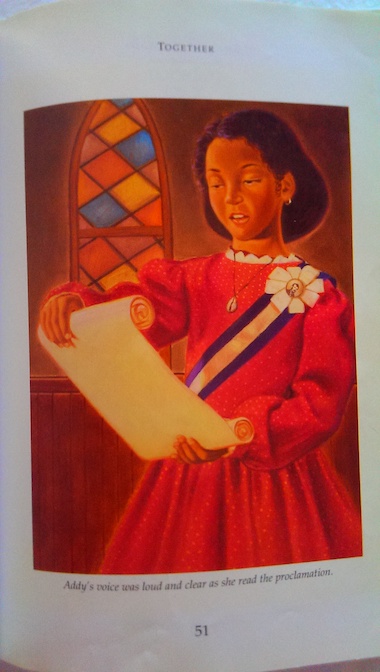
AddyChangesProclamationHowever, Auntie Lula does get to spend a little time with the family before her death, and she tells Addy not to be sad.  People don’t always get everything they want in life, but they can take some pride in what they do accomplish.  Lula and Solomon may not have gotten everything they wanted in life, not having had much time to enjoy being freed from slavery, but they did get to accomplish what was most important to them.  Solomon died knowing that he was a free man, far from the plantation where he’d been a slave.  Lula managed to reunite Esther with her family.  From there, Lula says, she is depending on the young people, like Addy and her family, to make the most they can of their lives, hopes, and dreams.

The theme of this story is hope and the need to persevere with determination.  Life has its difficulties, and not every problem can be solved.  However, things can get better.  After the reunion with Esther, Addy points out to her mother that Esther wasn’t walking or talking when they last saw her, and they never got to experience seeing her learn.  Addy is sad at the time they’ve lost with Esther, which they can never recover.  However, because of Lula and Solomon’s determination to bring Esther to them, they will have many more years to come with Esther.  Addy’s mother also reminds Addy that those who love us never leave us.  Auntie Lula and Uncle Solomon changed the family’s lives for the better because of the good people they were, and their memory will stay with them forever.

In the back, there is a section of historical information about the end of the Civil War, the emancipation of the slaves, and it further explains how racial issues continued into the 20th century, leading to the Civil Rights Movement in the 1960s.

AddyChangesHistorical