
The Pharaohs of Ancient Egypt by Elizabeth Payne, 1964, 1992.
This is a book for kids about the lives of Egyptian pharaohs, including Hatshepsut, Akhnaton, and Rameses the Second. It also includes details of Ancient Egyptian history, daily life, and religion. I would put the difficulty level of the book around the middle school level. It’s a chapter book with very few pictures and more dense writing than others I’ve read in the same series. It’s one of the Landmark Books (called Step Up Biographies in earlier printings).
Egypt is among the world’s oldest civilizations, having a long history, extending over thousands of years. The Ancient Egyptians created a powerful legacy that has influenced other civilizations for millennia.

In the early days of Egyptian civilization, groups of small villages that early settlers had established along the Nile joined together to form kingdoms. At first, there were three of them:
- The Bee Kingdom in Lower Egypt — at the Nile delta, on the Mediterranean
- The Reed Kingdom in Middle Egypt — near the site of modern Cairo
- The Hawk Kingdom in Upper Egypt — near the rapids that lay between Egypt and the Nubians to the South
If you’re wondering why “Lower Egypt” was in the northern part of Egypt and “Upper Egypt” was in the south, it’s because the Ancient Egyptians weren’t concerned about north and south with regard to their kingdoms. They lived along the Nile, their major source of water and transportation, and when they thought about the relations between cities and kingdoms, they were most concerned about whether they were upriver or downriver. So, “Upper Egypt” was the kingdom farthest upriver, and “Lower Egypt” was the one that was farthest downriver. The Nile just happens to flow from south to north.
Then, around 3200 B.C., the Hawk King known as the Scorpion conquered the kingdom in Middle Egypt. His successor Menes (also called Narmer), who ruled both Middle and Upper Egypt, conquered Lower Egypt as well, turning Egypt into a single nation with a single king. However, there were still rivalries between Upper and Lower Egypt, and the people in different regions spoke different dialects.
The Ancient Egyptians believed that their kings, called Pharaohs, were half-human and half-god. Part of the reason for this belief may have been because the Egyptians believed that a partially-divine ruler could help ensure that life in the Nile Valley could continue smoothly by appealing to his godly relations and partly because, if the king wasn’t completely human, he could be considered above the rivalries between the different regions and remain a unifying figure for the Egyptian people, no matter which region he had come from originally.
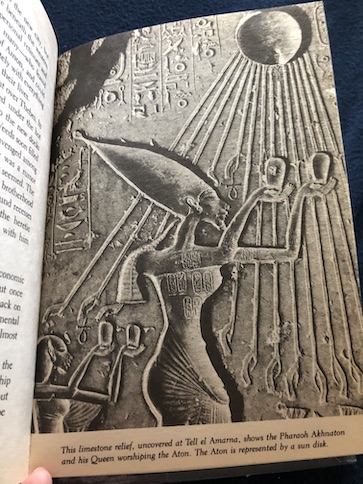
Although most Ancient Egyptians were polytheistic, like other ancient civilizations, there was one pharaoh who believed in only a single, all-powerful god. This pharaoh was Akhnaton, the father of Tutankhamen. (The book refers to Tutankhamen as a younger half brother of Akhnaton, but later sources say that he was Akhnaton’s son, although there is still some dispute about that. Either way, the two were related, and Tutankhamen was Akhnaton’s successor.) Akhnaton worshipped the sun, calling the sun god Aton. Part of the reason for this conversion to the worship of a single sun god instead of the many gods of the Ancient Egyptian pantheon may have been due to a power struggle between the pharaoh and the High Priest of Amon. However, Akhnaton seemed to genuinely believe in the Aton and was devoted to it, establishing a new capital city and outlawing worship of other gods. Unfortunately, his health was frail, and worship of the Aton didn’t extend beyond his death around the age of 42, with Egyptians returning to worship their old gods. Tutankhamen, who had been born Tutankhaton, changed his name and moved the capital away from Akhnaton’s city. Tutankhamen’s reign was short. He died in his late teens. (The cause of his death has never been precisely determined, although it seems likely that it was a combination of ill health, possibly a congenital condition due to inbreeding in the royal family, malaria, and a physical injury.) Tutankhamen’s main source of fame is his tomb, found largely intact in November, 1922.
Dynasties of Egyptian Pharaohs ruled Egypt for thousands of years, although in the later centuries of Ancient Egypt, foreign rulers moved in and took control for long periods. Then, in 332 B.C., Alexander the Great conquered Egypt, bringing it under Greek and Macedonian control and ending the reign of Egyptian Pharoahs forever.




 Jestress's Forgotten Books and Stories