Changes for Addy

American Girls

AddyChanges

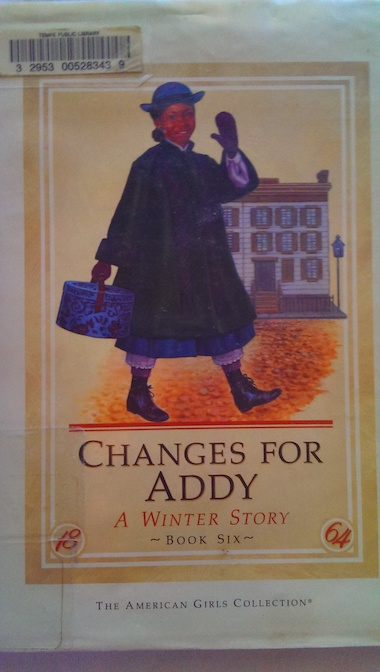
Changes for Addy by Connie Porter, 1994.

Since the Civil War ended, most of Addy‘s family has managed to reunite in Philadelphia. The one person who is missing is Addy’s little sister, Esther.  When Addy and her mother escaped from the plantation where they had been living as slaves, they were forced to leave Esther behind with family friends because she was too little to travel.  Since the end of the war, slaves have been released from plantations, but the Walkers haven’t received any word from their friends, Auntie Lula and Uncle Solomon Morgan and don’t know where they or Esther are.

Over the past months, the Walker family has sent inquiries to various aid societies helping war victims and displaced people, asking if the Morgans or Esther have sought help from them.  Finally, they get a response from the Quaker Aid Society, saying that the Morgans and Esther were at one of their camps in North Carolina.  They stayed for awhile because Esther was ill, but as soon as she was well enough to travel, they were eager to move on to Philadelphia.

Addy is happy because the news means that the Morgans and Esther might already be in Philadelphia, looking for them.  However, Addy’s parents are still worried because the Morgans are elderly, and from what the letter said, they were not in good health.  The family makes further inquiries to see if they could be at any of the local hospitals.

Eventually, the search for the Morgans and Esther pays off when Addy finds them at a church.  Uncle Solomon passed away on the journey to Philadelphia, and Esther seems unsure of who the people in her family are because she was so little the last time she saw them.  Auntie Lula pressed on for Philadelphia because she wanted to make sure that Esther made it safely back to her family.  Auntie Lula is in bad health herself, and she knows that she isn’t likely to live much longer, making the reunion bittersweet.

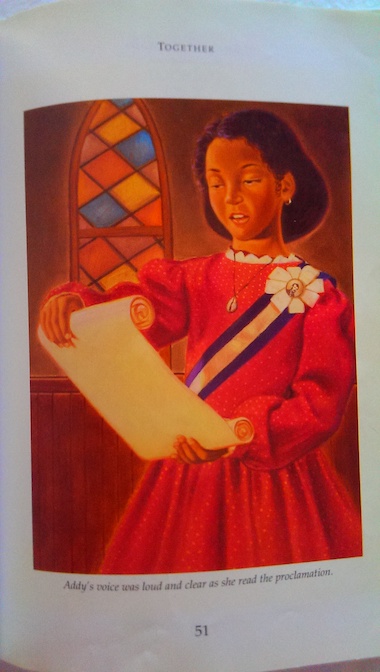
AddyChangesProclamationHowever, Auntie Lula does get to spend a little time with the family before her death, and she tells Addy not to be sad.  People don’t always get everything they want in life, but they can take some pride in what they do accomplish.  Lula and Solomon may not have gotten everything they wanted in life, not having had much time to enjoy being freed from slavery, but they did get to accomplish what was most important to them.  Solomon died knowing that he was a free man, far from the plantation where he’d been a slave.  Lula managed to reunite Esther with her family.  From there, Lula says, she is depending on the young people, like Addy and her family, to make the most they can of their lives, hopes, and dreams.

The theme of this story is hope and the need to persevere with determination.  Life has its difficulties, and not every problem can be solved.  However, things can get better.  After the reunion with Esther, Addy points out to her mother that Esther wasn’t walking or talking when they last saw her, and they never got to experience seeing her learn.  Addy is sad at the time they’ve lost with Esther, which they can never recover.  However, because of Lula and Solomon’s determination to bring Esther to them, they will have many more years to come with Esther.  Addy’s mother also reminds Addy that those who love us never leave us.  Auntie Lula and Uncle Solomon changed the family’s lives for the better because of the good people they were, and their memory will stay with them forever.

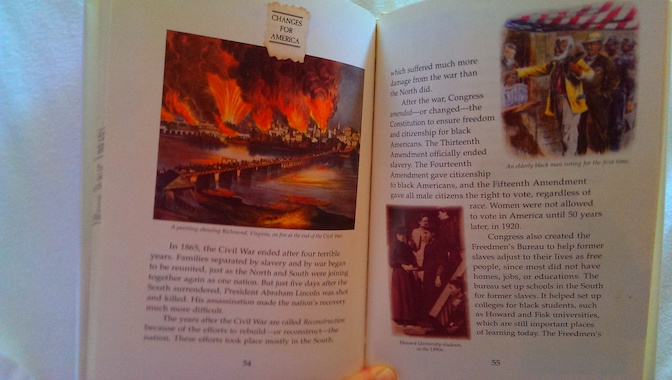
In the back, there is a section of historical information about the end of the Civil War, the emancipation of the slaves, and it further explains how racial issues continued into the 20th century, leading to the Civil Rights Movement in the 1960s.
AddyChangesHistorical

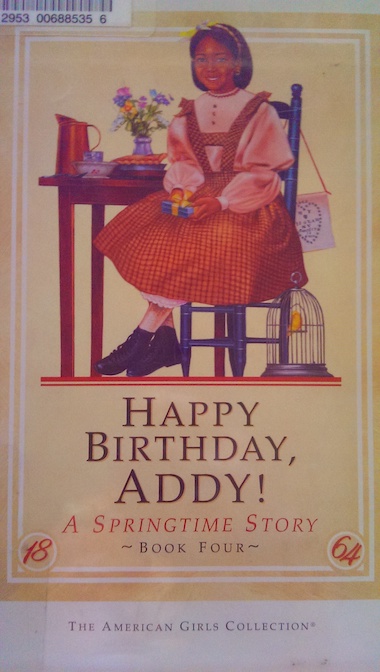
Happy Birthday, Addy!

American Girls

AddyBirthday

Happy Birthday, Addy! by Connie Porter, 1994.

Things are improving for Addy and her mother now that her father has finally joined them in Philadelphia.  Addy’s father has found work delivering ice, so the family has been able to move to bigger rooms in a boarding house.  However, making a new life for themselves in freedom still isn’t easy.  Addy’s father worked as a carpenter on the plantation where they used to live, and he’d like to find steady work in carpentry, but he’s having trouble finding an employer who is willing to hire a black man.

Addy’s family might be free from slavery, but they are still not treated as equals to white people.  There are places where black people can’t go and things they aren’t supposed to do, like riding on most of the city streetcars.  It angers and upsets Addy, but she doesn’t know what she can do about it.  She isn’t the only one who feels that way, and there’s been talk of violence in the city over it.

The boarding house where Addy’s family now lives is owned by Mr. and Mrs. Golden.  Then, Mr. Golden’s elderly, blind mother moves in with them.  Affectionately called M’dear, she’s a pleasant lady and tells Addy interesting stories, jokingly saying that she’s so old that she “was there the day God invented dirt.”  When she asks Addy how old she is, Addy says that she’s nine but doesn’t know when her birthday is exactly.  It was common for slaves not to know their birthdays because their parents couldn’t read or write and no one else thought it was important to record the dates of their births.  M’dear tells her that she should claim a birthday for herself.


Addy’s parents think that choosing a birthday for herself is a good idea, and her father says that he will make ice cream for her new birthday.  He has found a broken ice cream freezer that someone threw out, and he’s fixing it up for the family to use.  However, Addy isn’t sure at first what day she wants to choose.

One day, M’dear is feeling poorly, and she’s out of headache medicine.  Addy and Sarah offer to go get more for her.  To get to the drug store, they get on board one of the streetcars that black people are allowed to ride, which can be dangerous because they have to ride on the outside.  Then, the man at the drug store makes them wait until he’s served the white customers, speaking rudely to them.  When they try to take the streetcar back home, there is an argument that ends with all of the black people being thrown off the streetcar.  When M’dear hears about what the girls went through, she offers some wise thoughts about how people have to continue living their lives and being themselves, no matter what difficulties life throws their way.


In the end, circumstances continue to improve for Addy’s family when her father finally finds the kind of work he’s been looking for and Addy finds a special day to claim as her birthday when the end of the Civil War is finally announced.

I liked M’Dear’s message that the way people are treated doesn’t really change who they are.  The black people in the story are treated badly not because of what they did so much as what other people think they are or want them to be.  However, what other people think doesn’t change the nature of reality.  No amount of bullying or thinking that someone else is inferior or telling them that they are inferior can actually make them be inferior.  It can make things hard and unpleasant for the other person, but it will never actually change the reality of who they are, and people who think it does delude themselves.  M’Dear may be blind, but she sees much more clearly that most because she understands the reality of the situation better than they do.  Addy’s father has trouble finding work because he is black, but the fact that potential employers don’t like his appearance doesn’t make him any less the craftsman he is.  He has all the skills he needs; he just needs someone who has the ability to notice them.

In the back of the book, there is a section with historical information about how children were raised during the Civil War with some special information about the lives of slave children.  It also talks about children helped to support the war effort.


Addy Learns a Lesson

American Girls

AddyLesson

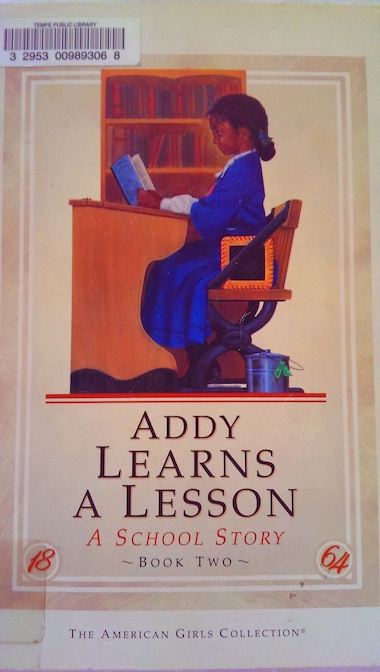
Addy Learns a Lesson by Connie Porter, 1993.

AddyLessonArrivalAfter escaping from slavery, Addy and her mother finally arrive in Philadelphia, Pennsylvania, where they will start a new life.  Philadelphia is a big city, and at first, Addy feels lost, not knowing where to go and what to do.  They have no family or friends to turn to, and neither she or her mother can even read the street signs, never having been taught to read.  They are dependent on help from other free black people, former slaves who have already established themselves in the community.

The first people they meet in Philadelphia are Mrs. Moore and her daughter, Sarah.  They are part of the Freedom Society of Trinity A.M.E. Church, which helps new arrivals escaping from slavery, like Addy and her mother.  The Moores take them to the church, where they attend a church supper, along with some other new arrivals.  Mrs. Moore asks Addy’s mother what work skills she has, and when she says that she can sew, Mrs. Moore says that she might be able to get a job in a dress shop.  Mrs. Ford, the white woman who owns the shop, is strict and fussy, but she hires Addy’s mother and gives them a room to live in.

Life in freedom isn’t as glamorous as Addy thought it would be at first.  Her mother works hard for little pay, and the attic room where they live is small and uncomfortable. She misses the rest of their family and still doesn’t know where her father and brother are.  There are also things that black people in Philadelphia can’t do, even though they aren’t slaves, like riding on the streetcar.

However, there is one thing that Addy is looking forward to: going to school for the first time.  Sarah Moore is Addy’s age, and she tells Addy about her family escaped from slavery in Virginia.  Like Addy, she couldn’t read when she first arrived, but now, Sarah attends school.  Addy is excited about attending the same school as Sarah and happy that she has made a new friend.  Addy’s new teacher, Miss Dunn, was also a former slave from North Carolina, and she reassures Addy that, although she hasn’t been to school before or learned to read yet, it won’t be long before she learns.


All of the other children at school are black, many of them former slaves.  However, Addy can’t help but notice that some of their families are more prosperous than others.  In particular, a girl named Harriet wears beautiful dresses, the kind that Addy has dreamed of having herself.  Sarah and Harriet don’t get along because Harriet is snobbish, but Addy is fascinated by her, wishing that she could have things like Harriet has.  Harriet says that her family were never slaves, and as bossy as Harriet is, Addy can’t help but admire her.  Harriet is nice to Addy at first, bragging about how smart she is and how much she can help Addy, but she isn’t as patient or as helpful to Addy as Sarah is.

When there is a spelling match at school, Addy accepts Harriet’s invitation to go to her house to study.  Harriet always seems to do well in class, and Addy is curious to see what her house is like.  However, Harriet and her friends force Addy to be their “flunky,” carrying all of their books, and they say insulting things about Sarah.  Then, Harriet retracts the invitation to study.

As Addy sees the way Harriet takes advantage of her, she comes to realize some important things about the way people act and about herself and the type of friends she really wants in her new life.  Unlike Harriet, Sarah is Addy’s real friend.  Addy realizes that she doesn’t need to admire people like Harriet because she is smart and works hard and can do just fine without Harriet’s false friendship.


In the back of the book, there is a section of historical information about education during the American Civil War, especially for black children.  It was actually against the law to teach slaves to read during Addy’s time, although some were able to learn in secret.  Even for free blacks in the North, there were few educational opportunities.  Black children couldn’t go to school with white children, and the schools for black children were poor, unable to afford many supplies.  Over time, more and more black people were able to get an education, in spite of the difficulties involved, and education helped to improve their lives.  However, segregated schools remained the norm until the 20th century.

I liked the way they showed the medal that Addy wins in the spelling bee.  Students who particularly excelled at a subject in class were sometimes given a small medal on a pin to wear as a badge of honor, something that people don’t do in modern times.