Boxcar Children
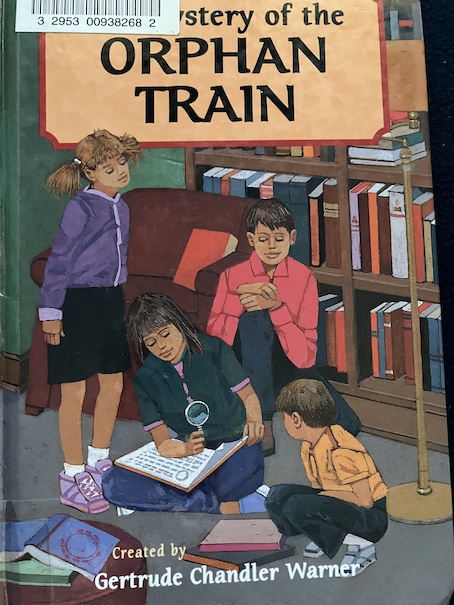
#105 The Mystery of the Orphan Train by Gertrude Chandler Warner, 2005.

Grandfather Alden is going on a business trip to Kansas, and he’s taking his grandchildren with him. They’re going to be staying at an old Victorian house that a friend of grandfather’s, Kate, has turned into a bed and breakfast. The house has been in their family for years, and one of its claims to fame is that a famous photographer, Ethan Cape, once stayed there and photographed her grandmother, Sally Crawford. Ethan Cape was known for his photographs of famous people, like royalty and movie stars, and nobody knew why he made it a point to visit this house in Kansas and photograph a woman he supposedly never met before, who wasn’t famous at all. People have offered to buy the photograph from Kate, but she refuses to sell it.
The Aldens find the old Victorian house charming, but Kate also tells them that there’s a mystery surrounding her grandmother. Not only does nobody know why Ethan Cape came to see her and photograph her, but Sally said before she died that she had a secret to share with her family. Unfortunately, she passed away before she could tell them what it was. It might have been the reason why she knew Ethan Cape and why he came to see her, but Kate thinks they’ll probably never find out.

A woman who’s staying at the bed and breakfast at the same time as the Aldens is fascinated by the bluebird necklace that Kate wears. The necklace used to belong to Sally, although nobody knows exactly how or when she got it or how old it really is. The woman recognizes it as an antique and tries to pressure Kate to sell it to her, but Kate refuses. Even a professor who is also staying at the bed and breakfast suggests to Kate that she might want to sell something for some extra money.
Far from wanting to sell anything, Kate has been trying to find some old family antiques that were sold years before when her grandfather needed money, repurchase them, and use them to furniture the bed and breakfast. She shows the Aldens one of the pieces that she’s managed to track down and buy, an old desk. It’s a bit of a mess, so the Aldens offer to help clean it up. While they’re cleaning, Henry finds a hidden compartment in the desk with a strange message for Sally signed “Thane Pace.”

When they show the note to Kate, she’s astonished, but she recognizes the name. Thane Pace was a boy who saved Sally’s life when she was a young child. Sally had been skating one day when she fell through the ice, and Thane Pace saved her. Thane Pace himself is a bit of mystery because he didn’t live in Sally’s town. He told everyone that he had come in search of his missing sister. They had both been sent out west on the orphan train as young children, but they were adopted by different families. However, nobody knows what happened to Thane Pace because, even though he saved Sally’s life, Sally’s father soon chased him away, accusing him of theft!
Was Thane really a thief? What does his message to Sally really mean? When Kate’s bluebird necklace suddenly disappears, the Boxcar Children investigate the mysteries of Sally’s past and consider if they’re related to the mystery of the missing necklace.
My Reaction and Some Spoilers
I loved this story, and it’s a new favorite of mine in this series! I love how the children have to look into the past and solve a kind of treasure hunt to learn the secrets of a pair of orphans from the past and the real identity of the famous photographer who once visited the house and his connection to it. Part of the mystery might seem obvious to adults and older readers who enjoy word games, even from my description, but I enjoyed the treasure hunt and riddles that lead the Aldens to the full story of what happened all those years ago.
I enjoy books with historical references, and the story explains a little about the history of the orphan trains, which ran from the mid-1800s to the 1920s. It was an early form of organized foster care in the United States, carrying orphans, homeless/abandoned children, or children whose parents were unable to care for them away from crowded orphanages in cities on the east coast of the United States to communities in the Midwest, where children were in demand as extra helpers on farms or in houses or just as family members for people who were unable to have children of their own. The orphan trains were later replaced with more modern forms of foster care, and there are rules now regarding the transporting, placement, or adoption of foster children across state borders. These rules exist to provide greater oversight for the protection of the children, the suitability of their new placements, and their continued welfare.
One of the criticisms of the orphan trains was that they provided too little oversight over the quality of the foster parents and their treatment of the children. The way the trains worked was that they had scheduled stops, and interested members of the communities could come to view the children from the train and select one or more to take home with them. There was little other qualification for a potential foster parent to take a child than for them to simply show up and little follow-up on the treatment of the children once they were placed with a new family, especially with the early orphan trains. They were known for placing most of their trust in “the kindness of strangers” will little verification. The result was that some orphans were lucky and were raised by families who loved them, treated them well, and educated them, while others were used as little more than slave labor.
Orphan trains were also known for their disregard for the relationships between siblings. They were focused on getting the children placed in homes as quickly and efficiently as possible, and if that meant splitting up siblings because a potential foster family only wanted one child, they would do that, which is the basis for the history behind this story. Potential foster families often had in mind the age of the child they wanted before they ever met any of the children, and they were eager to get exactly the type of child they had in mind. Some families specifically wanted boys who were old enough to help with farm work immediately, and they weren’t interested in infants, who would need extra care before they would be old enough to be useful. Other families specifically wanted infants so they could raise them as members of their own families without the influence of the children’s birth families, their memories of the past, or any bad habits they may have acquired hanging over them. These differing priorities among the foster parents are the reasons why siblings like Thane and his sister were separated from each other. However, Thane never forgot his sister, and he wanted to make sure that she knew the truth about their past in the end.
The disappearance of the necklace isn’t directly related to the secrets of the past, but the necklace is important as a family heirloom and the shared connection between Thane and his sister. It’s a separate puzzle from the treasure hunt to learn the truth about Thane, but it’s still fun and interesting.
 Jestress's Forgotten Books and Stories