That Terrible Halloween Night

TerribleHalloween

That Terrible Halloween Night by James Stevenson, 1980.

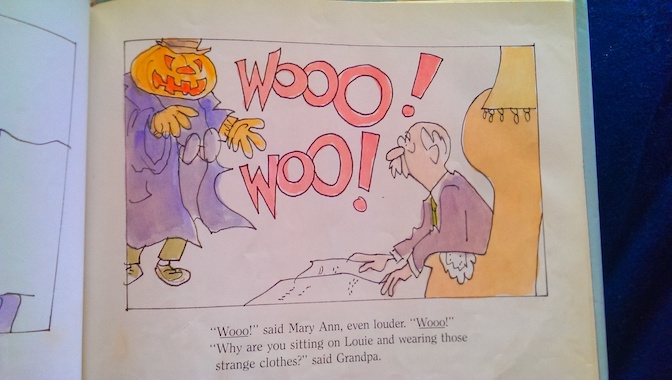
It’s Halloween, and Louie and Mary Ann think that it would be funny to play a joke on their grandfather and scare him.  First, they try putting a scary mask on their dog, Leonard, but their grandfather just pats the dog on the head.  Then, Mary Ann sits on Louie’s shoulders, and the kids put on a big, old coat and a pumpkin head.  However, their grandfather still isn’t frightened.

TerribleHalloweenCostume

When the kids ask him why he isn’t scared, their grandfather says that he doesn’t get scared much since “that terrible Halloween night.”  When the kids ask him what he means, he starts telling them about a Halloween when he was a kid.  He was out trick-or-treating when he saw a mysterious old house and couldn’t resist taking a look inside.

TerribleHalloweenTrickOrTreat

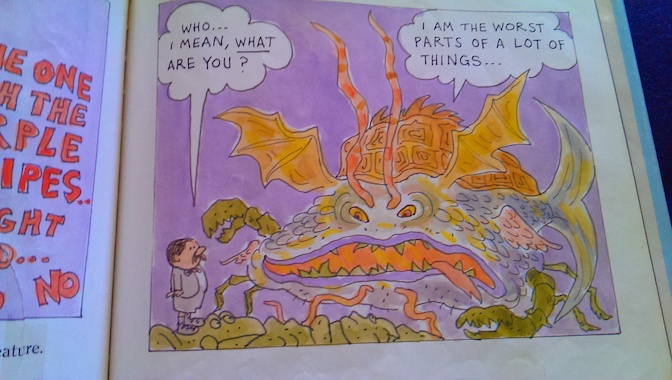
As the grandfather, as a kid, explores the house, he encounters all kinds of strange and frightening creatures.  (My favorite is the one that’s “the worst parts of a lot of things” just for the description.)

TerribleHalloweenMonster

But, nothing in the house is as scary as whatever is behind the final door in the house, the one that the monsters warn him not to go through . . .

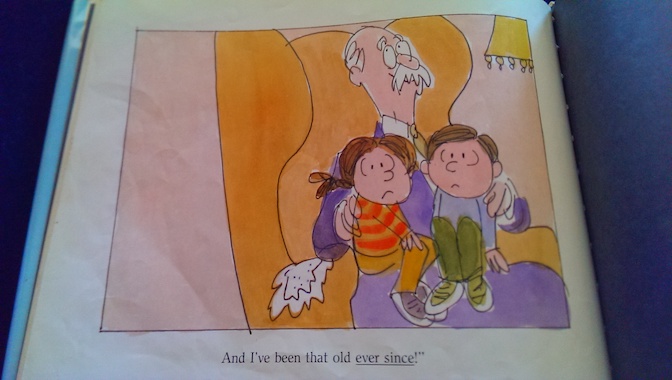
TerribleHalloweenOldMan

You never see what’s behind the door, but the result is the punchline of the story.  Typical grandfather way to frighten the kids!

TerribleHalloweenPunchline

One of the fun things about this story is that the grandchildren aren’t just listening to the story but are shown reacting to it as the grandfather tells the story, sometimes interrupting with questions or comments.  The pictures are drawn in a comic style, and much of the dialog is contained in speech bubbles in the pictures.

The book is currently available online through Internet Archive.

Heckedy Peg

HeckedyPeg

Heckedy Peg by Audrey Wood, 1987.

A mother leaves her seven children, all named after days of the week, alone at home while she goes to the market.  Before she leaves, each of the children asks her for something special, and the mother warns them not to let strangers in or touch the fire.

However, while she is gone, a witch, Heckedy Peg, comes to the house and asks the children to light her pipe for her, offering them a sack of gold in return.  At the sight of the gold, the children let her in, and she turns each of the children into a different kind of food, which she takes back to her hut in the woods.

HeckedyPegChallenge

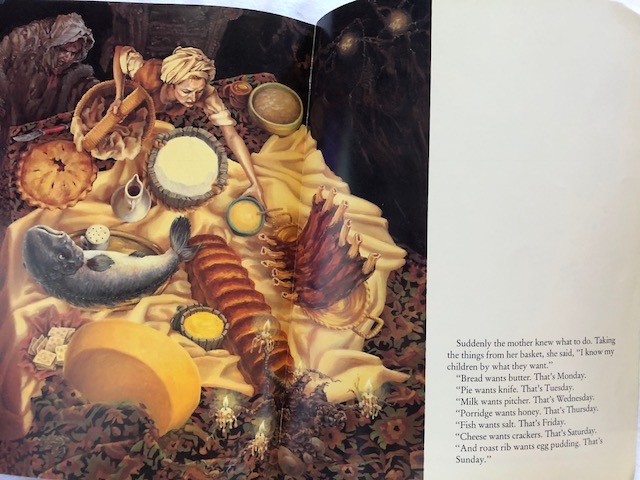
When the mother returns home and discovers that the witch has taken her children, she goes into the woods to get them back.  Heckedy Peg says that the mother can reclaim her children if she can determine which type of food on her table is which child.  At first, the mother doesn’t know what to do, but then she realizes that the things her children wanted from the market are the clues to determine their identities.

The book is currently available online through Internet Archive.

HeckedyPegAnswers

My Reaction

The pictures in the book are wonderful, but the most interesting part for me is in the note on the back, which explains that the story is based on a 16th century game that children still play which involves guessing the identities of children within a certain category of things.

I wouldn’t recommend the book for very young children because the way the children in the story were turned into food might be frightening.  Also, when the mother goes to the witch’s hut the witch refuses to let her in until she cuts off her feet, which she only pretends to do, but the idea is a little disturbing.  The part about cutting off the feet is a reference to part of the original game.

HeckedyPegCelebrate

Monster Manners

MonsterManners

Monster Manners by Joanna Cole, 1985.

Rosie Monster’s parents worry about her because she just can’t seem to understand how monsters are supposed to behave. Monsters are supposed to be fearsome. They’re supposed to growl, fight, and break things. Rosie is just the opposite. She’s endlessly polite and sweet.

MonsterMannersRosie

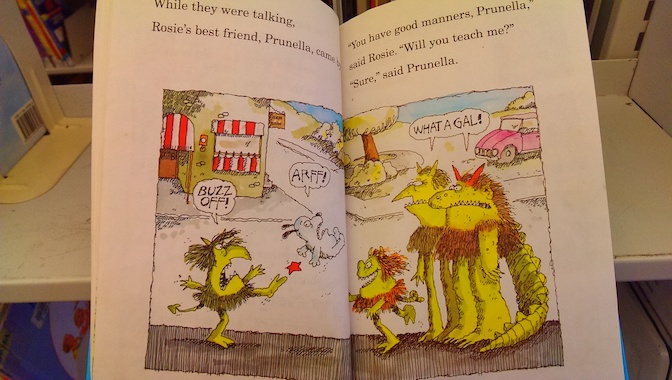
Rosie’s friend Prunella tries to teach her real monster manners, but no matter what, Rosie just can’t stop being polite.

MonsterMannersPrunella

It wouldn’t be such a problem for Rosie, except that she knows that her family and friends are disappointed in her.

MonsterMannersDisappointment

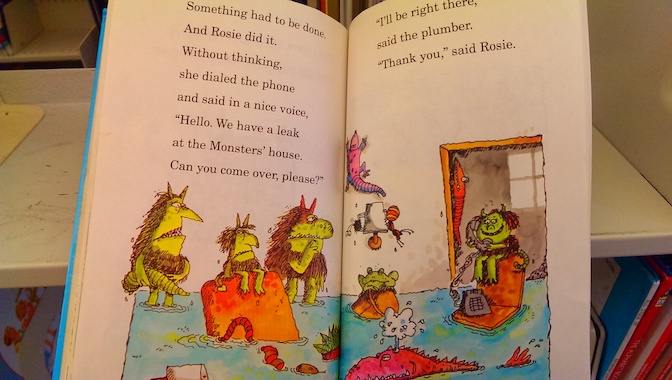
Then, a water pipe breaks at Rosie’s house. Although her parents, and even Prunella, try calling a plumber, they can’t get him to come to the house and help them no matter how loudly they growl into the phone.

MonsterMannersGrowling.jpg

It takes Rosie’s politeness to get the message across and get the help they need!

MonsterMannersPhone

A friend of mine who works in customer service wishes that more callers would be polite or, failing that, that he could just hang up like the plumber in the story.  Trying to help people who are determined to make the process of helping them harder than it has to be and who will curse and insult you for even trying is a frustrating experience.

The book is currently available online through Internet Archive.

The Day Jimmy’s Boa Ate the Wash

JimmysBoa

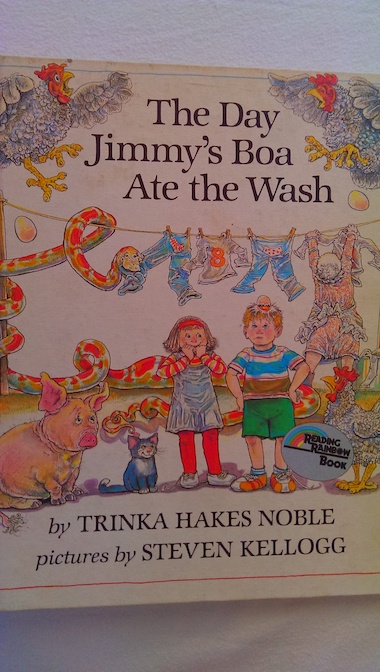
The Day Jimmy’s Boa Ate the Wash by Trinka Hakes Noble, pictures by Steven Kellogg, 1980.

The fun thing about this story is the backward way that the girl begins telling it, somewhat resembling The House that Jack Built, or better yet, the old No News Joke. The joke is really closer to the format of the story, with someone explaining the least eventful thing that happened as though it were the most important when it was just the end result of everything else.

A young girl (unnamed) arrives home, and her mother asks her how she liked her class trip to a farm that day. She says that it was boring until the cow started crying. When the mother asks her why the cow was crying, she says that the farmer wasn’t paying attention to where he was driving his tractor and knocked a haystack over on the cow.

As the mother continues to ask her daughter questions about what happened, backtracking through events, the real story begins to reveal itself:

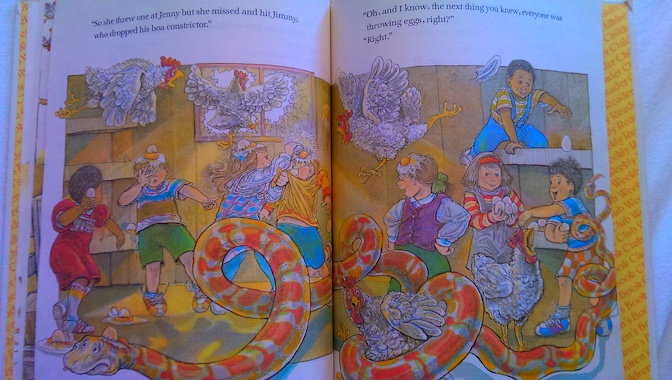
The girl’s friend, Jimmy, had a pet boa constrictor, and he brought it along on the field trip so it could meet all the farm animals.

JimmysBoaFieldTrip

However, the chickens became frightened, and one of them laid an egg on one of their classmates. She thought that someone else threw it at her, so she threw another egg at him, which hit yet another student.

JimmysBoaEggs

From there, it turned into one big food fight, with students throwing eggs at each other, and when they ran out of eggs, they threw corn at each other. The corn was for the pigs to eat, so the pigs wandered onto the school bus and started eating the children’s lunches. From there, chaos ensued until the farmer’s wife suddenly screamed, and the children’s teacher hustled the children onto the school bus to go home.

JimmyBoaLeaving

The children never knew exactly why the farmer’s wife screamed (although the reason is actually in the title to the book), but two things quickly became evident: Jimmy accidentally left his boa constrictor behind on the farm, but he has acquired a pet pig because there was still one left on the bus.

This summary doesn’t quite do the story justice because the backwards way the story starts out is part of the fun. The pictures in the book are hilarious, and the boa constrictor is shown at the end to have become a beloved pet of the farmer and his wife, even making friends with the chickens.

This is a Reading Rainbow Book.  It is currently available online through Internet Archive.

The Purple Coat

PurpleCoat

The Purple Coat by Amy Hest, 1986.

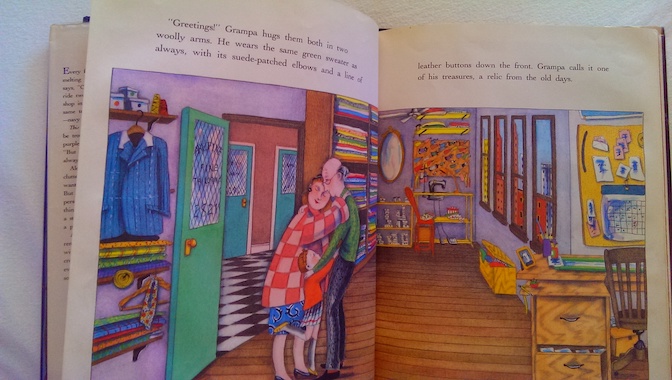
Every year in the fall, Gabrielle and her mother travel to the city to visit her grandfather’s tailor shop. While her mother shops at other stores, Gabby and her grandfather have lunch together (Gabby always eats the same kind of sandwich), and her grandfather makes her a new coat. Gabby always gets the same kind of coat, and it’s always navy blue.

PurpleCoatTailorShop

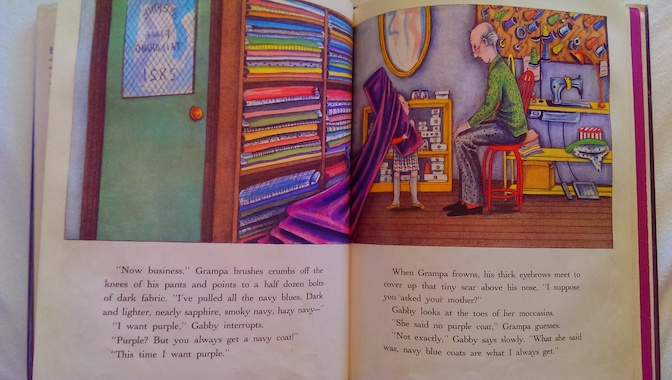
However, this year, Gabby wants something different. She wants a purple coat! She also wants it in a different style than her other coats, and she wants it to have a hood. At first, her mother and grandfather can’t believe that she really wants something so different from what she usually gets, and they point out that navy coats are classic, but Gabby is insistent.

PurpleCoatRequest

Gabby worries that her mother won’t let her get the coat that she really wants, but her grandfather remembers that when her mother was little, she once wanted something really unusual herself: a tangerine-colored dress. Sometimes, people do want to do different things, just to have a change and try something new. He also thinks of a way to give Gabby what she wants while allowing her to go back to her classic navy when she feels like it. Gabby’s new coat is reversible!
This is a Reading Rainbow book.  It is currently available online through Internet Archive.

Miss Nelson is Back

NelsonBack

Miss Nelson is Back by Harry Allard and James Marshall, 1982.

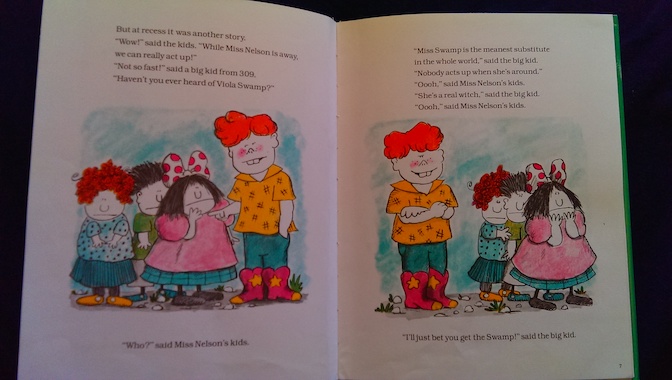
Miss Nelson, a teacher, tells her class that she will have to be away for awhile, having her tonsils removed, so someone else will be teaching their class.  At first, the kids think that they’ll be able to get away with a lot while Miss Nelson is away, but an older kid warns them that their substitute will probably turn out to be Viola Swamp, the meanest substitute ever.

NelsonBackWarning

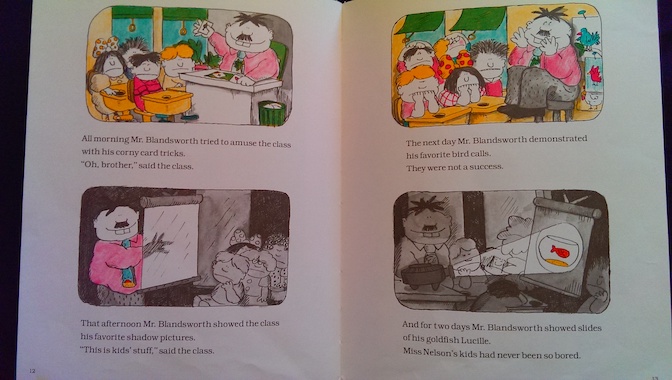
The kids are nervous until they find out that Mr. Blandsworth, the school principal, will be their substitute himself.  The worst thing about Mr. Blandsworth is that he’s boring, and he tends to treat them like they’re little kids.  They put up with it for awhile, but then, they realize that they can get rid of Mr. Blandsworth by convincing him that Miss Nelson has come back to school.

NelsonBackPrincipal

They put together their own Miss Nelson costume, with some of the kids sitting on each other’s shoulder’s to appear taller in the outfit.  It’s cheesy, but it convinces the principal.  But, the kids take it even farther than that.  Now that there’s no substitute teacher, they can do whatever they want!  Their “Miss Nelson” takes the class on an impromptu field trip to the movies and the ice cream parlor, and no one stops them because they’re with their “teacher.”
NelsonBackFieldTrip

Unfortunately, they make the mistake of walking past Miss Nelson’s house, and she discovers what they’ve been doing.

NelsonBackReveal

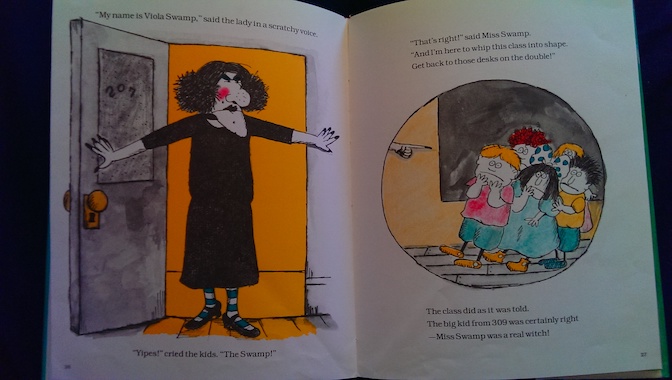
Miss Nelson arranges for Miss Viola Swamp to come and teach the class a real lesson.

NelsonBackSwamp

The book is currently available online through Internet Archive.

My Reaction

I actually like this book even better than the first book in the series because I think that the kids’ Miss Nelson costume is hilarious! Mr. Blandsworth is completely clueless about the kids’ deception, just as he never figures out what the real truth is about “Viola Swamp.”

As usual for the series, the story never explicitly states that Miss Nelson and Viola Swamp are the same person, but it’s heavily implied in the text (such as Viola Swamp’s scratchy voice from Miss Nelson having her tonsils out) and shown in clues in the pictures. Miss Nelson uses “Viola Swamp” as her alter ego whenever she needs to give her students some tough love, but that’s just a joke that Miss Nelson shares with the readers.

Ira Sleeps Over

IraSleepsOver

Ira Sleeps Over by Bernard Waber, 1972.

Ira, a young boy, is happy when his friend, Reggie, who lives next door, invites him to sleep over at his house. Then, his sister asks him if he’s going to take his teddy bear with him. At first, Ira says no, but his sister points out that he’s never slept without it.

Ira starts to worry about whether he should take the teddy bear with him or not. He worries that Reggie might laugh at him for having a teddy bear. His parents say that he won’t and that Ira should go ahead and take the bear with him. However, his sister says that Reggie probably will laugh.

IraSleepsOverWorry

Ira tries to talk to Reggie and sound him out on the idea of teddy bears to see if Reggie will laugh, but Reggie ignores Ira’s questions. Reggie is excited about all the things that he and Ira can do at the sleepover and eagerly explains his plans. It all sounds like fun, but Ira gets nervous when Reggie mentions ghost stories.

IraSleepsOverReggie

Ira continues to debate about whether or not he should take his bear with him. Before going over to Reggie’s house, he decides to leave his teddy bear at home.

The two boys have a lot of fun playing together at the sleepover. At bedtime, Reggie starts to tell a ghost story, and both of the boys are a little spooked. That’s when Ira discovers that Reggie has a teddy bear of his own.

IraSleepsOverTeddy

The book is currently available online through Internet Archive.

My Reaction

This is a nice story about how the things that we worry other people will find ridiculous or embarrassing are often more common and less embarrassing than we think. At first, Ira worries (because of what his sister said) that Reggie will think that his teddy bear, named Tah Tah, is silly and childish, but after discovering that Reggie has a teddy bear named Foo Foo, Ira realizes that Reggie will understand how he feels about his bear and decides to run home and get it.  Reggie probably dodged Ira’s earlier questions about teddy bears because he was similarly worried about what Ira would think of his bear.  Sometimes, when people really open up to each other and talk honestly about the way they feel, they learn that other people have shared their feelings and experiences more than they might have thought.

Imogene’s Antlers

ImogenesAntlers

Imogene’s Antlers by David Small, 1985.

One day, a young girl named Imogene wakes up to find that she has sprouted antlers during the night. It comes as a shock to the rest of her family, and she finds that it’s very difficult to do things with large antlers sticking out of her head.

No one seems to know why Imogene has sprouted antlers or what to do about them. Imogene’s mother faints just about every time she looks at her daughter, and her attempt to help Imogene hide them with a specially-designed hat is pure disaster. Imogene’s brother, Norman, thinks that Imogene might be a rare kind of elk now.

However, Imogene still has a lovely day as the family maid uses her as a rack to dry towels and the cook decks out her antlers with donuts to feed the birds.  She even puts candles on her antlers as an elaborate candelabra while she practices her piano lesson.

ImogenesAntlersDonuts

Still, it’s a most bizarre day, and her family is relieved when the antlers are gone the following morning.  But, Imogene’s adventures may only be just beginning.

The book never offers an explanation for why Imogene grew antlers or why she now has a peacock tail, but it doesn’t really matter. This is just one of those books that’s fun to read because it’s silly. While Imogene’s mother panics over her daughter’s condition and tries to hide it under a ridiculously big hat at one point, readers don’t have to worry about the long-term implications of Imogene’s antlers (or any other animal transformations) because she just enjoys them for what they are. The peacock feathers may not have as many practical uses as the antlers did, but one can imagine that Imogene will make the most of them while she has them.  I loved this book when I was a kid!

This book was featured on Reading Rainbow.  It is currently available online through Internet Archive.

Mirette on the High Wire

Mirette

Mirette on the High Wire by Emily Arnold McCully, 1992.

About 100 years ago (the book says, so it’s around the 1890s), a young girl named Mirette and her widowed mother run a boardinghouse in Paris. Most of the people who live there are actors and performers of various kinds.

MiretteBoardinghouse

One day, a strange, quiet man named Bellini comes to stay at the boardinghouse. Most of the time, Bellini prefers to keep to himself, but then Mirette catches him walking on the rope they are using for clothesline in the courtyard of the house. It turns out that Bellini is a tightrope walker. Mirette begs him to teach her how to do it, but he refuses.

MIretteRequest

Not to be daunted, Mirette begins experimenting with tightrope walking herself. After repeated falls, Mirette eventually learns to balance on the rope. When she shows Bellini that she can walk the length of the rope, he is impressed with her perseverance and teaches her more things to develop her skills. However, he becomes very upset when she boasts that she will never fall again.

MirettePractice

Mirette learns that Bellini was a world-famous tightrope walker until a friend of his was killed in a fall, and he lost his nerve. She talks to Bellini about it, and he says that he doesn’t know how to get over being afraid. Seeing Mirette’s disappointment and worry, however, gives Bellini the courage to try once again.

MiretteBellini

After talking with a performing agent staying at the boardinghouse, Bellini arranges a performance where he will walk a tightrope over a Paris street. When Mirette sees him hesitating at the beginning of the performance, she joins him on the wire, bolstering his courage and realizing her own dreams of becoming a real tightrope walker.

MiretteBelliniTightrope

There are other books in a series about Mirette and Bellini, where they perform tightrope acts and have adventures around the world, but I think that the first book is really the best.  The pictures are beautiful, done in an impressionistic style.

This book is a Caldecott Award winner.  It is currently available online through Internet Archive.

The True Tale of Johnny Appleseed

JohnnyAppleseed

The True Tale of Johnny Appleseed by Margaret Hodges, 1997.

This American folktale was based on the life of a real person, John Chapman.

Johnny Appleseed was born as Johnny Chapman in 1774. His family lived in Massachusetts. There were plenty of apple trees there, and Johnny loved them. When he was grown, he started traveling west with the idea of spreading apple trees.

He carried very little with him, and some people said that he wore the pot that he used to cook his meals on his head as he walked. Everywhere he went, he planted apple seeds.

His reputation spread, and although people thought that traveling around just to plant apple seeds sounded crazy, they sometimes let him stay with them on his travels. Even Native Americans seemed to like him because he was friendly and helpful and interested in learning their languages. His legacy continued long after his death with trees that were enjoyed by generations of families across the Midwest.

There is a section in the back of the book that explains more about the history behind Johnny Appleseed’s story, including the end of the Revolutionary War and the beginning of westward migration in America. One of the things they mention is the effect that the War of 1812 had on relations between pioneers and Native Americans. Because pioneers were already pushing into the territory of Native Americans in the area that later became Ohio, the tribes there sided with the British in the war, hoping to push out the invading pioneers. After the war was over, though, the pioneers continued to come west, and when they did, they retaliated against the tribes that had been on the side of the British. The pioneers could be brutal, and part of the reason that Native Americans liked Johnny Appleseed was that he was different. He wasn’t trying to hurt anyone or take land for himself; he just wanted to plant trees. After he planted trees, he would build fences around them to keep animals from eating them while they were growing.

John Chapman’s life was unconventional.  He never married, and he acted as a Christian missionary in his travels as well as a planter.  Although he could be regarded as something of an oddball in the itinerant way he lived his life, he became a legend.

The book is currently available online through Internet Archive.