Zathura

Zathura

Zathura by Chris Van Allsburg, 2002.

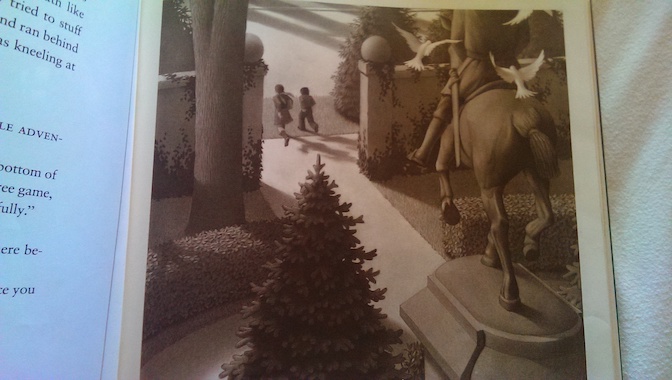
This book begins where Jumanji ends. It’s not completely a sequel because it has a different set of children and a new game, but it’s connected because the two children from Jumanji left the board game in the park again after they finished it, and they saw two boys that they know pick it up and take it home.
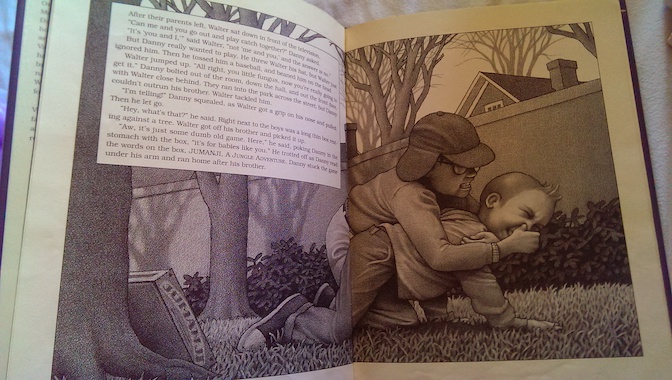
ZathuraBrothersWrestling

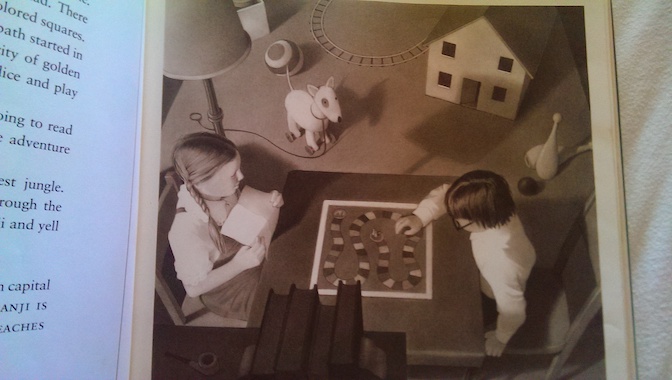
However, the two boys, Danny and Walter, don’t end up playing the same jungle board game, Jumanji, that was in the previous book. They find a second board game in the Jumanji box called Zathura and decide to try it instead. Zathura is a space-themed game where players travel a path from Earth to the planet Zathura. Like in Jumanji, elements from the board game come to life as the boys play, and someone must reach the end in order to end the game.
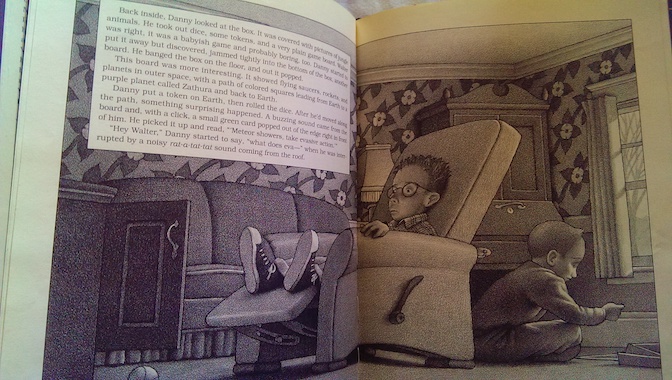
ZathuraStartingGame

Danny and Walter, a pair of brothers, fight a lot. Walter hates doing things with Danny. However, when Danny starts playing the game, sending their house into outer space, Walter must join in and play with his brother in order to bring the game to an end so they can go home. The two of them learn teamwork as they help each other face the dangers of the game while trying to reach Zathura.
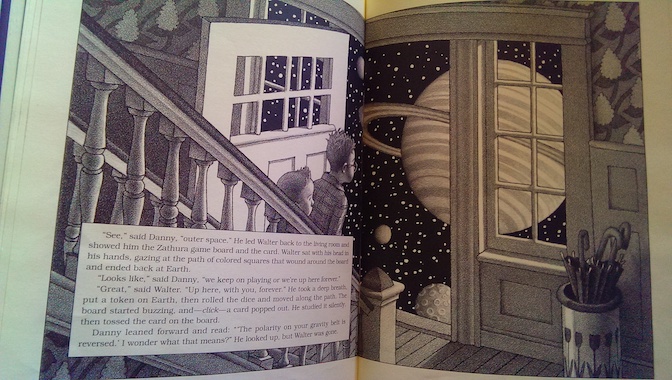
ZathuraOuterSpace

There is a movie version of this book, but there are major differences between the original book and the movie. The conflicts between the two boys are similar in the book and the movie, but the movie added a subplot about the boys’ parents being divorced (they weren’t in the original book), an older sister for the boys (it was just the two of them originally), and a kind of alternate reality where the older boy was trapped in the game by himself for years because he wished his brother away before finishing the game until his alternate self realized that he cared about his brother and wanted to cooperate with him.  In the original book, nobody was trapped in the game.

ZathuraAlienRobot

Chris Van Allsburg illustrations are always good, although I have to admit that I preferred the illustrations in Jumanji to the ones in Zathura.  It just seems to me that the pictures in Jumanji were more detailed and realistic.

The book is currently available online through Internet Archive.

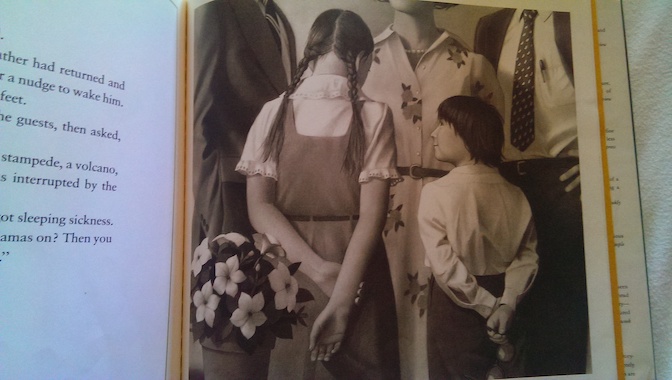
ZathuraGoingHome

Jumanji

Jumanji

Jumanji by Chris Van Allsburg, 1981.

Judy and Peter, a brother and sister, are left home alone while their parents go to an opera. In spite of their parents’ warning not to make a mess because they’ll be bringing guests by later, the kids scatter all of their toys around while playing. Then, the kids go to the park to play for awhile, and they find a board game labeled Jumanji with a note that the game is free to anyone who wants to play it. Judy and Peter decide to give the game a try and take it home.

JumanjiPark

Jumanji turns out to be a kind of race game. Players are supposed to make their way down a path through a jungle, facing all kinds of dangers, until someone reaches the golden city of Jumanji. The instructions warn them that once a game has begun, it will not be over until one of the players reaches Jumanji.

JumanjiGameStart

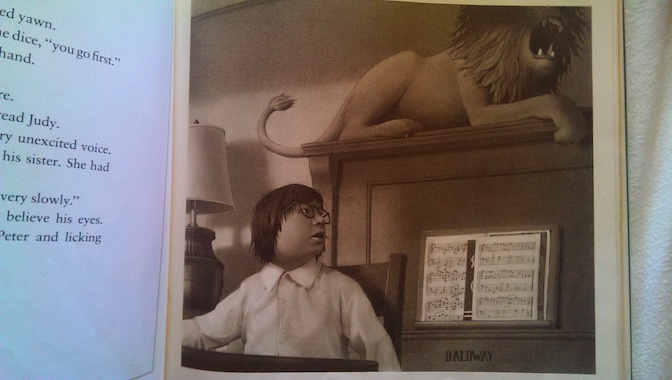
At first, Peter thinks that the game is boring and easy, but it soon becomes apparent that things that happen in the board game are starting to happen in real life when a live lion suddenly appears after an encounter with one on the game board.  Peter is scared and wants to stop playing, but Judy reminds him that they can’t stop because the game won’t end until one of them reaches the end of the path on the game board. Until the game ends, they’re stuck with the lion and anything else that happens to appear because of the game. They have no choice but to keep playing, facing each danger as wild animals rampage through their house.

JumanjiLion

Chris Van Allsburg books always have amazing illustrations, and the pictures in this book are especially good!  At the end of the book, the children see two other children find the game, which leads to the sequel, Zathura.

JumanjiRhino

There is a movie version of this book, but the movie differs greatly from the original story. In the movie, the two kids were friends, not brother and sister, and the boy ends up trapped in the game for a period of years until, finally, a new set of kids starts playing and helps the original players to finish their game.  When their game ends, the original children are returned to their own time, and no one but them knows that they were ever gone.  Things turn out better for the future children as well because the older players make things better for everyone in their own time.  There were no players stuck in the game in the original book, and everything takes place during a single day.

The book is currently available online through Internet Archive.
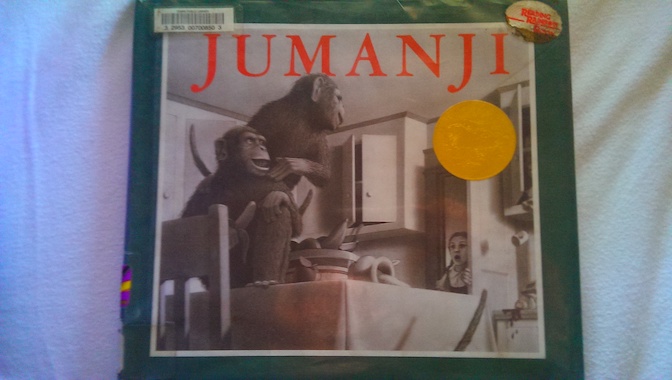
JumanjiParents

Hester the Jester

HesterJester

Hester the Jester by Ben Shecter, 1977.

This cute picture book takes place in a Medieval kingdom.  Little Hester’s father is the court jester.  Then, Hester decides that she wants to be a jester, too.  At first, Hester’s parents tell her that she can’t because she’s a girl.  (If you’re thinking that you know where this story is headed, wait.)

One day, the king is so sad that Hester’s father can’t cheer him up, no matter what he does.  When Hester starts putting on her jester act for her father and makes him happy, he decides to go ahead and have her perform for the king.  Hester does cheer the king up, but that isn’t the end of the story.

Hester tells the king that she has discovered that she doesn’t like being a jester after all because it makes her feel too silly.  So, the king, now in a much better mood, asks her what she would like to do instead.

This starts a sequence where the king allows Hester to try out various roles and see if she likes them.  She tells him that she wants to be a knight because knights are important, but she ends up not liking that when she learns that knights have to go into battle.  Then, Hester decides that being a king is even more important, so the king decides to let her try it.  But, Hester isn’t good at giving other people wise advice, as the king does.

HesterJesterKnight

In the end, when Hester’s mother is sad and doesn’t know what to do now that her daughter has become a king, Hester decides that what she most wants to do is to go home and be her little girl again.

In a way, this book seems like two little stories in one.  First, there’s Hester proving that she can be a jester even though she’s a girl, and then, there’s Hester trying to decide what she really wants to be the most, now that the king is letting her try anything she wants.  What she decides that she wants most is to be herself and go home.

So, is this little book anti-feminist, saying that girls are better off just forgetting about the other stuff they might want and staying girls?  I don’t think so.  Basically, this is just a silly little story about a little girl, one too young to have a profession of any kind, who is allowed to see the realities behind some of the things she’s been wanting to try.  Some parts, she likes, and some she doesn’t.  But, she’s too young and inexperienced for all of them (and some, she will never want to try again because she’s learned that they’re not what she really wants after all), so she’s just going to be what she is: a little girl with plenty of time to grow up, who needs her mother and whose mother needs her.  All throughout the book, Hester speaks her mind about what she wants and is honest about the things she doesn’t like, admitting when she changes her mind.  As for what might happen when Hester grows up and finds something else she might want to do . . . who knows?  By then, she may be willing to try new things again.  But, she knows what she wants for now and has a little better idea of some things that she won’t want in the future.
The book is currently available online through Internet Archive.
The Surprise Doll

SurpriseDoll

The Surprise Doll by Morrell Gipson, 1949.

Mary is a little girl who lives by the sea. Her father is the captain of a ship, and he travels to different countries all over the world. Sometimes, he brings presents for Mary from his voyages. So far, he has brought six dolls for her:

SurpriseDollTeresaSusan – from England, with rosy cheeks

Sonya – from Russia, with a cute turn-up nose

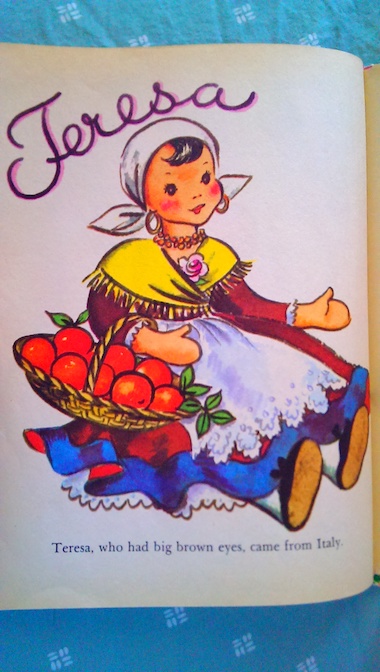
Teresa – from Italy, with brown eyes

Lang Po – from China, with raised eyebrows

Katrinka – from Holland, with blonde hair

Marie – from France, with a smile that brightens her whole face

Mary loves her dolls, but she realizes that if she had a seventh doll, she would have a doll for each day of the week. She asks her father if he will bring her another, but he says that she already has enough dolls.

When her father refuses her request, Mary pays a visit to the local dollmaker. She takes along her six dolls and explains to the dollmaker why she wants one more. After studying Mary and her dolls, the dollmaker agrees to make one for her as long as she’s willing to leave her other dolls with him for a week. At the end of the week, Mary returns to collect her new doll and receives a surprise!

SurpriseDollDollmaker

The “surprise” isn’t much of a surprise to the readers because the “surprise doll” is shown on the cover of the book, but it’s a cute story about how people around the world have many things in common. What the dollmaker notices about Mary and her dolls is that Mary shares certain qualities with each doll, the ones listed in the dolls’ descriptions above. So, he makes a doll for Mary that looks just like her by using her other dolls and their shared features as models. Her new doll, Mary Jane, is an American doll, but she has features in common with Mary’s other dolls from around the world, just like children in America can share qualities with children in other places. It’s a soft message about diversity and finding common ground.

SurpriseDollSeventhDoll

The Biggest, Most Beautiful Christmas Tree

BiggestChristmasTree

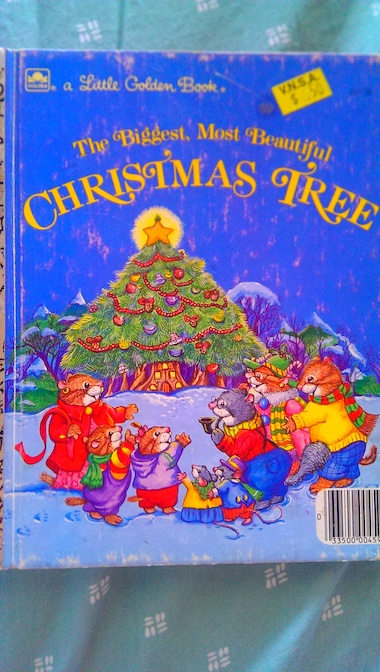
The Biggest, Most Beautiful Christmas Tree by Amye Rosenberg, 1985.

This is a Little Golden Book.

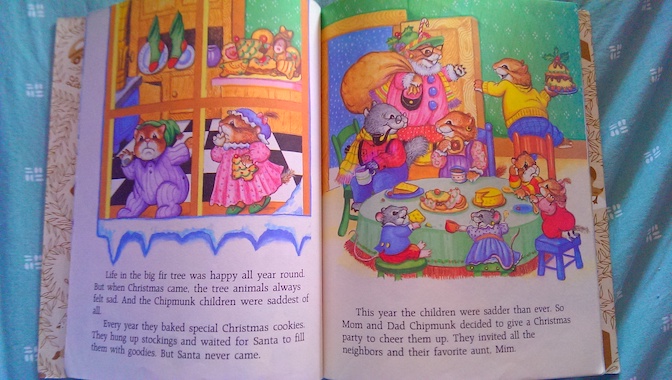
Every year at Christmas, the Chipmunk children, Nina and Nutley, are disappointed because Santa doesn’t visit their home in a large fir tree in the forest.  They always hang up their stockings and put out cookies, but for some reason, Santa never comes.

BiggestChristmasTreeDisappointment

However, this year, their Aunt Mim has figured out the reason why Santa passes them by and what to do about it.  Aunt Mim has realized that Santa can’t find their tree because it looks like every other tree in the forest.  What they have to do is to decorate their tree so that Santa can find it among all the others.

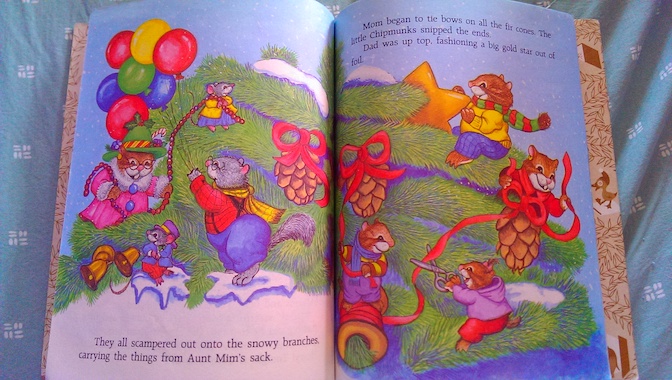
Aunt Mim brings lots of things they can use as decoration, and all of the other animals who live in the tree help with the decorating.  They tie bows on the pine cones, hang strings of berries, and paint balloons to look like large Christmas tree ornaments.

BiggestChristmasTreeDecoration1
BiggestChristmasTreeDecoration2

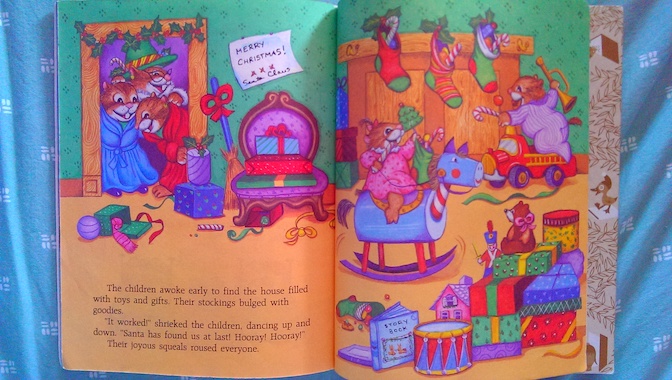
Sure enough, once Santa knows how to find the Chipmunk children, they get the kind of Christmas they’ve been waiting for!

BiggestChristmasTreePresents

This is just a cute picture book that I liked when I was young.  It is available to borrow and read for free online through Internet Archive.

The Legend of the Bluebonnet

LegendBluebonnet

The Legend of the Bluebonnet by Tomie dePaola, 1983.

This is a story about the Comanche People in what is now Texas, based on an old folktale.

There has been a severe drought and famine in the land for a long time, and many people have died.  The survivors pray to the spirits for help in ending the drought, and they receive a sign that it will not end until someone among the Comanches makes a sacrifice of the thing that is most dear to them.

LegendBluebonnetShaman

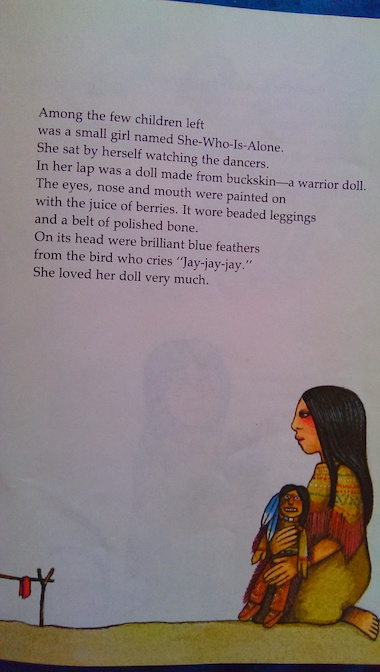
The people debate about who is supposed to make the sacrifice and what object the spirits could want, but one young girl thinks that the spirits are talking about her and her doll.  The girl is called She-Who-Is-Alone because she is the last of her family.  Her parents and grandparents are dead, victims of the famine.  The only thing she has left to remind her of them is her doll, a warrior with blue feathers in its hair, that her parents made for her before they died.

Desperate to end the drought and famine and to save her people, the girl makes the difficult decision to sacrifice her doll by burning it.  Her sacrifice is rewarded not only by the end of the drought but by the sudden appearance of a field of flowers as blue as the feathers in her doll’s hair.  The girl receives a new name from her people, acknowledging her sacrifice on their behalf.

LegendBluebonnetFlowers

A section in the back of the book explains a little about the Bluebonnet flower, which is the state flower of Texas, and the origins of the story in the book, which is based on a folktale.  This is also a little information about the Comanche People.

The book is currently available online through Internet Archive (multiple copies).

Strega Nona

StregaNona

Strega Nona by Tomie dePaola, 1975.

Strega Nona is a witch who lives in a small town and uses her magic to help people in various ways, everything from small cures or love potions.  However, she runs into problems when she hires Big Anthony to help her around her house.  Big Anthony is helpful, but he doesn’t always pay attention or follow orders.

StregaNonaAnthonyPot
Strega Nona has a magical pot that makes pasta.  To get it to make a never-ending pot full of pasta, she recites a certain rhyme.  To get it to stop making pasta, she recites a different rhyme and blows three kisses to it.

Big Anthony is forbidden to use the pasta pot himself, but he can’t resist telling people in town about it.  At first, no one believes him because it sounds so strange.  Everything thinks he’s just making it up.  Big Anthony is offended that no one believes him, so one day, while Strega Nona is gone, he sets out to prove to everyone that this magical pot exists.

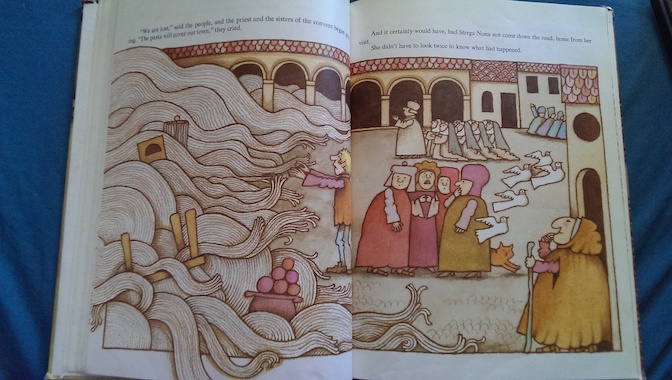
Big Anthony knows the rhyme to get the pot to start making pasta, and he uses it to make pasta for everyone in town so they will know that he was telling the truth.  Unfortunately, he doesn’t really know how to get it to stop because he didn’t know that Strega Nona blows kisses to the pot.  With the pot now sending a massive river of pasta through the town, what can Big Anthony do?

This is a Caldecott Honor Book.  It is currently available online through Internet Archive.
StregaNonaPastaRiver

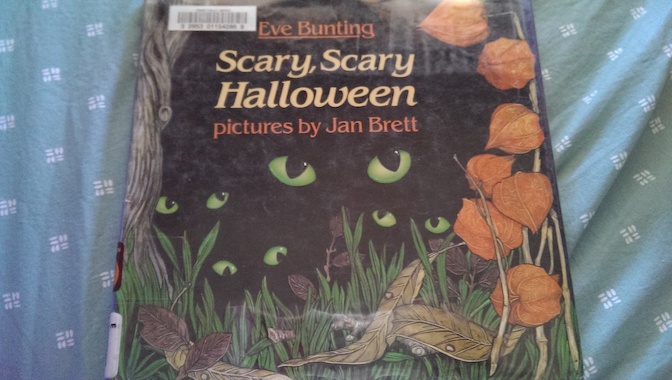
Scary, Scary Halloween

ScaryHalloween

Scary, Scary Halloween by Eve Bunting, pictures by Jan Brett, 1986.

I love the pictures in this book and enjoy the rhyming text of the story.  It’s a cute concept for Halloween, and young children will enjoy the repetition in the story.

ScaryHalloweenSkeleton

One Halloween night, unseen watchers observe children in costume trick-or-treating.  The mother cautions her children to remain hidden because of all the strange creatures that are out and about on Halloween.

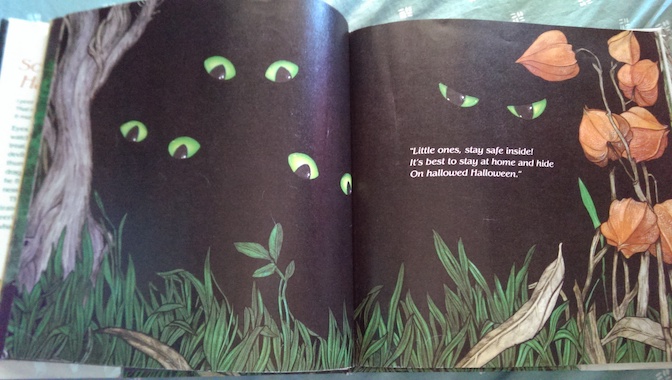
ScaryHalloweenEyes

Readers will know that the monsters are simply children in costume, but the watchers do not because they are cats, which is only revealed at the end of the story.  Throughout most of the book, they only appear as green eyes as they hide under the porch of a house.

ScaryHalloweenPorch

When all the trick-or-treaters are gone, the mother cat and her kittens are free to roam the night themselves.

ScaryHalloweenCats

I thought that it was cute how the mysterious tone of the book was due to the cats’ understanding of Halloween.  At first, it may seem very mysterious to young children as well, but completely understandable as it becomes more and more obvious that all the monsters are only trick-or-treaters and the little family hiding from them are cats, who think of themselves as being pretty fierce in their own right.

The book is available to borrow and read for free online through Internet Archive.

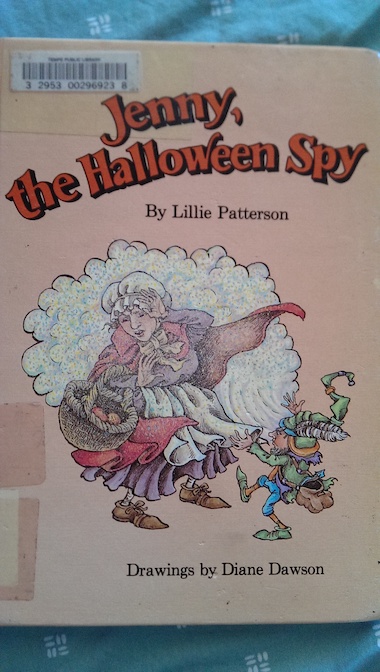
Jenny, the Halloween Spy

JennyHalloweenSpy

Jenny, the Halloween Spy by Lillie Patterson, 1979.

JennySpyWitchOne Halloween, Jenny goes to visit Nancy, a woman who local people say is a witch.  Jenny is curious about magic and, knowing that there are magical creatures abroad on Halloween, she wonders if she might see something unusual at Nancy’s house.

As she arrives at the house, Jenny peeks inside before announcing herself and sees Nancy putting some kind of oil in her eyes.  After Nancy welcomes her inside and offers her some cider, Jenny sneaks a little of this oil and puts it in one of her eyes to see what it does.  She discovers that the oil allows her to see magical beings that are hidden to most people.  There are fairies in Nancy’s house and rich furnishings that appear very ordinary to Jenny’s unaffected eye.

Using her new ability to see magical creatures, Jenny goes to the town market to see what is going on there.  However, when she catches a pixie stealing some fruit, the fairies and other “wee folk” decide to put an end to Jenny’s spying on their activities.  With some magic dust, the pixie removes her ability to see magical creatures and tricks her into getting onto an enchanted horse that takes her on a wild ride ending with a view of the devil!

The book is available to borrow and read for free online through Internet Archive.

My Reaction

JennySpyFairiesThis is a kind of cautionary story about the dangers of curiosity.  Jenny’s curiosity invites the attention of dangerous creatures and leads her into a frightening situation, something that she never wants to repeat.  For the most part, I think that curiosity is a trait that should be encouraged, but Jenny did deliberately seek out a person with a dangerous reputation and pry into the things she was doing, even trying some herself because she wanted to know more about it, so she could be considered to have gone looking for trouble.

In some ways, this book is very strange, but I can see where it draws on old folklore.  The end part about seeing the devil (accompanied by headless hounds) is a little bizarre and rather frightening for a modern children’s picture book but in keeping with folklore about Halloween and witches.  Although everything that happens to Jenny is supposedly really happening, part of me did wonder about the oil that she put in her eye because plants with hallucinogenic properties are used in folk medicine.  As far as the story is concerned, though, the magic and supernatural creatures are real.

The pictures are colorful and fascinating, but this book may be frightening for very young children.  Some of the fairies remind me a little of the pictures that inspired the Cottingley Fairy hoax.

The Little Old Lady Who Was Not Afraid of Anything

OldLadyNotAfraid

The Little Old Lady Who Was Not Afraid of Anything by Linda Williams, 1986.

“Once upon a time, there was a little old lady who was not afraid of anything!”

This is a cute picture book based on word and sound repetition.

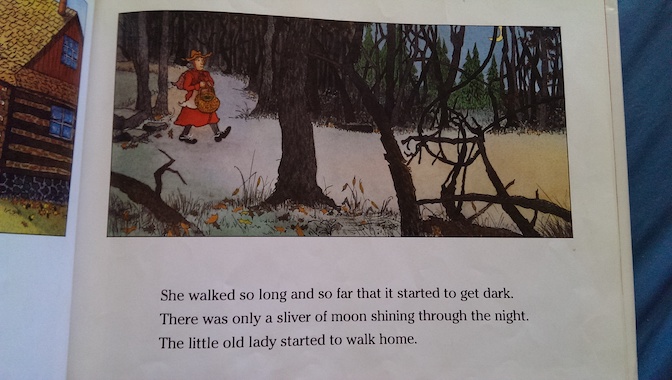
A brave lady ventures out into the woods one day, and as she makes her way home again when it gets dark, she begins to encounter some strange things.

OldLadyWoods

First, a pair of shoes with no one in them begin to follow her.  Then, she meets a part of pants with no one in them, and a shirt joins the parade of  clothes.  But, as weird as it is, nothing frightens the lady, not even the addition of a living jack o’lantern.

OldLadyClothes

OldLadyRun

When everything fails to frighten the woman (although she does look a little scared at one point), she has to help this strange collection of living clothes and pumpkin head to find a new purpose for themselves.

The book is currently available online through Internet Archive.
OldLadyScarecrow