Castle Diary

CastleDiary

Castle Diary: The Journal of Tobias Burgess, Page by Richard Platt, 1999.

Tobias is an eleven-year-old boy living in England in 1285.  He is from a noble family, and his father is sending him to his uncle to become a page.  As a page, Tobias will learn manners and skills that he will need as he eventually becomes a squire and then a knight.  During the first year of his training that he spends with his uncle, he keeps a diary of everything that happens to him and everything he learns.  Toby is a fictional boy, but his life and family are meant to illustrate what life was like for a young boy from his social level during the Middle Ages.

CastleDiaryPic1

The castle were Toby’s uncle lives is much bigger than his parents’ manor house.  Toby has to learn the roles of all the servants who live there: who is in charge of what and who reports to who.  Not all servants are equal, and some command more respect than others.  Some of them are even from noble families like his, including his aunt’s companion, Isbel.  Toby himself is assigned to do chores for his aunt like running errands, delivering messages, serving food at meals, and holding up the hem of her cloak when she walks outside.

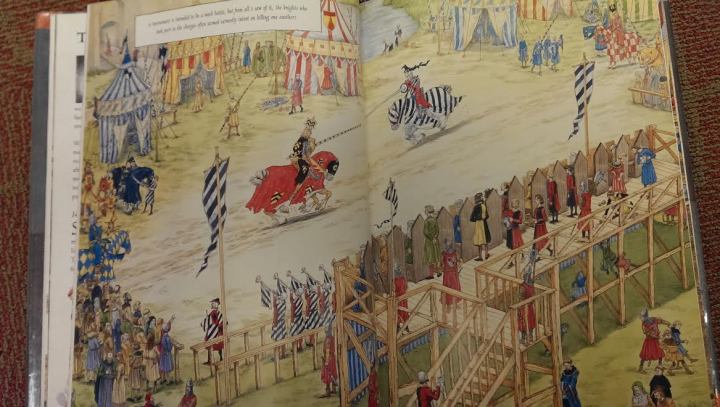
Toby shares a room with the other pages at the castle, all boys of noble families and destined to become knights, just like him.  They have lessons in reading, writing, mathematics, Latin, and scripture from the castle’s chaplain, and he is a harsh disciplinarian.  They practice their lessons on wax tables that can be smoothed out and used again.  The boys also learn manners and start learning archery and about all the weapons and armor that knights use.  When they have time to play, they try walking on stilts and play at being jousting knights by carrying each other on their backs and trying to knock each other off.
CastleDiaryPic2

During the course of the year, Toby gets to witness a hunt, a joust, and a banquet with important guests.  At one point, he gets sick and receives treatment from a physician.  He also encounters a poacher on his uncle’s land.  This man is eventually caught (although Toby decides not to turn him in) and put on trial, but in the end, he is not punished because the jurors were sympathetic.  The book ends with a Christmas celebration, after which Toby goes home to visit his parents.

CastleDiaryPic3

In the back of the book, there is a section with more information about Medieval society, castles, sieges, weapons, armor, and the changes that eventually brought an end to feudal system that Toby knew.

The book is part of a series of historical picture books.  It is currently available online through Internet Archive.

CastleDiaryPic4

Prayers at Eastertime

PrayersEastertime

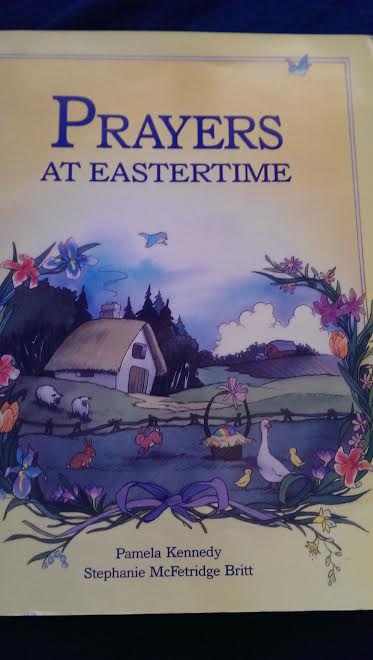
Prayers at Eastertime by Pamela Kennedy and Stephanie McFetridge Britt, 1989.

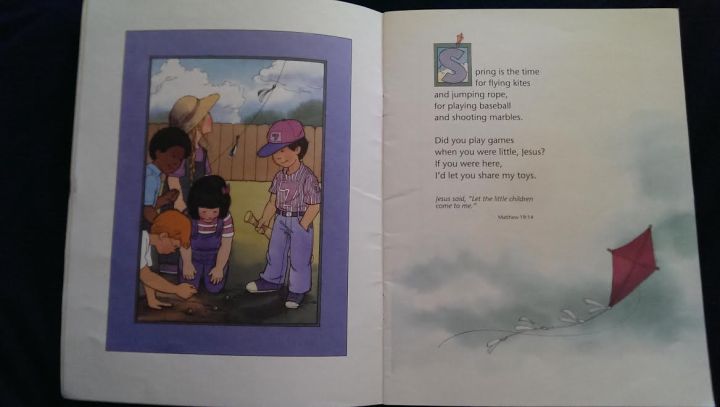
This was a present given to me one Easter many years ago, and I always liked it, especially because of the nice pictures.  Some of the prayers and accompanying Bible quotes are specifically for Easter and springtime, but others are just more general.

There are multiple copies of this book available online through Internet Archive.
Happy Easter!

PrayersEastertimePic1

PrayersEastertimePic2

PrayersEastertimePic3

Make Way for Ducklings

MakeWay

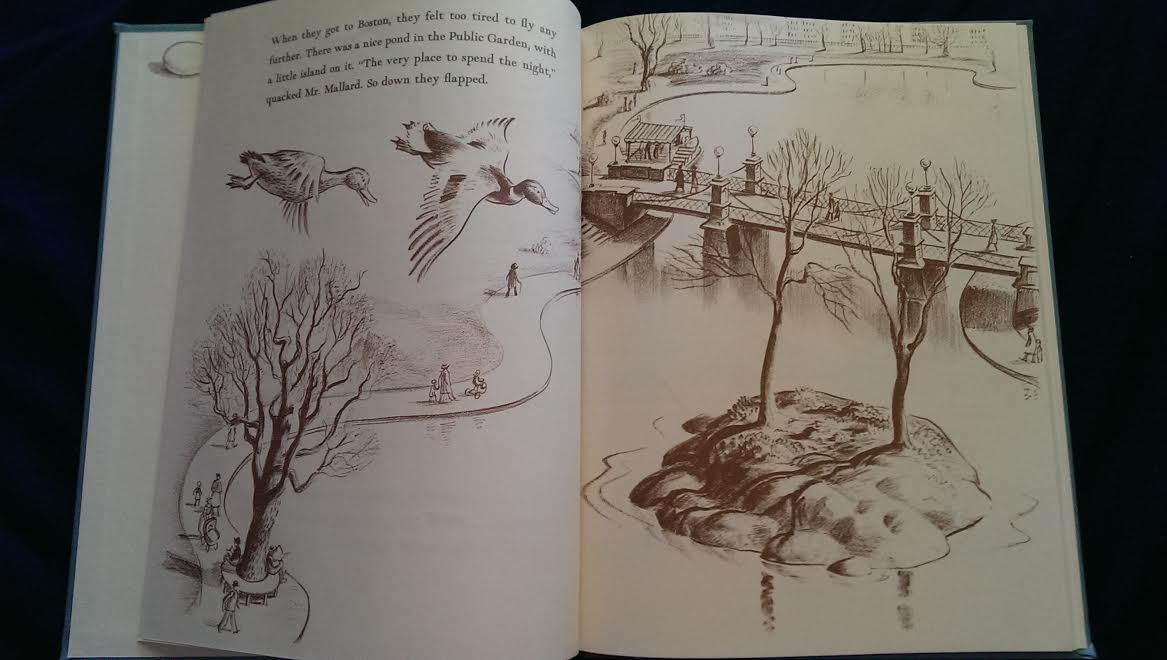
Mr. and Mrs. Mallard are looking for a new home where they can raise their babies.  After trying several places, they finally find a place that seems right on an island in the Charles River, not far from the Public Garden where people fed them peanuts.

MakeWayPic1

Then, one day, Mr. Mallard decides to take a trip to explore the river, leaving Mrs. Mallard and their ducklings on the island.  The two of them agree to meet again with their ducklings in the Public Garden in a week.  However, the journey from the river to the garden is perilous.  Mrs. Mallard and her ducklings need the help of some friendly policemen to make it safely through the city!

MakeWayPic2

The classic children’s picture book is cute and gentle with a happy ending for the Mallard family. This book is a Caldecott Medal winner and the Official State Children’s Book of Massachusetts.

MakeWayPic3

The book is available to borrow and read for free online through Internet Archive (multiple copies).

Ginger’s Upstairs Pet

GingerUpstairsPet

Ginger’s Upstairs Pet by John Ryckman, 1971.

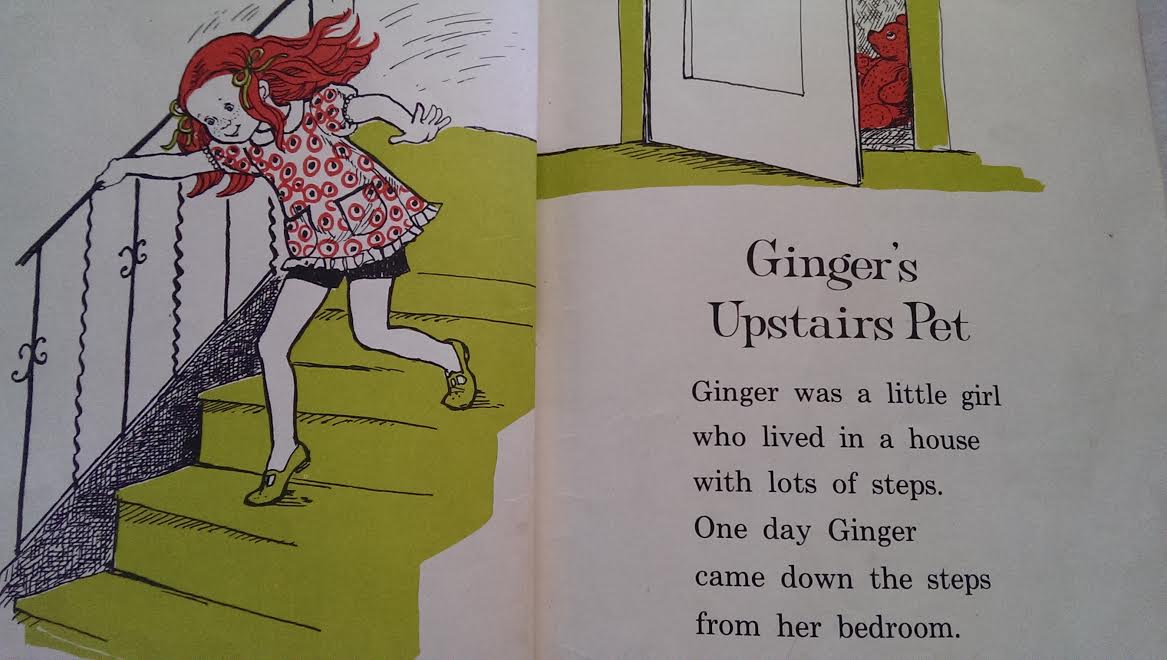
This is a cute picture book about a little girl named Ginger and the mysterious new “pet” she’s found.  At first, her mother doesn’t believe that Ginger has a pet, but Ginger keeps running downstairs from her room to ask for more food to feed her pet.  First, it’s cake.  Then, it’s apples.  Ginger keeps coming back down stairs with more requests for food.

GingerUpstairsPetPic1

Ginger’s mother thinks that Ginger is eating the food herself until Ginger comes downstairs with an especially strange request.  Then, her mother decides to see Ginger’s mysterious pet herself.

What kind of pet does Ginger have?  More importantly, how did she get it?

My Reaction and Spoilers

If you don’t want to know what pet Ginger has, don’t look at the pictures below!  I don’t mind giving spoilers, though, because this isn’t a very common book these days.  It isn’t on Internet Archive, although it’s possible to buy it on Amazon.  I won my copy in a drawing back when I was in first grade, and the school library was raffling off books they were getting rid of.

It’s a fun, light-hearted story about a strange day in the life of this family and the unusual “pet” that little Ginger temporarily acquires without even leaving her upstairs bedroom.  It’s a calm but humorous story that has enough reality to it to be believable.  Ginger’s pet and the way she found it are unusual enough that it would be unlikely that anything like this would happen to any real child, but not so far out and crazy to be completely unbelievable or too cartoony, and the situation is resolved realistically, after which Ginger and her mom have some cake themselves.  There’s nothing serious or tense about the story at all, so it would make good bedtime reading.  It’s one of the books that I think would be nice to see in print again.

The drawings are cute, and they’re interesting because they only use four colors: black, white, red, and green.

The Eleventh Hour

The Eleventh Hour by Graeme Base, 1989.

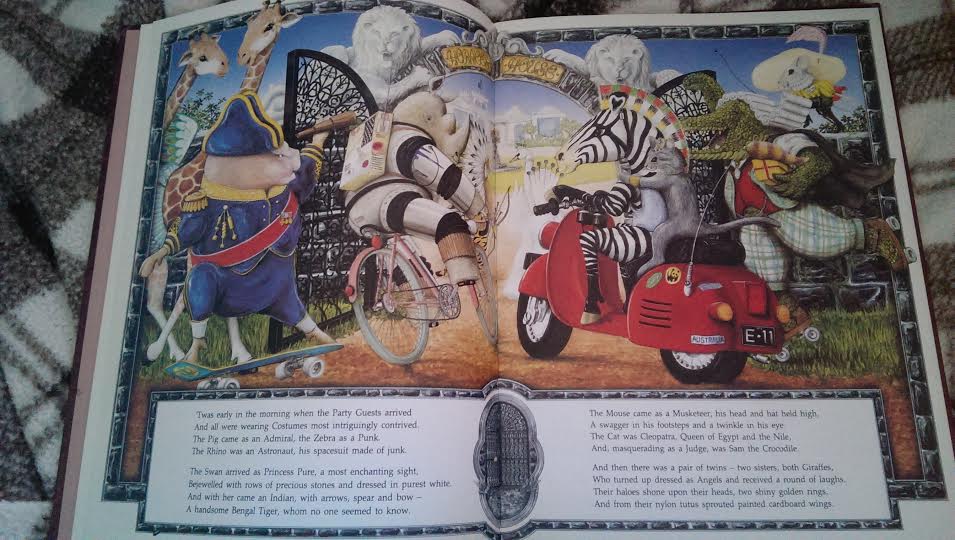
Horace the elephant is turning eleven years old, so he’s invited all of his animal friends to his house for a costume party.  The best part will be the extraordinary feast that Horace has created himself with all kinds of cakes and pastries and other desserts.

eleventhhourguests2

But, Horace refuses to let his friends eat any of the goodies until after they’ve played the party games. The guests have a lot of fun, but through all the games, they’re still thinking about that glorious feast. Only, when they finally go to eat, the food is all gone! Who could have taken it?

The book is available to borrow and read for free online through Internet Archive.

My Reaction

This picture book is actually a puzzle book, with puzzles difficult enough to even challenge adults.  Hidden within each of the large pictures taking up the entire page of each page in the book, are secret messages that hint at the identity of the thief, who is one of the party guests.  Some of the messages are in code.  Although a young child might enjoy the pictures in the book and the rhymes of the story, it would take someone older to be able to solve the puzzles.

There is a way to find the thief without finding the hidden messages or solving any codes, but it still requires attention to detail. There is a section in the back of the book that explains everything, pointing out all the secrets that you can find in the pictures, including the names of one of the giraffes and the swan, whose names are not given in the story itself.

But, don’t skip straight to the answers.  As Base himself says at the beginning to the section of answers, “the getting of wisdom is no match for the thrill of the chase, and those who choose the longer road shall reap their reward!”

Jumble Joan

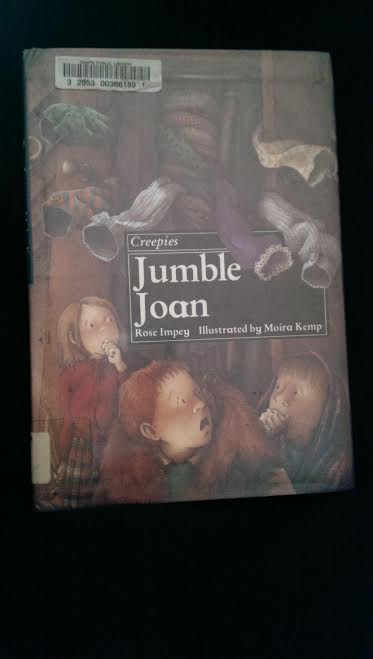
jumblejoanJumble Joan by Rose Impey, 1989.

A boy and his friend, Mick, take his little sister upstairs to explore their grandmother’s attic one evening.  The boys are hoping to scare the girl by telling her all sorts of creepy stories about the stuff they find in the attic, but if they’re scaring anyone, it might just be themselves.

A rocking horse becomes one of the dreaded “Ten O’Clock Horses” that might drag a child off into the night if she isn’t in bed on time.  An old stuffed parrot in a cage becomes “The Deadly Vampire Bat”, waiting to suck their blood.  But, the most sinister creature of all might be “Jumble Joan”, who hides by pretending to be a pile of old clothes, ready to steal away any little girls who might want to play dress up in their grandmother’s attic!

Although the brother narrates the story, the pictures show that his little sister knows exactly what the boys are trying to do, and she does things to turn the situation around.

This is one of the books in the Creepies Series.  Kids under the age of seven might find stories in this series a little scary because they focus on how stories about monsters can build in the imagination, even if you know that you made them up yourself.  Still, all of the books have good endings, and this one is pretty funny.

This book is available to borrow and read for free online through Internet Archive.

The Flat Man

flatmanThe Flat Man by Rose Impey, 1988.

Before Slender Man, there was . . . The Flat Man!  And he wasn’t quite as scary. As far as I know, there is no connection between the two fictional characters other than a similarity in name.  Still, the Creepies Series, while picture books, should probably only be given to children no younger than seven who like scary stories.  They might provoke nightmares in very young children and sensitive children.  I liked these stories as a kid for their imagination, but individual tastes may vary.

Like all the books in the Creepies series, The Flat Man features a child who enjoys being a little scared and makes up his own imaginary monster to battle with at bedtime.  The entire time, the boy knows that the monster is imaginary and prides himself on knowing just how to deal with him.

While lying in bed one night, the boy imagines the scary creature called the Flat Man for the fun of it.  He amuses himself with imagining that every sound he hears is the Flat Man, a paper-thin creature that can sneak in anywhere, squeeze himself through any crack. But, the Flat Man has weaknesses: he’s afraid of light and open spaces. The boy acts out his duel with the imaginary Flat Man, enjoying his triumph . . . right up until his father comes in to find out what’s going on.

This book is available to borrow and read for free online through Internet Archive.

My Reaction

Even though his imaginary creature is frightening, the boy enjoys it, comes up with his own solution for defeating it, and acts out a triumphant battle with it. Those who don’t mind a bit of spookiness will appreciate the boy’s imagination and may giggle at how he gets a bit carried away with his fantasy.

Scare Yourself to Sleep

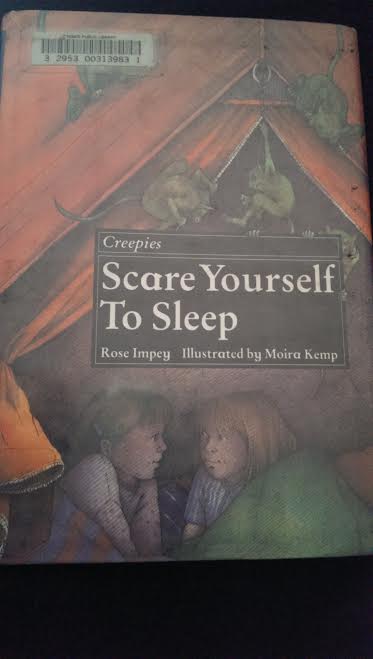
scareyourselfScare Yourself to Sleep by Rose Impey, 1988.

A girl and her cousin are camping out in the backyard when they decide to play a game they made up themselves called “Scare Yourself to Sleep.” They take turns inventing and telling stories about monsters lurking out in the darkness. The winner of the game is the one who successfully scares the other.

They talk about the Garbage Goblins, who live in trash cans. The Flying Cat is a creature that is half-cat, half-moth. The Tree Creeper lives in trees and looks like a branch, just waiting to fall down on someone. But, the best of all is the Invisible Man!

However, their stories are interrupted by the girl’s brother, Simon, who is trying to scare them . . . at least, they think it’s probably Simon. The monsters are made up, aren’t they?

The book is currently available online through Internet Archive. It’s part of a series.
scareyourselfpic1

My Reaction and Spoilers

I first read this when I was about seven years old, and I’ve loved it ever since! The pictures show not only what’s happening in the girls’ imaginations but hint at what’s happening in real life, just outside their tent as Simon acts out the things in their stories. It might be a little too scary for very young children, but kids about seven and up will like it (provided that they also like creepy stories).

The illustrations are vivid and detailed, and readers may be wondering up until the very end how much is really imagined. All the books in the Creepies Series are about the power of imagination and how it can be fun to be a little bit scared.

scareyourselfpic3