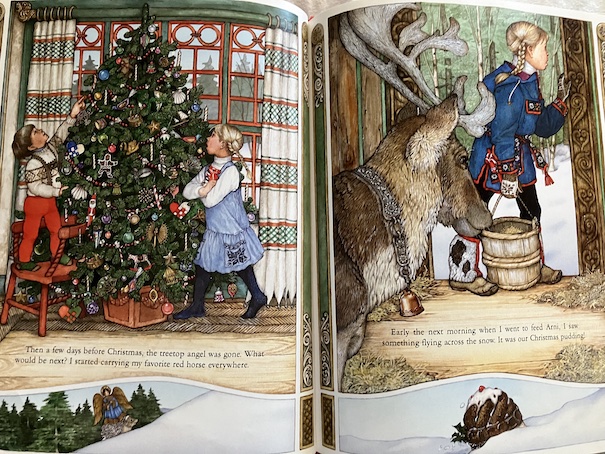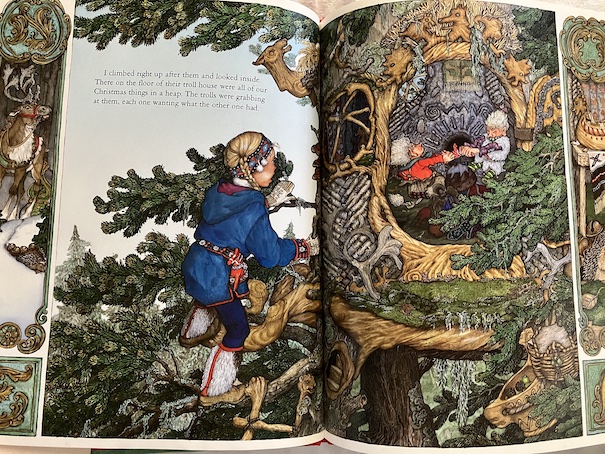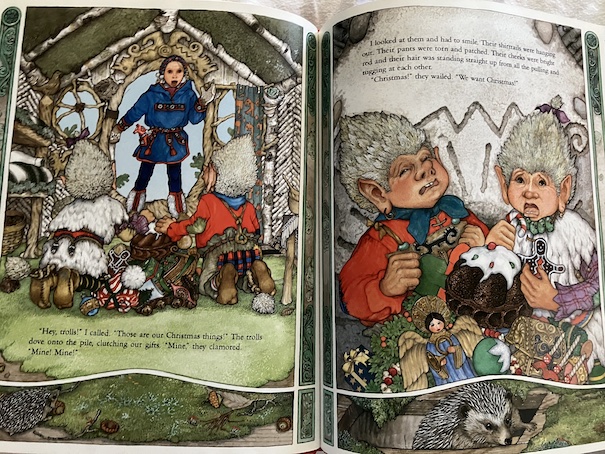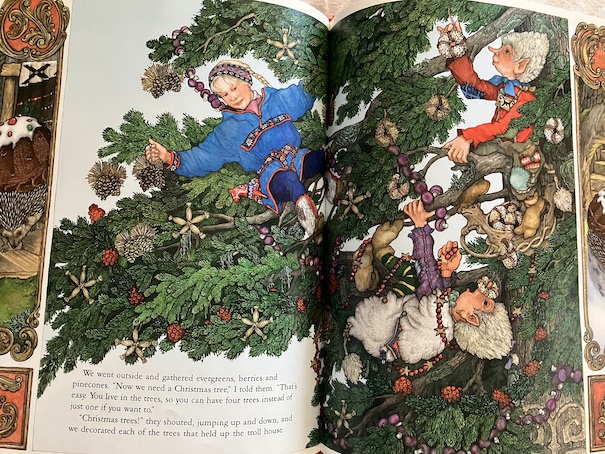
Christmas Trolls

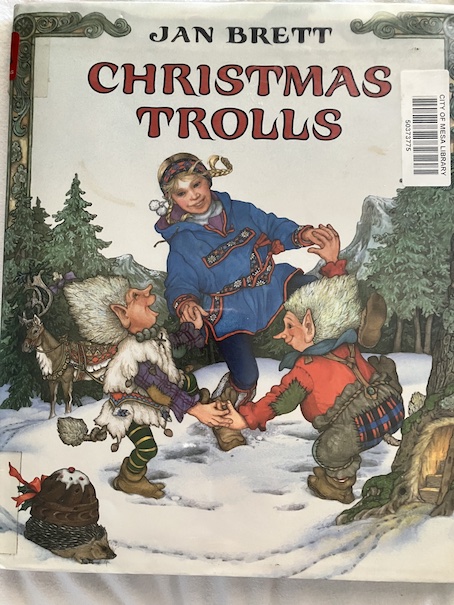
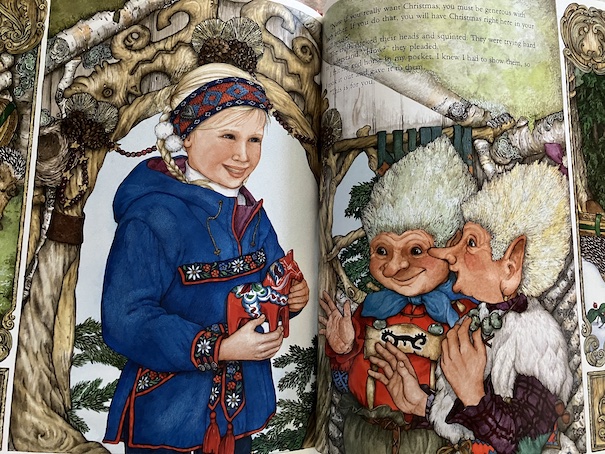
In this Scandinavian Christmas story, young Treva and her brother Sami are getting ready for Christmas when strange things start to happen.

First, Treva feels like someone is watching them when they go to pick out a Christmas tree in the forest. Then, after they start decorating for Christmas, some of their decorations start to disappear. They had already wrapped Christmas presents and hidden them away, but they discover that those are gone, too!

Treva begins to realize what is causing these disappearances when she spots their Christmas pudding, apparently moving quickly across the snow, stuck to the back of a hedgehog! Treva follows the hedgehog and pudding into the forest, where she finds two trolls, pulling the pudding up into their tree house.

In the tree house, Treva finds the trolls arguing over all of the Christmas things they’ve taken from Treva’s family. Treva confronts them about stealing their Christmas things. The trolls say that they just want Christmas. They’re like small children who want something but don’t know how to get it or make it for themselves, so they just started trying to take it from other people.

Treva tells them that she will show them what to do for Christmas. She helps them clean up their little house, make decorations, and decorate their tree for Christmas.

She also explains to them that arguing and being greedy isn’t the proper Christmas spirit, and it’s been ruining their mood. She tells them to try cooperating with each other and playing nicely together while they decorate. Finally, she teaches them that Christmas is about being generous and giving something to each other, not just taking things. To demonstrate what she means, she gives them their first Christmas present, her favorite Christmas decoration.

With the trolls now able to have Christmas on their own, Treva is able to reclaim the rest of her family’s Christmas presents and decorations. However, the trolls and their hedgehog friend have one more special Christmas present to give now that they understand what giving is.

The book is available to borrow and read for free online through Internet Archive (multiple copies).
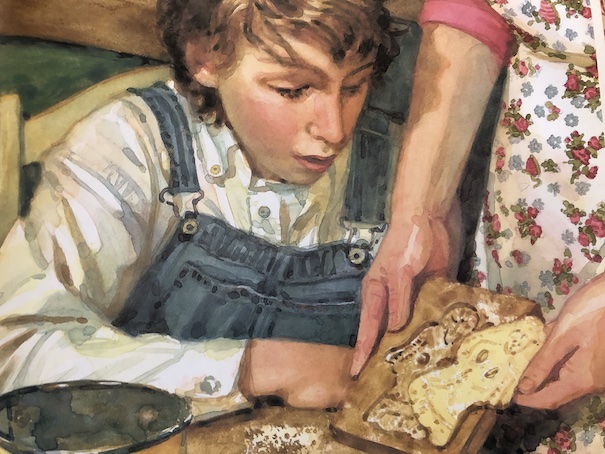
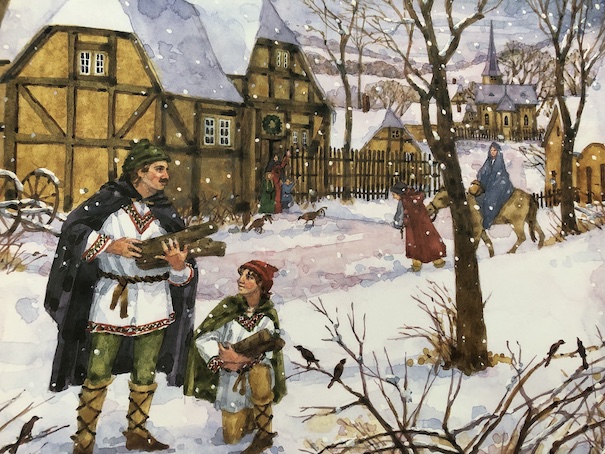
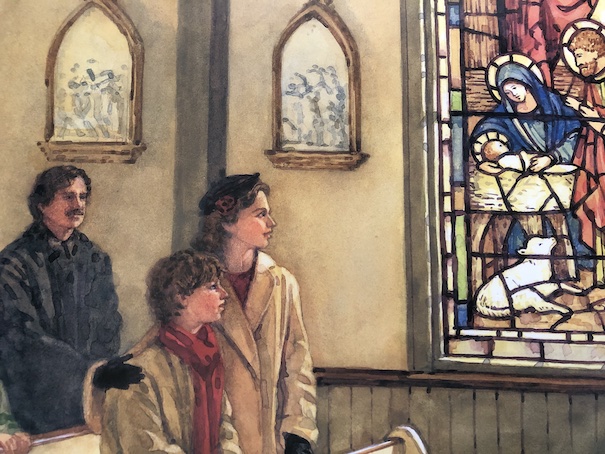
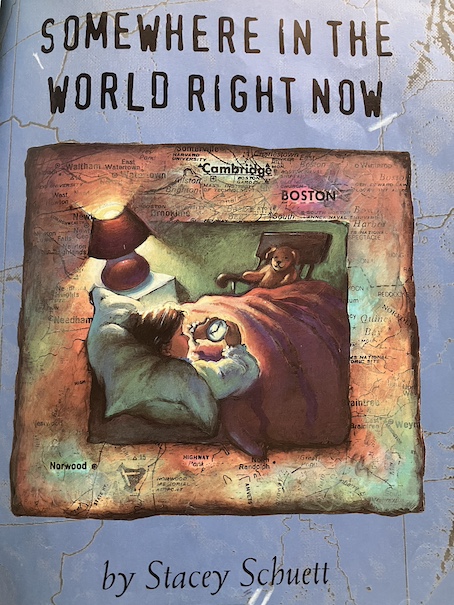
This is a fun Christmas story with beautiful, colorful illustrations! I really loved the pictures in the book, with all the colorful Christmas decorations. The designs of the family’s Christmas decorations are traditional Scandinavian decorations. The side and bottom panels of the illustrations also explain some of what’s happening even before the main character understands.

I also loved the designs of the troll and their fun hedgehog friend. Around the time this story was published, troll dolls, which have existed since the late 1950s, were having a rise in popularity. The trolls in this story somewhat resemble troll dolls, with their fluffy hair rising to a point, although the troll dolls have more colorful hair options. I enjoy stories that use fantasy creatures, especially ones that aren’t especially common. The trolls in this story are troublesome, but in a little kid manner, not overly threatening. They’re more about mild magical mischief and lessons they have to learn.

Homespun Sarah

This picture book tells a story in rhyme about a girl living in 18th century Pennsylvania and what she and her family do to make her a new dress when she begins outgrowing her old one.

As Sarah gets dressed one morning, her old dress is noticeably tight, and it’s beginning to get too short for her. Because her family lives on a farm, they must produce most of what they need themselves, and that includes clothing. For Sarah to have a new dress, they must make one themselves entirely from scratch, which is what “homespun” means – they make the dress from homemade cloth from yarn that they have spun themselves.

Various family members carry out different household chores, and as the story continues, readers see how everything they do is not only a part of the family’s daily life but also contributes to the creation of the new dress. The family raises sheep, so they must start by sheering the sheep to get the wool for the dress.

In between doing routine chores, like doing the laundry and making new candles, they card and comb the wool and spin it into yarn with their spinning wheel. The family also owns a large loom, which is how they weave the wool yarn and flax into cloth called linsey-woolsey. The cloth they make is blue and red, dyed using plants that they have produced and gathered.

Once they’ve made the homespun cloth, Sarah’s mother measures her to plan the size of the dress and sews the dress. Sarah gets a new red dress, while her younger sister gets a blue one. Sarah is excited about her new dress, which fits her much better than the old one, and spins around to show it off!

The author’s note at the beginning of the book says that the story is set in Pennsylvania during the 1700s, and she wanted to show how people lived during that time, having to produce everything or almost everything they used by themselves. It also shows various aspects of family life, from where and how they slept to what they ate. The characters in the book, even the children, are shown drinking beer, but the author explains that is because water wasn’t considered entirely safe to drink. The beer they drank back then was very weak and “barely alcoholic”, which was why the children could have it. (We have water treatment facilities and devices available in the United States in modern times to ensure the quality of the water, so this isn’t something that we typically do now, especially with children, and I have more to say about this in my reaction.)

The book is available to borrow and read for free online through Internet Archive.

When I was a kid, I often skipped over prefaces and author’s notes because I just wanted to get to the story, but the author’s note really adds some historical depth and helps to clarify some aspects of the story that children might misunderstand. For example, I thought that the clarification about the mention of the characters drinking beer was important. Alcohol, chemically speaking, is actually a mild poison. It’s mild enough that humans can have it in small amounts without dying or even becoming ill (although we can get sick or die from large amounts, and some people have a greater or weaker natural tolerance to it, compared to each other), but even weak alcohol might kill germs in water and make it safer for humans to drink. This is the way it’s being used in this book. Because this book is for children, it’s helpful to explain this so that child readers understand that what the characters have isn’t quite the same as modern beer and that it’s not okay for children to drink modern beer in the same way. I think this is good book for parents or other adults to read with kids, so the adults can point this out to kids and help them to understand other historical elements of the story that they might miss or misunderstand.

The author’s note also explains that, because people during the time the story is set, had to make their own clothes by hand, and making was a very time-consuming, labor-intensive process, people had far fewer clothes back then than they do now. It was common for someone to have only one set of clothes that they wore every day until they were no long usable. Getting a new set of clothes was an exciting occasion, and that’s what the story in the book tries to capture. When readers see what this family goes through to create just one new dress for a girl who is outgrowing her last one, they can understand how much that dress means to the girl who receives it.

I love books that show how things are made, so I appreciated this book for the process it shows. However, because the story is told in short, simple rhymes and focuses on the how the process would look to a casual observer without getting too detailed, I felt like there were many parts of the process that were implied rather than stated. For example, they don’t explicitly mention that the red and blue dyes for the cloth came from the red berries the girls gathered or the blue flowers of the flax plant, but it’s implied by the earlier mentions of these plants and the way the book showed the characters gathering them. That could be enough for a casual reader, but I’m the kind of person who likes hearing the details of the process, so I would have liked more detailed explanations.

I did appreciate the way the book showed aspects of daily life in the 18th century. Some of them are explained in the author’s note, but there are also other parts of daily life to notice in the pictures. One of my favorite ones was the way that the youngest child in the family is tied to her mother or older sister’s apron strings to keep her from wandering away and getting into trouble while they’re doing their chores.

Yetsa’s Sweater

Yetsa and her mother go to her grandmother’s house to help her prepare wool for making a sweater. Yetsa is getting too big for the sweater she’s wearing, but she still loves it because her grandmother knitted designs in it that have personal significance to her and her family.

Yetsa’s grandmother builds a fire and brings a large pot for the wool. They have to sort through the fleeces they received from Farmer McNutt and remove any little twigs or hay or anything that doesn’t belong. Yetsa yells when she finds some sheep poop stuck in the fleece. After they’ve removed the debris as best they can, they wash the fleece in hot water over the fire. Then, they rinse it in cool water and wring it out.

While the wool dries on the clothesline, they take a break and have some bread and blackberry jam.

The following week, they begin pulling apart the fibers of the wool, making it fluffier, a process called “teasing.” Then, Yetsa’s grandmother runs the wool through a carding machine, and they begin spinning it into yarn with a spinning machine.

When the spinning is finished, Yetsa’s grandmother has enough wool to make many sweaters.

In the back of the book, the author explains that Yetsa is her own granddaughter and that knitting is a traditional skill for Coast Salish women. They learned knitting from Scottish settlers who came to British Columbia, and the sweaters they made came to be called Cowichan sweaters, after the largest tribe in the region. Children like Yetsa begin learning how to prepare wool and knit at a fairly young age.

The book is available to borrow and read for free online through Internet Archive.

I love books that show people making traditional crafts, and I enjoying following this one from beginning to end! Readers get to see each step in the process of making the sweater, starting with the wool and ending with the finished sweater. I’ve been knitting from a young age, but I’ve never tried spinning my own wool, and I liked seeing the intricate patterns of the sweater.

When I was a kid, I often ignored authors’ explanations because my focus was on the story, but as an adult, I like the added details of author’s explanations. This is a family story because Yetsa in the story is based on the author’s own granddaughter.

The UFO Mystery

This book is part of the Sherlock Street Detectives series.

Halloween is approaching, and the Sherlock Street Detectives are talking about their costumes. David is going to be a bear, and he made his costume out of an old rug. Pedro is going to be a clown. Walter and Ann, who are twins, refuse to tell anyone what their costumes are because they want it to be a surprise.

Then, David says that he has to go home because it’s dinnertime, and after dinner, he’s going to look for a comet with his telescope. Pedro says that he’s never used a telescope before and asks if he can look, too. David says he can, and Pedro says that he will come back to his house when it’s dark.

When David and Pedro meet to use the telescope, David shows Pedro how to use a star map to find the constellations. While Pedro is looking through the telescope, he thinks that he sees a UFO! At first, David doesn’t believe him. It’s too early to see the comet, so he thinks maybe Pedro saw a meteor. Pedro insists that it was a UFO, and David points out that UFO stands for Unidentified Flying Object. That means that anything that “unidentified” can be a UFO. Pedro can’t identify exactly what it was he saw, but that only means that he didn’t recognize the object. It doesn’t have to be an alien spacecraft, just some normal thing he didn’t recognize, like a meteor, a comet, or even just a firefly.

Since David’s dad works for NASA, Pedro says that they should ask him if it could have been a comet other than the one they were expecting to see. However, David’s dad confirms that there should only have been one comet that night and that the comet should have been in a different part of the sky. The boys talk about getting Walter and Ann to help them investigate, but then, they see some strange creatures in the bushes!

What did Pedro really see through the telescope, and could those weird creatures really be aliens?

The book is available to borrow and read for free online through Internet Archive.

This is fun mystery picture book! Figuring out what/who the aliens are is the easiest part of the mystery, since this is before Halloween and the twins were being mysterious about what their costumes are, although it might seem harder to young children. The answer to what Pedro thought he saw through the telescope is revealed first, although I wasn’t entirely sure what to think of it myself. At first, I thought that the “aliens” might have been throwing around some glowing toy or something, but they would have to have thrown it really high to get it in front of the telescope because the boys were using the telescope on the roof. There’s a perfectly logical explanation behind the phenomenon, and David figures it out by noting where the object was and it was moving. David’s father confirms David’s guess with a call to NASA.

One of the nice things about this simple mystery story is that it introduces some real concepts for stargazers and amateur astronomers. There is a vocabulary list and glossary in the back of the book.

This series also offers good representations for racial diversity. Racial issues don’t enter into the story. The kids are just a bunch of kids who happen to live in the same neighborhood and are friends and like to solve mysteries, but they are a mixed racial group, and that’s nice to see. David is black, Pedro is Hispanic, and the twins are white. The children’s races are not referred to in the text of the story, but they are shown in the pictures.

The Halloween Play

Halloween is coming, and the students in Roger’s class at school are preparing for their Halloween play. The class rehearses their play every day, and they make invitations to the play to send out to people in town.

On the night of the play, the school’s auditorium is full of people waiting to watch the play, and Roger waits backstage for his turn to go on stage. He doesn’t have a big role in the play, but his role is important.

The other students in Roger’s class go on stage, dressed as witches, ghosts, and skeletons. They perform the songs and dances they’ve rehearsed. The audience laughs at the funny parts, and everyone is enjoying the play.

All the time, Roger is backstage, listening and preparing for his part. He counts down the lines until the moment comes when Roger steps on stage for the play’s finale!

The book is available to borrow and read for free online through Internet Archive (multiple copies).

I remember reading this book when I was a little kid, and it was a Halloween favorite of mine! Felicia Bond is better known today as the illustrator (but not the author) of If You Give a Mouse a Cookie, which was originally published two years after this particular picture book. The art style between the two books is noticeably similar, but the book about the Halloween play is different because this is about mice who live like people and do not interact with humans. I was also amused that one of the student mice in this book was dressed in an orange shirt with a black zig-zag and black shorts, like the cartoon character Charlie Brown, who wears a yellow shirt with a black zig-zag and black shorts. The tv special It’s the Great Pumpkin, Charlie Brown was known for popularizing the concept of Halloween tv specials, and Roger the mouse plays a large pumpkin in his class’s Halloween play, although Roger isn’t the mouse wearing the Charlie Brown style clothes. Roger is the one in the sweater with an R on the front. I was just amused by this little detail in the pictures of his class.

This picture book is a sweet little story about a mouse boy and the Halloween play given by his class. School plays on a wide variety of themes are a common experience for human children attending both public and private schools, and they are often memorable points in children’s school experiences. They can also be very emotional experiences. Students can be nervous about plays and being on stage in front of an audience, and sometimes, there are conflicts about which students get the best parts. This cute little picture book doesn’t have any drama in it and doesn’t talk about stage fright, although there are other children’s books that address these issues.

Instead, the story is more about a magical evening and the small but important role played by one particular student. Much of the story shows the build-up to the play, and when the play begins, Roger only appears on stage at the end of the play. The rest of the time, he’s listening to the other students from back stage, waiting for his cue to step into the spotlight. We don’t know exactly what the play is about, but it’s not that important. Those quiet moments of anticipation backstage are magical, and Roger will never forget how exciting this evening has been!

Everyone Goes as a Pumpkin

Emily thinks that she has the best costume for the upcoming Halloween party! It’s a beautiful dress that makes her feel elegant and magical.

Emily takes the costume on the bus to show her grandmother, but somehow, the box with the costume in it disappears during the ride. Emily is upset at losing the costume and doesn’t know what to do. She doesn’t want to go to the party as something ordinary, like a pumpkin.

Then, her grandmother suggests that she just go as herself. As herself, Emily is truly unique!

I liked the grandmother’s unorthodox solution to the problem of the missing costume. I can understand a kid loving a particular costume so much that it seems like nothing else will do, but showing Emily that she’s just fine going to the party as herself is a good way to show her that she is just fine as she is, just being herself. Emily would have liked going with the costume she loved, but she doesn’t need any costume in particular because she is good enough by herself.

The Pet Day Mystery

This book is part of the Sherlock Street Detectives series.

It’s Pet Day at school, and twins Walter and Ann are bringing their dog, Watson, and their cat, Fuzz Face to school with them. Watson is really Walter’s dog, and Fuzz Face is Ann’s cat. The school bus is chaotic and noisy because the other children have their pets with them, too.

At school, each of the kids tells the rest of the class about their pet. When it’s time to go to lunch, the kids give their pets food and water and leave them in the classroom.

When they come back from lunch, a pair of hamsters are missing, and their owner, Tina, thinks that Fuzz Face might have eaten them. Ann points out that Fuzz Face couldn’t have eaten the hamsters because Fuzz Face was in his cage during lunch.

The kids figure that the hamsters are probably hiding somewhere in the room, and they ask Tina to tell them everything she knows about the hamsters so they can find them. They use what Tina tells them about the habits of hamsters to figure out where they are.

The book is available to borrow and read for free online through Internet Archive.

It’s a fun picture book mystery, but it’s also educational, like other books in the series. The information the kids give about their pets is true. Some of them say where their pets originally came from, like Pedro, who says that his pet parrot is a breed that comes from South America. Ann mentions that her cat takes vitamins and has to go to the vet sometimes, like people have to visit their own doctors. I liked how the characters use facts about the behavior of hamsters to figure out where the hamsters went.

I was a kid about the age of the characters at the time this book was published, although I don’t remember reading this book at the time. When I was in kindergarten, the year before the book was published, we had a special pet event in my class, but we didn’t do it like the class in this book. As I recall, different people brought in pets on different days so it was less chaotic and there was no chance of one pet eating another, which is a real risk. Also, all pets had to be in cages to keep them from running away or causing trouble, and they were never left unattended. My mother helped me bring our pet birds to class, and she took them home with her immediately afterward, so they weren’t left sitting around the classroom.

The book has a vocabulary list and glossary in the back.

The Mystery of the Missing Scarf

This book is part of the Sherlock Street Detectives series.

Ann doesn’t have much confidence in her twin brother Walter’s dog Watson. She doesn’t think that he’s capable of learning tricks, and when Walter shows her the new trick he’s taught Watson, she isn’t very impressed. The trick is for Watson to just grab a red rag out of Walter’s hand and run off with it.

Ann is more concerned with getting her scarf washed and hung out to dry before they go see their friends. David and Pedro like Watson’s trick. At least, it’s a pretty good trick for Watson because Watson doesn’t know many.

Pedro shows the other kids how he’s making a weather vane. It’s a windy day, so it’s a good time to try it out.

Then, Ann notices that the scarf she hung out to dry is gone! At first, she blames Watson for taking it as part of the trick Walter taught him. However, the dog is not at fault. Pedro uses his weather vane to show Ann how to find her scarf.

The book is available to borrow and read for free online through Internet Archive.

It’s a fun picture book mystery, but it’s also educational. I liked the part where Pedro explains how he made his weather vane. Kids can follow along with his explanation to make a weather vane of their own. The mystery of what happened to the scarf isn’t difficult, but the way the children found the scarf was clever. The book also has a vocabulary list and glossary in the back.

The North Pole Mystery

This book is part of the Sherlock Street Detectives series.

David is supposed to be watching his younger brother, Adam, while his mother is gone, but he gets absorbed in his new book. When David’s friends come to see him, they realize that Adam is missing!

The kids look for Adam everywhere, but they can’t find him. David is very worried.

Walter tries to use his dog, Watson, to track down Adam, but Watson hasn’t been trained to track people. When that doesn’t work, Walter tries writing down everything David can remember about Adam’s disappearance, but because David was reading instead of watching, he can’t remember much.

One thing that David remembers is that Adam wanted to go for a walk. David didn’t want to go, so he let Adam play with his compass instead. David explained to Adam that a compass always points toward the North Pole, and that fascinated Adam because the North Pole is where Santa Claus lives. The kids realize that Adam still has the compass, so he is probably using it to go north and find Santa!

What they need to do is go north themselves to find Adam, but they don’t have another compass. What can they do?

The book is available to borrow and read for free online through Internet Archive.

It’s a fun picture book mystery, but it’s also educational. The books in this series use scientific concepts to explain the mysteries or to help solve problems. This book explains how a compass works, and to find Adam, the kids have to create a compass of their own.

There is also a vocabulary list and glossary in the back of the book.

A One-Room School

Historic Communities

The book begins by saying that there was a time when not all communities had schools at all. In areas where the population was low, children had lessons at home or from a neighbor, if they had lessons at all. Towns and villages needed enough children living there to support even a small school. (The book doesn’t describe exactly when or where they’re talking about, but it’s implied that this is the United States or the American frontier.) When there were enough settlers in an area for a school, they might make a small log cabin for the school. As populations grew and there were more students, they would build better schools.

Requirements for teachers were different back then than they were today. Most teachers were men because married women were not allowed to be teachers. Only single women could teach. Teachers were also often required to handle rough students as well as teach them, and all ages and grades of students would study together in one-room schools. The teacher would manage the different grade levels by having them dividing them into groups based on their levels and having the different groups take turns reading aloud to her while other students did quiet work, like practicing writing. The teacher would set some students quiet tasks to do while focusing on a different group, and then, they would switch. Teachers were also responsible for the cleaning and maintenance of their school, but they typically assigned students chores to help with that. Local families would provide room and board for the teacher of their community, and they would also contribute toward the teacher’s salary.

Lessons were basic and focused mostly on the “three Rs” – reading, writing, and arithmetic. (Those three subjects contain the letter ‘R’ near the beginning, even if they don’t all start with that letter.) There was often little time to teach anything else, and these were the subjects that were most important to people with the most common jobs, such as farmer, craftsperson, or storekeeper. In schools that taught a wider range of subjects, students would also learn history (mainly focused on the United States), world geography, and grammar.

Small schools often had few books or supplies. Because paper was often in short supply, children would memorize lessons and verbally recite them back to the teacher and would practice writing on slates (small blackboards). When students were able to buy paper, they bought a blank notebook they called a copybook. The paper in the copybook wasn’t lined, so if they wanted lined paper, they had to draw the lines themselves, using a ruler.

A small school might also only have two books for the students to study: a primer for beginning readers (which showed the alphabet, numbers, and some basic spelling words and poems) and a copy of the Bible. The most popular series of books for building reading skills in the 19th century was McGuffey’s Eclectic Readers. The series started with a primer and continued with six readers, each one at a higher reading level than the last one to build more advanced reading skills. In the small, one-room schools, students would work through these books at their own pace. (Since all ages and grade levels were together in one room, there was little concern about each student moving to the next grade at the exact same time as their peers since they were all still going to be in the same room with the same teacher anyway. As long as a student was continuing to come to school and make progress, it didn’t really matter how fast or slow the progress was.)

The book describes the daily routines of students at small, one-room schools, including how they would get to school each day and what they would do at lunchtime and recess. Most children simply walked to school, although they often had to walk long distances to get there. Sometimes, they might ride a horse to school or get a ride from an adult in a wagon or sleigh, if it was winter. Children brought their lunches from home, but some schools also maintained a school garden. Most of the children from these small schools would grow up to be farmers, so gardening was a valuable skill for them to practice, and the students would also eat what they grew in the school’s garden. During the winter, they could make a soup with vegetables they grew on the stove in the schoolhouse (which also kept the schoolhouse warm) that everyone would eat for lunch. The schoolhouse stove could also be used to heat up foods that the children brought from home. Besides their lunch break, the students would also have two short recess breaks during the day. During recess, they could walk around outside, talk to their friends, play games, or play with toys they brought from home, like marbles. Toys were often homemade or easily improvised, such as using string to play Cat’s Cradle.
Sometimes, students would play pranks on their teacher or fellow students, such as hiding bugs and spiders to scare someone, pouring water on their seat if they got up, or covering the schoolhouse chimney to fill the school with smoke and smoke everyone out of the school. The last prank was dangerous.

Punishments for pranks and misdeeds, such as being late or falling asleep in class, were at the teacher’s discretion. They could take whatever form the teacher thought was appropriate for the situation, and they could be as harsh and strict as the teacher thought was necessary. Sometimes, they could be a form of poetic justice, designed to fit the crime. We aren’t told why one misbehaving boy was told to put on a girl’s bonnet and sit with the girls in class, although it might have been a fitting punishment if his misdeed was teasing the girls. (That was just a guess of mine, that the teacher might have decided that, if he wanted to tease girls, he should try sitting in their place for awhile.) Some punishments were meant to teach lessons and reinforce the idea that children should not repeat certain behaviors, such as having the children repeatedly write lines, sentences that spelled out what they were supposed to do or not do. (For example, a student who was late to school could be assigned to write, “I will not be late to school” or “I will be on time to school from now on” a certain number of times.) Other punishments were purely for humiliation, like having a student wear a cap that labeled them as a “dunce”, in the hopes that the embarrassment would keep them from misbehaving again. (This could also be the goal of making a boy wear a bonnet and sit with the girls.) Punishments could even include physical punishments. Teachers were allowed to whip their students, if they though it was necessary, and some teachers even punished children who were physically fighting by making them take turns whipping or hitting each other with a stick. The book doesn’t explain the motive for doing this, but I think that they were probably emphasizing the idea that people who fight get hurt and that getting hurt is unpleasant to discourage them from fighting more in the future. I also suspect that the point of making them take turns hitting each other was to make it equal, so it wasn’t just one person beating up on the other, but that’s just a guess. When the students got home, and their parents found out about what they had done at school that day, they might even get a second punishment, on top of whatever punishment the teacher assigned them!
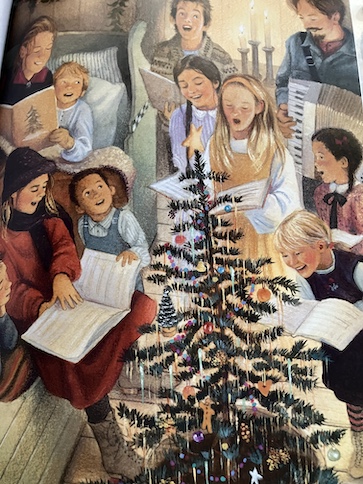
Sometimes, schools had special events for holidays or academic events that involved members of the wider community. For example, schools sometimes had spelling bees, including some where adult members of the community would watch or participate. Schools often had Christmas pageants, where children would sing songs or recite poems they had memorized or perform a play written by the students themselves. At the end of the school year, students would have oral exams in front of their parents and other community members, followed by a picnic with games.

The book ends with a section of games and activity suggestions designed to show modern kids what it might be like to be a student in an old-fashioned one-room school and compare their own schools to old-fashioned schools.

The book is available to borrow and read for free online through Internet Archive.

Books in the Historical Communities series focus mostly on the 1800s in the United States, but they don’t always mention exactly what time period they are describing. It’s often more implied than stated, and that’s true of this book, too. The book mentions the 19th century once or twice, but it doesn’t mention any specific date or date range.

The pictures in the book are a combination of drawings and photographs of real people in historical costumes, reenacting scenes at schoolhouses and the lives of the students. I liked the combination of real people and drawings to illustrate different concepts about life and education in old-fashioned, one-room schools.

There are some concepts of education in a one-room school that fit with the educational concepts of the modern Montessori system, such as having students of different levels being taught together and having students progress at their own rate in different subjects. In a way, I think that the Montessori system hearkins back to this one-room school style of education, and that’s examined in more detail in the classic children’s book Understood Betsy, which is by Dorothy Canfield Fisher, who was an early advocate of the Montessori method of education in the United States.