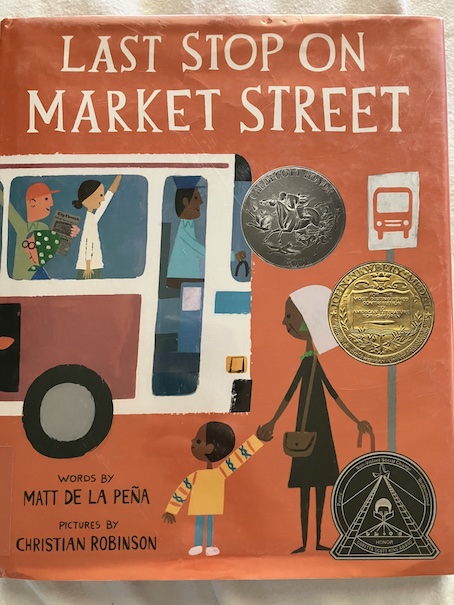
Last Stop on Market Street

After church, CJ and his grandmother have to wait for the bus while other people just get in their cars and leave. CJ is annoyed because it’s raining. He asks his Nana why they have to wait in the rain and why they don’t have a car. His Nana says that they don’t need a car because they have the bus.

The bus is interesting because many interesting people take the bus. The bus driver does little tricks, like pulling a coin from behind CJ’s ear, and there are interesting passengers, like the lady with a jar of butterflies and a man with a guitar.

While CJ’s friends, whose families have cars, go straight home after church, CJ and his Nana have somewhere else to go. CJ wishes that he could just go home, too, but Nana points out that the boys who just go straight home miss meeting so many interesting people. CJ does enjoy listening to the man with the guitar playing music on the bus.

CJ and his grandmother get off at the last stop on Market Street, which is in a bad neighborhood. CJ comments about how dirty it is, but his grandmother points out that people who surrounded by dirt know how to see what’s beautiful.

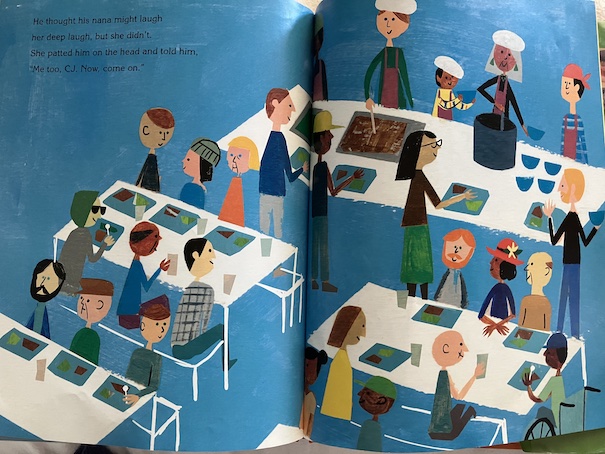
The reason why CJ and his grandmother are here is that they help out at a soup kitchen. CJ recognizes the faces of people he’s seen there before, and he realizes that he’s glad that he came.

This book is the winner of multiple awards. It’s a Newbery Medal winner, a Caldecott Honor book, and a Coretta Scott King Award honor book for its messages about appreciating and helping other people in a diverse community.

This is one of those picture books that I think can speak to adults as well as kids, maybe even more so because adults might understand some of the broader context of the story. CJ and his grandmother probably don’t have as much money as some of CJ’s friends and their families, which is why they don’t have a car. When CJ comments about why do they have to wait for the bus in the rain, his grandmother could have given him a straightforward answer about how they can’t afford a car, but that would have been depressing. Instead, she points out the positives of the bus and the people they meet. All through the book, she points out the positives about situations that both CJ and the readers can see are not entirely positive. It’s noticing these positives that help make the situation better.

CJ and his grandmother don’t have much money themselves, but Nana is teaching CJ how to help other people and build relationships with them. The people they meet are often poor people or people who are unfortunate in some way, but they still enjoy meeting these interesting people with colorful lives. There are times when CJ wishes that he could be somewhere else or doing something else, but yet, he also enjoys parts of where he is and realizes that what he’s doing is better than other things he could be doing. CJ and his grandmother experience the enrichment of life experiences and relationships with other people.

Aunt Flossie’s Hats (and Crab Cakes Later)

On Sunday afternoons, a pair of sisters, Susan and Sarah, go to visit their Great-Great-Aunt Flossie. They love her house because it is full of interesting things, especially Aunt Flossie’s hat collection.

When their aunt welcomes them in, she offers them tea and cookies and promises that they will get some crab cakes later. After they have their tea and cookies, Aunt Flossie lets the girls try on her hats and tells them stories about them.

The girls are fascinated by the different colors and styles of the hats, but to Aunt Flossie, they represent memories. As the girls pick hats to try, Aunt Flossie tells them what the hats remind her of.

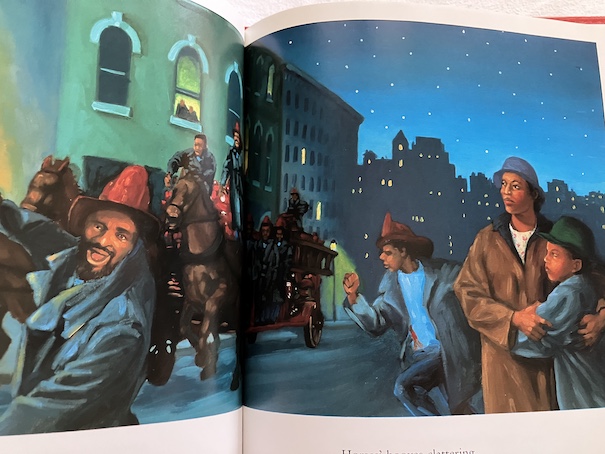
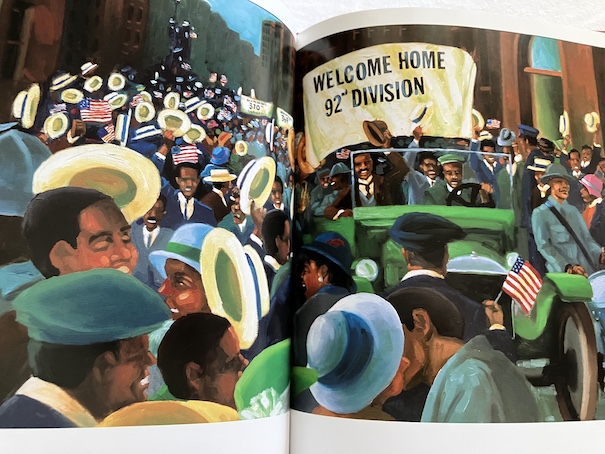
One hat that still has a slight smokey smell reminds Aunt Flossie of a big fire she witnessed in Baltimore. Another hat, one with a red feather, reminds Aunt Flossie of the parade she saw at the end of the Great War (what WWI was called before WWII).

Aunt Flossie’s favorite hat has pink and yellow flowers, and it reminds her of the time when she almost lost it, but it was rescued by a friendly dog. The girls love Aunt Flossie’s stories about her hats, and they love the crab cakes they get later with their family!

The book is available to borrow and read for free online through Internet Archive (multiple copies).

This is a sweet, slice-of-life story about an elderly aunt sharing her memories with her young nieces. The girls enjoy their time with their aunt, trying on the hats in her collection and getting glimpses of the past through her stories. By spending time together, getting together for tea (and crab cakes later) and trying on the hats, the girls are also building new memories. Years later, they will be able to tell stories about the afternoons they spent with Aunt Flossie and the stories she would tell them about her hats. A note in the book’s dedication indicates that the story is based on memories of the author’s own elderly Aunt Flossie.

The pictures in the book are colorful, like the colors of the aunt’s hats, and they’re also a little soft. I think the soft quality of the images is a good match for the memories the aunt shares with the girls and the new memories they’re creating by sharing stories and spending time together as a family.

Flossie and the Fox

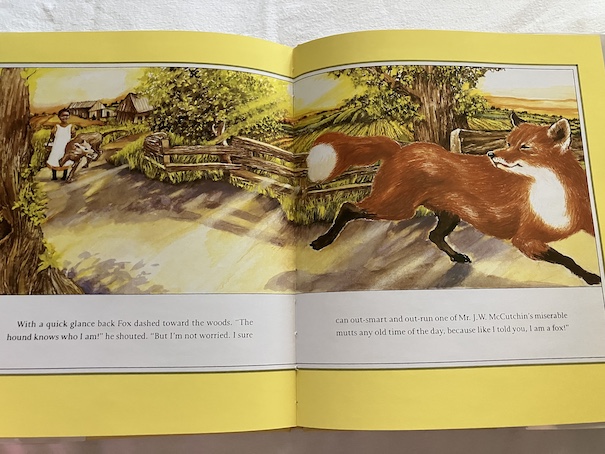
Little Flossie Finley’s mother asks her to take a basket of eggs to Miz Viola because a fox has been troubling her chickens, and they’re too scared to lay eggs. The fox is a sly creature, and he always seems to outwit the hounds.

Flossie doesn’t remember ever seeing a fox before, and her mother tells her that foxes will do just about anything to get eggs. Flossie isn’t sure what she’ll do if she meets the fox, but she remembers what her mother says about how “a fox be just a fox.” She decides that doesn’t sound too scary.

On the way, Flossie does meet the fox. The fox talks to her, and Flossie can tell that he wants the eggs she’s carrying. However, Flossie refuses to be impressed by the fox and tells him that she doesn’t even believe that he’s a fox because she’s never seen one before. The fox is surprised that she isn’t intimidated by him and tries to prove to her that he’s a real fox.

For everything the fox says to try to prove his identity, Flossie has an answer to deny it. He points out his thick fox fur, but Flossie says that rabbits also have thick fur. His pointed nose also doesn’t mean that he’s a fox because rats also have pointed noses. A cat they meet verifies that the fox is a fox, citing his yellow eyes and sharp claws, but since the cat also has yellow eyes and sharp claws, Flossie says that isn’t proof of being a fox. Even his characteristic bushy tail isn’t firm proof because squirrels also have bushy tails.

There is one being who knows for certain that the fox is a fox – the hounds that chase foxes. Flossie knows that as well as the fox does.

The author’s note in the front of the book says that the author enjoyed listening to stories told by her family when she was young, and the story in this book is one that she remembered from her youth. She particularly wanted to tell this story in a rural Southern dialect, like the one her grandfather used when he used to tell stories.

I enjoyed this fun story where a clever girl tricks a classical trickster. She knows that the fox is really fox, but she uses the similarities between the features of a fox and the features of other animals to pretend like she doesn’t and to keep the fox attempting to convince her until she reaches a point where the fox can no longer pursue her. Knowing the author’s connection to this folk tale style story adds an element of coziness, imagining the author hearing the story as a little girl herself.

The time period of the story is indefinite, but from the characters’ clothes, it looks like it might be some time during the late 19th century or early 20th century.

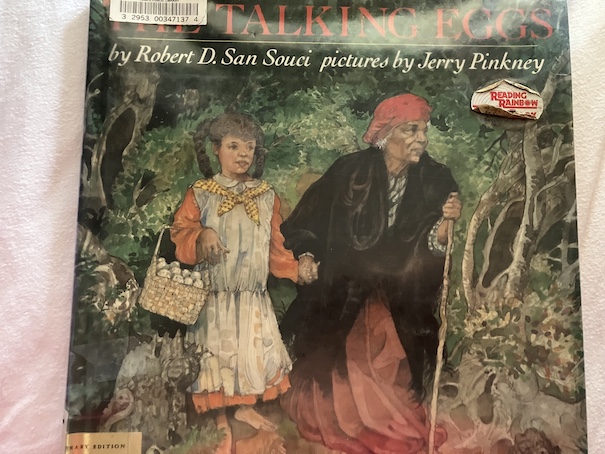
The Talking Eggs

There was a poor widow who lived on a small farm with her two daughters, Rose and Blanche. Rose was the widow’s favorite daughter because she was so much like her mother. They were both mean and bad-tempered, and they had grand dreams of becoming rich someday, although neither of them had the slightest idea how to accomplish that. Blanche, on the other hand, was a sweet girl, and her mother made her do all the work while she and Rose just sat on the porch, talking about all of their grand dreams.

One day, when Blanche goes to fetch water from the well, an old woman approaches her and begs her for a drink. Blanche gives her some water, and the old woman thanks her, telling her that she will be blessed for her kindness.

However, when Blanche gets home, her mother and sister yell at her for taking so long. They hit her, and Blanche runs away into the woods. Then, she meets the old woman again. She explains to the old woman what happened, and the old woman invites her to come to her house. However, she cautions Blanche not to laugh at what she sees there. Blanche promises that she won’t laugh.

The old woman is no ordinary woman, and everything at her house is strange. Some of these strange things are amusing, some are amazing, and some are just plain weird and a little alarming. The animals are all strange, with chickens of different colors and cows with curly horns. Then, inside the house, the old woman removes her head and puts it in her lap to brush her hair. Then, the woman produces a fancy stew from just one old bone. After supper, they go outside and watch rabbits in fancy clothing dance.

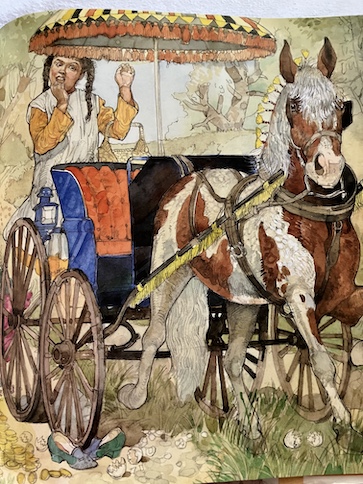
In the morning, the old woman tells Blanche to go out and gather some eggs before she goes home. Blanche is allowed to take any that tell her to take them and to leave ones that say not to take them. Blanche does as she is told, although the ones that tell her to take them are the plain-looking eggs, and the others are covered in jewels. The old woman tells Blanche to throw the eggs over her shoulder, one at a time, and when she does so, the eggs break and wonderful things burst out of them – fancy clothes, coins and jewels, and even a horse and carriage.

By the time Blanche gets home, she has many beautiful clothes, money, and luxurious things. Blanche’s mother pretends to be nice to her when she returns, but it’s only so Blanche will tell her where she got all the rich things. That night, when Blanche is asleep, her mother talks to Rose, telling her that she should also befriend the old woman and get the same rich rewards as Blanche. Then, they will steal all of Blanche’s things and head to the city to live the rich life that they’ve always dreamed of.

Of course, lazy and bad-tempered Rose isn’t as kind or hard-working as her sister. She ignores the old woman’s instructions and does everything she shouldn’t do. When she tries to force the old woman to give her riches, the old woman’s magic gives her and her mother their just desserts.

This book is a Reading Rainbow Book. It is available to borrow and read for free online through Internet Archive.

There is a note at the beginning of the book that this story comes from a Creole folktale that appeared in a 19th century collection of folktales from Louisiana by Alcee Fortier. It resembles folktales from Europe was probably adapted from fairy tales brought to Louisiana by French immigrants. It reminds me of the Mother Holle story, where a kind, well-behaved, hard-working girl is rewarded for following Mother Holle’s instructions, while her spoiled sister is punished for laziness and disobedience.

The old woman in this story is a similar figure to Mother Holle, with strange powers and magical objects, but there is no explanation of who she might be. The fact that she can remove her head just to brush her hair shows that she’s supernatural, but we don’t know if she’s supposed to be a witch or some other supernatural creature.

Personally, I don’t think I would laugh at any of the things in the old woman’s house. I think the strange animals sound more amazing than comical. I think I’d really be impressed by the different-colored chickens and the cows with the weird horns. I have to admit, though, that if someone takes off their head, my first reaction would probably be to run for it.

Mirandy and Brother Wind

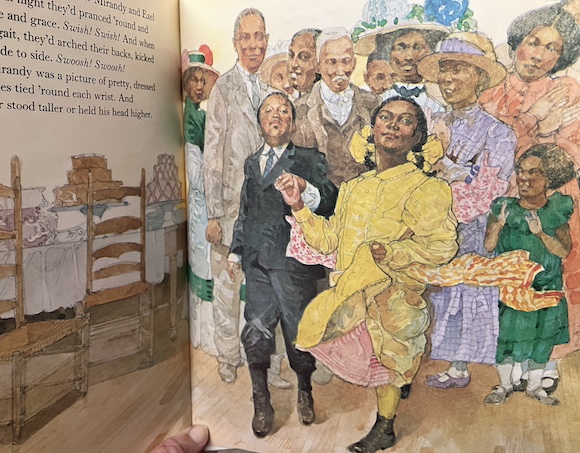
It’s springtime, and “Brother Wind” (the wind personified) is striding through the valley. Young Mirandy is getting ready for the junior cakewalk, and she imagines that, if Brother Wind was her partner, she would be sure to win the cakewalk. Her mother says that anyone who can catch the Wind can make him do whatever they want, so Mirandy decides that she’s going to catch Brother Wind before the cakewalk and make him dance with her!

That’s easier said than done. Mirandy doesn’t know how to catch the Wind, and her grandmother doesn’t think such a thing is possible. She asks different people what to do, and she tries different ways of catching him. She tries catching him in a quilt, but he gets away.

Then, Mirandy tries visiting Mis Poinsettia, the conjure woman (a sort of witch or woman with magical knowledge), and she asks her if she has a potion that would help. Mis Poinsettia’s advice is to trap the Wind in a bottle of cider, but that doesn’t work, either.

Eventually, Mirandy manages to trap Brother Wind in the chicken coop. Once she has Brother Wind, he has to give her a wish. However, on the night of the cakewalk, Mirandy realizes that there is someone else she wants for a partner besides Brother Wind, and she asks Brother Wind for help in a different way from the one she had planned.

I thought this was a charming picture book, with bright, colorful illustrations that really conveyed that sense of lightness and air in the presence of Brother Wind! The old-fashioned clothing of the characters is part of the charm, and I like this sweet introduction to the concept of a traditional cakewalk. Cakewalks were a kind of traditional African American dance contest with a cake as a prize for winning. The people participating are dancing as they parade around the room, which is a little different from the cakewalks or candywalks that some modern people do at school or church carnivals as a kind of raffle game. In the game version, the players are just walking, not dancing, and they stop on numbered spots whenever the music stops, winning prizes if the number of their spot is drawn. For Mirandy, winning the cakewalk isn’t a matter of stopping in the right place but actually dancing well.

All through the book, there is a boy who likes Mirandy, but Mirandy doesn’t think of him as a dance partner because she has her heart set on Brother Wind as the perfect dance partner, and the boy is kind of clumsy. Mirandy really wants to win the contest, so it’s important to her to have the best partner she can. However, when one of the other girls at the cakewalk talks badly about the boy and his clumsiness, Mirandy can’t stand to hear him being insulted. She boldly declares that the boy will be her partner, and they will win in the contest together … with a little help from Brother Wind.

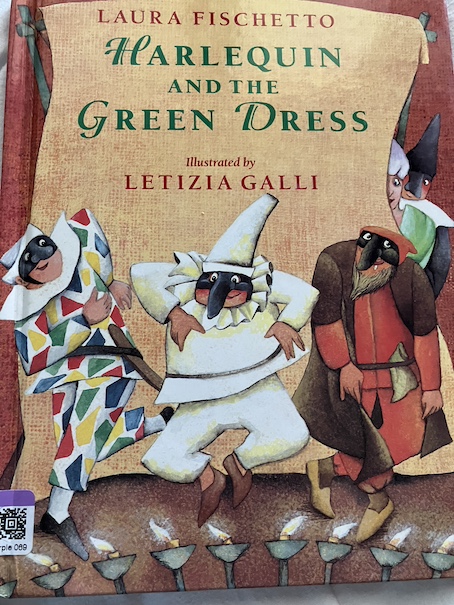
Harlequin and the Green Dress

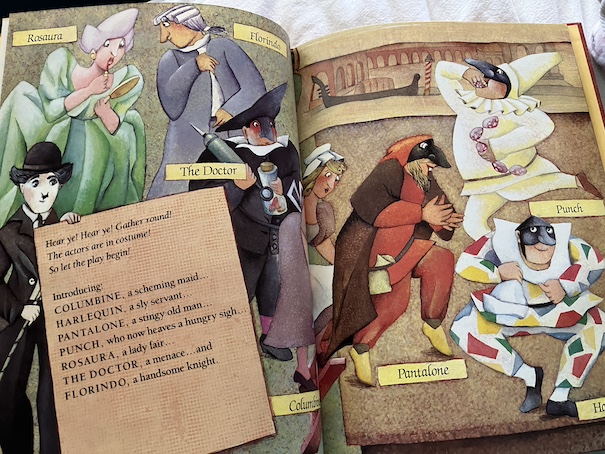
What I love about this book is that it’s a fun introduction to commedia del arte and its stock characters! A figure that looks like Charlie Chaplin holds a card that summons readers like guests to a play and introduces our characters like this:

  • Columbine – “a scheming maid …”
  • Harlequin – “a sly servant …”
  • Pantalone – “a stingy old man …”
  • Punch – “who now heaves a hungry sigh …”
  • Rosaura – “a lady fair …”
  • The Doctor – “a menace … and”
  • Florindo – “a handsome knight.”

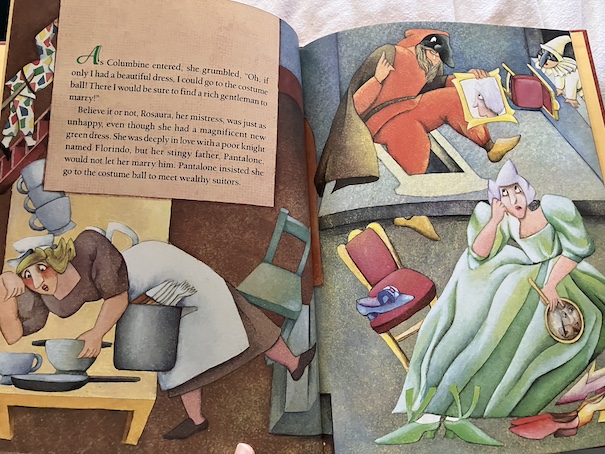
There is going to be a costume ball. Rosaura, a wealthy young lady, has a beautiful green dress to wear, but she is unhappy because her father, Pantalone, refuses to let her marry the man she loves, Florindo. Florindo is a poor knight, and Pantalone hopes that Rosaura will meet a wealthier suitor at the costume ball.

Meanwhile, Rosaura’s maid, Columbine, wishes that she had a beautiful dress so that she could go to the costume ball herself. She thinks that, if she went to the ball, she might also meet a rich man.

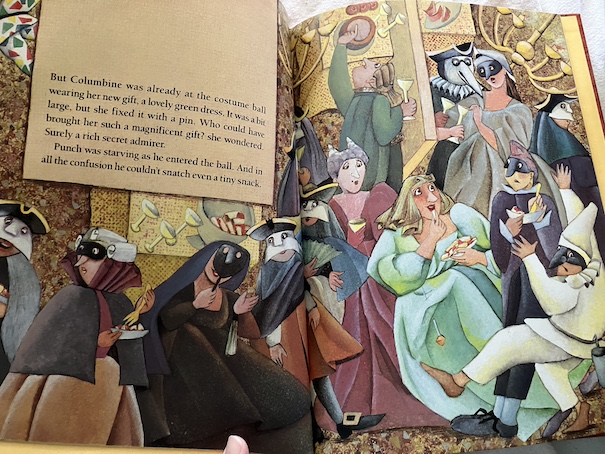
Harlequin is in love with Columbine, and he wants to do something that would impress her. He decides to borrow Rosaura’s dress and give it to Columbine as an anonymous gift so that Columbine can to go to the ball, but unbeknowst to him, Florindo is coming up with a scheme that will allow Rosaura to run away with him and get married. Florindo enlists his servant, Punch, to pretend to kidnap Rosaura, to provide a reason for her sudden disappearance. He tells Punch that he will know Rosaura at the ball because of her magnificent green dress, not knowing that Columbine has already received the dress from Harlequin and is wearing it at the ball.

Chaos ensues when Punch abducts Columbine, thinking that it’s Rosaura and that she’s just playing along with Florindo’s plan. When Punch says that he’s taking her to her suitor, Columbine assumes that he’s taking her to the secret admirer who gave her the dress.

In the meantime, poor Rosaura is having hysterics because she can’t find her dress and can’t go to meet her suitor. When Harlequin discovers what a mess all the scheming has caused, he comes up with another scheme to straighten out everything. Can he reunite Rosaura with Florindo, convince Pantalone to allow their marriage to take place, make her that Punch gets all the snacks he wants, and make things right with Columbine?

I love books that introduce lesser-known topics, and I imagine that few young readers would know anything about commedia del arte. For kids who are old enough to appreciate a little theatrical history and expand their cultural horizons, this is a fun introduction to an art form that they may have never seen before!

My first introduction to the stock characters was in Agatha Christie movies because Agatha Christie was fond of commedia del arte and put references to it into some of her stories, like The Affair of the Victory Ball. There is a section at the back of this book that explains the historical background of this type of theater and more about the characteristics of the stock characters.

I did think that the story in the book jumped around oddly in some places, and the role of The Doctor wasn’t very well explained. I think part of the reason was that the action would be easier to understand if we were watching it on stage rather than reading it in a book. The pictures are also chaotic and a little difficult to follow. I think they’re meant to convey the shifting scenes and the fast and chaotic movements of the characters as they go about their various schemes. The story itself is meant to be chaotic and action-filled because of all the characters’ schemes and counter-schemes. The action and visual jokes would probably make more sense seeing them performed rather than hearing them described.

I did like the part at the end, where we see the actors taking their bows and some of them removing their masks because the story was a play the entire time. The story isn’t meant for readers to see the characters as real people and events that are actually taking place. It’s all been a stage play the entire time. The pictures also indicate that it was always a play, with its flat scenery, objects at strange angles, and characters that seem to be separated from each other by thin walls. It’s all a bit unreal because it is unreal.

To get around some of the chaotic nature of the story and make it more fun for kids, I think this is a good book to read aloud with a lot of enthusiasm and maybe even act out rather than just telling it, encouraging young listeners to get involved in the story and the imaginary world of the theater.

The Mysterious Giant of Barletta

This story is adapted from an Italian folktale. There is a note in the beginning about the town of Barletta and the statue that stands in front of the San Sepolcro Church. According to the note, nobody knows who the statue is supposed to represent, which is why there are stories about it. This one takes place during the Middle Ages, the 11th century.

Because no one knows who the statue is supposed to be, the people of Barletta call it, “The Mysterious Giant.” No one even knows for sure how long it has been there. It has been there for as long as anyone can remember, including Zia Concetta, the oldest person in Barletta. People are accustomed to gathering around the statue to meet each other, and many of them will give the statue a friendly greeting or wish it good night.

However, one day, the town is threatened by an invading army. The people of Barletta are unprepared for invaders, and many of them prepare to flee, not knowing what else to do. Zia Concetta appeals to the statue to save their town.

The statue hears Zia Concetta’s request, and it comes to life, climbing down from its pedestal. Together, he and Zia Concetta come up with a plan to discourage the invaders.

When the invaders arrive, they see the statue, sitting by itself outside the city, crying. When they ask the giant statue why it’s crying, it says that the other boys at school are mean to him because he’s smaller than everyone else. When the invaders hear that everyone else in Barletta is bigger than the giant statue, they decide that they don’t want to meet the rest of the townspeople and leave!

The book is available to borrow and read for free online through Internet Archive.

I always like books that reference folklore! The theme of someone who is large pretending like they’re much smaller than other people to scare off an attacker is one found in other folktales. For example, in Fin M’Coul (a version of which was also written and illustrated by Tomie dePaola), Fin M’Coul, who is a giant, pretends to be his own baby to make an enemy think that his father must be larger and more fierce than he actually is.

I particularly liked this story because, unlike other folktales, it has a real setting and a definite landmark, the statue that is sometimes called the Colossus of Barletta. The way it is drawn in the book isn’t exactly as it appears in real life. In real life, it holds a cross in the hand that is raised, although the cross was not part of the statue originally. It probably originally held a spear or a flag standard. It is about three times the size of an adult human, which isn’t as large as it is shown the book. As in the book, it isn’t certain exactly who the statue is supposed to be, although it appears to be the statue of an emperor. He appears to be a middle-aged man wearing a jeweled diadem. The reason why nobody knows exactly who it was supposed to be is that it wasn’t originally made or displayed in Barletta. It was probably originally looted from Constantinople by the Venetians. There is a story from Barletta that it was once lost in a shipwreck on the way from Constantinople and washed up on the shores of Barletta in 1309, where some of its bronze was used for casting bells for a monastery. Then, in the 15th century, the statue was restored and displayed in front of the church. That, by itself is a fascinating story, although it isn’t explained in the book.

Princess Hyacinth

Princess Hyacinth by Florence Parry Heide, illustrated by Lane Smith, 2009.

For reasons nobody understands, Princess Hyacinth is not affected by gravity, and she floats upward anytime she is not restrained or weighted down.

It’s a real problem because, while it’s difficult enough when she floats up to the ceiling of the palace, if she were allowed out of the palace without something weighing her down, she would simply float away.

Princess Hyacinth’s parents go to great lengths to make sure that she is always secured to something or weighed down with special weighted clothes and a very heavy crown.

Of course, being weighted down all of the time makes life difficult for Princess Hyacinth, too. She wishes that she could go outside and play and swim with the other children, but she can’t because she can’t be outside without the weights. There is one boy in particular who comes by her window with a kite with a crown on it and says hello to her, but it would be difficult for her to go out and play with him.

Then, one day, when Princess Hyacinth is particularly bored and tired of being weighted down, she persuades a balloon man to tie a string to her and let her float among his balloons. At first, it’s fun, floating along as the balloon man walks through the park, but then, the balloon man is startled by a dog and accidentally lets go of her!

As Princess Hyacinth floats upward into the sky, she is thrilled because she has never felt so free in her life, but where will it end? How high can she go, and is there any way for her to get back? Fortunately, there is a way for her to get home, with the help of a friend!

The book is available to borrow and read for free online through Internet Archive (multiple copies).

My Reaction

This story reminded me of a much-older story from the 19th century, The Light Princess, but this picture book is much, much less serious than that book. In The Light Princess, the princess is cursed, and the story is about breaking this curse that has afflicted her all of life. In this book, there is never any explanation about why Princess Hyacinth isn’t affected by gravity, and she is never cured. Instead, she makes a friend who helps her find a way to live with her condition and enjoy it.

I liked the art style in this book. I found it amusing that the king, queen, and palace guards are drawn in the style of the face cards in a deck of playing cards. Princess Hyacinth is a cute little girl, and when she’s wearing her heavy princess gear, you can almost feel the weight of it on her. In the end, there are still times when she has to be tied down, but she seems more normal, less weighted down, because she has found someone to help her deal with her condition.

Somewhere in the World Right Now

This picture book explains time zones by showing what people and animals all over the world are doing at the same time, reminding children that, somewhere in the world right now, it’s a different time of day.

The book begins with A Note to the Reader, explaining that it takes 24 hours for the Earth to make one full rotation on its axis and that the Earth is constantly turning. This rotation is what makes the sun seem to move across the sky and creates our periods of day and night. Then, it explains how, in 1884, our formal system of time zones was established to standardize how times of day are expressed around the world. There are 24 time zones, roughly equal in size, with a few adjustments for geographical boundaries. Within each time zone, it is the same time, and it is one hour different from the time zones on either side of it. It also explains that the international date line is an imaginary boundary drawn through the middle of the Pacific Ocean that marks the point at which new days begin. There is a map in the book that illustrates all the time zones we will be traveling through and the International Date Line. The places we see in the rest of the book are also labeled on the map.

The main part of the book shows what people and animals around the world are doing “right now”, compared to a child in the United States. We don’t see the child in the United States until the very end of the book, but everything else is based around her “right now.” The text doesn’t specify where each of the places are, but each picture has a map in the background with labels that indicate the location to readers.

The first place we see is London, England. It’s the middle of the night (or possibly very early in the morning, after midnight but the sun isn’t up – according to the map at the beginning of the book, it’s 1 am), but a baker is preparing fresh bread to sell in the morning. Meanwhile, there are elephants sleeping in Uganda, whales swimming in the sea, penguins protecting their chicks in Antarctica, and a little girl sleeping in Madagascar.

It’s dawn in India, and people there are waking up. People are eating breakfast in Bhutan, and people are on their way to work in the morning in China. At the same time, it’s lunch time in Siberia, and there are kangaroos and koalas eating their own lunch in Australia.

Meanwhile, it’s afternoon on the western coast of the United States. There’s a fishing boat returning to port in Alaska, and a girl on a farm in California. As we move further east, it gets later and later. When we reach Chicago, it’s evening, and people are heading home. In Guatemala and Honduras, children who have been playing outside head for home, and families are having supper.

Eventually, we reach Boston, Massachusetts, where someone is reading a story book to a little girl before bed. It’s 8 pm, according to the time on the map at the beginning and the clock next to the little girl’s bed. All the things that we’ve seen in the book are happening, somewhere in the world, right now, as she is going to bed.

The book is available to borrow and read for free online through Internet Archive (multiple copies).

This book is educational, showing children how time and time zones work around the world, but it’s also a good, gentle bedtime story. Although we don’t really know it until the very end, it’s framed around a girl who is going to bed and is hearing a bedtime story. It is relaxing to think about how different things are happening in different places, to people and animals around the world, almost counting them off like counting sheep. No matter when it is or where you are, there’s someone, somewhere in the world, going through a different point in their day.

I found the human parts of the story more interesting than the animal portions, but I think children would enjoy hearing about the animals and seeing the animal pictures. It’s also relaxing to think about animals just going about their routines, like people go about theirs. There’s nothing stressful happening to any of the people or animals in the story.

I remember, when I was younger, I sometimes pictured things happening around the world when I had trouble sleeping. I can’t remember why I started doing this, if it was because I read this book or one like it. Somehow, though, I found it reassuring to think that, somewhere, it was daytime for someone else and that there were always people awake somewhere. It might be just me, but somehow, I found that idea reassuring because it meant that there were other people taking care of things, and it was their turn to be awake and do things, so I could have my turn to relax and rest.

All in a Day is a picture book on a similar theme, but instead of just showing what’s happening around the world at one particular moment, All in a Day follows children in various countries through the course of an entire day.

All In a Day

The format of this book is a little unusual. The book was a cooperative project among authors and illustrators from different countries to show children what is happening around the world at the same moment in different time zones.

Mitsumasa Anno, the primary author of the book, is from Japan, but he writes as a boy called Sailor Oliver Smith, or “SOS”, who has been shipwrecked with his dog on an uninhabited island near the International Date Line in the Pacific Ocean at noon on January 1 (which is also midnight on New Year’s Eve, Greenwich Mean Time). He is on the island for a full day before he is rescued, sending out appeals for help and thinking about what other children around the world are doing at every hour of the day as they celebrate the New Year.

As you read through the book, the small pictures of the children in different countries tell a complete story for each child in each country. The little mini-stories within the main story are presented almost comic book style. They contain no text themselves, but the boy on the island offers commentary on what’s happening with the children in other countries. During the time when SOS is asleep on his island, his dog, Matey, takes over the narration.

Children in Brazil are making and flying kites with their family and going swimming at the beach. People in Australia also go to the beach because it’s summer there in January, and they camp out overnight. A boy in the US sneaks out of bed to get a look at the party his parents are having at midnight, and is woken by his cat the next morning. The boy in England wakes up his too parents early in the morning by playing his trumpet. People in Kenya go a busy market and have dinner as a family. Children in China set off firecrackers, watch fireworks, and eat special foods. The story in Japan is about a little girl whose toy is stolen by a dog, and her cat chases after the dog to get it back. At first, they worry because the cat doesn’t return home for dinner, but the cat eventually comes in late with the toy, eats its fish, and goes to bed. Because this book was written in the 1980s, the book refers to Russia as the Soviet Union. The boy in the Soviet Union goes sledding with his friends and tries to ride his bike in the snow, which doesn’t work well. Children in various countries watch tv and read books during the day, and readers get to see their dreams when they sleep. At the end of the book, SOS sees a ship coming to pick him up at 9 am on January 2.

There is a message at the beginning of the book from all of the authors and illustrators who participated about children around the world, encouraging children to think about children in other places and what they might be doing throughout their day. Because it’s a different time of day in different places, some children are asleep in bed while others are awake and playing. However, it reminds readers that, no matter who we are, where we live on Earth, or what we look like, we’re all human beings on the same planet with the same sun and moon looking down on our days and nights. It’s a call for empathy and unity among nations and the people who live everywhere on Earth. In the back of the book, there is more scientific information about the movement of the Earth around the sun and the rotation of the planet and what makes different time zones. There is also information about the different authors and illustrators around the world who contributed to the project.

The book is available to borrow and read for free online through Internet Archive (multiple copies).

I have a vague memory of reading this book when I was young, but I can’t remember exactly when I read it. I think I was an older child because I already understood the concept of different time zones. I do think that kids who are a little older would get more out of the story and the concept of different time zones than very young children.

Older children would also probably find it easier to follow the different story lines of the children in each country. The format of the story may be a little difficult for very young children to follow because it does feel a little disjointed, getting just a snippet of each child’s day and night per page. However, the book is interesting to reread multiple times, following each child’s day, and I remember being fascinated by the notion of what everyone around the world was doing at different times.

The call for people to think about other people in other places and the call for international understanding is a nice, peaceful message for the New Year. As an adult, I was interested in seeing which authors and illustrators contributed to the book. Each set of illustrations for different countries has a different style. The illustrator for the boy in the US is Eric Carle, known for The Very Hungry Caterpillar. Not all of the illustrators are actually from the countries they illustrated, but more are. The two exceptions were for Brazil and Kenya, but the illustrator who did the pictures for Brazil did live there for a time, and the the couple who did the pictures for Kenya wrote and illustrated other books about Africa.

Somewhere in the World Right Now is a picture book on a similar theme, but instead of following children around the world through an entire day, it just shows what’s happening around the world at one particular moment. I think that makes Somewhere in the World Right Now a little easier to follow for younger children.