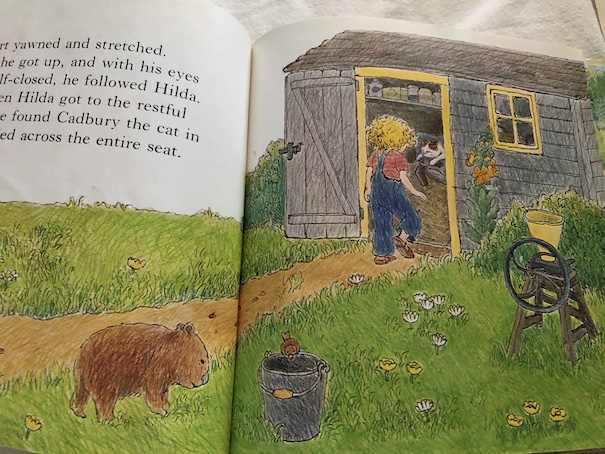
One hot morning, Hilda finishes watering her garden and decides that she needs to rest for a while.
When Hilda needs to rest, she has a special place she likes to go – an old armchair that she keeps in a shed. She calls the chair her “restful chair.”
Hilda is joined in her restful chair by Osbert the wombat and Cadbury the cat. However, Osbert and Cadbury aren’t the only animals who enjoy the restful chair. Soon, a pair of rabbits ask to join the others in the chair.
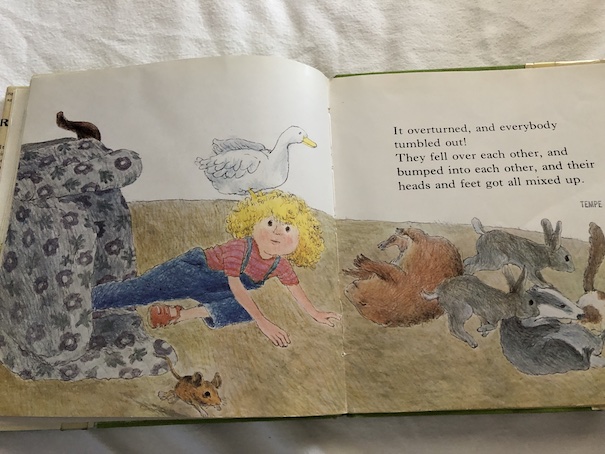
As Hilda and her animal friends sit in the restful chair, other animals come to join them. As the chair becomes more loaded with animals, it starts to creak and groan.
Eventually, the chair just can’t take it anymore, and it falls over, dumping everyone onto the floor.
Still, all the animals decide that they had a good rest. As the animals leave, Hilda sets the chair up again, and she and her animal friends go inside to have some watermelon.
The book is available to borrow and read for free online through Internet Archive.
My Reaction
This is a cute, fun story about animals who enjoy a comfortable chair as much as a little girl. Kids like stories with repetition, and they would probably enjoy seeing the parade of animals who come to join Hilda in her chair. They would probably also see the ending coming, that the chair won’t be able to hold everyone. It’s just a question of which animal is going to be the last straw for the chair. Fortunately, no animals were harmed by this experience, and even the chair seems okay, even though it fell over.
Because there is a wombat in the story, I assumed that the story takes place in Australia. It probably does, but from the publication information, it looks like it was first printed in Great Britain. The author was originally from Israel, but she was living in London at the time the book was published.
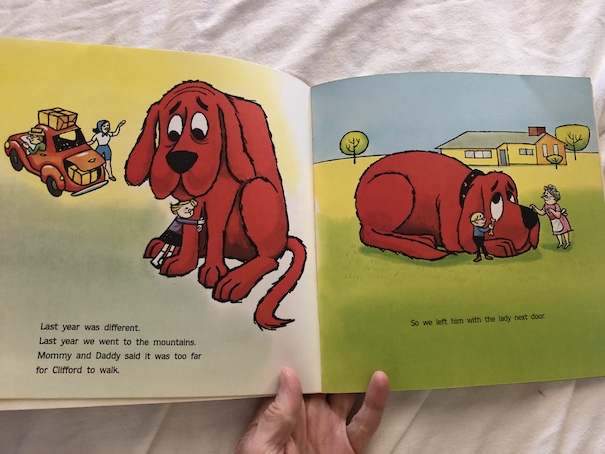
Emily Elizabeth and her parents don’t usually take long trips during the summer because it’s too difficult to bring Clifford along. He’s just too big to go on trains or buses. One summer, Emily Elizabeth’s parents decide to go camping in the mountains. They can’t take Clifford, so they leave him behind with a neighbor.
However, Clifford misses Emily Elizabeth too much, so he decides to go find her! A gigantic red dog can create a lot of chaos on a cross-country trip.
Along the way, he does help a man with a broken-down grocery truck, and the man is grateful enough to feed him.
He also arrives at the family’s campsite just in time to save Emily Elizabeth after she thought it would be fun to play with some baby bears she found.
The family considers that next year, they may find a way to take Clifford with them somewhere else.
The book is available to borrow and read for free online through Internet Archive (multiple copies, including one in Spanish).
My Reaction
Like all Clifford books, the humor is based around Clifford’s enormous size. Even though the family thought that it would be too far for Clifford to walk to come to the mountains with them, he tracks them down there anyway. Then, after he rejoins his family, he sleeps with Emily Elizabeth, his ear propped up to be her tent. The idea they’re considering next for transporting Clifford is a flat-bed truck. I could well imagine my own dog trying to track me down if I went on vacation without her, but fortunately, when your dog is about the same size as Toto in the Wizard of Oz, traveling with a dog isn’t as difficult.
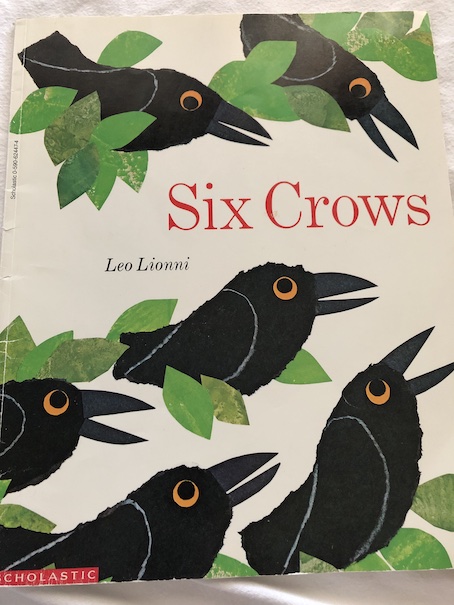
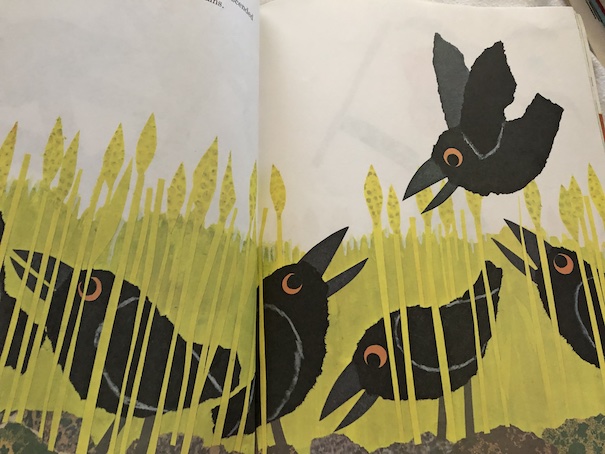
A farmer in the Balabadur Hills (the book doesn’t explicitly say that this story takes place in India, but it’s implied) has a good farm, but he also has a problem with the crows who live nearby. Whenever his wheat is ripe and about ready to harvest, the crows come and eat it.
Chasing the crows away doesn’t work because they always come back. The farmer decides to try building a scarecrow instead. It does frighten the crows, but with an unexpected result.
The crows decide that they must make their own scare-person, a kite that looks like a big, fierce bird, to scare away the scarecrow. When they fly over the field with their scare-person kite, the farmer gets scared and decides that he needs a bigger, scarier scarecrow.
The situation escalates, with the birds building an even bigger and scarier bird kite to scare the farmer.
Meanwhile, an owl who has been watching all of this unfold decides that it’s gone far enough and goes to talk to the farmer and the crows about the situation. The owl persuades both sides to speak to each other and work things out.
When they talk, the farmer and the crows realize that they don’t want to fight with each other. The crows depend on the farmer’s wheat for food, and the farmer realizes that he actually enjoys having the birds around. The owl fixes the mean-looking scarecrow to have a happy and friendly look.
I’m not sure that this is really a traditional fable because the book doesn’t provide any background information on the story and the author isn’t credited as doing a “retelling”, but the story is told in a folktale or fable format about conflict resolution. When the farmer and the crows are feuding, they continually escalate the situation with bigger and scarier “weapons” until the owl convinces them that the only way out of the situation is to talk it out and come to an agreement.
The book is available to borrow and read for free online through Internet Archive (multiple copies).
The Story of Ferdinand by Munro Leaf, drawings by Robert Lawson, 1936.
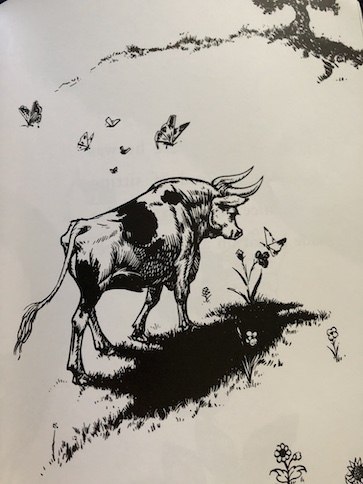
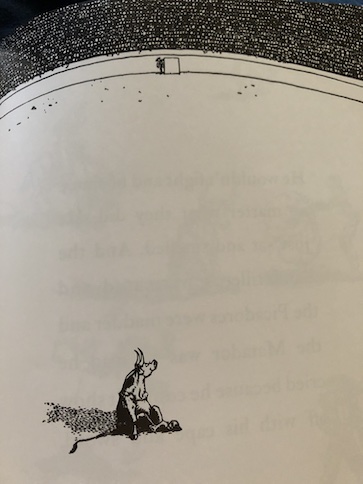
Ferdinand is a young bull living in Spain. He has been different from the other young bulls since he was a little calf. While the other young bulls liked to run around and butt their heads together, Ferdinand preferred to simply enjoy the peaceful countryside and smell the flowers. His mother sometimes worried about him, sitting all by himself under his favorite tree. She was afraid that he would be lonely, but Ferdinand told her that he just liked sitting under the tree and smelling flowers and that he didn’t want to play rough with the other young bulls. As long as Ferdinand was happy, his mother was content to let him do what he wanted to do.
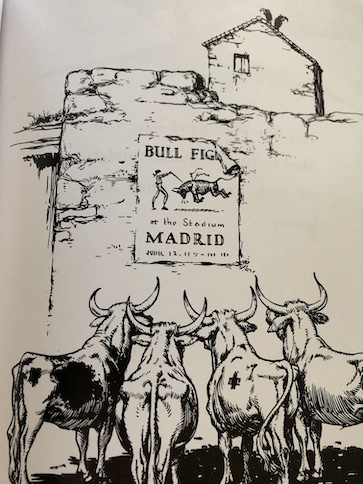
As time went on, Ferdinand and all of the other young bulls grew up big and strong. The young bulls who had always played rough together were fascinated by the bull fights held in Madrid. They thought that it would be exciting to be picked to participate in the fights. But, Ferdinand had no interesting in fighting of any kind. Although he was big and strong, he still preferred to just enjoy his flowers and his favorite tree.
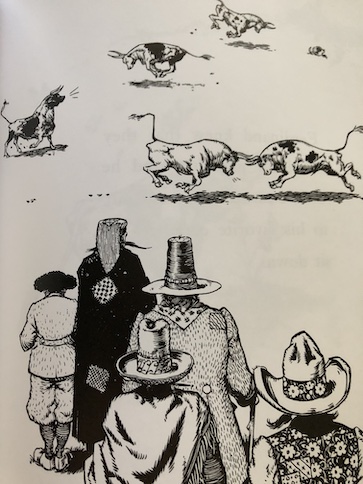
When some men come to the field to pick out bulls for the bull fight, the other bulls try to show off for the men. Ferdinand doesn’t, but by accident, he sits on a bee and is stung. When the men see him jumping around in pain, they assume that he must be the fiercest bull in the field!
Poor Ferdinand is carted off to Madrid, but no matter what the bull fighters do in the arena, they just can’t get Ferdinand interested in fighting them. There is only one thing that interests Ferdinand, and that’s flowers. When the men put him in the bull fighting arena, he just sits and looks at the pretty flowers that the women in the stands are wearing in their hair, enjoying the smell. They are so disappointed at the lack of fighting that they put Ferdinand back in the cart and put him back in the field … which is exactly where he wants to be.
The book is available to borrow and read for free online through Internet Archive (multiple copies, including some in different languages). It has been reprinted many times. It has not been out of print since its first publication, and it has been made into a movie.
My Reaction and A Little History
I remember that I didn’t care for this book when I first read it years ago. I was really worried for poor Ferdinand when he was picked to join the bullfight. Because the book is for young children, it doesn’t make it fully clear that the bullfight is supposed to end with the death of the bull. The bullfighters all have spears and swords “to stick in the bull”, and the book says it’s to make the bull mad, but adults and older kids realize that they’re really going to hurt and kill the bull during the fight. There are vultures in some of the pictures as a clue that death is a real risk.
Fortunately, nothing bad happens to Ferdinand in the story. Because Ferdinand is a peaceful bull, who has no interest in fighting and only wants to enjoy flowers, he is not exciting enough for the bullfight, so he gets sent home to the field and the peaceful life he loves. The other bulls may not know that their lives could be much shorter because of their willingness to fight.
It’s also interesting to note that this book was written in the 1930s, when the world was headed for World War II. It was also published shortly before the Spanish Civil War. Because of its pacifistic themes, it was banned by both Franco and Hitler. The author, Munro Leaf, said that he didn’t really mean the story to be a serious one, but its themes resonated with even the adults of his time, in different ways, as this article from Sotheby’s notes:
“In 1937 Leaf wrote that he had published a book he “thought was for children… but now I don’t know” and in 1938 The New Yorker wrote “Ferdinand has provoked all sorts of adult after-dinner conversations.””
It wasn’t just Hitler and Franco who were suspicious of the book’s intentions. Some people also suspected it of being “Red Propaganda” or “Fascist Propaganda”, presumably because some people feared the pacifism in the story would encourage people not to fight communists or fascists. Some people also questioned the book’s message on the topic of masculinity. I could see that the story could be regarded as a commentary on men who think they have to tough, macho fighters, like the bulls. Even though Ferdinand might be regarded as a failure as a bull for not engaging in the fighting and rough play of the other bulls and not going through with the bullfight, he lives a happier, more peaceful, and ultimately, longer life because of it. Maybe he’s not a failure after all but just smarter than the average bull. Ferdinand is certainly a non-conformist who finds a way to make it work for him. How any reader might feel about that could depend on what they think conformity means and how they feel about that.
However, the book also received a lot of positive support. There is an anecdote that Gandhi loved it, and President Franklin Roosevelt requested a copy. The Sotheby’s article also recounts a story that I first heard from my children’s literature teacher when I was in college, that 30,000 copies of the book were sent to Germany after World War II as a peace gesture. When my teacher told the story, she explained that few children’s books were published during the war (and if you’ve already read my review of Emil and the Detectives, you already know that even children’s books were not exempt from book burnings if they had anti-war themes), so the distribution of the copies of The Story of Ferdinand were welcome, and the children who received them loved the story.
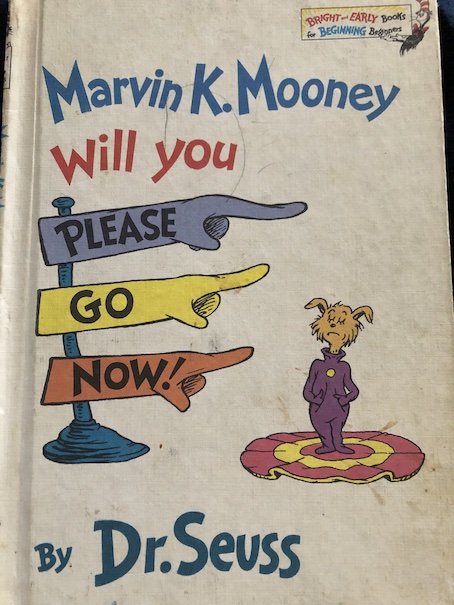
Marvin K. Mooney, Will You Please Go Now! by Dr. Seuss, 1972.
It’s time for Marvin K. Mooney to go, but he absolutely refuses. Where is going? We don’t know because the book doesn’t say. I imagine that he’s supposed to go to bed because it’s bedtime. He looks like he’s wearing footie pajamas, and the large hand that points for him to go looks like it might be a parent’s hand, but that’s just a guess. This book is just a nonsense rhyme.
The owner of the hand repeatedly tells Marvin to go, telling him that he can go in any way he chooses, as long as he goes.
In the tradition of Dr. Seuss books, all the suggested methods of going are nonsensical, and there are a few made-up nonsense words and devices thrown in.
Eventually, when the owner of the large hand insists, Marvin decides that it really is time for him to go.
The book is available to borrow and read for free online through Internet Archive (multiple copies).
My Reaction
I’m not a big fan of Dr. Seuss. I wasn’t even as a kid, mainly because my early introduction to Dr. Seuss was The Cat in the Hat and Green Eggs and Ham, two of the major ones people think of when they think of Dr. Seuss. I thought that the Cat in the Hat was way too pushy, and I was very concerned about the welfare of the pet fish in the story. When my teachers made the requisite eggs and ham and dyed them with green food coloring, I absolutely refused to eat them. I didn’t mind it when they turned milk bright green with food coloring for our earlier green-themed day because milk turned the color of mint ice cream looked good, but nothing that turns the shade of green of those green eggs and ham looks appetizing. Knowing that it was just food coloring didn’t help. Speaking of becoming more accepting of new experiences, Sam I Am really needs to learn how to take “no” for an answer.
Anyway, my early Dr. Seuss experiences didn’t appeal to me much, so I didn’t seek out Dr. Seuss books as a kid. I never encountered this particular Dr. Seuss book until I was an adult, and the one thing about Dr. Seuss that really appeals to me now is the knowledge that The Cat in the Hat was specifically meant to be a more interesting alternative for beginning reader than the Dick and Jane readers that were popular in the mid-20th century century. All Dr. Seuss books contain a limited range of simple vocabulary with a few made-up words thrown in to make it interesting, and they’re all meant to be funny and somewhat bizarre to keep young readers interested.
As I said, I don’t know for sure who is telling Marvin to go in this story or where he’s supposed to go. I think it’s probably bedtime, and he’s supposed to go to bed. It would be just like a parent to use a child’s full name to tell them that they’re supposed to do something when they’re not listening. But, it doesn’t really matter. There are some Dr. Seuss books that have a moral to them, but this isn’t one of them. It’s just supposed to be a simple story that’s fun for young children to read. You can imagine where Marvin goes yourself!
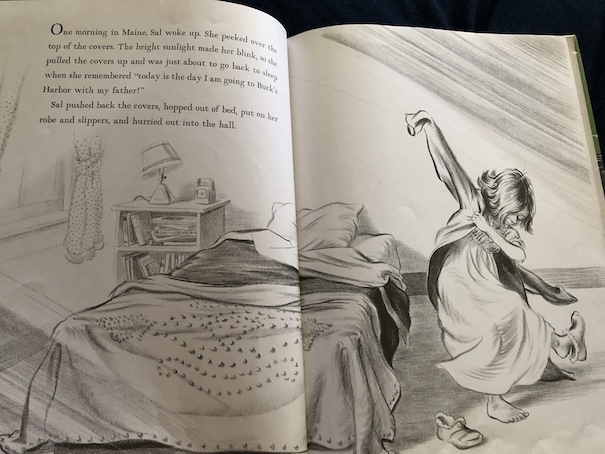
This cute picture book features Sal, a little girl who also appeared in Blueberries for Sal. She and her family live or are staying on an island off the coast of Maine. One morning, Sal wakes up and is excited because she remembers that she and her father will be going to Buck’s Harbor (a real place).
She helps her little sister, Jane, to get ready, and while they’re brushing their teeth, she feels that one of her teeth is loose. She’s never had a loose tooth before, and she runs to tell her mother. Her mother tells her not to worry about it because everyone loses their baby teeth when they’re growing up. She say that a new, bigger tooth will grow in when the old tooth falls out. Her mother says that if she puts her baby tooth under her pillow, she will get a wish, but she shouldn’t tell anyone what the wish is.
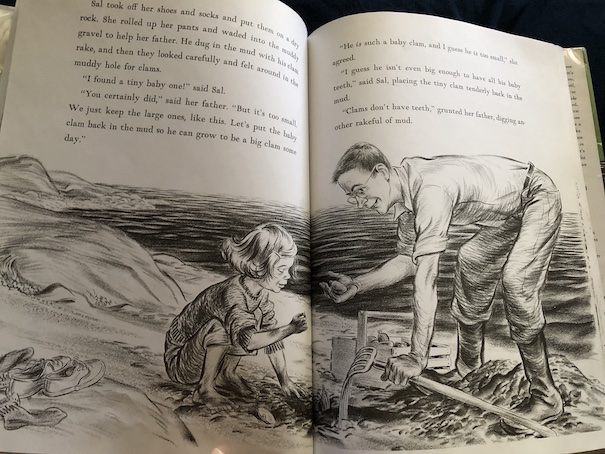
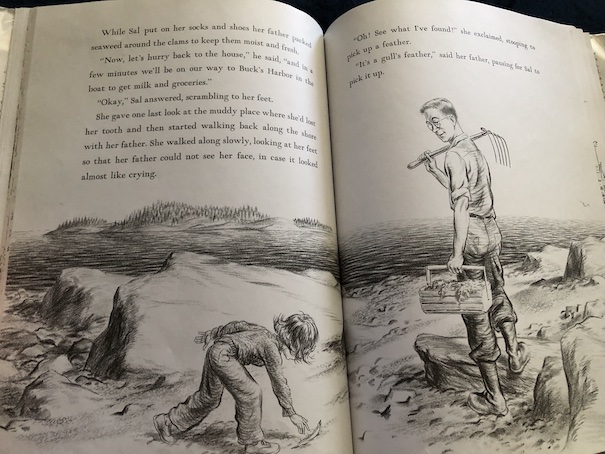
On her way to the beach, where her father is digging clams, Sal proudly tells all the animals she sees about her loose tooth. When she reaches her father, she tells him about the tooth, too. Then, she joins him in digging for clams.
Then, Sal realizes that she’s already lost the tooth somewhere. She’s really disappointed because she wanted to make a wish. As she and her father walk back to the house, Sal sees a feather that a gull lost. Since the feather is kind of like a tooth because a new feather grows in when one falls out, she decides that she can make her wish on that.
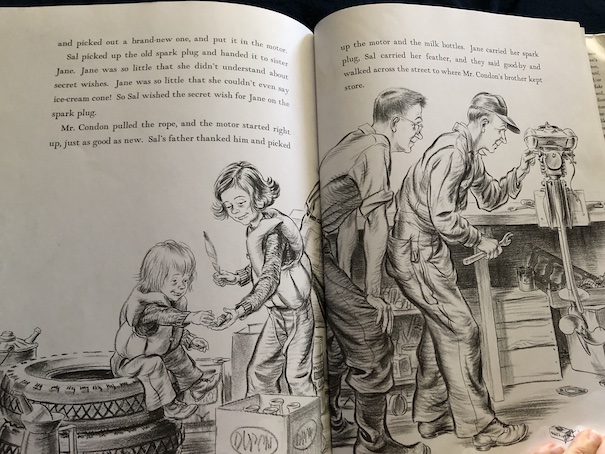
When it’s time to go to Buck’s Harbor, the motor on the boat won’t run, so the girls’ father has to row the boat. When they go to get the motor fixed, Sal tells the mechanic about her tooth. When the spark plug in the motor is replaced, Sal compares the old plug to her lost tooth and gives the old plug to Jane so she can have something to wish on, too.
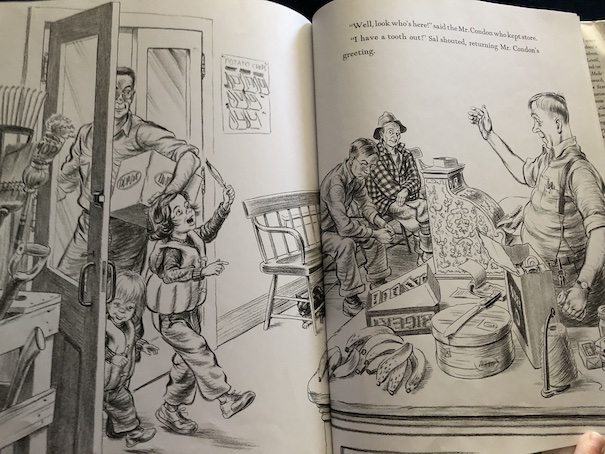
She also tells the men at the grocery store about her tooth, and she ends up getting an ice cream cone, exactly what she wished for! The book ends with Sal, her father, and her little sister all going home for clam chowder for lunch.
The book is available to borrow and read for free online through Internet Archive (multiple copies). It’s a Newbery Honor Book!
My Reaction
This is just a cute little story about a little girl who is proud of losing her first loose tooth. It’s a sort of rite of passage that all small children go through. Her parents don’t tell her about the tooth fairy or promise her money for her tooth, but she does get a wish. Because her wish is a simple one, it’s easily fulfilled.
The different animals that can be found on the coast of Maine would also be interesting to child readers. Sal and her father also talk about which of the animals have teeth and which don’t. The birds and the clams don’t have teeth, but seals do. Sal keeps making comparisons between her tooth and other things that have to be replaced eventually, like the bird’s feather and the old spark plug, finding a kind of magic in things that are discarded and replaced with something new.
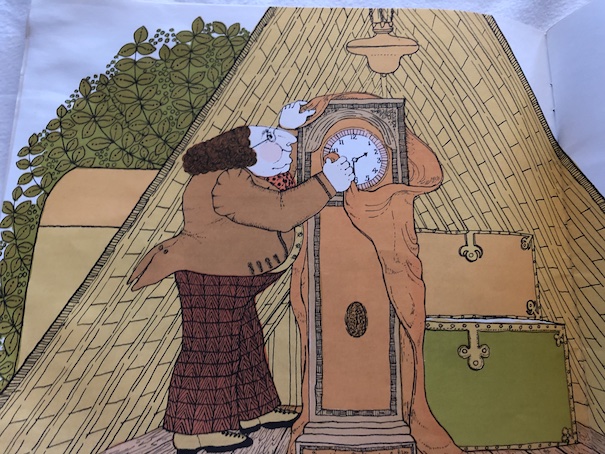
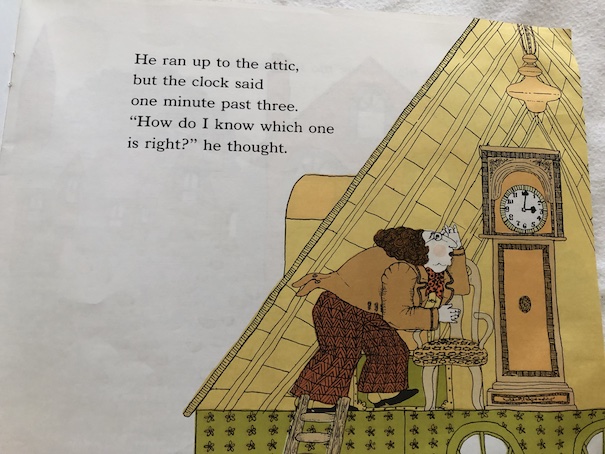
One day, Mr. Higgins finds an old grandfather clock in his attic. He likes the grandfather clock, but he wonders if it really keeps accurate time.
To figure out how accurate the grandfather clock is, he decides to buy another clock. He puts the second clock in his bedroom.
The problem is that when Mr. Higgins goes from his bedroom up to the attic, the clock in the attic reads one minute later than the one in the bedroom. Mr. Higgins isn’t sure which one is right.
Confused, Mr. Higgins decides to buy a third clock to compare to the other two. He puts this one in his kitchen. However, the same thing happens! Each time Mr. Higgins leaves one clock and walks to the next, they’re always a little different!
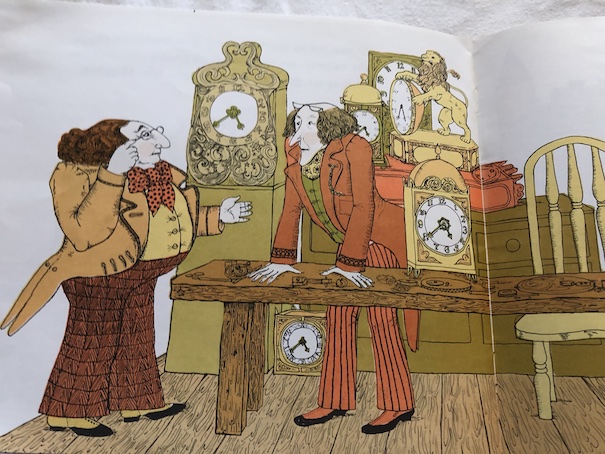
After purchasing a fourth clock gives him the same results, Mr. Higgins asks the Clockmaker what the problem is and he should do. The Clockmaker comes to Mr. Higgins’s house to take a look at his clocks.
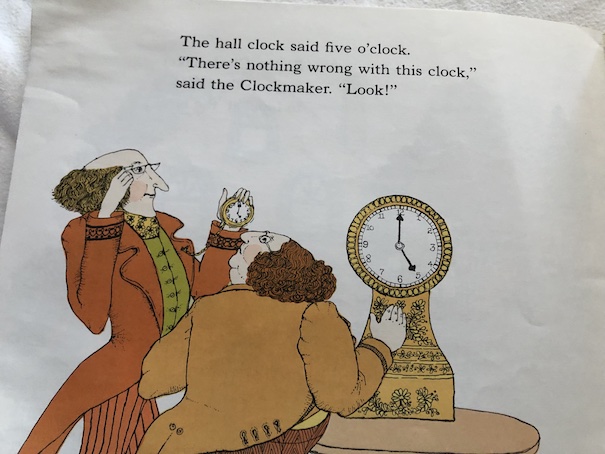
When the Clockmaker compares the time on his watch to the time on each of the clocks, each of the clocks is correct. All of Mr. Higgins’s clocks are working just fine. Suddenly, Mr. Higgins knows what he must do!
Mr. Higgins goes out and buys a watch like the one the Clockmaker owns. Since he bought his watch, all of his clocks have been reading correctly, and Mr. Higgins is happy.
The book is available to borrow and read for free online through Internet Archive (multiple copies).
My Reaction
This is a fun picture book, partly because even kids will begin to figure out what’s going on with Mr. Higgins’s clocks before he does. He never figures out that it takes him one minute to get from one floor of his house to the next. It doesn’t occur to him that the clocks he left behind in each room have been advancing since he walked to the next one. Even at the end, he still doesn’t seem to fully understand it. He just knows than, when he compares any of his clocks to his new watch, they’re always right! The reason why this happens is never explicitly explained. It’s just left for readers to notice and chuckle at.
This fun picture book is written in comic book form. Almost all of the text is in speech bubbles in the pictures.
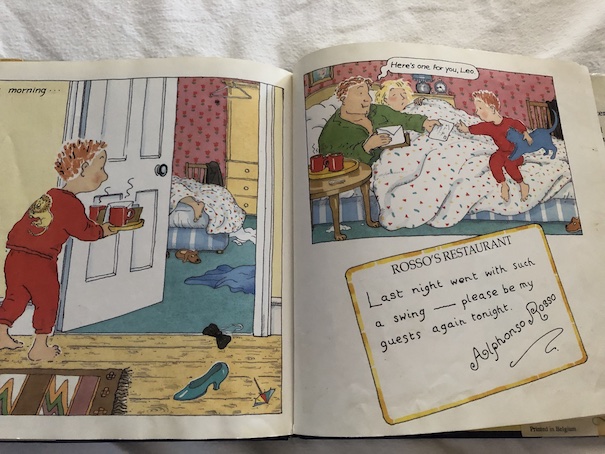
One morning, Leo finds an unexpected prize in his cereal box: an invitation to dinner at a fancy restaurant! He and his parents decide to accept the invitation, getting dressed up for the occasion.
The food is great, and Leo notices that there is a band playing. He asks his mother if she’s going to dance, and on a whim, she decides to dance with the waiter with the dessert cart.
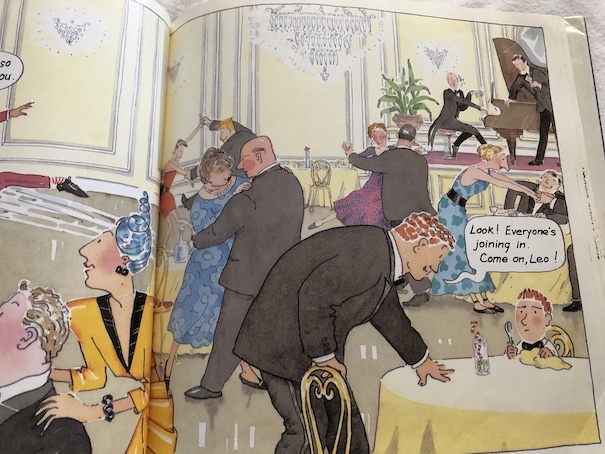
From there, the evening goes from good to great for everyone! The restaurant turns into a party with everyone dancing, Leo’s mother swinging from the chandelier, and the musicians having the time of their lives!
Then, a lady who is a dancing with Leo loses one of her diamond earrings. Leo volunteers to find it for her, and it turns up in an unexpected place.
The evening is such a success that the owner of the restaurant invites them to dinner the next night, too!
The book is available to borrow and read for free online through Internet Archive. It was first published in Great Britain.
My Reaction
In real life, fancy adult restaurants tend to serve foods that kids don’t like and require a level of etiquette that kids often find stifling, but in this fun, comic book style story, Leo and his parents have the time of their lives on this fun evening out! All of the adults in the story are open to some zany fun, and even the owner of the restaurant enjoys himself so much that he’d love to have them back the next day.
Like all picture books, it’s the details in the pictures that really make the story. The story doesn’t tell you that the reason why the cereal box prize was an invitation to this restaurant is that the restaurant owner also owns that brand of cereal, but it’s shown in the pictures, with his name on the box. When Leo and his parents arrive at the restaurant, the owner meets them and compliments them on their taste in cereal. Later, he’s shown eating a bowl of his cereal himself. I also loved the picture that includes Leo’s mother letting loose and swinging on the chandelier. The other people in the restaurant are also eccentrics. One of the dancing women is wearing a dress with a banana print and a matching hat with a banana on it, and while Leo is searching for the lost earring, he finds a lady in an elephant print dress and fuzzy slippers. There’s nothing dull about this elegant dinner or the people enjoying it!
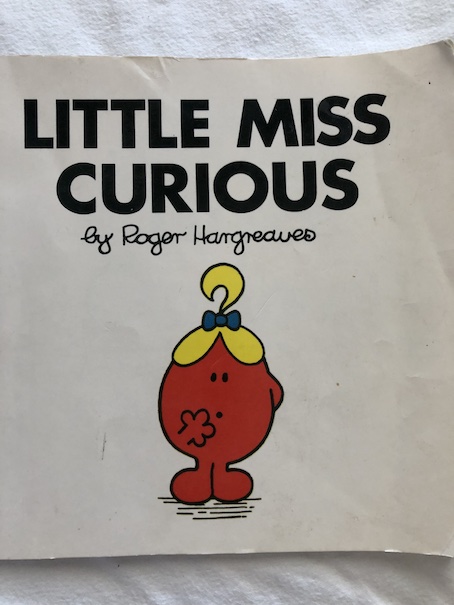
Little Miss Curious is a very curious person. She is curious about everything.
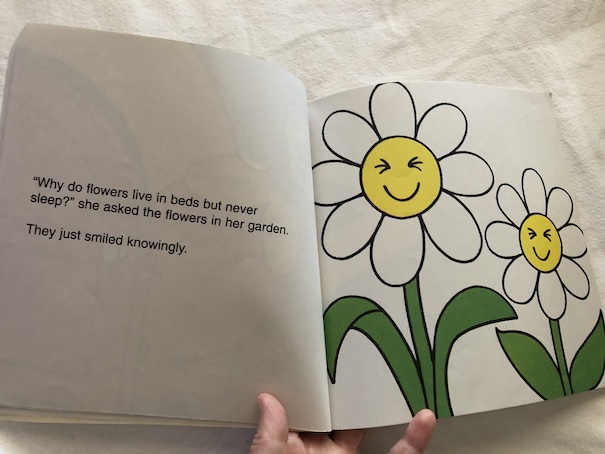
She wonders about all kinds of things and constantly asks questions. Most of the questions she has are silly nonsense, but Little Miss Curious can’t stop wondering things like why flowers are in beds but don’t sleep or why sandwiches don’t contain sand.
She finds out that sandwiches do have sand when Mr. Nonsense makes them, but this is the only question she gets answered in the book.
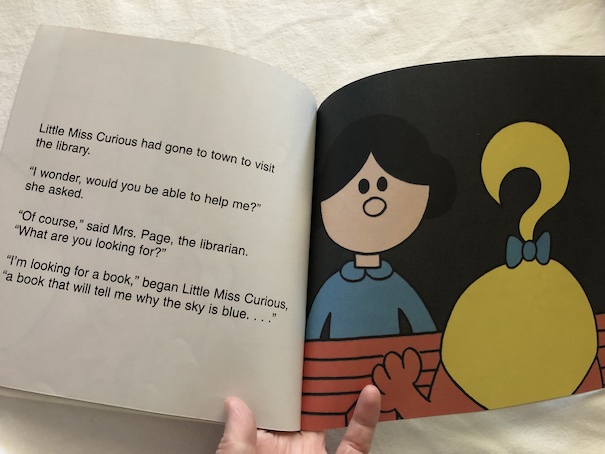
Little Miss Curious has so many questions that she decides to go to the library in town and find books that can answer all of her questions. It’s a sensible thing to do, but because books in this series are mainly nonsense, her library visit doesn’t go as planned.
Little Miss Curious takes so much time peppering the librarian with all of her questions that the other patrons get annoyed, and Little Miss Curious gets thrown out of the library.
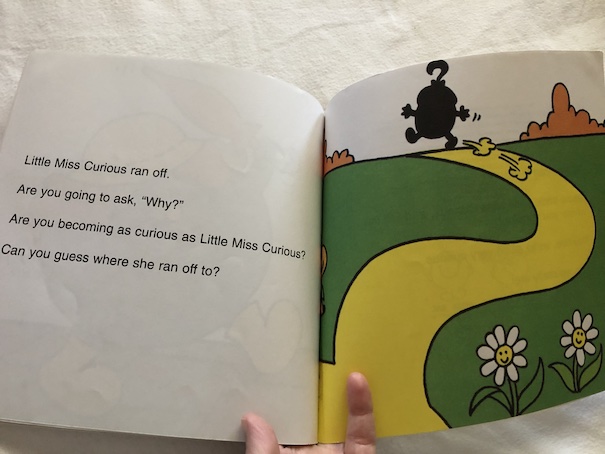
Little Miss Curious can’t understand why that happened or why people are giving her strange looks. The book ends with her running off down the road, and it invites curious readers to wonder why and where she’s going.
This book is part of the Little Miss series. It’s available to borrow and read for free online through Internet Archive (multiple copies).
My Reaction
Sometimes, books in this series emphasize morals by showing positive traits and negative ones, but even more often, the traits of the characters are played for humor, and that’s the case with this book. No morals are taught, and no lessons are learned. Miss Curious faces some consequences for wasting people’s time with ridiculous questions, but she doesn’t seem to understand the way people react to her. There is no change to her character, and the story has an open end, where readers are invited to be curious about where Little Miss Curious is going and what she’s going to do next.
Although Little Miss Curious’s curiosity goes overboard, curiosity is inevitable, and the reader can be as curious as anyone. In a nonsense book, that’s about as close to a moral as I can draw. Mainly, the book is for fun and humor. Readers can chuckle at the silly things Little Miss Curious ponders and indulge in a little curiosity of their own.
Fin M’Coul retold and illustrated by Tomie de Paola, 1981.
This is a retelling of a classic Irish folktale. The story is fun and silly, but one of the parts of this story I like the best is the introduction of the Giant’s Causeway – a real place with a magical look. There’s a geological explanation of this rock formation, but this story introduces the folkloric explanation.
In ancient times, when Ireland was inhabited by giants and magical creatures, a giant named Fin M’Coul lived on Knockmany Hill with his wife, Oonagh. One day, as he is building a causeway between Ireland and Scotland, Fin M’Coul hears that another giant, Cucullin, is coming.
Cucullin has a fearsome reputation, and he has beaten up many other giants, just to prove how strong he is. So far, Fin M’Coul has been able to keep out of his way, but Cucullin is now looking for Fin M’Coul to beat him. In fact, he’s so close that there’s no time for Fin M’Coul to get away.
Fin M’Coul goes home to his wife and asks her what he should do. Oonagh says that he won’t have any peace until he gets this confrontation with Cucullin over with, but Fin M’Coul doubts that he could be a match for Cucullin in a fight. Oonagh decides that they’re going to have to defeat Cucullin with cunning rather than strength.
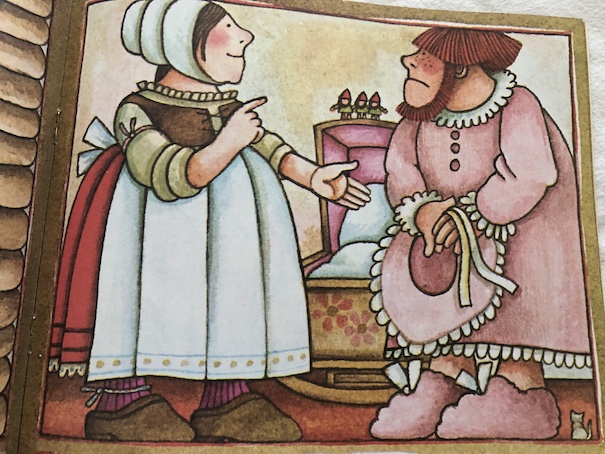
She quickly does a special charm to bring them success, and then, she begins setting the scene for the trick they’re going to play on Cucullin. She makes up a giant cradle and makes her husband dress in baby clothes and sit in the cradle. It’s ridiculous, but Oonagh has a plan.
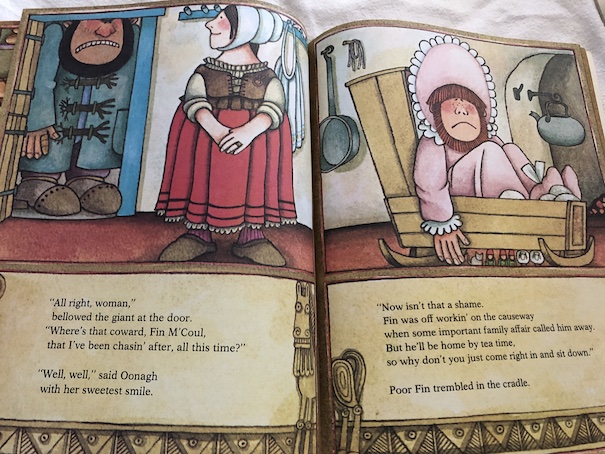
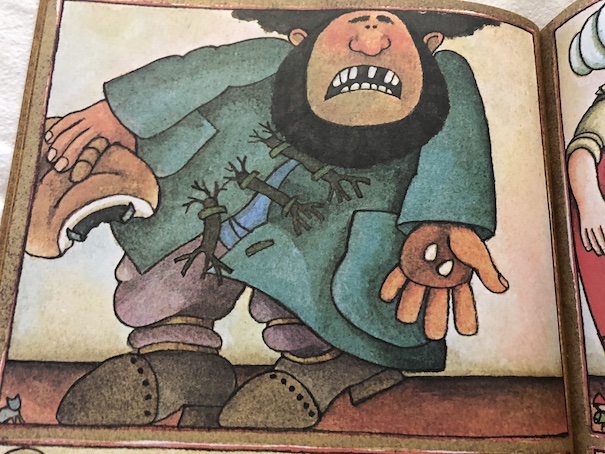
When Cucullin comes, Oonagh tells him that her husband isn’t home, but she invites him to come in and wait with her and her “baby.” Not only is the “baby” astonishingly large, even by giant standards, but Oonagh carefully convinces Cucullin of the baby’s unusual strength. She tricks him into thinking that the “baby” can eat bread and cheese that’s rock hard while giving Cucullin bread with a frying pan in the center and a real stone instead of cheese. Not only does Cucullin break his teeth on these things, but if Fin M’Coul’s “baby” can eat these things, how much stronger could Fin M’Coul be?
Oonagh’s tricks allow Fin M’Coul to get the upper hand against Cucullin and defeat him once and for all!
There is a brief section in the back of the book that explains a little about the background of the legend. I love the pictures in this version of the story. Tomie de Paola books always have fun illustrations, but if it weren’t for the little people and animals in the pictures with the giant characters, you might almost forget that the main characters in the story are all giants.
The book is available to borrow and read for free online through Internet Archive.






























 Jestress's Forgotten Books and Stories