Pecos Bill

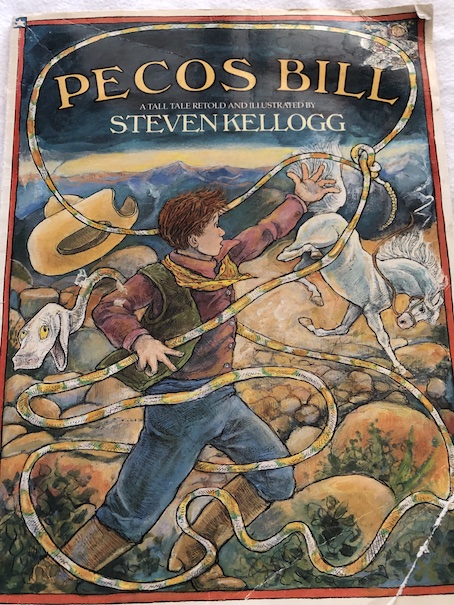
Pecos Bill retold and illustrated by Steven Kellogg, 1986.

I remember this book from when I was in elementary school! This was the book that my teacher or librarian (I forget which one now) used to introduce us to the concept of tall tales. Tall tales, like the story of Pecos Bill, are a major feature of American folklore, particularly Western American folklore.

When the story begins, young Bill is traveling west from New England with his family as part of a wagon train. As they cross the Pecos River, Bill tries to fish, but an enormous trout pulls him out of his family’s wagon. Bill is rescued by a coyote, and he spends some time living and growing up with the coyotes and other animals in Texas.

Eventually Bill meets up with a cowboy named Chuck, who explains to him that he’s a human and a Texan, not a coyote. Chuck gives him some extra clothes to wear (because he’s long outgrown his childhood clothes). Chuck tells Bill that many Texans are outlaws, but they would be better if they started herding cattle and became ranchers. Bill decides to try life as a Texas rancher.

Because of his wild upbringing, Pecos Bill is able to perform amazing feats of strength, like subduing a giant rattlesnake to the point where it becomes tame and allows Pecos Bill to use him as a lasso. He also gets the hide of a monster to make other lassos to give to the worst gang of outlaws around. The outlaws are so impressed with Bill’s ability to subdue wild creatures that they agree to make him the boss of their gang, and they all become cowboys.
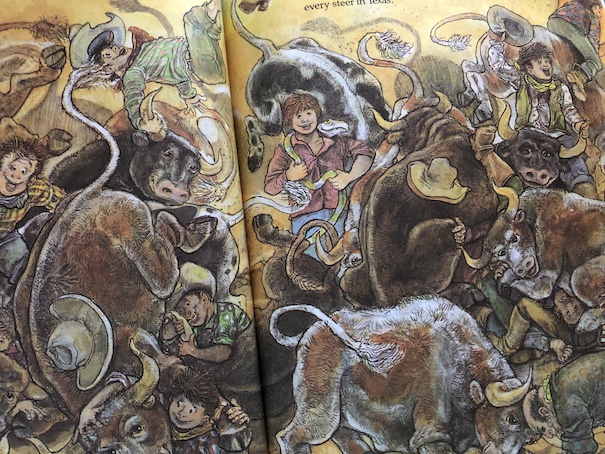
Bill subdues a wild horse called Lightning and uses the language of wild animals to befriend him. He leads the other cowboys on a massive cattle drive, and he creates the impossible Perpetual Motion Ranch on Pinnacle Peak.
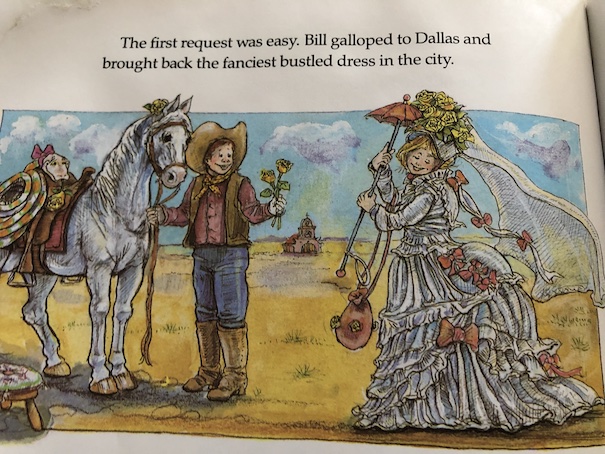
Then, Pecos Bill meets a pretty girl named Sue and decides to get married. However, Sue’s bustle is so tight that when she tries to sit on Bill’s horse, Sue bounces in the air so high that she reaches the moon. Every time she hit the ground, she bounces into the sky again, so Pecos Bill has to lasso a tornado to catch up with her.
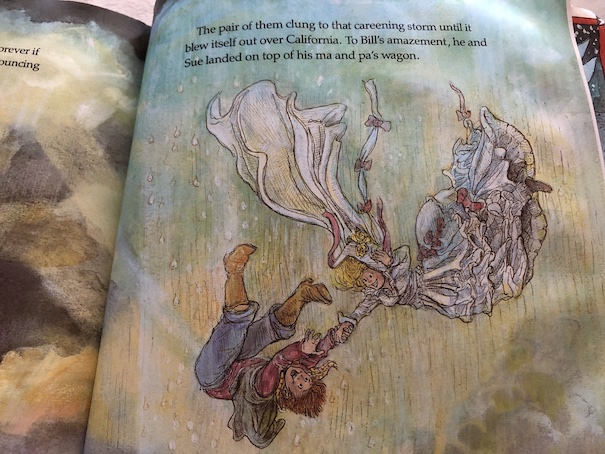
When they finally land, they land on top of Bill’s family’s wagon in California. Apparently, they’re still wandering after all these years, trying to find a place to settle. Pecos Bill convinces his family to settle with him and his bride in Texas.

I’m not very big on tall tales, in spite of having grown in the American Southwest, where many of these types of stories evolved, but I have some sentimental attachment to this one because it was my first as a kid. The pictures in the book are wild and chaotic, just like the action in the story.

The book is available to borrow and read for free online through Internet Archive (multiple copies).

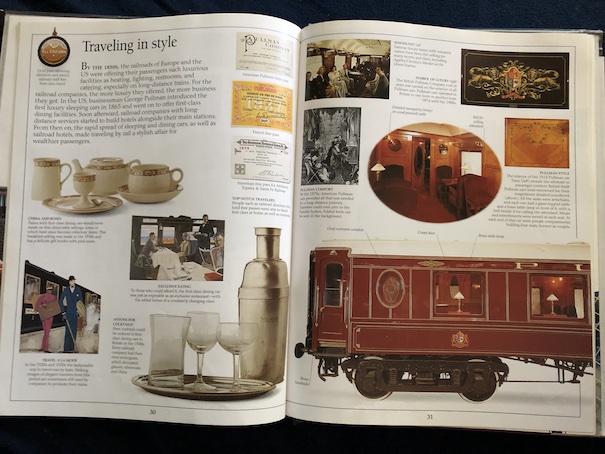
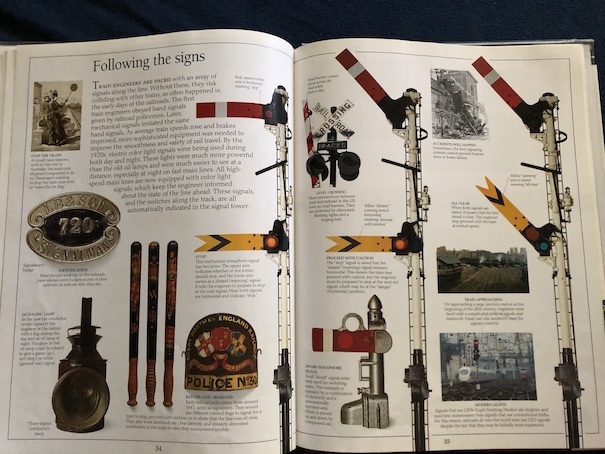
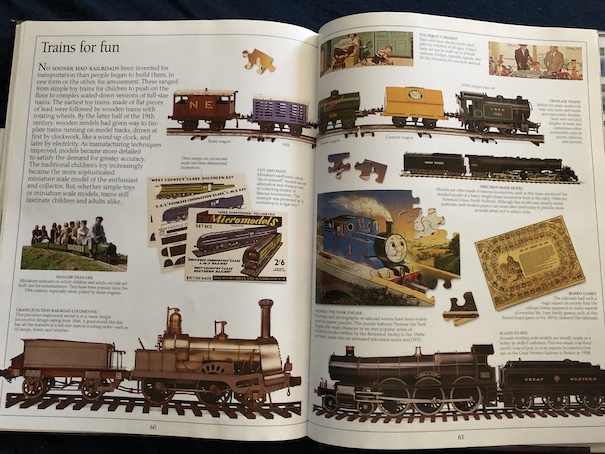
Eyewitness Train

Eyewitness Books

Eyewitness Train by John Coiley, 1992, 2009.

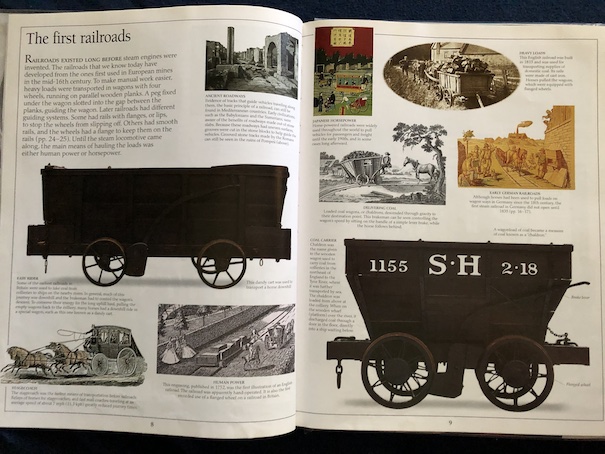
I love Eyewitness Books for their collections of pictures! I always say that nonfiction books for adults need more pictures because pictures are worth a thousand words, and I love how this particular book uses pictures to explain the details of different kinds of train cars and how railroads work.

It begins with an explanation of what trains are and the history of the first railroads. Trains, which are series of linked wheeled vehicles, are older than the first steam engines and developed from chains of wagons used in European mines during the 1500s. Steam engines were developed in the 1700s, although it wasn’t until the 1800s that railroads as we know them developed and became popular modes of transporting people and goods.

The book explains how steam engines work, using pictures of model train engines with cutaway designs. Then, it explains about railroads around the world and how railways are built.

From there, the book explains about both freight trains and passenger trains. The part about mail trains reminds me of the kids’ book Mailing May. When it discusses passenger trains, it explains the differences between first, second, and third class sections on historic passenger trains. There is also a page about George Pullman, who developed luxury sleeping and dining cars catering to wealthy travelers. The level of luxury on trains could be quite impressive, and the book mentions that this is the level of luxury the passengers experienced in Agatha Christie’s Murder on the Orient Express, a classic mystery story that many people think of when they hear about luxury train travel.

When I was a kid, the sections about passenger trains and sleeper cars would have appealed to me the most because that is the stuff of stories, and I’ve always been a big mystery fan. However, I also find the parts about how railroads function interesting. They explain about the purpose of the signal tower and how train signal and track controls have changed since the 1800s. Earlier, I covered a different train book that showed the old, manual signals they would use, but this book covers modern methods of signaling and controlling trains as well. It also explains the evolution of train stations.

The book covers the differences between steam, electric, and diesel trains, and there are also sections about elevated trains and underground trains. There is also a section about new technology for trains and what the future of trains might be.

I also enjoyed the section about toy trains and model railroads!

The book ends with a map showing famous railways around the world, a timeline of the development of trains, a glossary of terms, and a section with sources of additional information, a list of railway museums, and recommendations for movies that include trains, including the movie versions of Harry Potter, The Polar Express, and The Railway Children.

My copy of this book included a poster about trains and a CD with train clip-art, but not all copies of this book might include the same extra items, especially if you buy a used copy. I lucked out with mine. The book is available to borrow and read for free online through Internet Archive.

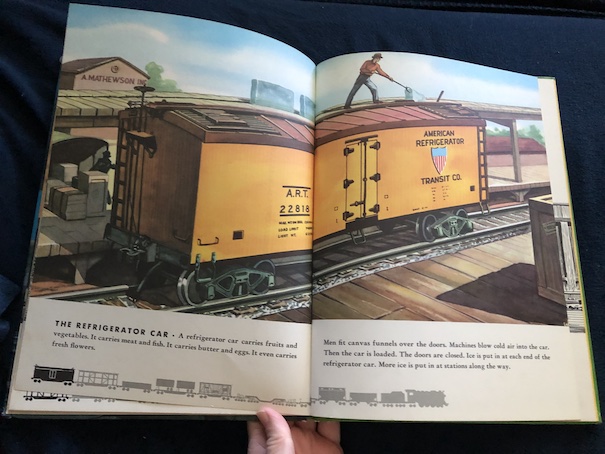
The Big Book of Real Trains

The Big Book of Real Trains by Elizabeth Cameron, illustrated by George J. Zaffo, 1949, 1953, 1963.

This is a vintage children’s nonfiction book that’s all about trains! It was reprinted and had its copyright renewed many times, which is why I give multiple dates for the book. My edition was the 1973 printing. The pictures are detailed, and they alternate between color and black-and-white.

I thought it was interesting that the first half of the book devotes a page to explaining each specific type of train car and its purpose, so kids can learn to recognize them on sight. If you look at the bottom of each of those pages, you’ll see how they’re slowly building a complete train, from locomotive to caboose, with each new car.

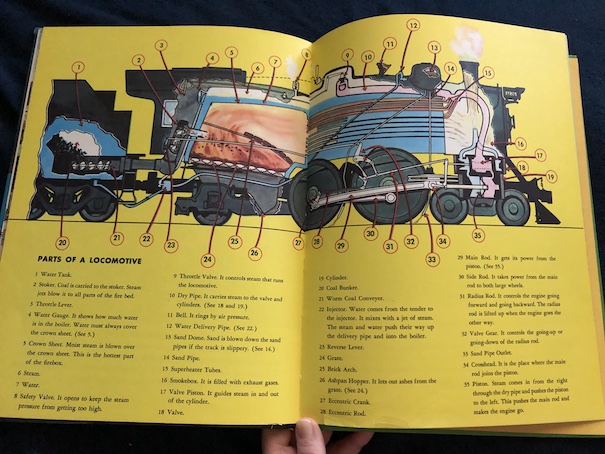
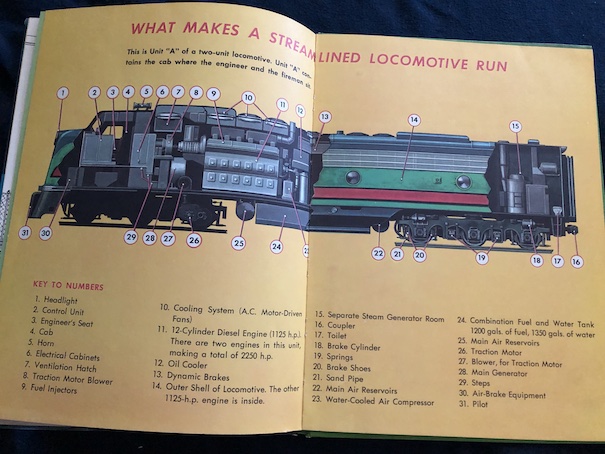
There is a special page that shows the inside of a locomotive to explain each of its parts and how it functions, and there is another picture that shows the parts of a streamlined locomotive.

After the book explains each of the basic train cars, it explains the classification yard, where freight cars are assembled into trains.

I particularly liked the sections of the book that explain the signals railway personal use and all of the types of personnel who work on trains. The signals are old-fashioned manual signals, but it’s still interesting, especially if someone might be writing a story that takes place in the past on a train. Some of the jobs might also be different on modern trains, but I liked how they pointed out just how many types of people who might be working on a train. The book refers to these workers as “men”, which sounds a little old-fashioned, but I noticed that the tiny figures representing different jobs had different skin colors, even for higher-ranking jobs on the train, which is very good for a vintage book. The illustrator made an effort to show diversity! Overall, I thought their explanations were pretty good.

The book is available to borrow and read for free online through Internet Archive, although the copy is listed under an alternate title, The Book of Classic Trains.

The Story of Ruby Bridges

The Story of Ruby Bridges by Robert Coles, illustrated by George Ford, 1995.

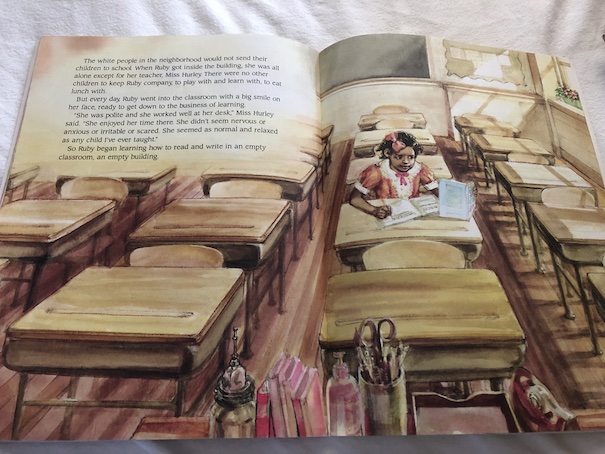
This is a beautifully illustrated picture book about Ruby Bridges, one of the first black children to attend a school that was formerly all-white during the desegregation of schools that took place during the Civil Rights Movement. The story is told in the form of the memories of Ruby and other people, looking back on their experiences, rather than as a first-person account.

When the book begins, it introduces Ruby as the child of a poor family who moved to the city after her father lost his job picking crops when farmers began using mechanical pickers instead. After her family moved to New Orleans in 1957, her father worked as a janitor, and her mother became a cleaner at a bank.

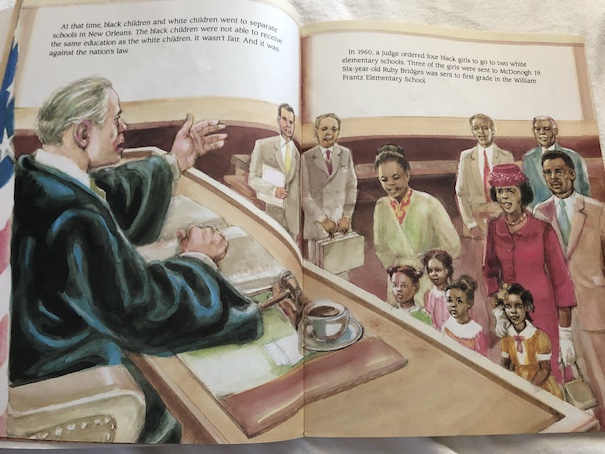
The book explains briefly that schools were segregated at the time, and that black children were not given an education that was equal to what was offered in white schools. Because the book is for children, it doesn’t go deep into detail about the Civil Rights Movement and desegregation or exactly how Ruby Bridges’s family became involved. (Ruby was selected as one of the children because she passed a test for academic aptitude, showing that she could keep up with a class of white children, who had better early education.) It simply says that, in 1960, a judge decided that four young black girls would be sent to schools that had been for just white children and that six-year-old Ruby Bridges was one of them.

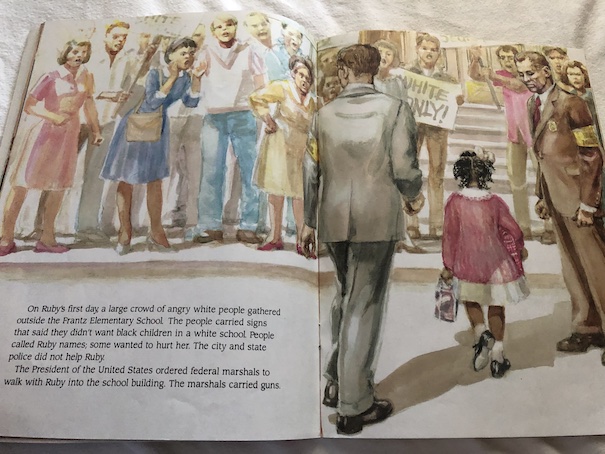
It was a harrowing experience for young Ruby. There were protesters outside the school, yelling angrily and threatening the little girl. For her safety, she had to be escorted by armed federal marshals.

Parents in the area refused to send their children to school so they wouldn’t be in the same classroom with a black child, so Ruby Bridges was literally in a class all by herself. Her teacher, Miss Hurley taught Ruby in an otherwise empty classroom. Miss Hurley was surprised at how Ruby was able to keep a good attitude in spite of the angry protestors and the lack of other children.

One day, Miss Hurley was looking out the window as Ruby approached the school, and she thought she saw Ruby saying something to the angry crowd before coming inside. When Miss Hurley asked Ruby what she said to them, Ruby said that she was talking to them; she was praying for them. Miss Hurley hadn’t realized it before, but Ruby had a ritual of praying for the people who were angry and hated her every day before school. This was just the first time that Miss Hurley had seen her doing it.

Ruby also said the same prayer after school. This prayer was part of what helped her get through those difficult days of hostility and loneliness.

The book ends by explaining that the parents soon began to send their children to school again and let them join Ruby’s class because they realized that life had to continue and that keeping their children from their education was hurting them. The angry protestors gradually gave up. Ruby continued going to school and eventually graduated from high school. She later married a building contractor and had four sons of her own. She founded the Ruby Bridges Educational Foundation to help parents become more involved with their children’s education and to promote equality in education.

The book is available to borrow and read for free online through Internet Archive (multiple copies).
My Reaction

I’ve heard the story before of Ruby Bridges praying for the people threatening her and protesting against her. This particular rendition is very good, although there is one thing that confuses me. According to this book, her teacher’s name is Miss Hurley, but I understood her name was Barbara Henry. I thought perhaps Hurley was her maiden name and that she later got married, but I haven’t been able to find anything to confirm that. I haven’t found anything to explain where the name Hurley came from at all. I’m not the only reviewer who questions the name confusion.

Ruby Bridges wrote books herself about her experiences, at different reading levels, and they’re also available on Internet Archive.

Ben’s Trumpet

Ben’s Trumpet by Rachel Isadora, 1979.

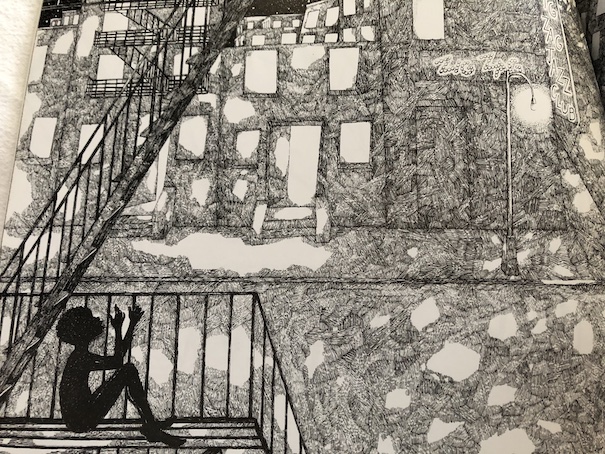
A boy named Ben likes to listen to the music coming from the nearby jazz club at night.

During the day, Ben stops by the club on his way home from school so he can watch the musicians practice.

Ben’s favorite instrument is the trumpet. Ben doesn’t have a trumpet himself, but he imagines that he does and that he can play for his family or play along with the musicians from the club.

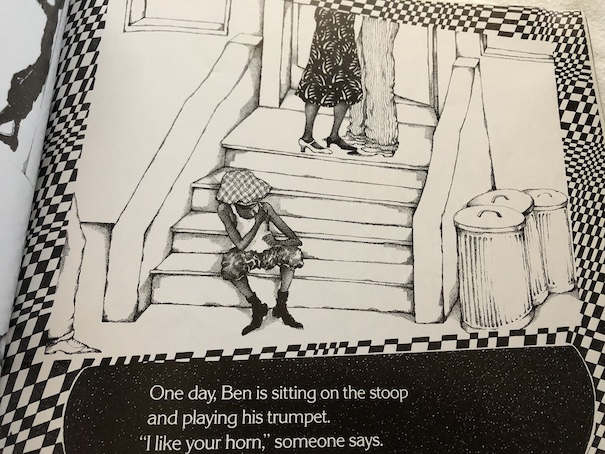
Some of the other kids in the neighborhood laugh at Ben for playing an imaginary trumpet, but the trumpeter from the club doesn’t laugh. When he sees Ben playing his imaginary horn, he compliments him.

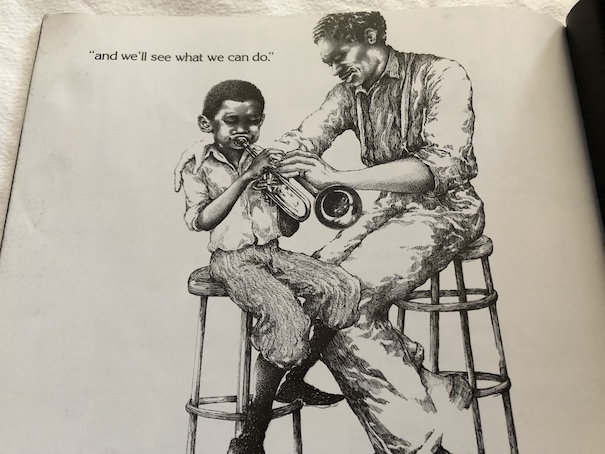
Later, when he sees Ben watching the club, the trumpeter invites Ben inside and lets him try his trumpet for real.

This book is a Caldecott Honor Book. It’s available to borrow and read for free online through Internet Archive (multiple copies).

My Reaction

I thought this was a nice story about an adult who understands a boy’s dream and is willing to take him under his wing. Both Ben and the trumpeter understand the love of music, and the trumpeter sees how badly Ben wants to be a real musician. We don’t know whether Ben eventually becomes a professional musician or not because the story ends with him trying a real trumpet for the first time, but the story implies that the trumpeter may become a mentor to Ben and that this might be the beginning of Ben realizing his dream.

The book doesn’t give a specific date for the story, but the illustrations and use of terms like “the cat’s meow” indicate that it takes place in the 1920s. The illustrations not only give the story its 1920s vibe, but the abstract lines included in the pictures help to convey the sounds of the music and echo the art deco style popular during the 1920s.

There are a couple of things in the pictures that adults should be aware of. There is one picture where Ben’s baby brother is completely naked, for some reason, and there are adults with cigarettes. Other than that, I can’t think of anything else about the book that would be a cause for concern. There is no specific location given for the story, but it takes place in a city, and all of the characters are African American.

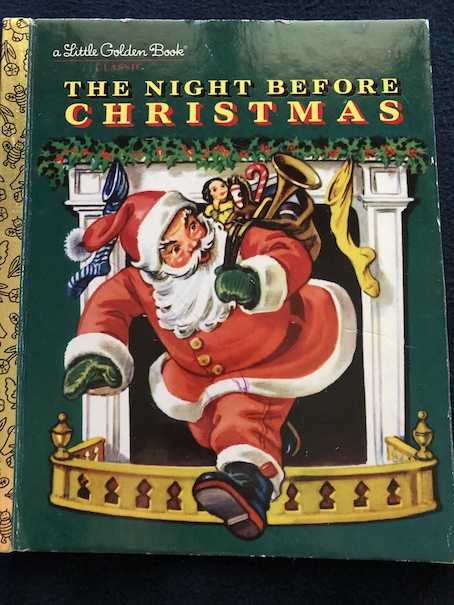
The Night Before Christmas

The Night Before Christmas by Clement C. Moore, illustrated by Corinne Malvern, 1949.

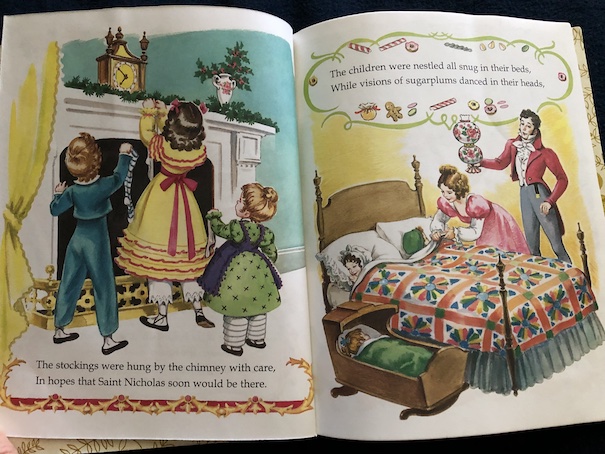
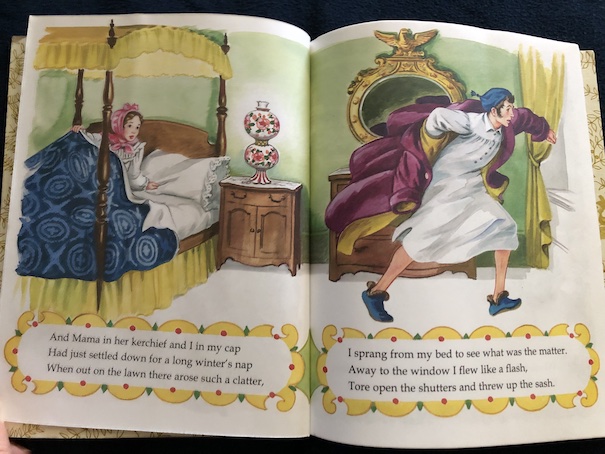
This version of The Night Before Christmas is part of the classic Little Golden Books series. The original poem, A Visit From St. Nicholas by Clement Clarke Moore, has been made into picture books for children many times since it was first published in 1823, but this version has some sentimental value to me. I think it was the first version that I ever read as a child. I had forgotten which version it was for years, but when I found this book again recently, I recognized the pictures. (It’s funny, but I remember thinking as a child that the youngest child looks a little too big to be in a cradle, but she is in the picture when the children are being put to bed.) Most people think of the poem as being called The Night Before Christmas instead of its original title, A Visit From St. Nicholas, because the phrase “the night before Christmas” appears in the first line of the poem. Many of the picture book versions that we read as children used The Night Before Christmas or ‘Twas the Night Before Christmas as a title.

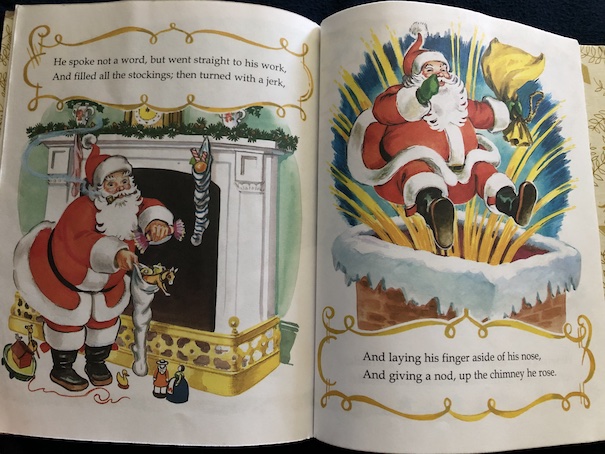
This Little Golden Book makes a cozy and pleasant bedtime story for Christmas Eve with its images of a 19th century/Victorian family hanging up their stockings and going to bed on Christmas Eve with the anticipation of the sweets, presents, and fun of the next day. Then, the father of the family is suddenly woken when he hears Santa Claus arriving.

This 19th century poem established and popularized the image of Santa Claus as generations of Americans came to know it. It describes him as a fat and jolly little old man and names all of the reindeer who pull his sleigh. This is probably the first piece of writing that established that Santa has eight reindeer and gave them specific names, which would later be echoed in the storybook and song versions of Rudolph the Red-Nosed Reindeer.

The father of the family in the poem happily watches Santa Claus leaving presents for his children and then leaving by the chimney and riding off in his sleigh with a cheery, “Happy Christmas to all and to all a good night!”

Various picture book versions of this poem are available online through Internet Archive, including this Little Golden Book version.

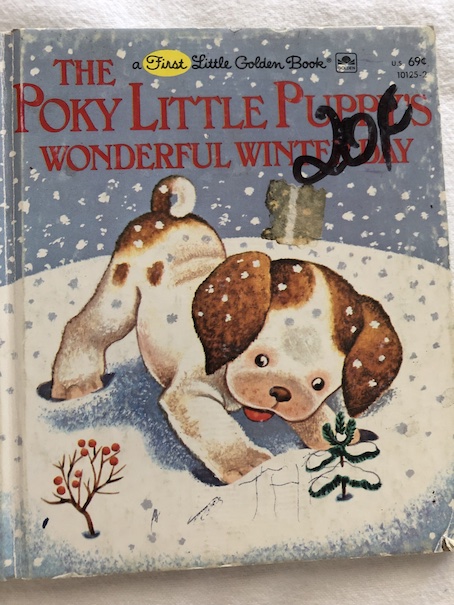
The Poky Little Puppy’s Wonderful Winter Day

The Poky Little Puppy’s Wonderful Winter Day by Jean Chandler, 1982.

This book is part of the Poky Little Puppy series of picture books from Little Golden Books.

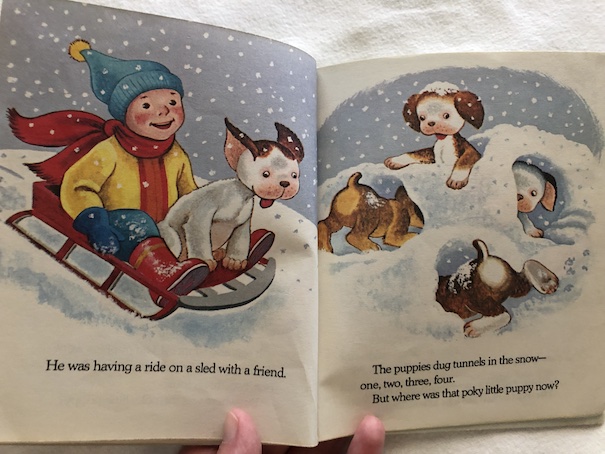
The Poky Little Puppy is the last to wake up on this snowy day, seeing his brothers and sisters rushing outside to play as he starts his breakfast. When he finishes his breakfast and goes outside, he doesn’t see the other puppies, but there are children playing in the snow.

The Poky Little Puppy follows the puppy paws through the snow and finds his siblings. The other puppies go sliding now a hill together, but the Poky Little Puppy gets a ride on a child’s sled.

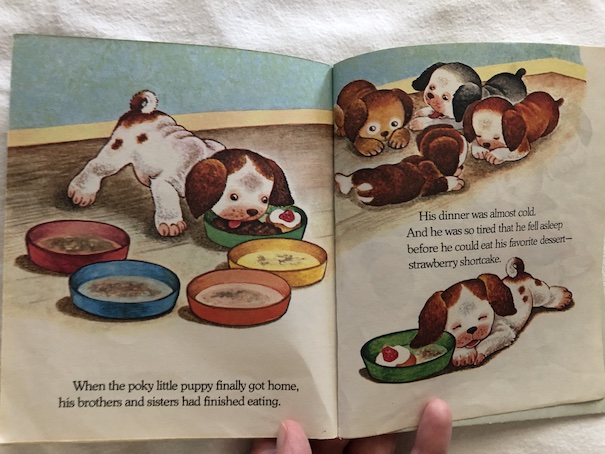
The Poky Little Puppy also tries to make a snow angel with a child and chases snowballs the children throw. He was the last puppy to start playing and the last to make it home to dinner because he is “poky” and arrives late to everything, but in the process, he had the most fun of everyone! (Although, he does fall asleep before eating his dessert.)

The book is available to borrow and read for free online through Internet Archive.

My Reaction

This is just a cute little story about the fun that a puppy has on a snowy day. I liked the message that the Poky Little Puppy has fun going through the day at his own pace and doing his own thing. Even though he isn’t always doing what his brothers and sisters are doing and sometimes trails behind them, he makes the most out of this fun, snowy day!

Native Americans

Native Americans by Jay Miller, 1993.

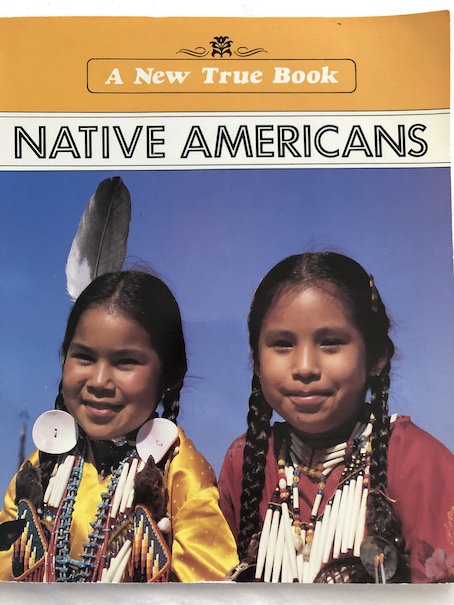
This book is part of the New True Books series, a series of nonfiction picture books on a variety of topics. This particular book gives an overview of the history and culture of Native Americans.

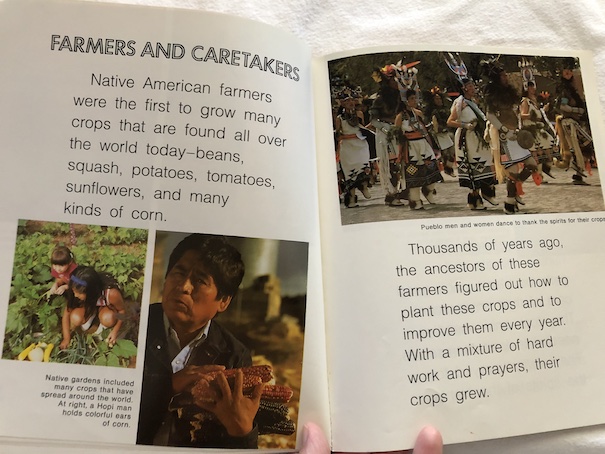
The book starts with some basic definitions and broad explanations of certain aspects of Native American culture, beginning with the explanation of why Native Americans are sometimes called “Indians.” The book notes that each tribe of Native Americans also has a name for itself. Each tribe has had its own culture, which it thought was better than other tribes’ cultures, but throughout history, tribes have interacted and traded with each other. One factor that made Native American cultures different from each other was whether tribes relied mainly on farming or hunting and gathering for food.

The book refers to hunter-gatherers as “caretakers”, a term that I can’t recall seeing before for hunter-gatherers. The reason why they use the term “caretakers” is they say that hunter-gatherers took care of their environments and only took the plants and animals they needed for survival, not wasting anything.

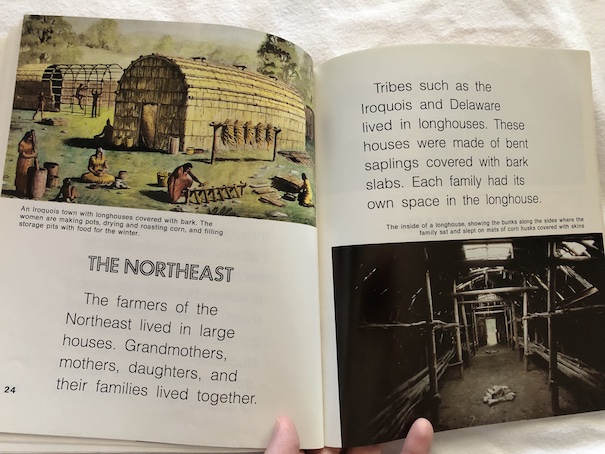
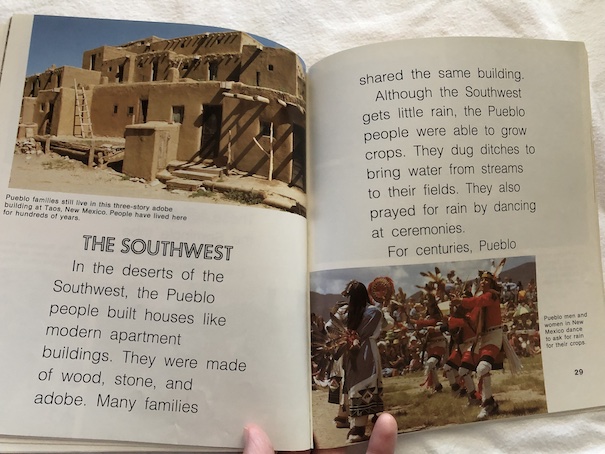
There are sections of the book that discuss some general aspects of Native American culture, like types of homes and tribal leaders. Of course, as the book notes, many cultural aspects varied, depending on the tribe, the environment where they lived, and whether they were mainly farmers or “caretakers.”

The book also has sections about the Native America tribes of various regions of North America, like the Northeast, the Southeast, the Southwest, the Northwest Coast, and the Plains.

The book ends with a brief section called Changes, which explains how Native American cultures were impacted by the arrival of Europeans in North America.

The book is available to borrow and read for free online through Internet Archive.

Happy Birthday, Little Witch

Happy Birthday, Little Witch by Deborah Hautzig, illustrated by Marc Brown, 1985.

This was one of my favorite Halloween books when I was a child, and so is the first book in the series, Little Witch’s Big Night. The first time I read these books, I read them out of order, but you really have to read the first book in order to understand Happy Birthday, Little Witch because it turns out that Little Witch still doesn’t understand the idea of trick-or-treating or that human children wear costumes on Halloween after meeting some children trick-or-treating on the previous Halloween. She really thinks that she met a small astronaut, pirate, and devil on Halloween, and that makes it difficult for her to find them when she wants to invite them to her birthday party.

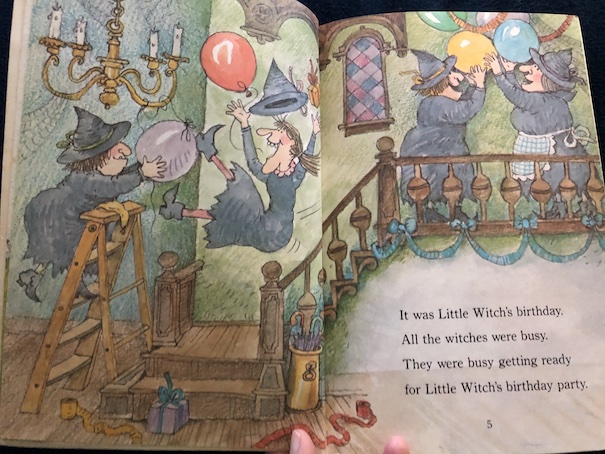
The witches in Little Witch’s family are decorating and preparing for Little Witch’s birthday party, but Little Witch is sad. Witches are generally bad and nasty, and Little Witch knows all the tricks her family will pull at her birthday party. Little Witch is nicer than the other witches, and she wishes that her party could be nicer, too. Then, she gets the idea of inviting the new friends she met on Halloween, who she only knows as Pirate, Astronaut, and Devil.

She doesn’t know her friends’ real names, so she tries to search for them in place where she thinks that a pirate, an astronaut, and a devil might hang out, taking her cat Bow-Wow and her pet bat Scrubby with her. She hitches a ride on a rocket ship, but her astronaut friend isn’t inside.

She checks out a pirate ship, but her pirate friend isn’t there, and the captain makes her walk the plank.

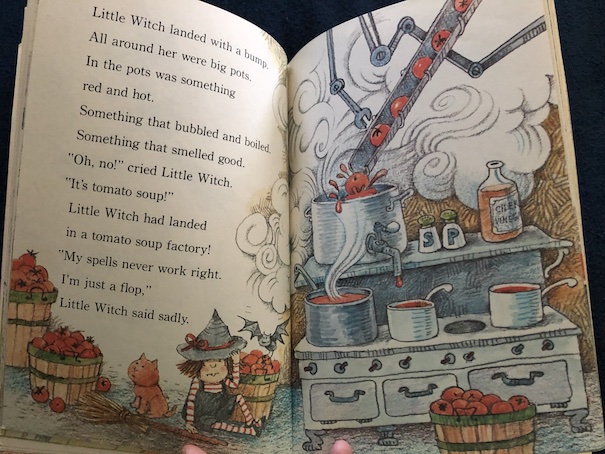
As for the devil, she thinks that she should try someplace that’s red and hot and ends up in a tomato soup factory (which I think is the funniest part if you’re reading this as an adult and you realize what kind of red, hot place she was really thinking of going to look for a devil).
However, the cook in the factory suggests to her that if she’s looking for her friends, they’re probably in school. At the school, Bow-Wow the cat gets frightened and runs away.

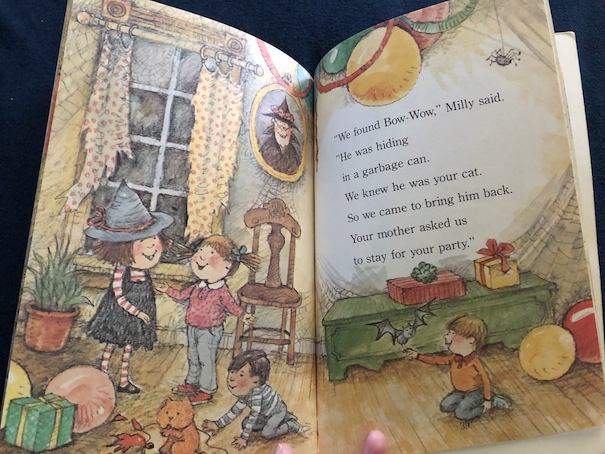
When Little Witch gets home, she finds out that her friends are ordinary children. They found her pet cat and brought it to her house, so her mother invited them to join the party. Her friends introduce themselves by name for the first time.

Little Witch’s party is nicer than it usually is, and she gets to play different games with her new friends. Little Witch’s mother says that she loves her, even though she is more good that most little witches.

Something that I didn’t mention in the review of the previous book is that both of these books were illustrated by Marc Brown, who created Arthur. The book is available to borrow for free online through Internet Archive.

Little Witch's Big Night

Little Witch’s Big Night by Deborah Hautzig, illustrated by Marc Brown, 1984.

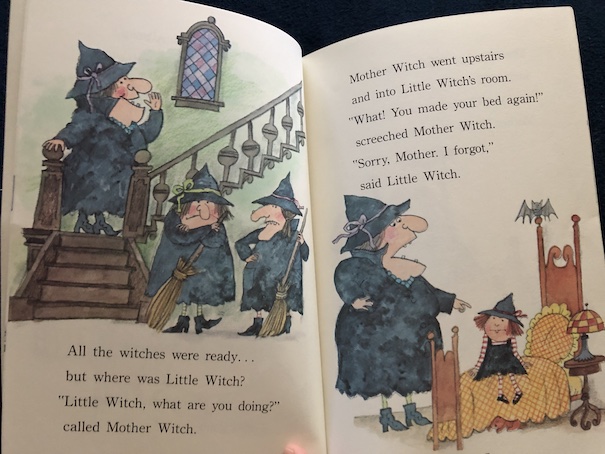
On Halloween night, all the witches in Little Witch’s family are busy getting ready for their big broomstick ride. However, when Mother Witch sees that Little Witch has cleaned her room and made her bed, something too nice for a witch to do, she punishes her by telling her that she will have to stay home.

Because Little Witch is left at home, she is there to answer the door for three trick-or-treaters dressed as an astronaut, a devil, and a pirate. Since she doesn’t have any treats to offer them, she offers to give them rides on her broomstick.

The trick-or-treaters have a great time as Little Witch has her broom do tricks and she shows the pirate a real pirate ship.

The trick-or-treaters have so much fun that they promise to come back next year. Little Witch resolves to be good all year so that her mother will punish her again and make her stay home from the Halloween flight, so she will be there to meet her new friends when they come back.

However, when the other witches come back, Mother Witch says that she missed Little Witch on the flight and that she will get to come on the flight next year. Little Witch asks if she can bring some friends with her, and Mother Witch says that will be fine, as long as Little Witch isn’t too good.

This was one of my favorite Halloween books when I was a child, and so is one of the other books in the series, Happy Birthday, Little Witch. The first time I read these books, I read them out of order, but you really have to read the books in order to understand Happy Birthday, Little Witch because it turns out that Little Witch still doesn’t understand the idea of trick-or-treating or that human children wear costumes on Halloween. She really thinks that she met a small astronaut, pirate, and devil on Halloween, and that makes it difficult for her to find them when she wants to invite them to her birthday party. The Little Witch in this series isn’t the same as the Little Witch in the Little Witch Craft Books.

The book is available to borrow for free online through Internet Archive.