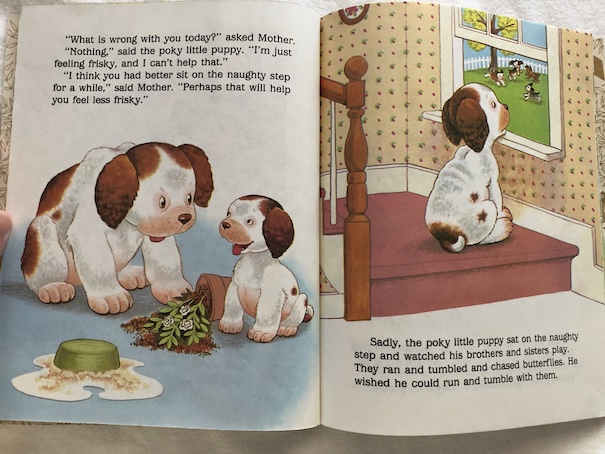
The Poky Little Puppy and his siblings are excited because they’re going to visit their grandmother. The Poky Little Puppy wakes up later than his siblings, and when he gets up, he feels playful and frisky. He keeps running around and knocking things over. He makes such a mess that his mother puts him in time out to calm down.
After while, his mother lets him go outside to play with his siblings, but she warns him not to get dirty because they’re going to visit his grandmother. However, the Poky Little Puppy doesn’t listen. Instead, he digs a hole under the fence and ends up in the neighbor’s yard, where he plays with some laundry and drags it through the mud, getting himself and the laundry all dirty.
As his mother and the other puppies start walking to their grandmother’s house, the mother sends the Poky Little Puppy back to apologize to the neighbor. Instead, the Poky Little Puppy gets into more trouble by chasing a butterfly through another neighbor’s flower bed. When he finally makes it to his grandmother’s house, he’s wet and muddy and leaves tracks all over his grandmother’s floor.
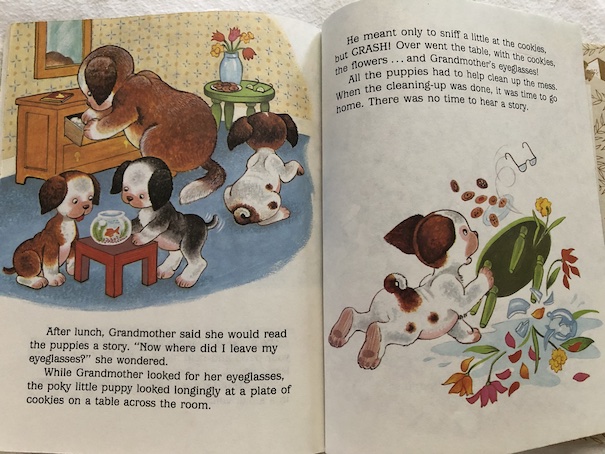
His grandmother makes him help her clean up, but even that doesn’t calm him down. Grandmother wants to read a story to the puppies, but the Poky Little Puppy is still too energetic. He knocks over a table and makes another big mess. By the time they get it all cleaned up, there’s no time for a story, and they all have to go home.
Finally, the Poky Little Puppy seems to have exhausted himself and is feeling badly about the trouble he’s caused today. When the puppies have their dinner and dessert, he is extra careful and doesn’t even drop a crumb. He later apologizes to the neighbors and promises to do better.
The book is available to borrow and read for free online through Internet Archive.
My Reaction
This is just a cute little story about the problems that young kids can get into when they’re feeling energetic and playful but are also acting thoughtlessly and going too far. Just being playful by itself isn’t a problem, but the Poky Little Puppy has to learn some self-control about how he plays, just like human children.
The puppies’ mother allows them to go exploring a little outside of their own yard, but she warns them to stay away from the highway because the cars are dangerous and reminds them to be home in time for dinner. She also adds that if they get lost, they should rely on their sense of smell to get home.
As the puppies explore, they meet other animals in the countryside and stop to play. Eventually, they find themselves on the edge of the city. They are frightened of the noise of the cars, and a pigeon tells them that they’d better stay away from the city if they want to avoid cars.
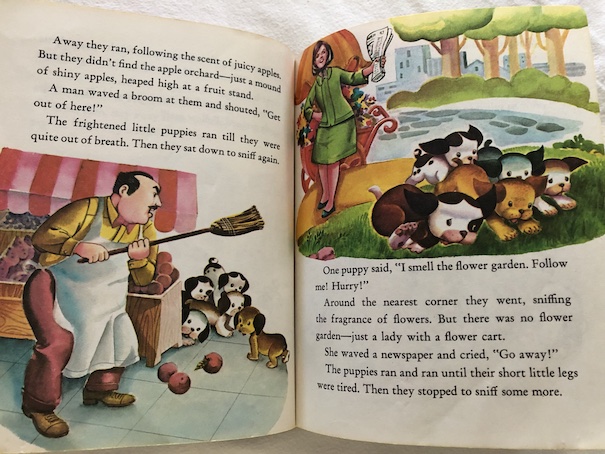
The puppies realize that they need to turn around and go home, but when they try to sniff for familiar smells to go home, they have trouble. When they try to smell the apple orchard, they accidentally find a stand where a man is ffselling apples instead. Trying to smell flowers leads them to a flower cart. Trying to sniff for animals smells leads them to the zoo.
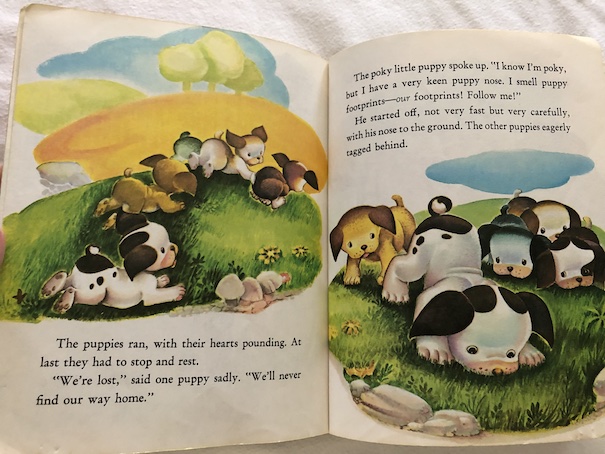
Then, the Poky Little Puppy realizes that what they really need to do is sniff for their own smell so they can retrace their steps home. Sniffing for their own trail works, and the puppies get home in time for dinner!
My Reaction
Like other Poky Little Puppy books, the story is cute. Nothing very stressful happens in the story, making it a good story for bedtime. Even though the puppies get lost temporarily, it isn’t for very long, and they get home in time for dinner, as they do in other Poky Little Puppy books.
The Poky Little Puppy by Janette Sebring Lowrey, illustrated by Gustaf Tenggren, 1942, 1982.
This is a famous class children’s book, the first in a series from the Little Golden Books collection! In fact, it was one of the original first 12 Little Golden Books that were published in 1942.
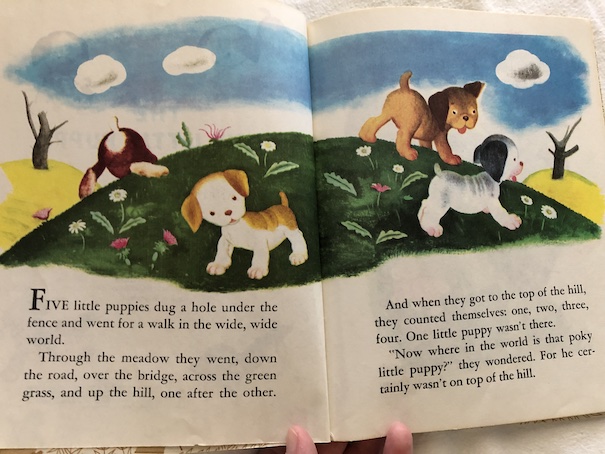
Five little puppies like to dig holes under the fence and go exploring. Then, four of the puppies realize that one of their brothers isn’t with them. They look around and find him sniffing at the ground. When they ask him what he’s doing, he says that he smells something.
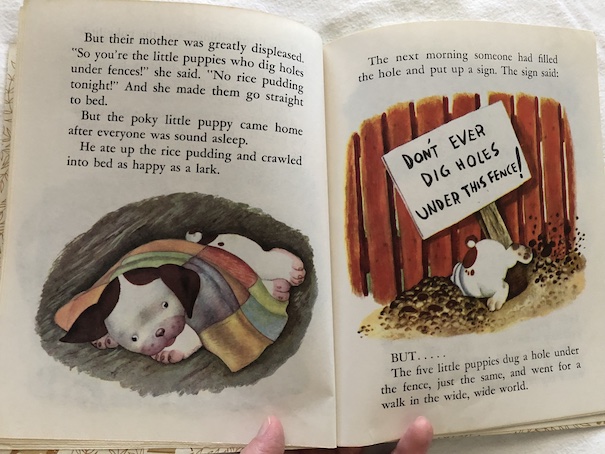
The puppies realize that the smell is rice pudding, and they hurry home to get some. However, their mother is angry about the holes they dug and sends them to bed without dessert.
The puppy who originally smelled the rice pudding is slower than the others (or “poky” as the book describes him, which is why he’s called the Poky Little Puppy). He comes home later than the others, and while everyone is asleep, he eats all the rice pudding himself.
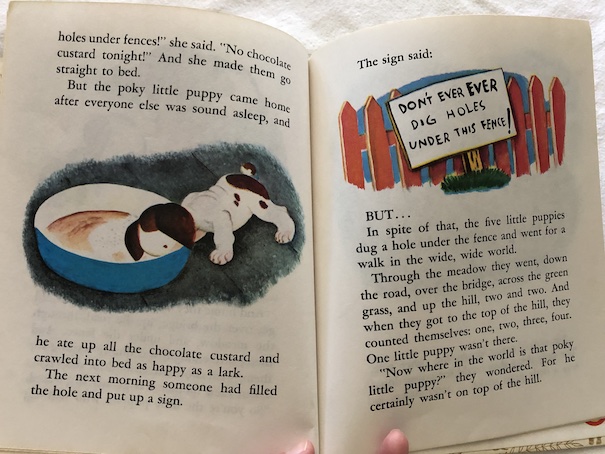
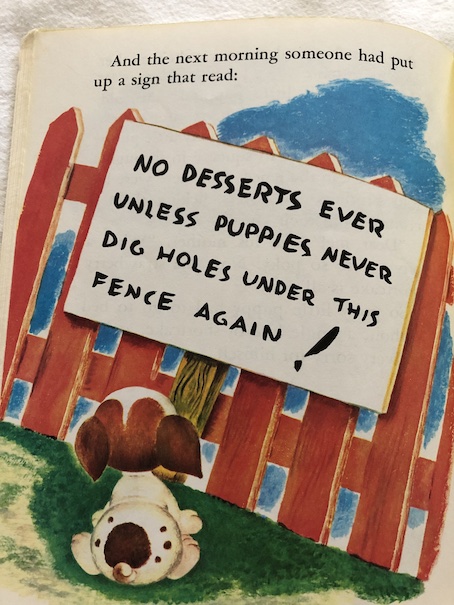
The next day, their mother puts up a sign telling them not to dig holes under the fence, but the puppies ignore it and dig holes anyway so they can go exploring. While they’re out, the Poky Little Puppy hears something.
The other puppies realize that it’s the sound of chocolate custard being dished up, and they hurry home to get some. Again, they’re punished for digging holes, and they’re sent to bed without dessert. And again, the Poky Little Puppy comes home last and eats all the dessert while everyone is in bed.
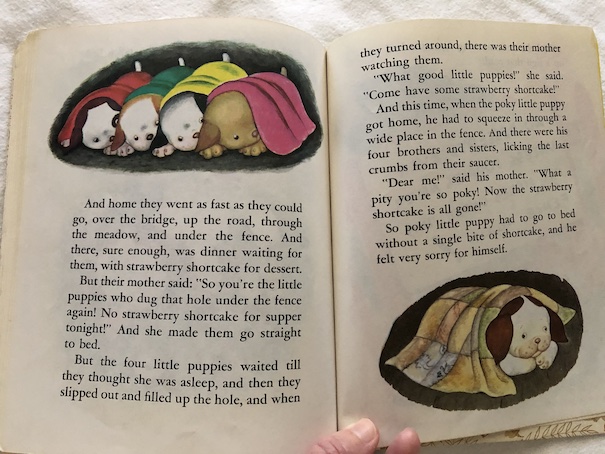
The next day, the puppies dig holes again, but this time, when they hurry home for dessert and their mother is mad at them, the four puppies who got home quickly fill in the holes they dug. Their mother, seeing that they fixed the holes, decides to let them have their dessert. The Poky Little Puppy, who came home late again, doesn’t get any because the others ate his share, too.
The book is available to borrow and read for free online through Internet Archive (multiple copies).
My Reaction
This is a very simple story, but I remember liking it as a kid. Kids like stories with repetition, so the repeated incidents in the book appeal to them. The Poky Little Puppy thinks that he’s found a trick to getting all the dessert by staying out late enough that his mother has gone to bed and can’t tell him to go to bed without dessert. But, his trick stops working when the other puppies clean up their act and get the dessert before he even gets there. In the end, all of the puppies learn that digging holes means no dessert for any of them anymore.
A little boy named Matt goes to visit his grandfather on his farm. They notice a storm approaching, and Matt worries about where the animals will go when the storm comes. His grandfather tells him that the animals all know where to go.
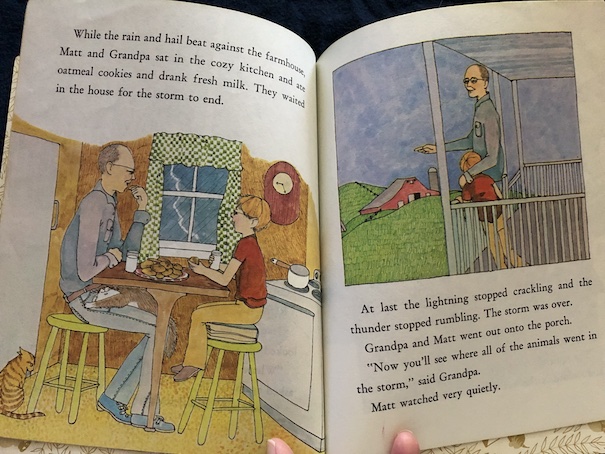
The animals also notice the approaching storm. When the rain comes, Matt and his grandfather go inside the house with the cats. After the storm is over, Matt’s grandfather takes him outside to show him where all the animals went during the storm.
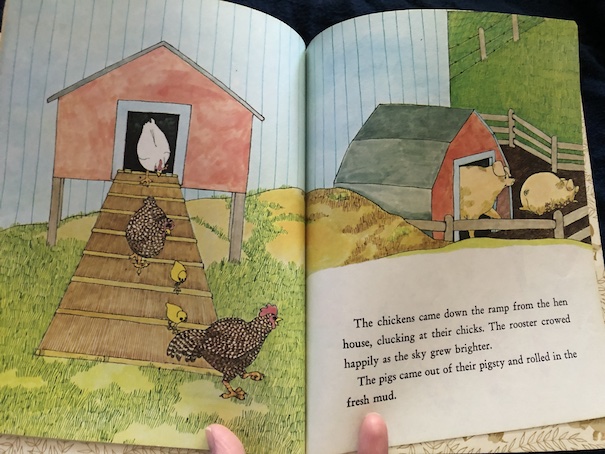
Matt watches as all of the animals, both the domesticated animals of the farm and the wild animals who also live there, emerge from their hiding places. Every animal has a place to go, and they’re all fine after the storm.
The book is available to borrow and read for free online through Internet Archive.
My Reaction
I like this story because it’s very calm. I think it could make a good bedtime story for young children. Although the boy in the story is concerned about the animals and where they will go during the storm, the animals are never in any danger. The grandfather knows that the animals will all be fine, and he reassures his grandson that they all have a place to go. It’s reassuring that the storm is natural, the animals know what to do when it happens, and the boy sees that everything is fine. The story ends with the boy and his grandfather watching the sun come out after the storm.
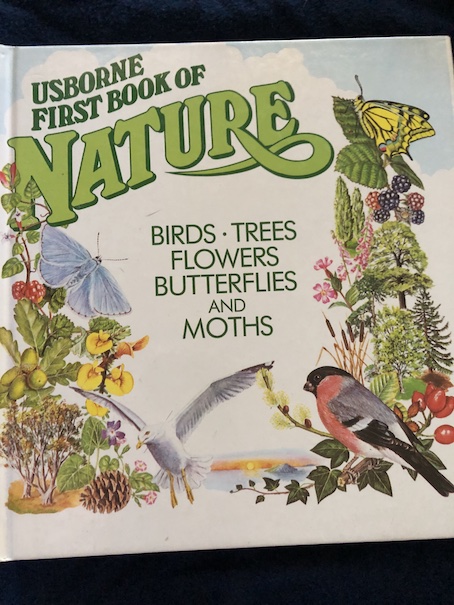
Usborne First Book of Nature designed by David Bennett, 1980.
I remember getting this book as a present from my grandmother as a child because my grandmother was an amateur naturalist. Although it’s a nonfiction book, I’m sentimental about it for that reason.
The book is divided into four sections covering different types of plants and creatures (each of which has its own book in the Usborne collection, but this book is a compilation):
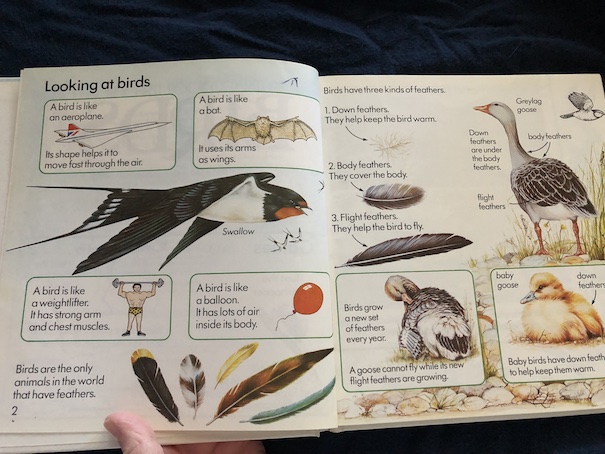
Birds
This chapter explains about the parts of birds, like the different shapes of beaks and feet different birds have, aspects of birds lives and behavior, and how birds fly.
Trees
This chapter explains the parts of trees, like how roots and twigs grow and the differences between different types of leaves, tree flowers, and seeds.
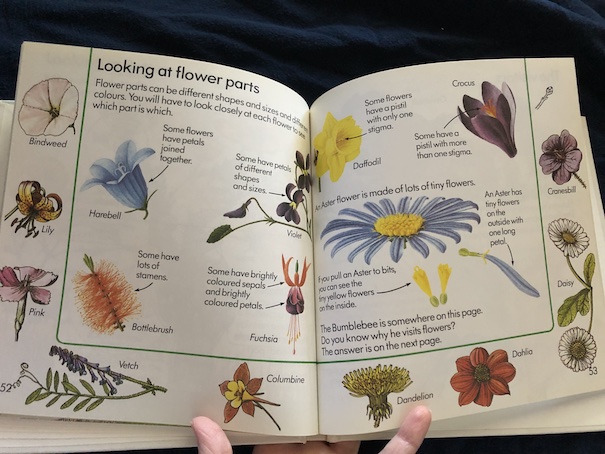
Flowers
This chapter explains the parts of flowers and about pollen and seeds. It also points out the creatures that like to visit flowers, like bees and hummingbirds.
Butterflies and Moths
This chapter explains the similarities and differences between butterflies and moths and what their life cycles are like.
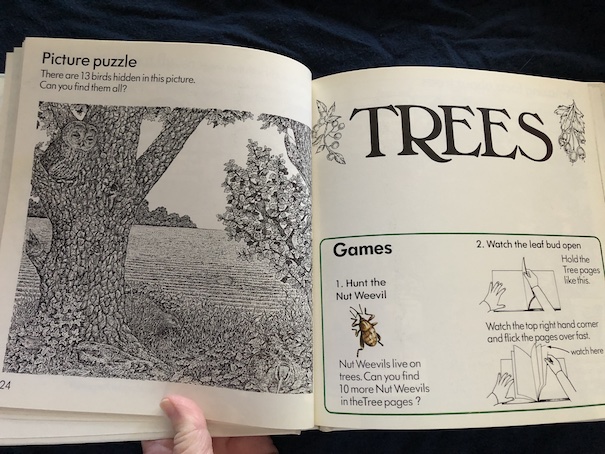
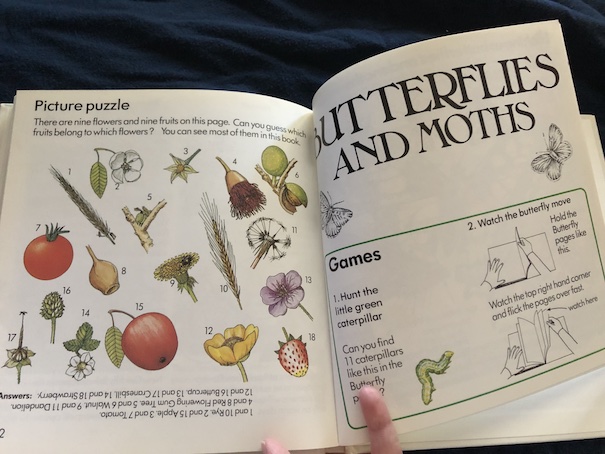
One of the best parts of this book is that it is designed to be interactive as well as informative. Some of the activities are explained at the beginning of each chapter, and there’s a puzzle or game at the end of each chapter. The upper right corners of each chapter have images that are meant to be used as a flip book. In the bird section, readers can quickly flip the pages to watch a bird fly. In the tree section, a leaf bud opens. In the flower section, a flower opens. In the butterfly and moth section, a butterfly opens and closes its wings.
Each chapter also has a game where you hunt for different creatures within the pages of that chapter and see how many you can find, and then, there’s another game or puzzle at the end. At the end of the bird chapter, there’s a picture puzzle where you have to find all the birds hidden in a black-and-white picture. At the end of the tree section, you have to find how many products are made from or come from trees in a busy market scene. At the end of the flower chapter, you have to match up different types of fruits with their flowers. The butterfly and moth section doesn’t have a game at the end.
This book is available to borrow and read for free online through Internet Archive.
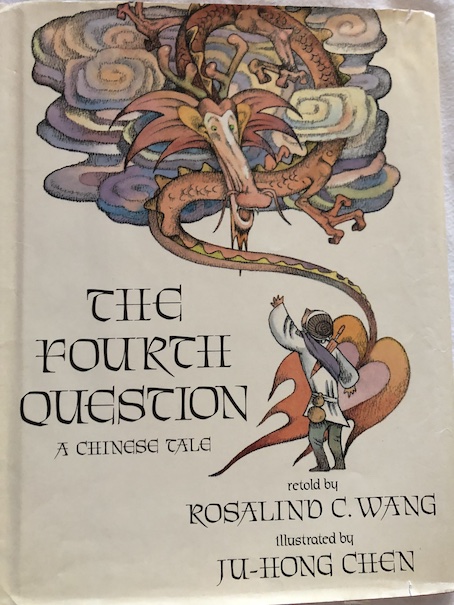
The Fourth Question retold by Rosalind C. Wang, illustrated by Ju-Hong Chen, 1991.
This is a retelling of a Chinese folktale.
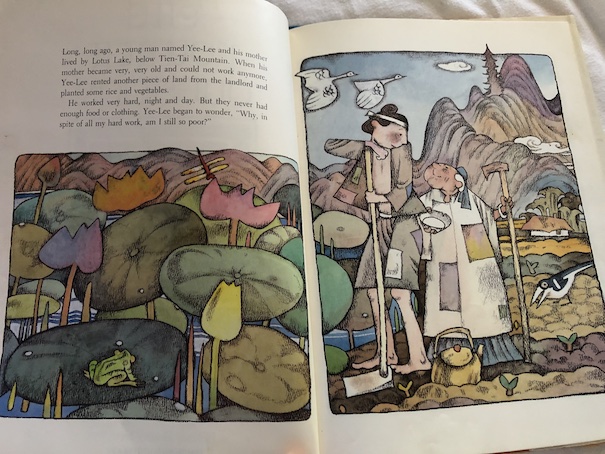
There was once a poor young man, Yee-Lee who lived with his mother. Even though Yee-Lee works very hard, he can barely make enough money to keep him and his mother alive. He wonders why he has so little money even though he works so hard and decides to go to the Wise Man of Kun-lun Mountain to seek the answer and his advice so he and his mother can have a better life.
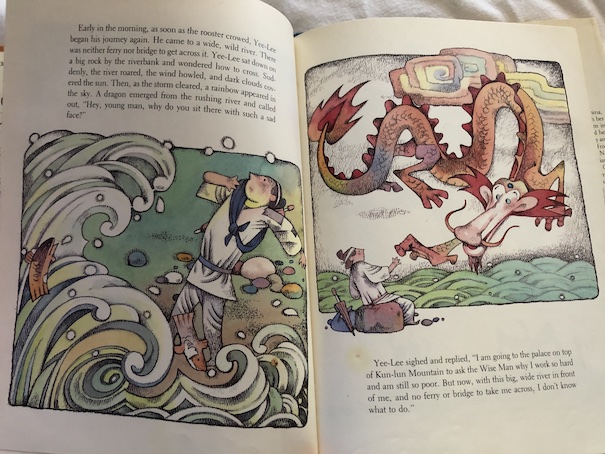
It’s a long way to reach the Wise Men, and along the way, he encounters other people who also needed help. A kind old woman who gives Yee-Lee some water and food has a daughter who is unable to speak and wants to know how to help her. An old man has a tree in his orchard that won’t bear fruit, and he can’t figure out why. A dragon who helps Yee-Lee to reach the mountain cannot manage to fly to heaven even though he has lived a good life. Yee-Lee has sympathy for all of these people and the dragon and appreciates the help they give him, so he promises that when he reaches the Wise Man, he will seek the answers to their problems as well.
However, when Yee-Lee finally reaches the Wise Man, he is told that he is only allowed to ask three questions during his visit. It’s a problem because Yee-Lee now has four questions to ask, the three that he promised to ask for others plus the original question that he wanted to ask for himself. He has to decide which of the questions will go unanswered.
Yee-Lee’s question is important to him, but when he thinks about the other people who are now depending on him to come back with answers for him, he reluctantly decides to forget his own question and answer theirs. However, in solving the problems of others, Yee-Lee finds the solution to his own problem. Like the heroes of other folktales, Yee-Lee is rewarded for his good deeds!
The book is available to borrow and read for free online through Internet Archive.
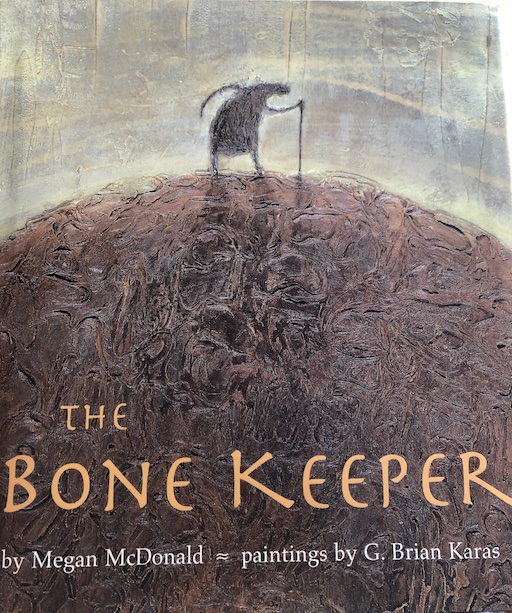
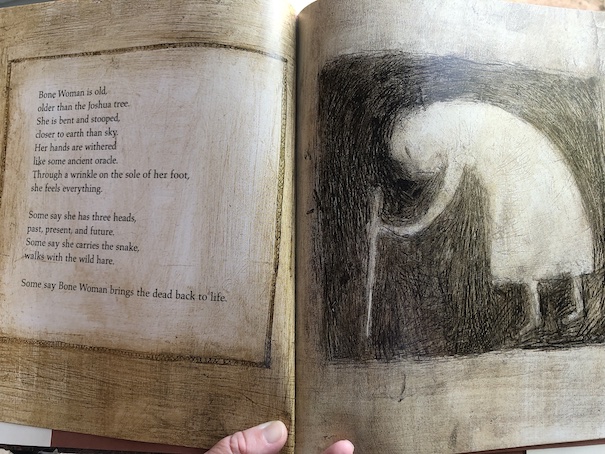
The Bone Keeper by Megan McDonald, paintings by G. Brian Karas, 1999.
The story in this picture book is written as an unrhymed poem and illustrated with paintings that resemble paintings on a cave wall.
Bone Woman is a strange old woman. She is ancient, legendary, may have powers to bring back the dead, and lives in a cave full of bones.
She spends her time searching for bones in the desert sand. She collects the bones, studies them, and arranges them to form complete skeletons.
When she manages to complete a skeleton, she performs a ritual to bring the creature back to life!
The book is available to borrow and read for free online through Internet Archive.
My Reaction
This is one of those picture books that I think would actually be appreciated more by adults than by children. The poetry and art style seem more sophisticated than the styles that children seem to prefer. Most of the pictures are not very colorful, using a lot of grays and browns and black, although the art style is unusual and fascinating, looking like paintings and drawings scratched into rock.
I think kids could understand the action of the story – a strange old woman who lives in a cave collects bones, assembles them into skeletons, and can use them to bring animals back to life. It’s a strange story, partly because there is no explanation about why she is doing this.
One of my regrets about this book is that it doesn’t explain the background of this story. I had expected that there would be a section at the back of the book that would explain more, but there isn’t. From the context – the pictures, the style of the story, the names that the woman is called, and the fact that the artist thanked the Phoenix Public Library and the Heard Museum (both places that are familiar to me) in the dedication – adults can figure out that this is a story from folklore, but it’s not immediately clear what kind of folklore. Anyone who doesn’t already know the story might be confused. I didn’t know this story when I read the book, so I had to look it up.
The story of the Bone Woman has been told and referenced in other books. The story of La Huesera (the Bone Woman) is a Mexican folktale. Sometimes, it’s also called La Loba (the Wolf Woman) because that is the animal that she particularly wants to resurrect. The Bone Woman is a “wild woman” or a “crone” who uses a kind of natural magic to bring life to lifelessness and restoring what was lost.
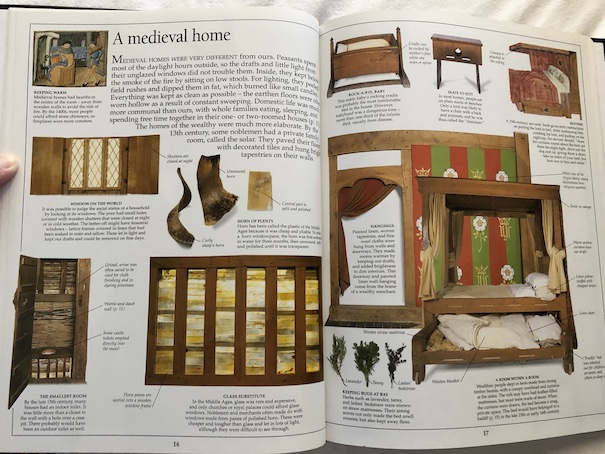
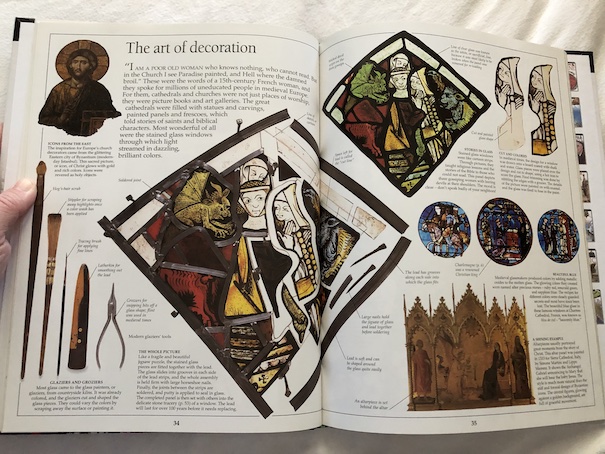
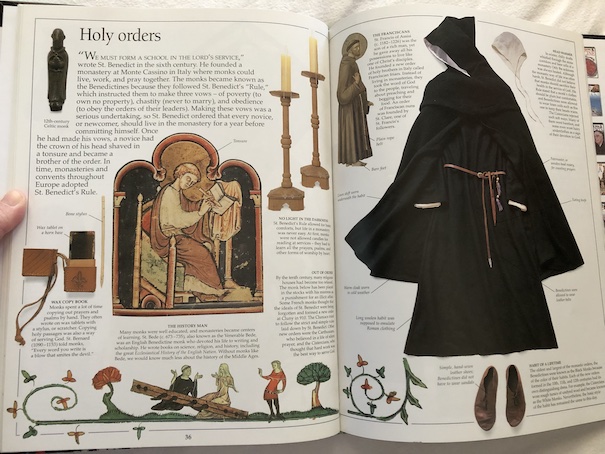
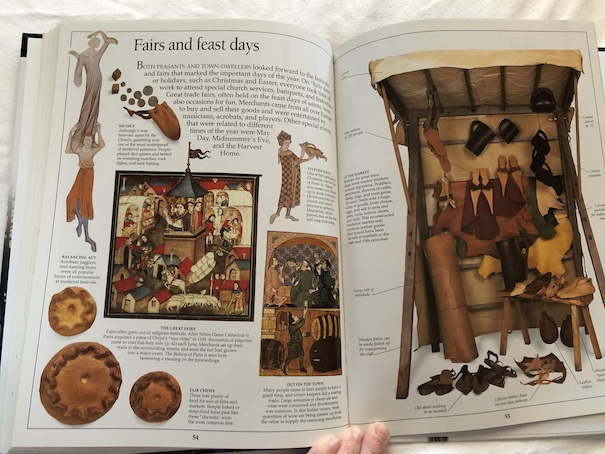
Medieval Life by Andrew Langley, photographed by Geoff Brightling and Geoff Dann, 1988, 2004.
I love books that explain the details of daily life in the past, and I especially like Eyewitness books because they include such great photographs to show objects that people would have used in the past.
This book begins by explaining the time period of the “Middle Ages”, which was the period between Ancient Greece and Rome and the Renaissance, when culture and knowledge from Ancient Greece and Rome came back into vogue. The Middle Ages lasted about 1000 years, roughly from 400 to about 1540 AD. (Estimates of the start and end dates vary because this was a period defined by cultural changes, which are gradual and don’t have precise start and end dates.) This long period of time can also be divided into smaller periods and contained many important events that helped to shape society and culture, including The Crusades and The Great Plague.
Medieval society was hierarchical and was based on land ownership. The king and the highest nobles controlled the land and allowed people in lower levels of society to use it or grant farming rights to peasants in exchange for rent in the form of their services and a share of what they produced. The peasants or serfs were tied to the land they farmed, and the land was owned by the lords they served. They were not regarded as “free” people, and they couldn’t leave their lord or the land except by raising enough money to buy some land for themselves or by marrying a free person from a higher level of society.
A lord’s manor included not only his manor house or castle but the nearby village, church, and the farmland where his serfs worked. Often, villages and manors had little contact with the outside world, so the people who lived there had to make most of what they needed themselves. Most people never left their land or were only able to travel a short distance from it, so the only new people they might meet would be traveling peddlers, soldiers, or pilgrims.
The book explains what would be found in a typical Medieval home. Poor people lived in houses that had only one or two rooms for the entire family. Few people could afford to buy glass windows. Poor people only had wooden shutters to cover their windows. Others might have tallow-coated linen over a lattice frame, which would let in light, and some wealthier people had pieces of polished horn in their windows, which also let in light, although you couldn’t really see through them well. What people ate varied depending on their social status. Wealthier people could afford a wider variety of foods, and poor people mostly ate what they produced themselves.
Women’s lives also varied depending on their social status. Pleasant women farmed and provided for their families alongside their husbands. Women in families of craftsmen and tradesmen often worked alongside the men in the family business. Wealthy women managed their husbands’ households or could rise to rank of influential abbess if they joined religious orders. However, the highest ranks in society were occupied by men.
While peasants served their lords, lords also owed services to higher nobles and, ultimately, to the king, although sometimes the king struggled to control powerful nobles and assert his authority over them. The king generally had to keep his nobles satisfied with his rule if he wanted to retain their loyalty because, while he was the source of their land and authority, they were effectively ruling over their own smaller lands with their own troops. While nobles owed their king military service and support, if they were dissatisfied with the state of their lands or were just unoccupied with other battles to fight and saw an opportunity, they would sometimes use their troops to raid the lands of neighboring nobles. Part of the king’s job involved preventing his nobles from being dangers to him and to each other. The king also made and enforced laws, settled disputes, and oversaw the collection of taxes.
Christianity, specifically in the form of Catholicism, was central to the lives of people in the Middle Ages. During this time, stonemasons and craftsmen developed new techniques for building impressive cathedrals that still stand today. These cathedrals were lavishly decorated with statues, frescoes, and stained glass windows that depicted Biblical stories and the lives of saints. These works of art were important for helping to teach people who did not have the ability to read the Bible themselves about their religion.
Religious orders of monks and nuns performed important functions for society, such as caring for people who were poor or sick, providing safe places for travelers to stay, and copying written texts by hand. In the centuries before the printing press was invented, there were only handwritten books, and they took time and skill to produce. It could take an entire year for someone to copy an entire Bible. Few people were able to own personal books, and much of the schooling in this period was provided by religious orders.
The book describes the rise of Islam during the early Middle Ages, increases in trade and commerce, the growth of towns, and guilds that controlled different professions. It also describes Medieval music and entertainment, such as plays and parades. One of my favorite parts of the book is about fairs and feast days.
The book ends by describing the beginning of the Renaissance and the rediscovery of classical Greek and Roman culture as well as the beginning of the Reformation and the development of new scientific discoveries and artistic styles.
The book is available to borrow and read for free online through Internet Archive (multiple copies).
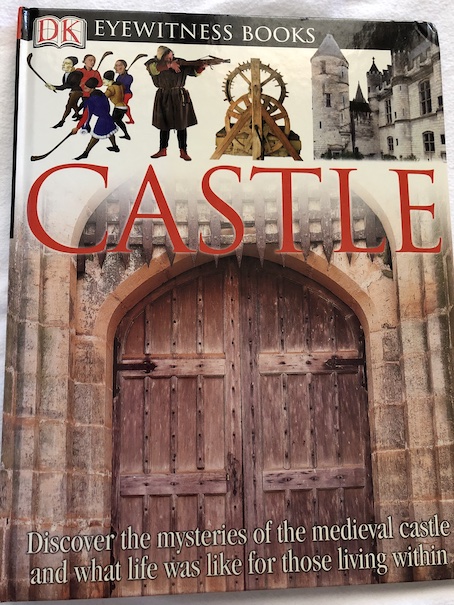
Castle by Christopher Gravett, photographed by Geoff Dann, 1994, 2004.
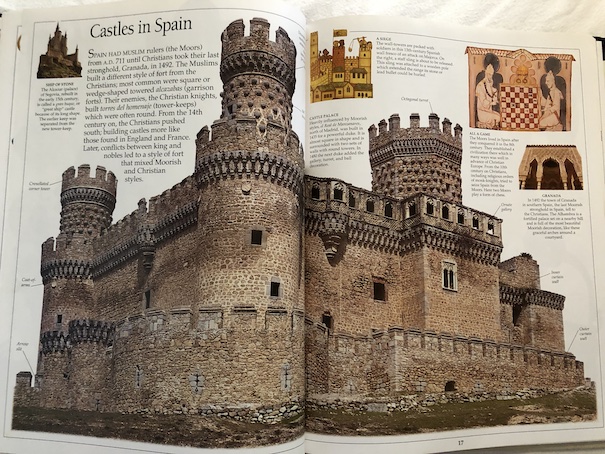
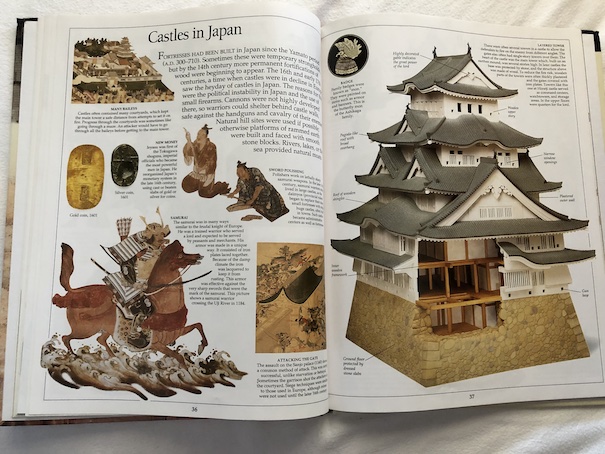
Eyewitness books are always great for the photographs that they use to illustrate the concepts in the book!
This book is all about Medieval castles. It starts by explaining the evolution of castle-building from early wooden motte-and-bailey castles to the great stone castles that we often think of as being the classic Medieval castle. However, stone castles could come in different shapes and styles, depending on where they were located.
The book shows examples of castles in different countries. Most of the focus of the book is on castles in European countries, including Spain, Germany, and France. However, the book also includes information about castles in Japan.
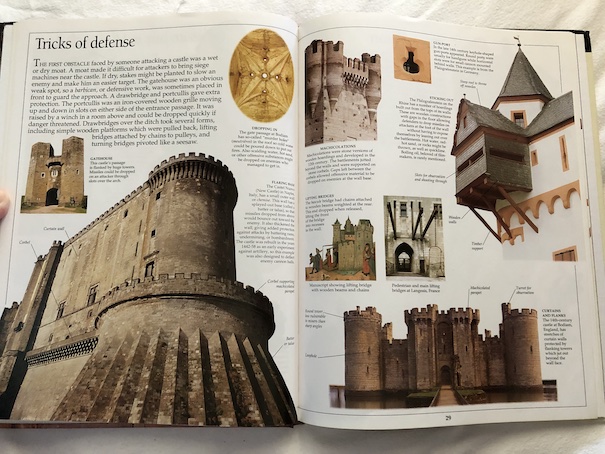
Castles were built for defense, and the book explains the types of defenses that castles would have, such as gatehouses, murder holes, lifting bridges, battlements with corbels and machicolations, and loopholes. It also explains what a siege was like, what types of weapons would have been used, and what knights and soldiers were like.
The parts of the book that I liked best were the parts that described the rooms in a castle and the daily lives of the people in a castle. Among the rooms in a castles were the great hall, kitchen, and chapel. I like how they show the objects that would be found in different rooms and how they would be used.
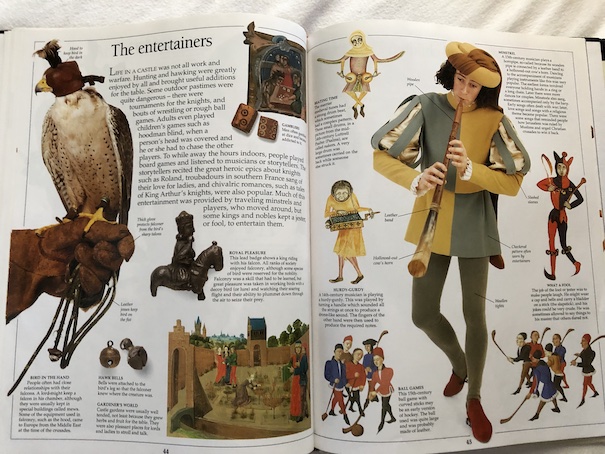
The book explains the lives of the lord of the castle and women and children who lived there. There is information about the types of foods they would eat in a Medieval castle and the types of games and entertainment they would have enjoyed.
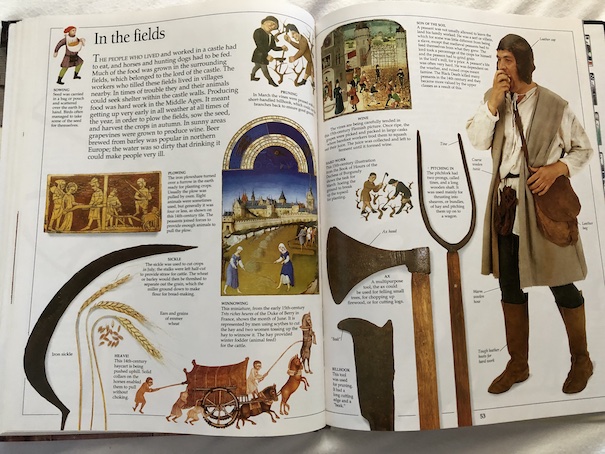
There is also information about other workers in and around the castle, including the castle builders and people who tended the castle’s animals and worked in the agricultural fields around the castle, producing food and textiles for the population.
There are sections in the back of the book with additional facts and information about castles and the people who lived in them and a glossary.
The book is available to borrow and read for free online through Internet Archive (multiple copies).
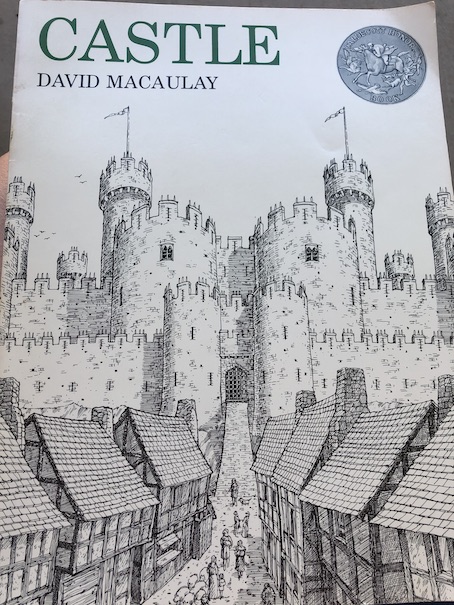
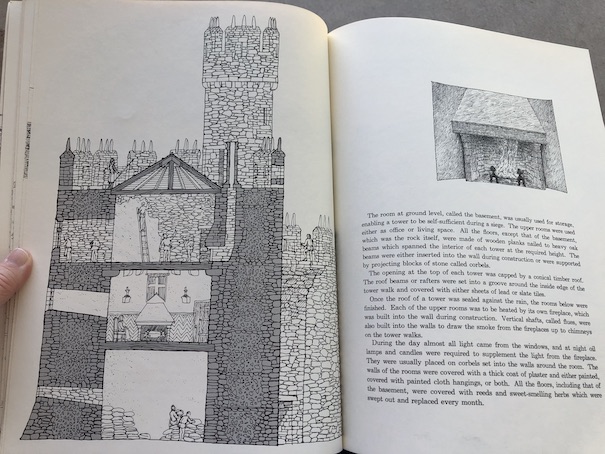
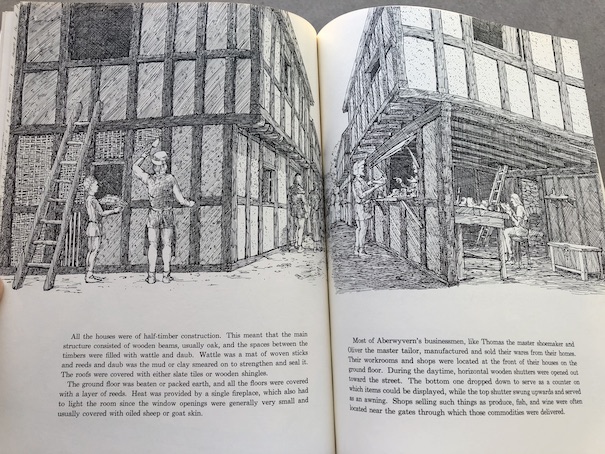
Castle is one of David Macaulay’s books about historical architecture, and like his earlier book, Cathedral, it has detailed and realistic drawings to explain each step in the building process.
The castle in the story is fictional, but it’s based on real castles built by English lords during the conquest of Wales, circa 1277 to 1305. The process for constructing the castle and the military strategy behind it are historically accurate. The English, under King Edward I, used a strategy of establishing permanent towns and castles in Wales to dominate the Welsh. The construction of these castles and their accompanying towns took years, but it was part of a long-term political and military strategy that actually aimed at avoiding direct armed conflict. The purpose of the castles and towns was not only to support the occupying English forces and settlers, but also to provide economic centers that the Welsh would also find beneficial. The idea was that the Welsh, while initially opposed to the interlopers, would eventually come to rely on the presence of the new towns for business and trade and not want to force the newcomers out. This strategy is in keeping with the nature of castles themselves because they are defensive structures, designed for holding off attackers in order to maintain territorial control, shielding the people within the castle so they cannot be forced out. The fictional castle in the story is built with a fictional town called Aberwyvern and belongs to a fictional nobleman, Lord Kevin.
The beginning of the book explains the military strategy of Edward I and how he appointed noblemen to build castles in Wales. When choosing the site for a castle, they would take into account the natural landscape and its defensive capabilities. For example, Lord Kevin’s castle will be built on a high outcrop on the edge of a river. The high ground and the surrounding water will make the castle harder to attack.
The book shows a plan of the castle that will be built and explains the different craftsmen who will be working on the construction, along with the tools they will use. The book then describes the various stages of construction, beginning with the preparation of the site and the digging of a moat that will separate the section of rocky outcropping where the castle will be built from the land around it, where the town will be located. The moat is important because it provides an extra defensive feature.
My favorite parts explain the living quarters of the castle. People think that castles must have been uncomfortable with bare stone walls, but actually, the walls are only bare in ruined castles that were exposed to the elements over time. When a castle was inhabited, the walls were covered with plaster. The plaster would be painted and/or hung with tapestries for decoration. Reeds and nice-smelling plants would cover the floors as a kind of carpeting, and the plants would be swept out and replaced regularly.
The castle and town take years to finish, and the pictures show how they look at each stage of construction, both in aerial view and up close.
Toward the end of the book, King Edward visits the castle and warns Lord Kevin that there have been some Welsh uprisings. Lord Kevin and his people make sure that they have enough food and supplies to last through a siege, and the following year, the castle’s defenses are put to the test when they do have to withstand a siege.
Eventually, the Welsh attackers are forced to retreat when they are unable to take the castle and they receive word that more English forces are coming.
Over time, the community includes people of Welsh and English descent, living side-by-side, and the town extends beyond the original town walls. The town walls are no longer necessary for defense. By that point, the castle itself is mostly neglected, and people sometimes scavenge stones from it for other buildings.
This book is a Caldecott Honor Book. It is available to borrow and read for free online through Internet Archive (multiple copies). There is also an animated film version of this story, which is available online through Internet Archive.



























 Jestress's Forgotten Books and Stories