The Poky Little Puppy’s Wonderful Winter Day

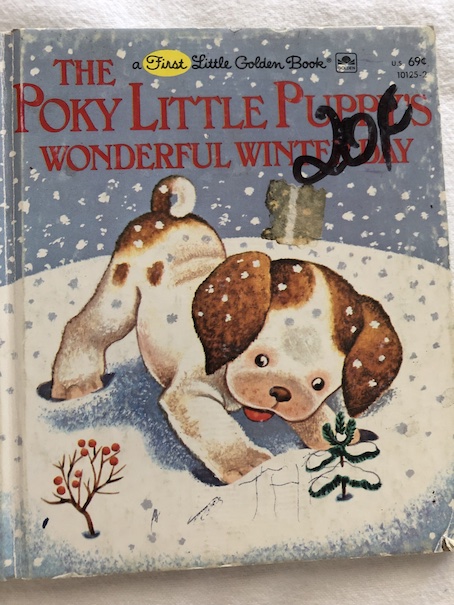
The Poky Little Puppy’s Wonderful Winter Day by Jean Chandler, 1982.

This book is part of the Poky Little Puppy series of picture books from Little Golden Books.

The Poky Little Puppy is the last to wake up on this snowy day, seeing his brothers and sisters rushing outside to play as he starts his breakfast. When he finishes his breakfast and goes outside, he doesn’t see the other puppies, but there are children playing in the snow.

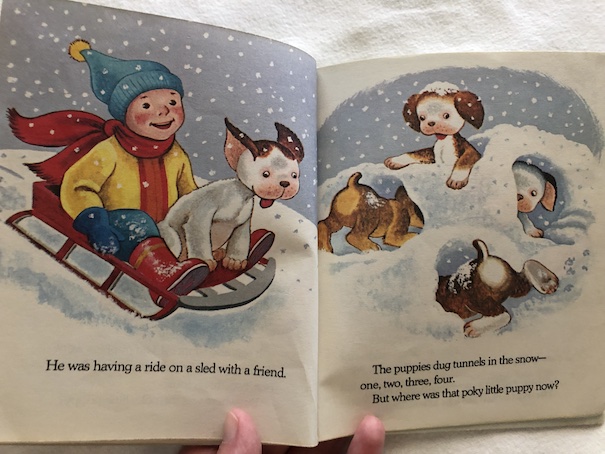
The Poky Little Puppy follows the puppy paws through the snow and finds his siblings. The other puppies go sliding now a hill together, but the Poky Little Puppy gets a ride on a child’s sled.

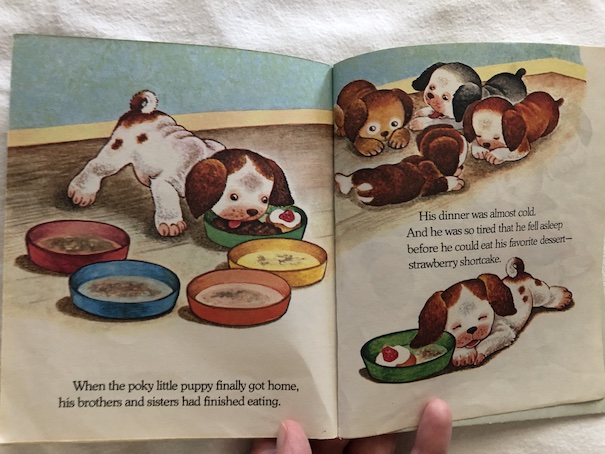
The Poky Little Puppy also tries to make a snow angel with a child and chases snowballs the children throw. He was the last puppy to start playing and the last to make it home to dinner because he is “poky” and arrives late to everything, but in the process, he had the most fun of everyone! (Although, he does fall asleep before eating his dessert.)

The book is available to borrow and read for free online through Internet Archive.

My Reaction

This is just a cute little story about the fun that a puppy has on a snowy day. I liked the message that the Poky Little Puppy has fun going through the day at his own pace and doing his own thing. Even though he isn’t always doing what his brothers and sisters are doing and sometimes trails behind them, he makes the most out of this fun, snowy day!

Native Americans

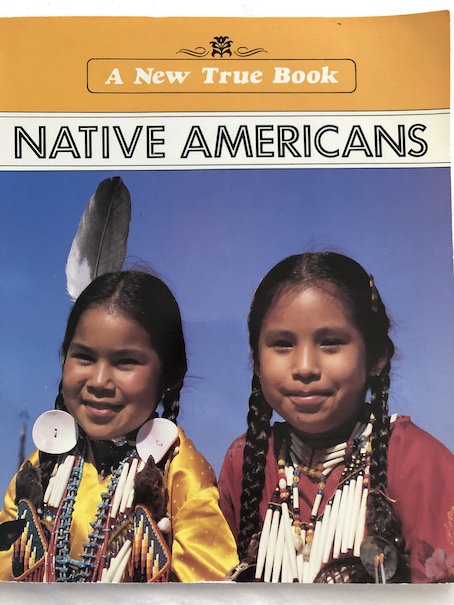
Native Americans by Jay Miller, 1993.

This book is part of the New True Books series, a series of nonfiction picture books on a variety of topics. This particular book gives an overview of the history and culture of Native Americans.

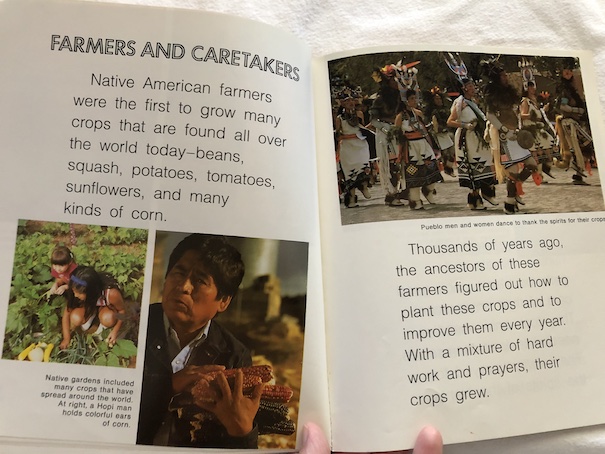
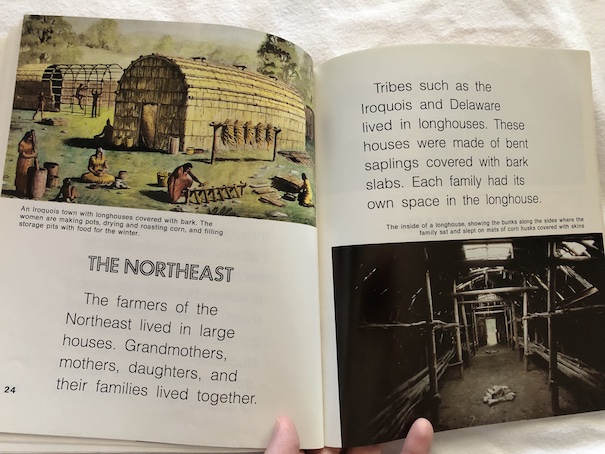
The book starts with some basic definitions and broad explanations of certain aspects of Native American culture, beginning with the explanation of why Native Americans are sometimes called “Indians.” The book notes that each tribe of Native Americans also has a name for itself. Each tribe has had its own culture, which it thought was better than other tribes’ cultures, but throughout history, tribes have interacted and traded with each other. One factor that made Native American cultures different from each other was whether tribes relied mainly on farming or hunting and gathering for food.

The book refers to hunter-gatherers as “caretakers”, a term that I can’t recall seeing before for hunter-gatherers. The reason why they use the term “caretakers” is they say that hunter-gatherers took care of their environments and only took the plants and animals they needed for survival, not wasting anything.

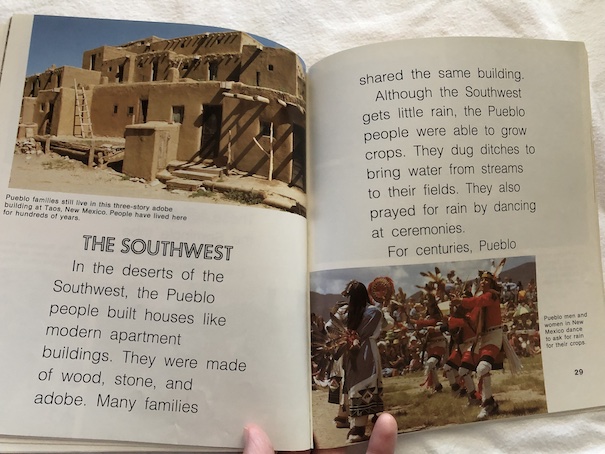
There are sections of the book that discuss some general aspects of Native American culture, like types of homes and tribal leaders. Of course, as the book notes, many cultural aspects varied, depending on the tribe, the environment where they lived, and whether they were mainly farmers or “caretakers.”

The book also has sections about the Native America tribes of various regions of North America, like the Northeast, the Southeast, the Southwest, the Northwest Coast, and the Plains.

The book ends with a brief section called Changes, which explains how Native American cultures were impacted by the arrival of Europeans in North America.

The book is available to borrow and read for free online through Internet Archive.

Happy Birthday, Little Witch

Happy Birthday, Little Witch by Deborah Hautzig, illustrated by Marc Brown, 1985.

This was one of my favorite Halloween books when I was a child, and so is the first book in the series, Little Witch’s Big Night. The first time I read these books, I read them out of order, but you really have to read the first book in order to understand Happy Birthday, Little Witch because it turns out that Little Witch still doesn’t understand the idea of trick-or-treating or that human children wear costumes on Halloween after meeting some children trick-or-treating on the previous Halloween. She really thinks that she met a small astronaut, pirate, and devil on Halloween, and that makes it difficult for her to find them when she wants to invite them to her birthday party.

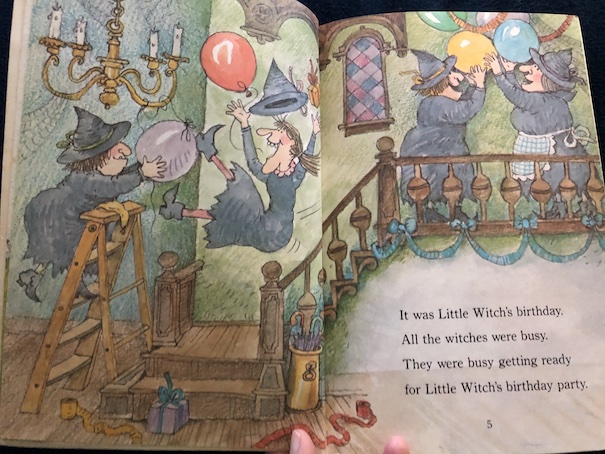
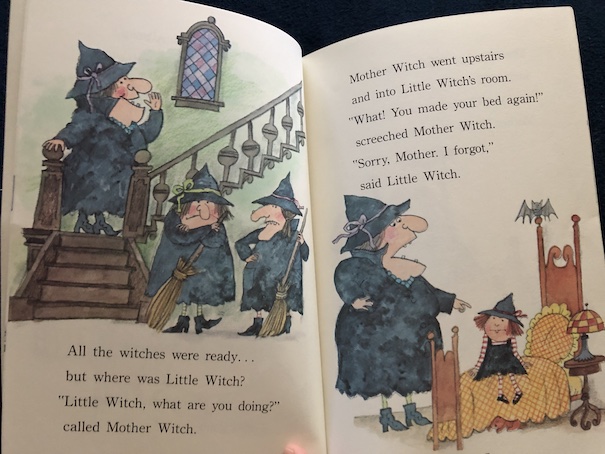
The witches in Little Witch’s family are decorating and preparing for Little Witch’s birthday party, but Little Witch is sad. Witches are generally bad and nasty, and Little Witch knows all the tricks her family will pull at her birthday party. Little Witch is nicer than the other witches, and she wishes that her party could be nicer, too. Then, she gets the idea of inviting the new friends she met on Halloween, who she only knows as Pirate, Astronaut, and Devil.

She doesn’t know her friends’ real names, so she tries to search for them in place where she thinks that a pirate, an astronaut, and a devil might hang out, taking her cat Bow-Wow and her pet bat Scrubby with her. She hitches a ride on a rocket ship, but her astronaut friend isn’t inside.

She checks out a pirate ship, but her pirate friend isn’t there, and the captain makes her walk the plank.

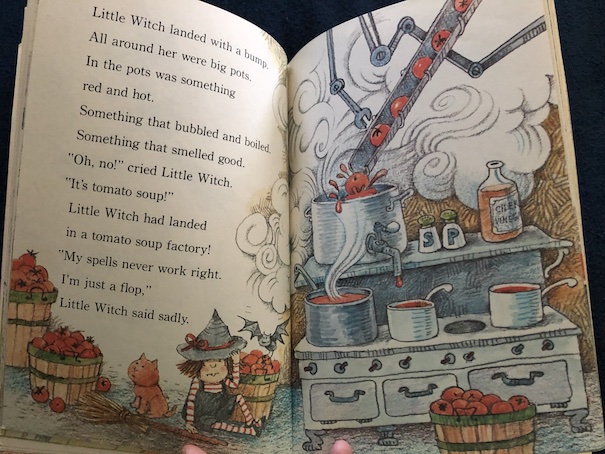
As for the devil, she thinks that she should try someplace that’s red and hot and ends up in a tomato soup factory (which I think is the funniest part if you’re reading this as an adult and you realize what kind of red, hot place she was really thinking of going to look for a devil).

However, the cook in the factory suggests to her that if she’s looking for her friends, they’re probably in school. At the school, Bow-Wow the cat gets frightened and runs away.

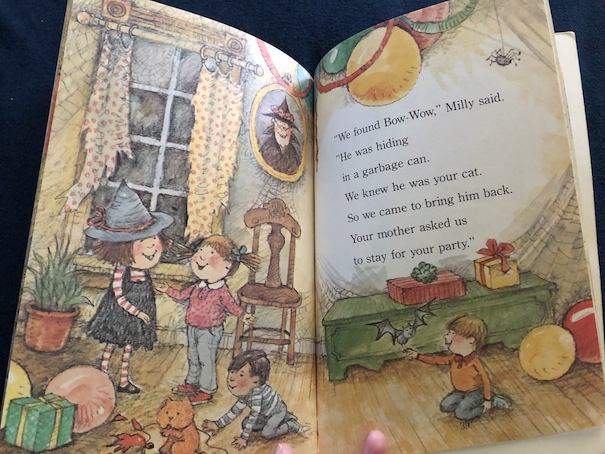
When Little Witch gets home, she finds out that her friends are ordinary children. They found her pet cat and brought it to her house, so her mother invited them to join the party. Her friends introduce themselves by name for the first time.

Little Witch’s party is nicer than it usually is, and she gets to play different games with her new friends. Little Witch’s mother says that she loves her, even though she is more good that most little witches.

Something that I didn’t mention in the review of the previous book is that both of these books were illustrated by Marc Brown, who created Arthur. The book is available to borrow for free online through Internet Archive.

Little Witch's Big Night

Little Witch’s Big Night by Deborah Hautzig, illustrated by Marc Brown, 1984.

On Halloween night, all the witches in Little Witch’s family are busy getting ready for their big broomstick ride. However, when Mother Witch sees that Little Witch has cleaned her room and made her bed, something too nice for a witch to do, she punishes her by telling her that she will have to stay home.

Because Little Witch is left at home, she is there to answer the door for three trick-or-treaters dressed as an astronaut, a devil, and a pirate. Since she doesn’t have any treats to offer them, she offers to give them rides on her broomstick.

The trick-or-treaters have a great time as Little Witch has her broom do tricks and she shows the pirate a real pirate ship.

The trick-or-treaters have so much fun that they promise to come back next year. Little Witch resolves to be good all year so that her mother will punish her again and make her stay home from the Halloween flight, so she will be there to meet her new friends when they come back.

However, when the other witches come back, Mother Witch says that she missed Little Witch on the flight and that she will get to come on the flight next year. Little Witch asks if she can bring some friends with her, and Mother Witch says that will be fine, as long as Little Witch isn’t too good.

This was one of my favorite Halloween books when I was a child, and so is one of the other books in the series, Happy Birthday, Little Witch. The first time I read these books, I read them out of order, but you really have to read the books in order to understand Happy Birthday, Little Witch because it turns out that Little Witch still doesn’t understand the idea of trick-or-treating or that human children wear costumes on Halloween. She really thinks that she met a small astronaut, pirate, and devil on Halloween, and that makes it difficult for her to find them when she wants to invite them to her birthday party. The Little Witch in this series isn’t the same as the Little Witch in the Little Witch Craft Books.

The book is available to borrow for free online through Internet Archive.

Grover Goes to School

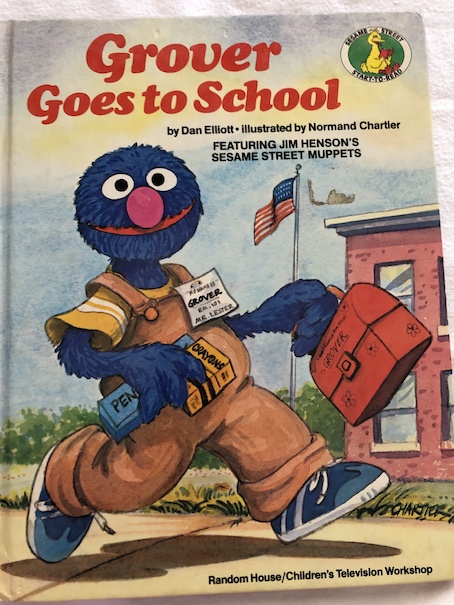
Grover Goes to School by Dan Elliott, illustrated by Normand Chartier, 1982.

This nostalgic picture book about a child’s first day of school features Grover, one of the characters from the Sesame Street tv show.

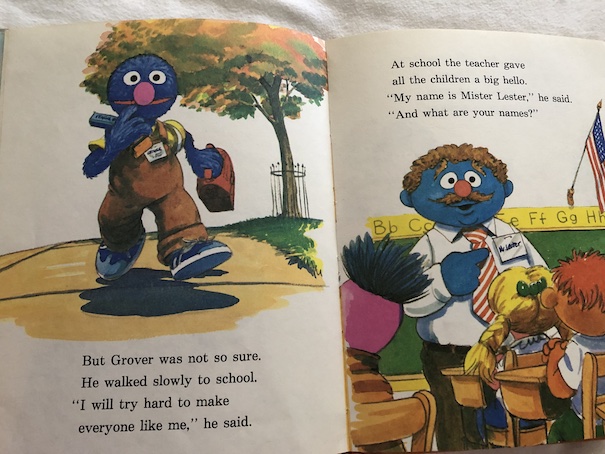
Grover is very exited about his first day at school. He’s ready and has everything he needs, but then, he starts to worry about whether the other kids at school will like him or not. His mother tells him that all he needs to do is be himself, but Grover decides he’s going to try hard to get everyone to like him.

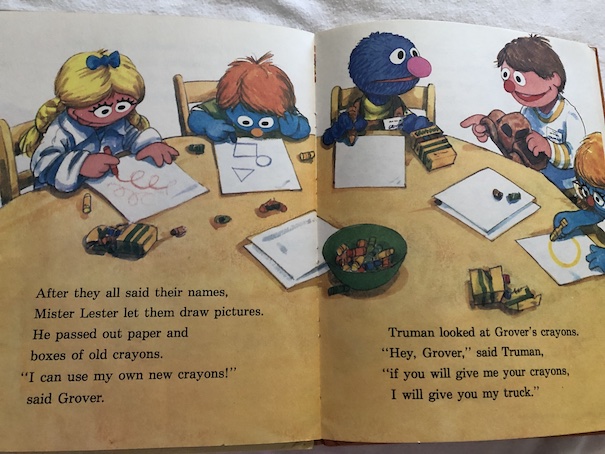
Grover’s attempts to get the other kids to like him cause him to agree to do things that he doesn’t really want to do. When a boy named Truman likes Grover’s nice, new crayons and offers to trade him his old toy truck for the crayons, Grover doesn’t really want to make the trade, but he agrees because he wants Truman to like him.

Then, Grover offers to clean up while the other kids have snack time. Grover does a good job cleaning, but the others forget to save a cookie for him.

The day gets worse with Grover helping the others play jump rope when he doesn’t want to and feeling obligated to trade his lunch for food that he doesn’t want. Finally, Grover bursts into tears

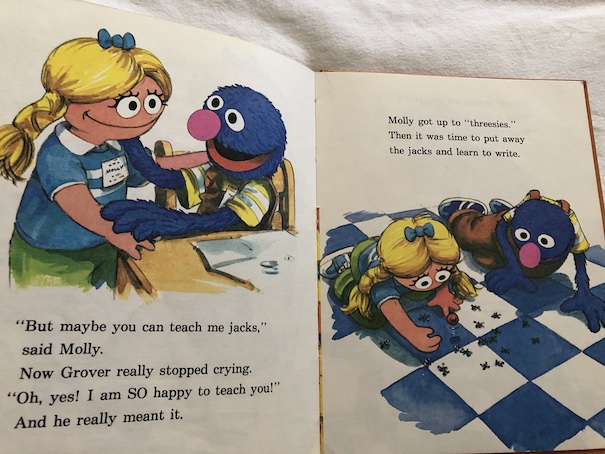
Seeing Grover sad and upset, a girl named Molly asks him what’s wrong. Grover explains everything that’s been happening to her, and she says that she’ll play with him and cheer him up. Molly doesn’t know how to play jacks, which is Grover’s favorite game, but she says that she’d like to learn, and Grover enjoys teaching her.

When a boy named Bill offers to trade his old pencil box for Grover’s nice, new one, Grover decides to say no and keep the pencil box he loves. Grover worries that Bill might be mad at him, but he’s not. Instead, it turns out that Bill also likes jacks.

Making friends with Molly and Bill turns Grover’s day around, and by the time he comes home, he’s feeling much better about school.

The book is available to borrow and read for free online through Internet Archive.

My Reaction

I loved this picture book when I was a kid! I used to watch Sesame Street as a young child, and I liked Grover, who is a shy monster kid who just wants to be friends with other people. In this book, he not only shows little kids how to get used to school on their first day but also teaches a lesson about trying too hard to get people to like you and what it means to be a real friend with someone. Grover realizes that he doesn’t have to do things he doesn’t want to do or give people things to buy their friendship. People still like him even if he sometimes tells them “no.” Like his mother says, he just needs to be himself, and he learns to make friends in ways that are comfortable to him, finding kids who genuinely care about others’ feelings and share common interests.

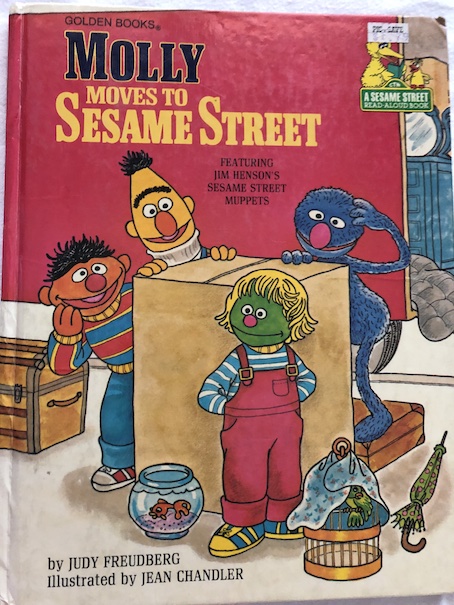
Molly Moves to Sesame Street

Molly Moves to Sesame Street by Judy Freudberg, illustrated by Jean Chandler, 1980.

The characters from Sesame Street greet a new neighbor who is getting used to a new home and needs some new friends.

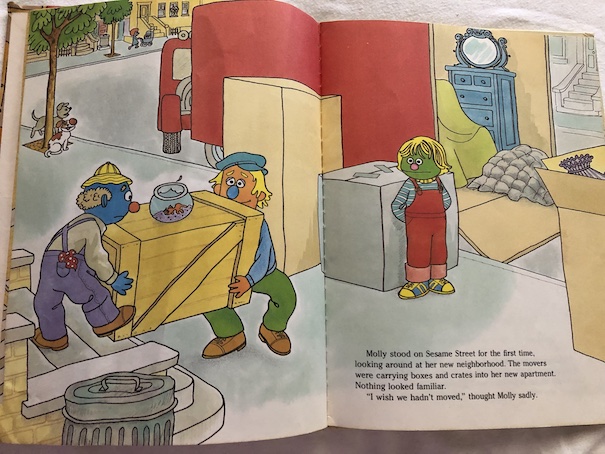
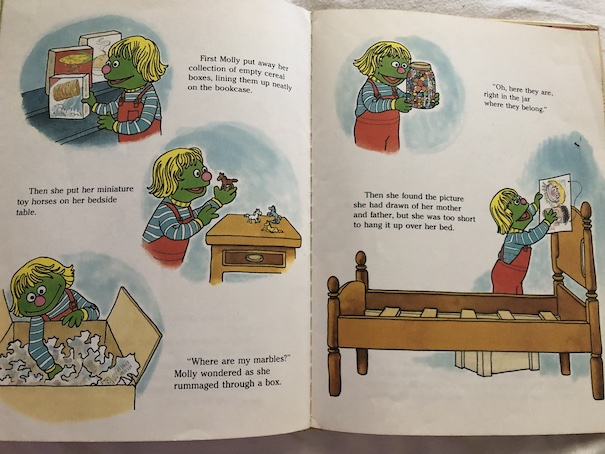
Molly and her parents are moving into a new apartment on Sesame Street, but Molly feels uncomfortable because nothing in this new neighborhood feels familiar. Her new room is still bare and doesn’t look or feel like home. Molly’s parents reassure her that it will feel more like home once all of her belongings are unpacked.

After Molly helps to unpack for awhile, her parents encourage her to go out, explore the neighborhood, and make some new friends. They say that, by the time Molly comes back, they’ll have things unpacked, and her new room will look much better.

When Molly first meets the characters from Sesame Street, they’re playing a game of hide-and-seek, but they all come out when she calls to them. They all introduce themselves to Molly and invite her to join their game.

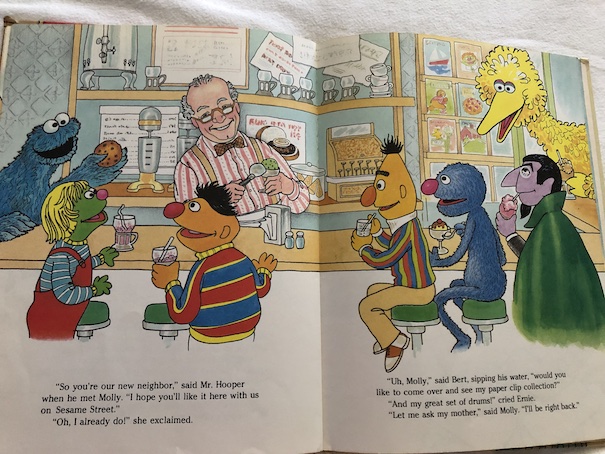
After they play, they all go to Mr. Hooper’s store for ice cream and sodas. Molly is happy that she’s having fun and starting to make friends, and she’s starting to like her new neighborhood.

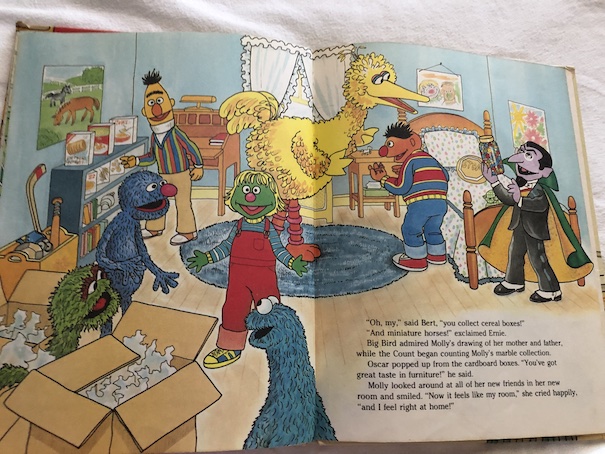
When Molly returns to the apartment, her parents have finished unpacking and arranging her new room. Molly is happy because it looks and feels more like home, and she invites her new friends to come over and see it.

This is a fun and reassuring picture book for young children that shows how making a new home look familiar and making new friends can help them to feel more at home when they move to a new place.

The book is available to borrow and read for free online through Internet Archive (multiple copies, some in different languages), but some later printings of the book have different illustrations and include Elmo, who wasn’t in the first edition of the book.

Castles

Castles by Stephanie Turnbull, illustrated by Colin King, 2003.

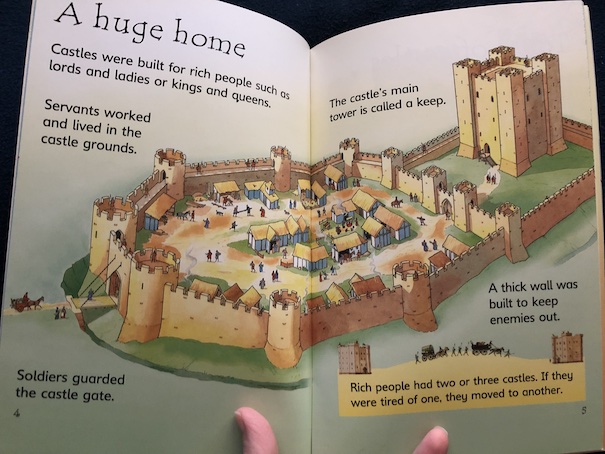
This nonfiction picture book for kids is part of the Usborne Beginners series, originally published in Britain. There are other books about castles, knights, and life in the Middle Ages from Usborne, but this book in particular, like others in its series, is a simplified version meant for beginning readers. The book is recommended for ages 4 and up.

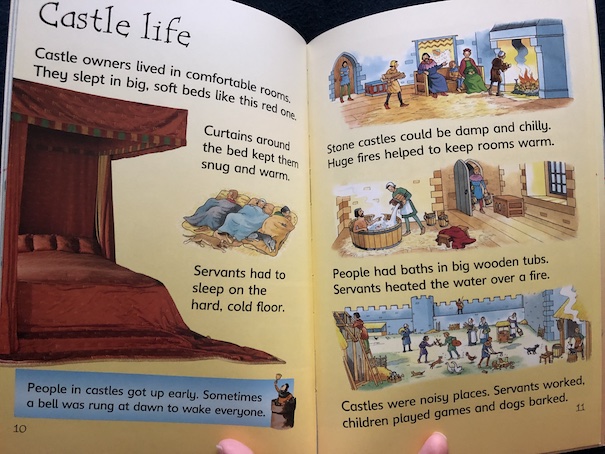
The book explains different types of castles and the parts of a castle. It also offers details about daily life for people who lived in castles, including hunting, food and feasts, and things they would do for fun.

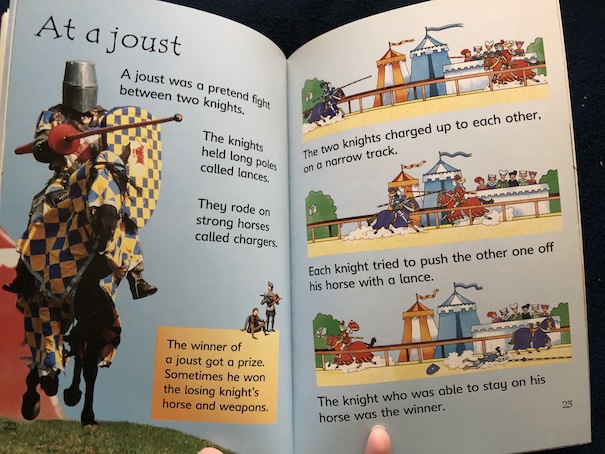
There are also pages about knights, the armor they wore, jousts, and attacking and defending a castle.

The book ends by explaining why castles from the Middle Ages are in ruins today.

In the back of the book, there is a glossary of terms and a link to the Usborne site’s page of quicklinks, which still works and has links to child-friendly informational sites on various topics, organized first by topic and then by related book. Both the book and the website offer Internet safety tips for kids and parents.

The book is available to borrow and read for free online through Internet Archive (multiple copies).

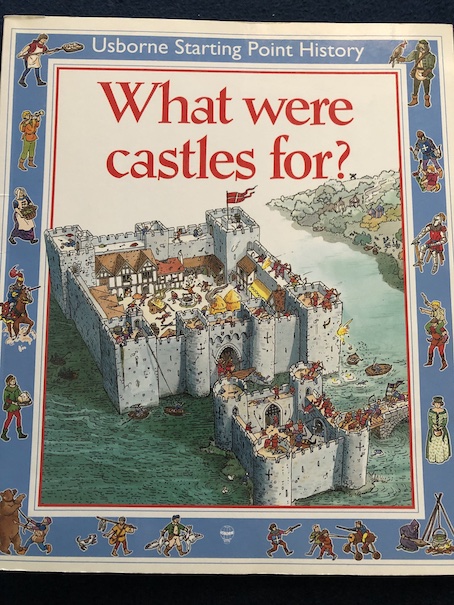
What Were Castles For?

What Were Castles For? by Phil Roxbee Cox, illustrated by Sue Stitt and Annabel Spenceley, 1994.

This nonfiction picture book for kids is part of the Usborne Starting Point History series, originally published in Britain.

I love books about daily life in the past, and this book explains the lives of people who lived in castles during the Middle Ages by answering questions about what castles were for and what people in castles did. Each page of the book is organized around sections answering specific questions.

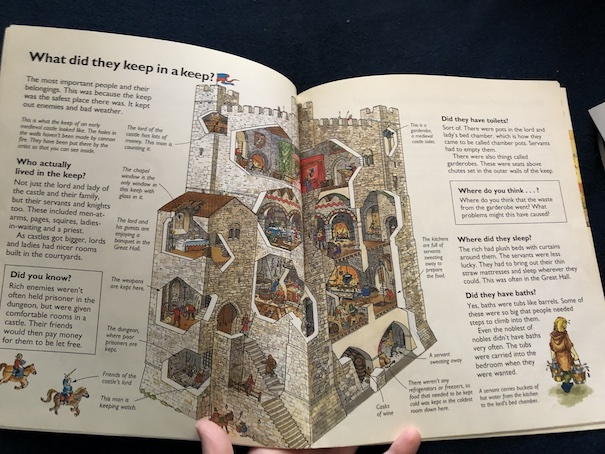
First, the book describes the basic purpose of castles and different types of castles that have existed and how they were built. The, it shows different parts of a castle and what people did in different parts. One of my favorite parts is where they show what is in a castle’s keep, which is where the lord of the castle and his family lived. The book uses cutaway pictures to show what is inside buildings, and the detailed pictures show the different activities of the people.

Among the activities of the nobles who lived in castles, the book explains how they would hunt and hold feasts and jousts.

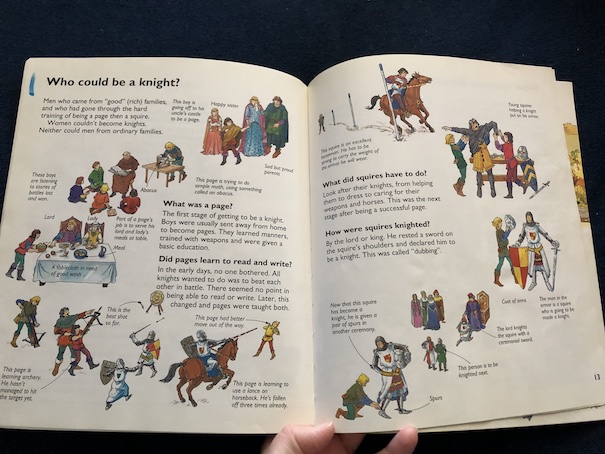
Knights and warfare were central to the purpose of a castle, which was to provide a defensible fortress for the noble families who lived in them and their supporters. The book explains how boys from noble families were raised and educated to be knights. There are also pages showing weapons and the siege of a castle.

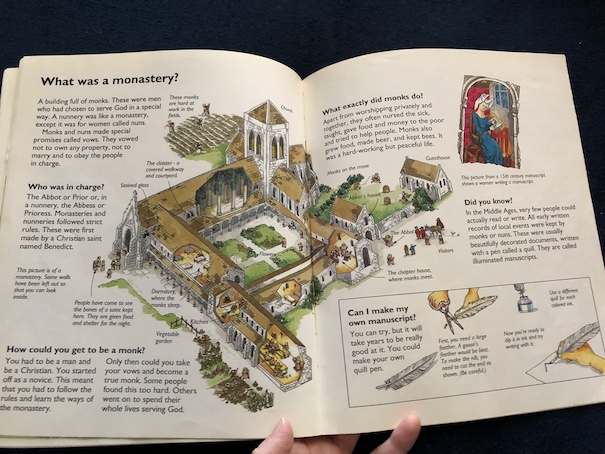
One of the things I liked about this book is that, while it is mainly about castles and the people who lived in them, it also shows how people lived outside of castles in small villages, towns, and monasteries. While castles are iconic of the Middle Ages, seeing how people lived in these other places gives a more expanded view of life in Medieval times.

The pictures really make the book! Every picture from the cutaway castle views to the scenes of villages and towns or jousts and hunts, show many people and small details. There are little descriptions labeling the people and details, most giving extra historical information, but some just for fun so readers can notice humorous details, like the monk being chased by bees at the monastery, the chicken escaping along the castle wall, the sister who is happy that her brother is going off to learn to be a knight, and the page who is learning archery but hasn’t made the target yet (his last failed shot falls short of the target, but it’s labeled as the best he’s done so far).

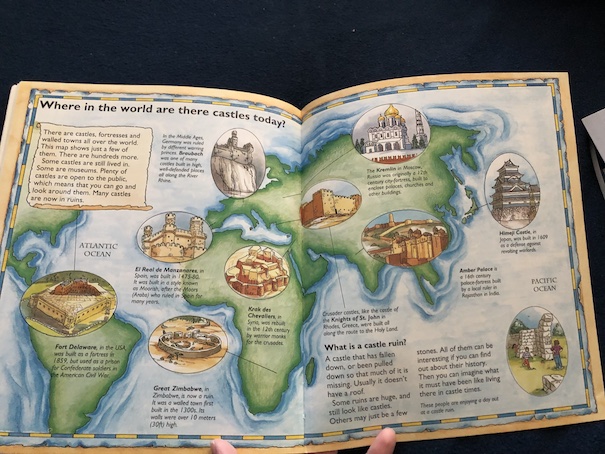
In the back of the book, there is a section with the legend of Richard the Lionheart and his minstrel and a map marked with famous castles around the world.

The book is available to borrow and read for free online through Internet Archive (multiple copies, including one in French).

Mystery at Kittiwake Bay

Mystery at Kittiwake Bay by Joyce A. Stengel, 2001.

Cassie Hartt has only recently moved to Kittiwake Bay, Maine with her mother and brother following her parents’ divorce. Her mother is a nurse, and she has found a job at the local hospital, which is actually 30 miles away from the little town where they were able to find a house. Because of her mother’s long commute, Cassie will need to look after her 7-year-old brother, Danny. Soon after arriving, she meets a nice boy named Marc Nolan, who is a little older than she is and loves boats, and a girl name Liz Painter, who likes photography and walks her cat on a leash. Liz is the one who introduces Cassie and Danny to the Beachcombers Club, which is a group for kids Danny’s age who like to go swimming and camping and the kids who hang out at the Sand Shack coffee shop. Marc is one of the Sand Shack kids, and so is a boy named Ryan Jerrick, who is Liz’s crush. Cassie is glad to be making friends and starting to get settled into her new home, but soon, there are complications.

One evening, on her way home from the grocery store with her dog, Sam (short for Samson), Cassie sees some mysterious figures sneaking around in the dark. She doesn’t know who they are, but the way they’re sneaking around worries her. She later learns that there have been robberies in the area.

Cassie develops a fascination for the large house that she saw on a cliff near the ocean, and Marc and Ryan tell her that’s a senior citizens’ residence called Waterview Manor. Both of them work there part time. Liz says that the house wasn’t always a senior citizens’ residence and that there are a lot of weird stories about the place. It was built by a rich man before the Civil War, but it became property of the town in the 1950s. One of the stories about the place is that it was once part of the Underground Railroad helping escaped slaves. The boys say that a woman named Mrs. Wentworth says that her grandfather was one of the people helping escaped slaves. There’s also a story about Captain Kidd hiding his treasure somewhere around the old house, although Ryan doesn’t believe any of these stories. He thinks Mrs. Wentworth just tells tall tales. Cassie thinks that she might like to volunteer at the house, like the boys did before they started working there as employees. If her little brother joins the Beachcombers Club, she’ll have some free time for volunteer work.

When Cassie goes to Waterview Manor to sign up, she witnesses an argument between Ryan and Mrs. Wentworth, who is confined to a wheelchair. Ryan was being disrespectful because Mrs. Wentworth was telling one of her stories about the history of the town that Ryan thinks is outlandish, and Mrs. Wentworth was telling him off. Ryan doesn’t actually like working at Waterview, but he has to keep his job because he needs the money. Cassie thinks he’s arrogant. Ryan has no patience for the fetching and carrying he has to do for the older people, and he thinks that Mrs. Wentworth’s mind is going. Cassie thinks that Mrs. Wentworth sounds like she still has her faculties and is sympathetic when Mrs. Wentworth laments about not being able to do things she used to do because her hands and feet won’t obey her anymore. Mrs. Wentworth is physically feeble these days, but she knows what she’s talking about when it comes to local history.

After she signs up to volunteer, Cassie can’t resist a peek into the forbidden East Wing of the house, and she meets Marc there. They both admit that they’re curious about the stories of treasure in the house. Unlike Ryan, Marc believes Mrs. Wentworth’s stories, and Cassie can’t wait to hear more!

Mrs. Wentworth used to be a history teacher, and she does know more about local history than Ryan gives her credit. She tells Cassie how her grandfather used to be a conductor on the Underground Railroad and how his friend, Mr. Palmer, who was the original owner of Waterview Manor, was a stationmaster, which meant that he hosted and hid the escaping slaves that Mrs. Wentworth’s grandfather conducted to him. Mrs. Wentworth’s grandfather told her about a secret room where they used to hide people and a secret tunnel that would take them to the landing site for the boat that would smuggle the runaways to Canada. When Cassie asks her about the story about Captain Kidd hiding his treasure somewhere in the area, Mrs. Wentworth said that her grandfather always believed he did, although Captain Kidd was much older than both her grandfather and the Manor. She explains a little about the life story of Captain Kidd and how it seems that most of his treasure was never found.

However, they soon have a more modern mystery on their hands. Whoever has been stealing things in the area recently seems to have started taking things from Waterview Manor. First, an expensive chess set belonging to one of residents disappears. Then, some jewelry and a coin collection disappear. Then, someone steals Mrs. Wentworth’s beloved lavaliere necklace, a special present from her late husband. For someone to both know about the residents’ valuables and to have access to them, the thief must be somebody working at the Manor! Who, could it be? Is it grumpy Ryan, who needs money? Is it John, another employee, who often acts a little strange? Could it even be helpful Marc, who seems nice but is often lurking around areas where both he and Cassie aren’t supposed to be? Or is it someone else Cassie wouldn’t even think to suspect?

The mysteries of the past start mingling with the mysteries of the present. Cassie sees signal lights from the tower of the old house that remind her of of the signals Mrs. Wentworth said the Underground Railroad used. Is someone now using them for a different purpose?

The book is available to borrow and read for free online through Internet Archive.

My Reaction

The Underground Railroad is a popular subject in US children’s books. There is something compelling about people sneaking around on clandestine missions and hiding in secret rooms and secrets passages, and since these things were used in the real life Underground Railroad, they make convenient devices for US children’s books with some historical flavor. The former Underground Railroad secret passage in Waterview Manor does play a role in this story. Someone is using it for a new purpose, just like they’re using signals from the tower.

The purpose of the Underground Railroad secret tunnel in the story is also to show that Mrs. Wentworth knows what she’s taking about when she tells her stories about local history. Ryan tries to discount her stories because some of them sound a little far-fetched and dramatic and because he thinks scornfully of the old people he serves in his job. Ryan has a negative attitude and looks at the elderly as being senile and demanding. Cassie feels differently because she has more empathy and, perhaps, because her mother is a nurse, which may make her more aware of the human condition and more comfortable helping other people. She seems to understand what Mrs. Wentworth means when she talks about finding it frustrating that she can’t do things she used to do, and she says that she agrees with Mrs. Wentworth when she says that she likes keeping her hair long even though a nurse at the Manor says it would be easier to care for if she cut it shorter. The nurse is probably thinking that short hair would be easier on those who might have to help Mrs. Wentworth wash and brush it, but Cassie understands when Mrs. Wentworth explains why she likes her hair long. Cassie thinks the people who live at Waterview Manor are interesting, and she admits to her mother that she likes to pretend that they’re her grandparents. She is fascinated by Mrs. Wentworth’s stories, and because she and Marc believe what she says, they are able to get to the bottom of the mysteries surrounding the Manor.

I was pretty sure I knew who at least one of the thieves was, and I was also pretty sure I knew why. I was correct in my first guess, but there were enough red herrings along the way to give me some doubts, so there was plenty of suspense in the story. One of them wasn’t fully aware of what he was getting involved with at first, but he does bear responsibility for what he did even after he knew.

This book also deals with the subject of divorce and how it affects families and children. Books like this were once rare, but they have been very common staples of children’s literature since the late 20th century, reflecting changes in American society and a growing willingness to discuss difficult topics with children. Moving to a new state and starting over after the divorce wasn’t easy for Cassie, her mother, and her brother. Cassie quickly becomes interested in the history of her new town, and it doesn’t take her long to find some new friends and a volunteer activity to keep her occupied. However, other aspects of the changes in her life and family will take longer to get used to. Her mother has to work long hours with a long commute, so Cassie frequently has to be responsible for her younger brother when he’s not at activities of his own, and her mother often isn’t home for Cassie to discuss things with her.

There is also some tension between Cassie and her brother because the divorce has changed their relationship with each other. Because Cassie has become more of a caregiver to Danny because her mother has to work, she has to make arrangements for Danny before she can do anything on her own, which sometimes makes things awkward for her. Danny also becomes jealous because Cassie does have more ability to do things on her own than he does and because she makes friends and settles into their new town more easily than he does.

One part of this book that I hated was when Danny intentionally left Sam outside alone to spite Cassie, and Sam is poisoned by one of the villains and nearly dies. Cassie is very upset with Danny because of this incident, understandably so, but I didn’t like it that the other characters were pressuring her to be okay with Danny and forgive him too quickly. They do this because Danny is young, they think that he left the dog out by accident, and Danny feels really badly about almost getting the dog killed. Cassie knows, although Danny doesn’t initially admit it, that Danny left the dog outside on purpose. That purposefulness maliciousness is not a thing that I think should be too easily forgiven, especially not because someone just “feels bad.” Let’s insist on a little empathy here, Danny. Cassie feels bad because you almost got her dog killed. Sam really feels bad because he’s the one who almost died! Maybe your feelings shouldn’t be given first priority here, since you were the one who caused the harm. Sam is a dependent animal. Under no circumstances should animal abuse be excused, and leaving a dependent animal outside alone to be lost, hit by a car, or yes, harmed by some other malicious person is abusive. Danny should not be given a pass for malicious behavior or animal abuse just because he “feels bad.”

Giving people that type of excuse for malice and abuse just encourages more of it in real life because the person finds that there are no consequences for their actions and it gets them the forgiveness and attention they want, so they keep doing it. It’s a dangerous thing to allow. The story makes it clear that Danny was acting out on bad feelings that he already had about the divorce and feeling neglected by both his mother and Cassie, but I think it’s important to make it clear to him that, even if he’s “feeling bad”, that does not give him the right to hurt other people or animals. Nobody has the right to hurt others just because they’ve got mixed-up feelings. I hate it that the other characters don’t seem to feel that way.

The story ends happily when Danny tries to make it up to Cassie by investigating the situation and Cassie rescues him from the bad guys. They have a heart-to-heart talk that makes Cassie realize how important Danny is to her and that she has to make time for paying attention to him and supporting him more during this difficult time. Still, I feel very strongly that the story and the other characters should emphasize to Danny that causing hurt because you feel hurt is wrong and damaging to relationships. The way the other characters tried to make Cassie feel bad about the situation also really felt like gaslighting. She had a real and serious reason for being angry with her brother, and it just made me really angry when they acted like she was the bad one because Danny was “feeling bad” and she wanted him to be accountable for his actions. He knew what he was doing, and he should have known it was dangerous to Sam, even if he didn’t know that someone was going to deliberately try to kill the dog.

I know that Danny has some emotional issues that need to be addressed, but I’m saying that he also has some behavior issues that also need to be addressed. There are helpful ways to deal with emotions and destructive ways to deal with emotions. Danny is not too young to understand the consequences of his actions and to accept them. I don’t think that learning that it can take awhile to regain trust after betraying someone’s trust is also an unbearable lesson. In fact, I’d call it a life skill. If it helps him to develop more empathy and consider other people and the consequences of his actions before he lashes out, it is worth it.
Seashells for Katie and Andy

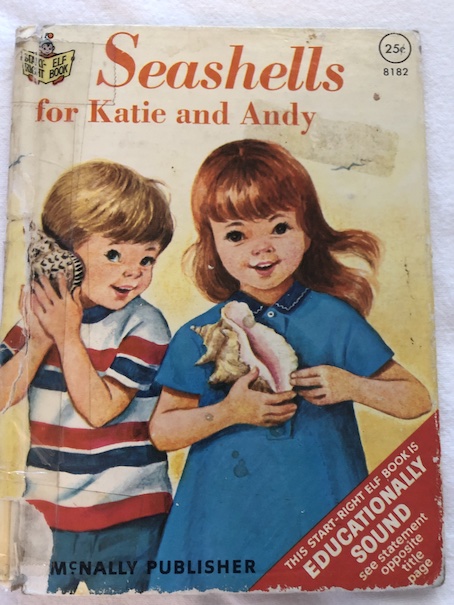
Seashells for Katie and Andy by Solveig Paulson Russell, illustrated by Marjorie Cooper, 1973.
This is a cute little picture book that presents information about seashells in story form.

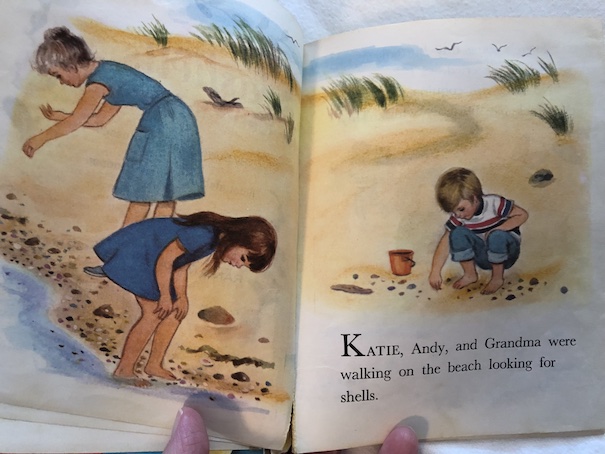
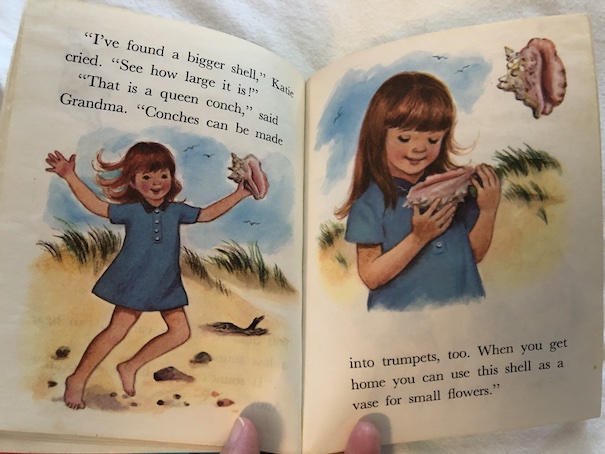
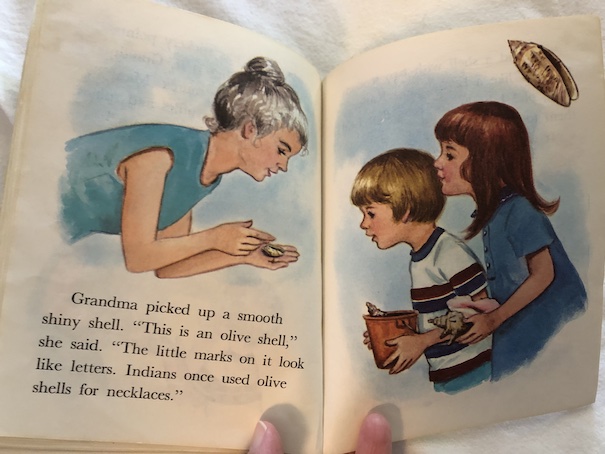
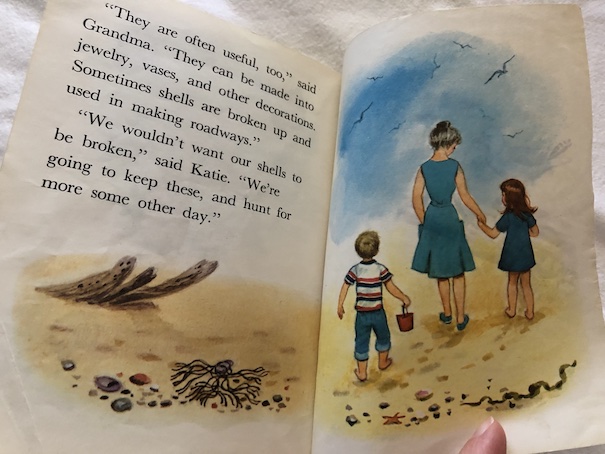
Katie and Andy are at the beach with their grandmother. As the children collect seashells, their grandmother tells them what kind of shells they are and a little about them.

The shells included in the book are: coquina shells, cowrie shells, triton shells, conch shells, lace murex, olive shells, scallop shells, and limpets.

Toward the end of the book, the kids ask their grandmother if they can find shells anywhere else besides the beach, and she tells them about snail shells.

The grandmother also tells the children about different uses people have for seashells. She talks about how they can be used for jewelry, vases, and decorations of different kinds. She also mentions that they can be broken up and used in roads, but the children don’t like the idea of breaking shells.

My Reaction

This book is nostalgic for me because my own grandmother was an amateur naturalist, and she used to give us gifts of seashells that she found in her own travels. Some of the shells in my old collection still have labels with the names of the shells in my grandmother’s handwriting.

In the beginning of the book, there is a note to parents and teachers from the National College of Education in Evanston, Illinois about how the information in the book is educationally sound. I don’t have anything to criticize about the information in the book except one instance where the grandmother talks about “Indians” making necklaces from a certain type of shell. I’m pretty sure from context that they mean American Indians and not people from India, but I think that “American Indians” or “Native Americans” would be better terms to use for the sake of clarity.

They never say exactly where the beach in the story is, which would make a difference in the types of shells that the characters might find. Most of the shells covered in the book have a pretty broad worldwide distribution, but I suspect from the selection of shells given that the characters are probably in the Southeastern United States.