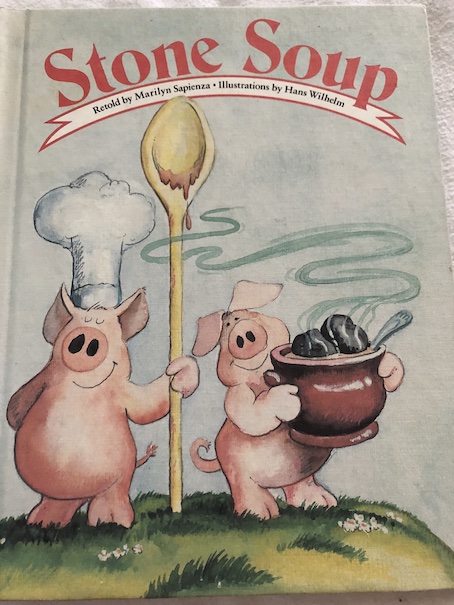
Stone Soup

Stone Soup retold by Marilyn Sapienza, illustrations by Hans Wilhelm, 1986.

This is a retelling of a traditional folktale, sometimes called Stone Soup and sometimes Button Soup (and other names). The basic story is the same, but sometimes, it uses a stone and sometimes a button. All of the characters in this particular version of the story are represented by animals. Some of the pictures are in color, and some are black-and-white.

Max and Molly are backpacking across country, and they are getting tired and hungry when they spot a village. Hoping to get something to eat there, they decide to approach the villagers and ask for food.
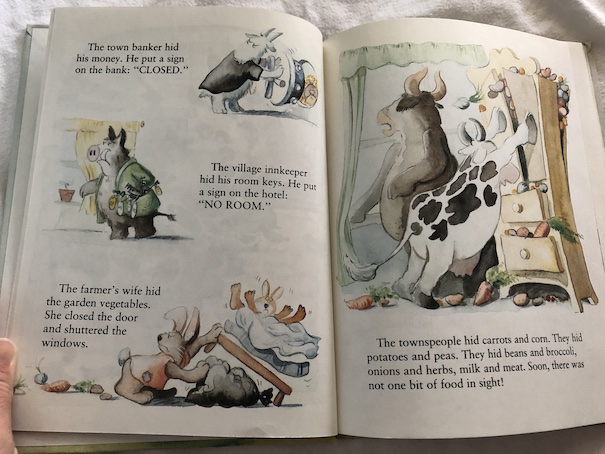
However, the villagers are not friendly, and the last thing they want is to share their food or anything else with strangers. As soon as they see Max and Molly coming, they quickly hide their food and anything else the travelers might want them to share. (I’m not sure why the innkeeper closes his hotel as soon as he sees potential customers coming. You can’t stay in the hospitality industry very long like that.)

When Molly and Max get into town, all of the villagers pretend like they’re starving and refuse to help Molly and Max. However, they see through the villagers’ act and come up with a plan of their own.
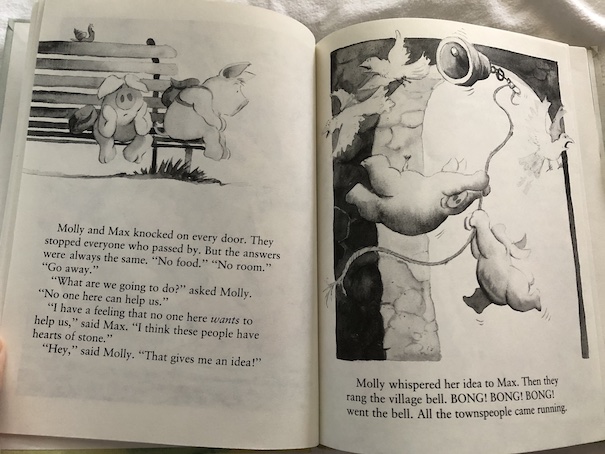
They ring the village bell to call of the people in the village. At first, the villagers are irritated because the bell is only for use in emergencies, but Molly and Max say that having no food is an emergency and that they have a plan to solve it. They are going to teach the villagers to make Stone Soup.
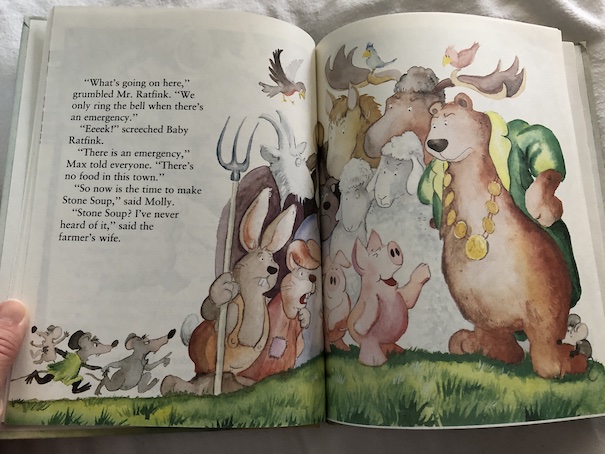
The villagers say that they’ve never heard of Stone Soup, and Molly says that it’s a secret recipe that she’s willing to share. It starts with a pot of hot water and some stones. Molly makes a show of tasting the “soup” and says that it’s good, but it’s even better if you make “the fancy kind.”
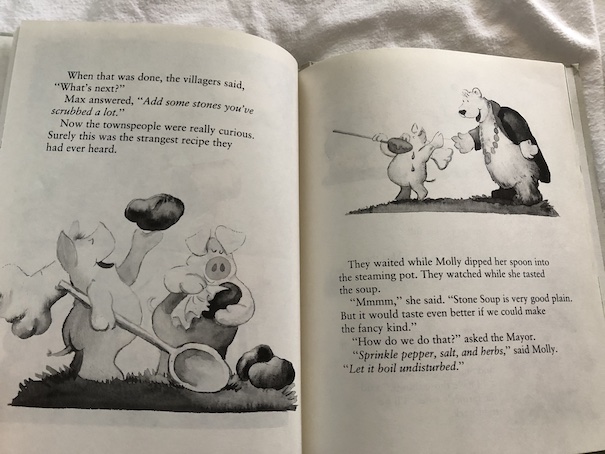
When the villagers ask how to make the fancy kind, she asks for some salt, pepper, and herbs. After the mayor’s wife supplies those, Molly asks for some carrots and onions. When she says that she supposes that they’ll have to do without them, the farmer’s wife steps up and offers some.
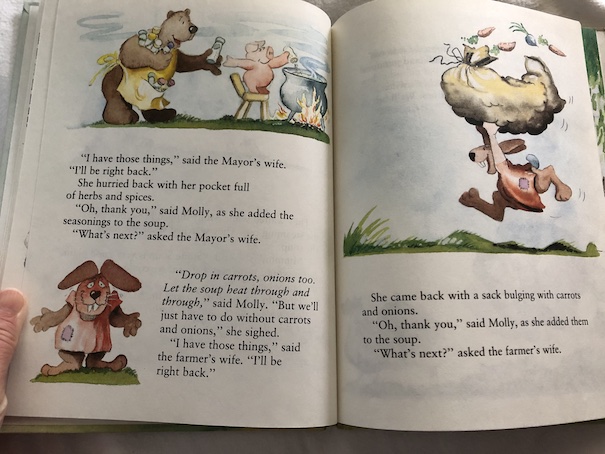
Little by little, Molly and Max coax the villagers into supplying other ingredients, almost without realizing what they’re doing. In the end, the Mayor of the village says that it’s the best soup he’s ever tasted, and it’s amazing, considering that it was only made with stones and water.

The moral of the story is that everyone benefits when people are wiling to share. Everyone gets a share of the soup, but when they start serving it, the villagers also provide other food to eat alongside it, and they all have a feast. The innkeeper gives Molly and Max a room for the night, and when they leave in the morning, they remind the villagers to “Share Stone Soup with everyone.”

In the back of the book, there is the complete recipe for Stone Soup, with rhyming steps. It doesn’t have details, like amounts and cooking times and temperatures, but I suppose someone could use these general guidelines to make an improvised soup. Really, I think the meat should be precooked if you’re adding it as a final ingredient. Otherwise, the veggies would be overdone before the meat is fully cooked.

There are many different versions of this story that have been made into picture books. I haven’t been able to find a copy of this particular book available to read online, but you can find various versions other versions of the same story online through Internet Archive.

The Elves and the Shoemaker

The Elves and the Shoemaker story adapted by Lucy Kincaid, illustrated by Gillian Embleton, 1981.

I loved to read this folktale when I was a kid! This particular copy was made specifically for beginning readers with large type and a section in the back that shows key words in the story with little pictures to explain what they mean. Aside from my nostalgic associations with this book, I also really enjoy the detailed, realistic pictures.

There was a shoemaker who worked very hard but never seemed to get much money for the shoes he made. He and his wife are on the verge of starvation, and he only has enough leather to make one final pair of shoes.

Before going to bed, he cuts out the leather for the last pair of shoes, planning to sew them in the morning. However, in the morning, he discovers that someone else has already sewn the shoes together, and the shoes are very fine quality. The shoemaker has no idea who finished the shoes for him, but they did an excellent job, and he is able to sell them for enough money to buy food and enough leather for two more pairs of shoes.

Once again, he cuts out the leather for the shoes, and again, in the morning, he discovers that someone else has sewn the shoes together. The shoes are excellent, and he is able to sell them for enough to buy leather for four more pairs.

This continues night after night, and the shoemaker’s business begins to prosper, but he and his wife wonder who is helping them. One night, they hide and watch to see who will come to do the sewing. As they sit up, waiting, they see a pair of small elves who enter through the window and begin sewing the shoes together.

The shoemaker and his wife want to thank the elves for their help. Noticing that the elves are wearing ragged clothes and have no shoes of their own, they decide to make the elves their own sets of clothes and shoes.

On Christmas Eve, they put the elves’ new clothes on the table where the shoemaker usually puts the shoes that need to be cut and watch to see what the elves do. The elves are overjoyed to see the new clothes, realizing that they are presents for them. They immediately put the clothes on and dance around with happiness, singing that they don’t need to work anymore.

That is the last time the shoemaker and his wife see the elves, but the shoemaker’s business continues to prosper.

In the Harry Potter series, J.K. Rowling used the device of gifts of clothing ending a house elf’s service to a particular household, but she didn’t invent that concept. It was already a feature of folktales like The Elves and the Shoemaker, which was one of the folk tales collected by the Brothers Grimm.

This book is available to borrow and read for free online through Internet Archive. There are also many other versions of the same story.

Mother Goose Rhymes

Mother Goose Rhymes, illustrated by Eulalie, 1950-1953.

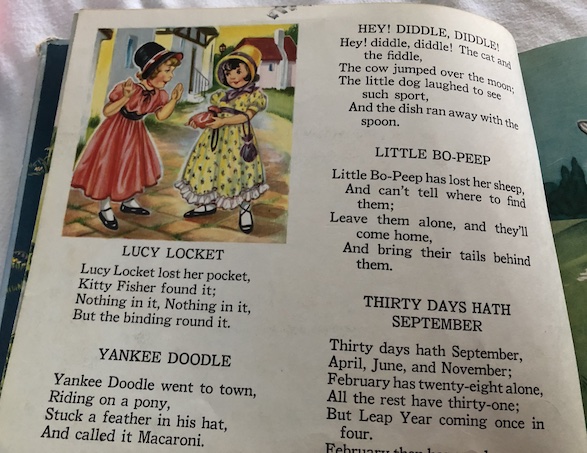
This was one of my first books of rhymes and poems as a child. We’ve had this book for as long as I can remember. I always loved the illustrations in the book, which are realistic in style, and like the illustrations in old Kate Greenaway books from the late 19th century, showing children in clothes that would be appropriate for the early 19th century, with high waists and short jackets. I suspect that Kate Greenaway’s work may have been some of the inspiration for the illustrations in this book. Some of the illustrations are small ones that appear in corners of the pages, surrounded by the text of the rhymes. Other illustrations take up a full page. All of them are full color illustrations.

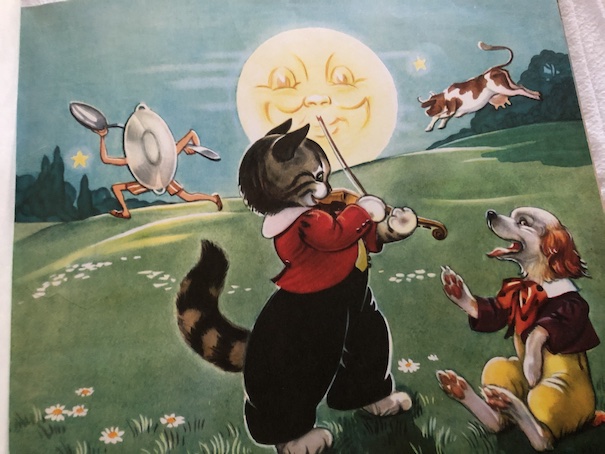
People can recite popular nursery rhymes like Mary Had a Little Lamb, Old Mother Hubbard, Little Bo-Peep, and Lucy Locket from memory because many of us heard and memorized them early in life. But, since we’re on the subject, who is/was Mother Goose and what are these rhymes about really?

Mother Goose rhyme books don’t really have an author because the rhymes are short little folk poems with no known original author. When an “author” is credited for a collection, they are credited as being “collectors” of the rhymes included, not as the original creators of those rhymes. The first person to collect and describe folk and fairy tales as being “Mother Goose” stories was the French author and folk tale collector Charles Perrault. In 1697, he published a collection of stories called Stories or Tales from Past Times, with Morals or Mother Goose Tales. It isn’t completely clear how many of the stories in this book were completely Perrault’s own creation, based on common themes often found in folk and fairy tales, and how many were stories he collected from other sources and modified to fit his style and purpose. The stories included in this original Mother Goose book included many fairy tales that are now childhood classics, like Cinderella, The Sleeping Beauty, Puss in Boots, Little Red Riding Hood, and the scary Bluebeard. This collection of stories was not meant for children. The stories were intended for adults because fairy tales were in fashion among the aristocratic literary circles in Paris at the time the book was published. The exact reasons why Perrault decided to use the imaginary “Mother Goose” as the supposed source of these stories or even who “Mother Goose” once was are uncertain. American legend sometimes cites “Mother Goose” as being the wife of Isaac Goose and the mother Elizabeth Goose, who lived in Boston in the 17th century and told stories and sang songs to her (a story referenced in The Only True Mother Goose Melodies published in Boston in 1833), but it’s unlikely that Perrault was referencing her. A more likely theory is that “Mother Goose” was a reference to a somewhat forgotten figure of French folklore who would have been more familiar to people living in the late 17th century who studied folk and fairy tales. There was a French legend from the Middle Ages about a queen who told stories that amazed children and was sometimes called “goose-footed”, and possibly, this story or a similar figure from French history or legend became known as “Mother Goose.”

In the 18th century, Perrault’s book was translated into English, and English authors began putting together their own “Mother Goose” books that included English nursery rhymes. The book that shifted the association of “Mother Goose” from stories to rhymes was Mother Goose’s Melody, or, Sonnets for the Cradle, a collection of English nursery rhymes published by John Newbery, a famous English publisher of children’s literature in the 18th century who was nicknamed “The Father of Children’s Literature” and who would later become the namesake of the Newbery Medal for excellence in American children’s literature. Mother Goose’s Melody popularized the association of “Mother Goose” with children’s nursery rhymes in both England and America, and ever since, it has been used in the title of collections of nursery rhymes. Many of the popular Mother Goose rhymes are centuries-old ones from England, although some later classics, like Mary Had a Little Lamb, were added to American books of nursery rhymes in the 19th century.

But, what do these rhymes mean, or do they mean anything? Are they just nonsense rhymes for children about things like a cow jumping over the moon or a boy and girl falling down the hill, or is there some additional meaning behind these rhymes that have kept them in the public consciousness for so many centuries? The exact origins as well as the original authors of many old nursery rhymes have been lost to time, but there are indications that various nursery rhymes may have begun as folk songs or rhymes referencing current events that were happening at the time they were originally composed. Although they sound like harmless and innocent nonsense, people who heard them at the time when they were first composed would have recognized references or pieces of dark humor about real events or scandals that were public knowledge. In modern times, there is some debate about the exact meaning behind some of these rhymes because, while the references in the rhymes may have seemed clever and humorous to people at the time of their creation, they are too esoteric for modern people, who are centuries removed from the events they were referencing. For generations, people passed on the rhymes to their children but not the explanations of their meaning, so most were simply forgotten. However, there are articles that you can about The history lessons that may be hidden in nursery rhymes and The Dark Side of Nursery Rhymes, which discuss what we know about the creation of these nursery rhymes and theories about their original meanings. Sometimes, there are multiple theories about certain rhymes because there just isn’t enough evidence to firmly settle on one, and also, it’s possible that rhymes could be inspired and shaped by more than one event or source.

This particular book of Mother Goose Rhymes is available to borrow and read for free online through Internet Archive. However, there are also many other books of Mother Goose rhymes available through Internet Archive and Project Gutenberg, including Perrault’s Tales of Mother Goose.

A Child’s Garden of Verses

A Child’s Garden of Verses by Robert Louis Stevenson, illustrated by T. Lewis and Sara Gutierrez, 1989.

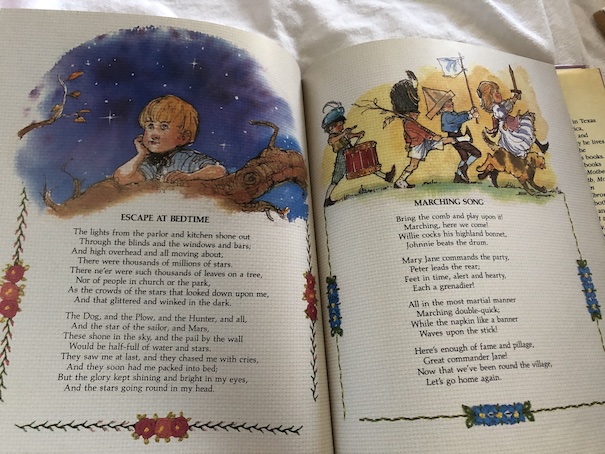
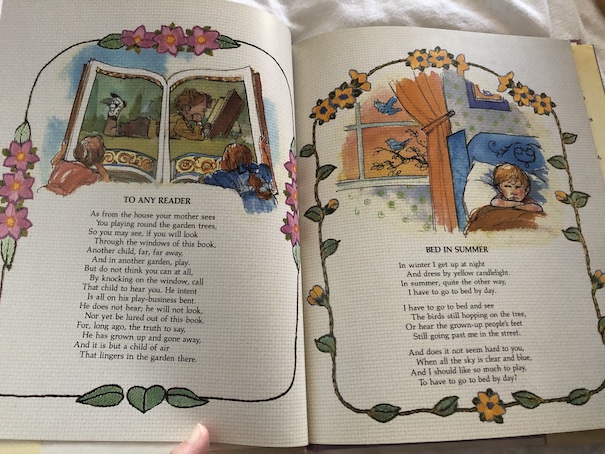
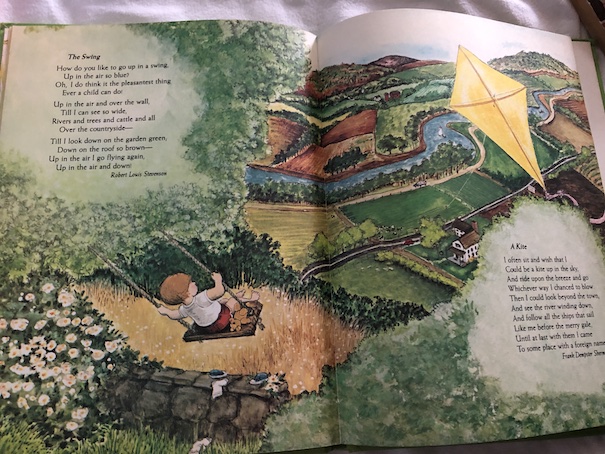
This is a reprinting of the classic collection of children’s poems by Robert Louis Stevenson first published in 1885 as Penny Whistles. What makes this edition of the book different from other printings is the illustrations, which are an unusual combination of watercolors and embroidered borders. Mary Pope Osborne, author of the Magic Tree House series wrote an introduction to the book about the life of Robert Louis Stevenson and his youth in Scotland in the 1850s, which inspired his poems for children. (See my list of Books from 1850s for the types of books children were reading during this time period, but remember that they also would have read books that were published in previous decades.)

The poems have gentle themes from the lives and fantasies of children, like games of pretend, bedtimes, and the little things that children notice and that adults often take for granted, like shadows and the beauty of stars. Some of them have things that are now anachronistic, like lamplighters, but they’re still imaginative and enjoyable for all ages.

I’ve always liked Robert Louis Stevenson’s children’s poems, and this book has my favorites! My personal favorites are:

To Any Reader – Robert Louis Stevenson speaks to children reading these poems about the child he used to be and how the poems are like a window on his childhood, although his own youth is long gone.
Escape at Bedtime – About a child who sneaks out of bed at night to look at the stars.
The Swing – I mentioned this one before because it’s included in another collection of poems, and I’ve often thought of it when I’ve been on swings.
Picture Books in Winter – A child enjoys picture books indoors when it’s cold outside.
The Land of Storybooks – About the adventures that children who love books enjoy in their imaginations.

However, my mother’s favorite children’s poem is Bed in Summer because it reminds her of her own childhood and having to go to bed while the sun was still shining in summer and other children in the neighborhood were still playing outside. (I didn’t have this experience when I was growing up because I never lived in a place that had daylight savings time, which changes the clocks by one hour, providing an extra hour of daylight before sunset. Arizona is very hot, so there’s a benefit for doing things after the sun has set, and few people have any interest in pushing back time to maximize the scorchingly hot daylight hours. My childhood memories include going to parks with my parents after the sun set and being put to bed after we got home.)

There are many copies of this book available in various printings online both at Internet Archive and Project Gutenberg because the text of the original book is now public domain. I didn’t see this particular printing with these illustrations available online, but if you just want to read the poems, there are plenty of other copies of the book to choose from!

A Child’s First Book of Poems

A Child’s First Book of Poems with pictures by Cyndy Szekeres, 1981.

I think this actually might have been my first book of poetry. At least, I’ve had it since I was a fairly young child, and I can’t remember reading any other book of poetry before this one. If I had an earlier book of poetry, it was probably a book of Mother Goose rhymes.

The poems in the book are about a variety of topics and some of them are by famous people and were popular poems for decades before this book was published. Among the authors whose poems appear in this book are Emily Dickinson, A.A. Milne, and Robert Louis Stevenson.

Among my favorite poems in the book:

Wild Beasts by Evaleen Stein – About children pretending to be animals.
Choosing by Eleanor Farjeon – About choosing between various nice things.
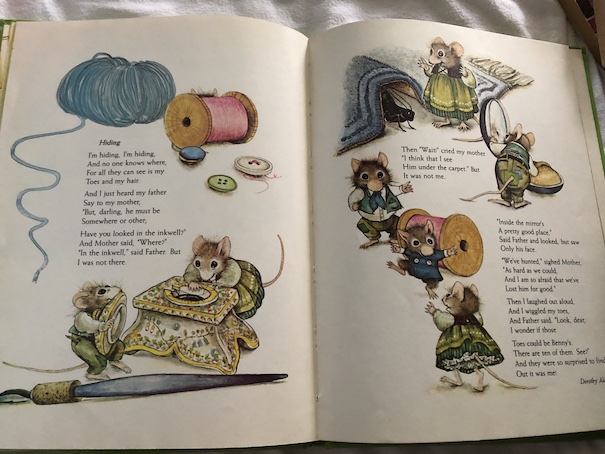
Hiding by Dorothy Aldis – A child hides while his parents search for him. My mother often quoted from this poem when we were kids and she was looking for one of us. “I’m hiding, I’m hiding, and no one knows where …”
The Swing by Robert Louis Stevenson – I think of this poem whenever I’m on a swing.
Bedtime by Eleanor Farjeon – Children making excuses to stay up later.

The pictures really make this book special. They are all drawn in a realistic style. Some just show ordinary children and animals, but some contain whimsical elements, like animals wearing clothes, depending on the poem.

The book is available to borrow and read for free online through Internet Archive.
An Early American Christmas

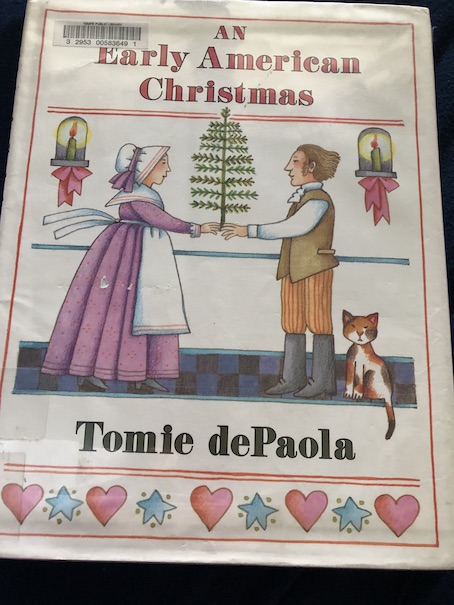
An Early American Christmas by Tomie dePaola, 1987.

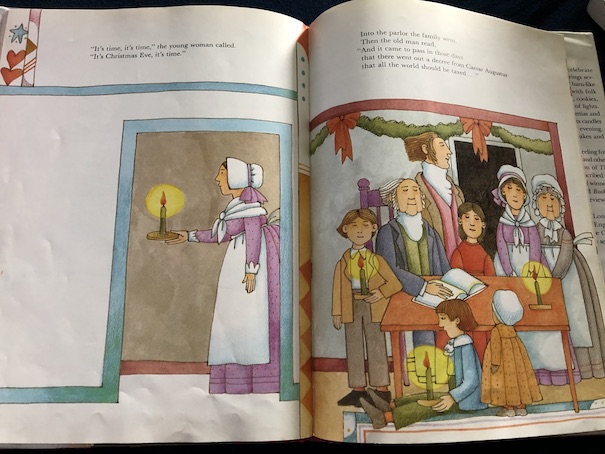
A note at the beginning of the book explains the story behind the book, which is based on the history of early Colonial America. Although Christmas is now a popular American holiday with lavish celebrations, many early colonial groups didn’t celebrate Christmas much at all. Even among Christian groups, Christmas was not regarded as a major holiday. In particular, groups like the Puritans, Presbyterians, Quakers, and Baptists tended to avoid celebrating Christmas, seeing it as a frivolous sort of celebration. However, there were other groups, like Catholics, Lutherans, and Episcopalians, who did celebrate the holiday in a festive fashion. The author of this book imagines what it would have been like for a family that celebrates Christmas if they moved to a New England community that didn’t during the early 1800s. In particular, he used New Hampshire as his inspiration.

The beginning of the story describes a New England town that doesn’t celebrate Christmas with decorations or songs. Then, a new family comes to the village. They were originally from Germany, and they had lived in Pennsylvania before coming to the village. (This would make them Pennsylvania Dutch.) They are usual because of their festive Christmas celebrations.

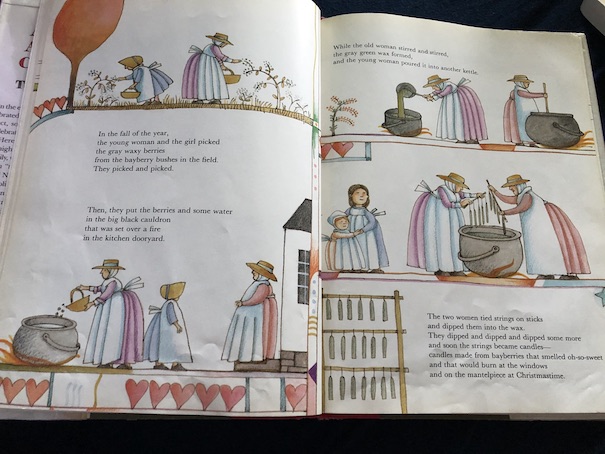
They begin planning for their Christmas celebration in the fall. The women and girls pick bayberries and use them to make candles. They say that bayberry candles bring good luck when they’re burned on Christmas.

The men and boys gather the crops that they will need for their feast. The grandfather of the family carves figures for their manger scene.

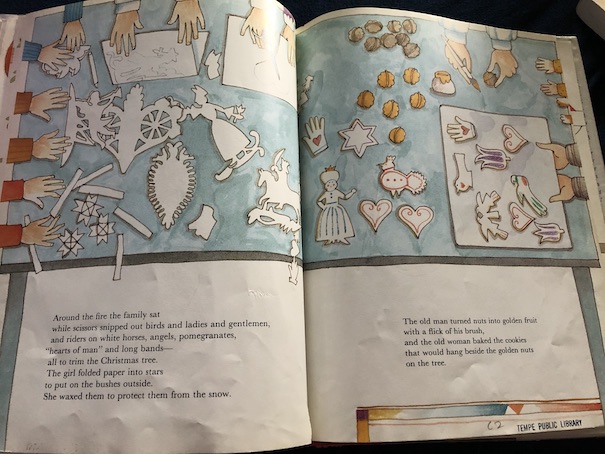
In December, the whole family makes paper decorations and specially-shaped cookies. I liked the variety of baked goods that they show in the pictures. They pick out a tree and make strings of popcorn and dried apples.

On Christmas Eve, they read the story of Jesus’s birth and decorate their home with all of the decorations they have prepared.

As the years go by and other people in town see what the Christmas Family is doing, they begin to celebrate Christmas, too.

The book is available to borrow and read for free online through Internet Archive.

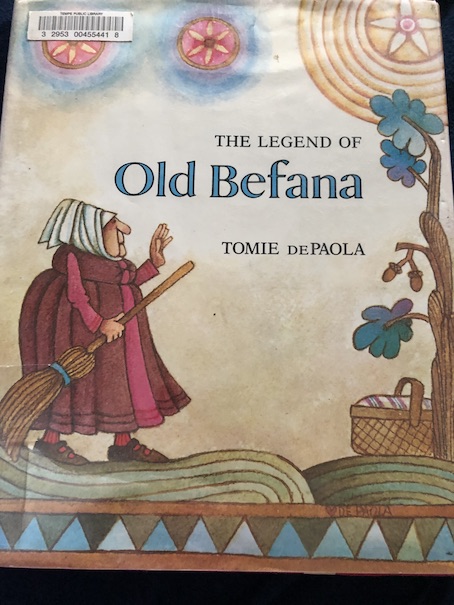
The Legend of Old Befana

The Legend of Old Befana by Tomie dePaola, 1980.

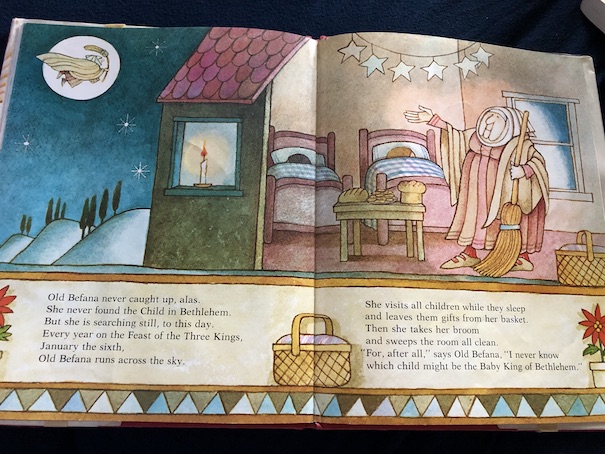
The story is based on a Christmas story from Italian folklore. According to Italian tradition, Old Befana visits the houses of children on January 6th, the Feast of the Three Kings, and leaves treats and gifts. Legend has it that she is on an eternal search for The Christ Child.

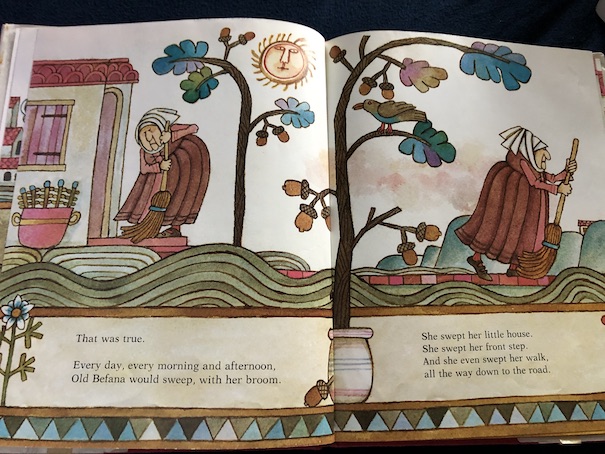
Old Befana is a strange old woman who living in a village in Italy. She is a grumpy woman who spends almost all of her time sweeping. Sometimes, she bakes good things to eat and sings lullabies, although she lives alone, so there’s no one for her to bake for or sing to. People think that she is crazy.

One night, Old Befana wakes up to see a bright light. There is a dazzlingly bright star in the sky, and it makes it difficult for her to sleep.

The next day, as she is doing her usual sweeping, she hears the sound of bells. A strange and beautiful procession comes over the hill. Among the procession are three men in royal robes.

The three kings stop and ask Old Befana if she knows the way to Bethlehem. She says that she has never heard of the place. The kings say that they are looking for “the Child,” but Old Befana doesn’t know what child they mean. They explain to her that this Child is a king and that His appearance was signaled by a bright star in the sky.

Old Befana confirms that she has also seen the star. A boy among the procession tells Old Befana that they are bringing gifts to the Child because He has come to change the world. The boy urges Old Befana to come with them, but old Befana says that she is only a poor woman and continues her sweeping.

After they leave, however, Old Befana continues thinking about what they said, and she starts to think that maybe she should go see the Child. She bakes all kinds of cookies and candies as gifts. She also decides to take her broom so that she can sweep the Child’s room because His mother will be tired. However, she stops to do her usual sweeping before she leaves her home.

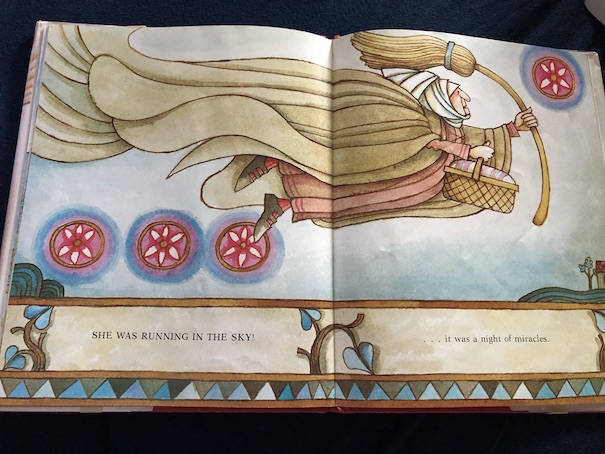
By the time she is finished with her sweeping, the procession is so far ahead that she is unable to catch up to them. Just as Old Befana laments that she cannot catch up to the procession, the angels declare that, “This is the night of miracles.” Suddenly, Old Befana can run fast, even running across the sky.

Unfortunately, Old Befana still doesn’t know the way to Bethlehem or who the Child is, so she doesn’t get to see the Christ Child. However, she still continues her search. Every year on January 6, she runs across the sky, carrying her broom and her basket of treats. At every house she finds with a child, she sweeps the room clean and gives the children gifts and treats because she never knows for sure which of them might be the Child she is seeking.

The book is available to borrow and read for free online through Internet Archive.

The Clown of God

The Clown of God by Tomie dePaola, 1978.

The book begins with a note that the story is based on an old French legend, although the story actually takes place in Italy.

A young boy named Giovanni has no parents and must live as a beggar, but he knows how to juggle. He juggles fruit and vegetables in the marketplace, and the produce sellers give him food in exchange for drawing people’s attention to their wares.

One day, Giovanni sees some actors putting on a play, and he asks for a job with the troupe. After he demonstrates his juggling ability, they agree to take him on in exchange for food and a place to sleep.

Over time, Giovanni’s juggling act becomes more elaborate. Eventually, he becomes famous in his own right and leaves the troupe to become an entertainer for many important people.

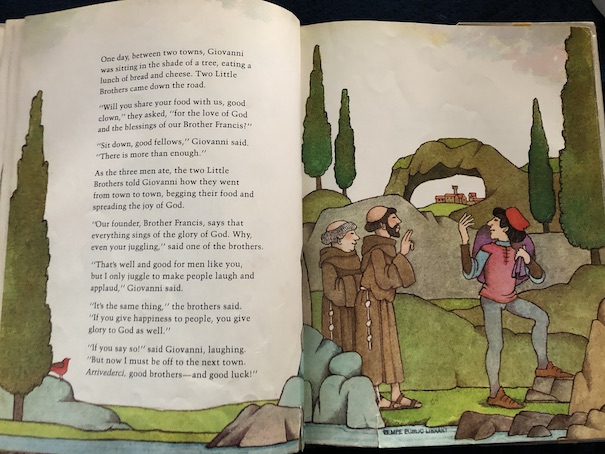
During his travels, he meets two monks, who ask him if he is willing to share his food with them. He agrees, and they tell him about Brother Francis, the founder of their order. (St. Francis of Assissi. They are Franciscan monks.) They say that everything in the world is a sign of God’s glory, even Giovanni’s juggling. Giovanni says that he never thought of it like that before. He just likes making people happy with his performance. The monks say that making people happy is a way of glorifying God.

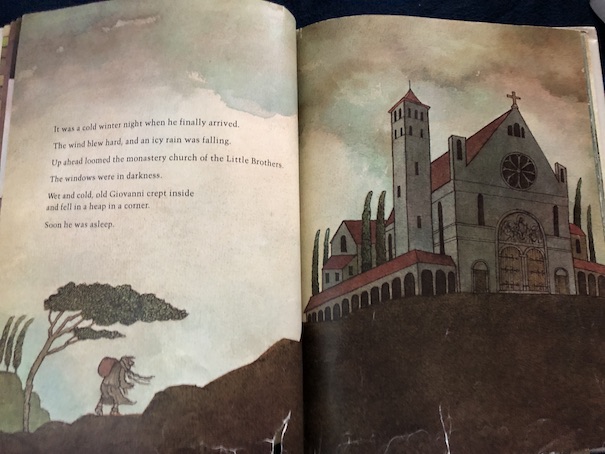
Giovanni continues his performances, but as he gets older, people get tired of his act, and one day, he actually drops one of his juggling balls. For a time, he has to live as a beggar again. However, he eventually finds his way to the monastery where the Franciscan monks live.

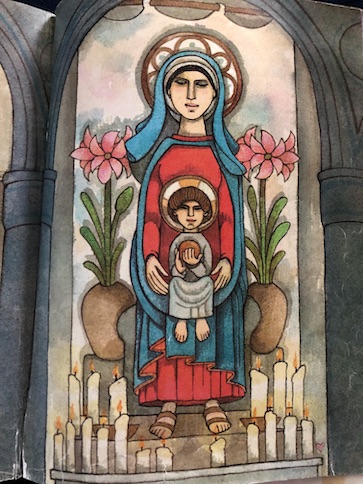
He arrives at the monastery at Christmas, and there is a special procession where people are offering gifts to the Christ Child, placing them in front of a statue of Jesus and Mary. Giovanni is struck by how serious the Christ Child looks in the statue, and so he decides to perform the act that used to make everyone smile.

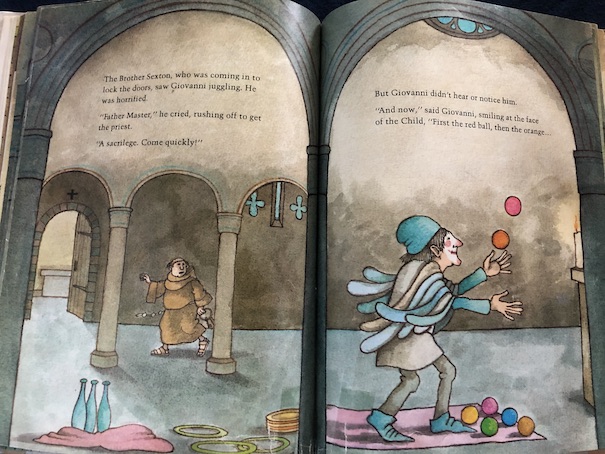
When one of the monks sees him juggling in front of the statue, he thinks that it’s a sacrilege and calls the priest to come see what Giovanni is doing.

The story is sad because Giovanni’s exertion in giving the best performance of his life causes him to have a heart attack and die. However, the priest and the monk notice that, suddenly, the statue is smiling and holding Giovanni’s special golden ball.

The story is about using talents to the fullest. The juggler’s talent, as the monks said, was a gift from God. For as long as he could, he used it to make people happy, and when he was too old to do so anymore, he gave his last, finest performance for Jesus.

The book is available to borrow and read for free online through Internet Archive.
The Puppy Who Wanted a Boy

The Puppy Who Wanted a Boy by Jane Thayer, illustrated by Lisa McCue, 1958, 1985.

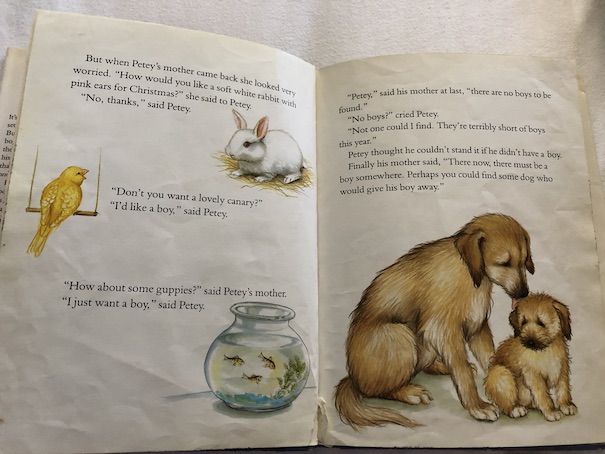
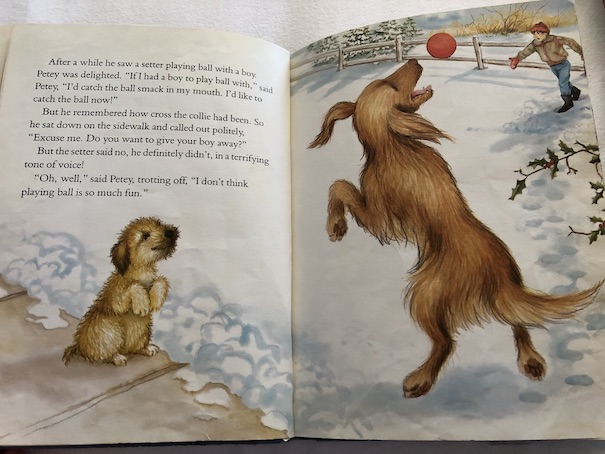
A puppy named Petey tells his mother that he wants a boy for Christmas. His mother says that he might get one if he’s good, and when Petey is a good puppy, his mother tries to find one for him.

Unfortunately, Petey’s mother just can’t seem to find a boy for Petey anywhere. She suggests trying to see if any other dog is willing to part with his boy. However, no other dog wants to give up his boy.
Eventually Petey comes to an orphanage with a sign that says Home for Boys. Petey decides that if the boys have no parents, maybe they could also use a dog. It’s Christmas Eve, and most of the boys are inside are singing Christmas carols, except for one boy, sitting by himself outside.

Petey jumps into the lonely boy’s lap, and the boy loves him right away. When a lady comes to check on the boy, the boy asks if he can bring the puppy in, and she says yes.

All of the boys in the home love Petey and want to keep him. The lady says that Petey can stay if his mother lets him, and Petey knows that she will. Instead of getting just one boy for Christmas, Petey found fifty!

The story was first published in 1958, but my edition is from 1985 and has different illustrations. In the older book, the puppy looked like a beagle.

The book is available to borrow and read online through Internet Archive (multiple copies).

Clifford's Christmas

Clifford

Clifford’s Christmas by Norman Bridwell, 1984.

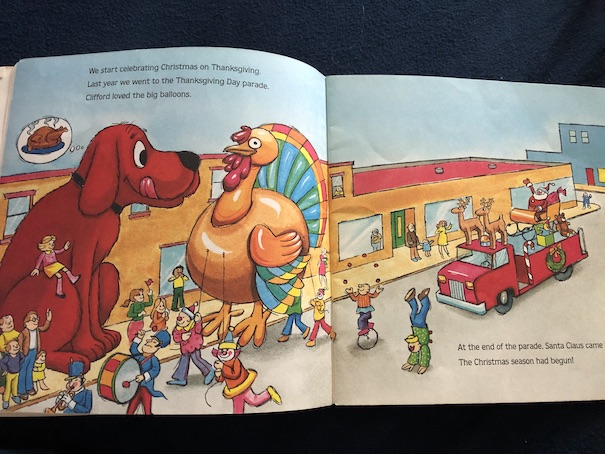
Christmas is coming, and Emily Elizabeth and Clifford are ready to celebrate! Emily Elizabeth talks about how the Christmas season begins with Thanksgiving. (That’s not how everyone regards it, but it is a common way to mark the season in the United States. The day after Thanksgiving, Black Friday, is considered the start of the Christmas shopping season, with people looking for bargains on Christmas presents.)

When it starts to snow, Emily Elizabeth, Clifford, and their friends have fun playing in the snow. They get a Christmas tree, prepare their stockings, and participate in other holiday activities leading up to Christmas. Clifford even gets a kiss under mistletoe!

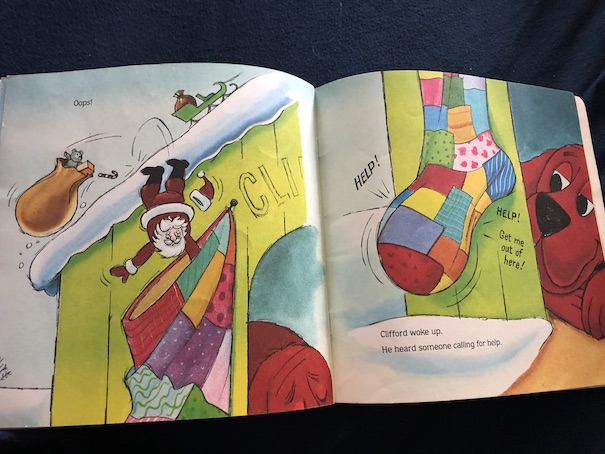
When Santa comes, he lands on the roof of Clifford’s dog house and accidentally falls into Clifford’s stocking, dropping his sack of toys. Clifford has to rescue him.

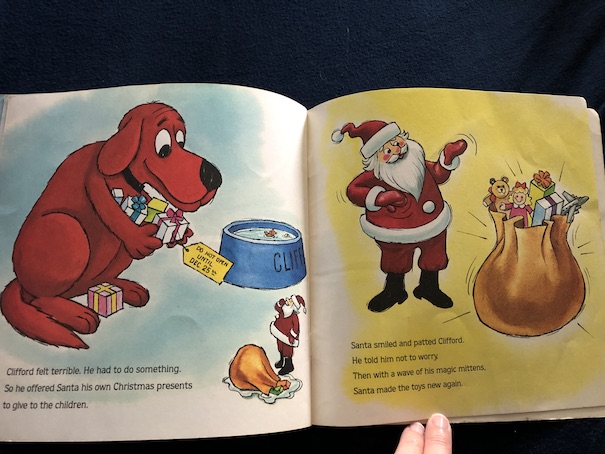
The toys fall into Clifford’s water bowl, but Santa fixes them with his magic. No harm done, and it’s a Merry Christmas after all!

This is just a cute Christmas story with a popular children’s books character. I loved the Clifford books when I was a kid, but I have to admit that they don’t look as good to be now as an adult. The entire plot of Clifford books revolves around Clifford’s enormous size, which is the very idea of the series. However, the plot of this is light, the problem is both caused and immediately solved by Clifford’s large size, and I think I’m just not interested in the usual trope of Famous Character Saves Christmas In Some Way anymore. I think that some Christmas stories with popular characters are still good, but for them to work, they usually have to have deeper, more clever, more interesting plots. This book isn’t bad, but I just didn’t think it was particularly great.

The book is available to borrow for free online through Internet Archive.