The First Book of Painting

The First Book of Paintings by Lamont Moore, 1960.

This book is meant to be a beginner’s introduction to understanding and appreciating paintings. I thought it was interesting how, in the book’s introduction, it points out that the word “art” is based on the Latin word for “skill.” Art work is skilled work, and it explains how other types of skills are referred to as “arts.” Artists are people who are skilled at making things, but they also have an ability to see things more clearly than most people, form strong mental images, and convey those mental images and their feelings about them through their art.

The book is divided into sections that focus on different elements of paintings and artistic principles, explaining their role in art and providing examples of their use. The elements of paintings are line, shape, space, light, and color. The artistic principles covered in the book are pattern, balance, rhythm, contrast, and unity. Some of these sections also include suggested activities for readers to try that demonstrate these concepts.

Line – The lines of a painting define shapes in the painting. They also convey the idea of movement and direct the eyes of the viewer to important points of interest. This section shows a cave drawing a rhinoceros and suggests that readers trace it onto another piece of paper but change some of the lines to see the difference it makes.

Shape – Shapes are defined by lines. Shapes are flat, but their placement can create the illusion of depth and distance. The book suggests studying shape in drawing by drawing a friend’s silhouette.

Space – Shapes occupy and fill space. The placement of shapes within space create balance and suggest depth.

Light – Light is used to create the illusion of three-dimensional shapes because physical objects have sides that reflect light and cast shadow. It can also be used to give viewers a sense of substance because metal objects in paintings should look particularly reflective. Lighting can also convey mood in a painting. Part of this section explains how impressionists use light to give paintings more of an appearance of depth when viewed at a distance.
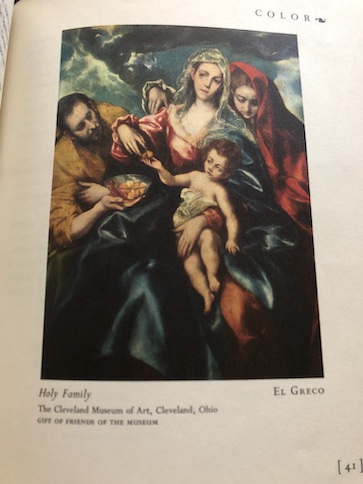
Color – The colors help to convey the mood of the painting. Certain colors also look better in combination with each other.

Pattern – Patterns are repeated features, like repeated shapes, lines, colors, and/or repeated light and dark spaces. Patterns can be used turn a few simple elements into part of a larger concept.

Balance – The concept of balance means that elements of a painting should balance each other, like placements of shapes and objects, points of interest, and areas of dark and light colors. If elements are out of balance, it can unsettle the viewers and give them the impression that something is wrong and needs to be fixed.

Rhythm – Rhythm in a painting suggests movement and energy, like the subjects of a painting are alive and moving.

Contrast – Contrast in a painting creates visual interest. If the elements of a painting are too much alike, they can look dull. The contrast could be in the placement and grouping of elements in the picture (such as some objects in the picture being grouped while others are isolated) or contrast between light and dark elements, making some of them stand out from others.

Unity – Unity refers to how well all of the elements of a painting combine to form a whole. All of the previously listed aspects of a painting need to work together effectively to convey the subject of the painting and the mood and message of the artist.

One of the things I like about this book is that is uses a wide selection of paintings from different countries and time periods as its examples, from cave paintings and paintings on Grecian pottery to Renaissance portraits and modern art.

At first, when I was reading the book, I was annoyed that almost all of the pictures of paintings in the book are black-and-white. Then, I discovered that the pictures in the chapter about the use of color in paintings are full color. That is the only place in the book (aside from the cover) where there are color images. I think the reason why they did that is to draw attention to the colors in that chapter while emphasizing other aspects of painting in the other chapters, but I think I would still prefer more color images throughout the book.

The book is available to borrow and read for free online through Internet Archive.

The FunCraft Book of Print and Paint

The FunCraft Book of Print & Paint by Heather Amery and Anne Civardi, 1976.

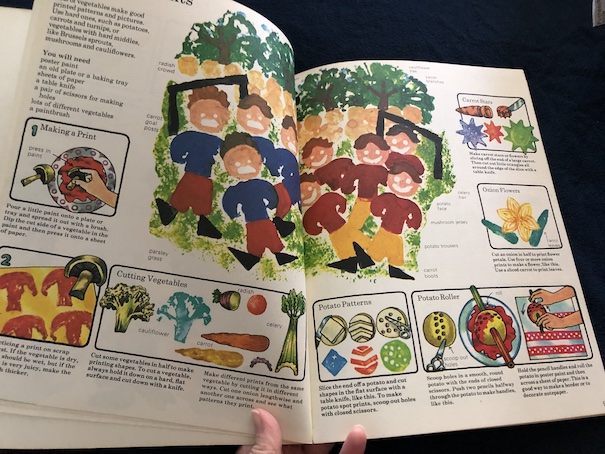
This is the American edition of a British book, and it’s part of a series of craft and activity books. When I was a kid, I was really into crafts, but I didn’t do even half of the crafts in the craft books we had. This particular book is interesting because I first thought that it was going to be about painting pictures, and it is, but it’s specifically about making “prints” with paint. Basically, the crafts involve using various objects, from leaves and veggies to your own hands and fingers as stamps to make pictures and designs.

I remember once taking part in an activity at our local library that involved making pictures with stamps make from cut potatoes, like the book shows in the section about vegetable prints. Our potato stamps weren’t as elaborate as the ones shown here, and it’s interesting that they thought of using other veggies to get some different shapes as well.

The range of objects and techniques that the book uses in making prints is also interesting. It points out that you can make some interesting patterns by painting on a page and folding it over or using string coated in paint to make swirls. There are tips for making using tools like stencils and rollers to make designs.

The book also includes some painting techniques, like how to mix colors, and some tips for how to enhance pictures you’ve made, like painting over parts of a picture with glue and then shaking on some powdered colors. It gives suggestions for different powdered colors, like colored sand, salt, or sugar or using powdered spices or cocoa from your kitchen (more expensive, but it will give your artwork a scent).

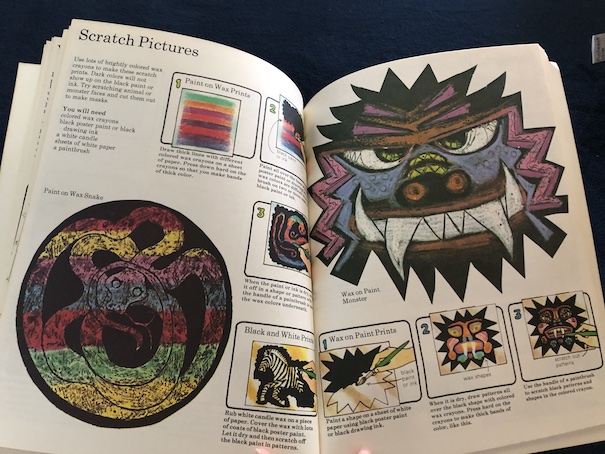
One of my favorite suggestions was a technique that I did like a lot when I was a kid, making scratch pictures with a simple form of sgraffito. You can buy kits and specially prepared paper for doing this today, which didn’t exist when I was a kid (at least, not anywhere where I could buy it). Instead, I had to do it the old-fashioned way, using the technique in this book – drawing a rainbow of colors on paper, covering of it with black, and then scratching the black off to make rainbow pictures and patterns.

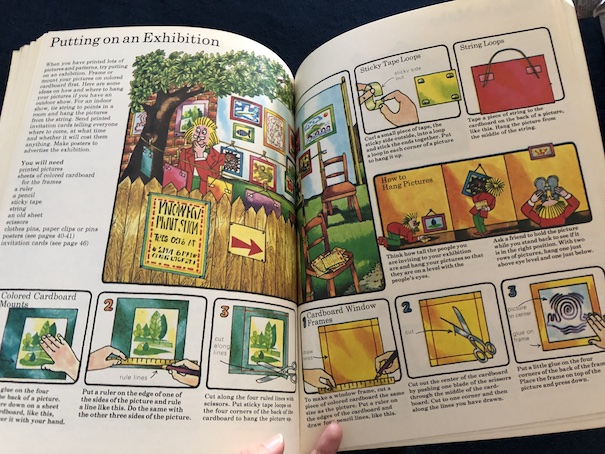
There are too many tips and techniques for me to cover everything in detail. The last few pages cover uses of the techniques for specific projects, how to make prints on cloth, and how to have an exhibition of the pictures you’ve made.

The book is available to borrow and read for free online through Internet Archive.
Bird Wise

Bird Wise by Pamela M. Hickman, illustrations by Judie Shore, 1988.

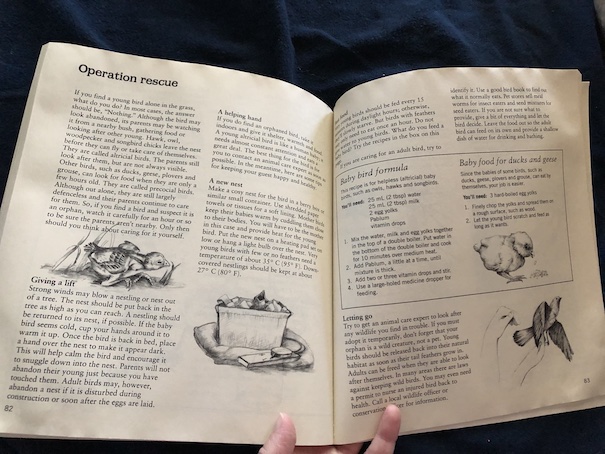
This is a beginning guide to birds and bird watching for kids. I thought that the guide was very helpful with nice, detailed illustrations. The book explains the appearance, biology, and lives of birds and offers activities to help readers understand and interact with birds.

The first section in the book is about the appearance and body parts of birds. It explains how different birds have differently-shaped beaks and feet and different types of feathers and how the differences help each type of bird eat the foods they like and live in the places where they live. One of the activities for this section is about how to start a feather collection. The book also explains that different birds have different styles of flying.

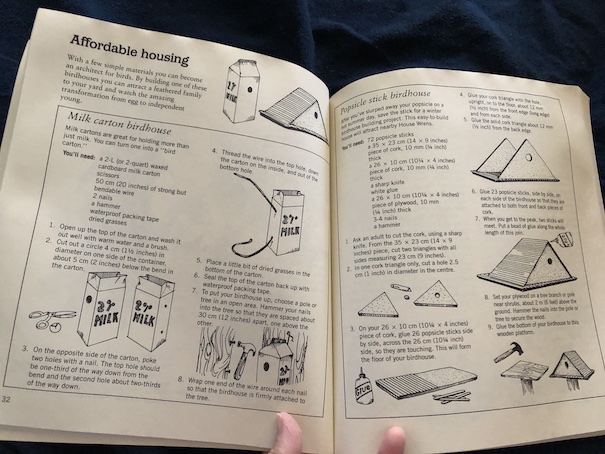
The section about how birds live explain about different types of bird nests and how they migrate and raise their young. The book explains different methods for making bird feeders and bird houses.

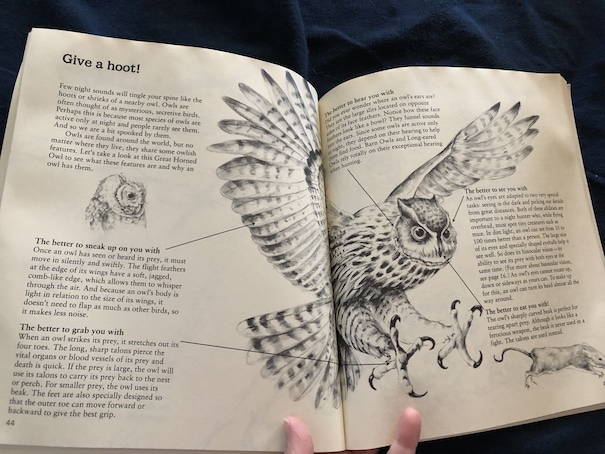
The book profiles certain specific types of birds, including owls (there is an activity about dissecting owl pellets, which I had to do when I was in elementary school), gulls, hummingbirds, and woodpeckers.

In the section about bird watching, the book offers tips for what to look for to identify a bird’s type. It also explains how to make bird blinds to avoid being seen and how to recognize types of bird songs.

The book also contains other helpful information, like how to care for injured birds and how to plant a garden that will attract birds. It also includes a board game that emphasizes some of the lessons about birds in the book.

Overall, I was pleased with the range of information in the book. It was interesting and well-presented.

The book is available to borrow and read for free online through Internet Archive.

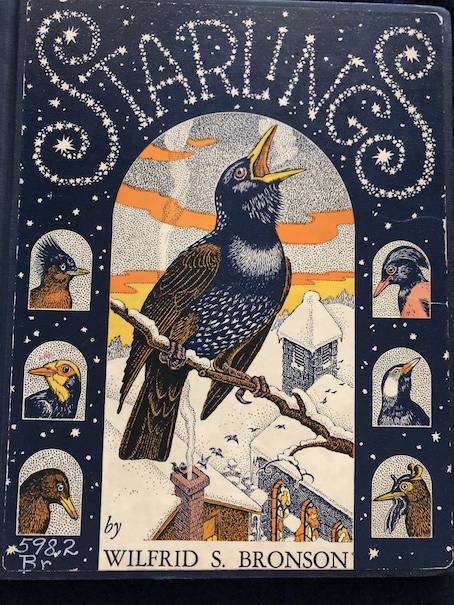
Starlings

Starlings by Wilfred S. Bronson, 1948.

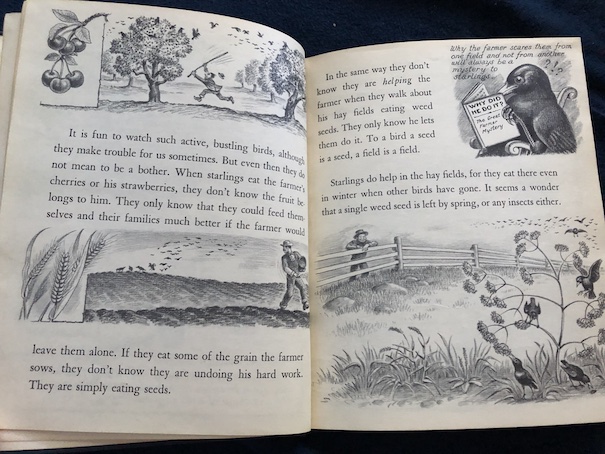
The title of the book tells you what it’s about; this is a children’s picture book about starlings. That sounds pretty straight-forward and even a little dull, but there is more to learn about starlings than I imagined, and the author of this book has an imaginative way of explaining information. I love books that cover odd topics in detail, and I enjoyed the whimsical quality of this book. The pictures are detailed black-and-white drawings, some with captions like comics. Most of them explain the anatomy of the birds or their habits, but they have some unique ways of expressing educational information.

The book begins by describing the singing of starlings and then explains how farmers view starlings. Starlings can be a pest to farmers when they eat their fruit or the seeds the farmers are trying to plant, but they can also be helpful when they eat weed seeds and prevent weeds from coming up in the farmers’ fields. Of course, the birds don’t know when they’re helping or hindering because, as far as they’re concerned, they’re just there to eat any food that happens to be available at the moment. I like the little picture of the bird reading a mystery book, trying to figure out why farmers don’t mind when they eat some seeds and try to scare them away from others. That’s an example of the whimsy I was talking about.

The book continues describing what starlings eat and places where they like to roost, and it explains how they affect people living in cities (mainly, messing up their cars). There were times when people in cities considered them such a nuisance that they would shoot them, and some poor people hunted them for food. Actually, the entire reason why we have starlings in the US is that people over-hunted other types of birds (there is a disturbing picture of hunters with piles of dead birds at one point in the book), and birds are an important part of the ecosystem. Even though they can annoy farmers when they eat seeds and fruit, they also eat bugs that are pests to crops.

I was really struck by the passage that explained how starlings were first brought to the United States and why they were brought here:

“Some people think that starlings have no right to food or nesting-places because they are not ‘American birds.’ Yet all the starlings you see were born in America. So were their parents and grandparents and great-great-grandparents and all their relatives clear back to 1890. In that year their ancestors were caught in Europe and brought in cages to America. So many American birds had been killed at that time by our own ancestors that our crops were growing wormier and wormier each year, while insect pests grew worse and worse. So starlings were imported to help us fight the insects. They were freed in Central Park in New York City and left to look out for themselves.”

This explanation uses simplified language for children, and it also oddly evokes imagery of human beings. We don’t normally refer to animals as “foreigners” because animals don’t speak different human languages or have allegiances to foreign governments like people from other countries do. When we talk about new species that have been introduced to an environment where they did not originally belong and quickly spread out and multiple, we usually call them “invasive species.” In that case, the ecological concern is that the new invasive species will disrupt the balance of the natural environment and crowd out native species, but the author is trying to point out that the situation with the starlings was different. The starlings were introduced to the environment in the US on purpose, not by accident, and it was done specifically because they were meant to a solution to a problem. The environment had already been disrupted by humans who had moved into areas where they had not lived previously and where they killed too many of the native species themselves without regard to what that would do to the natural environment and their own farming. The introduction of the starlings was meant to restore a balance that had been lost. However, the people who had originally caused the problem didn’t see it that way, seeing the starlings as pests because they were “foreign.” While birds in general may occasionally be a nuisance because they don’t understand human priorities, they still perform useful functions for human beings as they go about their lives, just being the birds they are – eating annoying weed seeds and bugs and scavenging food from what humans throw out.

“People who think that starlings should be starvelings because they are ‘foreigners’ should remember that these American-born birds save much of what they themselves throw away and are still helping us to fight insects as they did in 1890.”

I understand what the author is trying to explain about balance in the ecological system, but I was struck by the human imagery that the passage evokes: “Foreigners” who came to New York City, not unlike immigrants fresh off the boat from Ellis Island during the 19th century, set free to make their way in a strange environment among people who often regarded them as worthless pests, disliking them while still using the useful services they provided. The comparison still fascinates me. At first, I wasn’t sure that the author meant to make that broader comparison here. I thought he probably used that language just to simply the ecological concepts for children’s understanding, but the author does make another comparison a little further on:

“So let’s be fair. If American-born starlings are foreigners, then so are all people in America except the Indians (Native Americans). So are many kinds of birds, animals, and plants. Our ancestors brought them here from other countries. But if all these creatures, and ourselves, are American now, then so are the starlings. Yes indeed!”

So get off your high horse, starling-haters.

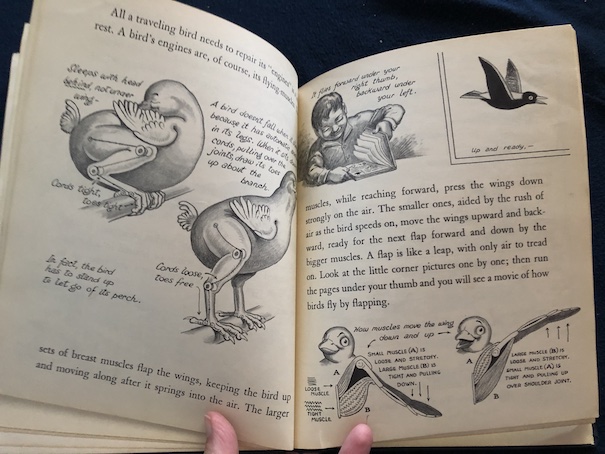
At several points in the book, the author compares birds to airplanes, explaining their muscles and flying mechanisms like machinery. I liked the page where the author compares different planes and helicopters to types of birds (cruisers being like gliding eagles and albatrosses, fast-turning speed planes like starlings and swallows, and hovering helicopters like humming birds). The parts that describe how birds cling to branches as they sleep and how their wings move look accurate and helpful. The part about how a bird creates eggs is hilarious. The text about the formation of the egg inside the bird isn’t bad. It completely skips over the subject of the fertilization of eggs (understandably), and the picture show the bird as a kind of egg-making factory with little men assembling the parts of the egg in stages instead of showing a bird’s reproductive anatomy.

In the upper right corners of this section of the book, there are little squares with a flying bird because part of the book is meant to be uses as a flip book to see a bird flying. The page shown above with the boy flipping through the book shows how to use the flip book portion.

There is a section of the book that explains how baby birds develop in the egg and eventually hatch.

There is also a section in the book that shows how adult starlings will prepare a nest for their eggs and how they raise their babies.

As I was reading the book, I wondered who the author, Wilfred S. Bronson, was. Bronson was an artist specializing in natural history, and he wrote and illustrated other books for children about animals and natural history. In the years before he wrote this particular book, he served in the US Army during World War I and painted murals for the Works Progress Administration (WPA) during the Great Depression. He also participated in expeditions to gather specimens and create illustrations of wildlife for botanical gardens and museums.

I haven’t found a copy of this particular book to read online, but it was republished in 2008 and is still available from Amazon.

Bells

Bells by Elizabeth Starr Hill, illustrated by Shelly Sacks, 1970.

I love books about oddball topics, so a children’s picture book about the history of bells was irresistibly intriguing.

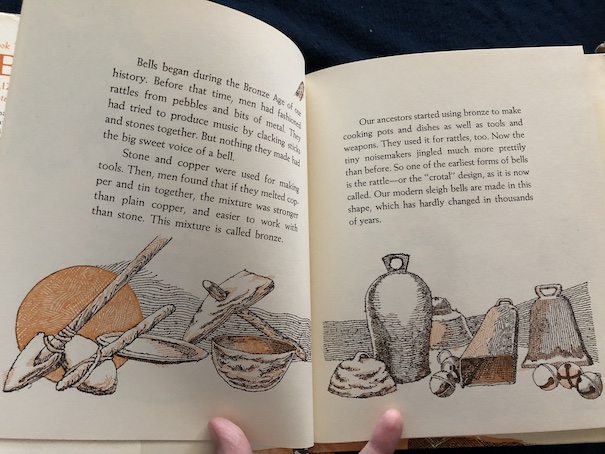
The book begins with the origins of bells in the Bronze Age. People had made rattles of various kinds before the Bronze Age, but after they learned to make bronze, an alloy of copper and tin, they discovered that they could make metal rattles with a much prettier sound. These metal rattles/early bells were made in the “crotal” design, which is the same shape as today’s jingle bells or sleigh bells. Other shapes of bells, like gongs and the classic bell shape may have been inspired when people realized that pleasant sounds could be made by banging bronze utensils against bronze dishes and bowls.

Bells have been used for thousands of years and have served many purposes. The oldest bell that has been found (at the time the book was written) was over 3000 years old and came from the area near Babylon. King Solomon of Israel used to have bells to frighten away birds from the roof of his temple. The Spartans were able to infiltrate a walled town in Macedonia because the sentry wore a bell on his uniform that helped them to keep track of where he was, but in other instances, nets with bells attached to them were used to warn of the presence of enemies. Bells have also been frequently used in religious services.

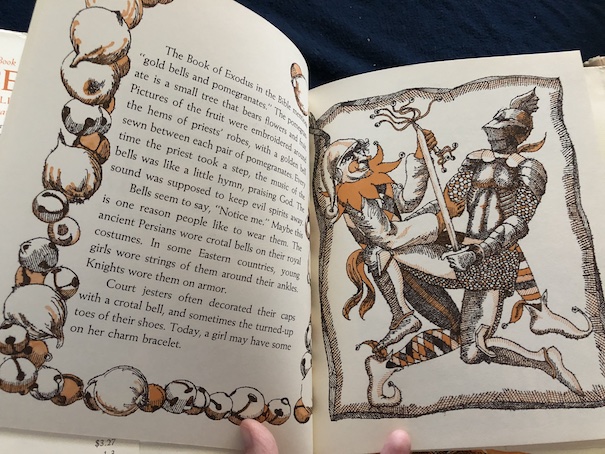
Sometimes, people wear bells to call attention to themselves. The classic jester’s cap with crotal bells (jingle bells) attached to it is meant to be attention-getting.

Bells can be made of many different materials, from different types of metal bells to glass bells to clay bells. There are even wooden ones, although they make more of a clunking sound than a ringing. People used to make bells by hammering pieces of metal into shape, but then they developed ways to cast bells in molds, which is how bells are made today.

There are many superstitions that have been attached both to the making of bells and their use. The book describes the Bilbie family, who famously made bells in Medieval England. The Bilbies were superstitious and consulted astrologers to determine the best times to make their bells. They also always rang bells for the first time on full moons. Various people have believed that ringing bells frightens away demons and witches.

The parts about superstitions and legends are my favorites. In particular, there is a legend in England about a town that was completely buried during an earthquake. The people in the town always rang their church bells at Christmas, and the legend is that if you go to a particular spot and put your ear against the ground, you’ll still hear them ringing the bells. However, the book says that there’s actually a scientific explanation behind the phenomenon. People who have put their ears to the ground at that spot have heard bells ringing, but they’re actually the bells from a nearby town, not one underground. The ground actually conducts sound very well, even better than sound waves moving through the air, so a person standing upright might not hear the bells ringing from another town, but someone who put their ear to the ground could hear the conducted sound vibrations. It’s not unlike the phenomena experienced by people who put their ears to the rails on railroad tracks to listen for the train. There are also stories of people having heard the approach of herds of animals, like buffalo, coming toward them in this way. The book doesn’t mention it, but “keep an ear to the ground” is actually an expression for watching and listening for signs of things that are going to happen because people noticed that vibrations in the ground could be indications of something coming toward them.

The book also describes some famous bells, like the Liberty Bell, Big Ben (Big Ben is actually the name of the bell in the clock tower, not the clock tower itself, although people informally think of the clock tower as Big Ben) and Tsar Kolokol, the largest bell in the world.

There are also a few nursery rhymes that mention bells (although the book doesn’t give any background information about the rhymes) and some information about change-ringing and carillons.

The book annoyed me a little in the way it kind of jumps around, telling some history, then some legends, then some more history, and then more legends. It’s a very easy read, and the information is interesting, but it’s a big disjointed. It sometimes feels more like a list of facts and short stories than one cohesive story. It might help if there were headings or chapter divisions in the book to organize the information, but there aren’t.

The book is available to borrow and read for free online through Internet Archive.

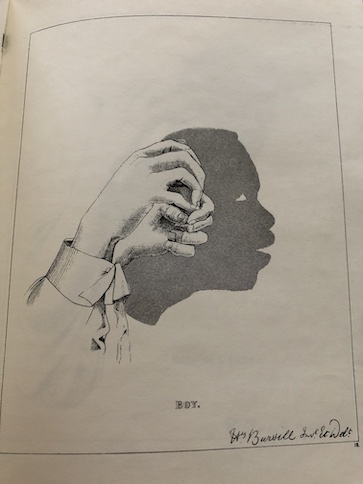
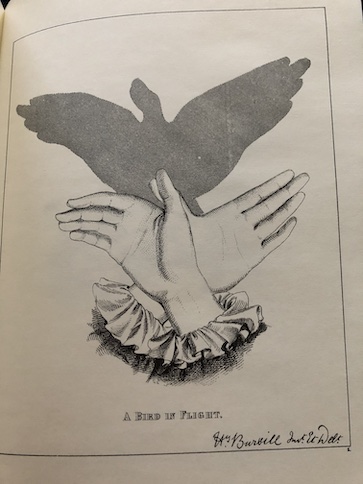
Hand Shadows

When I first read and started playing with this book as a kid, I didn’t stop to read the preface in the book or look at the publishing date, so I completely missed the fact that this is a reprint of a book from the late 1850s. The author, Henry Bursill (link repaired 9-11-24), was a professional artist

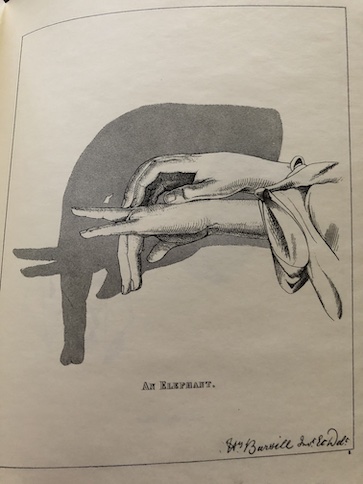
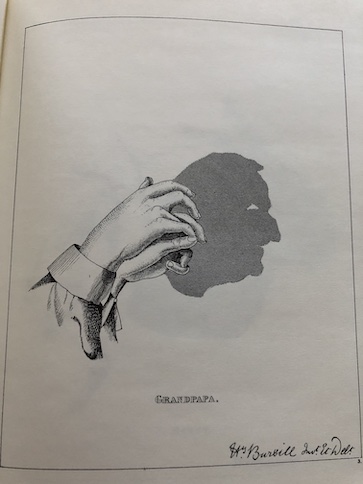
In the preface, Bursill refers to a well-known print from the early 19th century called The Rabbit on the Wall, which shows a father making shadow figures on the wall with his hands to amuse his children. Bursill says that there have been other books about hand shadows before his, but he emphasizes that his book is not the same as theirs because he has worked out his own hand shadows through experimentation. He says that it will take some practice for people making hand shadows to get them perfectly, but he encourages people to practice and not be afraid to work out new hand shadows of their own through experimentation. Bursill did the illustrations for the book himself, and he says that he began sketching some of the designs during his time as an art student and that he would amuse some fellow students by making hand shadows on the wall of his studio.

Other than the preface, the only words in the book are the captions on each of the pictures. I’ve tried some of the hand shadows in the book, and I had a more difficult time than the preface makes it sound. The only ones I’ve really been able to do well were the bird and the greyhound. I haven’t given up on mastering some of the more difficult ones someday, though!

The book is available to read for free online through Project Gutenberg and Internet Archive (multiple copies).

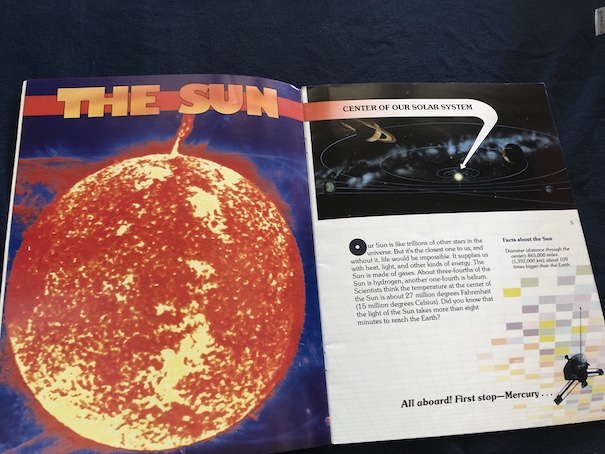
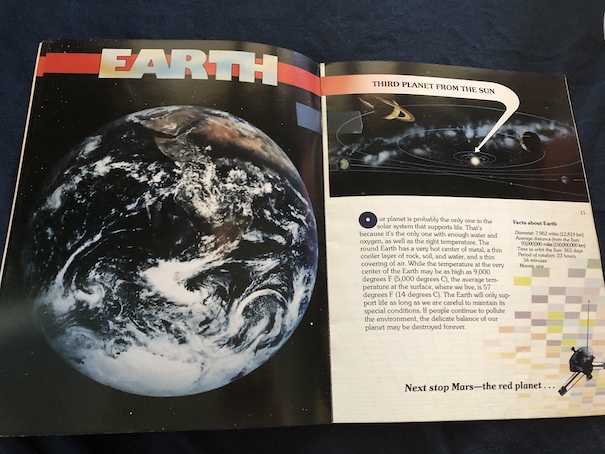
Voyage to the Planets

Voyage to the Planets by Jeff Davidson, 1990.

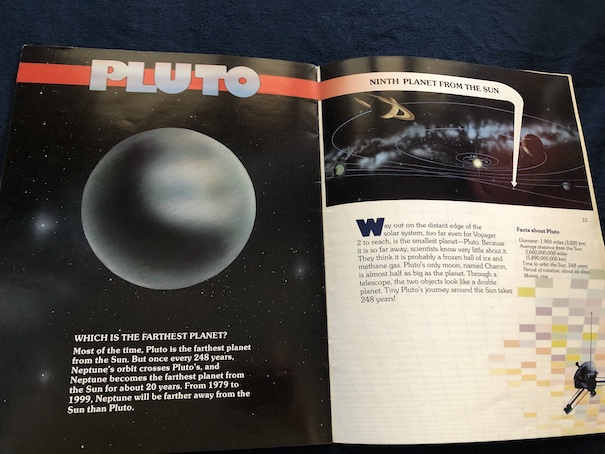
This was my second favorite book about outer space as a kid! It would have been the first favorite, but my first favorite had glow-in-the-dark pictures, and this one doesn’t. I bought them at the same time at a school book fair, but the one with the glow-in-the-dark pictures definitely caught my attention first. This book does, however, have pictures of the planets taken by the Voyager 2 space probe.

The beginning of the book explains a little about the solar system and its place in the galaxy and the Voyager 2 probe.

Then, it takes readers on a journey through the solar system, beginning with the sun at the center of the solar system and moving outward, planet by planet. The page about each planet explains the origin of the planet’s name in Roman mythology and gives facts about the planet, such as its size, distance from the sun, and rotation and orbit periods.

The page about Earth specifically mentions, “The Earth will only support life as long as we are careful to maintain its special conditions. If people continue to pollute the environment, the delicate balance of our planet may be destroyed forever.” Books, movies, tv shows, and teachers in public school gave us environmental messages very early in life when I was young in the 1980s and 1990s.

The book ends with Pluto as the ninth planet, which is what we were taught as kids in the early 1990s. There is no mention of “dwarf planets” or the Kuiper Belt because the book was published in 1990 and scientists didn’t find definite evidence of Kuiper Belt objects until 1992.

Discover the Night Sky

Discover the Night Sky by Chris Madsen and Michele Claiborne, 1989.

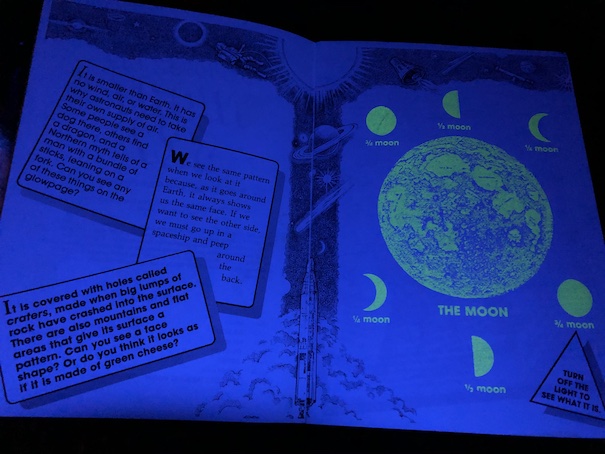
I bought this book at a school book fair when I was a kid, and it was my favorite book about the stars and outer space because it has glow-in-the-dark pictures. As a child, I loved anything that was glow-in-the-dark. Actually, I still do.

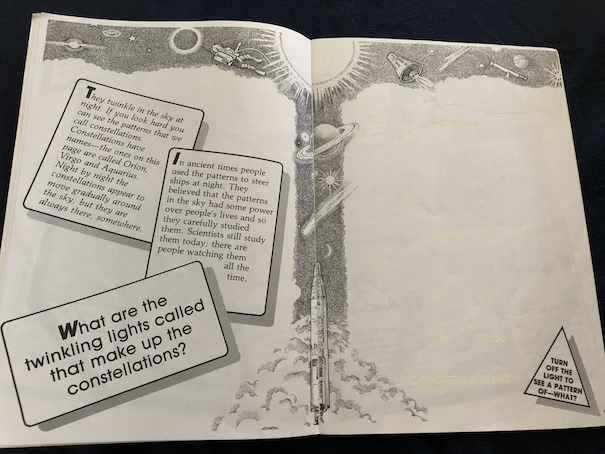
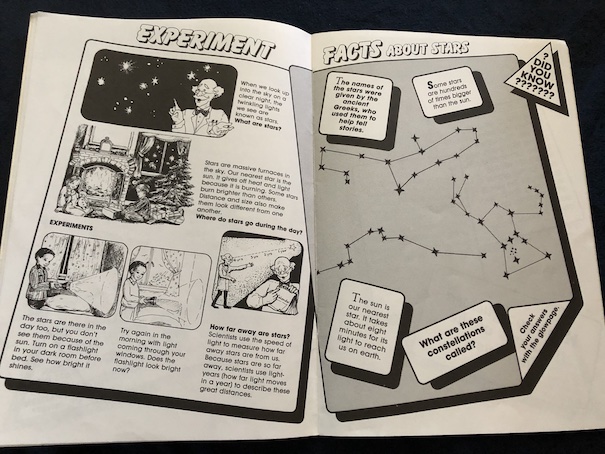
Every page in the book is designed to be interactive. There are pages that talk about different aspects of outer space, but the pages with the glow-in-the-dark pictures want you to guess what’s in the picture based on descriptions of it. Then, you’re supposed to turn off the light and look at the glowing picture to see what it is. You can see the what the glow-in-the-dark picture is without turning off the lights if you tilt the book and look at it at an angle or use a black light (like I did to take the pictures), but it is more fun if you really do look at it while it’s glowing in the dark. (Like other glow-in-the-dark toys, it glows better if the page has been in the light first to charge it.)

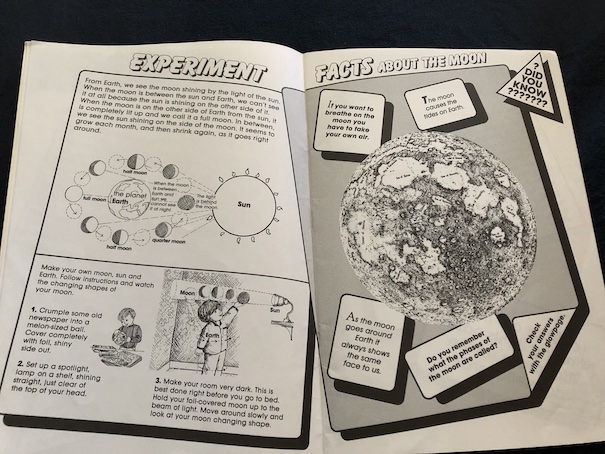
The pages after each glow-in-the-dark page have facts about the object in the glow-in-the-dark picture and an experiment for readers to do. The experiments help demonstrate the nature of the moon, stars, and planets, like what causes the phases of the moon, what causes seasons on Earth, and why you don’t see the stars during the day, even though they’re still there.

The information in the book is still factually correct, although it shows Pluto as being the last planet of the solar system. (Since people still quibble about this, I don’t consider it a big issue.) It isn’t a bad introduction to outer space for young children. The last page in the book is about the Voyager 2 space probe. Its primary mission ended around the time the book was first published, but we have contact with the space probe today (as of early 2021).

The book is available to borrow and read for free online through Internet Archive. The online version of the book doesn’t fully do it justice because you can’t take advantage of the glow-in-the-dark feature, but you can still read the text and see the experiment pages.

Somewhere in Africa

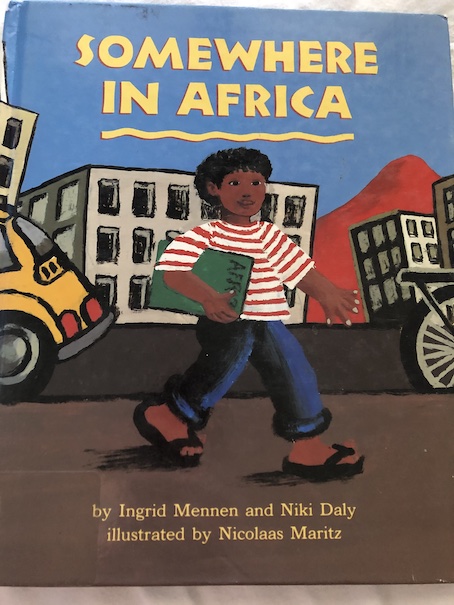
Somewhere in Africa by Ingrid Mennen and Niki Daly, illustrated by Nicolaas Maritz, 1990.

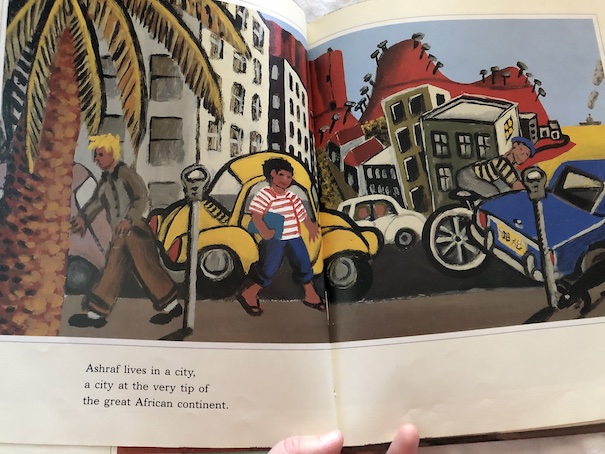
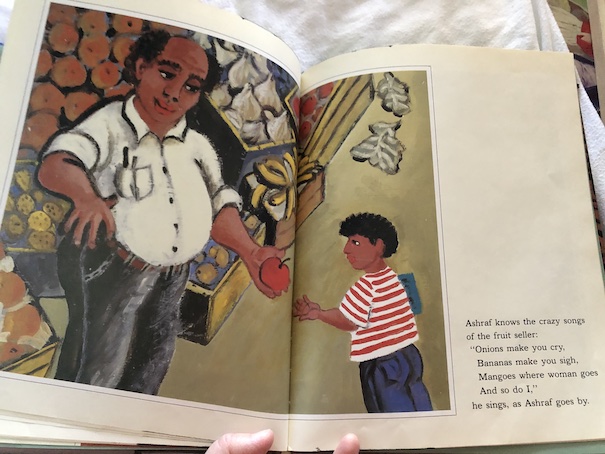
I didn’t read this book when I was a child, although it’s old enough that I could have, but I was fascinated when I found it in a Little Free Library because this is an American edition of a book that was originally from South Africa. I enjoyed the colorful painted pictures, and I think it’s a good book for explaining to American children what it would be like to be a kid in South Africa. For a child living in a city, life actually wouldn’t be too different from the lives of American children living in cities. Africa isn’t all savannas and animal safaris.

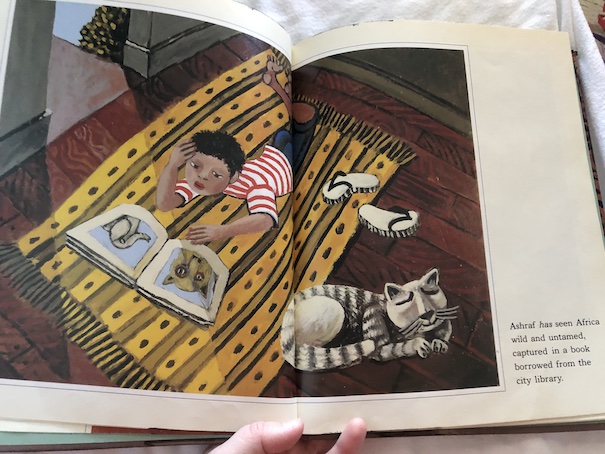
A boy named Ashraf lives in Africa. He doesn’t live in a place with lions, crocodiles, and zebras, though. He lives in a very busy city. Ashraf likes animals, and he reads about them in his favorite library book.

As Ashraf goes to the library, he sees all of the busy traffic of the city and passes by shops with fascinating things in their windows. In the market, there is a fruit seller singing about his products. Other people are selling flowers, and there are street musicians.

When Ashraf gets to the library, he checks out the same book about African animals again.

The book is available to borrow and read for free online through Internet Archive (multiple copies).

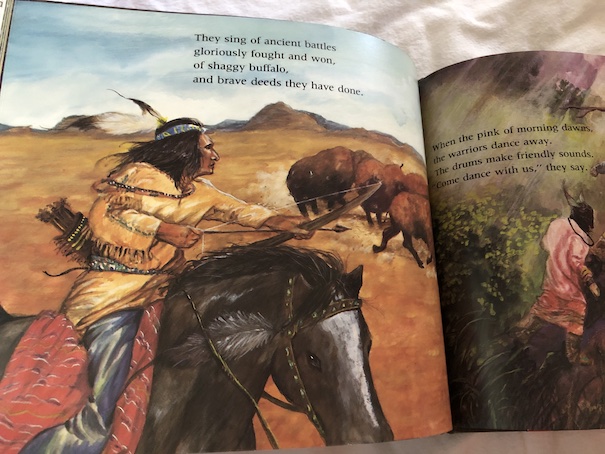
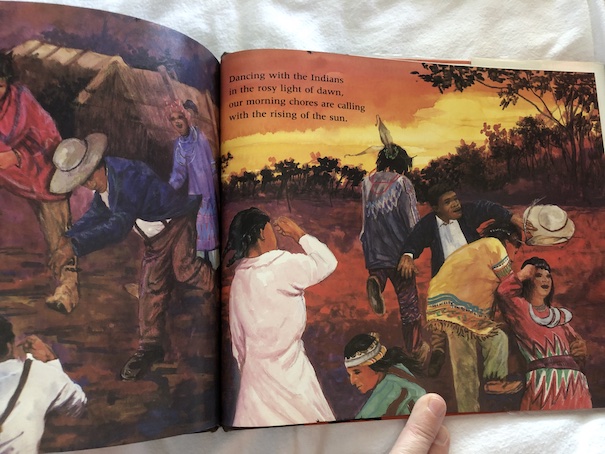
Dancing with the Indians

Dancing with the Indians by Angela Shelf Medearis, illustrated by Samuel Byrd, 1991.

I love books with historical background, and this is a fascinating picture book that is based on the history of the author’s family. Like the author’s earlier book, Picking Peas for a Penny, it is told in rhyme, from the point of view of the author’s mother as a child in Oklahoma during the 1930s.

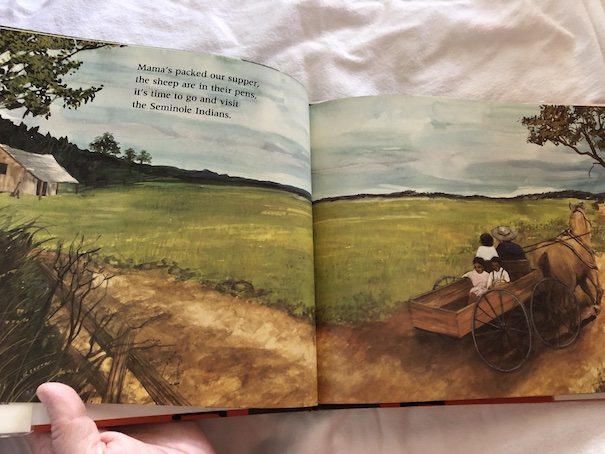
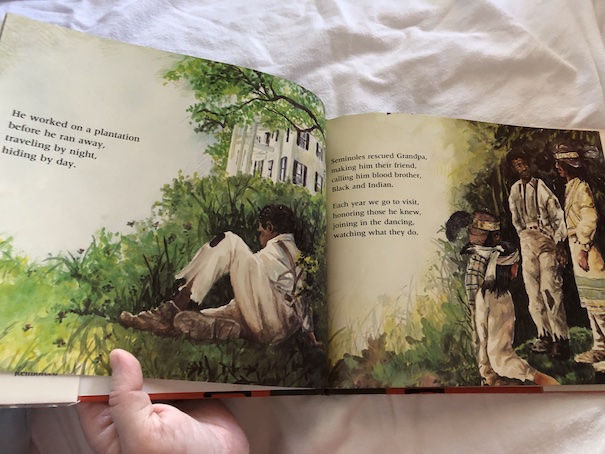
The girl and her brother are going with their parents to visit the Seminole American Indians. As they travel in their wagon, the parents explain to the children the history of their family. Many years before, the girl’s grandfather (the author’s great-grandfather) escaped from slavery and ran away to Oklahoma, where he was accepted by the Seminole tribe. Ever since, his descendants have continued to visit the tribe and join in Seminole celebrations and ceremonies as part of their extended family.

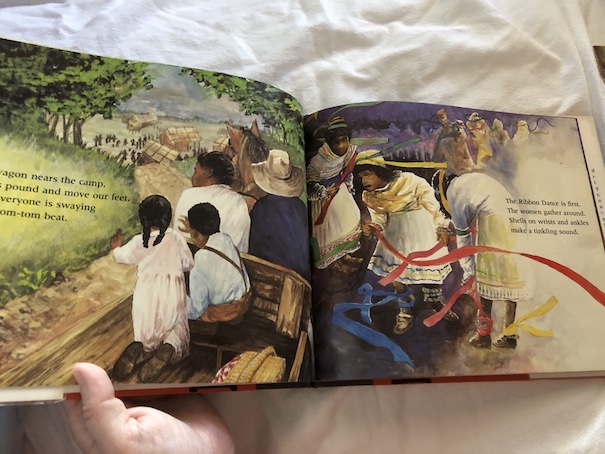
The night is an exciting celebration with dancing, drumming, and songs and stories of past triumphs.

They all dance and celebrate through the entire night, until morning. As the family returns home to tend to their farm, the father promises them that they’ll return to dance with the Indians again.

I liked this book because it explains an aspect of American history that I don’t remember being discussed much when I was in school. In fact, I think that the first time I saw anything that explained that escaping slaves sometimes headed west instead of north before the Civil War was in a Disney Adventures magazine, where they were talking about cowboy, specifically mentioning black cowboys. However, another option was for escaped slaves to join up with Native American tribes. The Seminole tribe of Florida and Oklahoma was one group that was known to accept escaped slaves and adopt them into the tribe, starting in the early 1700s continuing into the 1850s. Some of the escaped slaves married into the tribe. The African Americans who joined the Seminoles and their descendants came to be called Black Seminoles. Parts of the two cultures intermingled. Black Seminoles adopted Seminole traditions, and they also introduced Seminoles to aspects of their traditions. The relationship has had complications as well, and even in modern times, there are debates about how much Black Seminoles count as part of the tribe and how much they should be entitled to certain benefits

This is a Reading Rainbow Book. The book is available to borrow and read for free online through Internet Archive (multiple copies).