Night is an owl who likes to go out hunting for food at night, and Day is a poodle who lives with family called the Pennyfeathers. Because Day is usually only out during the day and sleeps in the family’s house at night, they don’t usually meet. However, by chance, Day rescues Night from a fox.
Night is grateful, and the two of them become friends. However, because they are normally active at very different times, they can’t easily meet to talk to each other.
They sometimes leave each other little treats, like a bone with some meat or something from one of Night’s hunts.
They also begin meeting at the kitchen door at night to talk to each other.
However, Day’s barking and Night’s hooting is too loud, and they start keeping the Pennyfeathers awake at night. At first, they can’t figure out why Day keeps barking every night, but their son, Bobby, sneaks out one night and sees the way Day seems to be talking to the owl.
Bobby correctly realizes that Day and the owl are friends and that they’re just trying to talk to each other. To solve the problem, Bobby builds a dog house for Day so that Day can comfortably sleep outside and talk to his owl friend without disturbing everyone.
Day likes the new dog house, and Night meets him there every night so the two friends can talk whenever they want.
My Reaction
This is a cute picture book that I’ve liked since I was a kid. I like the way that Day and Night talk to each other and some of Day’s misconceptions about what his humans are thinking. When Mr. Pennyfeather yells at them to be quiet, Day tells Night that he thinks Mr. Pennyfeather is barking at the moon.
Some of the pictures are in black-and-white and some are in color. It seems to be common in older picture books to have a mixture of black-and-white and color images. I think it might partly have been done to save money on printing.
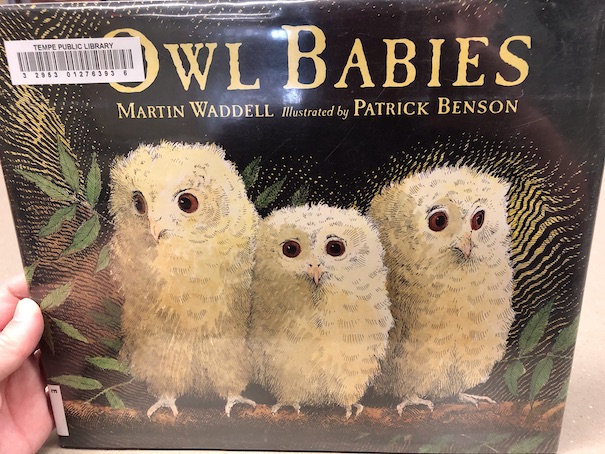
Owl Babies by Martin Waddell, illustrated by Patrick Benson, 1992.
Sarah, Percy, and Bill are three owl babies who live in a tree with their mother. One night, they wake up and can’t find their mother. They think it over, and they decide that she has probably gone out to get food for them.
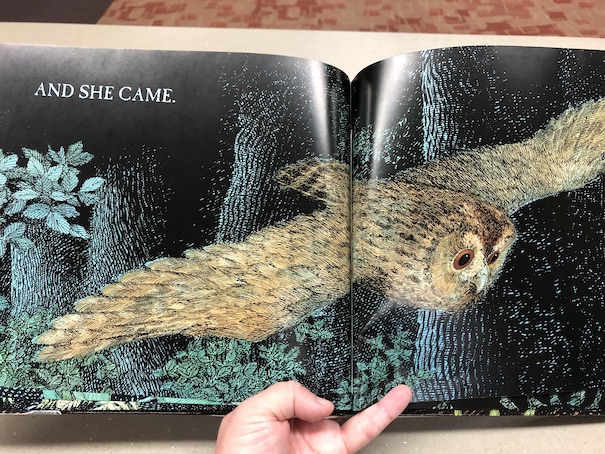
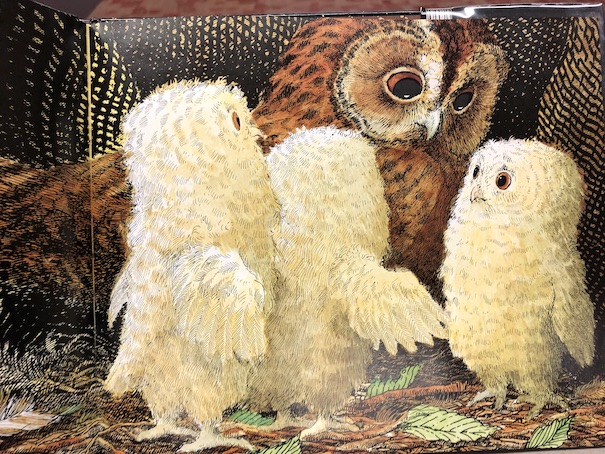
They wait for her and try to be brave, but they get worried that she isn’t coming back. Then, suddenly, their mother does come home!
The little owls are happy to see their mother, and their mother reminds them, “You knew I’d come back.”
It’s common for children to worry when their parents go away without them, wondering if they will ever come back. The story reminds young children that, even when mommy has to go away for a while, she will still come back home.
The book is available to borrow for free online through Internet Archive.
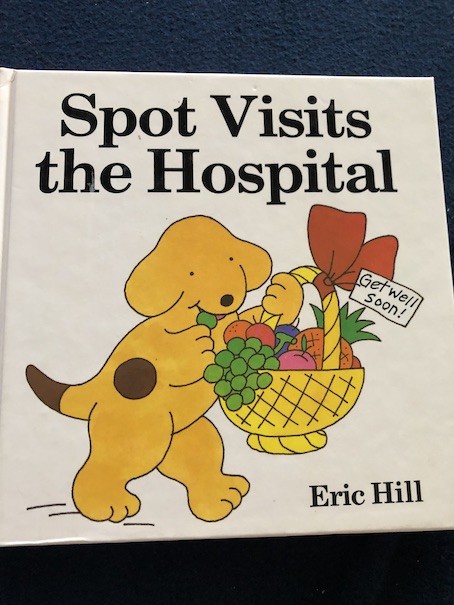
Spot’s friend Steve, who is a monkey, is in the hospital with a broken leg. Spot and some of their other friends decide to go visit him and take some presents to cheer him up.
Steve likes their presents, and Spot and his friends sign Steve’s cast. They play in the hospital’s playroom, where they have toys, games, and books for child patients.
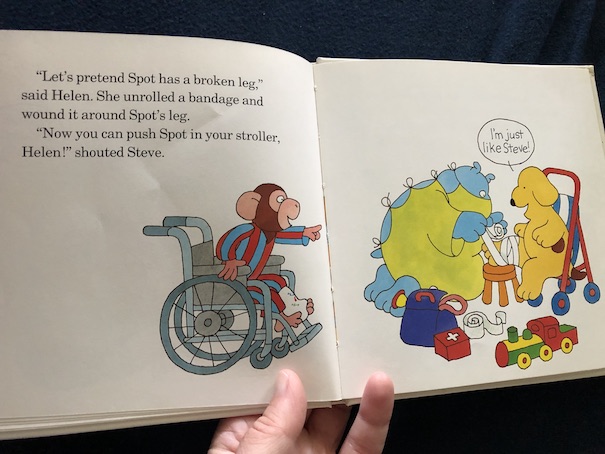
Spot’s friend Helen decide to play doctor, and she puts a bandage on Spot’s leg, as if his leg is broken, like Steve’s. They start pushing Spot around in a stroller, like it’s a wheelchair.
Their friend Tom hides, and they all go looking for him, finding him in an x-ray room. In real life, they would probably get in trouble for goofing off around the x-ray equipment, but in the book, nobody catches them doing it. I think the reason why the book has this episode in it is to have a reason to show readers the x-ray equipment and explain how the doctors used it to examine the break in Steve’s leg.
Spot is fascinated by what he sees in the hospital and tells his mother that he might like to be a doctor someday.
This story could encourage children who find the idea of studying medicine and helping people interesting, but it also makes a visit to the hospital seem less scary for children who may worry about what happens there and what all the big machinery, like the x-ray machines, are for.
The book is available to borrow and read for free online through Internet Archive.
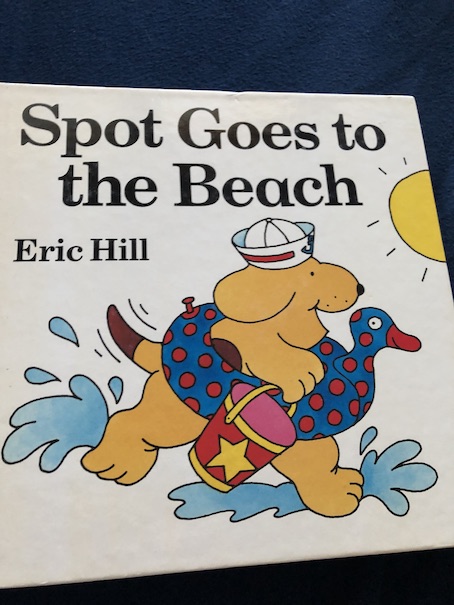
Spot’s parents take him to the beach to spend the day there. When they get to the beach, Spot wants to get a sailor hat from a stand selling beach equipment, and his father also buys him some beach toys.
Spot plays with a beach ball, builds sand castles, and buries his father in the sand.
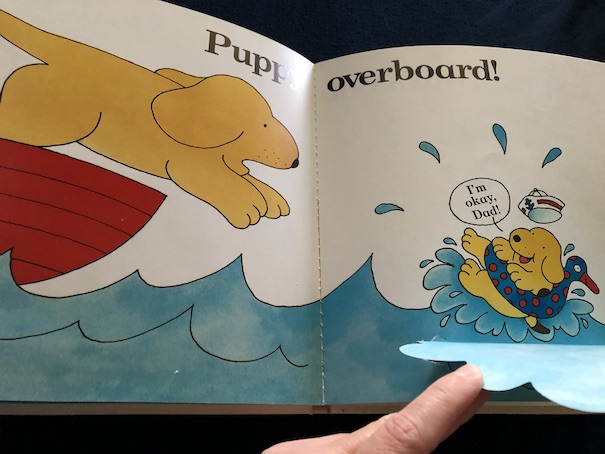
Spot and his father later go fishing, and Spot falls in the water, but Spot is fine because he’s wearing a pool float.
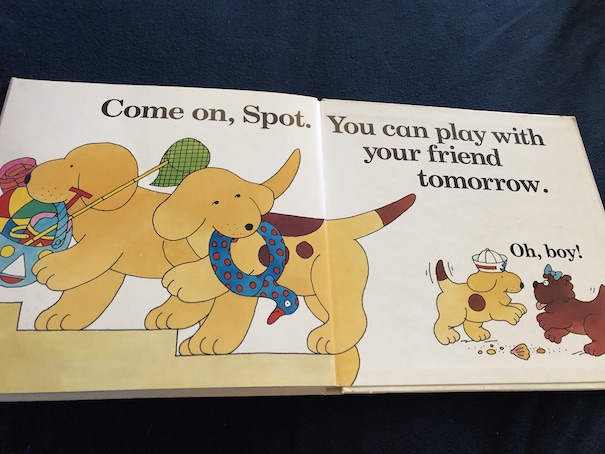
Before they leave the beach, Spot also makes a new friend, another puppy!
This is just a cute book for children about the fun things that they can do at the beach.
Like other Spot books, this book is a lift-the-flap picture book. The British version of the title is Spot Goes on Holiday. It’s available to borrow and read for free online through Internet Archive (multiple copies).
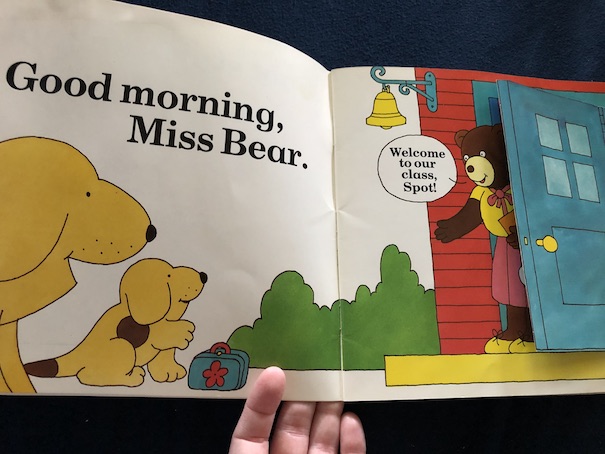
Spot is going to school for the first time. His mother drops him off at the school, where he meets his teacher, Miss Bear.
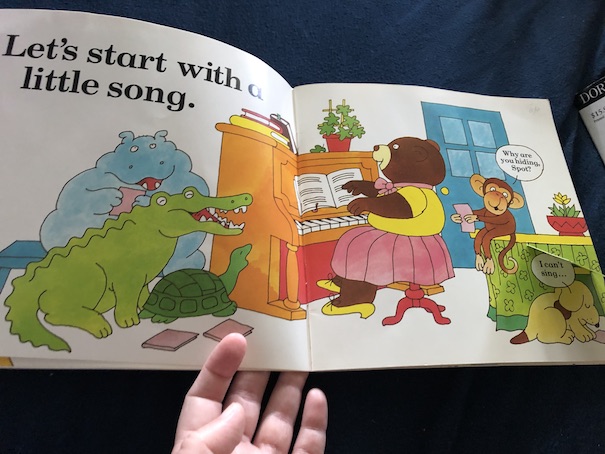
Spot and his animal friends participate in typical kindergarten activities. They sing a song while their teacher plays the piano (although Spot hides because he can’t sing), and they play dress up in the classroom playhouse.
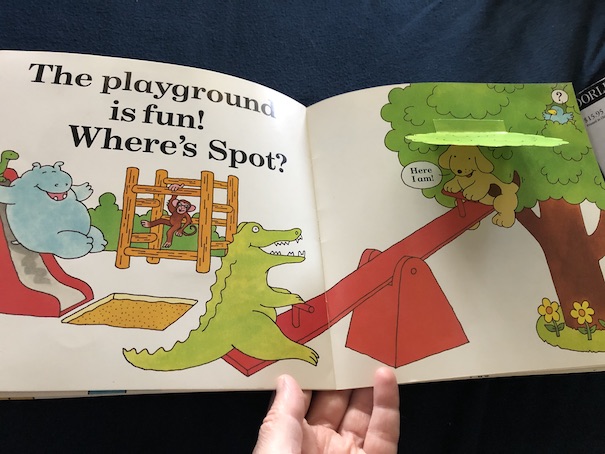
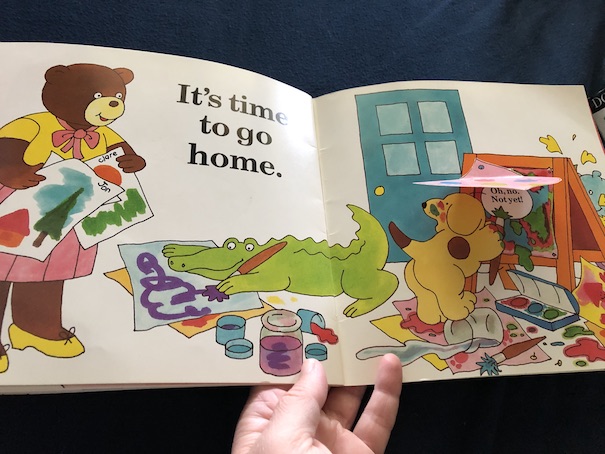
They play on the playground and show what they brought for show-and-tell. Spot roughhouses with a friend during storytime, and he loves painting pictures with his friends. When school is over, Spot doesn’t even want to go home because he’s had so much fun!
Like other Spot books, this is a lift-the-flap book. It is available to borrow and read for free online through Internet Archive (multiple copies), but to be honest, it’s not as much fun to read electronically because you can’t experience the lift-the-flap effect.
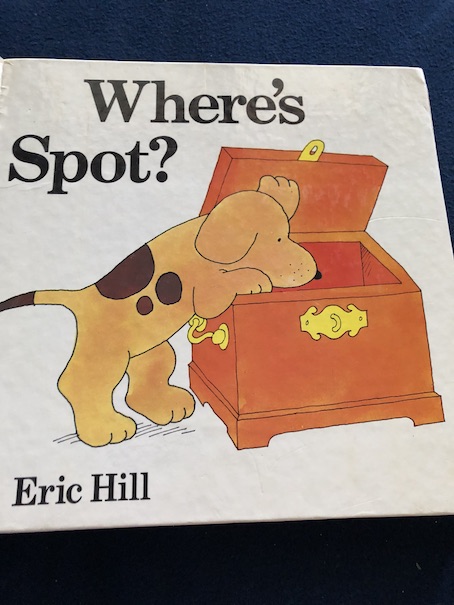
This is the first modern lift-the-flap book for children, inspired by the author’s young son, who was playing with some sheets of papers on which he had drawn some concepts for an advertisement. There was an earlier style of lift-the-flap book from the 18th century, but this first book in the Spot the Dog series led to the popularization of modern lift-the-flap books for children.
Spot’s mother, Sally, notices that her puppy hasn’t eaten his dinner. She doesn’t know where he is, so she goes looking for him.
Sally searches for Spot all around their house, looking behind a door, in a closet, inside a clock and piano, under the stairs, and under the bed. In each place, she finds different animals (no explanation, there are just a lot of animals in this house).
Finally, the turtle hiding under the rug suggests that Sally check the basket, which is where she finally finds Spot.
The story is very simple, and the lift-the-flap concept is what really makes it work. The interactive element is fun, as if the readers are participating in a game of hide-and-seek with the characters. Kids enjoy being surprised by the different kinds of animals hiding all over the house. I loved it when I was a kid!
The book is available to borrow and read for free online through Internet Archive (multiple copies), but to be honest, it’s not really a good book to read online because the lift-the-flap effect doesn’t carry over.
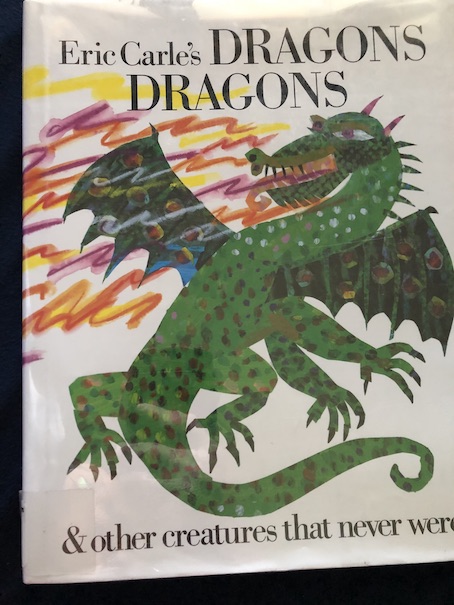
Dragons, Dragons, and Other Creatures that Never Were by Eric Carle, 1991.
This is a collection of poems and quotations about various mythical creatures from around the world. The poems and quotes come from various sources. Some are by famous authors and some are nursery rhymes and pieces of folklore. The quote about the leviathan is from The Book of Job.
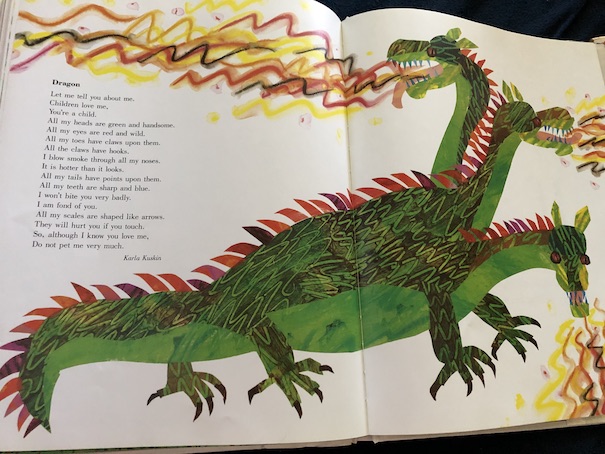
The illustrations are what really make the book interesting. They are bright and colorful, and the middle section of the book folds out to reveal a particularly long picture of a Chinese dragon.
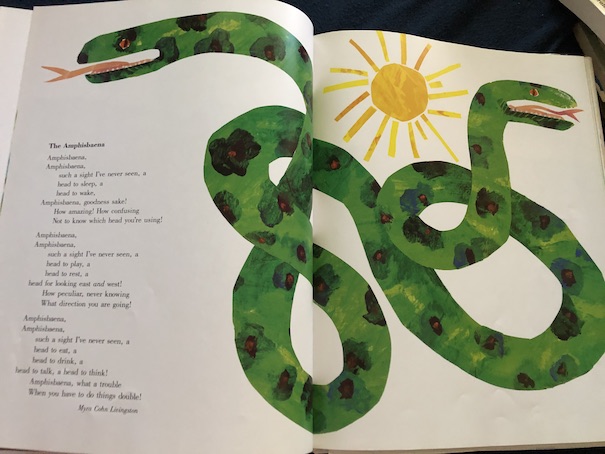
Although there are common mythological creatures, like dragons, unicorns, yetis, the phoenix, there are also less common ones that some children may not have even heard of, like the giant bird called the roc, the two-headed amphisbaena, the kappa, and the bunyip.
Most of the descriptions of the creatures are in the poems themselves and in the accompanying pictures, but there is a glossary in the back that explains more about what each creature is and where it is from.
The book is available to borrow and read online for free through Internet Archive (multiple copies).
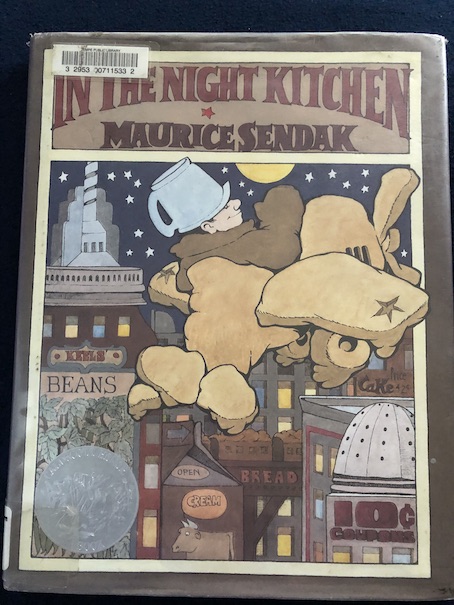
This is a very surreal children’s picture book about a strange dream that a boy has one night.
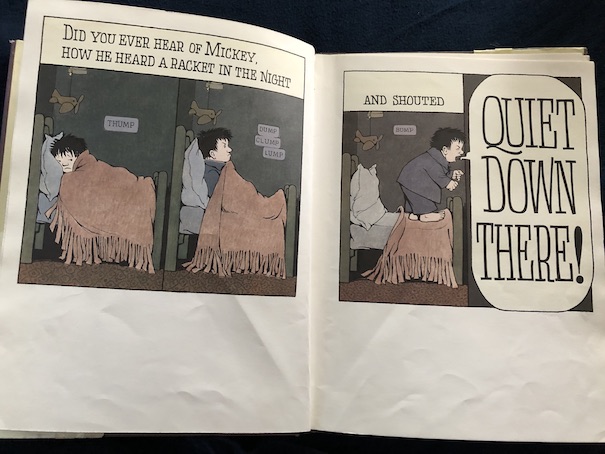
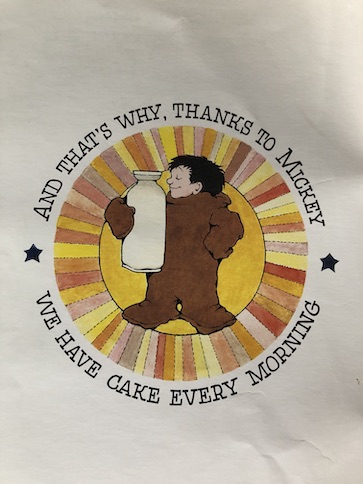
One night, a boy name Mickey is trying to sleep when he hears a strange thumping sound. He yells for the person making it to be quiet, and he suddenly finds himself falling out of bed.
He continues falling through the floors of his house and loses his pajamas. (Mickey is naked for most of the book, and at times, you can see his private parts in the pictures. The rest of the time, he is covered in batter. This is a very strange book.)
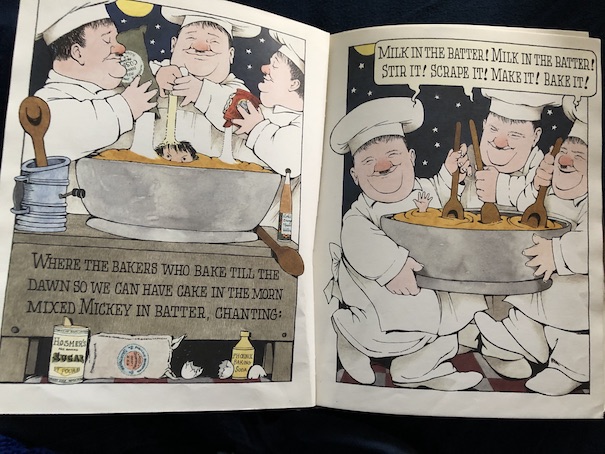
Mickey falls into a bowl of batter in the Night Kitchen, and the cooks mix him into the batter and try to bake him into a cake. However, Mickey climbs out of the oven and into some bread dough, which he shapes into an airplane.
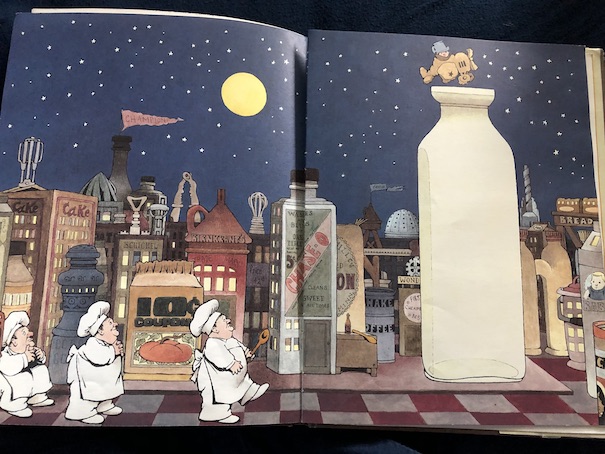
The cooks cry out for milk for the cake they want to bake, so Mickey grabs their measuring cup and flies off in his bread dough airplane to find some.
He dives into a giant bottle of milk, losing the batter that was covering him. Mickey gets a cup of milk and pours it into the batter. The cooks are happy and bake their cake.
Then, Mickey slides down the side of the bottle and ends up in his own bed and in his pajamas again.
Apparently, the whole thing was a dream, but it’s a very odd dream. I didn’t like Mickey being naked in the pictures because I don’t see any particular reason why he should be. This would still be an odd, surreal dream even if he was wearing his pajamas through the whole adventure. It’s not terrible, but I did find that part a little unsettling and unnecessary. The rhymes in the text of the story were cute. I think it would sound nice read aloud.
The book is available to borrow for free online through Internet Archive (multiple copies).
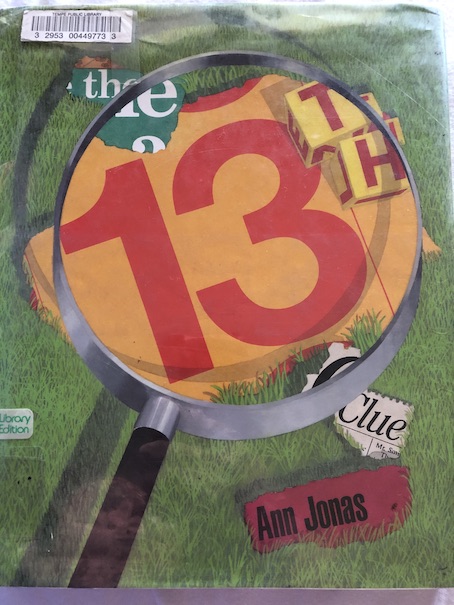
This picture book is almost entirely pictures. The pictures present clues to a treasure hunt and reveal the true story of the book.
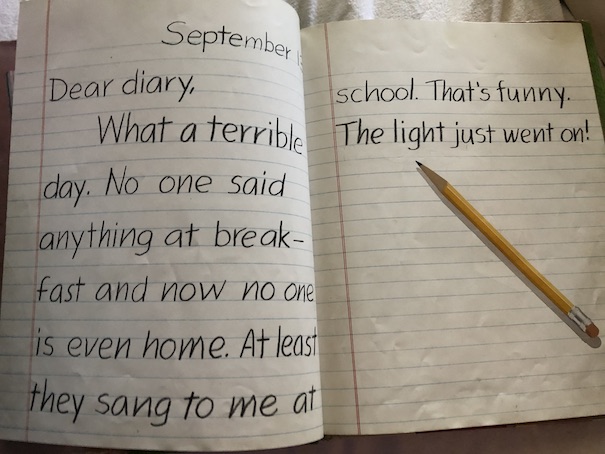
The book begins with a diary entry. At first, we don’t know who is writing it, but this person writes about what a bad day it’s been. We know that the person must be a kid because they mention school, and I guessed that it was the person’s birthday because people sang to them at school. But, she thinks that others have forgotten her birthday. The diary entry breaks off when the person notices a light going on in the house when, supposedly, no one else is home.
From this point on, until the very end of the book, the text is presented in the form of clues for our birthday kid (who turns out to be a girl, as shown in shadows and a reflection in water in later illustrations) to follow that lead to the place where her friends are waiting to give her a surprise party. Readers can figure out the clues along with the girl, some of which are easier and more direct than others.
I love puzzle books, and I thought that it was interesting how we don’t even know who the main character of the book is, only finding that out as the book continues. I liked the challenge of figuring out the clues as the book went along, although none of them were particularly difficult. They aren’t written in any kind of code, just kind of hidden in plain sight, most of them using objects that are part of the rest of the scene. Some of the letters of words are jumbled and have to be unscrambled. I’m sure it would seem harder to children.
This is a pretty easy book, but not one that would be suitable to read to children who can’t read themselves. There are no solutions provided to the puzzles, but that’s okay because, first of all, they aren’t very hard, and second, there are no opportunities for the reader to make choices based on the puzzles, so there is nothing for the reader to get wrong. The end of the story is obvious. Most of the fun is just studying the pictures to see the cute ways her friends decided to hide their “secret” messages. The hardest message to spot is the one written in the hillside.
The book is available to borrow for free online through Internet Archive.
Phoebe the Spy by Judith Berry Griffin, illustrated by Margot Tomes, 1977.
Phoebe Fraunces is a thirteen-year-old girl living in New York in 1776. The Fraunces family is black, but unlike most black people in the American colonies at the time, they have never been slaves. (There were some free black families who had never been slaves during this period of history, but they were uncommon.) Phoebe’s father, Samuel Fraunces owns a tavern called The Queen’s Head. It’s a popular place for people to meet, and Samuel Fraunces allows some prominent Patriots to meet there in secret and discuss their plans. Being party to such meetings could come with consequences as the colonies are on the brink of war.
One day, in April 1776, Samuel confides in his daughter that he has overheard something disturbing. He believes that George Washington’s life is in danger, that there are soldiers who are willing to kill their general for money. Samuel is worried about what he heard, but he isn’t sure what the plot against George Washington actually is and has no proof of what he heard. He’s afraid that if he tells Washington about what he heard too soon, without proof, the conspirators will just wait for a safer time to strike, so he asks Phoebe to help him uncover the truth. Samuel knows that George Washington will be coming to New York soon, and he has asked Samuel to help him find a housekeeper for the house where he will be staying. Samuel wants Phoebe to take the housekeeper position and to keep her eyes open for signs of danger.
Phoebe doesn’t know if she can do what her father wants her to do. She isn’t sure what she’s supposed to be watching for, and she doesn’t know how she could stop the plot if there is one. Her father tells her that she should look out for a man who is part of George Washington’s bodyguard and whose name starts with the letter ‘T’. This is all that Samuel was able to tell about the conspirator from the conversation that he overheard. He tells Phoebe to be careful, not to trust anyone, and to meet with him regularly in the market to tell him what she has learned. The two of them also discuss how odd it is that a man like George Washington, who owns slaves, would be at the center of a fight for freedom. Phoebe hopes that he will free his slaves after the war is over, although her father doubts that will happen. Still, the Fraunces family supports the cause of the Patriots, and Phoebe agrees to help her father find the conspirators and save George Washington’s life.
Phoebe is young to be a housekeeper, but she is accepted into Washington’s household. There, she meets Mary the cook and her son Pompey. Pompey also performs chores for the family, like carrying firewood. The work isn’t too hard for Phoebe because much of it is what she is accustomed to doing for her family’s tavern, like making beds, cleaning the silver, and making sure that meals are served on time. George Washington doesn’t say much when he’s around Phoebe, but she carefully observes the people around him. Every day, she goes to the market to buy food and see her father.
At first, Phoebe has nothing to report to her father. Everyone around George Washington seems to be nice or at least behaving normally, and nobody’s last name begins with the letter ‘T’. Mr. Green, a member of George Washington’s bodyguard, seems a bit unfriendly, but a younger man, Mr. Hickey, seems rather nice and sometimes gives Phoebe little presents.
However, there is a traitor among the household, and although it pains Phoebe when she learns who it is, she must do her duty and protect the life of the person she has promised to protect.
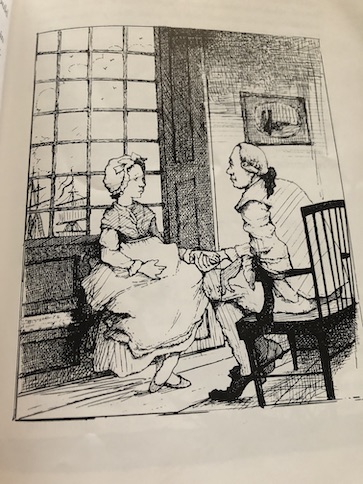
Some of the pictures in the book are black-and-white drawings, and some are in muted colors.
The original title of this book was Phoebe and the General. It is available to borrow and read for free online through Internet Archive.
Historical Background
The story is based on the real Fraunces family of New York. Samuel Fraunces really did own a tavern called the Queen’s Head and allowed Patriots to meet there. A note in the back of the book explains that after the war ended, he was given a reward by Congress, and he changed the name of the Queen’s Head to Fraunces Tavern. Fraunces Tavern still exists today, and it is still a restaurant, although part of it has been converted into a museum.
The racial identity of Samuel Fraunces has been in dispute for some time. No one is completely sure what he actually looked like. There is a portrait of a white man that has been reputed to be Samuel Fraunces, but the true identity of that portrait is in dispute. Samuel Fraunces is known to have had the nickname of “Black Sam”, but different sources describe the family differently. All that is known of Samuel Fraunces’s background is that he was born around 1722 and was originally from the West Indies. It’s possible that the Fraunces family may have been mixed race because some sources refer to Samuel Fraunces as “mulatto” (an old term for someone born to a white parent and a black parent, not considered a polite term now), which might explain the other, differing accounts of the family’s race.
The story of Phoebe Fraunces saving George Washington’s life is legend, but the facts regarding that incident are also in dispute. The legend might be based on a misunderstanding, and Samuel Frances’s real daughter, Elizabeth, does not seem to have been old enough at the time to have taken part in this adventure. The story has had a tendency to appear and reappear around patriotic milestones in the United States, first around the centennial in 1876 and then around the bicentennial in 1976, when this book was written.






















 Jestress's Forgotten Books and Stories