A Fence Too High

The Land of Pleasant Dreams

A Fence Too High by Jeanine Bartelt, Jeff Parker, and Tony Salerno, 1986.

Peter falls asleep while counting sheet jumping over the fence and meets Lacey the Lamb in his dream. Lacey the Lamb is sad and worried because, even though she’s growing up to be a fence-jumping sheep, there is one fence that she just can’t get over. Peter offers to take a look at the fence with her and see if he can help. When he does, it turns out to be a giant rainbow.
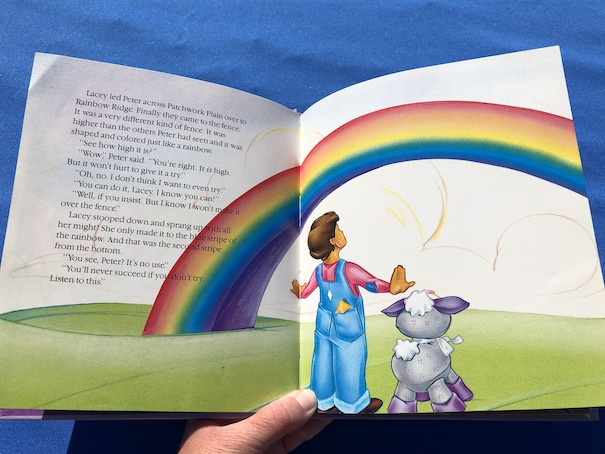
It’s important that Lacey make it over this fence because she is taking part in a fence-jumping contest in less than an hour. Lacey doesn’t think that she can learn to jump this fence in so little time. However, Peter encourages Lacey to try again.

After a few more tries in which she hits the blue stripe on the rainbow and then the yellow stripe and then the orange stripe, Lacey is ready to give up. She thinks that it’s hopeless. Peter points out that it isn’t hopeless because each time that Lacey has tried, she has improved, gradually hitting higher and higher marks on the rainbow. He doesn’t think that Lacey should give up so easily.
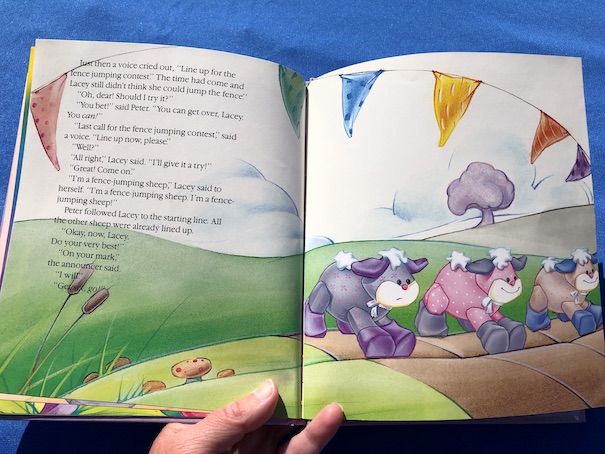
Even though she’s still feeling very unsure of herself, she decides to participate in the contest. This time, Lacey does make it over the fence, and she feels much better about herself because of her success. She thanks Peter for giving her the encouragement to try one more time.

Moral: If At First You Don’t Succeed, Try, Try Again.

It’s a nice story about the importance of making an effort, trying again, and not giving up just because there are obstacles and challenges. Life has many challenges, and just because something is difficult doesn’t mean that it’s impossible or not worth doing. People don’t need to be perfect; it’s enough to be willing to improve.

This book was made into an episode for the tv show version of the series with puppets.
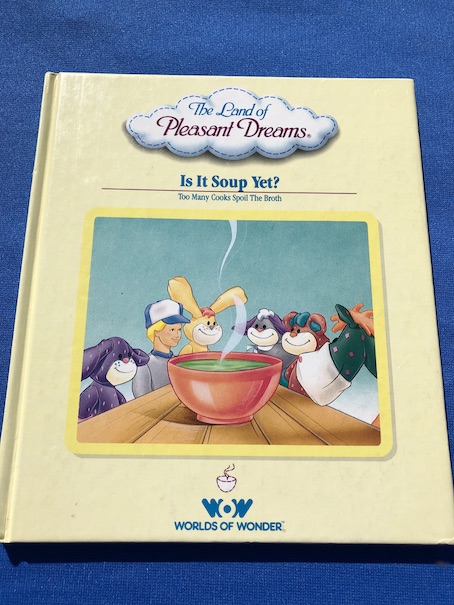
Is It Soup Yet?

The Land of Pleasant Dreams

Is It Soup Yet? By Ane Weber, Ron Krueger, and Tony Salerno, 1986.

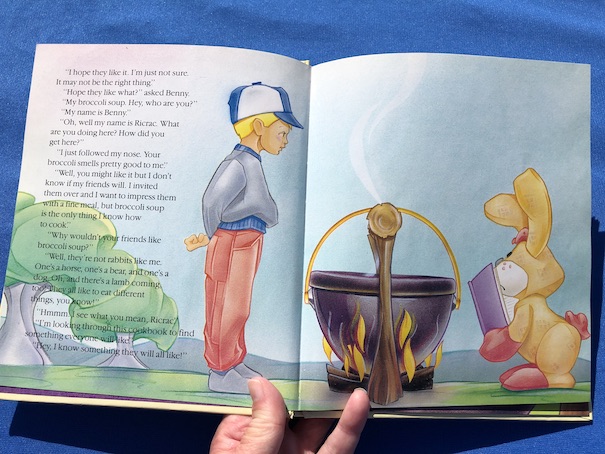
When Benny enters the Land of Pleasant Dreams, he meets Ricrac Rabbit.  Ricrac is trying to cook something for his friends, but he’s worried because the only thing he knows how to make is broccoli soup, and he doesn’t know if his friends will like it because they all have different tastes.

Because Benny’s father is a chef, he suggests that Ricrac try his recipe for black bean broth because everyone loves that when his father makes it.  Ricrac decides to give it a try, adding the black beans to his broccoli soup. 

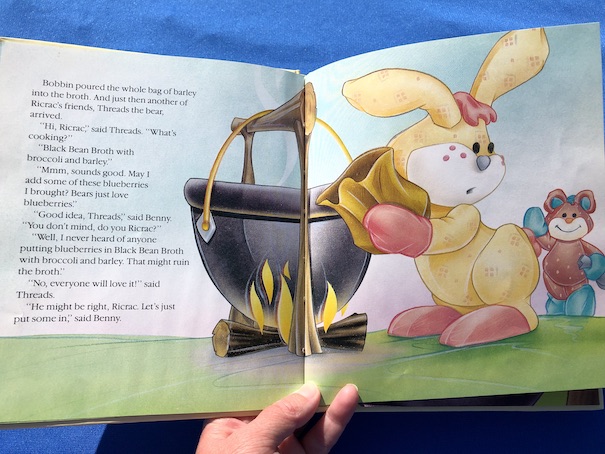
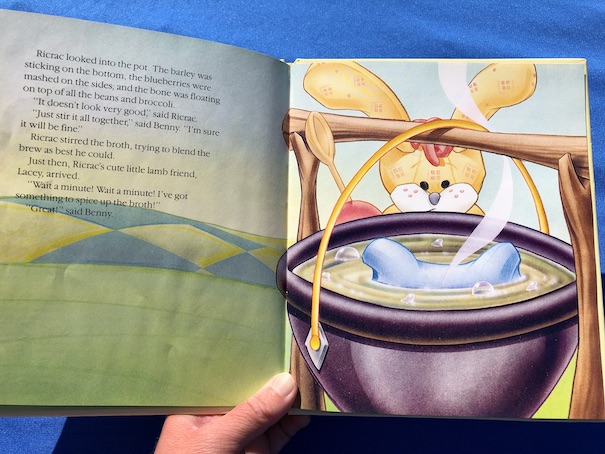
However, as each of Ricrac’s friends arrive, they also decide to bring their favorite ingredients with them.  Bobbin the Horse brings barley, and Threads the Bear brings blueberries.  Then, Snips the Dog brings a bone, and Lacey the Lamb brings buttercups.  In an effort to please everyone, Ricrac adds each ingredient to the soup.

When they finally try it, the soup is horrible.  At first, everyone argues about which ingredient ruined the soup, but Benny realizes that their real mistake wasn’t trying the soup according to Ricrac’s original recipe.  When they try the broccoli soup as it was supposed to be made, without the extra ingredients, it’s really good.

Moral: Too Many Cooks Spoil the Broth.

The point of the story is that trying to please everyone often means pleasing no one.  When planning a project, if you try to stretch it in too many different directions, it’s difficult to accomplish anything because you’re not focusing on anything in particular. In the end, you have to pick one way and stick with it, focusing on what you can do best.

The book is available to borrow and read for free online through Internet Archive. This book was made into an episode for the tv series with puppets. Sometimes, you can find it or clips of it on YouTube.

Can’t You Sleep, Little Bear?

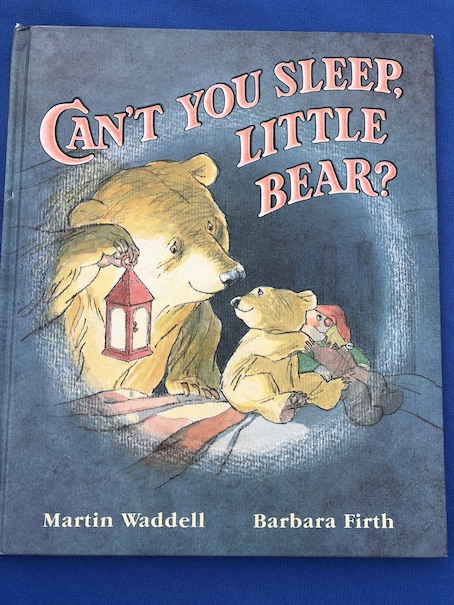
Can’t You Sleep, Little Bear? By Martin Waddell and Barbara Firth, 1988.

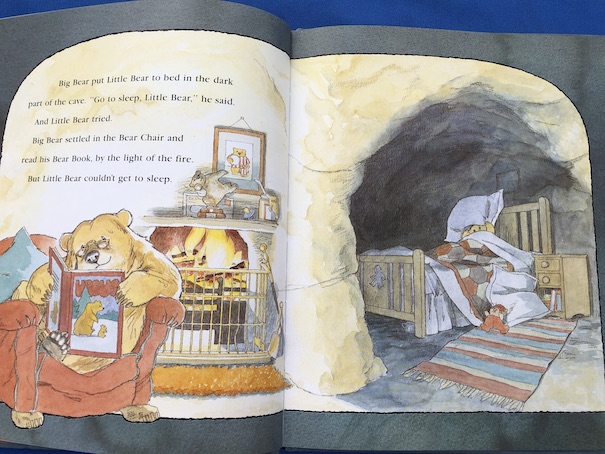
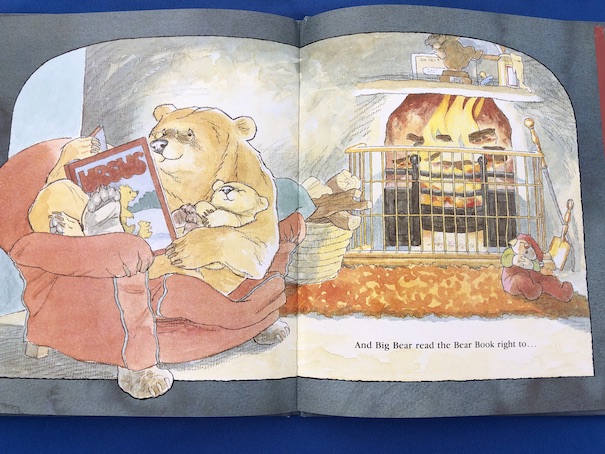
Big Bear and Little Bear live in their Bear Cave.  (Big Bear is apparently the father of Little Bear, but they don’t call him that.)  After Big Bear puts Little Bear to bed at night, Little Bear has trouble sleeping.  Little Bear says that he can’t sleep because he’s afraid of the dark.

Big Bear gives Little Bear a lantern, but that doesn’t work.  Little Bear says that the lantern isn’t big enough.  Big Bear tries to bring two larger lanterns, but neither of those helps, either.

Little Bear says that the dark beyond the cave bothers him.  To prove to Little Bear that the darkness outside isn’t scary, Big Bear takes him outside.

Outside, he shows Little Bear the moon and the stars, so he’ll know that it’s not completely dark.  Little Bear falls asleep in Big Bear’s arms.

This is one of those cute bedtime stories that can help to reassure young children at bedtime. Sometimes, it is a big, scary, dark world out there, but it’s not always as dark as it seems when you take a second look, especially if you’re with someone you can really trust. Because the bears appear to be father and son, it also makes a nice father/son story.

The book is currently available online through Internet Archive. There is also an animated version of this story. I haven’t seen it for sale (if anyone knows where to get it, let me know), but it sometimes appears on YouTube (link repaired July 18, 2024).

Old Bear

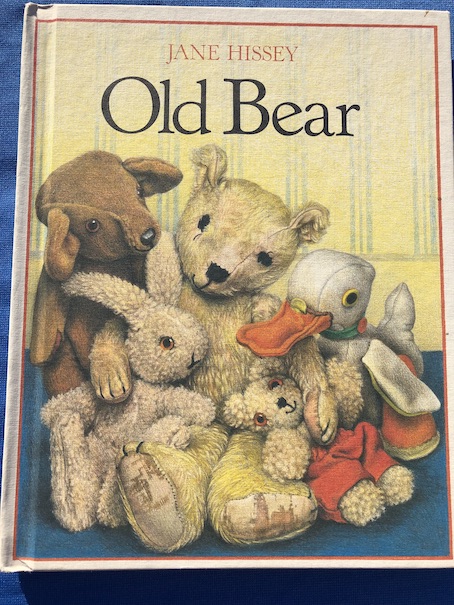
Old Bear by Jane Hissey, 1986.

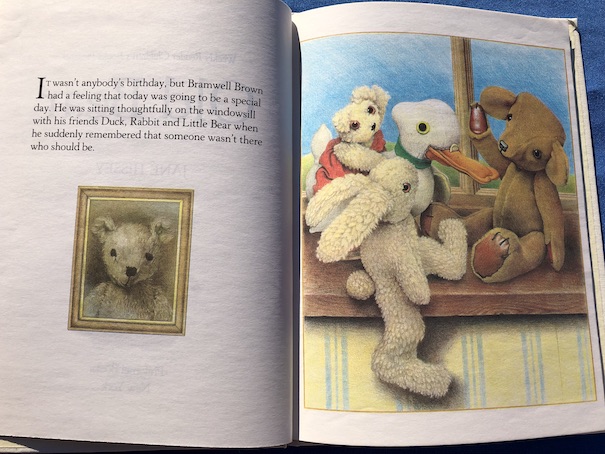
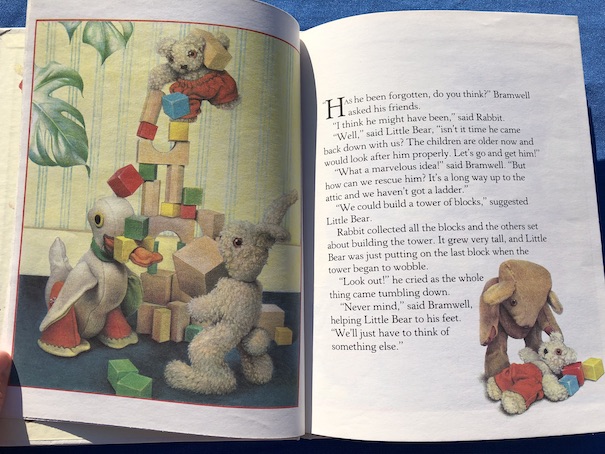
A group of stuffed animals remember that an old friend of theirs, Old Bear, was put up in the attic because he was an old toy and the children of the house were too rough with him.  The other stuffed animals miss him and worry that the humans in the house have forgotten about him, so they try to think of a way to get him out of the attic.

The problem is that the entrance to the attic is in the ceiling, high above their heads.  The stuffed animals try various tricks to get up to the attic, from building a tall tower of blocks to jumping on the bed.

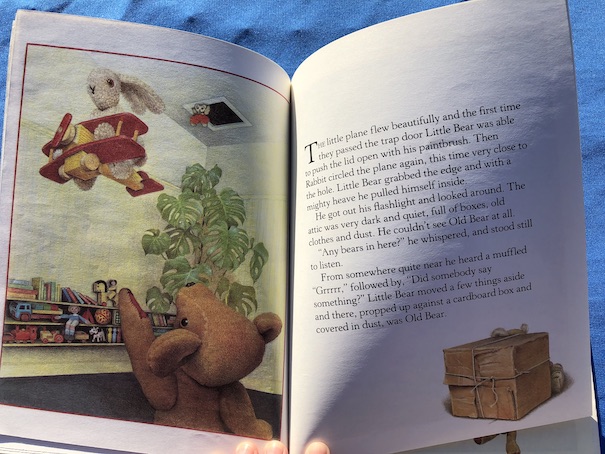
Eventually, they are successful when they use a toy airplane.  After Little Bear finds Old Bear in the attic, they use parachutes made of handkerchiefs to parachute back into the playroom to rejoin the other stuffed animals.

Old Bear says that he spent most of his time in the attic sleeping, but he is glad to be back with his friends.

I remember my mother reading this book to me when I was a young child in the 1980s! One of the things that I like about this book is the detailed pictures. The textures on the stuffed animals are excellent, giving readers the feeling that they could reach into the book and touch the fluffy Little Bear, Bramwell’s paws (which look like they’re made of vinyl), and the Duck, who looks like he’s made of felt.  The stuffed animals’ schemes to reach the attic are also fun and clever, using other children’s toys.

The book is part of a series originally published in the UK. The series was later made into a British television series during the 1990s. This particular story is one of the episodes, and you can see this episode on the author’s YouTube channel.

The book is available to borrow and read for free online through Internet Archive. (To borrow a book through Internet Archive, you have to sign up for an account, but it’s free, and then you read the book in your browser window.)

Happy Birthday, Moon

Happy Birthday, Moon by Frank Asch, 1982.

Bear really loves the moon and decides that he would like to give the moon a birthday present.  The problem is that he doesn’t know when the moon’s birthday is.  He tries asking it, but it doesn’t answer.

Deciding that he needs to get closer to the moon to talk to it, Bear goes to the mountains to ask the moon when its birthday is.  In the mountain, Bear hears his own echo and thinks that it is the moon answering him.  When Bear tells the moon that his birthday is tomorrow, the “moon” replies that its birthday is tomorrow.  Bear is pleased, especially when the moon echoes his wish for a hat for its birthday.

Bear buys the moon a hat and puts it on top of the moon by putting it in a tree.  The following morning, the hat is on Bear’s doorstep, and Bear accepts it as the moon’s present to him.

When the wind blows poor Bear’s hat away, Bear goes to the mountains again to apologize to the moon for losing the hat.  It’s okay, though, because Bear and the moon still love each other.

Bear never realizes that what he’s hearing is his own echo.  It’s sweet although somewhat silly.  If you wonder what happened to the hat in the end, it’s shown on the back cover of the book, holding a bird’s nest.

The book is currently available online through Internet Archive. (When you borrow a book from Internet Archive, you have to set up an account, but it’s free.)

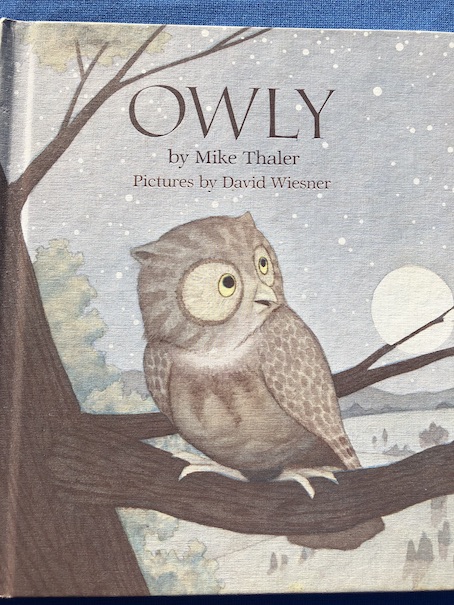
Owly

Owly by Mike Thaler, 1982.

Owly is a curious young owl.  He is always asking his mother questions, like how many stars there are in the sky or how high the sky is.

Owl’s mother tells him to go and see these things for himself, but there are too many stars in the sky to count, and he can’t fly high enough to reach the sky.

The story continues with Owly’s questions and attempts to find the answers, but all of his questions are unanswerable because they involve amounts too big to count or measure.

In the end, Owly and his mother talk about how much they love each other, and they compare it to the number of stars in the sky and the other things that couldn’t be counted or measured.

This is one of those children’s books where the story leads up to how much the parent loves the child (and vice versa). I’ve seen other books where the author sets up a cute way to talk about how much parents love their children, and sometimes, the set up is pretty obvious in this type of story. However, the message is still sweet, and this gentle story might make nice, calming bedtime reading. The pictures are as gentle and calm as the story itself.

The book is currently available on Internet Archive.

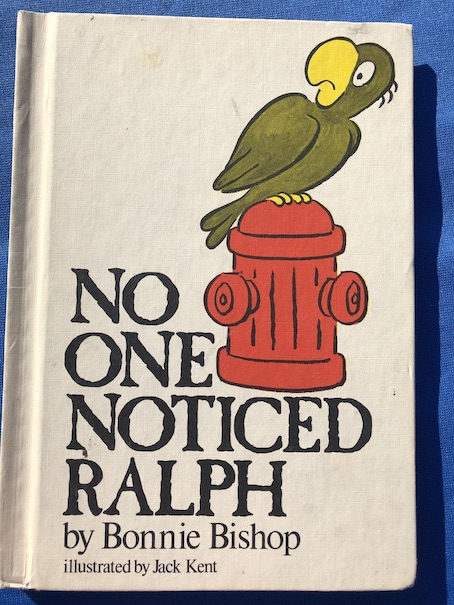
No One Noticed Ralph

No One Noticed Ralph by Bonnie Bishop, 1979.

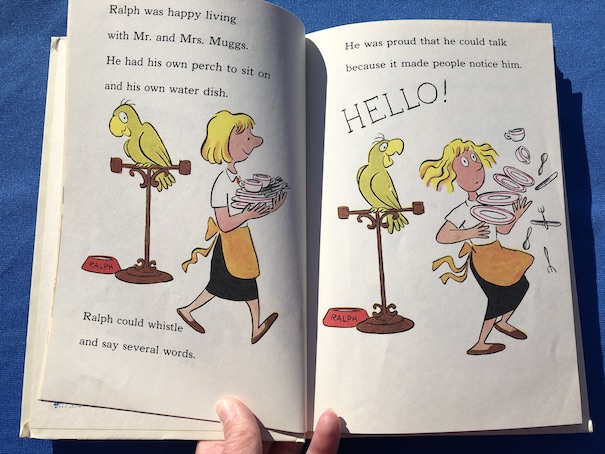
Ralph is a parrot, living in an apartment with Mr. and Mrs. Muggs.  Ralph can whistle and talk, and he likes doing it because he enjoys the attention he gets from people when he does it.

He has certain times when he whistles, like when he wakes up Mr. and Mrs. Muggs in the morning, and certain words he says to get treats.  Sometimes, in the evenings, Mr. and Mrs. Muggs will light a fire in the fireplace and make popcorn, so Ralph will say, “Fire!” to remind them.
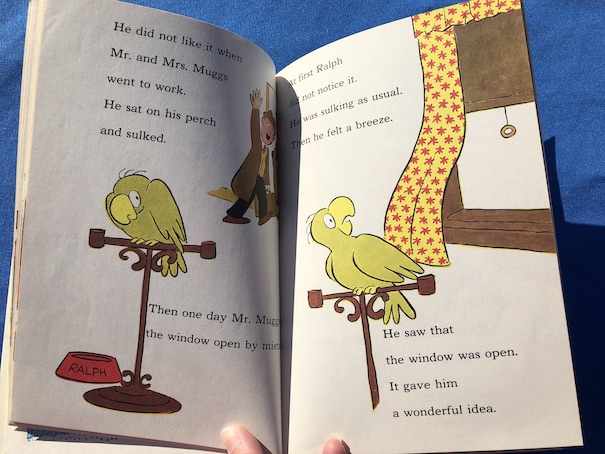
Ralph gets lonely when Mr. and Mrs. Muggs leave for work, and one day, he notices that they’ve left a window open.  He decides to fly outside and look for people to give him attention.

When he reaches the street, there are plenty of people, but they don’t pay attention to Ralph.  He tries whistling and using words he knows.  It has an effect on the people around him, but not what Ralph expects, and still no one notices him.

Then, Ralph sees an apartment on fire, and says, “Fire!”  It makes a man nearby notice the fire and call the fire department. The man who called the fire department realizes that Ralph is the one who yelled “Fire!” and calls him a hero.  Finally, Ralph gets attention!

Mr. and Mrs. Muggs return home to see everyone with Ralph and hear the story about how he became a hero.  Ralph is rewarded with a ride on the fire truck, his picture in the paper, and a lifetime supply of sesame seed crackers but it’s the attention he loves most.

I love this picture book and thought it was funny when I was a kid, when I had a pet bird myself.

Johnny and the Birds

Johnny and the Birds by Ian Munn, illustrated by Elizabeth Webbe, 1950.

This cute little picture book is a collection of short stories about a little boy named Johnny and his adventures with wild birds. The stories are very short and are meant to teach children about wild birds.

Johnny and the Catbird – Johnny thinks that he hears a kitten while looking for strawberries, but it’s actually the sound made by a catbird.

The Blue Jays – Father Blue Jay scares a hawk away from his nest.

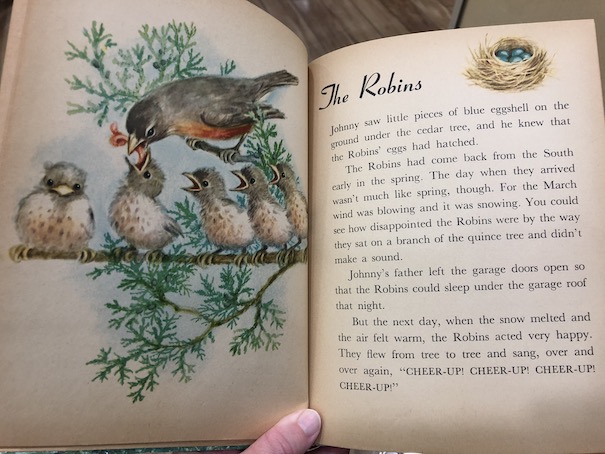
The Robins – Johnny knows that the Robin eggs have hatched when he sees the bits of blue eggshell under the tree where they live.

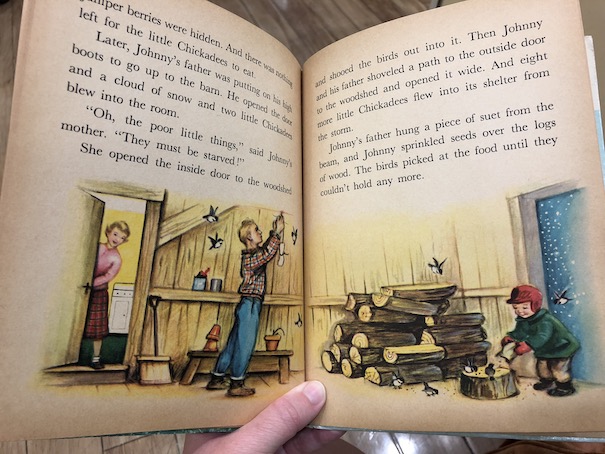
The Chickadees – The Chickadees don’t fly south during the winter like other birds, but Johnny’s family helps them when it’s snowing and they need something to eat.

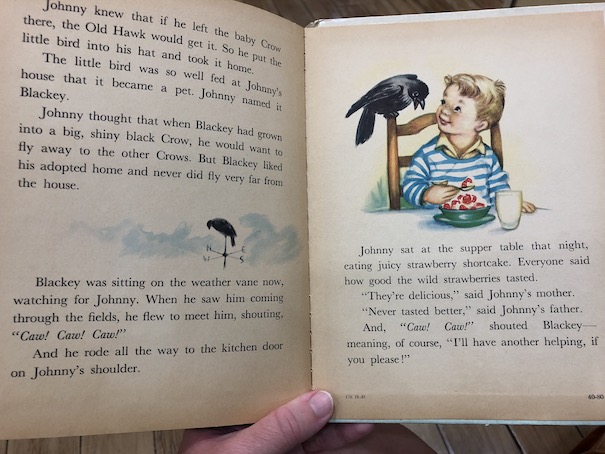
The Crows – Johnny finds a baby Crow out of its nest. Apparently, it’s an orphan, and Johnny fears that it might get eaten by a hawk, so he takes it home and takes care of it. It becomes a pet, and he names it Blackey.

The book is available to borrow and read for free online through Internet Archive.

The Mystery of King Karfu

The Mystery of King Karfu by Doug Cushman, 1996.

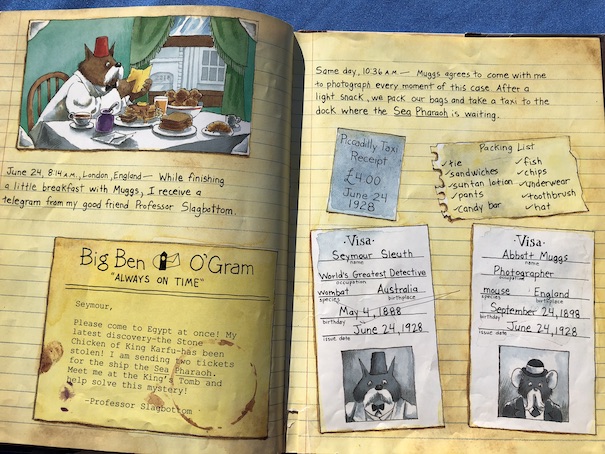
Seymour Sleuth, an Australian wombat living in London, introduces himself as “the greatest detective in the world.”  His friend, Abbott Muggs, a mouse, is a photographer who assists him in his cases and documents them.  When the story begins, Seymour receives a telegram from his friend Professor Slagbottom, who is working on an archaeological site in Egypt.  Someone has stolen one of their finds, the Stone Chicken of King Karfu, and he needs Seymour’s help to find it!  Seymour and Muggs head for Egypt!

King Karfu was a wealthy pharaoh and a wonderful cook, and the Stone Chicken may provide clues about the Lost Treasure of King Karfu, the nature of which is unknown.  When they reach the dig in Egypt, Professor Slagbottom explains that he was researching a message in code on the outside of the Chicken when it was stolen.  The suspects are the other people on the dig, who may be trying to steal King Karfu’s Treasure.

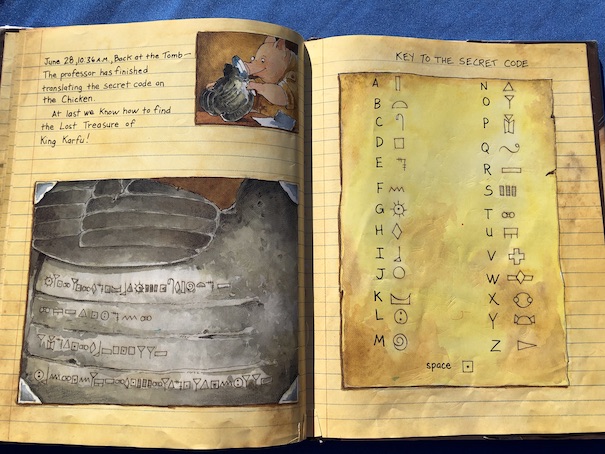
Seymour interviews the suspects one at a time and considers their connection to clues found at the scene of the crime.  As an adult, I figured out who the culprit was pretty quickly, but for the benefit of child readers, Seymour provides notes about the clues and suspects to help them understand the connections. The pictures in the story also provide important clues.  After Professor Slagbottom’s decoder is stolen, Seymour realizes who the thief is.

After they get the Stone Chicken back, readers can use the decoder provided to solve the code and learn where the Treasure is.  It turns out that the Treasure is actually a recipe, written in the same substitution code – for peanut butter and jelly sandwiches!

I always like mysteries that involve codes and puzzles, and this cute animal mystery would be fun and challenging for young kids.  With the key provided, it would be a good introduction to substitution codes for kids who have never seen them.  There is one other book with Seymour Sleuth, The Mystery of the Monkey’s Maze.  The author, Doug Cushman, is also the author of the Aunt Eater Mysteries.

The book is currently available online through Internet Archive.

I Like Things

I Like Things by Margaret Hillert, illustrated by Lois Axeman, 1982.

This is a cute little picture book about the fun of collecting things.  A young girl talks about the things that she collects and why she likes them.

She enjoys collecting all kinds of things with different shapes, sizes, and colors.  Sometimes, she likes to sort the things in her collections, like buttons, by color or size.

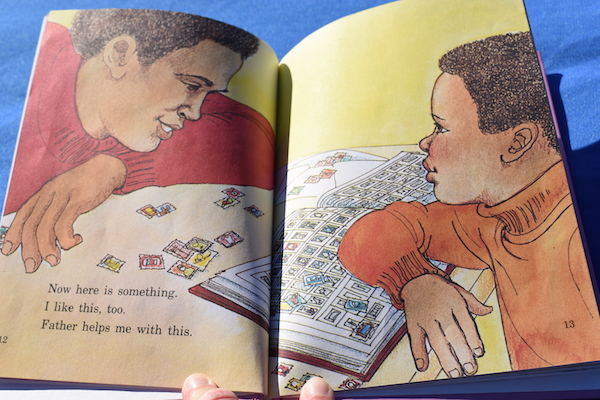
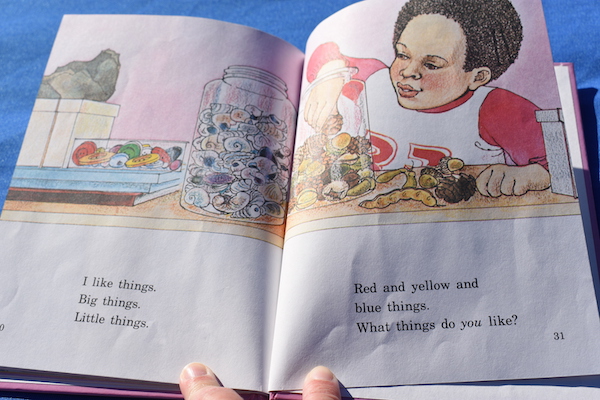
Sometimes, her father helps her with her stamp collection.  She also likes to find seashells and rocks at the beach.  Sometimes, she and her friend trade sports cards from their collections.

At the end of the story, the girl asks readers what kinds of things they like, so adults can use the story to get kids to talk about what they like to collect.

I thought it was interesting how the girl put one of the bigger rocks in her collection into a jar that was partly full of water so that the water would act as a magnifier, making the rock look bigger.

One thing I noticed is that the girl never refers to the objects in her collections by name.  Mostly, she just talks about what she does with them using very simple words.  I think that’s to make the book easier for younger children.  There is a word list in the back of the book of all of the words used in the story, and there are only 64 different words.