Thomas’ Snowsuit

ThomasSnowsuit

Thomas’ Snowsuit by Robert Munsch, 1985.

Thomas absolutely hates the new snowsuit that his mother bought him.  He thinks it’s ugly.  When it’s time for him to go to school, his mother has to wrestle him into it because he refuses to put it on himself.

ThomasSnowsuitNew

That’s fine until it’s time for Thomas to once again put on his snowsuit so he can go outside for recess.  His teacher insists that he has to wear it, but he refuses.  When the teacher tries to wrestle Thomas into his snowsuit, the results are hilarious!

ThomasSnowsuitTeacherSwitch

Thomas and his teacher end up getting their clothes all mixed up.  When the school’s principal tries to help, it only makes things worse.

ThomasSnowsuitTeacherPrincipalSwitch

Finally, Thomas is persuaded to put on his snowsuit when a friend of his wants him to come out and play.

ThomasSnowsuitFixed

Thomas eventually helps set the teacher and principal right again after recess, and the principal decides that it’s time to retire to Arizona, so he won’t have to deal with snowsuits again.

ThomasSnowsuitArizona

Like all Munsch books, the storyline is bizarre and hilarious, and half the fun is watching it unfold in the pictures!

The book is currently available online through Internet Archive.

Murmel, Murmel, Murmel

Murmel

Murmel, Murmel, Murmel by Robert Munsch, 1982.

Robin is playing in her backyard sandbox when she hears a “Murmel, Murmel, Murmel” sound from a hole that she has never seen before. In the hole, Robin finds a baby. Since Robin herself is only five years old, she decides that she needs to find someone older to take care of the baby.

Robin asks various people, but they all have reasons why they can’t take the baby. Then, Robin encounters a truck driver who is enchanted with the baby’s “Murmel, Murmel, Murmel” and says that he wants him.

The story never explains where the baby came from, how he ended up in Robin’s sandbox, or if his parents are looking for him, but apparently, he’s happy with the truck driver. As for the truck driver’s truck, he says that Robin can keep it because he already has seventeen others. Robert Munsch books are like this. That’s basically the explanation.

The book is currently available online through Internet Archive.

MurmelTruck

Something Good

SomethingGood

Something Good by Robert Munsch, 1990.

Tyya begs her father to buy “something good” at the grocery store. Tyya would much rather have him get something like ice cream and cookies instead of boring things like bread and eggs, which is what he usually gets.

However, when she tries to get whole cartloads of ice cream and candy bars, her father makes her put it all back. Tired of her messing around, Tyya’s frazzled father tells her to just stand in one place and not move. Unfortunately, he tells her that near a display of large dolls. Because she doesn’t move, a store employee mistakes Tyya for a doll and puts her on the shelf with the others, giving her a price tag of $29.95.

Some people try to buy Tyya, but she yells at them, scaring them away. Tyya’s father comes to get her, but he has trouble taking her out of the store because she still has a price tag on her, and the man at the register insists that her father has to pay for her.

In real life, no grocery store would try to sell a child, and it would be a crime if they did. However, because this is a Robert Munsch story (where all kinds of crazy things happen), Tyya’s father finally pays the $29.95 because she’s worth it, and Tyya says that her father finally bought something good at the grocery store.  Sort of touching, in an odd kind of way, I guess.

One of the benefits of this story is that it has a lot of potential for reading aloud because the reader can really play up the parts where the characters yell.

The book is currently available online through Internet Archive.

Moira’s Birthday

MoirasBirthday

Moira’s Birthday by Robert Munsch, 1987.

Moira wants to have a birthday party and to invite every kid in her school, from kindergarten to sixth grade. Her parents say that she can have only six party guests total, not six grades’ worth. However, so many kids at school want to come to her party that she ends up inviting the whole school anyway.

When every kid in school shows up on the day of the party, Moira’s parents are bowled over. There are so many kids that they hardly fit in the house. Moira calls up a pizza place, asking for an enormous amount of pizza, and a bakery, asking for an enormous amount of birthday cakes. The kids also help out by supplying their own food from home.

Naturally, Moira’s house is a mess, and her parents are upset, but Moira, seeing the enormous pile of birthday presents that everyone brought, promises a present to everyone who helps to clean up.

But, just when everything seems to have worked out all right, the trucks from the bakery and pizza place show up with the rest of Moira’s order.

The book is currently available online through Internet Archive.

This House is Made of Mud

HouseMud

This House is Made of Mud by Ken Buchanan, illustrated by Libba Tracy, 1991, 1994.

The edition of this book that I have is the bilingual edition with English and Spanish.  Originally, the book was written in just English. I like to use kids’ books for Spanish practice, which is why I like this one.  It’s a Reading Rainbow Book.

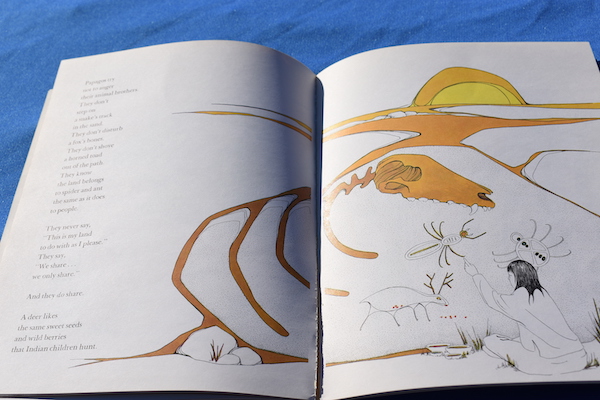
The story is written in a poetical form (non-rhyming), describing an adobe house, which is why it’s made of “mud.”  It’s a traditional way of building houses in the American Southwest, where I’m from.

HouseMudBeginning

As the book describes the house, it compares it to the land around it and the world in general.  Like the Earth, the house is round, which is how some Native Americans build their houses.

HouseMudRound

Aside from the people who live there, animals also share the house, from the family pets to bugs and mice who live in the walls and under the floor.

HouseMudAnimals

Their yard is the desert, surrounded by mountains and full of cactus.

HouseMudYardCactus

The people who live there have many friends who come to visit, and it is a house full of love.

The book is currently available through Internet Archive.

HouseMudLove

Monster Slayer

MonsterSlayer

Monster Slayer retold by Vee Browne, illustrated by Baje Whitethorne, 1991.

This is a retelling of a Navajo folktale.  An Editor’s Note at the beginning of the book explains a little about the original legend.  It is actually part of a much longer story.  The book only focuses on the Walking Giant part.  The Walking Giant threatened the villages of the Anasazi.  The author and illustrator of this book are both Navajo.

Changing Woman, who created both humans and monsters, had twin sons, but they did not know who their father was until they were twelve years old, when their mother told them that their father was the Sun.

MonsterSlayerAnasaziVillage

The twins went to see their father, but they were returned to Earth to help their people to fight the monsters which plagued the land.  The monsters prevented the Anasazi from planting their crops, and people were starving.  The people appealed to Changing Woman and her sons for help.  The twins’ father gave them his lightning arrows to use in the fight.

MonsterSlayerVillagers

Hearing the sound of thundering footsteps, Changing Woman told her sons that it was the sound of the Walking Giant.  The twins took their armor, sacred magic feathers, and lightning arrows and set out to find the giant.  Eventually, they found him by a lake.  The twins hid behind a rock, but the giant could smell them.

MonsterSlayerMagicFeathers

As the fight began, the twins let the giant shoot the first arrow at them because their father told them to, since Walking Giant was older that they were.  However, their magic feathers helped them to evade the giant’s boomerang.  Then, one of the twins used a lightning arrow to finish off the Walking Giant.  To commemorate their victory, Changing Woman named this twin Monster Slayer.  (The other boy was already named Child Born of Water.)

MonsterSlayerGiant

This story is interesting but felt a little disjointed to me. That may be because it is a shortened version of the legend.  I wish that the beginning note explained a little more about the context of the story.  This book won the Best Juvenile Book Western Heritage Award from the National Cowboy Hall of Fame.

The book is available to borrow and read for free online through Internet Archive.

The Spooky Halloween Party

SpookyHalloween

The Spooky Halloween Party by Annabelle Prager, illustrated by Tomie de Paola, 1981.

This book was an old Halloween favorite of mine when I was a kid.  It’s funny, slightly spooky, and has a bit of a twist ending!

Albert’s friend, Nicky, is inviting all of their friends plus his cousin Suzanne to a spooky Halloween party at his new apartment on Halloween night.  Albert hasn’t been to his new apartment yet, and Nicky says that it’s going to be really scary because he wants everyone to come in costume and to not tell anyone what they’re going to be so that everyone will be surprised when they take off their masks at the end of the evening.

SpookyHalloweenNickysParty

Albert doesn’t think Nicky’s party is going to be all that scary because he’s pretty confident that he’ll know who his friends are right away, even in costume.  Some of them have already given him hints.  Nicky was practicing going, “Whoo, whoo!” in order to scare people, so Albert knows that, whatever his costume is, it’s something that makes that sound.  Jan called up and asked Albert if he had an old mop that she could borrow, so he thinks that she’s probably going to be a witch and that she just got confused, thinking that witches carry mops instead of brooms.  Dan told Albert straight out that he’s going as a pirate because he doesn’t see the point in keeping his identity a secret.  So, Albert isn’t expecting any real surprises at Nicky’s party.

As for Albert’s costume, he’s tired of wearing the usual old clothes in the dress-up box, so he decides that this time, he’ll wear the box itself.  He cuts holes for his eyes and arms and decorates it so that he looks like a robot.  Almost completely covered by the box, he’s sure that everyone will have a harder time guessing his identity than he will theirs.

SpookyHalloweenElevator

When Albert arrives at Nicky’s new apartment house, he meets a girl dressed like a princess in the elevator.  She says that she’s going to the Halloween party on the fifth floor, and when Albert says that he is too, she suggests that they walk there together.  Albert guesses that she is Nicky’s cousin, Suzanne, who he hasn’t met before.

The apartment is pretty spooky, lit by jack o’lanterns, and there are already some guests there.  Albert is a little surprised that he doesn’t see a pirate, but there are a couple of witches and an owl, who could be Nicky.  Yet, when Albert tries to talk to the other guests, they seem to be acting strangely, and he realizes that he’s not quite sure who is really who.

SpookyHalloweenArrival

The princess is pretty spooked, and as the party goes around the apartment house, trick-or-treating, she kind of clings to Albert.  When some strange noises and a far-away “Whoo, whoo” sound startle her, Albert reassures her that it’s only Nicky in his owl costume.  Then, the princess tells him that she knows the owl, and it’s not Nicky.  That’s when Albert really starts getting scared, wondering why he doesn’t seem to know his own friends.

SpookyHalloweenTrickOrTreat

The book is available to borrow and read for free online through Internet Archive.

My Reaction and Spoilers

The reason why Albert doesn’t seem to know anyone becomes apparent when they unmask themselves after trick-or-treating.  Albert is really among strangers!  The princess isn’t Nicky’s cousin at all, and he followed her to the wrong Halloween party!  There were two Halloween parties on the fifth floor that night.  Nicky lives in apartment C, and Albert accidentally joined the party in apartment B.  Fortunately, Albert’s friends are also trick-or-treating around the apartment building and show up at that moment.

What started out as a potentially embarrassing mistake actually ends up making the evening more fun for everyone.  Albert’s mix-up brought an element of real suspense to both of the Halloween parties, with him wondering who everyone really was, the guests at the wrong party wondering who he was, and all of Albert’s friends wondering where he was.  Also, Albert gets some new friends out of this experience, and both parties end up combining into one big party at Nicky’s apartment.

SpookyHalloweenBigParty

Race isn’t important to the story and is never mentioned, but I’d just like to say that I appreciated the diversity of characters in the pictures.  Albert is black and so is Jan (you can see that when she isn’t wearing her clown costume), and the boy in the owl costume looks like he might be Asian.  I also really love that owl costume!  I don’t think I’ve ever actually seen anyone dress as an owl for Halloween, but it looks awesome!

Cranberry Halloween

CranberryHalloween

Cranberry Halloween by Wende and Harry Devlin, 1982.

The citizens of Cranberryport need to raise money to build a new dock after theirs was destroyed in a storm. Almost everyone in town volunteers to help, and Mr. Whiskers volunteers to keep the money they raise in his grandfather’s old moneybox.

CranberryHalloweenRaisingMoney

Mr. Grape, a rather cranky old man, not only refuses to donate money to the cause but he insists that it is a mistake to trust Mr. Whiskers with the money because he is a sloppy and careless person. However, Maggie’s grandmother speaks up for Mr. Whiskers, and he gets the job of treasurer for the fund.

CranberryHalloweenSpookyHouse

On Halloween night, Mr. Whiskers and young Maggie make their way to the town party, where Mr. Whiskers will present the money for the dock at the town hall.  As they pass by the spooky old house where Mr. Whiskers’s aunt used to live, two men in pirate costumes try to steal the money from them.

CranberryHalloweenPirates

Mr. Whiskers and Maggie hide in the spooky old house, but the pirates are still waiting for them outside. What are they going to do?

CranberryHalloweenTrapped

Mr. Whiskers uses his memories of the old house to find a way out, and it isn’t long before they uncover the villain who put the pirates up to the attempted theft.

The book includes a recipe for Cranberry Dessert in the back.

CranberryHalloweenRecipe

That Terrible Halloween Night

TerribleHalloween

That Terrible Halloween Night by James Stevenson, 1980.

It’s Halloween, and Louie and Mary Ann think that it would be funny to play a joke on their grandfather and scare him.  First, they try putting a scary mask on their dog, Leonard, but their grandfather just pats the dog on the head.  Then, Mary Ann sits on Louie’s shoulders, and the kids put on a big, old coat and a pumpkin head.  However, their grandfather still isn’t frightened.

TerribleHalloweenCostume

When the kids ask him why he isn’t scared, their grandfather says that he doesn’t get scared much since “that terrible Halloween night.”  When the kids ask him what he means, he starts telling them about a Halloween when he was a kid.  He was out trick-or-treating when he saw a mysterious old house and couldn’t resist taking a look inside.

TerribleHalloweenTrickOrTreat

As the grandfather, as a kid, explores the house, he encounters all kinds of strange and frightening creatures.  (My favorite is the one that’s “the worst parts of a lot of things” just for the description.)

TerribleHalloweenMonster

But, nothing in the house is as scary as whatever is behind the final door in the house, the one that the monsters warn him not to go through . . .

TerribleHalloweenOldMan

You never see what’s behind the door, but the result is the punchline of the story.  Typical grandfather way to frighten the kids!

TerribleHalloweenPunchline

One of the fun things about this story is that the grandchildren aren’t just listening to the story but are shown reacting to it as the grandfather tells the story, sometimes interrupting with questions or comments.  The pictures are drawn in a comic style, and much of the dialog is contained in speech bubbles in the pictures.

The book is currently available online through Internet Archive.

Encyclopedia of Legendary Creatures

LegendaryCreatures

Encyclopedia of Legendary Creatures by Tom McGowen, 1981.

This book is organized into brief encyclopedia-style entries, describing legendary creatures from around the world.  Everything is in alphabetical order, not organized by country or any other over-arching categories.

There are two things that I particularly like about this book.  One is that the mythological creatures in the book aren’t just limited to the common ones, like giants, vampires, werewolves, and unicorns (although they each have entries of their own); there are also some lesser-mentioned creatures like the Hulder Folk and the Abatwa People.  The Hulder Folk, who come from Norse folktales, look like ordinary humans, but they have tails like cows.  According to the book, they love to sing and dance, but their songs are always sad, which makes me think of country music.  They also can intermarry with humans, although their marriages are usually unhappy, which also, oddly, makes me think of country music.  The Abatwa People are part of the folklore of the Zulus in South Africa.  They are tiny people, but fierce warriors, and they get offended if people don’t treat them like they are the same size as humans.  (There are also real people in Africa called Abatwa who are pygmies.  The legendary people in this book may be connected to old legends about them, exaggerating their shorter-than-average height.)

LegendaryCreaturesNisse

The other thing that I really like about this book is the pictures.  There are many books about mythology and folklore that don’t have pictures of the creatures, and it really makes a difference being able to see what something looks like (or supposedly looks like, since these are legendary creatures) as well as read a description.

As a side note, there is an episode of the kids’ cartoon show, Arthur, where his friend, Sue Ellen, who isn’t usually frightened by scary stories, hears a strange noise that makes her think about various mythological monsters that she’s heard about in the different countries that she’s visited with her parents.  These unusual monsters, like Baba Yaga, Kappas, and Bashees, which most of her friends haven’t heard about before, do frighten her.  When I saw Kappas described in this book, it reminded me of that.