The Stinky Cheese Man

StinkyCheeseMan

The Stinky Cheese Man and Other Fairly Stupid Tales by Jon Scieszka and Lane Smith, 1992.

StinkyCheeseManDuckThis book is a spoof on a number of classic fairy tales. As it explains in the introduction, the short stories included in the book are more Fairly Stupid Tales than Fairy Tales, giving the example of Goldilocks and the Three Elephants: A girl smells peanut porridge and wants to enter the elephants’ house to eat some and try out their furniture, but elephant furniture is too big for her to climb up on, so she just leaves, The End. That incredibly short story isn’t found anywhere else in the book, but it’s a good example of what the other stories are like.

Even the set up of the book is a joke, with the Little Red Hen showing up to demand help with her wheat only for Jack the Narrator to tell her that it’s too soon because they haven’t even had the title page yet. The title page has the words “Title Page” larger than the title itself, and the dedication is upside down because who would actually read it anyway? Then, Chicken Licken thinks that the sky is falling and that everyone should run and tell the President, but it turns out that what’s falling is actually the Table of Contents, which squashes everyone before Foxy Loxy can eat them.

Then, the rest of the stories begin:

StinkyCheeseManMattressesChicken Licken – As described above

The Princess and the Bowling Ball – parody of the Princess and the Pea – Starts off like the original story with the prince’s parents testing princesses to see if they can feel a pea through a whole bunch of mattresses, but none of them ever do, so the prince takes matters into his own hands to rig the test in favor of the girl he really wants to marry.

The Really Ugly Duckling – parody of The Ugly Duckling – When the really ugly duckling grows up, he’s basically just an ugly duck. The End.

The Other Frog Prince – parody of The Frog Prince – The frog isn’t really a prince. He just said that because he wanted a kiss.

Little Red Running Shorts – parody of Little Red Riding Hood – Jack the Narrator accidentally spoils the story by revealing too much in his introduction to it, so the characters feel like there’s no need to act it out, and the Little Red Hen fills up the extra space, demanding to know why they haven’t gotten to her story yet.

Jack’s Bean Problem – parody of Jack and the Beanstalk – Jack the Narrator starts to tell his own story about defeating the Giant, but the Giant protests because he doesn’t like always being tricked and takes control and reads a story that he “wrote” himself, cut out of pieces of other random stories from different books. When the Giant threatens to eat Jack if he can’t tell a better story, Jack tells a story that constantly repeats until it transitions into the next one.

Cinderumpelstiltskin – parody of Cinderella and Rumpelstiltskin – Starts out like the usual Cinderella story, but Rumpelstiltskin shows up and offers to teach her how to spin straw into gold. Cinderella doesn’t see how that can possibly help her since he doesn’t have a gown for her to wear to the ball, so she ends up without either a gown or any gold.

The Tortoise and the Hair – parody of The Tortoise and the Hare – A rabbit tells the tortoise that he’s so slow that he can grow hair faster than the tortoise can run. By the end of the story, the tortoise is still running, and the rabbit is still growing hair.

The Stinky Cheese Man – parody of The Gingerbread Man – An old couple make a “child” for themselves out of stinky cheese. When he takes on a life of his own and run away, they don’t bother to chase him because they can’t stand the smell. Nobody else wants to chase him, either.

StinkyCheeseManCinderSo, why isn’t there a Little Red Hen story listed? At the end of the book, she shows up to complain about how she had to do everything herself to make the bread and nobody even saved space for her story (because Jack had to sneak away from the Giant after he fell asleep). The Giant wakes up and decides to make a chicken sandwich with the bread.

Understanding the jokes in the book requires a knowledge of the stories they’re spoofing, so this isn’t a book for very young children. Any kid who reads this should already know the classic fairy tales and be old enough to appreciate the humorous twists. I think kids feel clever when they realize that they can recognize the references in the stories and know where and how the parodies are different from the originals. Some of the humor has to do with the abrupt endings, simplifying issues that are more drawn-out in the original stories.  I remember liking this book when I was in elementary school!

The art style is very distinctive, with a number of cutout elements with different textures. It’s fascinating to see the way that the pictures were put together.

The book is currently available online through Internet Archive.

The Paper Bag Princess

PaperBagPrincess

The Paper Bag Princess by Robert Munsch, 1980.

Princess Elizabeth is a stylish young princess, engaged to the handsome Prince Ronald. But, one day, a dragon attacks her castle, incinerating all of Elizabeth’s fine clothes and carrying Ronald off to its lair.

Donning the only thing she can find to wear, an old paper bag, Princess Elizabeth tracks the dragon down to rescue Ronald.

In this unconventional fairy tale story, Princess Elizabeth must defeat the dragon in a duel of wits in order to rescue her prince, but in a humorous twist ending, Ronald is somewhat less than grateful for her help because Princess Elizabeth is no longer stylish in her old paper bag.

The book is available to borrow and read for free online through Internet Archive.

PaperBagPrincessRonaldRescued

My Reaction

Books like these can be a good antidote to people who are tired of prissier princess stories with flamboyant gowns and a wedding (or at least kissing) at the end. The story is deliberately humorous and correct in pointing out that people who worry more about the clothes you’re wearing than the things you do for them are not worth bothering with.  Prince Ronald is shallow. He has the look of a prince but not much substance, caring more about appearances than about what his princess went through for his sake.

Why Mosquitoes Buzz in People’s Ears

Mosquitoes

Why Mosquitoes Buzz in People’s Ears retold by Verna Aardema, pictures by Leo and Diane Dillon, 1975.

The story comes from a West African folktale, and all the characters are animals.

In the beginning, a grumpy iguana gets tired of hearing a mosquito telling tall tales. He sticks a couple of sticks in his ears so that he won’t have to listen anymore, and this decision leads to a series of unfortunate events that leads to the accidental death of a baby owl.

MosquitoesIguana

It starts with a snake trying to talk to the iguana, who does not hear him. The snake, thinking that perhaps the iguana is angry with him, goes to hide from him in a rabbit hole, startling the rabbit out. The chain reaction of events continues, with different animals startling each other, until a frightened monkey crashes through a tree branch, which breaks, killing the baby owl.

MosquitoesMonkeyTree

The Mother Owl is so distraught at the death of her baby that she doesn’t wake the sun so that dawn can come, as she usually does. When the other animals realize that dawn isn’t coming, King Lion calls a meeting to determine the reason why. Together, they trace the events backward to the iguana. The iguana is not at the meeting because he still has sticks in his ears and hasn’t heard a thing about it.

MosquitoesMeetingMonkey

When the other animals track down the iguana and take the sticks out of his ears, they demand to know why he wouldn’t talk to the snake. When he tells them that he had sticks in his ears because he couldn’t stand listening to the mosquito’s stories anymore, the mosquito ends up taking the blame for everything. The Mother Owl is satisfied with the explanation and hoots to wake up the sun, although the mosquito escapes punishment by hiding. So, ever since, the mosquito whispers in people’s ears to find out if everyone is still angry.

MosquitoesMeetingIguana

The art style in the book is a little unusual. When I looked at the pictures the first time, I thought of them as looking stenciled. However, there is a note in the beginning of the book, near the copyright information, that says that the pictures are a combination of watercolors and india ink. The artists used an airbrush and pastels, and they created the “cut-out effect” with frisket masks and pieces cut out of vellum.

This book is a Caldecott Award winner. It is currently available online through Internet Archive.

Tawny Scrawny Lion

TawnyScrawnyLion

Tawny Scrawny Lion by Kathryn Jackson, illustrated by Gustaf Tenggren, 1952.

The tawny, scrawny lion can never get enough to eat! No matter how much he hunts and eats, he’s always hungry, and his ribs are showing. He thinks that it’s because hunting is so much work that he wears off anything he eats right away. If only the other animals didn’t run so much, trying to get away from him! (Gee, I wonder why.) He tries to tell the other animals that if they would just not run so much, he would have to eat less of them. Needless to say, that argument doesn’t impress them much.

TawnyLionHungry

Trying to get the lion to stop chasing the rest of them, the other animals convince the fat rabbit to go “talk things over” with the lion, thinking that if the lion eats the fat rabbit, he’d get fat for awhile and leave the rest of them alone.

Seeing how scrawny the lion is, the rabbit decides to invite the lion to join him and his siblings at his house for dinner. The lion likes the idea of going to the rabbits’ house, thinking of the nice dinner he could have on all the fat little rabbits, but things don’t turn out the way that the lion thinks they will.

TawnyLionRabbitTalk

The rabbit tells the lion that they are making carrot stew tonight, but before they can eat, they need just a few more things for the stew. The lion follows the rabbit around as he gathers berries, mushrooms, and herbs and catches a few fish to add to the stew. By the time they’re done with all of that, the lion is too hungry and exhausted to chase the rabbits, so he accepts some of their stew instead.

TawnyLionFishing

To the lion’s surprise, the stew is actually very filling, and when he has eaten it, he isn’t hungry anymore. For the first time, he feels fat and satisfied. Because of that, the lion ends up not chasing the other animals anymore but helping the rabbits catch fish and gather berries for more of their amazing, wonderful stew!

TawnyLionStew

This is a popular Little Golden book that kids have loved for generations! The stakes are high for the rabbits, who could be eaten by the lion, but I think kids know that the rabbits are going to find a clever way to satisfy the lion without getting eaten. I think it’s also not bad to have a story that points out that, if you aren’t healthy eating the things you’re eating, it’s okay to change.

It is currently available online through Internet Archive (multiple copies).

Nate the Great

NateGreat

Nate the Great by Marjorie Weinman Sharmat, 1972.

Nate is eating his favorite breakfast, pancakes, when his friend Annie calls him from her house down the street, asking for his help in finding a lost picture. When Nate arrives at Annie’s house, she says that she painted a picture of her dog, Fang, and then left it on her desk to dry, but it disappeared.

NateGreatBreakfast

After establishing that Annie’s house has no trapdoors or secret passages, Nate declares that this will be a very dull case. But, of course, he investigates anyway.

NateGreatAnnie

Nate searches Annie’s room, and not finding the picture, asks Annie who else knew about it. Annie says that she showed it to Fang, her little brother Harry, and her friend Rosamond.

NateGreatYellow

Determining that Fang didn’t bury the picture of himself and that Rosamond is only interested in cats, that just leaves Harry. But, if Harry took Annie’s picture, why did he take it and what did he do with it?

NateGreatHarry

My Reaction

This is a fun mystery for young children, one of the first mysteries that I read as a kid. The pictures in the book have clues, and it helps if kids know how to combine colors to create new ones (hint).

Later editions of the book also have a section of activities in the back. Most of them have to do with art and color, and there is also a recipe for pancakes.

Cranberry Easter

CranberryEaster

Cranberry Easter by Wende and Harry Devlin, 1990.

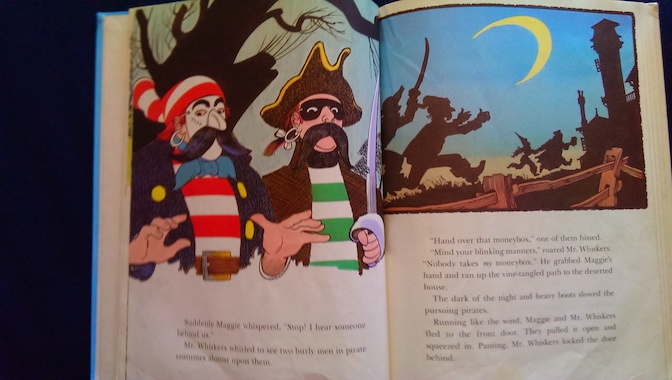
Mr. Whiskers is eager to talk to Seth, the owner of the General Store, about this year’s Easter egg hunt.  Seth hosts one every year, and Mr. Whiskers is full of plans.  However, Seth tells him that he’s thinking of closing the store and moving.  He’s been lonely in Cranberryport since his wife died, and he’s thinking that he might want to retire and move to a warmer climate.

CranberryEasterSethMoving

When Mr. Whiskers tells Maggie’s Grandmother what Seth said, she says that he’s not the only one thinking of moving.  A couple of her friends say that they can’t handle living alone on their farms in the winter anymore, and because they haven’t been able to find rooms to rent in town, they are thinking of moving to a warmer climate, too.

CranberryEasterMaggieSuggestion

Then, Maggie comes up with a possible solution. She reminds them that the building that the General Store occupies was once a hotel.  There are rooms above the store that Seth hasn’t been using.  If he cleaned up those old rooms, he could rent them out to Grandmother’s friends.  Seth is reluctant at first because the rooms need a lot of work to clean up, but with a little urging and help from his friends, they soon manage to turn the old hotel rooms into nice-looking apartments.

CranberryEasterRenovations

Grandmother’s friends love the apartments because, with rooms right over the store, they won’t even have to go out for groceries when the weather is bad.  The arrangement works well for Seth, too.  When members of the community help to clean up the old rooms, it reminds him that he has friends in town, and with some of them living right above his shop, there will be no need for him to feel lonely anymore.

CranberryEasterApartments

Of course, when Seth decides to stay in town and hold the Easter egg hunt after all, Mr. Whiskers has to follow through on his promise to dress up as the Easter Bunny.

CranberryEasterBunny

Like other books in the series, this book includes a recipe in the back, for Cranberry Cobbler.

CranberryEasterCobblerRecipe

Papa Gatto

PapaGatto

Papa Gatto by Ruth Sanderson, 1995.

This beautiful picture book, set in a fairy-tale Italy, is based on several folk tales, as the author explains on the page with the publishing information.  Among the tales that served as inspiration for this story is The Colony of Cats, which is from Andrew Lang’s The Crimson Fairy Book.  In some ways, this story is similar to Cinderella and Mother Holle, with its wicked stepmother and stepsister.

In the distant past, so the story says, it was common for animals to talk, and one of the wisest cats was Papa Gatto, who served as an adviser to the prince.  Papa Gatto had a lovely wife and a beautiful mansion, but soon after the birth of their eight kittens, his wife died.  Needing someone to help care for the motherless kittens, Papa Gatto decides to advertise for someone to help.

PapaGattoAdvertises

In the town, there is a widow who has a daughter named Sophia and a stepdaughter named Beatrice.  As in many fairy tales, the widow favors her own daughter, who is lazy and spoiled, while giving all of the hard work to her stepdaughter, who is much nicer.  When they hear about Papa Gatto’s advertisement, Beatrice feels sorry for the young kittens and wants to help.  However, the widow, thinking of the generous fee that the wealthy Papa Gatto is offering, decides that she wants it for Sophia.  Sophia doesn’t want the job, but at her mother’s urging, she goes to see Papa Gatto anyway.

PapaGattoSophia

Papa Gatto gives Sophia the job tending his house and family while he’s away on a trip, but Sophia doesn’t know how to work hard and has no real intention of doing a good job.  She simply makes herself at home in Papa Gatto’s lovely mansion, trying on his dead wife’s jeweled collars as bracelets and neglecting the housework and kittens.  When Papa Gatto returns home and sees what she’s done, he sends her away in anger.

When Beatrice hears that Papa Gatto is once again looking for help, she goes to see him without telling her stepmother about it.  Papa Gatto sees how interested she is in the kittens and how gently she treats them, he gives her the job, reassured that she will do it well.

PapaGattoBeatrice

Sure enough, when he returns from his next journey, he sees that Beatrice has taken good care of the house and kittens and rewards her with the jeweled necklace/bracelet that Sophia had admired.  Needless to say, Beatrice’s stepmother and stepsister are angry with Beatrice when she returns home, and Sophia takes the bracelet for herself.

Meanwhile, Papa Gatto has told the prince about Beatrice.  The prince has been thinking about marrying, and he says that he would like to meet Beatrice.  Papa Gatto tells him that she will probably be at the coming fair in town, and the prince should attend and look for the girl with the bracelet.

At first, the prince mistakes Sophia for Beatrice, a deception that she and her mother encourage.  However, when the prince speaks to Papa Gatto again, Papa Gatto realizes the deception and sets things right.

PapaGattoRevelation

The pictures in this book are beautiful!  And, of course, there’s a happy ending.

I liked it that Beatrice didn’t accept the prince’s offer of marriage immediately, saying that she’d like to get to know him first.  It’s more sensible than the fairy tales where they get married right away.

PapaGattoHappyEnding

Clever Tom and the Leprechaun

CleverTom

Clever Tom and the Leprechaun by Linda Shute, 1988.

This picture book is based on an Irish folktale, The Field of Boliauns.

Tom Fitzpatrick thinks that his fortune is made when he is lucky enough to catch sight of a leprechaun one day.  If a person can manage to catch hold of a leprechaun and frighten him, the leprechaun will hand over his gold.  Tom thinks of himself as a clever man, so he doesn’t see how he could fail.

CleverTomCapture

Tom does capture the leprechaun, and the leprechaun does promise to show him where his treasure is buried.  The leprechaun directs Tom to a field of boliauns (a kind of weed, also known as ragwort or ragweed) and points out the plant which marks the place where he buried his treasure.

CleverTomField

Tom needs to get a shovel to dig for the treasure, but he worries about whether he’ll correctly remember the spot when he gets back.  He takes off one of his red garters and ties it on the plant so he’ll be able to find it again, making the leprechaun promise not to touch it while he’s gone.

CleverTomGarter

The leprechaun promises not to touch the garter, but Clever Tom isn’t quite as clever as the leprechaun.  When Tom gets back to the field with his shovel, he’s in for an unpleasant surprise.

CleverTomTrick

Clever Tom might not have his fortune made after all, but he has a great story to tell to the younger generation.

CleverTomTaleTelling

In the back of the book, there is a section with more information about the folk tale, Irish legends and leprechauns, and Irish culture and history.  One of the things I found interesting was the explanation that the leprechaun in the picture book is wearing a red coat because that’s how they are described in Irish folklore.  It’s usually the Trooping fairies who are described as wearing green, like we often see leprechauns depicted in St. Patrick’s Day decorations.  The stories of buried gold left by leprechauns may also may also be based on treasure hoards left by Viking raiders during the Early Middle Ages.  The leprechaun in this story also has ale made from heather, which is something that only Danish Vikings were said to know how to make.

Gila Monsters Meet You at the Airport

GilaMonsters

Gila Monsters Meet You at the Airport by Marjorie Weinman Sharmat, pictures by Byron Barton, 1980.

This is a humorous picture book about a boy moving from one side of the United States to the other and his misconceptions of what he’s going to find when he goes west.

At the beginning of the story, the boy lives in an apartment in  New York City.  As far as he’s concerned, he could live there forever, but his parents decide that they’re going to move “Out West.” (The book never really says what state they’re moving to, but it seems to be somewhere in the Southwestern United States, like Texas, New Mexico, or Arizona.)

GilaMonstersMoving

The boy thinks he’s going to hate his new home.  He thinks of all the things that he’s heard about the West, like there’s cactus everywhere so you hardly know where to sit down, everyone dresses like a cowboy and rides horses everywhere, all he’ll ever get to eat is chili and beans, and he’s bound to die of heat exhaustion in the desert.  His best friend in New York, Seymour, told him that Gila monsters would meet him at the airport.

GilaMonstersCactus

Of course, there aren’t any Gila monsters at the airport when the boy gets there.  Instead, he meets another boy whose family is moving East.  The two boys talk to each other for awhile, and the Western boy starts telling him that he’s not looking forward to heading East because he’s heard that it’s always cold there, the cities are overcrowded and full of gangsters, the buildings are so tall that airplanes fly through the apartments, and there are alligators in the sewers.  He expects to find alligators waiting for him at the airport.

GilaMonstersAirportBoy

Of course, things aren’t as bad as either boy is expecting.  The boy from New York realizes that Seymour and his other friends back East don’t know much about the West, and he starts realizing that things in his new home are actually pretty good, some of them not all that different from home.

GilaMonstersArrival

This book was featured on Reading Rainbow.

Mrs. Armitage, Queen of the Road

ArmitageRoad

Mrs. Armitage, Queen of the Road by Quentin Blake, 2003.

When Mrs. Armitage‘s Uncle Cosmo decides to get a new motorcycle, he lets her have his old car.  However, it isn’t in very good condition.

ArmitageRoadCar

Mrs. Armitage and Breakspear decide to try it out, but as they drive along, pieces of the car fall off.  Some of it is because the car is in bad repair, and some is due to accidents Mrs. Armitage has.  First, the hubcabs, then the fenders fall off.  Mrs. Armitage shrugs it off , saying, “Who needs them?”

ArmitageRoadHubcaps

Eventually, the car goes almost entirely to pieces, but who needs it all?

ArmitageRoadWreck

When Uncle Cosmo shows up with his friends and their motorcycles, they help her fix up what’s left of the car into one amazing machine!
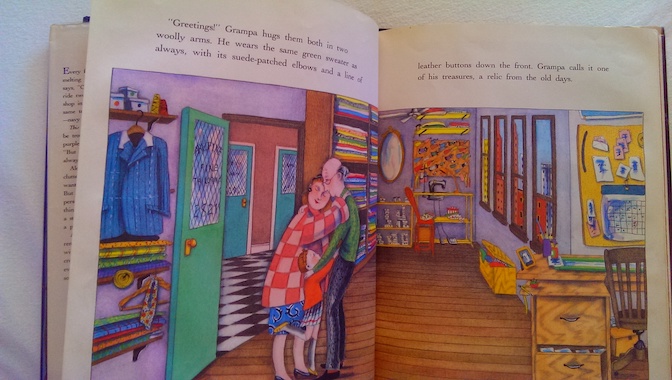
The book is available to borrow and read for free online through Internet Archive (multiple copies, including one in Spanish).

ArmitageRoadMachine