The Prince Who Knew His Fate

This picture book is a retelling of an Ancient Egyptian story (sometimes called The Tale of the Doomed Prince) about a prince and a prediction regarding his death with an unknown ending. The only known original version of the story is incomplete. For this book, the author has given the story an ending.

An Egyptian king wishes for a child, but when his son is born, the seven Hathor goddesses offer a prophecy for the prince’s fate. They say that, “He is destined to be killed by a crocodile or a snake or a dog.”

The king is distressed by this prediction for his son’s fate, and he decides to protect him from it as best he can. He has a special house built for the prince, where he grows up, attended by servants and given all sorts of good things to keep him happy. The king wants his son to stay in this house, where he will be safe. 

However, as the prince gets older, he becomes more interested in the outside world. One day, he sees a man passing the house with a dog, and the prince wants a dog of his own. The king relents and allows his son to have a dog, in spite of the prophecy.

The prince further demands that his father allow him to leave the house and travel. After all, he says, if his fate is already determined, it won’t matter if his father tries to protect him from it. He says that, if he must die eventually, he might as well live his life to the fullest while he can. The king allows his son to have a chariot and to hunt and travel the Nile. Everywhere the prince goes, he brings his dog with him.
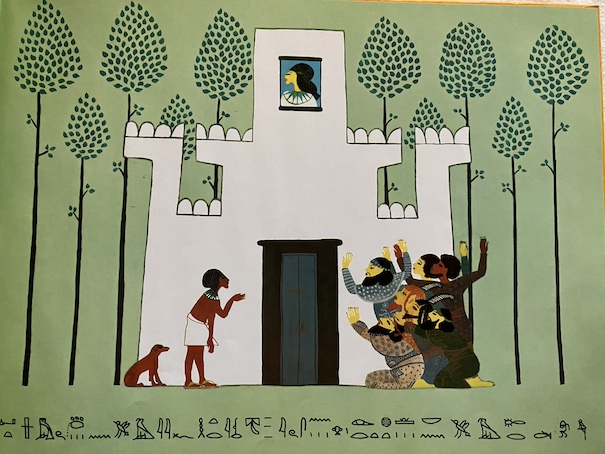
Eventually, he comes to the country of the Chief of Naharin, who only has one daughter. The chief keeps his daughter in a special house with a single window, high off the ground. He says that he will allow his daughter to marry the man who can jump up to that window. The prince manages to make the jump, and he marries the chief’s daughter.

After they are married, the prince explains to his wife the prophecy about his fate. His wife wants to kill the prince’s dog, but he refuses to allow it because he’s had the dog since it was a puppy. His wife begins to watch over him, to try to prevent him from being killed. She manages to kill the snake that comes for the prince, and the prince manages to make a deal with the crocodile, but can he truly escape his fate?
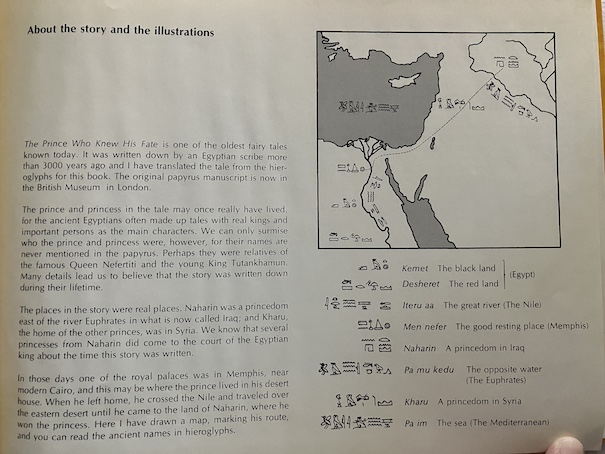
There is a section at the back of the book that explains more about the original story, which was written over 3000 years ago and is “one of the oldest fairy tales known today.” There is also some information about Ancient Egypt and the carvings that were the inspiration for the illustrations in the story.

I always enjoy folklore, and this story is fascinating because the original ending is unknown. The author of this book, Dr. Lise Manniche, who was a Danish Egyptologist, translated the story from the original hieroglyphics and added an ending to the story. I thought that the ending fit well enough, and I was pleased that it was a happy ending, even though it holds to the idea that the fate must be fulfilled. I also enjoyed the illustrations, based on Ancient Egyptian carvings from around the time that the story was created, and the addition of the hieroglyphs of the original story along the bottom of the pages.

I first heard about the folktale in this book in a mystery book for adults called The Snake, the Crocodile, and the Dog by Elizabeth Peters. It is part of the Amelia Peabody mystery series, about a Victorian era woman who is married to an archaeologist. Elizabeth Peters is a pen name for Barbara Mertz, who was an Egyptologist herself. Because this folktale featured prominently in that mystery novel, I was thrilled to find this version of it!

Apple Tree Christmas

Apple Tree Christmas book cover

Apple Tree Christmas by Trinka Hakes Noble, 1984.

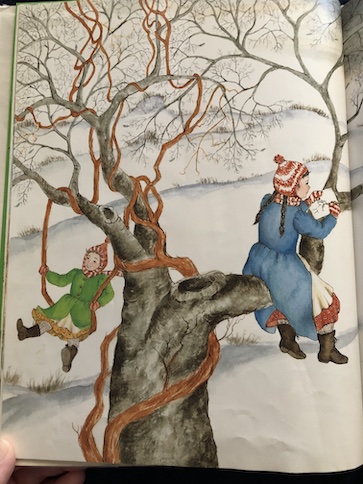
A farm family in 1881 lives in their barn because they haven’t built a separate house yet. Outside the barn, there is an old apple tree that the family loves.

They like to pick the apples from the tree, and use them for cider and applesauce. The two girls in the family like to climb the tree. Josie, the younger girl, likes to swing on the vines that hang from the tree’s branches. Katrina, the older girl, likes to draw in the tree with her paper resting against a crooked branch. She thinks of that special limb as her “studio.”

Then, a terrible winter storm ruins the apple tree before Christmas. The whole family is sad at the loss of the tree, but Katrina is particularly devastated at the loss of her studio. Will she even be able to draw again if she can’t craw in her special place?

The family uses most of the ruined tree as firewood, and they use apples they’ve saved from the tree as decorations on their Christmas tree. However, because of the loss of the apple tree, it doesn’t really feel like Christmas to Katrina. Then, their father shows them that he has saved their favorite parts of the tree and turned them into special Christmas presents.

The book is available to borrow and read for free online through Internet Archive.

My Reaction

I thought this was a charming Christmas story! When I first saw the title, I guessed that the family would use an apple tree as a Christmas tree, but that’s not it at all. It’s just about the family feeling sad about the loss of their apple tree and how the remains of the tree made it a memorable Christmas. Because the father of the family saved their favorite parts of the tree when he was cutting up the rest for firewood, they will still be able to enjoy the things they loved about the tree, particularly Katrina, who receives a special drawing table made out her favorite branch of the tree.

The author dedicated the book to her own father because he made a special drawing board for her. On the inside dust jacket of the book, the explains that the inspiration for the apple tree and vine swing came from her own childhood in rural Michigan.

I love the artwork in this book! The pictures are realistic and detailed, and they have an old-fashioned charm that fits well with the modern Cottagecore aesthetic. I love the family’s home in the barn, with the girls sleeping in the loft and being wrapped in colorful patchwork quilts! The first book that I read by this author was The Day Jimmy’s Boa Ate the Wash, but she wasn’t the illustrator for that book. I didn’t know the she did illustrations, but seeing the illustrations in this book makes me want to see more by her!

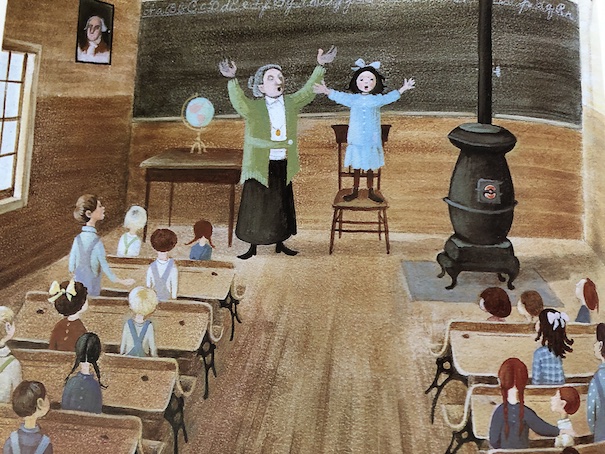
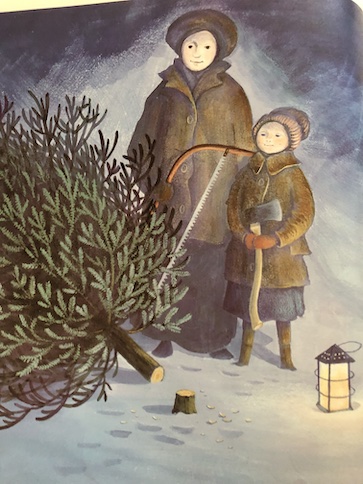
The Year of the Perfect Christmas Tree

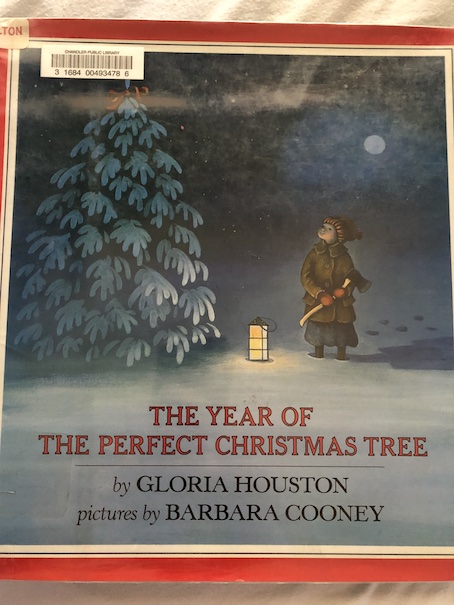
The Year of the Perfect Christmas Tree by Gloria Houston, pictures by Barbara Cooney, 1988.

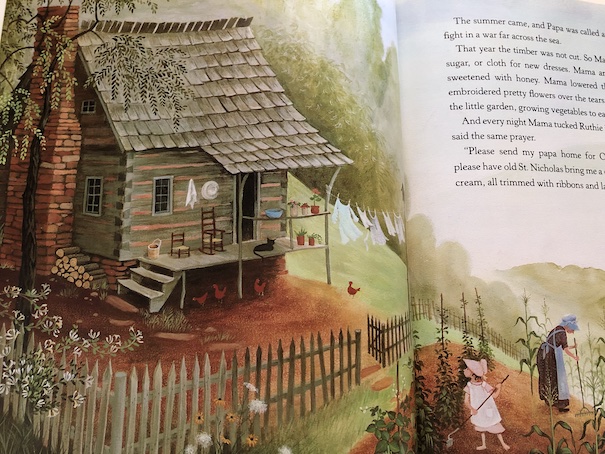
Ruthie is a little girl living on a farm in Pine Grove in the Appalachian Mountains during World War I. (The story calls it The Great War because that was its name before WWII.) During the spring, Ruthie’s father selected a tree for the village church’s Christmas celebration. The local families take turns providing the tree, and it’s their family’s turn. Ruthie goes with him to pick out the right tree and mark it with a red ribbon.

However, during the summer, Ruthie’s father has to go away to be a soldier overseas. Ruthie and her mother tend the farm while her father is away, but money is tight. Ruthie thinks ahead to Christmas and prays for her father to come home and for a special Christmas present for herself – a pretty doll with a cream-colored dress with ribbons and lace.

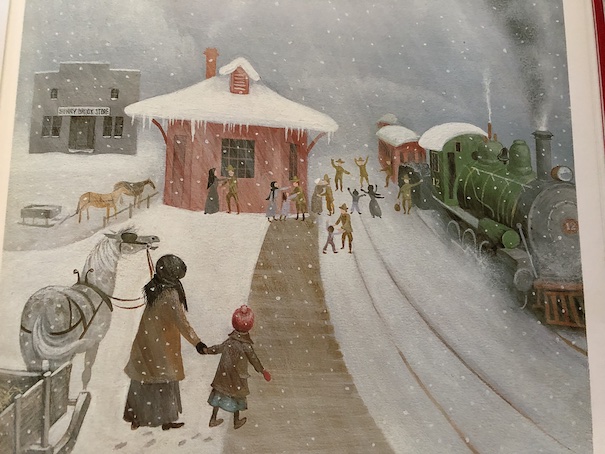
In the fall of that year (1918), Ruthie’s father writes a letter, saying that the Armistice has been signed, meaning that the war is over, so he’s sure he’ll be home for Christmas. Ruthie and her mother keep waiting for him to arrive any day, but he doesn’t seem to come, and they don’t know exactly when to expect him.

At school, Ruthie is told that she will have the role of the heavenly angel in the Christmas play and that they are still expecting Ruthie’s father to supply the Christmas tree. Ruthie is looking forward to it, but Ruthie and her mother don’t have enough money for a new dress for the angel costume, and there is still the worry about when her father will return home, and if he will make it in time to cut the Christmas tree and take it to the church.

The local preacher tells them that the person who is due to provide a Christmas tree next year is willing to do it this year instead, if Ruthie’s father can’t get home in time, but Ruthie’s mother is still sure that their family can manage the tree. Ruthie’s mother decides that she and Ruthie will go get the tree themselves. It isn’t easy, but they manage it, and Ruthie’s mother also finds a way to make a dress for Ruthie’s angel costume.

However, there are two more things that would make this Christmas perfect for Ruthie – if her father returns home in time for Christmas and if she somehow receives the doll of her dreams.

The book is available to borrow and read for free online through Internet Archive (multiple copies).

My Reaction

This is a sweet, old-fashioned Christmas story about wishes coming true. Wishes coming true at Christmas is a popular theme in Christmas stories, and in this book, they come true because Ruthie’s mother and Ruthie do what they need to do to make everything work out the way they want it to. They could have let someone else provide the Christmas tree, and no one would have thought less of them for doing it because the father of the family was still away, but they were determined to see their family’s promise to provide the Christmas tree through. The mother also uses her old wedding dress for the material for Ruthie’s angel costume, and it’s implied that she also made the angel doll for the top of the Christmas tree that becomes Ruthie’s special Christmas present.

The pictures are charming, and they fit well with the Cottagecore aesthetic that’s been popular in recent years.

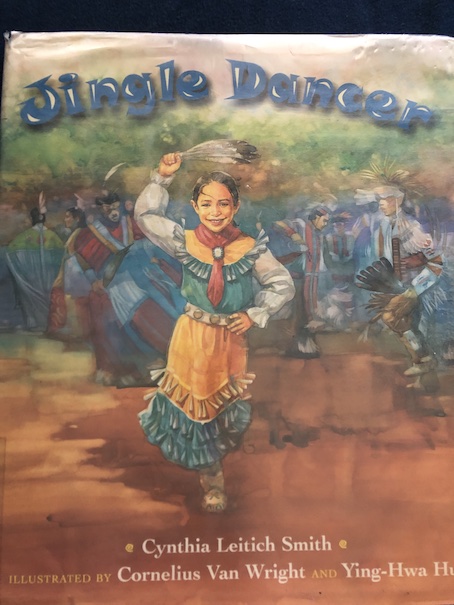
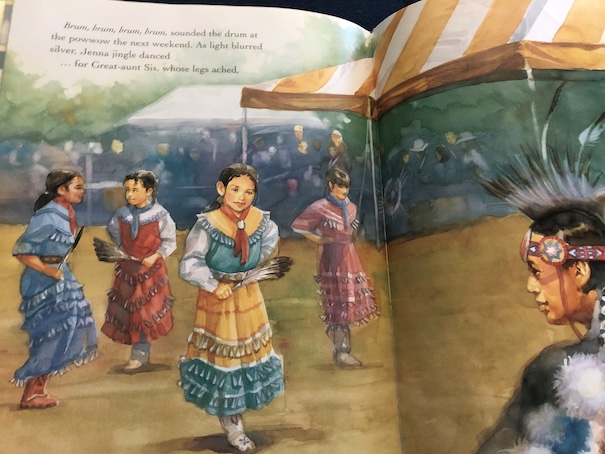
Jingle Dancer

Jingle Dancer by Cynthia Leitich Smith, illustrated by Cornelius Van Wright and Ying-Hwa Hu, 2000.

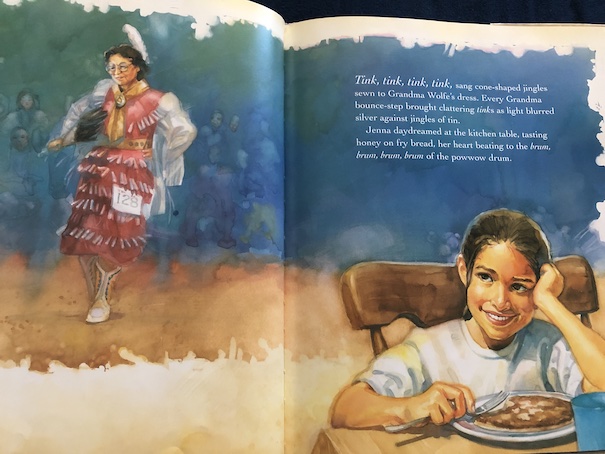
Jenna is inspired to become one of the jingle dancers at the powwow because her grandmother has been a jingle dancer. She loves the way the little cone-shaped bells on the dancers’ costumes sing!

Her grandmother tells her that there won’t be enough time to get the tin for making the jingles for her costume this time, but next time, she can dance with the Girls group.

Jenna knows how to do the dance because she has watched old videos of her grandmother dancing and has practiced. However, she can’t really do a proper jingle dance without the jingles for her dancing costume.

However, her grandmother isn’t the only person Jenna knows who has been a jingle dancer. Other women in Jenna’s family and among her family’s friends have also been jingle dancers, and not all of them dance anymore. Perhaps, with their help, Jenna can get the jingles she needs in time for this powwow!

The book is available to borrow and read for free online through Internet Archive.

My Reaction

I liked the way the book showed how Jenna’s family and friend supported her and helped her to take part in a tradition that they have all shared. They can’t all be there to see Jenna when she dances, but Jenna dances for all them, her dress covered in borrowed jingles!

A section in the back of the book explains more about Jenna’s tribe and the traditional dance shown in the story. The story is set in Oklahoma, and Jenna is part of the Muscogee (Creek) Nation and has Ojibway (Chippewa/Anishinabe) ancestry. Elements of both tribal cultures appear in the story. The tradition of jingle dancing originated with the Ojibway people, and the book describes details of the costume (called “regalia” in the book) that women and girls wear to perform the dance. The book also contains a glossary of words that appear in the story with some additional details about their significance.

I think this story is a fun way to introduce readers to Native American traditions that may not be familiar to them. I also enjoyed the pictures, which have a lovely, dream-like quality to them.

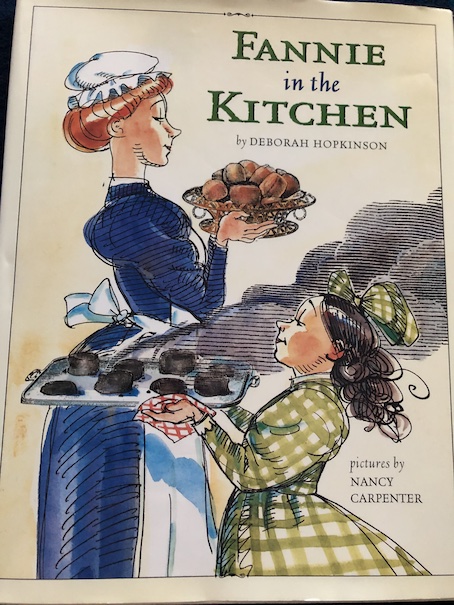
Fannie in the Kitchen

Fannie in the Kitchen by Deborah Hopkinson, 2001.

This is the story of Fannie Farmer and her famous and popular cookbook! When I first heard of the Fannie Farmer Cookbook (originally The Boston Cooking-School Cook Book (1896)), I wasn’t sure whether Fannie Farmer was a real person or if that was just a pseudonym or a marketing name for the cookbook, but Fannie Farmer was a real person in the late 19th century, and that was her real name. The story in this picture book is based on her real life, although details may be fictionalized, and the pictures give the story humorous twists.

In the beginning of the story, a little girl named Marcia Shaw prides herself on how many things she can do around the house and how much help she can give to her mother. However, she’s still a little girl, and there are some things she doesn’t know how to do well. In particular, Marcia doesn’t know how to cook. Now that her mother is expecting another baby, Marcia’s mother decides that she needs to hire some extra household help, especially with the cooking.

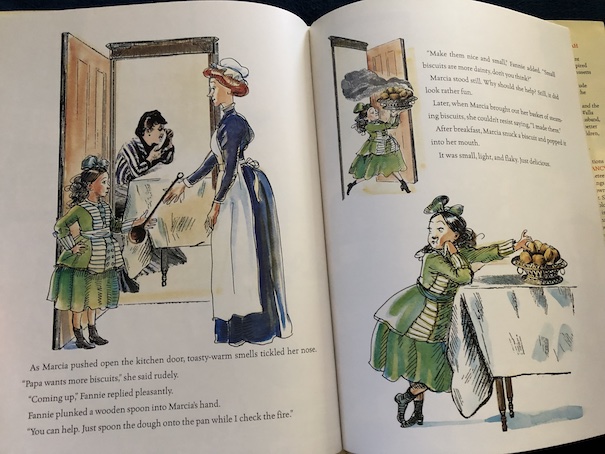
Marcia is a little offended that her mother considers her inadequate to help by herself, but when the new help arrives, a young woman named Fannie Farmer, Marcia has to admit that she’s a good cook. Even better for Marcia, Fannie doesn’t consider her cooking techniques trade secrets. She enjoys letting Marcia help in the kitchen and teaching her cooking tips.

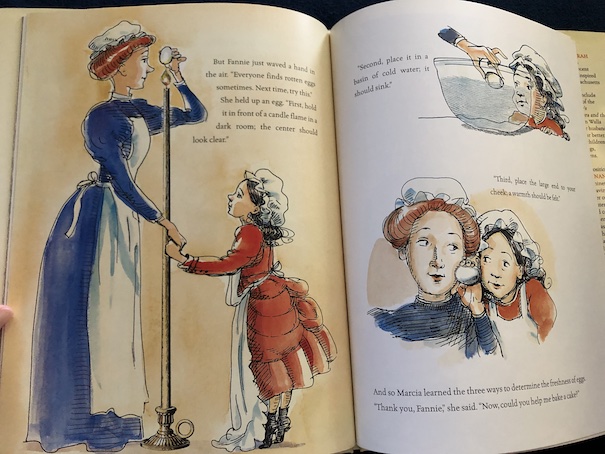
Under Fannie’s tutelage, Marcia’s cooking skills improve. Fannie teaches her many important pieces of information about cooking, like how to measure ingredients and how to tell when ingredients are fresh or if they’ve gone bad.

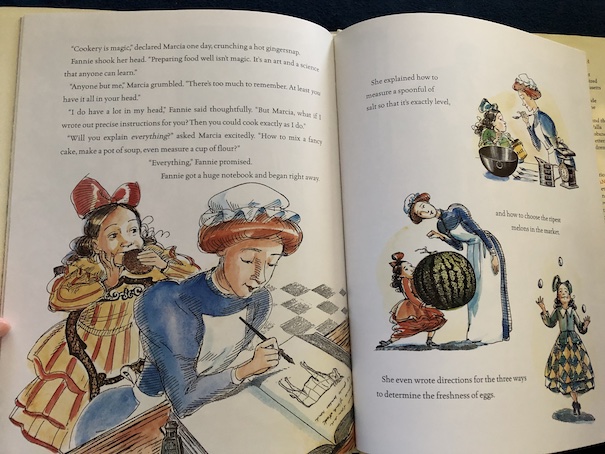
Marcia enjoys learning to cook with Fannie, but she thinks that she’ll never be as good as Fannie because there’s just too much to remember. She doubts that she’ll ever be able to memorize it all. Marcia is amazed that Fannie can keep all of that cooking information in her head. To help Marcia, Fannie decides to write out a notebook with recipes and cooking instructions, including all of the specific measurements for ingredients and detailed information about cooking techniques to make the recipes come out just right.

This is what makes Fannie Farmer and her cookbook so unique for their time period. If you’ve ever seen a very old recipe book or even just old family recipes written down, they often don’t have all of the amounts of ingredients written down, or the amounts are written in very vague terms. Old recipes also offer little to no cooking techniques, like how to tell when it’s time to turn a griddle cake over or how to tell if a cake is done baking. The assumption was that girls (usually girls for this time period) would learn to cook by watching their mothers and by learning from their examples. However, that assumes that their mothers knew all of these cooking tips themselves, that the mothers remembered to tell their daughters what they knew and explained it well enough for them to understand (some people don’t have much of a talent for teaching, even when it’s a subject they know themselves), and that the daughters understood or remembered everything their mothers said. Otherwise, the vague directions in cookbooks and family recipes were of little help, and new cooks had to learn through experimentation or trial and error. Fannie’s approach to cooking, as explained in the story, is an art and a science that anybody can learn if someone explains it well enough, so she puts her focus on recording all of the necessary details of her recipes.

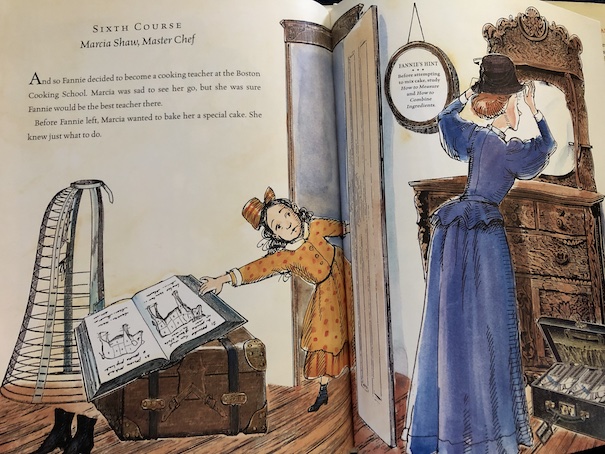
Fannie’s recipe book, started for Marcia, turns out to be very popular with both the Shaw family and their friends and neighbors. As word spreads about it, people start coming by to borrow recipes or get cooking advice. Fannie realizes that there is a lot of demand for better teaching of cooking techniques, and she really enjoys teaching cooking, so she decides to accept a job at the Boston Cooking School.

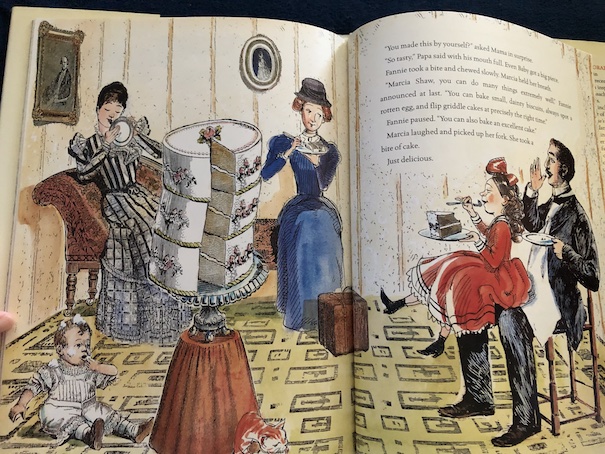
Before Fannie leaves the Shaws, Marcia borrows the cooking notebook and makes a special cake for Fannie to show her what she’s learned. The cake comes out just right because Marcia has followed Fannie’s directions.

There are hints from the Fannie Farmer cookbook throughout the book, and there is a section in the back of the book with historical information about Fannie Farmer. It also includes a sample recipe for Griddle Cakes.

The book is available to borrow and read for free online through Internet Archive (multiple copies). New and used copies are also available on Amazon. You can also buy the original Fannie Farmer Cookbook through Amazon or read it online through Internet Archive (multiple copies).

My Reaction

One of the things I liked about this book is the illustrations. There are eccentric details in the pictures that add humor to the story, like how Marcia stacks a bunch of chairs on top of each other while making candles, so she can make them extra long, and one of her extra long candles appears later, when Fannie shows her how to tell if an egg is fresh by holding it up to a light. For some reason, Marcia’s mother also has a weird habit of licking her dishes when she’s eating one of the yummy recipes, and there is one picture where it looks like she’s lost control of the baby carriage, and it’s rolling away with the baby. I’m sure these aren’t historical details and were just thrown in to be funny.

I think it’s also important to point out that the real-life Fannie Farmer lived an unconventional life for someone of her time period. She was plagued with health problems from a fairly young age. At some points in her life, she was unable to walk, possibly because of a stroke, and when she walked, she had a limp. She never married, but she built a fulfilling career around her talent for cooking. and achieved lasting fame because she wanted to share her knowledge with others. She is credited with establishing exact and level measurements in cooking in the United States, and she was also a strong believer in quality food and proper nutrition, especially for people with health problems.

The Moon Jumpers

The Moon Jumpers by Janice May Udry, pictures by Maurice Sendak, 1959.

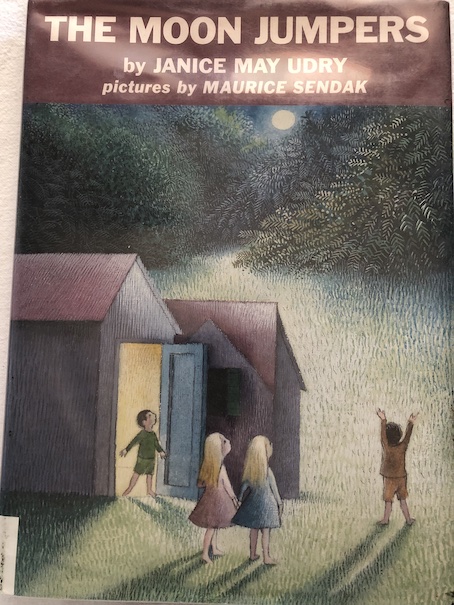
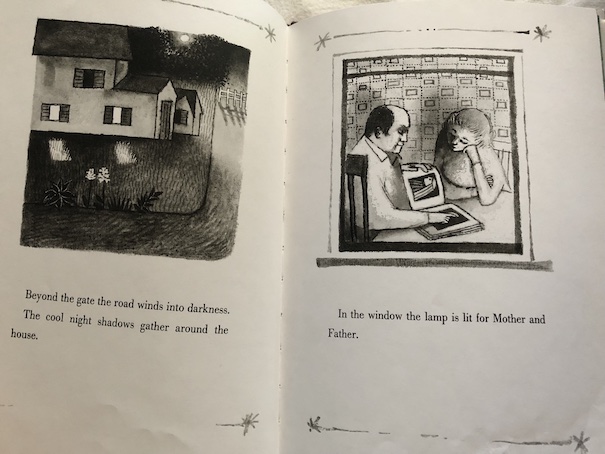
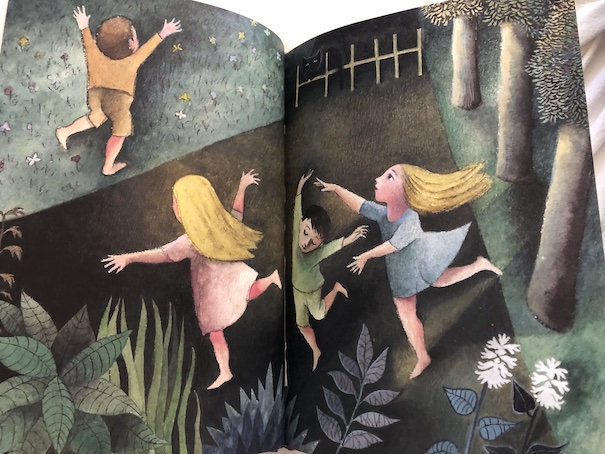
In this pleasant, relaxing children’s picture book, some children enjoy a beautiful summer evening! Some of the pictures are in black-and-white and some are in color, but the best pictures are the full-color, full-page illustrations. The illustrations are by Maurice Sendak, who wrote and illustrated Where the Wild Things Are. The story is told from the point-of-view of the children.

While their parents are in the house, the children go outside to enjoy the relative coolness of the evening. They run barefoot through the grass and play tag.

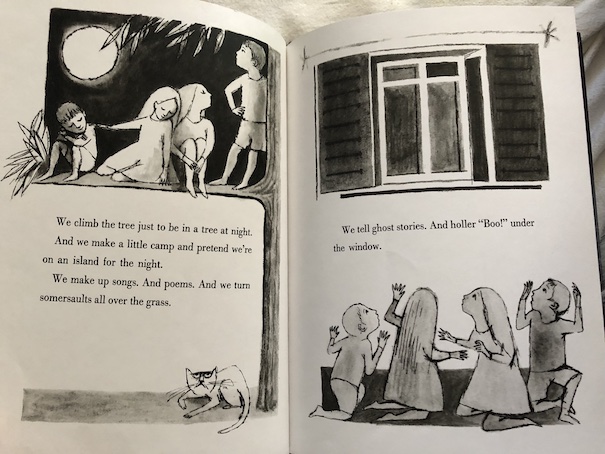
They climb a tree “just to be in a tree at night.” They set up their own camp, make up songs and poems, and tell each other ghost stories.

The moon is rising, and the children jump in the air, trying to touch it, although they know they can’t.

Eventually, their parents call them inside to go to bed. As the children go to bed, they say goodnight to the moon through their bedroom window.

The book is available to borrow and read for free online through Internet Archive (multiple copies). It’s a Caldecott Honor Book!

My Reaction

This is a nice, calm book that would make a good bedtime story on a summer night! It reminds me a little of Goodnight Moon, Time of Wonder, and The White Marble, which are other calm bedtime stories. It isn’t told in rhyme like Goodnight Moon, but it does show the beauties of summer and evenings spent outside, like Time of Wonder and The White Marble.

Time of Wonder

Time of Wonder by Robert McCloskey, 1957, 1985.

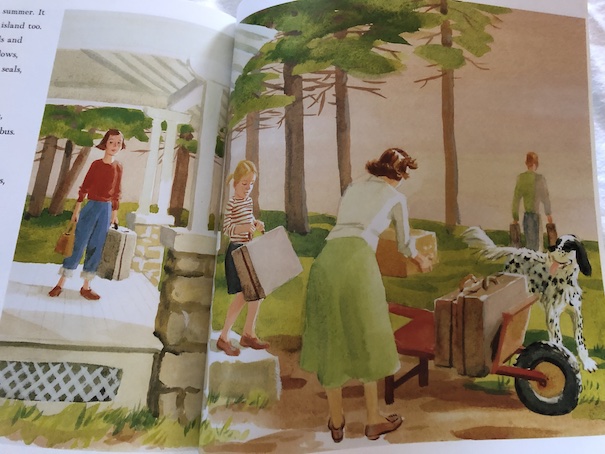
This is a beautiful, very relaxing picture book about a family’s summer vacation on an island off the coast of Maine. Although you can see from the pictures that the main characters are a pair of sisters, the entire story is told in the second person, from the point of view of “you.” Readers are meant to feel like they’re part of this magical summer trip!

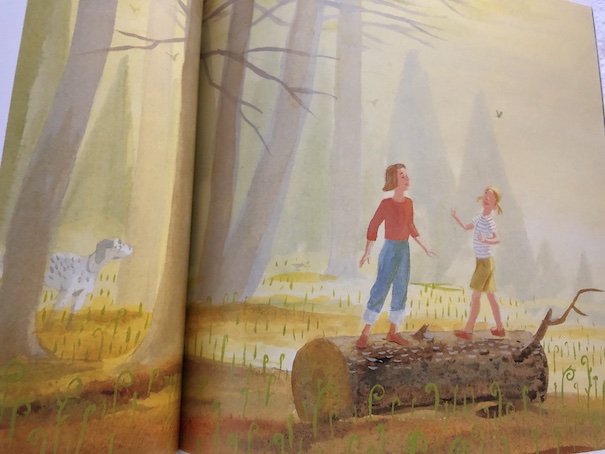
“You” feel like you’re spending the morning walking in the fog along the bay, enjoying the plants and birds in the forest nearby, and sailing in the bay with seals and leaping porpoises.

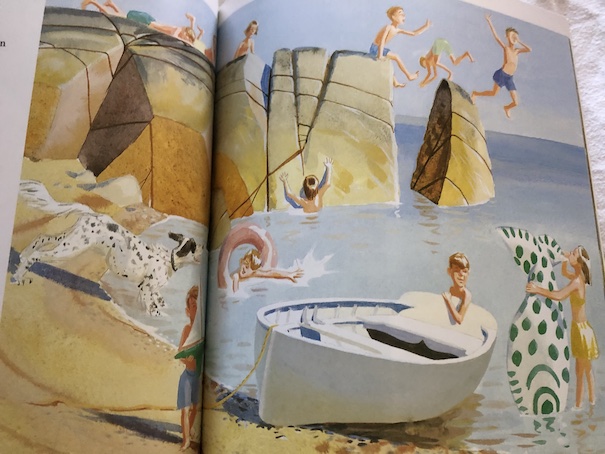
During the day, there are other children playing on the beach, diving from the rocks, and swimming. In the evening, “you” row a boat out into the quiet water and use a flashlight to look at the crabs.

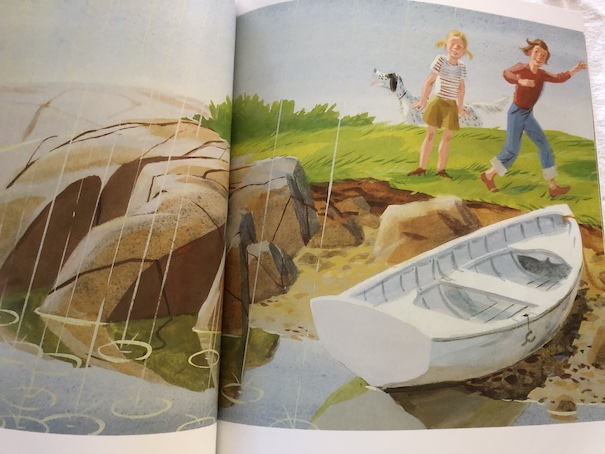
When it rains, “you” feel it! Most of the time the weather is peaceful, but there is a storm approaching, and people know they have to get ready for it. When it comes, it brings a strong wind that blows through the house!

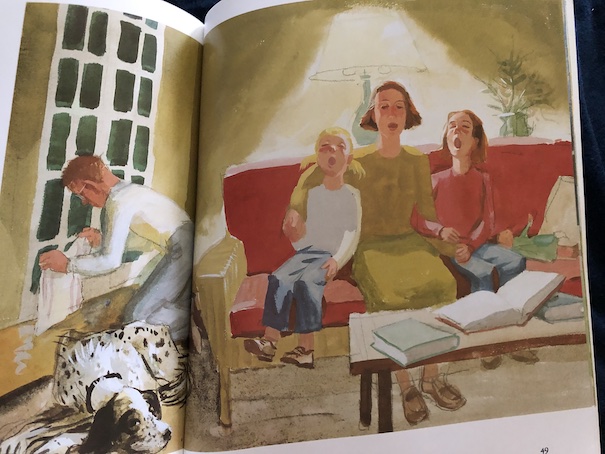
The family reads together and sings songs until the storm is over and it’s time to go to bed.

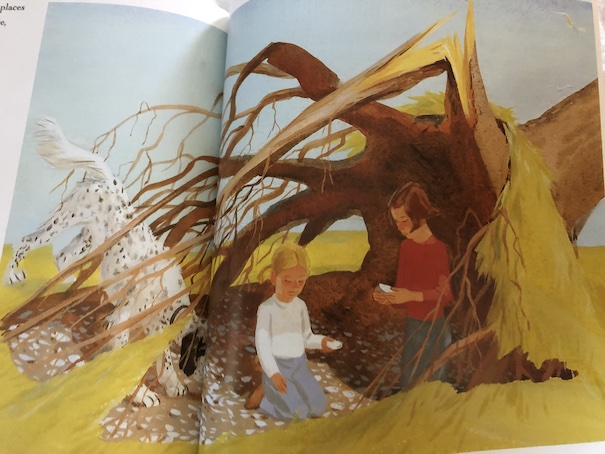
The next day, trees are uprooted, and “you” get to explore what’s beneath their roots.

When it’s time to go home because school will be starting again, you’re a little sad to leave this place, although you’re also glad to go home again.

The book is available to borrow and read for free online through Internet Archive (multiple copies). It’s a Caldecott Medal winner!

My Reaction

This is a great book when you want something calm and relaxing or you feel like you need to take a mental vacation, whether you’re a kid or adult! Nothing stressful happens in the story. It’s just a lovely memory of a peaceful vacation. Even the storm that comes doesn’t do anything worse than blow things around the room and knock over some trees and plants. The girls in the story help clean up after the storm, find ancient seashells under the roots of a fallen tree, and are happy that the sunflowers are looking toward the sun again.

When the girls are looking at the shells under the fallen tree, they think about the Native Americans who lived in the area before white people came and before the tree grew there. They call them “Indians” instead of Native Americans, but that’s the only thing I can find to nitpick about the story.

I think this would make a great, calming bedtime story for kids, especially during the summer! It reminds me a little of the song Verdi Cries, about someone’s memories of a special vacation.

The setting for the story, on an island off the coast of Maine, is based on the author’s family’s summer home, and the two girls in the story are based on his own daughters. They are not named here because the story is about “you”, but the older girl is Sarah (called Sal) and the younger girl is Jane. They appear in and are named in Blueberries for Sal and One Morning in Maine, where they are much younger.

Hilda’s Restful Chair

Hilda’s Restful Chair by Iris Schweitzer, 1981.

One hot morning, Hilda finishes watering her garden and decides that she needs to rest for a while.

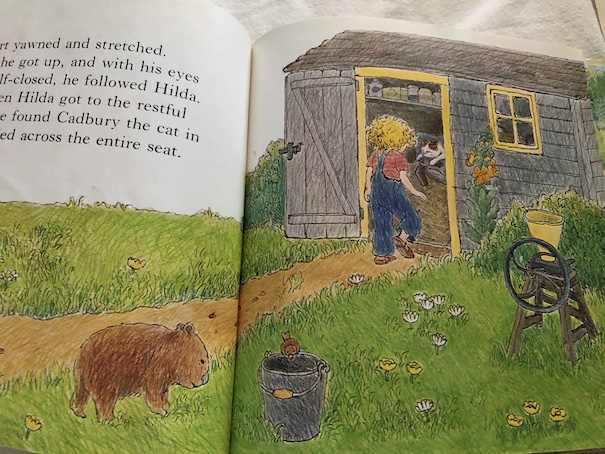
When Hilda needs to rest, she has a special place she likes to go – an old armchair that she keeps in a shed. She calls the chair her “restful chair.”

Hilda is joined in her restful chair by Osbert the wombat and Cadbury the cat. However, Osbert and Cadbury aren’t the only animals who enjoy the restful chair. Soon, a pair of rabbits ask to join the others in the chair.

As Hilda and her animal friends sit in the restful chair, other animals come to join them. As the chair becomes more loaded with animals, it starts to creak and groan.

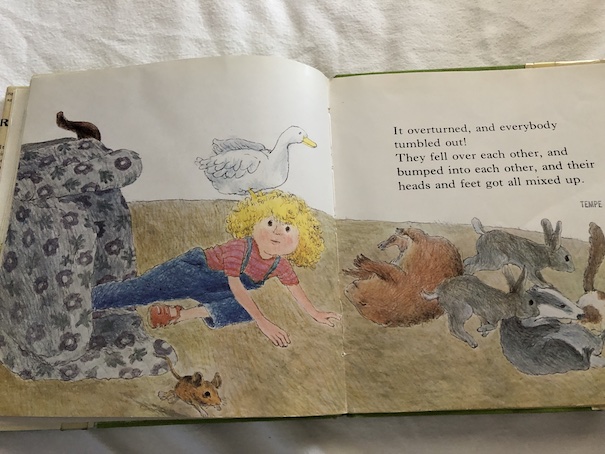
Eventually, the chair just can’t take it anymore, and it falls over, dumping everyone onto the floor.

Still, all the animals decide that they had a good rest. As the animals leave, Hilda sets the chair up again, and she and her animal friends go inside to have some watermelon.

The book is available to borrow and read for free online through Internet Archive.

My Reaction

This is a cute, fun story about animals who enjoy a comfortable chair as much as a little girl. Kids like stories with repetition, and they would probably enjoy seeing the parade of animals who come to join Hilda in her chair. They would probably also see the ending coming, that the chair won’t be able to hold everyone. It’s just a question of which animal is going to be the last straw for the chair. Fortunately, no animals were harmed by this experience, and even the chair seems okay, even though it fell over.

Because there is a wombat in the story, I assumed that the story takes place in Australia. It probably does, but from the publication information, it looks like it was first printed in Great Britain. The author was originally from Israel, but she was living in London at the time the book was published.

Clifford Takes a Trip

Clifford

Clifford Takes a Trip by Norman Bridwell, 1966.

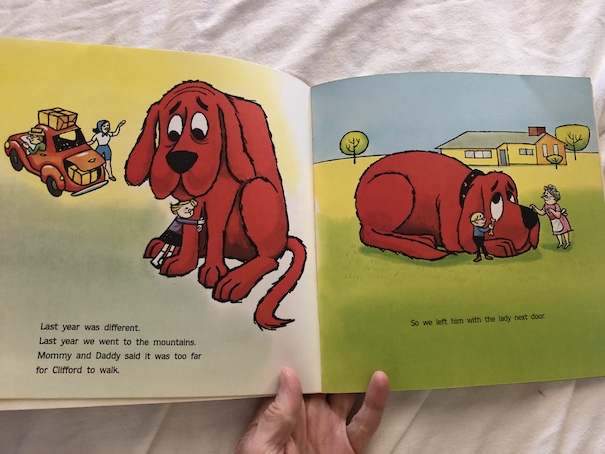
Emily Elizabeth and her parents don’t usually take long trips during the summer because it’s too difficult to bring Clifford along. He’s just too big to go on trains or buses. One summer, Emily Elizabeth’s parents decide to go camping in the mountains. They can’t take Clifford, so they leave him behind with a neighbor.

However, Clifford misses Emily Elizabeth too much, so he decides to go find her! A gigantic red dog can create a lot of chaos on a cross-country trip.

Along the way, he does help a man with a broken-down grocery truck, and the man is grateful enough to feed him.

He also arrives at the family’s campsite just in time to save Emily Elizabeth after she thought it would be fun to play with some baby bears she found.

The family considers that next year, they may find a way to take Clifford with them somewhere else.

The book is available to borrow and read for free online through Internet Archive (multiple copies, including one in Spanish).

My Reaction

Like all Clifford books, the humor is based around Clifford’s enormous size. Even though the family thought that it would be too far for Clifford to walk to come to the mountains with them, he tracks them down there anyway. Then, after he rejoins his family, he sleeps with Emily Elizabeth, his ear propped up to be her tent. The idea they’re considering next for transporting Clifford is a flat-bed truck. I could well imagine my own dog trying to track me down if I went on vacation without her, but fortunately, when your dog is about the same size as Toto in the Wizard of Oz, traveling with a dog isn’t as difficult.

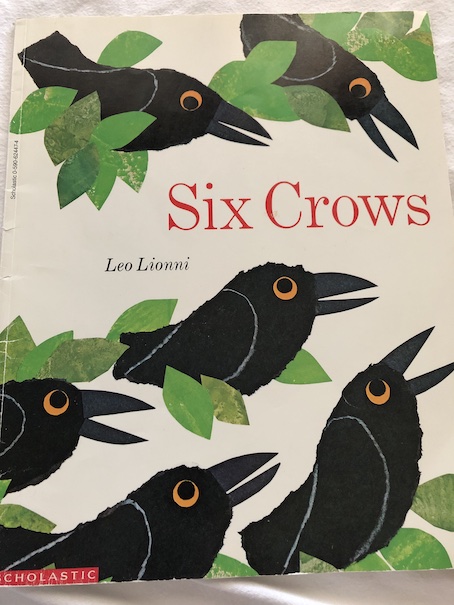
Six Crows

Six Crows by Leo Lionni, 1988.

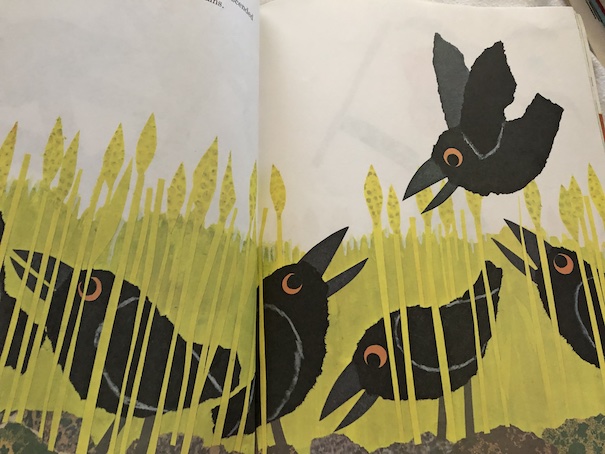
A farmer in the Balabadur Hills (the book doesn’t explicitly say that this story takes place in India, but it’s implied) has a good farm, but he also has a problem with the crows who live nearby. Whenever his wheat is ripe and about ready to harvest, the crows come and eat it.

Chasing the crows away doesn’t work because they always come back. The farmer decides to try building a scarecrow instead. It does frighten the crows, but with an unexpected result.

The crows decide that they must make their own scare-person, a kite that looks like a big, fierce bird, to scare away the scarecrow. When they fly over the field with their scare-person kite, the farmer gets scared and decides that he needs a bigger, scarier scarecrow.

The situation escalates, with the birds building an even bigger and scarier bird kite to scare the farmer.

Meanwhile, an owl who has been watching all of this unfold decides that it’s gone far enough and goes to talk to the farmer and the crows about the situation. The owl persuades both sides to speak to each other and work things out.

When they talk, the farmer and the crows realize that they don’t want to fight with each other. The crows depend on the farmer’s wheat for food, and the farmer realizes that he actually enjoys having the birds around. The owl fixes the mean-looking scarecrow to have a happy and friendly look.

I’m not sure that this is really a traditional fable because the book doesn’t provide any background information on the story and the author isn’t credited as doing a “retelling”, but the story is told in a folktale or fable format about conflict resolution. When the farmer and the crows are feuding, they continually escalate the situation with bigger and scarier “weapons” until the owl convinces them that the only way out of the situation is to talk it out and come to an agreement.

The book is available to borrow and read for free online through Internet Archive (multiple copies).