Thanksgiving on Thursday

Magic Tree House

There is a letter to the readers at the beginning of the book, where the author briefly describes the history of the Thanksgiving holiday and how it started as a three-day harvest festival and didn’t become a regularly-celebrated holiday until President Lincoln declared it as a national holiday of thanksgiving to be celebrated annually on the last Thursday in November in 1863. The separate prologue to the book explains that Jack and Annie have started learning magic, and they’ve been going on a series of missions to find different types of magic.

It’s Thanksgiving, and the children know that they will be leaving for their grandmother’s house soon, but they can’t resist going to the tree house to see if there’s another message from Morgan. There is a message that tells the children that they are about to find a new kind of magic. A book in the tree house takes the children back in time to the first Thanksgiving in the American colonies.
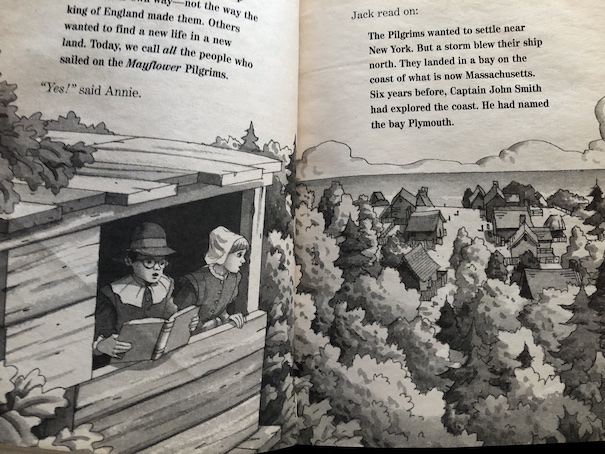
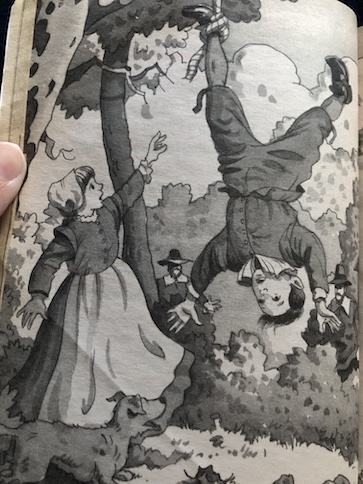
They read about the Pilgrims and the voyage of the Mayflower, and they realize that they are now in 17th century Plymouth. Annie remembers how her class at school put on a play about Thanksgiving, and she gets excited, thinking about how they’re about to meet some of the people they studied in school. She dashes off, eager to get a look at them, although Jack thinks they should pause and work out a plan before they approach anyone. Unfortunately, Jack gets caught in a hunting snare.

A group of people, Pilgrims and Native Americans, come to see what got caught in the snare, and they find Jack and Annie. When they question the children, Jack isn’t sure exactly what to say, so he tells them that they came from “a village up north” and that they’re here to learn how to grow corn. Remembering something else from the book, he claims that his parents sailed to the colonies with Captain John Smith when he and Annie were babies. Captain Standish says that Squanto knew Captain John Smith and that he might remember them. To the children’s surprise, when Governor Bradford asks Squanto if he remembers two babies called Jack and Annie who sailed with Captain John Smith, he says he does. Jack wonders if he’s mistaking them for two other children from the past.

The children witness the arrival of Chief Massasoit and his men. Priscilla tells the children that they were invited to join the harvest festival (something that historians debate), but they weren’t expecting such a large group, and they wonder if they’re going to be able to feed everyone. The Wampanoag say that they will go hunting to provide more food, but the Pilgrims say that they will also gather more food.

Jack and Annie are invited to join the food-gathering efforts, although it’s difficult for them because they’re not used to hunting and fishing, like 17th century children would be. Annie thinks it won’t be so bad because they’ve helped their parents prepare for Thanksgiving before, but the types of food at this harvest festival are very different from the “traditional” Thanksgiving food the children would have expected, and the methods of preparing them are old-fashioned. Jack and Annie find themselves trying to catch eels and find clams and trying to tend things cooking over an open fire. The children’s efforts don’t go well, and at first, they’re afraid that they’ve ruined the feast, but the magic they came to seek saves everything.
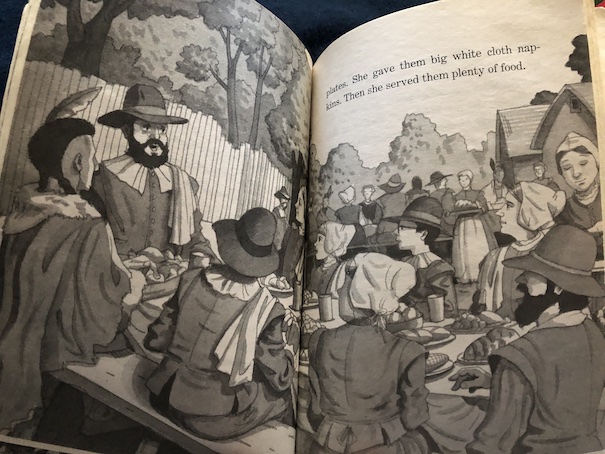
The magic that the children find is called the “magic of community.” Even though Jack and Annie think that they haven’t contributed much, and they burnt the turkey they were trying to cook, their mishaps haven’t ruined the feast because the entire community was helping all the time. Because everyone contributed something, there is enough for everyone. Besides learning how the first Thanksgiving was different from the holiday they know, Jack and Annie learn about cooperation, how people share and support each other.

At one point, Jack asks Squanto why he says that he remembered them. Squanto seems to realize that Jack and Annie aren’t quite what they said they were, but he says it wasn’t really them that he was remembering. He explains a little about his own past and what it felt like to be an outsider in a strange place, reminding the children to remember that feeling and to be kind to others in the same situation.

I liked the author’s noted about the history of the Thanksgiving holiday. For another book that explains the first Thanksgiving feast from the point of view of both the Pilgrims and their Wampanoag guests, I recommend Giving Thanks by Kate Waters.
On The Mayflower

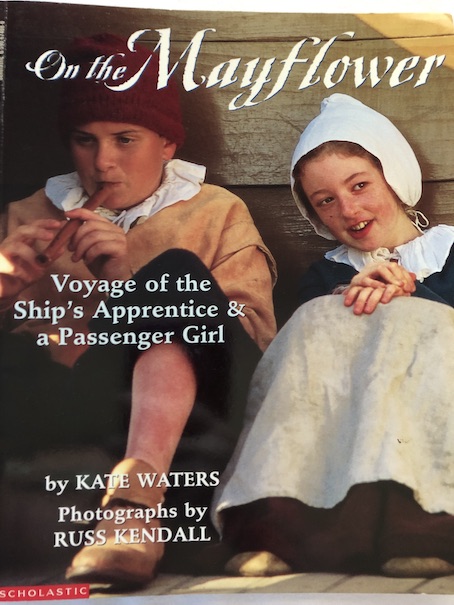
On the Mayflower by Kate Waters, 1996.

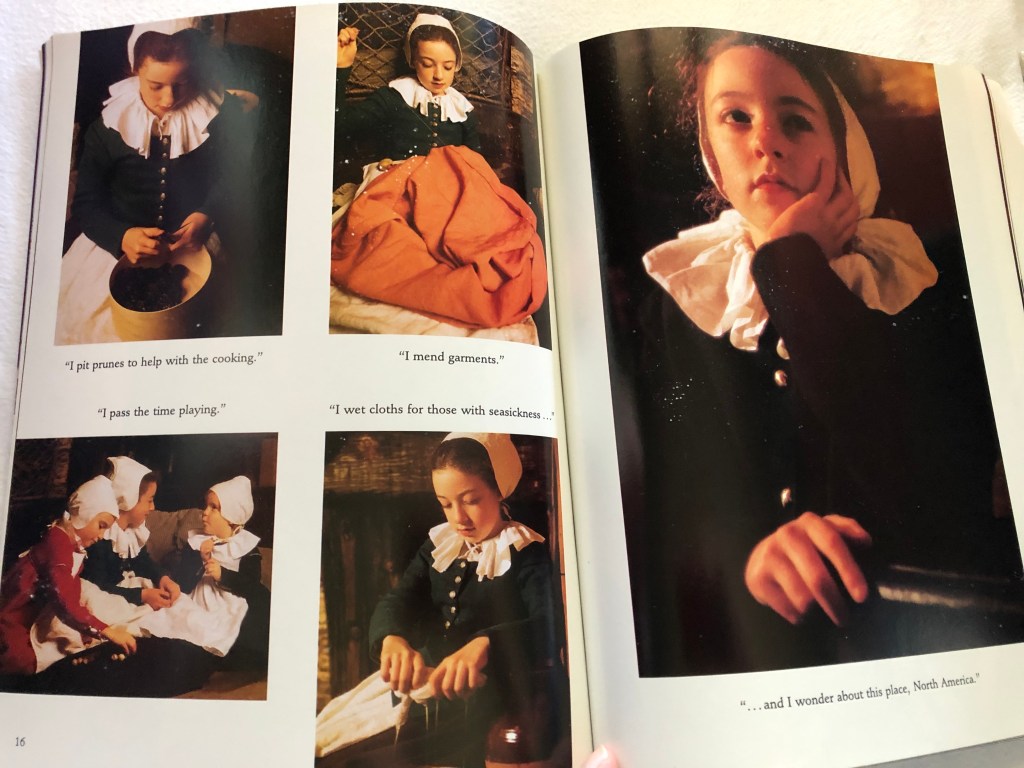
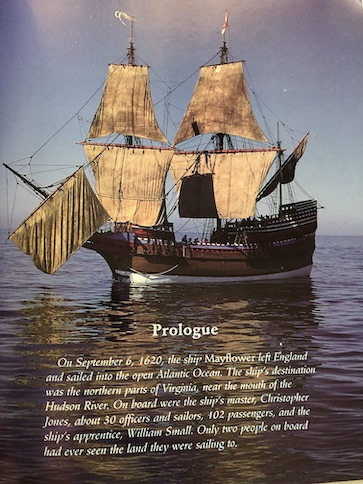
This book is part of a series by same author about children growing up in Colonial America. Each of the books is the series has photographs of historical reenactors portraying real people from Colonial history. This book focuses on two children who are traveling on the Mayflower in 1620, heading to what would become the Plymouth colony. One of the children is a girl who is a passenger on the ship, and the other is a boy who is part of the crew, a ship’s apprentice. In the section of historical information in the back of the book, the author explains that the girl was based on a real girl who was a passenger on the Mayflower, although the boy was not based on a specific apprentice; he is just meant to show what a ship’s apprentice would have been like at that time and to help explain the duties of the various crew members as he assists them.

The ship’s apprentice is called William Small. He is specifically apprenticed to the ship’s master, Christopher Jones (historical character). As an apprentice, he is learning basic navigation skills and assists the regular crew members with various tasks, including serving food.

The girl is named Ellen Moore. She and the other passengers are traveling in cramped quarters, and people are often seasick or trying to find ways to keep themselves occupied during the long journey. Ellen is traveling with younger siblings, and she plays with them in between performing routine chores, like sewing and preparing food.

During the voyage, there is a terrible storm, and the passengers are all confined below deck without light because lanterns and candles would pose too much risk of fire while the ship is rocked during the storm. William has to help the ship’s carpenter to repair leaks. Before the storm is fully over, Mrs. Hopkins, one of the passengers, gives birth to a baby she names Oceanus (historical person, the real Oceanus made it through the voyage although he sadly died young, possibly about age six, but the date of his death is uncertain).

The book ends with their arrival in the Americas. Because the storm blew them off course, the Mayflower did not arrive at its intended destination in Virginia but further north at Cape Cod in what is now Massachusetts. Because winter was setting in, the passengers decided not to risk further travel and established their colony there, 65 days after their ship first left England.

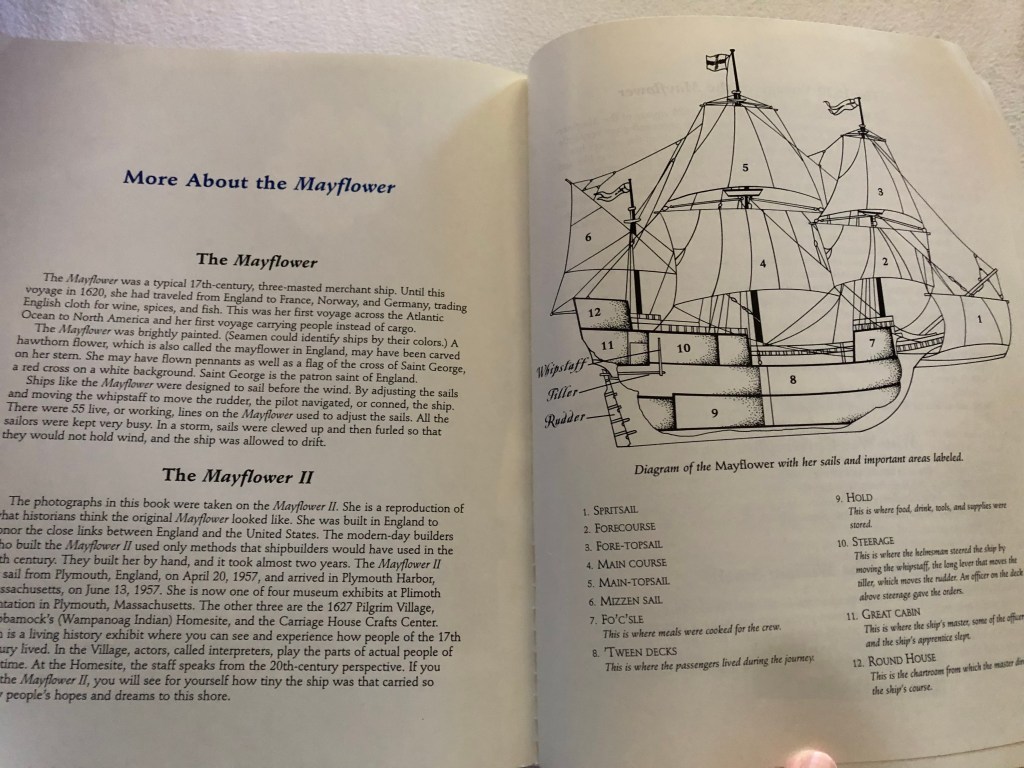
In the back of the book, the section with historical information explains more about both the characters in the story and the reenactors. The historical Ellen Moore and her siblings were traveling to the colony without their parents, under the guardianship of the other families, acting as young servants in their employment. The book mentions that the Moore children were without their parents because of a family tragedy but is not specific about what it was. I looked it up, and the story is both sad and bizarre. I can see why the author didn’t want to explain it in a children’s book. Apparently, the children’s parents had an arranged marriage and were not happy being married to each other. The children’s mother had a long love affair with another man, and also apparently, all of the children were the biological children of her lover. The mother’s husband began to notice that the children physically resembled his wife’s lover. The couple bitterly divorced, and after the husband was granted custody of the children (which, apparently, weren’t his anyway), he decided to send them away to the Americas with the departing pilgrims, paying for them to be taken on the voyage, never seeing them again. Sadly, Ellen probably did not survive the first winter at the Plymouth colony because she disappears from the historical record during that time. Out of the four Moore children traveling on the Mayflower, only one survived to adulthood, Ellen’s young brother Richard. Richard married twice in his life and had seven children of his own. He became a sailor and ship’s captain and eventually died an elderly man in Salem, Massachusetts, during the 1690s, not long after the Salem witch trials. None of this information about Richard is mentioned in the book, but I thought it was interesting background information. In the book, there is also additional information about the ship, The Mayflower, and the reproduction ship used in the pictures, The Mayflower II.

The book is available to borrow for free online through Internet Archive.

Molly’s Pilgrim

MollysPilgrim

Molly’s Pilgrim by Barbara Cohen, 1983.

Molly has been unhappy since her family moved to the smaller town of Winter Hill, New Jersey so that her father could get a better job. In New York City, there were other Jewish girls like her, and she didn’t feel so strange and out-of-place. The Winter Hollow girls don’t understand her at all and don’t like her. Molly’s family fled Russia to escape persecution, and they’ve only been living in America for about a year.  Molly still has a Yiddish accent and doesn’t quite speak proper English yet.  Molly is constantly teased about the way she talks and her unfamiliarity with American habits.

MollysPilgrimSchool

One girl in particular, Elizabeth, makes up rhymes to make fun of Molly, even following her home from school like a creepy stalker, to continue singing them at her. The other girls follow Elizabeth’s lead because they kind of admire her and because she is always giving them candy.

MollysPilgrimBullies

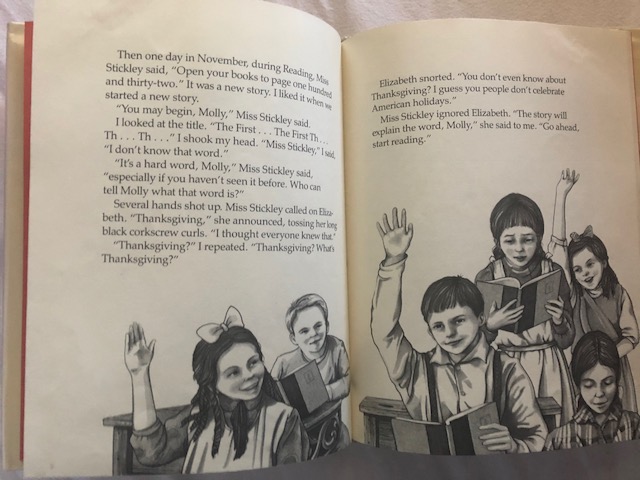
Then, one day, the girls’ teacher begins teaching them about Thanksgiving. Of course, Elizabeth makes a big deal about the fact that Molly has never heard about Thanksgiving before. But, Molly finds the story about the pilgrims interesting. The teacher says that for their Thanksgiving activity, instead of making paper turkeys like they usually do, the children are going to make clothespin dolls to look like American Indians and pilgrims, so they can create a scene like the first Thanksgiving.

MollysPilgrimClass

When Molly gets home and explains the assignment to her mother, she has to tell her mother what a “pilgrim” is. She explains it by saying that they were people who came from across the ocean in search of religious freedom. Her mother understands that and offers to help Molly with the doll.

However, when Molly sees what her mother has done with the doll, she is worried. The doll is beautiful, but her mother has dressed the doll in the clothes of a Russian refugee, like Molly’s family, not in the traditional Puritan garb of the pilgrims. At first, Molly is sure that she’ll be teased more than ever at school when she shows up with a doll wearing the wrong clothes and that people will think that she’s stupid for not understanding how pilgrims dressed.

MollysPilgrimDoll

But, Molly’s mother is correct in pointing out that their family are modern pilgrims, coming to America for the same reasons that the original pilgrims did. Molly does get some teasing from Elizabeth (that’s not a surprise, since it’s Elizabeth, after all), but when the teacher asks Molly about the meaning of her doll, it leads everyone to a better understanding, both of the holiday and where Molly and her family fit in with their new country and its history.

Molly’s teacher points out that the holiday of Thanksgiving wasn’t entirely an original idea that the pilgrims invented all by themselves but that they took their inspiration from a much older Jewish tradition from the Old Testament.  Human beings do not exist in a vacuum, and we all regularly take ideas that we’re exposed to and build on them in our own lives.  Although Puritans were generally known for their belief in religious “purity” (hence, their name) and noted for their intolerance to different religions and beliefs, they also strongly believed in education, which frequently involves taking past ideas and knowledge and applying them toward new situations.  Their Thanksgiving celebration was just an example of that, an older idea that they used for their own purpose, adapted to the lives of the people who adopted the tradition.  It was their celebration, but not their sole intellectual property.

The book is currently available online through Internet Archive (multiple copies).

There is also a sequel to this book called Make a Wish, Molly, in which Molly learns about birthday parties in the United States.

My Reaction and Additional Information

The book doesn’t mention it, but the word “pilgrim” itself is also much older than the early Puritan colonists in America.  Before the development of the America colonies, it referred to any religious traveler on their way to a holy place, and many people still use it in that sense.  A person on a pilgrimage could be just about anyone from anywhere going to anywhere else as long as the journey has spiritual significance.  The Puritan colonists used that term for themselves to emphasize the reasons why they were seeking new homes in a new land.  For them, it was a kind of pilgrimage to a place where they could start again.  Molly’s family came to America in search of religious freedom, just as the Puritans did.  Their journeys weren’t quite the same, but they shared a common purpose and ended up in the same place (more or less).

By showing the links between Molly and her family and the pilgrims, Molly’s mother and her teacher help the other students to understand that Molly really does fit in, that her being there makes sense, and that she has a place in their class and in their celebration of Thanksgiving.

This story was also made into a short film. I remember seeing it in school when I was a kid in the early 1990s.  I checked on YouTube, and there are trailers posted for this film.  One thing that I hadn’t remembered from when I was a kid was that the time period of the book was earlier than the film.  In the film, the characters are shown to be contemporary with the time the film was made, but the style of dress of the girls in the book’s pictures and the things that Molly’s mother says about why the family left Russia indicate that the book probably takes place during the late 19th century or early 20th century, possibly around the same time as the events in the famous play/movie Fiddler on the Roof.

As a side note, if you’re wondering why the girl is named Molly, which doesn’t sound particularly Russian, Molly is typically a nickname for Mary and other, similar-sounding, related names.  Molly’s mother also calls her Malkeleh, which may be her original name or perhaps another variant, if her original name was Malka, as another reviewer suggests.

In spite of the warning on that last site I linked to about reading a book with your child that may be covered in class, I say to go ahead and read it anyway.  It’s hard to say what books may or may not be used in classes by individual teachers, and if your child’s teacher doesn’t happen to use this one, it’s still a good story.  Perhaps just warn your child not to say something that would spoil the ending for their classmates who haven’t read it yet.

Giving Thanks

GivingThanks

Giving Thanks by Kate Waters, 2001.

This book describes the feast of 1621 that we think of as “the first Thanksgiving” from the point of view of two boys: Resolved White (a six-year-old English colonist) and Dancing Moccasins (a fourteen-year-old Wampanoag).  The book explains that the reality of this feast is somewhat different from the way many people think of it.  For one thing, the exact date is unknown, and it wasn’t really a single meal but a kind of harvest celebration that took place over several days.  The events of that celebration were re-created using reenactors from the Plimoth Plantation living history museum.

In the beginning of the book, Dancing Moccasins explains that his family has been harvesting their crops and preparing to move to the place where they live in the winter. Wampanoag lived in different places depending on the time of year, moving between them when the seasons changed.  At their winter home, they would continue hunting and fishing, returning to the place where they planted their crops at the end of winter.

GivingThanksBeginning

Similarly, Resolved’s family has finished harvesting their crops and have stored up food for the winter.  Now that most of the hard work is over, they have time to relax and celebrate.  The community is planning a feast.  Resolved and his friend, Bartle, follow some of the men, who are going out hunting and target-shooting.

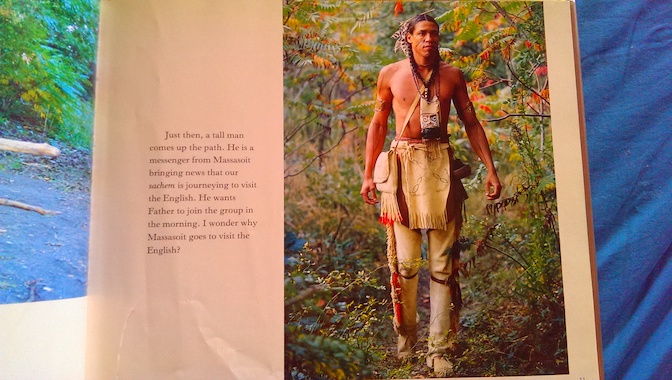
The colonists meet up with some of the Wampanoag, which is how Dancing Moccasins and Resolved first see each other.  Dancing Moccasins returns home and tells his father what he has seen.  Then, a messenger arrives from their chief, Massasoit, saying that he will be visiting the colonists soon, and Dancing Moccasins’s father is invited to come.

GivingThanksMessenger

Just as Dancing Moccasins is wondering about the purpose of this visit, Resolved is wondering the same thing because word has reached the colonists that they will soon be visited by the chief and representatives of the tribe.  (The book explains in the back that the exact reasons for the Wampanoag visit to the colonists are unknown today, only that it happened at the same time that the colonists were planning their harvest feast.) The two boys meet again when Dancing Moccasins accompanies his father on the visit to the colonists’ village.

GivingThanksGovernorDinner

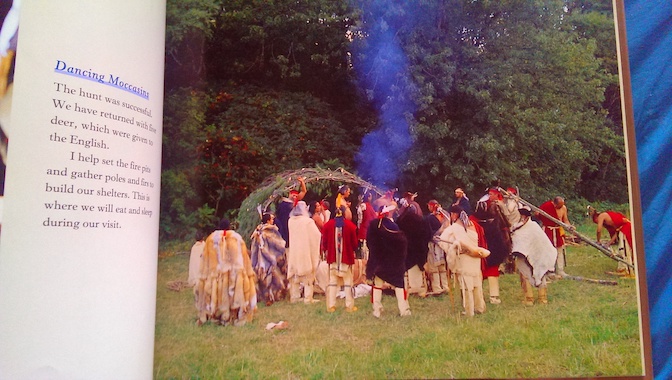
When the Wampanoag arrive at the village, they are treated as honored guests, and some of the Wampanoag go deer-hunting to provide a present for their hosts.  The chief dines with the governor of the colonists.  The Wampanoag build shelters for themselves, where they will stay during their visit.

GivingThanksShelters

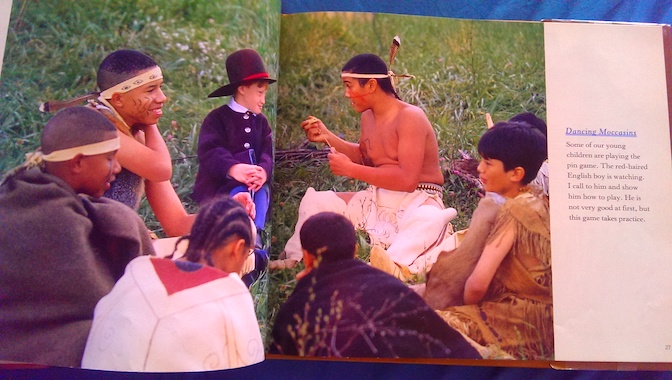
Eventually, Dancing Moccassins invites Resolved to play a game with him and some other Wampanoag boys when he sees him watching them.  Some of the Wampanoag men also join in the games that the English men play, like competing to see who can throw a log the farthest.

GivingThanksGames

At the end of the day, Dancing Moccassins and Resolved each eat with their own families, but there is plenty for everyone.

There is a section in the back with historical information about the harvest feast, traditions about giving thanks among both the colonists and the Wampanoag, and how Thanksgiving eventually became a national holiday in the United States.  There is also information about food and clothing in the time of the story and a recipe for samp (a kind of corn pottage eaten by the Wampanoag and later adopted by the English colonists).  The book also has some information about the Plimoth Plantation living history museum and the reeanctors.  It is part of a series of books by the same author about the lives of children in Colonial America.

The book is available to borrow and read for free online through Internet Archive.

Samuel Eaton’s Day

Samuel Eaton's Day

Samuel Eaton’s Day: A Day in the Life of a Pilgrim Boy by Kate Waters, 1993.

This is the story of a boy who traveled to America from England on the Mayflower and whose family lived in Plymouth, Massachusetts. The book focuses particularly on how a boy like Samuel would have helped with a harvest during the year 1627.  The role of Samuel in the book is played by a boy who is one of the reenactors at the Plimoth Plantation living history museum.

Samuel’s mother died when he was a baby, but his father remarried, and he now has a stepmother (whom he calls “Mam”) and a younger half-sister, Rachel.  Now that Samuel is seven years old, he is considered old enough to help the men bring in the rye harvest.  Samuel is eager to help because he wants to prove that he is no longer just a little boy and that he is capable of doing a man’s work.

The book begins with Samuel waking up and getting dressed in the morning.  He has a few routine chores to perform, such as getting water, gathering firewood, and checking a snare that he has set for catching wild game, before he and his father go to the fields to help with the harvest.  After breakfast, Samuel and his father meet up with a neighbor, Robert Bartlett, and go to the fields with the other men.

SamuelEatonBinding

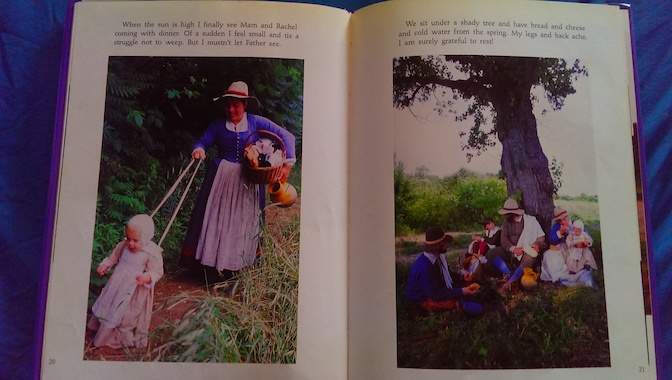
Robert Bartlett tells Samuel that it will take a few days for them to complete the harvest.  Samuel isn’t considered old enough to wield a sickle by himself, so he is given the task of gathering up the rye that his father and Bartlett cut and binding it into sheaves.  It’s hard work, and at times, Samuel wonders if he’s really up to the task.  When his Mam comes with lunch, she gives Samuel the chance to come home with her, if he is too tired, but Samuel is determined to stay and finish out the day.

SamuelEatonLunch

At the end of the day, Samuel is very tired and has blisters, but he is proud of the work he has done, and the men congratulate him.

The end of the book has a section that explains a little about the real Samuel Eaton, who eventually had his own farm when he grew up, and the boy who reenacted his life, Roger Burns.  There is also information about the clothing of the period, the Wampanoag people (seen briefly when Samuel is helping to gather mussels for the family’s dinner), the rye harvest, and the Plimoth Plantation living history museum.  The book also provides the lyrics to the song that Samuel and the others sing to entertain themselves while they’re working in the fields, The Marriage of the Frog and the Mouse.

Sarah Morton, a girl who was featured in an earlier book in the series, also appears briefly in this book.

The book is currently available online through Internet Archive.

SamuelEatonSarah

Sarah Morton’s Day

sarahmortonSarah Morton’s Day: A Day in the Life of a Pilgrim Girl by Kate Waters, 1989.
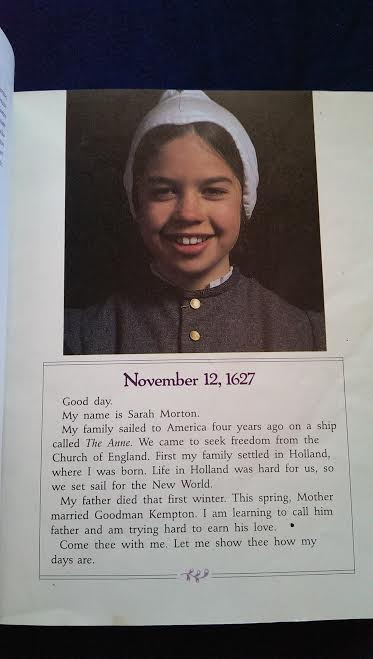
This book is part of a series of historical picture books. It features a young girl who was an historical interpreter at Plimoth Plantation, a living history museum, playing the part of a real pilgrim girl who lived in 17th century Plymouth.  The pilgrim girl’s name was Sarah Morton, and she was nine years old in 1627, the year that Plimoth Plantation reenacts.

As Sarah Morton, the girl takes readers through a typical day in her life.  She demonstrates the chores that a pilgrim girl would have to perform.  She explains the clothes that a pilgrim girl would wear and what people ate.  There is a recipe for 17th Century Indian Corn Bread, a simple recipe that readers can make at home, but it warns that modern people wouldn’t think that it tastes very good.  It’s basically just water and cornmeal grits.

sarahmortonpic1Although much of Sarah Morton’s day is taken up with chores, she also discusses her relationship with her mother and her new stepfather.  The death of a parent was something that pilgrim children often experienced.  After her father’s death, Sarah’s mother remarried, and Sarah is concerned about whether her new father likes her.

However, her stepfather is a good man who cares about her.  He gives her lessons in reading and writing, something that not every pilgrim girl would have.  He also gives her a special toy: a knicker box, which is a wooden box with arches for rolling marbles through as a game.  She gets to play with her friend, Elizabeth.

The two girls are also excited about a ship that has been sighted out at sea.  Soon, new people will be coming to their colony, and they wonder if the ship is also carrying letters from England or special goods that they would like, like a new bolt of cloth.

In the back of the book, there are sections explaining a little about the Plimoth Plantation living history museum, the real Sarah Morton, and the girl portraying Sarah Morton, Amelia Poole. The Plimoth Plantation site has more information about the real Sarah’s Morton’s life, including what happened to her when she grew up.  If you’re curious about what Amelia Poole is doing today, she is a fiber artist and lives in Maine.

The book is available to borrow and read for free online through Internet Archive.

sarahmortonpic2