Raggedy Ann and Andy and the Camel with the Wrinkled Knees

Raggedy Ann and Andy and the Camel with the Wrinkled Knees by Johnny Gruelle, 1924.

This book is part of the original Raggedy Ann series by its creator, Johnny Gruelle. Unlike earlier books in the series, this book is a single long adventure rather than a collection of short stories.
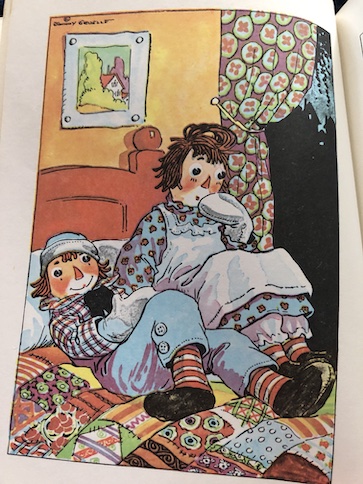
Raggedy Ann and Andy are lying in their doll bed in Marcella’s playhouse one night when they see a strange man sneaking up to the big house. They see him reach through a window, steal something, and run away. Wondering what just happened, they run to the house and talk the other dolls. The other dolls say that the thief just stole the French doll!

Raggedy Ann and Andy try to follow the man to rescue the French doll, but they can’t catch up to him because he flew away! As they try to figure out what to do, a fairy comes along. They explain the situation to the fairy, and the fairy says that they can fly if Granny Balloon Spider weaves a balloon for them. So, they go to Granny Balloon Spider weaves them a silken balloon, and they sail away into the air.
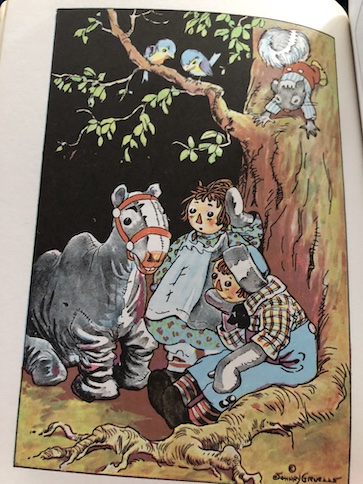
When Raggedy Ann and Andy decide it’s time for them to get off the balloon, they grab hold of a tree limb and untie the silken strings that have them tied to the balloon. When they jump down from the tree, they meet an old stuffed camel with wrinkled knees. They explain their situation to the camel, and the camel says that the man who took the French doll sounds like the one who kidnapped him from his owner, a small boy. The camel escaped from the man, but he thinks he could find him again, except that it was dark when he ran away, so he could find his way better if he couldn’t see.

Raggedy Ann and Andy tie a handkerchief around the camel’s eyes and climb on his back. At first, the camel just goes around in circles, but Raggedy Ann and Andy realize that he needs to run backward to retrace his steps, and then, they start getting somewhere.

Along the way, they meet a girl named Jenny who is trapped in a patch of snap dragons. The snap dragons won’t let her go. When they try to help her, Raggedy Ann and Andy get trapped by the snap dragons, too. They don’t know what to do until a tired old horse comes and rescues them.

Jenny explains that she was searching for her brother, Jan, who was kidnapped by a magical creature called a Loonie. The tired old horse says that he knows where Jan is now, so they decide to rescue Jan before continuing their quest to find the French doll.

The Tired Old Horse leads them to the tree where the Loonie lives, and the Camel recognizes it as the place that he escaped from. They discover that the Camel as the ability to get inside the magical tree when he’s blindfolded, and he carries the others inside. From there, they find a trap door that leads to Loonie Land.

In Loonie Land, they are captured and brought before the king of the Loonies, who is a very silly king. The king insists that they won’t let Jan go until they answer three riddles. The riddles are very silly and make little sense, but Raggedy Ann and Andy figure out that the king doesn’t know the answers himself, so as long as they give him some kind of answer, they will be answering the riddles. The king is astonished that they are able to come up with answers and tries to insist that he has to ask them three more riddles, but Raggedy Ann and Andy insist that they’ve fulfilled the bargain already and that they’re going to take Jan. Raggedy Andy tweaks the king’s nose, and the king summons his looniest knight to fight them.
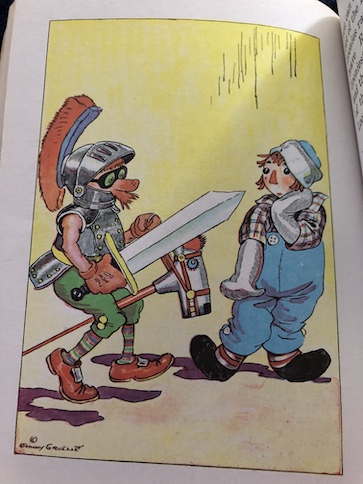
The looniest knight comes riding up on a hobby horse, but he’s afraid of Raggedy Andy and pretends that his hobby horse is acting up and that it has thrown him off. Since Raggedy Andy has “vanquished” the looniest knight, the king decides that they can take Jan and go.

With Jan rescued, they are able to resume their quest to find the French doll. Going further, they meet Winnie the Witch. The witch says that the man with the French doll bought some magic medicine from her, but he gave her a lead dime. Since he cheated her, the witch says that the magic medicine she made for him won’t work. The tired old horse asks if she has some medicine that will make him less tired. When he has her medicine, he becomes more energetic.
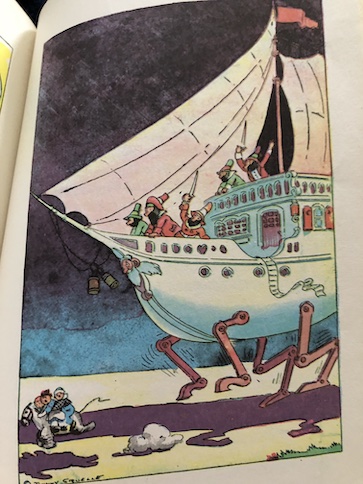
When they ask the witch how to find the man with the doll, she has them close their eyes and count to ten. When they open their eyes, they find themselves outside the tent of the man who took the doll. It turns out that Babette, the French doll, was kidnapped by pirates! Getting away from them is also going to be difficult because the pirates have a jumping house boat!

The book is available to borrow and read for free online through Internet Archive (multiple copies – including an audiobook). The LibriVox audiobook is also available on YouTube.

My Reaction and Spoilers

This story is cute, and I’m sure that it would be amusing for young children. Actually, I found it amusing as an adult because there are some silly jokes in the book that adults can enjoy, like how Raggedy Andy keeps talking while trying to tell the camel that he shouldn’t talk because Raggedy Ann is trying to think. At one point, the camel also gets confused about why the French doll is French when she has a china head. (Ha, ha. Groan!) One of my favorite parts was the part with the king of the Looneys and his nonsense.

The ending is also pretty silly. The tired old horse convinces the pirates to reform by offering them lollipops. It turns out that the pirates are actually a bunch of girls in disguise! These girls apparently had a deprived childhood, but they always liked to read stories about pirates and pretend that they were pirates. When they had a chance, they bought this magical jumping ship and started playing out their pirate fantasies, trying to get all the things that they didn’t have when they were younger, which is why they’ve stolen toys and are easily bribable with candy.

The story has a happy ending where the pirates help Raggedy Ann, Raggedy Andy, and the French doll get home. They reunite Jenny and Jan with their parents, and it turns out that the camel once belonged to Jan’s father. Jan’s father is happy to see his old toy and gives the camel to Jan.

Mystery of the Pirate’s Ghost

Mystery of the Pirate’s Ghost by Elizabeth Honness, 1966.

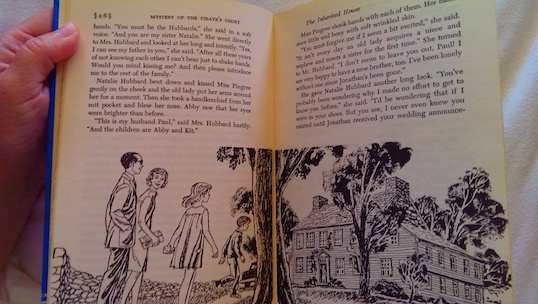
Abby and Kit Hubbard’s mother has just received a letter telling her than her half brother, Jonathan Pingree, has died and left her the old Pingree mansion.  He has left over bequests to other family members as well, and money to be held in trust for Abby and Kit.  It’s exciting news, and the family may move to live in the mansion they have inherited, although it partly depends on Mrs. Hubbard’s other relatives. 

Mrs. Hubbard, who was born Natalie Pingree, has never met her half-brother or half-sister.  They were her father’s children, from his first marriage.  She doesn’t know much about her father’s early life because he died when she was very young, and all that she knows about him is what her mother told her.  Apparently, her father’s first marriage was not a happy one.  He stayed in that marriage long enough for his first two children, Jonathan and Ann, to become teenagers.  Then, he made sure that his first wife and children were settled comfortably enough in the family home and left them to move to Philadelphia to start a new life by himself.  Sometime later, his first wife died and he married Natalie’s mother, who was much younger.  After his death, Natalie and her mother moved in with her mother’s sister, Aunt Sophie.  When Natalie got married, Aunt Sophie sent a wedding invitation to Johnathan and Ann, but they never came to the wedding or made any reply.  Natalie assumed that they felt uncomfortable about their father’s remarriage and didn’t want to see her, which is why she’s so surprised about Jonathan leaving the family home to her.  The only reason she can think of why he would do that is that neither he nor his sister ever married or had children of their own, so there was no one else to leave the house to.  Both of them were more than 30 years older than Natalie, and Ann is now an elderly woman, still living in the house.  Jonathan’s will has made provision for her as well, and the Hubbards go to see her at the Pingree mansion.

Mrs. Hubbard is pleasantly surprised that Ann is actually happy to see her.  Ann Pingree explains that the reason why she and Jonathan never replied to the wedding invitation was that, until that invitation arrived, neither of them had known that their father had another child, and they felt awkward about it.  However, Ann has been lonely since Jonathan’s death, being the last of the Pingrees, and she is glad to have Natalie and her husband and children with her and is eager to have them move into the mansion and live there. (Ann doesn’t live in the old mansion itself, but she does live nearby.)

Aunt Ann shows the family around the old mansion and explains more about its history and the history of the Pingree family. It turns out that the house, which has existed since Colonial times, although it has been burned, remodeled, and expanded over time. The house also has a number of secrets. Apparently, there used to be a tunnel running from the basement of the house to the beach that was used to bring in smuggled goods during the Colonial Era. There is also a hidden room behind a fireplace upstairs where the children of the family could hide during Indian attacks. (It doesn’t say how often that happened.) To the family’s surprise, Ann also tells them that the mansion is supposed to be haunted. The kids think it all sounds exciting, although Ann doesn’t explain much about the ghost the first time she mentions it. (Kit uses the phrase, “Honest Injun?” when asking Aunt Ann if she really means it when she says that the house is haunted. This isn’t a term that people use anymore because it isn’t considered appropriate.)

Mr. Hubbard is able to get his job transferred to a different branch of the company he works for, so the Hubbard family decides that they will move into the Pingree mansion. The kids like living by the beach, and their parents tell them that they can use the old ballroom of the house as a kind of rec room. Soon, they meet a couple of other children who live in cottages nearby, Chuck and Patty, and make friends with them. Chuck and Patty have already heard that the Pingree house is supposed to be haunted, although they’ve never seen anything really mysterious, just a light in the house once when they thought that the house was supposed to be empty.

The next time Aunt Ann comes to visit, the four children ask her to tell them about the ghost, and she tells them the story of the first Pingree to live at Pingree Point. This ancestor, also named Jonathan Pingree, built the original house in the late 1600s. He was a shipbuilder who owned several ships of his own, and he wanted to live near the sea. Later, he also became a privateer. When the kids call Jonathan a pirate, Aunt Anne agrees and explains that, unlike a pirate, Jonathan’s position as privateer was all perfectly legal because he had a Letter of Marque. (Yes, privateers operated within the law, but yes, they were also essentially pirates who raided other ships for their goods. In other words, they did the same things, but privateers did it with permission whereas ordinary pirates didn’t get permission. Historically, some privateers continued their pirating even after permission was revoked, so as Aunt Ann says, “the line between that and piracy was finely drawn.”) His son, Robert, was sailing on one of his father’s ships when it was taken by other pirates, and Robert was forced to join their crew. The family never saw Robert again and only found out what had happened from a fellow crew member who was set adrift and managed to make it back home. What happened to Robert is a mystery. His family didn’t know if he had really taken to the life of a pirate and couldn’t return home because he couldn’t face his family, if he had been killed in some fight, if he had been hung for piracy because he had gotten caught and couldn’t prove that he was forced into it. However, members of the family claimed that Robert’s spirit did return to the house and that he knocks at doors and windows, begging to be let back into his old home. Aunt Ann says that she’s never seen the ghost herself, but old houses can make all kinds of noises on windy nights, and that’s what she thinks the “ghost” is. As Chuck and Patty leave, they say, “we hope that old ghost doesn’t show up to frighten you.” Of course, we all know that it will because otherwise this book would have a different title.

One day, Kit is bored and starts playing around in the secret room, pretending that he’s hiding from American Indians. While Kit is in the secret room, he overhears the servants, John and his wife Essie, who have worked for the family for years, talking. Essie seems very upset and wants John not to do something that might risk their home and jobs, but John says that it’s too late and that they’re already “in it” and “can’t get out.” Kit tells Abby what he heard. That night, Abby hears banging and wailing during a storm and fears that it’s the ghost. Soon, other strange things happen, like a desk that mysteriously disappears and a cupboard that also mysteriously appears in its place. The children like John, and they don’t want to think badly of him, but he’s definitely doing something suspicious. One night, the children try to spy on him, and Abby once again hears the wailing and sees a mysterious, cloaked figure in the fog. Is it the ghost?

There are some interesting facets of this story that make it a little different from other children’s books of this type. For one thing, the children confide their concerns to their parents almost immediately, and the parents immediately believe them. In so many children’s mysteries, either the children decide to investigate mysterious events on their own before telling the parents or the parents disbelieve them, forcing the children to investigate on their own. It was kind of refreshing to see the family working together on this mystery. It actually makes the story seem more realistic to me because I can’t imagine that I would have been able to keep worries about mysterious things secret from my parents as a child, and they would have noticed if I was sneaking around, trying to investigate people, anyway. Abby and Kit do something dangerous by themselves before the story is over, but they also confide what they’ve done to their parents at the first opportunity and do not take the same foolish chance again.

The truth of John’s activities comes to light fairly quickly, although it takes a little longer for the family and the authorities to decide how to handle the situation. Investigating John brings to light some of the Pingree family secrets, and Abby and Kit soon discover the fate of Robert the pirate and the truth of his ghost. I’ll spoil the story a little and tell you that the ghost that Abby sees is apparently real, but it isn’t very scary. Once they learn the truth of what happened to Robert and see that his body gets a decent burial, the ghost appears to be at peace.

One thing that bothered me was the way that the characters talk about Native Americans in the book. It’s not the talk about Native American sometimes abducting children because I know that happened. It’s more how they picture that would happen. In the scene where Kit was hiding in the secret room, Kit imagines that the Indians were attracted to the house by the smell of his mother’s cooking and that he went into hiding while his mother fed them to avoid being abducted. As part of his scenario, he imagines that his mother would have wanted to “hold her nose against the Indian smell.” What? Where did that come from? There are all kinds of tropes about Native Americans in popular culture, from the “noble savage” image to that silly “Tonto talk” that actors did in old tv westerns, but since when are they supposed to smell bad? I’ve never seen characters in cheesy westerns hold their noses before, so what’s the deal? I tried Googling it to see if there’s a trope that I missed, but I couldn’t find anything about it. I’m very disappointed in you, Elizabeth Honness.

This book is currently available online through Internet Archive.

Candleshoe

candleshoeCandleshoe by Michael Innes, 1953.

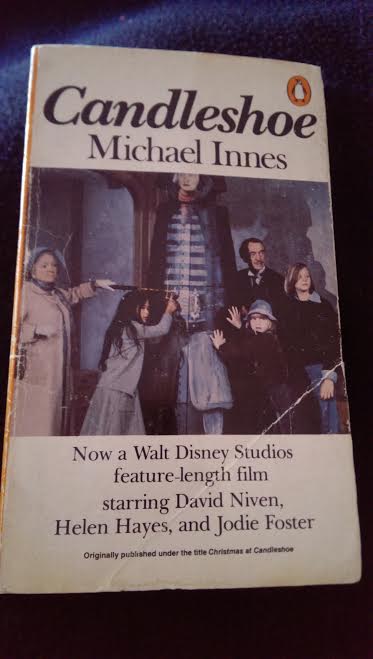
I own the movie version of the book, which was originally named Christmas at Candleshoe (although it’s not about the holiday).  It contains the text of the original story, but the picture on the front cover is from the movie.

The Disney movie is very different from the original book.  For one thing, the hero of the story is a boy (Jay), not a girl (Casey/Margaret), and unlike the movie version, the child’s identity is established for certain by the end of the book. The book has a happy ending, and so does the movie, but part of the movie’s point was that the idea of family isn’t dependent on blood relations alone, so it isn’t important whether Casey is really Margaret or not (although there are strong hints that she is).

The book is a bit hard to follow at first because it jumps back and forth between different places and different sets of characters, although it all takes place during the course of a single day and night.  Actually, I’m not sure this can really be called a children’s book, but I included it here because of the movie tie-in.  Because of the difficulty level of the book, I’d really recommend it for older children or adults.  Personally, I have to admit that I liked the movie better.

The story takes place in the mid-twentieth century, after WWII. There are two manor houses involved, Benison Court and Candleshoe. Benison Court, the newer of the two, is owned by the Spendloves, and Candleshoe, the older one, is owned by the elderly Miss Candleshoe. The two families are related, and neither one of them has as much money as they used to. The Spendloves take in some extra money by offering tours of Benison Court and showing people paintings and antiques owned by the family for generations. To raise some additional money, they decide to sell a couple of the paintings by Titian. To their surprise, the expert they call in to evaluate the paintings tells them that the paintings are forgeries.  Archdeacon, who cares for the antiques and library at Benison, reminds the Spendloves that during the war, the paintings were sent to Candleshoe for safekeeping.

Meanwhile, a couple of American tourists, the wealthy Mrs. Feather and her son Grant, having seen Benison, stop by Candleshoe. Mrs. Feather is fascinated by the old place, in spite of its state of disrepair, and Miss Candleshoe invites them to have dinner there and spend the night. Mrs. Feather has an interest in purchasing Candleshoe for herself and fixing it up.  Miss Candleshoe and her longtime friend, the retired chaplain, Armigel, know that there is not enough money for them to fix up Candleshoe, and they like the idea of traveling, so they are willing to consider selling the manor house. This plan does not sit well with Jay, the orphaned son of Miss Candleshoe’s housekeeper, Mrs. Ray.

After Mrs. Ray died, Miss Candleshoe cared for Jay, and now, with Miss Candleshoe and Armigel showing signs of senility, Jay has been handling much of the practical running of Candleshoe. On this particular evening, Jay is worried about more than the possible sale of the property. He has been noticing strange people paying unusual attention to the house. He suspects, correctly, that they intend to break into the house that night, and he has assembled a small army of local children, armed with antique weapons, to defend the place. Grant, befriending Jay, admires the boy’s practical turn of mind but worries that they are not up to the task of handling the siege that is coming to this isolated country house. As the danger presses closer, the Spendloves, Archdeacon, and the art expert are heading toward Candleshoe in search of the missing paintings.

The answer to all of these problems may lie in the strangest feature of the house: the Christmas box, a stone monument in the gallery made by Gerard Christmas and dedicated to the memory of an ancestor of the Candleshoes, who may have been a pirate. According to the lore of Candleshoe, the box will open at a time when Candleshoe is in crisis and will save the day.

The book is available online through Internet Archive.

But, is Casey Really Margaret?!

I think so. I want to say, “yes, she is,” but “I think so” is about as definite as I can be because the movie changed the story from the original book.

Whether or not Casey is actually Margaret, the lost heir to Candleshoe, is the burning question everyone is left with after watching the Disney movie Candleshoe. The movie deliberately left Casey’s true identity unresolved at the end, probably because they wanted to have the people at Candleshoe decide to accept her into their family on her own merits, not just because they had to because she’s the heir to the place. In the beginning, the audience is told that missing heir of Candleshoe, Margaret, was kidnapped as a young child by her own father, apparently in some kind of marital/custody dispute, and that she disappeared after his death in a car accident and has not been located although attempts to find her were made in the ten years that have passed since her disappearance. Casey is a teenage girl who was apparently an abandoned child with an unknown past and no memory of her early life who bears an odd resemblance to Margaret, including a couple of distinctive scars that are like ones Margaret was known to have. She is recruited as by con artist to play the part of Margaret, returning to Candleshoe as the lost heiress in order to gain access to the house and find a hidden treasure. Although Casey initially came to Candleshoe under false pretenses as part of a con with the promise of a share of the Candleshoe treasure and a red Ferrari as her payment, she eventually becomes fond of the people there and decides that she can’t let them be cheated by the real villain. Casey proves herself to be part of the Candleshoe family through her loyalty to them, and in the end, they would accept her whether she really was Margaret or not. It’s a nice sentiment, but viewers still have the urge to ask who Casey really is.

Casey is legitimately an orphan or abandoned child, found at about the right time and the right age and in the right place to really be Margaret. She has no memory at all of her early childhood, her parents, or where she came from, and she also bears some telltale scars that match ones that young Margaret was known to have. That’s what we’re told about Casey. Casey’s history is never explained in detail in the movie (we never find out under what circumstances she was found and entered into the Los Angeles foster care system), but from what we do know, her history meshes well enough with Margaret’s known past that it would seem plausible for her to actually be Margaret. Is she really Margaret, and Harry Bundage, the con man, just persuaded her that she was only pretending in order to use her for his own ends? Or, is the real Margaret still out there somewhere? If Casey actually is Margaret, did she lose her memory in the car crash that killed her father, or did he abandon her somewhere before his death, even though he had kidnapped her from her mother and took her to a completely different country?

When Harry Bundage is briefing Casey about Margaret’s background, he poses the theory that Margaret was in the car when her father crashed it and that she may have wandered off in a state of shock after the accident. That explanation might be partly for the benefit of the viewers, helping to explain how Casey could be Marget and not remember it. A young child suffering from shock might be unable to tell anyone who she was or what had happened to her. An accident may even have left some bruising that might have obscured the telltale scars that could have identified her, but again, the matter is never fully settled, and we just don’t know enough of Casey’s background to make a full connection. There are enough pieces to make it possible, maybe even probable, but nothing that definitively settles the matter.

In the final scene of the movie, Casey asks Margaret’s grandmother what will happen if Margaret is ever really found and comes home, and the grandmother says cryptically that maybe she already has. It’s a brief hint that the grandmother thinks Casey might really be her kidnapped granddaughter, even though she accepts that Casey was lying to her earlier about things she said she remembered and knows that Casey herself thought that she was just an imposter. Casey does have those telltale scars, and it does seem like quite a coincidence that two random girls of the same age and similar circumstances would have identical sets of scars. However, the movie stops short of declaring that Casey really was Margaret all along, and the unanswered questions still rankle viewers. So, some of us turned to the original book to get more detail, but it turns out that it doesn’t completely help.

As I said, the original book was different from the movie. Not only was the child hero in the book a boy instead of a girl, he wasn’t kidnapped and taken to America the way that Margaret was. In the book, Jay definitely knows who his mother was, and it’s the question of who his father was that establishes his identity as the heir to Candleshoe. It turns out that Jay’s father was the nephew of the lady of Candleshoe, making her his great-aunt rather than his grandmother. Her nephew had been a ne’er-do-well, and although his family didn’t know it, he had married an American woman before his death. He died not too long after the marriage, but by that point, he had fathered Jay. Jay’s mother knew about her husband’s family, but she wasn’t sure yet whether or not she wanted to tell them about Jay. She took the job as housekeeper so she could observe the family and decide whether or not to reveal their relationship. Unfortunately, she died in an accident before she made up her mind. By the end of the book, Jay’s identity is established, and he is definitely proven and recognized to be the heir to Candleshoe, and because of that, I believe that Casey really is the missing Margaret. At least, that’s as close to confirmation as we’re likely to get. If the child in the book was the rightful heir to Candleshoe, it would make sense if the child in the movie was, too, even if it’s not really the same child.

Of course, that’s not full proof, and it doesn’t answer the questions about Margaret’s kidnapping or her father’s accident or how Casey was found and placed in foster care in California without anyone else connecting her with the missing Margaret when Margaret’s disappearance was reported to the authorities and newspapers. I have a theory that Harry Bundage was right that Margaret was in the car during the accident and that she did wander away from the scene of the accident in shock and possibly suffering injuries that covered up her identifying scars, but that’s still just a theory. There’s nothing in the movie or book that I could use to prove it. We don’t even know exactly why Margaret’s father in the movie kidnapped her in the first place or why Margaret’s mother died not long after she disappeared. (A convenient accident or illness for story purposes so there’s one less person to try to identify Casey/Margaret, or did she kill herself out of despair at the loss of her husband and daughter? The movie doesn’t say, so those are just guesses, too.) There’s a lot of backstory missing, and the book doesn’t clarify these points because of the differences between the book and movie. I guess it’s not really important to the story in the movie, but inquiring minds still want to know.