Swallows and Amazons

Roger Walker is staying at a farm near a lake for the summer holidays in 1929 with his mother and siblings. His father is away on a ship, a destroyer, and the family write letters to him. The children are particularly waiting for a reply from their father because they’ve asked him for permission to do something special, and their mother says that they will be allowed to do it if their father agrees. What they want is permission to sail the family’s sailboat, the Swallow, by themselves and to camp out on an island in the middle of the lake. They are all thrilled when their father agrees that they can do it! Roger is especially thrilled because, until their littlest sister, Vicky, was born, he was the baby of the family, and he was often left out of things that the older children were allowed to do.

There are a couple of conditions on the permission for the children to go sailing and camping by themselves. The first is that the two oldest children, John and Susan, are in charge. Roger and their other sister, Titty, will have to follow their orders. Before the children can camp out, their mother also makes them tents to use, shows them how to set up the tents, and takes them on a sailing trip so she can make sure that the children know what they’re doing. The excited children prepare for their sailing and camping expedition, giving themselves sailing roles, working out ship’s articles, and gathering supplies. John will be the captain of their ship, while Susan will be the mate and cook. Roger is a cabin boy, and Titty is an able seaman.

When the children go to the island, they find a nice place to set up their camp and a harbor for their boat. Surprisingly, they also discover signs that someone else has been on the island before them, but they don’t know who that is. They begin to think of the mysterious people who have been there before as “Natives” of the island, and they also start to think of their mother and other adults who help them as “Natives.” Their mother plays along with it, as if she’s part of one of the stories the children have probably been reading. When their mother comes to bring them some supplies, the children also mention seeing a man with a parrot on a house boat. The man helping their mother, Mr. Jackson, says that the man often has his nieces with him, but they don’t seem to be with him this time. The children’s mother tells the children where to go to pick up milk, and she says that she wants the children to talk to her every couple of days so she will know they’re all right and so they can pick up more provisions from her.

The children continue with their camping and fishing, and they continue to notice the man on the houseboat, who they think of as being like a “retired pirate” with his parrot. They also notice that he has a small cannon on his houseboat. One day, the children spot another boat approaching the island, sailed by a pair of girls. The children hide and watch the boat. Then, it sounds like the cannon on the boat goes off, and the “retired pirate” is on the deck, appearing to shake his fist at the girls in the boat. The children from the Swallow think that the man on the houseboat might be firing at the girls! The girls also run a flag with a skull and crossbones on it up their mast. The girls are being pirates! The children try to follow the girls’ boat, the Amazon, to see who the girls are and where the boat docks, but they lose track of the Amazon.

The lady who gives the children their milk talks to them when they come to get their supplies. She tells them not to bother Mr. Turner, the man on the houseboat. The children realize that Mr. Turner thinks of them as a nuisance, although they don’t know why. The crew of the Swallow takes it as the “retired pirate” stirring up the “Natives” against them. Then, someone steals their boat, the Swallow, and the children are set upon by the pirate girls at their camp!

There is a battle at the camp between the Swallows and the Amazons, but one of the Amazons asks for a “parley.” The crew of the Swallow confronts the Amazons about the theft of their boat, and the Amazons confront the Swallows about the campers trespassing on “their” island. The crew of the Amazon says they’ve been coming to this island for years, and they’re the ones who built the little fireplace the Swallows found when they started setting up camp.

During their “parley”, the children sort of continue their imaginary roles as explorers and pirates in their talk, but they also reveal some of their real backgrounds. The two girls from the Amazon explain that Mr. Turner on the houseboat is their Uncle Jim. At least, they say that sometimes he’s their uncle and is nice to them. They’ve been visiting the island for years, and their uncle is the one who gave them their boat. However, this year, their uncle is a hostile “native” and their enemy. The Swallows say that Mr. Turner has apparently been complaining about them to the local adults, “stirring up the natives” against them, so he is their enemy, too. The Amazons, Nancy (real name Ruth) and Peggy (Margaret) Blackett, suggest a truce between the Amazons and the Swallows and an alliance against their shared enemy, the “pirate” Jim Turner, characterized as a Captain Flint type character. If the two crews are allied, it won’t matter who technically “owns” or controls the island because they have a shared mission against their enemies, particularly Uncle Jim, aka “Captain Flint.” The Amazons admit that they really have wanted to be allies all along. The Swallows agree to this plan, and the two crews sign a treaty with each other.

As the two crews celebrate their new alliance, the Amazons explain how their uncle came to be their enemy. Usually, their uncle likes playing with them when they visit during the summer, sailing and exploring with them and teaching them things he knows about sailing. However, this year, he’s writing a book about his travels, and he doesn’t have time for them. He gets upset when they disturb his work, and the girls’ mother has told them to leave him alone when he’s working. The girls feel betrayed that he isn’t paying attention to them and gets annoyed by them. The day when the crew of the Swallow thought the man on the houseboat fired his cannon at them, the girls say that it wasn’t the cannon. They set off a firecracker when Uncle Jim was asleep as a prank, and that’s why he was shaking his fist at them as they fled in their boat.

It sounds like the Blackett girls have been a nuisance to their uncle because they’re hurt that he’s not spending time with them, and they’re trying to get his attention. Still, the Swallows enjoy their new alliance with the Amazons. Each of the crews has some experience sailing, the Amazons having learned what they know from their uncle and the Swallows having been taught by their father. John is impressed by what the Amazons teach them, but there are a few things that they know that the Amazons don’t. The two crews learn from each other, and they begin planning war games with their two ships to practice for a battle with their sworn enemy. In between, they enjoy their camping and exploring activities.

It turns out that Mr. Turner on the houseboat has been blaming the children from the Swallow for his nieces’ pranks with fireworks, which is why he’s been complaining about them to local people. When Mr. Turner leaves a complaining note at the Swallows’ camp, John realizes why he resents them. John knows that he could tell Mr. Turner the truth about who had the fireworks, but he doesn’t want to tattle on the Amazons because of their alliance and because Mr. Turner is angry and offensive and accuses him of being a liar when he insists that he and his siblings didn’t do what he’s accusing them of doing.

The Swallows and the Amazons start a daring war game with each other, a contest for them to try to capture each other’s ship. The winning crew will have their ship declared the flagship of the fleet! The Swallows attempt to capture the Amazon after dark, but their attempt is foiled because the Amazons sneak out of their house and head for the island that night. Titty, left alone on the island to mind their camp, realizes that the Amazons are on the island and decides on a risky plan to take their ship herself!

However, the children aren’t the only marauders abroad that night. When Titty takes the Amazon, she overhears some men in another boat. Some charcoal burners told the children from the Swallow earlier that Mr. Turner should make sure that he locks up his houseboat securely because they’ve heard some talk that someone might try to break in, but they never delivered the message because Mr. Turner accused John and his siblings of setting off the fireworks, and they forgot they were going to tell him what the charcoal burners said. The men that Titty overhears are suspicious, and they seem to be hiding something. After the Swallows win the mock war, the Swallows tell the Amazons what the charcoal burners said, although the Amazons are reluctant to tell their uncle to lock up his boat because they want to stage their own raid on it.

The Walker family will be heading home in only three more days and bad weather may be coming, so the children have to hurry to make the most of their adventures as Swallows and Amazons. Titty tells her siblings about the men who seemed to be hiding something, and she thinks it’s some kind of treasure. Her older siblings think that she probably dreamed about hearing men hiding something because she fell asleep on the Amazon, but Titty persuades Roger to come with her to find the treasure.

The book is available to borrow and read for free online through Internet Archive. This is the first book in a series, and it’s been adapted for film and television multiple times.

The author of the story, Arthur Ransome, named the character of Roger after Roger Altounyan, who he met when the real-life Roger was a child, visiting grandparents in the Lake District of England with his sisters. (Real-life Roger Altounyan later became a doctor and pharmacologist, known for a pioneering treatment for asthma.) The names of the fictional Roger’s siblings are also based on the real-life Roger’s siblings. The name “Titty” is odd, but it’s actually a nickname. The real-life Roger had a sister, Mavis Altounyan, who was called “Titty” as a nickname after a children’s story, Titty Mouse and Tatty Mouse by Joseph Jacobs. The character of Titty is sometimes called “Kitty” in some adaptions of the story.

Although the story explicitly states the year as 1929 when the Swallows and Amazons sign their treaty with each other, most of the book could take place at just about any time during the 20th century and into the 21st century because the children are dedicated to camping and sailing and don’t use any form of technology that would firmly date the book. The book has a timeless quality, and it’s the sort of independent adventure that many children dream of having!

The books in this series have been popular in Britain since they were first published, and they have also inspired other books for children on similar themes, having outdoor adventures with minimal adult help or interference. Enid Blyton wrote several series for children on these themes after Swallows and Amazons was published, such as The Famous Five Series and Enid Blyton’s Adventure Series, and Elinor Lyon started her Ian and Sovra series in the 1950s, explicitly stating that she wanted to write books with similar adventures for children but with child characters who weren’t as competent as the children in Swallows and Amazons. The children in Swallows and Amazons are very knowledgeable about sailing and camping and seem to do almost everything right, and Elinor Lyon thought it would be more realistic if the children in her stories didn’t entirely know what they were doing but somehow managed to muddle their way through anyway. There are also similar books by American authors written after Swallows and Amazons, like The Invisible Island by Dean Marshall.

The children in the story take their inspiration for their imaginary play from books they’ve read, like Robinson Crusoe and Treasure Island. All of the children in the story seem familiar with sea stories and books about exploration and island adventures, and they make references to aspects of them and use those aspects when they’re playing. For example, they refer to adults and anyone who is unfamiliar to them as “Natives” and “savages”, and they call their bottles of ginger beer “grog”, while tea is “hot grog”, lemonade is “Jamaica rum”, toffee candy is “molasses”, and tins of corned beef is “pemmican”, living out their fantasy that they’re sailors exploring unknown territory. Later, they compare Jim Turner, the man on the houseboat, to Captain Flint and call him that for most of the story. Some of the language that the children use, like “natives”, “savages”, and the phrase “Honest Injun” are racially out of date and can have some offensive connotations. The children probably got those phrases from the books they’ve been reading, and they seem to think of them innocently, as part of their imaginary play, living out the stories they’ve read, but modern readers should be aware.

Blackbeard’s Ghost

Blackbeard’s Ghost by Ben Stahl, 1965, 1976.

This is the novel that the live action Disney film Blackbeard’s Ghost from 1968 was based on. My copy is a later edition designed as a tie-in with the Disney movie, based on the cover, but it contains the text of the original story.

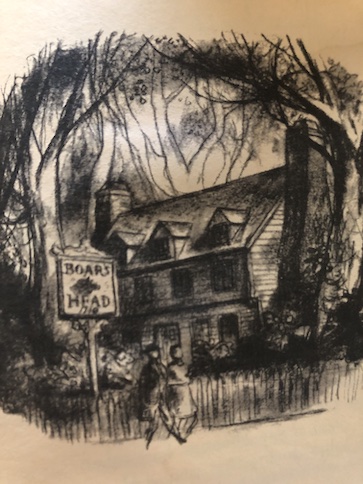
The story begins with a prologue that explains how Blackbeard the pirate evaded execution for piracy by offering to collect tolls from ships on behalf of the colonial governor, Governor Eden, in the town of Godolphin. However, instead of collecting tolls from the ships, he decided to use his position for his own benefit. Knowing that he would eventually need a source of stability on land instead of spending the rest of his life at sea, he looted wood from various ships and used it to build a tavern for himself called the Boar’s Head. He hired a woman rumored to be a witch, Aldetha, to tend the tavern for him. In the end, though, Blackbeard was killed by someone who wanted to collect the bounty on him for piracy. After his death, the poor woman who tended his tavern was burned at the stake for witchcraft.

(Note: The witch burning is historical inaccuracy because no witchcraft executions in North America involved burning, at least not in English-controlled parts of the American colonies. Accused witches in North America were typically hanged. None of this story is meant to be historically accurate, but I always feel compelled to point that out in stories that make that mistake. The town of Godolphin and the Boar’s Head Tavern are fictional. In real life, Blackbeard did receive a pardon from the real Governor Eden in Bath, North Carolina, and he was eventually killed in 1718 in a battle with Lieutenant Robert Maynard and his crew, as he did in this story. However, in the book, the tavern is now owned by a descendant of Maynard’s, and in real life, Maynard didn’t have any children.)

Most of the story takes place in the 20th century, when two 14-year-old boys, J.D. and Hank, talk about how the old Boar’s Head Tavern is about to be torn down because the former owner sold it, and there’s going to be a gas station built on the land instead. They think it’s a shame because they’ve heard ghost stories about the place and think the old tavern is fascinating. The boys go to watch the workmen tearing down the old tavern, but the workmen haven’t made any progress so far. Although they’d love to loot some of the expensive woods from the old tavern, they just can’t seem to dismantle the building. They’ve been able to dismantle some of the newer additions to the building, but somehow, they can’t seem to touch the original structure. The site has been plagued with mysterious accidents. Their equipment fails, heads fall off the ends of their hammers, and workmen keep getting injured in small accidents, not enough to seriously hurt anyone but enough to keep them away from their work for days at a time.

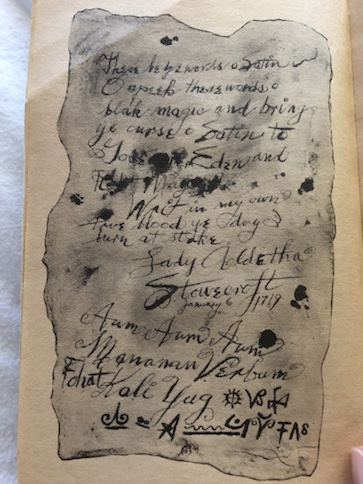
When J.D. and Hank see the workmen leaving the building in frustration soon after arriving, they decide to go inside and look around to satisfy their curiosity and see if there’s anything of value that they can salvage before the tavern is demolished. They don’t find much of value, but they do find their way into Blackbeard’s secret dungeon under the tavern. There, they find a piece of old parchment with a satanic curse written by Aldetha. (So, apparently, people were actually right about her being a witch. Plot twist!) Inspired by this creepy message from the past, the boys realize that they can make money from other kids by capitalizing on the ghost stories about the old tavern and holding seances to contact the spirits. They don’t really believe that seances are real, but they figure that, if they can get enough ghost-story fans to come to their seances, they can make a profit from this enterprise.

Of course, the boys’ seance awakens the ghost of Blackbeard. Blackbeard is invisible to everyone except for the boys, but he’s a solid ghost, who can manipulate physical objects. The boys quickly realize that Blackbeard can be a dangerous ghost, and he’s not at all happy when he finds out that a descendant of the man who killed him wants to have his tavern torn down.

The book is available to borrow and read for free online through Internet Archive. The Disney movie is available to buy or rent through YouTube or Amazon Prime. There is also a sequel to this book called The Secret of Red Skull, which involves spies and is also available online through Internet Archive.

My Reaction and Spoilers

There is some humor in this book because only the boys are able to see and hear Blackbeard, but by the end of the story, adults become aware of Blackbeard’s ghost, too. The boys’ history teacher is helpful in finding a way to appease the ghost by helping him to negotiate to buy back his tavern using his hidden treasure. When it becomes obvious both to Maynard and the company he tried to sell the tavern to that it’s haunted, they’re willing to accept pirate gold in exchange. The company also sees that it can use the building for public relations purposes by sponsoring a pirate museum in the old tavern. It’s good news for the teacher, too, because he gets to be the director of the museum. There, he can show off his collection of pirate memorabilia and indulge his love of pirate history. The tavern continues to be haunted by the ghosts of Blackbeard and his witch friend, leaving the story open for the sequel.

As expected of Disney films, the Disney movie version of the story is quite different from the book. In the movie, the person who can see the ghost is a college track coach who is staying in the old inn, which is still being operated by elderly descendants of Blackbeard’s old crew. There is a track meet in the movie that never appeared in the book, and at the end of the movie, Blackbeard disappears, having been freed from his haunting by performing a good deed.

I prefer the concept of the boys being the ones who accidentally summoned Blackbeard’s ghost, but the boys got on my nerves at first. In the early part of the book, they bickered a lot and didn’t seem to like each other enough to be best friends, although they seemed to be friendlier with each other later, when they were both trying to figure out what to do about Blackbeard. I think the teacher character was my favorite. He takes the matter of the ghost in stride, coming up with a practical solution that helps everyone.

A Ghost of a Chance

A Ghost of a Chance by Joan Carris, 1992.

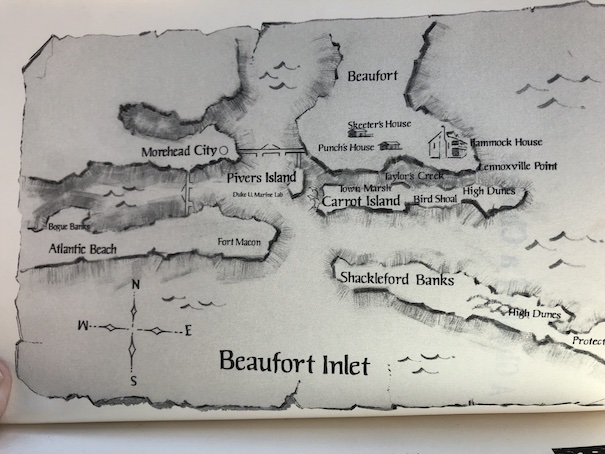
Punch (real name Philip) Wagner and his family are spending the summer by the sea in North Carolina, and his parents have let his friend Tom Ellis come with them. The 12-year-old boys are looking forward to exploring the area by themselves, but Punch’s father has arranged for the son of a friend of his to be their guide. At first, Punch isn’t thrilled about his father arranging for them to be led around by a boy they don’t know. Punch’s father has a very different personality from Punch. His father is a professor, very academic, so Punch doesn’t feel like he can take his father’s word that they’ll get along with this new boy. Punch and Tom particularly wanted their independence and a chance to make some plans of their own.

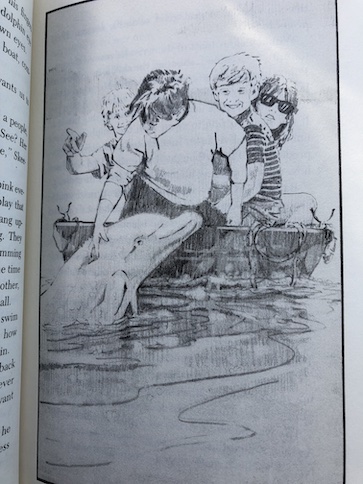
However, Punch is surprised to discover that his father’s old friend is a laid-back, jovial man who calls his father “old crawdad.” His son, Skeeter Grace, is a little younger than Punch and Tom, which makes Punch even less enthusiastic about having him as a guide. Skeeter Grace doesn’t seem to be any more excited about hanging out with Punch and Tom as they are with him, but the adults suggest that Skeeter take the other boys for a boat ride. Punch’s pretty older sister, Lila, says that she’d like to go with them. Punch warms up to Skeeter when he finds out that he participates in dolphin watches run by Duke University because he loves dolphins, although he considers Skeeter a bit of a know-it-all.

When Punch tries to ask Skeeter if he plans to work with the dolphin researchers when he grows up, Skeeter becomes oddly touchy. Punch mentions it to his father, and his father explains that nobody in Skeeter’s family has been to college before. His father is a carpenter, and it isn’t expected that Skeeter will attend college, either. Punch’s father points out that it must be difficult for Skeeter to want something that he doubts he’ll ever be able to get.

Punch is particularly interested in an old house nearby where Blackbeard once lived. He tries to persuade Skeeter to come with him and Tom to check it out, but Skeeter warns them not to go there. For one thing, that house is owned by somebody who wouldn’t like them trespassing, and for another, Skeeter is firmly convinced that the house is haunted by the ghost of Blackbeard. Lila says she doesn’t know why the boys are so interested in Blackbeard because he was a horrible person who killed people and “used women” (no details given, but you get the idea). Punch’s main interest is the stories about Blackbeard’s hidden treasure. He wants to be the one to find it.

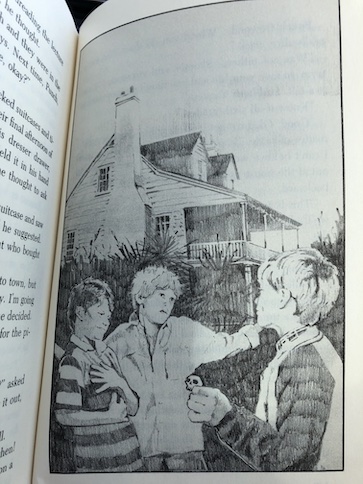
The boys go by Blackbeard’s old house, now called Hammock House, and they’re started by the sound of something hitting the roof and dropping down to the ground. When Punch picks up the small object, he discovers that it’s a small plastic skull with glittering red eyes. It’s startling, but it doesn’t seem likely that a real pirate ghost would toss them a plastic skull. Tom thinks maybe it’s some kind of warning, but Punch thinks that Skeeter probably tossed the little toy skull in the air when they weren’t looking, just to scare them.

Punch eventually persuades Skeeter to help him and Tom search for the treasure by pointing out to him that he would be able to afford college if they found Blackbeard’s treasure. He sees how badly Skeeter wants to go to college when Skeeter jumps on the project, bringing along a metal detector and helping the other boys dig and do research. At first, Punch just thought of the project as a fun summer adventure, but when he realizes what a big difference it would make to Skeeter to really find the treasure, the hunt becomes much more serious. Punch knows that searching for the treasure is a long shot, and it would be disappointing if they never found anything. Since it will be several more years before Skeeter will be old enough for college, they don’t have to succeed this summer, and the boys discuss making it an annual project every summer.

To make the most of this summer, they want to spend some time camping out and searching for treasure. Punch’s mother is reluctant to let the boys do that until Lila says that she’ll go with them. Lila knows that the boys are searching for treasure, and she encourages them to get into the mindset of being pirates as much as possible.

While the boys are using a metal detector, they find an old metal box. The contents don’t look like pirate treasure, but they appear to be someone’s treasure. There’s an old Bible, some jewelry, and a couple of tarnished silver baby spoons. On one hand, the boys are pleased to have found something, but on the other, it’s not as grand as what they had hoped to find. Lila says that the jewelry could be valuable, and the boys think that the local historical society might be interested in the old Bible. Skeeter explains that there used to be an old whaling community in the area they’re searching, but it was often damaged by storms. He says people sometimes buried valuables, knowing that their homes could be damaged or destroyed by storms. He figures that the owner of this particular box could have been killed in one of the storms, which is why he never returned for his box. They find some other boxes that appear to have been lost in a shipwreck, including one with spices and one with bottles of alcohol, but none of them are what they’re really looking for.

More and more, Punch becomes convinced that the only place where they should be looking for Blackbeard’s treasure is around his old house. He finally persuades Tom and Skeeter to come with him and have a look.

However, the house doesn’t seem as empty as the boys assumed it would be. Punch’s dog seems afraid of the house, and they still don’t know where the little plastic skull came from. Then, the boys hear a frightening scream, like the screams of a girl who was supposedly murdered by Blackbeard years ago. Is the house really haunted?

My Reaction and Spoilers

For most of the book, the boys are doing things like watching the dolphins, camping out, and digging for treasure in various places. The question of whether or not Blackbeard’s old house is haunted is the main mystery of the story, but the story doesn’t really become about that until almost the end of the book. Punch has the little skull to puzzle over before that, but it isn’t until the boys return to Hammock House to look for buried treasure that they become truly concerned with the ghosts that seem to be haunting the place.

There is a logical explanation behind the hauntings, at least some of them, making this the kind of Scooby-Doo Pseudo-Ghost Story that I always liked as a kid. In a way, this story is also a kind of MacGuffin story. It’s not so much what the kids find as the adventures that they have during the search that are important. The boys’ fathers understand because they later confess that they also hunted for Blackbeard’s treasure when they were young. It seems that, even though Punch thinks of his professorial father as being very different from him, when he was young, he was much the same sort of boy that Punch is now. Skeeter’s dreams of studying marine biology also do not depend on finding Blackbeard’s treasure. When his father finds out that’s what Skeeter really wants to do, he’s supportive, and Punch’s father, as a professor, offers some useful advice about scholarships.

There is some alcohol use in the book. There is a part of the story where the boys find a box with old liquor bottles and drink the contents, pretending like they’re pirates drinking rum. The boys get drunk and make themselves sick, and when Lila catches them, she lectures them about how they could have died. My first thought was that only an idiot drinks from random bottles that they just find. Even though they thought they were probably whiskey bottles, “probably” doesn’t seem good enough to just start drinking it. Also, Lila is right that they could have killed themselves from drinking too much. It is possible to die from alcohol poisoning by drinking way too much liquor of any kind all in one sitting, as kids they would be hit much harder than full-sized adults, and not having any prior experience with alcohol, they have no sense of their own limits. I’ve heard of college parties where people have died from alcohol overdose because they were new to drinking, didn’t know when they were going too far, and were in an environment where people were encouraging drinking to excess rather than learning restraint. What I’m saying is that the boys were in real danger because they were too young and inexperienced to understand the danger they were in. Fortunately, the boys learn their lesson without any lasting harm, and making themselves sick means that they’re unlikely to make the same mistake again.

The Secret of Skeleton Island

The Three Investigators

The Secret of Skeleton Island by Robert Arthur, 1966.

In the original editions of The Three Investigators, their cases were introduced by Alfred Hitchcock. Later editions of the books were rewritten to remove Alfred Hitchcock, but I’m using the version of this book that includes Alfred Hitchcock for my review.

At the beginning of the story, Alfred Hitchcock himself brings the boys a new mystery and an acting job. Of the three boys, only Jupiter has done any acting before. However, Alfred Hitchcock knows that Pete’s father is a movie technician and that he’s working on a new suspense film. When Hitchcock speaks to the boys, Pete’s father is helping to restore an old amusement park on an island off the southeast coast of the United States that will be used in the movie. The name of the island is Skeleton Island because it’s shaped like a skull, and other formations around it look like part of a skeleton. It was once a place where pirates hid out. Sometimes, people still find buried bones there, and the island is supposedly haunted. The problem is that someone has been stealing equipment from the movie company and sabotaging their boats. Hitchcock wants the boys to discover who is behind the theft and sabotage. As their cover for the investigation, the boys can take part in a short film being shot at the same location, about a group of boys searching for pirate treasure.

When the boys arrive at Skeleton Island, they hear about the Phantom of the Merry-Go-Round. Supposedly, years before, there was a girl who was riding the merry-go-round at the amusement park when there was a terrible storm. The girl, Sally, refused to get off the merry-go-round with everyone else, and she was killed when the merry-go-round was struck by lightning. Since then, the merry-go-round supposedly runs by itself, and Sally’s ghost rides it. The amusement park has been abandoned for years, but people still report seeing Sally’s ghost and the running merry-go-round.

The man who was supposed to bring the boys to the island, Sam, maroons them in the wrong place at night during a storm. They are rescued by Chris, a young diver who originally came from Greece, who was hoping to get work in the movie industry and is currently looking for treasure because he needs money to help his father. He says that he has sailed the area many times in his boat, and he tells the boys the legend of the pirate who was executed there, Captain One Ear. Nobody was able to find his treasure, and he went to his execution saying that Davy Jones had it. People have believed that the treasure is lost at sea, dumped overboard by Captain One Ear, and occasionally, a gold doubloon washes up on shore on the island, which seems to indicate that’s what happened. (ch 3)

As the boys approach the island with Chris, they see what looks like the lights of the merry-go-round with a pale figure among the horses. It looks like a girl in a white dress, and they hear the music of the merry-go-round. The Three Investigators want to go see the ghost and investigate, but Chris refuses. Instead, he takes the boys to the boarding house in town.

When the boys tell Pete’s father and the other movie people about their night’s adventures, they learn that Sam is known as a local prankster and troublemaker, and he’s been in trouble with the law before. Could he be behind the thefts, sabotage, and apparent hauntings? Some people suspect Chris because he’s a foreigner, local people don’t trust outsiders, and everyone knows that Chris needs money for his father, who has health problems. Maybe he could be stealing from the movie company to get money. On the other hand, the movie people are suspicious of some of the local fishermen. Some of the local people suspect that the movie people are secretly looking for pirate treasure instead of making a movie. Then, the boys learn about a robbery that took place in the area years before and are told that the robbers have recently been released from prison. It seems like there’s no end of suspicious people!

The Three Investigators think that the culprit behind everything is someone who was to drive away the movie company and keep people off the island. Who could that be, and what is there on the island that someone wants to protect?

The book is available to borrow and read for free online through Internet Archive (multiple copies).

My Reaction

I enjoyed this book because of its abundance of suspects! I kept changing my mind about what was really happening and who was behind it. Because there were several mysterious things happening at once – lost pirate treasure, ghost at a haunted amusement park, sabotage of the movie crew, old robbery with the money never found and the robbers recently released from prison, and suspicious locals suffering from a failing local economy – it occurred to me that there might even be multiple plots being staged by multiple people. There is one main scheme, and it is the one that I thought would be most likely, but there’s plenty of adventure and plot twists along the way. In the end, things are wrapped up neatly without any hanging plot threads.

The Midnight Folk

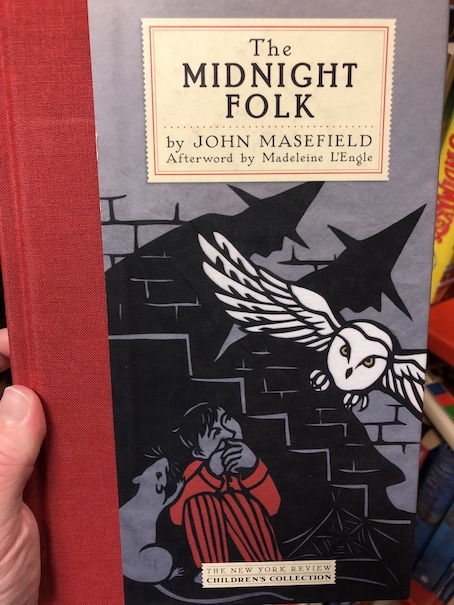
The Midnight Folk by John Masefield, 1927.

Kay Harker is an orphan, the ward of Sir Theopompus, usually in the care of his governess, Miss Sylvia Daisy. One day, Sir Theopompus asks Kay if he has any idea what he wants to do when he grows up. Kay says that he likes the idea of being a jockey, but Sir Theopompus says that he could be a sea captain, like his great-grandfather. According to the stories about him, Kay’s great-grandfather sailed around the world and stole a treasure from the priests of Santa Barbara worth about a million pounds (British money). The stories differ about what happened to the treasure, though. In some versions, his crew mutinied and took the treasure for themselves, but other stories say that he brought the treasure home with him and hid it somewhere in his family home, the home where Kay now lives.

Sir Theopompus asks Kay if he’s ever come across the treasure, but Kay says he hasn’t. Sir Theopompus suggests that if Kay finds the treasure, the two them could split it between them. Kay says that wouldn’t be fair, if he had to do all the work of finding it by himself, and also the treasure is stolen property, so it would rightly belong to the priests of Santa Barbara. Still, Sir Theopompus encourages Kay to search for the treasure. Kay doesn’t believe that the treasure is really in the house or that his great-grandfather would be a thief, and he doesn’t think it’s fair to tell such stories about him when he isn’t there to defend himself. His governess tells him that he has been impertinent and sends him to bed early.

Kay is later woken by someone calling to him to open the door, and he sees a door in his room that he has never noticed before. The voice he hears belongs to the black cat called Nibbins, who tells Kay to come with him and not make any noise. Most of the house is asleep, and Nibbins refers to the ones who are awake as the “midnight folk.” He leads Kay down a secret passage that was once used by smugglers.

There, Kay learns that his old toys were his “guards.” He doesn’t know where his old toys are because his governess packed them away when she came, saying that they would just remind him of the past. Nibbins says that his old toys had stumbled onto a clue about the hidden treasure and went in search of it. They didn’t think it would take them long to find it, but he hasn’t heard from them since. Kay sadly fears that his old toys may actually be dead. (A horrifying thought.)

Then, there’s an even more shocking revelation. Nibbins shows him that there are spy hole where Kay can see what’s happening in various rooms in the house, and in the dining room, he witnesses a meeting of witches! Nibbins shows Kay where the witches keep their brooms, and they take a couple of the brooms on a ride to the woods, where Nibbins introduces Kay to a poacher called Bitem. They witness the witches having a bonfire and a magical ritual at Wicked Hill. Nibbins says that he used to be a witches’ cat and helped with rituals like that. Sometimes, he still feels the call of magic.

The leader of the magical group is a wizard called Abner Brown, and they overhear him saying to the witches that they are going to hunt for the Harker Treasure. Abner has learned that the treasure is not actually in the Harker house, but it’s somewhere close by. Abner reveals previously-unknown details of the treasure’s history, including the fact that his own grandfather had once been in possession of it and hid it until someone called Benito Trigger found it. Abner has found evidence that his grandfather tracked down Trigger and confronted him in this very area and that Trigger may have killed him. Abner believes that the treasure is still hidden somewhere near to where his grandfather died. Nibbins leads Kay back to his bedroom through another secret passage before anyone discovers that he is gone.

Kay knows that what he witnessed the night before wasn’t a dream because, in the morning, he sees the remains of the leftover goose that the witches were eating the night before, picked to the bones. The servants think that the cats got at the goose and ate the leftovers, but Kay knows better.

Then, the portrait of Kay’s great-grandfather comes to life, and his great-grandfather invites Kay into the portrait, showing him the house as it was in the past. His great-grandfather denies having stolen the treasure years ago, but he says that it was entrusted to him and that he lost it. He was in Santa Barbara when the territory was breaking away from Spain, and the archbishop gave him the treasure to guard from the revolutionaries. However, his crew did mutiny and turn pirate. The crew took the treasure, and they abandoned Kay’s great-grandfather ashore, far from any European colony. For a time, he says that he was a slave of a tribe of Indians (Native Americans), but he eventually escaped and made it home to England. He heard that his old ship may have sunk, but he doesn’t know for sure. Even he doesn’t know where the treasure is now, thinking that it must have either sunk with the ship or been scattered by the crew. It’s always bothered him that he was unable to fulfill his promise to keep the treasure safe. He wants Kay to learn what happened to the treasure and, if possible, restore it to its rightful owners.

Through Kay’s midnight adventures and the ghosts of the past stirred up by the magic of the witches, Kay begins to learn the full sequence of events that led to the treasure being lost, and eventually, what happened to it. Along the way, Kay also makes the startling discovery that his governess is actually one of the witches!

The book is available to borrow and read for free online through Internet Archive (multiple copies).

My Reaction and Spoilers

There were some parts of the story that I found difficult to follow because the story kind of jumps around, people start talking about things as if we should already know about them, and some things that Kay encounters are not fully explained. Many of them seem like dream sequences or imaginings, except they have lasting consequences. Then, there are times when people go into lengthy explanations that seem to meander, and there are people who go by multiple names. For awhile, Kay almost seems to forget about seeking his great-grandfather’s treasure and starts looking for the treasure of an old highwayman instead, and there is a strange interlude with King Arthur and his knights.

Still, this story is a children’s classic, and it’s almost like a collection of all the features that are found in classic children’s literature: an orphan, talking animals, witches, pirates, ghosts, mermaids, a highwayman, King Arthur and his knights, hidden treasure, etc.

For awhile, I thought that the story might end with the implication that much of it was in Kay’s imagination. Kay is a lonely boy who doesn’t see his guardian very often and lives with a strict governess and no other children for company. I thought maybe he was spinning dreams or imagined stories to explain other events happening around him. I spent part of the story working out how a child might interpret a strict governess who took away his old toys as a witch, and I thought maybe she was in a romantic relationships with Abner Brown, which would be why Kay would see him as a wizard. Then, maybe these young people had parties in the house with their friends after Kay was put to bed, so he imagined that they were having witches’ meetings. They could also be hunting for the legendary treasure, so all the parts related to treasure-hunting could be true. However, the book implies that the magical parts of the story are real. Even the magical things Kay experiences have real world consequences, which help both him and readers to realize that what he has seen has really happened.

I thought that the story became a little more cohesive after Kay makes the discovery that his governess is actually one of the witches. He eventually learns the full truth of what happened to the treasure years ago and meets up with his old toys/guards, who are still alive and have been seeking the treasure the entire time. Kay’s toys/guards bring the treasure from its hiding place to a secret hiding place in Kay’s room and help him to alert the proper authorities and restore the treasure to its rightful owner. Kay’s governess is arrested when she and her friends are caught trespassing in pursuit of the treasure and in possession of smuggled goods. The governess is released when Abner Brown pays the fines for their activities, but she leaves the area instead of returning to Kay. Kay’s home life changes for the better because a friend of his mother comes to live with him and look after him.

Shadow Over Mousehaven Manor

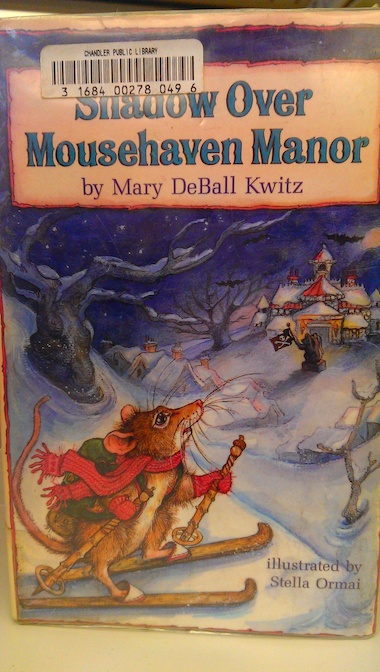
Shadow Over Mousehaven Manor by Mary DeBall Kwitz, 1989.

Minabell Mouse is happily looking forward to her Aunt Pitty Pat visiting her for Christmas with her new husband, Magnus, but she receives an urgent message from Magnus, saying that her aunt is very ill and may not survive much longer. He urges Minabell to home to her aunt’s home, Mousehaven Manor right away and bring the copy of her aunt’s will that her aunt left with her. With her home suddenly damaged badly by a storm, Minabell does immediately set out for Mousehaven Manor, crossing the Illinois prairie through the tunnel called Rodent Run, which small animals use to travel in safety. Before she leaves home, one of her friends gives her a Christmas present to take with her, something long and thin. It’s awkward to carry, but her friend insists that she take it with her and open it on Christmas. Another friend warns her to beware of the tough Chicago rats who are a gang of criminals who have invaded Chicago’s City Hall.

On the way, Minabell Mouse stops to rest and has a fearful encounter with a group of rats carrying a pirate flag with the name “Prairie Pirates” on it. She witnesses them murder a chicken at a farm, pluck it, and carry it off. It’s horrifying, and Minabell is lucky that the pirates didn’t see her. She is alerted by a stranger who makes her keep quiet.

The stranger introduces himself as Secret Agent Wendell Weasel, a member of the Illinois State Ski Patrol, a form of animal law enforcement. Minabell asks Wendell who those pirates were, but before he answers her questions, he insists that she identify herself and tell him where she’s going and why. Minabell explains to Wendell about her aunt, and he looks at the copy of the will she is carrying, which leaves everything to her, as her aunt’s closest relative.

Wendell urges Minabell to turn around and go home because it’s too dangerous for her to continue her journey. The Prairie Pirates are a band of Chicago rats, and the “Sungam” that they heard the pirates chant is the code name of their leader. Wendell says that he can’t tell her more than that because the information is classified, but he says that if Minabell really thinks about the word “Sungam”, she will see that there is a good reason not to go to her Aunt Pitty Pat and Uncle Magnus. (Hint, hint.) Of course, Minabell doesn’t see what Wendell is talking about at first and continues her journey because she thinks Aunt Pitty Pat needs her. She does, but not in the way Minabell expects.

Minabell does realize the significance of the word “Sungam” when she uses it to frighten off cats who attack her. Puzzling over the word more, Minabell tries writing it out in the snow and sees that it’s “Magnus” spelled backward. Minabell realizes that her aunt has actually married the leader of the Prairie Pirates! The Prairie Pirates have taken over Mousehaven Manor, and her beloved aunt is their prisoner! (Flying their pirate flag over the house isn’t the most subtle way to lure an innocent victim into their new hideout. I don’t think it even counts as a hideout anymore if you have a banner advertising that you’re there. Even if Minabell hadn’t already figured out the code name clue, the flag is a dead giveaway. Just saying.)

There is still time for Minabell to turn back before meeting the pirates, but she can’t leave her aunt in danger and Mousehaven Manor occupied by the enemy. However, she’s going to have to come up with a clever plan, or she’s going to be in danger, too.

I haven’t found a copy of this book online, but there is also a sequel called The Bell Tolls at Mousehaven Manor. There are only two books in the series.

My Reaction and Spoilers

I had to get this book because I vaguely remembered a teacher reading it to my class years ago in elementary school. There was a lot about the book that I forgot over the years. I had completely forgotten that it was actually a Christmas story. My strongest memory of this story was actually a small detail, but one that they repeat during the book. Minabell has a little ritual that she does whenever she needs to remember something, particularly when she needs to remember where she hid something. I had forgotten the rhyme she says, but I remembered her writing what she needs to remember on her forehead with her finger. That struck me as actually a clever trick because writing something, even if you never look at it again, helps things to stay in your memory because you really need to concentrate in order to write, and you can remember the act of writing, which brings back the memory of what you’ve written. When I was a kid, after hearing this story, I used to do that sometimes, write something on my forehead with a finger to help me remember.

Reading the book as an adult, the Sungam/Magnus clue is pretty obvious. The plot also sort of reminds me of The Mysteries of Udolpho, which I read several years ago because I really like Jane Austen’s Northanger Abbey, which references and parodies that book. The connection that book and this one is that part of the long, rambling, episodic plot of The Mysteries of Udolpho involves an aunt who has cluelessly married the leader of a gang of bandits, and the leader of the gang just wants to acquire her money and property. This book is a little different because the mouse aunt has not actually married the rat; he’s just holding her captive so he can take over her house and use it as the base for his gang and claiming that they’re married to justify occupying the manor. Like in The Mysteries of Udolpho, the bandit leader holds the aunt and her niece captive at an isolated manor house, trying to get the aunt to not only sign over all her money and property to him but also her niece’s inheritance. That’s why Magnus told Minabell to bring her copy of her aunt’s will. He needs to change the will so that it leaves Mousehaven Manor to him.

So, strangely, Shadow Over Mousehaven Manor is a little like The Mysteries of Udolpho for children. I actually recommend it more than The Mysteries of Udolpho because The Mysteries of Udolpho is rather long and disjointed. Both books contain some admiration of the beauties of the countryside while the character that travel, but the scenery descriptions are much longer in The Mysteries of Udolpho, and Shadow Over Mousehaven Manor is just more fun to read because it involves talking mice and pirate rats. The mice in this book are also much more sensible than the humans in The Mysteries of Udolpho. The mouse aunt knows darn well what Magnus is, while the human aunt was completely clueless almost up to the point where her husband caused her death. I’ve amused friends sometimes with describing The Mysteries of Udolpho, and I might put my short (short-ish) explanation of the plot (plots) of the book on the Internet sometime just for fun, but I mostly recommend reading that book only if you’ve already read and like Northanger Abbey.

I’m going to include some spoilers for the story because this book isn’t currently available to read online. Minabell has the presence of mind to realize that, before she attempts to enter Mousehaven Manor and save her aunt, she needs to hide the will she is carrying because she can’t let it fall into Magnus’s hands. When she does reach the manor, she is also imprisoned with her aunt in the manor’s dungeon, along with a friend who came to try to help her. (I don’t really know why any mansion in the US, mouse or human, needs a dungeon, but maybe mouse history in the US was more feudal than human society or something. It doesn’t really matter. It’s just a really cool mouse manor house, and it has a dungeon. It also has secret passages.) They get out of the dungeon because the aunt remembers an old song that has a clue to a secret way out of the dungeon, and they find their way to the belfry tower, where they ring the bell to signal for help. There, they meet a family of bats hibernating in the bell tower. The bell wakes them up, and one of them helps them reach their friends. Minabell, her aunt, and their friends battle the pirates and drive the out of Mousehaven Manor. They celebrate with a big New Year’s party, and Minabell decides that she wants to continue living at Mousehaven Manor with her aunt.

Mystery on Skull Island

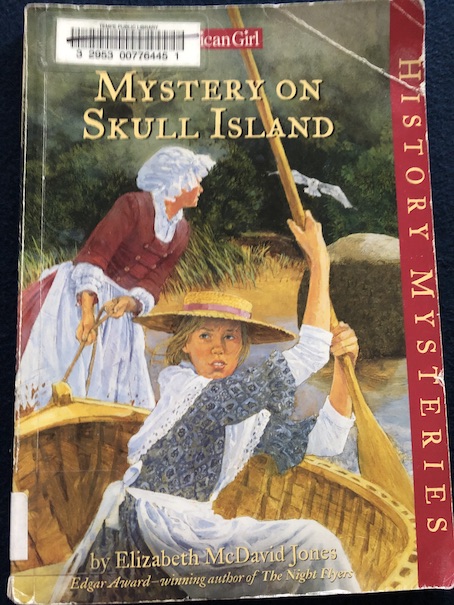
Mystery on Skull Island by Elizabeth McDavid Jones, 2001.

This book is part of the American Girl History Mysteries series.

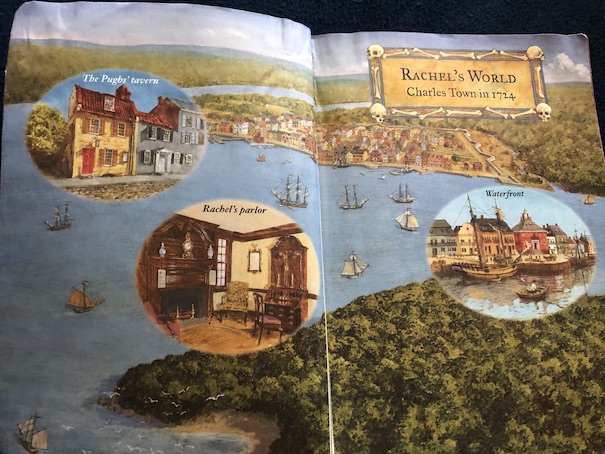
It’s 1724, and twelve-year-old Rachel Howell is traveling to where her father lives in Charles Town, South Carolina. Rachel has been living with her grandparents in New York since her mother died seven years earlier. Her father also used to live in New York, but after his wife’s death, he decided to move to South Carolina, hoping to start a new life. Now, her father has established himself in South Carolina and wants Rachel to come and live with him. Rachel has wanted to live with her father for some time, but she’s nervous because she doesn’t know what life in South Carolina will be like.

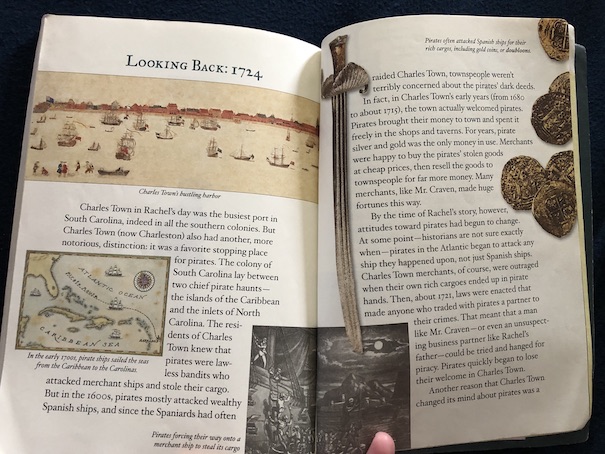
Rachel’s new life has a terrifying beginning when the ship that is taking her to Charles Town is attacked by pirates. The pirates force the passengers on board to hand over jewelry and other expensive items. They even take Rachel’s pendant, which belonged to her deceased mother. Fortunately, the pirates don’t hurt or kill anyone and let the ship go once they’ve taken everything of interest to them.

When Rachel arrives in Charles Town, she and her father have difficulty recognizing each other at first, but they are happy to finally be together. Rachel’s father is appalled when he hears about the pirates stealing Rachel’s mother’s necklace, but he is relieved that Rachel is all right. He explains that piracy has been a serious problem to shipping in the area. The local government has tried to combat the problem with harsh punishments, hanging many offenders. However, the pirates have money, and so local businesses still tolerate their presence.

The talk of pirates is shocking, but Rachel is soon in for another shock when her father tells her that he has become engaged and that Rachel will soon have a new mother. Rachel had been looking forward to having some time alone with her father to get to know him again, so she is not pleased at the news, but the engagement is the main reason why her father has sent for her. He wants Rachel to have a mother to care for her and for them to live as a complete family again. He tells Rachel that his fiance, Miranda LeBoyer, is from Philadelphia. She will be arriving in Charles Town soon with her aunt.

Rachel’s father is often busy with his work in the shipping industry, but he grants Rachel more freedom than she had with her grandparents, so she is able to explore her new town and make some new friends. The first friends she makes are the Pugh family, especially the daughter, Sally, who is about Rachel’s age. The Pughs own a local tavern, and Rachel often goes to visit them, sometimes helping with chores and learning to cook. She tells Sally about her worries about her new stepmother, but Sally says that she might not be so bad.

Like her life in South Carolina, Rachel’s first encounter with the woman her father plans to marry takes a disturbing turn. First, Miranda seems to disapprove of Sally and her brother, and Rachel fears that she will interfere with their friendship. Then, her father’s new business partner, Mr. Craven, stops by, and Rachel notices that Miranda seems to both recognize and dislike Mr. Craven. She overhears a conversation between the two of them in which Miranda calls Mr. Craven a “scoundrel” and refers to some kind of illegal dealings in his past. Yet, when Rachel’s father tries to ask Miranda what they’re talking about, Miranda lies and says that they’re discussing the weather and hurricanes that occur in Charles Town. Rachel worries about why Miranda would lie to her father and what kind of dishonest business Mr. Craven might be doing. What are the secrets that people in this town are hiding, and is Miranda really what she seems to be? With the help of her new friends, will Rachel find out the truth before it’s too late?

There is a section in the back of the book with historical information about piracy and life in South Carolina during the 18th century.

The book is available to borrow and read for free online through Internet Archive.

Pirates

Magic Tree House Research Guide

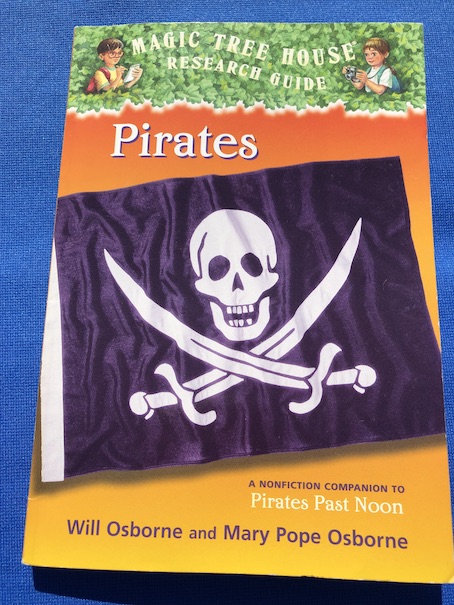
Pirates by Will Osborne and Mary Pope Osborne, 2001.

This book is the nonfiction companion book to Pirates Past Noon, part of the Magic Tree House Series. While the Magic Tree House Series is a fantasy series that involves time travel, there are companion books to some of the novels with nonfiction information related to the stories. The fantasy series is meant to introduce children to different historical periods and encourage an interest in reading, but the companion research guides take children further into certain subjects.

This book focuses on pirates throughout history, explaining how pirates functioned from the time of Ancient Greece and Rome, into the Middle Ages with Vikings, and beyond. It explains that, while legends and adventure stories make the lives of pirates seem fun and exciting, the realities of their lives were more harsh. Throughout the book, Jack and Annie, the characters from the main series, appear in illustrations and side notes to define certain terms or tell the readers fun trivia.

There is a chapter about New World pirates that explains the buccaneers and privateers that preyed on Spanish treasure ships in the Caribbean. The Golden Age of Piracy was in the late 17th and early 18th centuries. It was a period of intense pirating activity as governments recruited privateers to attack the ships of enemy nations. Pirates also attacked ships that traded with American colonies as they increased in size and number. The Golden Age of Piracy ended in the 1720s, when governments began instituting harsher punishments for pirates and sending more warships to confront the pirates. The book includes a Gallery of Pirates where it gives brief biographies of famous pirates, like Henry Morgan, Sir Francis Drake, Blackbeard, and “Calico Jack” Rackham with Anne Bonny and Mary Read.

There are chapters that describe the lives that pirates lived on their ships. One chapter talks about the types of ships that pirates used, how to distinguish between different types, and the trade-offs between size and speed. For example, sloops could move faster, but schooners were larger and could carry more. Although pirates operated outside of the law, they had rules for themselves to establish order and resolve conflicts on their ships, and there were punishments for people who broke the rules. People also had different jobs on pirate ships.

Part of the book also talks about legends of buried treasure and sunken ships. There is some truth to the legends, although mostly, pirates tended to spend their loot shortly after getting it instead of hiding it for later.

At the end of the book, there is a guide for doing further research which suggests research tips, other books to read and documentaries to see, and websites to visit. Of the websites listed in the book, only one still exists as of this writing: Maritime Pirate History. Another one, Treasure Island, pops up thanks to the Wayback Machine. It might be possible to find the others through the Wayback Machine by actually searching the Wayback Machine for them, but with so many other new sites and books that are probably equally as good, it might not be worth the time.


Pirates Past Noon

Magic Tree House

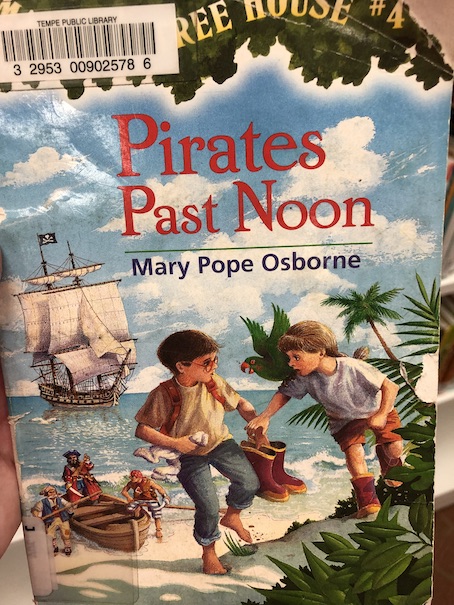
#4 Pirates Past Noon by Mary Pope Osborne, 1994.

One rainy afternoon, Annie urges Jack to go to the tree house with her because she has a feeling that they will soon meet its mysterious owner.  When they arrive, no one is there, so the kids start looking at the books.  The day is cold and wet, and Annie shows Jack a picture of a sunny beach, saying that she wishes they were there.  Soon, they find themselves on the beach. 

They have fun at first, but then some pirates come to the beach, looking for a treasure buried by Captain Kidd.  The evil pirate, Cap’n Bones, makes the kids prisoners aboard his ship until they figure out where the treasure is hidden from the clue written on the captain’s map.

The clue says that the treasure is hidden underneath the whale’s eye, and from the ship, Jack and Annie realize that the island is shaped like a whale with a big boulder for its eye.  The kids make the pirate captain take them back to the island in exchange for telling him where the treasure is.  While the pirates are digging for the treasure, a parrot flies over, saying, “Go back!”  The pirates take that as a sign of an approaching storm and flee, leaving the kids behind. 

A storm does come, but Jack still has difficultly tearing himself away from the treasure that they’ve uncovered.  Finally, the parrot convinces him to leave, and he and Annie use the tree house to go home again. 

Once they’re back in Pennsylvania, the parrot appears and turns into a woman and says that she’s Morgan le Fay.  She is the owner of the tree house and the amulet.  Besides being King Arthur’s sister and an enchantress, she is also the librarian of Camelot.  She has been using the tree house to travel to other times to collect books that the scribes in Camelot can copy for their library.  She put the spell on the tree house so that she can travel to some of the places in the books herself.  The kids can use the spell only because Annie truly believes in magic and Jack really loves books.  She and the tree house disappear as the kids head home, but Jack discovers that she left her amulet with him as a sign that she will come back.

I was surprised that the owner of the tree house turned out to be Morgan le Fay, both because an Arthurian character didn’t seem to quite fit with a magical children’s tree house and because Morgan le Fay wasn’t one of the good characters in the Arthurian legends. The exact nature of the character of Morgan le Fay changed through different retellings of the Arthurian legends, and she wasn’t always an adversary or villain, but she does do things in some of the stories that wouldn’t make her a good heroine for children’s literature. However, none of that matters in this series because, here, she’s just an enchantress from Camelot who is interested in books.

The book is currently available online through Internet Archive.

Mystery of the Pirate’s Ghost

Mystery of the Pirate’s Ghost by Elizabeth Honness, 1966.

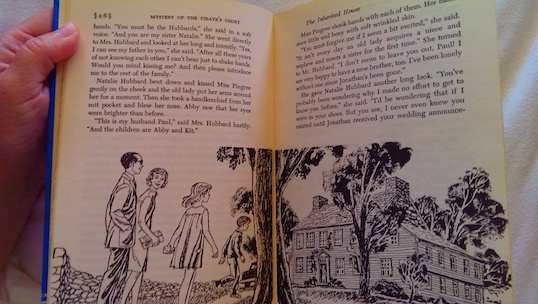
Abby and Kit Hubbard’s mother has just received a letter telling her than her half brother, Jonathan Pingree, has died and left her the old Pingree mansion.  He has left over bequests to other family members as well, and money to be held in trust for Abby and Kit.  It’s exciting news, and the family may move to live in the mansion they have inherited, although it partly depends on Mrs. Hubbard’s other relatives. 

Mrs. Hubbard, who was born Natalie Pingree, has never met her half-brother or half-sister.  They were her father’s children, from his first marriage.  She doesn’t know much about her father’s early life because he died when she was very young, and all that she knows about him is what her mother told her.  Apparently, her father’s first marriage was not a happy one.  He stayed in that marriage long enough for his first two children, Jonathan and Ann, to become teenagers.  Then, he made sure that his first wife and children were settled comfortably enough in the family home and left them to move to Philadelphia to start a new life by himself.  Sometime later, his first wife died and he married Natalie’s mother, who was much younger.  After his death, Natalie and her mother moved in with her mother’s sister, Aunt Sophie.  When Natalie got married, Aunt Sophie sent a wedding invitation to Johnathan and Ann, but they never came to the wedding or made any reply.  Natalie assumed that they felt uncomfortable about their father’s remarriage and didn’t want to see her, which is why she’s so surprised about Jonathan leaving the family home to her.  The only reason she can think of why he would do that is that neither he nor his sister ever married or had children of their own, so there was no one else to leave the house to.  Both of them were more than 30 years older than Natalie, and Ann is now an elderly woman, still living in the house.  Jonathan’s will has made provision for her as well, and the Hubbards go to see her at the Pingree mansion.

Mrs. Hubbard is pleasantly surprised that Ann is actually happy to see her.  Ann Pingree explains that the reason why she and Jonathan never replied to the wedding invitation was that, until that invitation arrived, neither of them had known that their father had another child, and they felt awkward about it.  However, Ann has been lonely since Jonathan’s death, being the last of the Pingrees, and she is glad to have Natalie and her husband and children with her and is eager to have them move into the mansion and live there. (Ann doesn’t live in the old mansion itself, but she does live nearby.)

Aunt Ann shows the family around the old mansion and explains more about its history and the history of the Pingree family. It turns out that the house, which has existed since Colonial times, although it has been burned, remodeled, and expanded over time. The house also has a number of secrets. Apparently, there used to be a tunnel running from the basement of the house to the beach that was used to bring in smuggled goods during the Colonial Era. There is also a hidden room behind a fireplace upstairs where the children of the family could hide during Indian attacks. (It doesn’t say how often that happened.) To the family’s surprise, Ann also tells them that the mansion is supposed to be haunted. The kids think it all sounds exciting, although Ann doesn’t explain much about the ghost the first time she mentions it. (Kit uses the phrase, “Honest Injun?” when asking Aunt Ann if she really means it when she says that the house is haunted. This isn’t a term that people use anymore because it isn’t considered appropriate.)

Mr. Hubbard is able to get his job transferred to a different branch of the company he works for, so the Hubbard family decides that they will move into the Pingree mansion. The kids like living by the beach, and their parents tell them that they can use the old ballroom of the house as a kind of rec room. Soon, they meet a couple of other children who live in cottages nearby, Chuck and Patty, and make friends with them. Chuck and Patty have already heard that the Pingree house is supposed to be haunted, although they’ve never seen anything really mysterious, just a light in the house once when they thought that the house was supposed to be empty.

The next time Aunt Ann comes to visit, the four children ask her to tell them about the ghost, and she tells them the story of the first Pingree to live at Pingree Point. This ancestor, also named Jonathan Pingree, built the original house in the late 1600s. He was a shipbuilder who owned several ships of his own, and he wanted to live near the sea. Later, he also became a privateer. When the kids call Jonathan a pirate, Aunt Anne agrees and explains that, unlike a pirate, Jonathan’s position as privateer was all perfectly legal because he had a Letter of Marque. (Yes, privateers operated within the law, but yes, they were also essentially pirates who raided other ships for their goods. In other words, they did the same things, but privateers did it with permission whereas ordinary pirates didn’t get permission. Historically, some privateers continued their pirating even after permission was revoked, so as Aunt Ann says, “the line between that and piracy was finely drawn.”) His son, Robert, was sailing on one of his father’s ships when it was taken by other pirates, and Robert was forced to join their crew. The family never saw Robert again and only found out what had happened from a fellow crew member who was set adrift and managed to make it back home. What happened to Robert is a mystery. His family didn’t know if he had really taken to the life of a pirate and couldn’t return home because he couldn’t face his family, if he had been killed in some fight, if he had been hung for piracy because he had gotten caught and couldn’t prove that he was forced into it. However, members of the family claimed that Robert’s spirit did return to the house and that he knocks at doors and windows, begging to be let back into his old home. Aunt Ann says that she’s never seen the ghost herself, but old houses can make all kinds of noises on windy nights, and that’s what she thinks the “ghost” is. As Chuck and Patty leave, they say, “we hope that old ghost doesn’t show up to frighten you.” Of course, we all know that it will because otherwise this book would have a different title.

One day, Kit is bored and starts playing around in the secret room, pretending that he’s hiding from American Indians. While Kit is in the secret room, he overhears the servants, John and his wife Essie, who have worked for the family for years, talking. Essie seems very upset and wants John not to do something that might risk their home and jobs, but John says that it’s too late and that they’re already “in it” and “can’t get out.” Kit tells Abby what he heard. That night, Abby hears banging and wailing during a storm and fears that it’s the ghost. Soon, other strange things happen, like a desk that mysteriously disappears and a cupboard that also mysteriously appears in its place. The children like John, and they don’t want to think badly of him, but he’s definitely doing something suspicious. One night, the children try to spy on him, and Abby once again hears the wailing and sees a mysterious, cloaked figure in the fog. Is it the ghost?

There are some interesting facets of this story that make it a little different from other children’s books of this type. For one thing, the children confide their concerns to their parents almost immediately, and the parents immediately believe them. In so many children’s mysteries, either the children decide to investigate mysterious events on their own before telling the parents or the parents disbelieve them, forcing the children to investigate on their own. It was kind of refreshing to see the family working together on this mystery. It actually makes the story seem more realistic to me because I can’t imagine that I would have been able to keep worries about mysterious things secret from my parents as a child, and they would have noticed if I was sneaking around, trying to investigate people, anyway. Abby and Kit do something dangerous by themselves before the story is over, but they also confide what they’ve done to their parents at the first opportunity and do not take the same foolish chance again.

The truth of John’s activities comes to light fairly quickly, although it takes a little longer for the family and the authorities to decide how to handle the situation. Investigating John brings to light some of the Pingree family secrets, and Abby and Kit soon discover the fate of Robert the pirate and the truth of his ghost. I’ll spoil the story a little and tell you that the ghost that Abby sees is apparently real, but it isn’t very scary. Once they learn the truth of what happened to Robert and see that his body gets a decent burial, the ghost appears to be at peace.

One thing that bothered me was the way that the characters talk about Native Americans in the book. It’s not the talk about Native American sometimes abducting children because I know that happened. It’s more how they picture that would happen. In the scene where Kit was hiding in the secret room, Kit imagines that the Indians were attracted to the house by the smell of his mother’s cooking and that he went into hiding while his mother fed them to avoid being abducted. As part of his scenario, he imagines that his mother would have wanted to “hold her nose against the Indian smell.” What? Where did that come from? There are all kinds of tropes about Native Americans in popular culture, from the “noble savage” image to that silly “Tonto talk” that actors did in old tv westerns, but since when are they supposed to smell bad? I’ve never seen characters in cheesy westerns hold their noses before, so what’s the deal? I tried Googling it to see if there’s a trope that I missed, but I couldn’t find anything about it. I’m very disappointed in you, Elizabeth Honness.

This book is currently available online through Internet Archive.