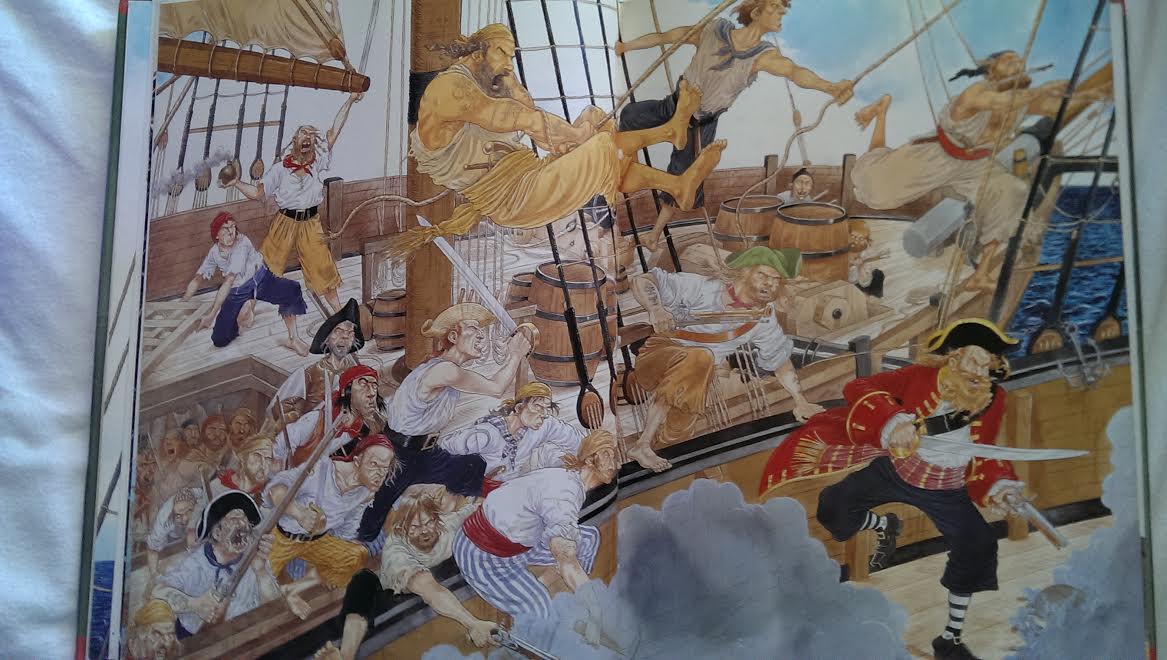
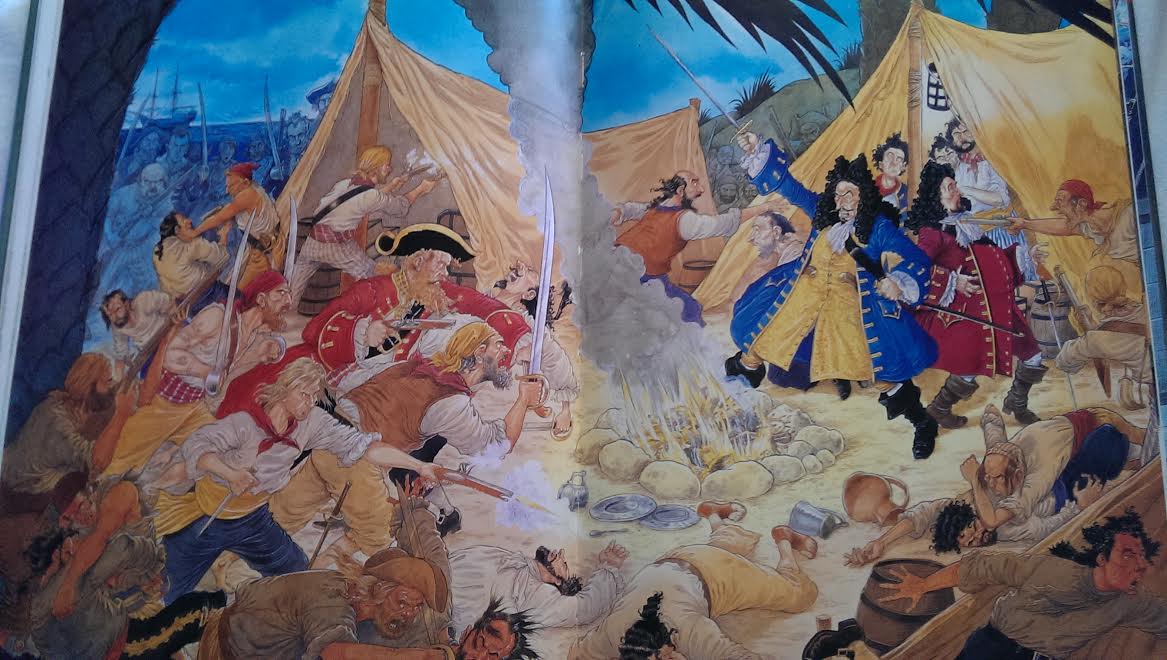
You Wouldn’t Want to Be a Pirate’s Prisoner

You Wouldn’t Want to Be a Pirate’s Prisoner by John Malam, 2002.

This picture book, which is part of a series, explains what it would have been like to be a pirate’s prisoner in the 18th century.  It sets the stage by casting the reader in the role of a Spanish ship captain in 1716.

The reason why the reader is cast as a Spanish captain, captured by English pirates, is because England and Holland had been at war with Spain until 1714.  During the war, the government of England (as well as Holland and France) authorized some ship captains to act as privateers, conducting raids on Spanish ships and outposts.  When the war ended and the privateers were dismissed from service, some of them continued to act as independent pirates.
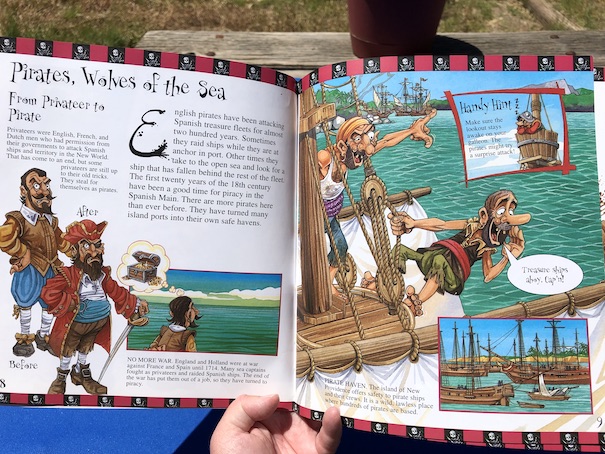
The book explains the geography of the “Spanish Main,” the area between the southern coast of North America and the northern coast of South America – basically, the Caribbean Sea and its islands and the Gulf of Mexico.  Spanish galleons in the 18th century carried gold and treasures from the Americas to Spain as well as timber from the rainforests and goods that were transported to the Americas across the Pacific Ocean, such as spices and silk.  All of these goods made Spanish treasure ships tempting targets for English pirates.
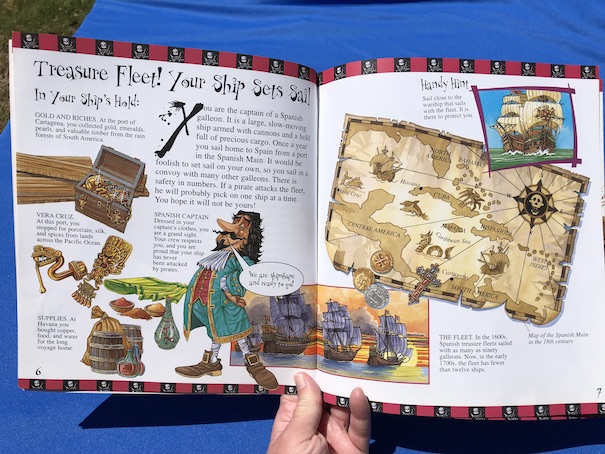
As a Spanish ship’s captain, there were a few precautions that you could take against pirate attack.  One of the most basic was traveling as part of a convoy because pirates would be more likely to attack a lone ship than one that was part of a group.  A fleet of ships would have a warship traveling with them for protection, and the closer your ship sailed to the warship, the less likely a pirate ship would try to separate you from the group and attack.
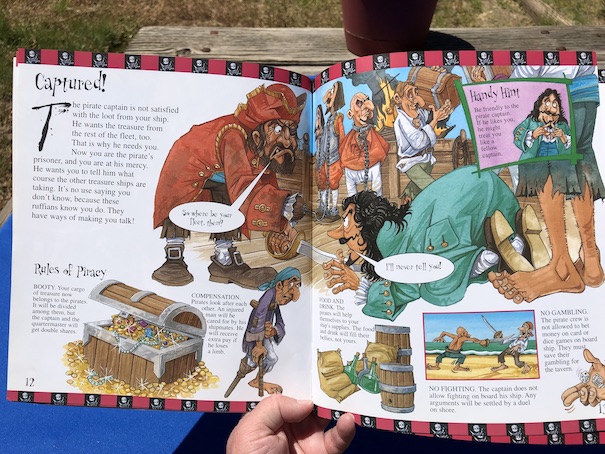
If the worst situation happened and the ship was taken by pirates, a captain could try to dress like other members of the crew to disguise his rank, but that didn’t always work.  The captain of the ship was in danger of being taken captive because he might have information that the pirates would find useful, like the exact route of other ships in a convoy.

The gruesome part of this book (and the source of the title, because this series basically focuses on the gruesome parts of history) is the part where they describe different forms of torture that pirates might use on a ship’s captain to convince him to tell them what they wanted to know.  Besides the direct physical abuse, pirates could also keep a captive in squalid conditions to make him weaker, more vulnerable, and exposed to disease.  In the end, they might simply decide to maroon the captive somewhere, even if they got the information they were after.

However, pirates could also face gruesome fates if they were caught. They could be hung and their bodies displayed publicly, as a warning to others.

The Best Book of Pirates

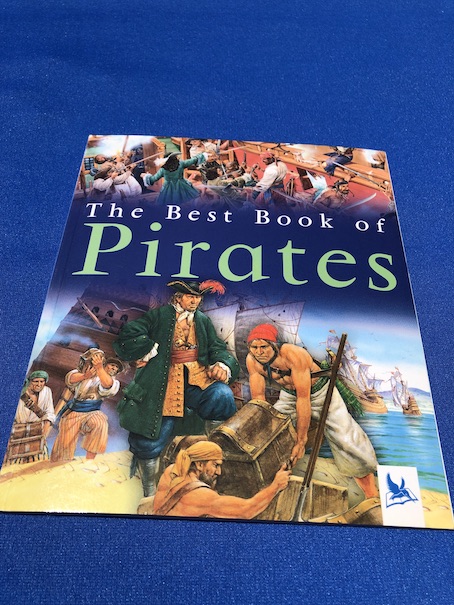
The Best Book of Pirates by Barnaby Howard, 2002, 2006.

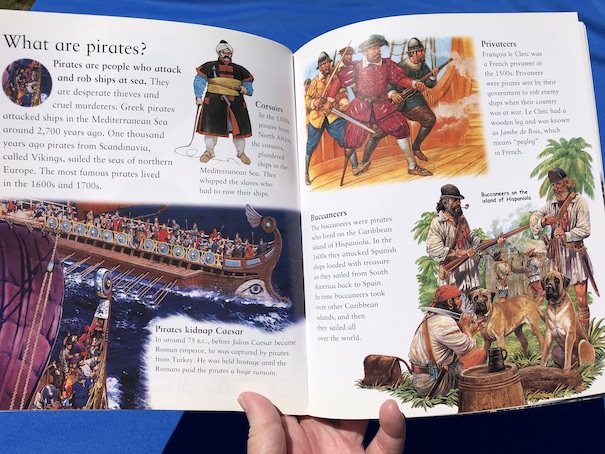
This is an easy and informative non-fiction picture book about pirates.  Rather than focusing on any particular time period or geographic area, the book gives a broad overview.  In the beginning, it explains a little about different groups of pirates through history, including Vikings, Corsairs, Buccaneers, and Privateers.  There is also a brief explanation of the Pirate Round, a sea route often taken by pirates during the late 17th century and into the 18th century.  The route led from North America and the Caribbean to Africa, circling the coast of South Africa to Madagascar and on to the Middle East and India.  (If you’ve seen the movie Cutthroat Island, the crew will basically be taking this route when the movie ends, heading from the Caribbean to Madagascar.)

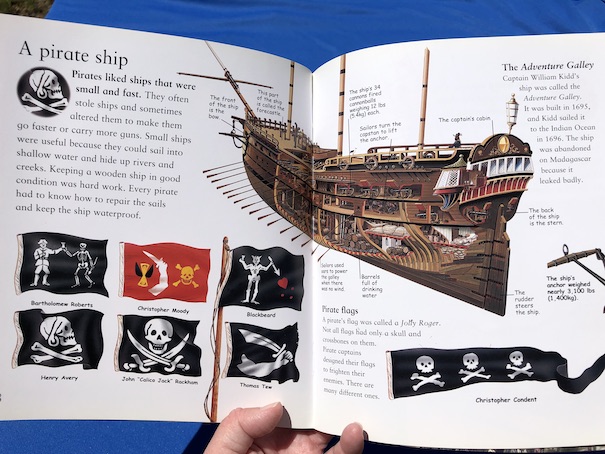
There is a diagram of a pirate ship from the late 17th century, showing what it would have looked like on the inside, and there are also examples of Jolly Roger flags, which were designed by individual pirates as personal identification, typically including skulls and skeletons to frighten their victims.  There is also some general information about what life would be like on board a pirate ship and the types of weapons they might have.

Then, the book begins to focus more on groups of pirates that operated in specific geographical areas and some of the more famous pirates from history.  The Barbary pirates (also called Barbary corsairs) were Muslims who raided Christian ships along the coast of North Africa and the Mediterranean during the 1500s.  Among the most famous Barbary pirates were a pair of brothers called Barbarossa (“Red Beard”).  Sometimes, European and American pirate ships that went to Africa to find gold and ivory also entered the slave trade.

In the section about the Spanish Main, it explains how privateers and pirates raided Spanish ships taking Aztec treasures from Mexico to Spain.  Buccaneers were specifically pirates who raided ships in the Caribbean.  Their name came from the type of fires they used when cooking meat (boucan or buccan).

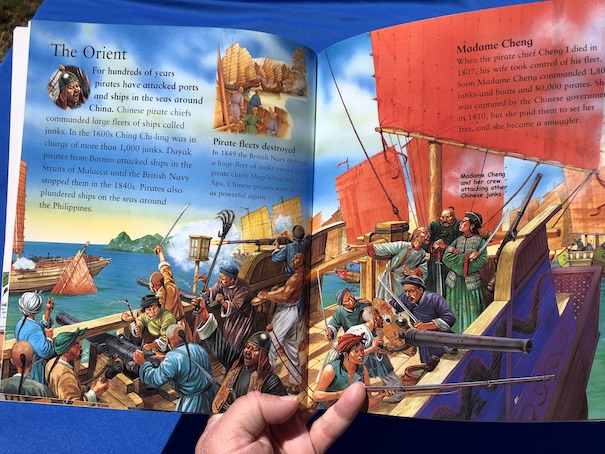
There were also Asian pirates who raided the coasts of China and the Philippines and areas around the Indian Ocean.  Chinese pirates and Dayak pirates from Borneo were powerful in the region until the 1840s, when the British Navy destroyed many of their ships.

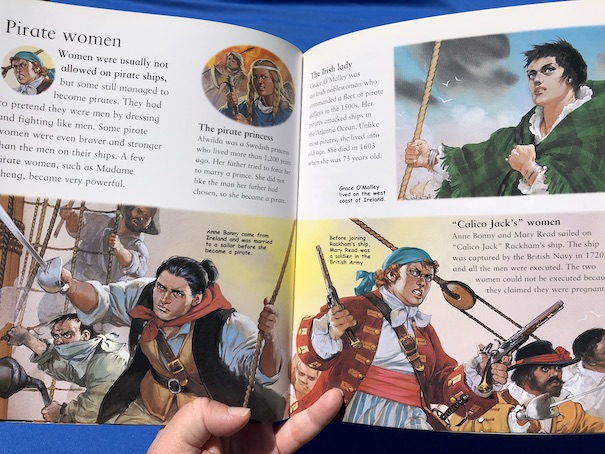
There is a section in the book specifically about female pirates.  Mary Read and Anne Bonny, who sailed with “Calico Jack” Rackham, were famous.  Grace O’Malley was a famous Irish pirate who was also an Irish noblewoman.  Madame Cheng was a Chinese pirate who took over her husband’s fleet after his death (but because this is a children’s book, it doesn’t mention her previous career).  Alwilda was a Medieval Swedish princess who turned pirate after her father tried to make her marry a man she did not want to marry (although her story may only be legend).

The book also talks about the famous stories of pirates burying treasure, although it says that pirates would usually spend their money quickly, sell items for money they could spend, or gamble it all away.

At the end of the book, there is a short section about modern pirates and how their goals and tools of the trade have changed.

The book isn’t very long, but I think that it provides a good, general overview of the subject of pirates throughout history, and the pictures are fascinating and detailed.

The book is currently available online through Internet Archive.

The Secret of the Floating Phantom

SecretFloatingPhantom

The Secret of the Floating Phantom by Norma Lehr, 1994.

Kathy Wicklow is going to be staying with her grandmother in Monterey for a while, helping her while she recovers from a twisted knee.  Kathy is disappointed about it because she only just got home from visiting her Aunt Sharon, and she was looking forward to some time at home with her dog, Snuggles.  Snuggles can’t even come with her to her grandmother’s house because of her grandmother’s allergies.

Kathy’s grandmother is a dance instructor, but someone else has to teach her classes until she’s better.  Her friend, Loretta, owns a Spanish restaurant and sometimes visits and brings dinner with her.  (The grandmother describes it as a “Spanish” restaurant, but they serve things like tacos and burritos with salsa, which is what people where I live think of as Mexican food.)  Kathy’s grandmother is sure that Kathy will like Loretta’s granddaughter and grandnephew.  However, she is strangely secretive about what she and Loretta have been doing during her visits, saying that their meetings, which they hold with a mysterious man called Mason, are financial discussions and are “not for children.”

Kathy learns that her grandmother and her friend are really holding séances. Loretta’s husband is dead, and Loretta fears that she might lose her property unless she can produce the original deed to it. She thinks her husband knew where the deed was, and she hopes to contact him so that he can tell her.  When Kathy spies on them during a séance, she sees a mysterious fog that seems to be trying to tell them something. No one else can see it but her. It appears to Kathy several more times, and it seems to be leading her not only toward the deed but toward a lost treasure from the early days of California.

Kathy is suspicious of Mason’s motives and the fact that he doesn’t seem to like her. It turns out that he is not really trying to help Loretta and her family but trying to find a treasure that was hidden by an ancestor of Loretta’s over a hundred years ago. At that time, the area where they now live in California was attacked by pirates. Loretta’s ancestor, Ambrose, was given the task of hiding the treasures from the local mission. He buried them under a tree and marked the tree with a cross. However, during the attack, he was badly injured and blinded. He was unable to find the spot where he buried the treasure himself, and the others who went to find it couldn’t locate the tree.

The fog-like spirit that Kathy sees is Ambrose. Lisa, Loretta’s granddaughter and Kathy’s friend, is spooked by Kathy’s visions, but she helps Kathy to follow the clues that the ghost provides to the treasure. In a hole in the trunk of the tree, Kathy also finds the deed that Loretta has been searching for. Mason tries to take the treasure himself, but he can’t move the heavy bricks on top of it by himself. Mason leaves before anyone can confront him. Digger, Lisa’s cousin, feels especially betrayed because Mason had seemed like such a good friend to him. Kathy notices that Mason seems to share some characteristics with one of the pirates from the attack in Ambrose’s time, which might be a hint that Mason is a descendant of the pirates, but it’s never fully explained.

The book is currently available online through Internet Archive.

Pirate Diary

PirateDiary

Pirate Diary: The Journal of Jake Carpenter by Richard Platt, 2001.

Young Jake Carpenter lives with his father in North Carolina in 1716.  His mother is dead, and his father is a medical doctor.  His father wants him to become a doctor as well, but he has decided that it’s important to the boy’s education that he see something of the world first, so he is allowing Jake to go to sea with his uncle, Will, who is a sailor.  Jake is excited about the prospect, and Will has told him many stories about the sea.

PirateDiaryPic1

Jake isn’t allowed to bring much with him because there is limited space on board the ship for personal belongings, and there are many things that Jake has to get used to, like sleeping in a hammock, the names for all the different parts of the ship, seasickness, the poor quality of food on the ship, and using the horn lanterns which are safer for candles on board ship but don’t cast much light.  Jake makes friends with Abraham, the cook’s boy, who promises him extra food in exchange for teaching him to read.  Jake’s main job on the ship is to help the carpenter, so he begins learning his trade.

When the ship is underway, Jake and his uncle learn that the captain is running from debts and that the ship is carrying contraband.  Jake doesn’t think that smuggling is a very serious crime because the main purpose is to avoid paying extra taxes on certain types of goods, and other members of the crew say that it isn’t fair for Americans to continue paying taxes to England when the king doesn’t really care about them or what they want.  The ship sails the Caribbean, but crew members say that they try to avoid docking at English-controlled ports, like the ones in Jamaica, so they won’t have to pay the customs fees. Abraham says that even if they were caught with their contraband, the authorities would likely look the other way if they offer them a share.  Will tells Jake that the captain of the ship will most likely hold back their wages in order to keep them with the ship for as long as possible, like he does with other sailors.

Discipline on board the ship is harsh and arbitrary, according to the captain’s whims.  When Will speaks up to save Jake from a harsh flogging, he himself is flogged and abandoned in a small boat.  Jake believes that his uncle will die because they left him at sea with no provisions!

Then, the ship is captured by pirates!

PirateDiaryPic2

Far from making things worse, Jake’s situation and that of the rest of the crew actually improves because of the pirate attack.  With the captain captured, his cruel punishments are over, and members of his crew eagerly join the pirates in the capture.  The pirates ask the crew about the treatment their captain has given them, saying that it will help them to decide what to do with him, and crew members explain the cruelties they have suffered, including what the captain did to Will.  They end up marooning the captain and his equally-cruel second mate on an island with drinking water.

As Jake’s father predicted, Jake gets to see a lot and learn a lot about life and death during his time at sea, perhaps even more than expected while under the command of the pirates.  He gets some experience in dealing with injuries as he has to help the ship’s carpenter saw off the leg of a man whose wound was too infected to treat in any other way, although the man later died anyway.  Later, the pirates join up with other pirate ships, and Jake participates in a raid on a Spanish treasure fleet!

PirateDiaryPic3

It’s not all excitement, and Jake spends some time talking about the routine chores that sailors did and how they would pass the time on board ship when nothing else was going on.  He does get to see St. Elmo’s Fire on the upper rigging of the ship, and the crew spots a “mermaid” once on a misty day.

An offer of amnesty for those willing to give up pirating allows Jake and other members of the crew to return home where he learns that his uncle has managed to survive after all!

PirateDiaryPic4

In the back of the book is a section with historical information.  It explains the history and geography of the American Colonies, where Jake lived and the history of piracy from the first known pirates to the privateers and buccaneers that led to the golden age of piracy in the 18th century.  Jake is a fictional character, but some of the pirates that Jake met in the story were real people, and the section in the back explains more about them.  The book is part of a series of historical picture books.