Whose Garden Is It? by Mary Ann Hoberman, illustrated by Jane Dyer, 2001.
This is a cute picture book, told in rhyme, about who is the real owner of a garden.
One day, Mrs. McGee goes for a walk and passes a beautiful garden. She wonders aloud whose garden it is. Of course, the owner of the garden, who is tending the plants speaks up, but he’s not the only one.
A small rabbit also tells Mrs. McGee that the garden belongs to him because he’s lived there his whole life, and he eats the vegetables. Then, a woodchuck says that’s nothing because he eats everything that grows in the garden. A bird chimes in, saying he eats the worms from the garden. Then, a worm says that worms are there to make the soil in the garden better, so he’s the real owner of the garden.
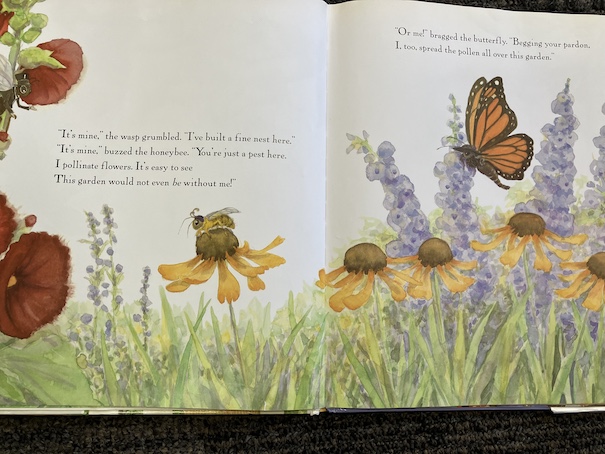
Various other creatures, big and small speak up, each of them pointing out that they live in the garden, what they’ve done for the garden, and what the garden has done for them. The bees and butterflies pollinate the flowers.
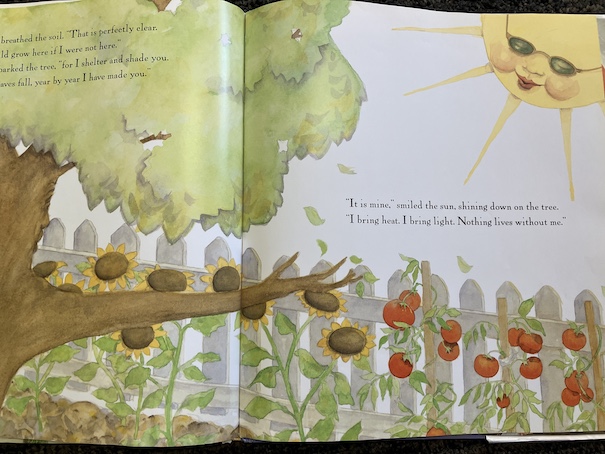
But what about the plants in the garden? They have a strong argument that they are what makes the garden a garden. Then again, the soil is where the plants grow, and the plants need the sun and rain to grow. Also, all plants grow from seeds, so the garden exists for the seeds that will be the future plants.
It seems that the answer to Mrs. McGee’s question isn’t as easy as she might have thought.
My Reaction
This is a charming story about how various plants, animals, creatures, and forces of nature are interconnected. The book doesn’t use the word “ecosystem“, but that’s the concept being described here. The garden’s ownership and the reason for its existence is much more than the gardener who owns the land and planted and tended the garden; it’s everything that’s growing in it, everything that contributes to its growth, and everything that depends on the garden. Without all of these creatures and natural forces put together, the garden wouldn’t be what it is.
The book doesn’t attempt to get scientific about the details of this garden ecosystem, and the animals wear clothes and talk, so the story isn’t meant to be entirely realistic. However, it is thought-provoking about how many different parts of nature affect each other. It could be a good book for introducing the topic to young children before teaching them about the science of ecosystems later. The rhyme scheme makes the story fun to read.
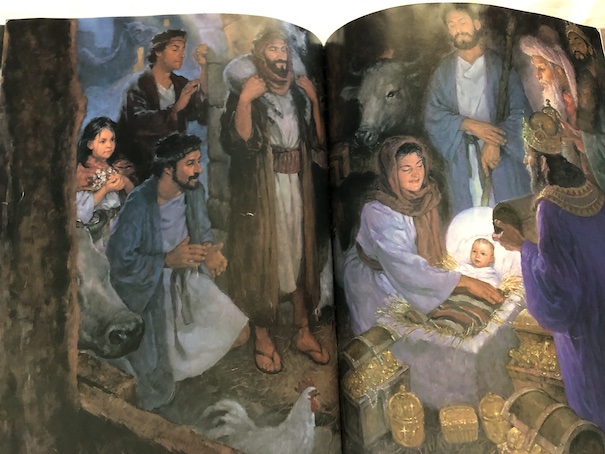
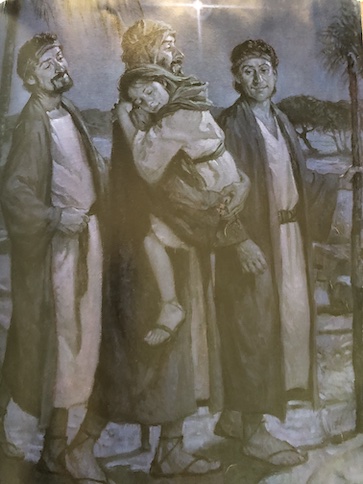
The Legend of the Christmas Rose by William H. Hooks, paintings by Richard A. Williams, 1999.
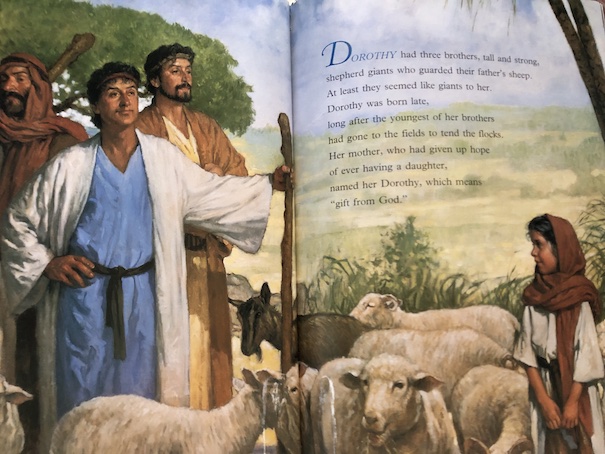
Dorothy is a 9-year-old girl with three brothers, who are all much older than she is. Her three brothers are all shepherds, and her daily chore is to take water to them when they’re out in the fields with the sheep. Her brothers love her, but they always treat her like a small child because they’re so much older.
One day, she spots some strange travelers on the road. She worries that they might be robbers, but her brothers tell her not to worry. There are more travelers on the road these days because the Roman Emperor has ordered everyone to return to their home towns to be taxed. However, because there are so many strangers traveling through the area, Dorothy’s brothers plan to spend the night in the fields with their sheep to keep an eye on them.
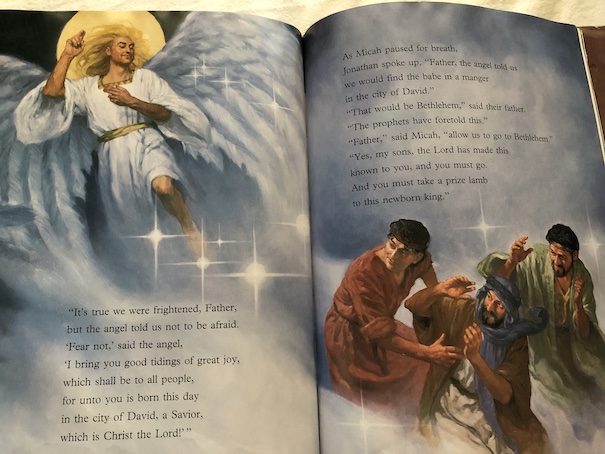
Early the next morning, the brothers return to the family home, excited. They tell their father that they saw angels in the field during the night. An angel appeared to them and told them that they would find a newborn Savior in a manager in the City of David, which is Bethlehem. Their father says that there is a prophecy about this. Because God has sent His messengers to announce the birth of the Savior to them, the brothers should go to the city and take a lamb with them as a present to the Savior.
Dorothy helps her brothers to pack their supplies for the journey to Bethlehem, but she knows that she will not be allowed to go with them because she is too little. In spite of that, Dorothy makes the sudden decision to follow her brothers secretly. However, as they travel, Dorothy suddenly realizes that she doesn’t have a present of her own to offer when she arrives.
When Dorothy begins to cry about her lack of a present to give, an angel appears to her and produces snowy white flowers. Dorothy is happy because she can bring the flowers with her as a present.
The book is available to borrow and read for free online through Internet Archive (multiple copies).
My Reaction
There is an Author’s Note at the back of the book that explains about the Christmas Rose plant and its associated legends. The Christmas Rose is a real plant, but technically, it’s not a rose, and it doesn’t always bloom at Christmas. It’s native to southern and central Europe, where winters are relatively mild, and the flower can bloom in Christmas, but in colder climates, it tends to bloom in spring. It’s actually a member of the hellebore family, which is toxic to humans, although it has been used medicinally as a purgative, and it does contain a chemical that can be used to treat heart conditions. The story in the book also references the plants’ medicinal uses.
There are multiple legends about the origins of the plant. The version presented here, the legend about an angel giving the flower to a young shepherd girl to offer as a present to baby Jesus, comes from Medieval nativity plays. There is an older Greek legend where the plant was discovered by a shepherd around 900 BC. In that version of the story, the shepherd used the plant to cure three princesses who were afflicted with delusions that they were cows. After he cured them, the princesses’ father, the King of Argos, allowed the shepherd to marry his youngest daughter.
Overall, I liked this picture book version of the legend. I like books about folklore, especially ones that use lesser-known stories. The pictures in this book are also realistic and beautiful, taking up full pages.
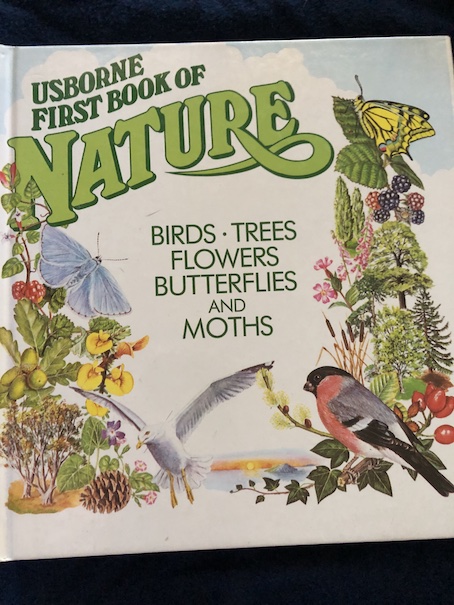
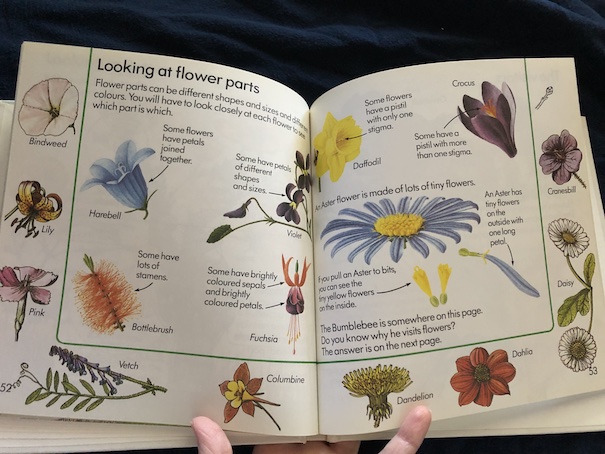
Usborne First Book of Nature designed by David Bennett, 1980.
I remember getting this book as a present from my grandmother as a child because my grandmother was an amateur naturalist. Although it’s a nonfiction book, I’m sentimental about it for that reason.
The book is divided into four sections covering different types of plants and creatures (each of which has its own book in the Usborne collection, but this book is a compilation):
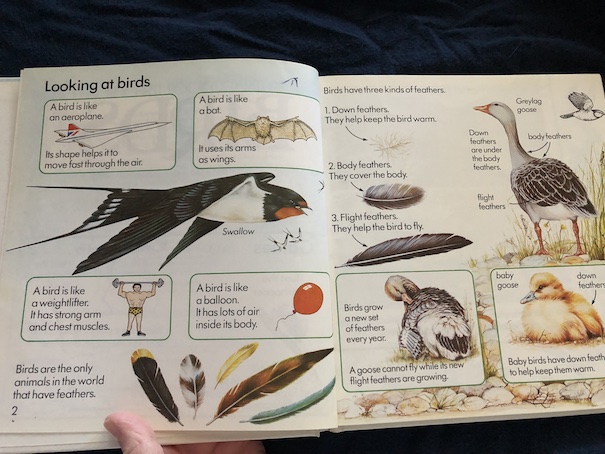
Birds
This chapter explains about the parts of birds, like the different shapes of beaks and feet different birds have, aspects of birds lives and behavior, and how birds fly.
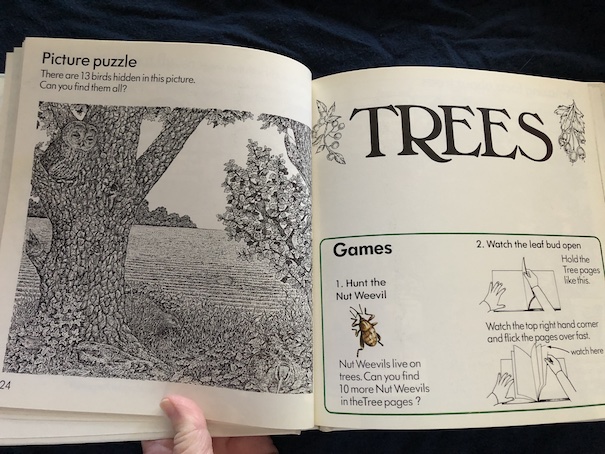
Trees
This chapter explains the parts of trees, like how roots and twigs grow and the differences between different types of leaves, tree flowers, and seeds.
Flowers
This chapter explains the parts of flowers and about pollen and seeds. It also points out the creatures that like to visit flowers, like bees and hummingbirds.
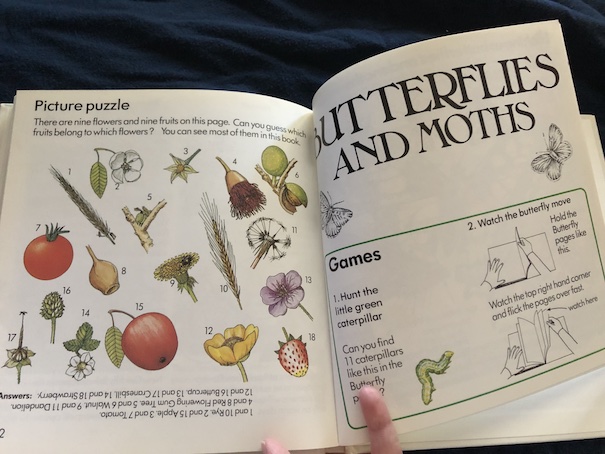
Butterflies and Moths
This chapter explains the similarities and differences between butterflies and moths and what their life cycles are like.
One of the best parts of this book is that it is designed to be interactive as well as informative. Some of the activities are explained at the beginning of each chapter, and there’s a puzzle or game at the end of each chapter. The upper right corners of each chapter have images that are meant to be used as a flip book. In the bird section, readers can quickly flip the pages to watch a bird fly. In the tree section, a leaf bud opens. In the flower section, a flower opens. In the butterfly and moth section, a butterfly opens and closes its wings.
Each chapter also has a game where you hunt for different creatures within the pages of that chapter and see how many you can find, and then, there’s another game or puzzle at the end. At the end of the bird chapter, there’s a picture puzzle where you have to find all the birds hidden in a black-and-white picture. At the end of the tree section, you have to find how many products are made from or come from trees in a busy market scene. At the end of the flower chapter, you have to match up different types of fruits with their flowers. The butterfly and moth section doesn’t have a game at the end.
This book is available to borrow and read for free online through Internet Archive.
The True Tale of Johnny Appleseed by Margaret Hodges, 1997.
This American folktale was based on the life of a real person, John Chapman.
Johnny Appleseed was born as Johnny Chapman in 1774. His family lived in Massachusetts. There were plenty of apple trees there, and Johnny loved them. When he was grown, he started traveling west with the idea of spreading apple trees.
He carried very little with him, and some people said that he wore the pot that he used to cook his meals on his head as he walked. Everywhere he went, he planted apple seeds.
His reputation spread, and although people thought that traveling around just to plant apple seeds sounded crazy, they sometimes let him stay with them on his travels. Even Native Americans seemed to like him because he was friendly and helpful and interested in learning their languages. His legacy continued long after his death with trees that were enjoyed by generations of families across the Midwest.
There is a section in the back of the book that explains more about the history behind Johnny Appleseed’s story, including the end of the Revolutionary War and the beginning of westward migration in America. One of the things they mention is the effect that the War of 1812 had on relations between pioneers and Native Americans. Because pioneers were already pushing into the territory of Native Americans in the area that later became Ohio, the tribes there sided with the British in the war, hoping to push out the invading pioneers. After the war was over, though, the pioneers continued to come west, and when they did, they retaliated against the tribes that had been on the side of the British. The pioneers could be brutal, and part of the reason that Native Americans liked Johnny Appleseed was that he was different. He wasn’t trying to hurt anyone or take land for himself; he just wanted to plant trees. After he planted trees, he would build fences around them to keep animals from eating them while they were growing.
John Chapman’s life was unconventional. He never married, and he acted as a Christian missionary in his travels as well as a planter. Although he could be regarded as something of an oddball in the itinerant way he lived his life, he became a legend.
The book is currently available online through Internet Archive.
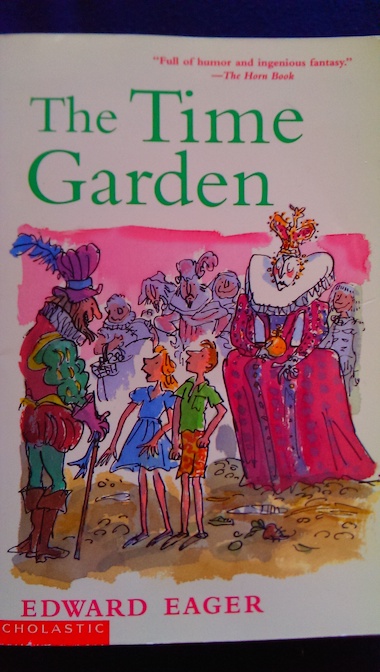
About a year after the events in the previous book in the series, Roger and Ann are excited when their father writes a play and announces that it will be performed in England. Unfortunately, their parents aren’t planning to take the children to England with them because the trip there will be just business, focusing on getting the play together. If the play is a success, they plan to send for the children so they can do some sightseeing in England, but until then, the children will need to stay somewhere else during summer vacation. Their mother, Martha, calls her sister Katharine to see if the children can come visit their cousins, but it turns out the Katharine is also looking for a place where Eliza and Jack can spend the summer. By coincidence, Katharine and her husband are also planning a business trip to Europe.
The adults talk it over and end up arranging for all four children to stay with Katharine’s husband’s great aunt, Mrs. Whiton, who lives in a house by the sea, not far from Boston. The children don’t find this prospect very exciting. Then the adults tell them that Mrs. Whiton writes children’s books, Eliza is sure that she’ll be trying to analyze them for inspiration for her stories, but Mrs. Whiton turns out to be better than they thought. She is unsentimental, something that Eliza appreciates, and her house is very nice. There is a pretty garden there, and a staircase that leads right down to the beach.
One day, when Mrs. Whiton sends them out to play in the garden, they find an old sundial that has a motto written on it: “Anything Can Happen When You’ve All the Time in the World!” The children have had experience with magic before, so they begin to suspect that this garden isn’t quite what it appears . . . and they’re right. A strange, toad-like creature call the Natterjack introduces himself to the children and tells them that the thyme garden, where there are many varieties of thyme growing, is also a time garden. He explains that he and his family have helped this garden grow since his grandfather’s grandfather was brought there from England along with a shipment of primroses and that they’ve put all of their magic into the garden and its plants. If the children would like to visit another time, all they have to do is to pluck a sprig of thyme and smell it.
Jack, who has decided that he’s too old for magic and is now only interested in girls, refuses to try it at first, denying the existence of magic, even in spite of the talking toad. The other children try it and find themselves at the same house during the time of the American Revolution. Everyone who sees them seems to think that they are the Whiton children of that time, and they end up participating in a ride very much like Paul Revere’s, riding through the countryside to alert people that the British are coming. At first, their ride is thrilling and successful, but if you know the other books in this series, you can guess that things are going to go wrong at some point.
When the kids reach a tavern, they try to tell the drunken men inside that the British will be at Lexington soon, and they say that they don’t care. As far as they’re concerned, if the British are going to Lexington, let the guys in Lexington deal with it. The children are offended that they don’t want to help and try to appeal to their patriotism and fellowship with other Americans. It turns out that they don’t have much patriotism (the United States isn’t a separate country yet, so there is that) or feelings of fellowship because their plan for if the British are defeated is basically “every man for himself.” (I understand this scene so much more now as an adult than I did when I read this as a kid. I think I’ve met their descendants.) The children are angered at this mercenary attitude, and Ann accuses them of being pro-British. One of them insists that they’re not because, “We ain’t pro-anything.” (Yep, this is familiar. Some people just want to be contrary until there’s something in it for them to gain.)
It gets worse when the anti-British talk causes the Natterjack, in a surge of British patriotism, to cry, “Rule, Britannia!” The drunks in the tavern then decide that the kids were trying to deceive them about the British coming because they’re actually on the side of the British, trying to distract them from the British army’s real plans. When they discover that the voice actually came from a talking toad, they declare that it’s witchcraft and decide to throw the children into the pond to see if they will float (an old test in witchcraft trials).
In a bizarre twist, they are saved by a band of attacking American Indians. (Native Americans ex Machina?) There’s no real reason for a tribe of American Indians to be attacking at this particular moment, and the kids in the story seem to realize that. This incident, like many others in this series, is partly based on other books in classic children’s literature, especially the works of E. Nesbit, the author’s favorite children’s author. A similar incident occurs to the children in E. Nesbit’s Five Children and It, although under different circumstances. The author of this story frequently pokes fun at tropes of classic children’s literature in his books and makes pop culture references from the 1950s, so the more old books you’re familiar with, the more you see the jokes, although I admit that, even knowing the background, this scene still bothers me. In the grand tradition of cheesy 1950s westerns, there’s a vague description of the carnage of the attack with the requisite scalping and tomahawking (yes, they use it as verb). Ann is upset about the attack and covers her eyes, although Roger says that he doesn’t think that this attack could really have occurred in real life because they would have heard about it if it were a real, historical event. Ann worries that they somehow caused it by messing with history. When the tribe is done tomahawking their attackers, the children are worried that they’ll be next, but the Natterjack tells the children that they can escape by smelling the thyme again.
Before we move on, I should point out here that, in different books in this series, it’s never entirely clear how much of the children’s adventures occur in the real world or in some kind of magical, alternate reality or maybe in their own minds, and this is actually intentional. The idea of sniffing a magical herb and being transported through time sounds kind of trippy. The whole “savage painted Indians” (their words, not mine) trope was a staple of old western shows, the kind that kids growing in the 1950s might have watched because that genre was popular, particularly in the late 1950s, when the book was published, so the children’s experiences may be partly patterned after what a 1950s kid might have imagined after watching those shows. (Sort of like the Arabian fantasies that their mothers had in previous books in the series, probably inspired by The Sheik.) So, this incident in the book is partly a take-off on similar ones in other children’s books, but it might also be the author’s commentary on the types of shows that were popular and children’s expectations. Perhaps some of the implication is that the children’s expectations, based on things they’ve read or seen on tv are what caused this weird, otherwise inexplicable attack in the first place. (It’s like on tv, kiddos, and now you can see it in full color! You expected it, so you got it. Still think this stuff is fun?) Part of the problem with this scene for me is that it’s difficult to tell exactly how the author means it. I can guess a little, given the author’s taste for making literary references and parodying tropes of children’s stories, but even as a parody, it’s uncomfortable by modern standards and still makes very little sense why it’s even happening at all. This scene is just plain needless and cringe-worthy in my opinion, but you sometimes run into things like that with older children’s books. It’s some consolation that this is the worst scene in the entire book, so it’s good to get it out of the way early.
Before we return to the main plot again, I’d also like to say that the children themselves don’t seem to understand exactly how the magic works (like other children in this series) or whether what happened to them was completely real or not. They debate about it periodically and wonder about the children that they replaced on this adventure (and on later ones as well). They never quite know if those children went somewhere else while they took their place or if both sets of children were just living out the same adventure at the same time, just seeing it in slightly different ways. These time travel questions are fun to ponder, but are never really explained, just theorized.
When the children get back to their own time from the Revolutionary War period, the Natterjack apologizes for getting them into trouble and asks them to put the plant sprig back in the ground, where it grows again (no “wasting thyme”, ha, ha). He also further explains that the name of the particular variety of thyme they pick in the garden is important because it has some bearing on where in time they will go. The thyme they had chosen was “wild thyme”, and they had to admit that their time was pretty wild. Ann borrows a gardening catalog from Mrs. Whiton’s old gardener and begins studying the different varieties of thyme. When they ask the Natterjack about the massacre at the tavern, he tells them that the mistakes they make or bad consequences of their interference will be erased by the good deeds they do, so their timely warnings about the British coming will have an effect, but that massacre has been erased from history. (Too bad it’s still in the book. There’s still no real reason for it to be there, dang western trope.) Good deeds performed during their adventures will earn them more adventures, so they have to remember to do some good in every time they visit.
So, while Jack spends most of his time getting to know the local teenage girls and doing normal teenage things and trying to ignore his sister and cousins when they talk about magic, the others get to spend their summer having magical time adventures. The next variety of thyme they pick is “splendid thyme.” Once again, they are taken back in the history of the house, where they are again mistaken for past Whiton children. The time period is around the Civil War, and the house is being used as a station on the Underground Railroad. The children help some escaping slaves to flee to Canada. (Their sentiments are strongly anti-slavery, which is a relief after that massacre scene. The escaping slaves aren’t portrayed too badly, although mostly, they’re in hiding during the adventure and are oddly unquestioning of how the kids managed to use magic to get them to Canada so fast, just embarrassingly grateful for it.)
After that, Eliza wants to know if they’re restricted to historical adventures only or if they can visit times that are fictional as well, referencing their adventures with Ivanhoe in the previous book. It turns out that the time garden is very accommodating, and they are able to go back in fictional time to visit the characters in Little Women (which, fortunately, took place not far from where they are staying), especially since Louisa May Alcott based the characters on herself and her sisters, giving the book a sense of semi-reality. Jack, who has been denying the magic all along, comes with them on this adventure, and spends all of his time fawning over the teenage Meg and Jo. The children help to reform an ungrateful family that has been taking advantage of the girls’ generosity (and, as Jo says, reforming “is punishment enough”).
Sharing in this adventure with the other children is enough to get Jack to admit that they’re having adventures, although he still refuses to look at it as being magic, preferring more scientific terms. At one point, he describes a theory of time as looking down on the world from an airplane. From high above, you can see many different places at once, but it would take a person on the ground a long time to get from one place to another. Similarly, Jack thinks that everything in history is happening all at once, but it just takes people a long time to get from one event to another because of their vantage point.
Then, the children get the idea to go visit their mothers in England. However, when they use Common Thyme with their wish, they end up seeing their mothers in the past, not the present. This is the point in the story where it crosses over with their mothers’ magical adventures as children in Magic By the Lake.
Eliza then gets the idea of using thyme seeds to travel through time instead of using a full-grown plant. She and Jack end up traveling to England. However, they end up in the wrong period of history, and because the magical rules are broken, everyone sees them as the modern children they really are and not as people from the appropriate time period. When Eliza manages to offend Queen Elizabeth I and ends up in the Tower of London, they need the help of Ann, Roger, and the Natterjack to straighten things out!
I think my favorite part of the story is really the thyme/time garden itself. Not only is it a fun pun, but I thought that it was clever how the titles of particular varieties of thyme relate to the times and places where the children end up. Different varieties of thyme plants really do have some incredible names in real life. At the end of the book, after the children go to England to join their parents because the play was successful, the Natterjack waits in the garden for the next set of children who will go on adventures, and after looking up other varieties of thyme that the book never mentioned, the possibilities for new adventures are tantalizing: Leprechaun Thyme (for adventures with leprechauns), Elfin Thyme (either for adventures with elves or maybe becoming smaller?), and Woolly Thyme (Want to go see a woolly mammoth? On the other hand, maybe it just goes to a sheep farm. This magic stuff never works like you think it will).
The book is currently available online through Internet Archive.
The Return of the Plant That Ate Dirty Socks by Nancy McArthur, 1990.
Michael and Norman’s father has finally gotten the chance to take a vacation, but his sons’ weird, sock-eating plants complicate things. You can board pets or ask someone to come in and feed them, but how can you ask someone to leave out socks for your houseplants? The boys’ parents still kind of think that the plants are more trouble than they’re worth, but the boys love them like pets and can’t bear to get rid of them. Instead, they persuade their parents to rent an RV for the family’s vacation. That way, they can take the plants along.
It seems like a good idea, although before they leave home, the boys notice that the plants are starting to produce seed pods, something that they decide not to tell their parents. Instead, they simply remove the seed pods from the plants when they find them. So, the family sets off for Florida and Disney World in their RV with the sock-eating plants sticking out through the sun roof.
At first, it seems like things might be okay on the trip, but one night, when the boys are visiting their grandmother and sleeping in the house instead of the RV, they forget to set out socks for their plants to eat. When they wake up in the morning, the RV is gone. The boys worry that the plants somehow got control of the RV and drove it off to find more socks, but it turns out that it was stolen by car thieves. The police recover the RV but are puzzled when witnesses describe the thieves as abandoning the vehicle, screaming and running away without their shoes on, one of them only wearing one sock. The family is relieved to get their RV back, not to mention their plants, however their adventures are just beginning.
The family has a good time when they get to Disney World, but the plants start drooping because they feel neglected, all alone in the RV all day. To get the plants out in the sunshine and supervised more, the boys ask the people at the daycare center at the RV park if they can leave their plants there during the day. The plants perk up a little more, getting attention from the staff and children, especially when they sing.
But, it turns out that the mother of one of the girls who has seen the plants, Dr. Sparks, is a botanist, and she’s very curious about the origin of these unusual plants. The boys’ parents think that it might not hurt to get an expert opinion about their strange plants, but the boys worry that if the plants turn out to be very rare, scientists will want to take them away or their parents might decide to sell them. Their parents still think that the plants are too weird and too troublesome to keep, but Michael and Norman think of them as their friends and pets. They’ve been trying hard to keep their plants’ sock-eating abilities quiet. Is it finally time to tell someone? Can Dr. Sparks be trusted?
They end up asking for Dr. Sparks’ help when Fluffy accidentally eats something he shouldn’t. Dr. Sparks knows that the plants are unusual, but by the end of the book, she’s still not sure that she believes that they really eat socks. The boys give her some seeds so that she can experiment without taking their plants, knowing that she’ll eventually discover just how unusual the plants are. By the end of the book, other people are also growing more plants like Fluffy and Stanley, partly because Michael’s friend Jason stole some of the seeds they were saving and sold them to other kids while Michael and Norman were out of town. The boys can’t get back the seeds, but they force Jason to at least confess to the other kids that the plants will eventually eat socks. Jason doesn’t think that they’ll believe him, but the boys know that it’s only right that the buyers be warned because they’ll discover the truth eventually. Fluffy and Stanley are also starting to acquire the ability to move around on their own.
The Plant That Ate Dirty Socks by Nancy McArthur, 1988.
Michael and his younger brother, Norman, share a room, but it’s not a peaceful arrangement. Norman is a neat freak, and Michael likes things messy. Michael’s always saving random things that might turn out to be useful later, although how useful they are is questionable because it’s hard to even find anything in his pile of junk. Michael also likes sending away for random things in the mail, like toys that require him to save a certain number of box tops. Often, by the time these things arrive, he’s forgotten what he sent away for.
One day, Michael gets a couple of seeds in the mail that he doesn’t remember sending away for. He plants one himself and gives one to his brother to plant. The seeds come with a set of instructions, but Michael soon loses them, and the boys are left to care for their plants themselves. Norman is very regular in his habits, watering his plant daily with his squirt gun and giving it the proper amount of plant food. Michael is more experimental, dumping plant food on his plant haphazardly and even giving it bits of human food from time to time. The boys have fun with their plants, treating them like pets, but soon, it becomes obvious that these aren’t normal plants.
It starts when socks start disappearing from Michael’s half of the room. With Michael’s messiness, he often has to dig out his dirty socks from the rest of his stuff, but even after Michael cleans up his room, he still can’t find all of his socks. The boys suspect that someone is stealing them, so they try to sit up at night (disguised as a robot and a gorilla, as if that would help) to find out who the thief is. That’s how Michael discovers that his plant is actually eating his socks. They try an experiment and discover that Norman’s plant also eats socks, except that Norman’s plant prefers clean socks, and Michael’s plant only eats the dirty ones.
When the boys demonstrate to their parents that the plants are eating socks, their mother wants them to get rid of the plants immediately, but the boys plead for their pet plants (which they name Fluffy and Stanley). Michael promises to keep his half of the room neat from now on to keep his plant from eating anything it shouldn’t and proves that keeping plants for pets, even ones that eat socks, would be less expensive than keeping a dog or a cat, especially if they only buy cheap socks. Reluctantly, their mother agrees to let them keep the plants, but their father forbids them to tell anyone about them because everyone will think they’re crazy.
However, with people at the store wondering why they’re buying so many socks, Michael’s friend Jason spending the night, and the upcoming science fair, for which Michael still needs a project, can Michael keep their weird plants a secret? Does he even want to?
One of the things that I remembered from reading this book as a kid was the part where they invent Fudge Ripple Pancakes. It starts because they were making up code words to use when talking about their plants, and someone overhears them saying “Fudge Ripple Pancakes,” so they have to make up a recipe to go with it. The recipe isn’t exactly included in the book, but basically, it involves adding chocolate syrup to regular pancake mix. The boys try it themselves and decide they like them. Norman has a large squirt gun, kind of like a Super Soaker (but called by a different name), and he uses it to both water his plants and squirt syrup on his pancakes.











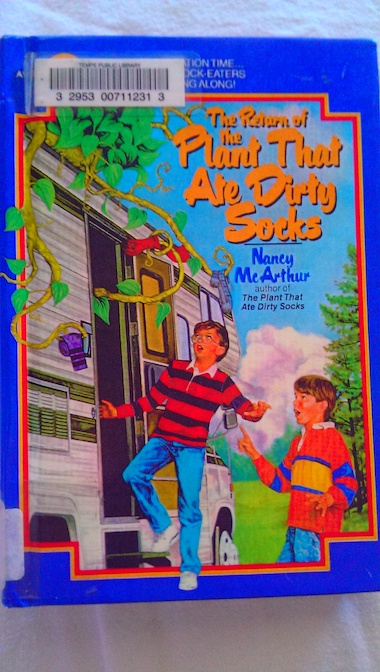 The Return of the Plant That Ate Dirty Socks by Nancy McArthur, 1990.
 The Plant That Ate Dirty Socks by Nancy McArthur, 1988.
 Jestress's Forgotten Books and Stories